There’s a text that you can send to your friends, that will crash their phone instantly, if it’s sent from an iPhone to another iPhone.
It’s been annoying people across the country, as people message each other the secret code.
The string of unique characters resets the phone, causing it to frustratingly turn on and off.
However, Apple today released a statement saying how to fix the phone if it is sent the malicious text.
The iPhone maker told the Press Association: “Apple is aware of an iMessage issue caused by a specific series of unicode characters and we will make a fix available in a software update. Until the update is available, you can use these steps to re-open the Messages app.”
Sending your friend the string of characters, however, does not just crash Messages.
It can also be used to affect the Snapchat and Twitter apps, if sent in private messages on either of the platforms.
However, an expert has told the Press Association that nothing more sinister than a simple reboot will happen if you are sent the message, and that they assume Apple will fix it soon.
Mark James, security specialist at anti-virus firm ESET said: “I am sure we have all had our desktop machines reboot after a seemingly random event has triggered the dreaded reboot. These mobile computers we call phones today have the same core instructions – if all else fails then reboot.
“This does not necessarily mean it’s a security flaw or indeed an exploitable bug but Apple will none the less try and rectify this as soon as they possibly can.”
A new mood website developed at UBC offers support to people with depression and anxiety. Raymond Lam, director of the UBC Mood Disorders Centre, says MoodFx is different than other websites because it uses scientifically validated questionnaires proven to be helpful for people to track their conditions over time. Users log in and answer a few simple questions about their mood in the past week, how their sleep and appetite have been and so on.
Using a “Gauss gun” principle, an MRI machine drives a “millirobot” through a hypodermic needle into your spinal cord and guides it into your brain to release life-threatening fluid buildup …
May 28, 2015
University of Houston researchers have developed a concept for MRI-powered millimeter-size “millirobots” that could one day perform unprecedented minimally invasive medical treatments.
This technology could be used to treat hydrocephalus, for example. Current treatments require drilling through the skull to implant pressure-relieving shunts, said Aaron T. Becker, assistant professor of electrical and computer engineering at the University of Houston.
But MRI scanners alone don’t produce enough force to pierce tissues (or insert needles). So the researchers drew upon the principle of the “Gauss gun.”
K&J Magnetics | Gauss Gun Demonstrations
Here’s how the a Gauss gun works: a single steel ball rolls down a chamber, setting off a chain reaction when it smashes into the next ball, etc., until the last ball flies forward, moving much more quickly the initial ball.
Based on that concept, the researchers imagine a medical robot with a barrel self-assembled from three small high-impact 3D-printed plastic components, with slender titanium rod spacers separating two steel balls.
Aaron T. Becker, assistant professor of electrical and computer engineering at the University of Houston, said the potential technology could be used to treat hydrocephalus and other conditions, allowing surgeons to avoid current treatments that require cutting through the skull to implant pressure-relieving shunts.
Becker was first author of a paper presented at ICRA, the conference of the IEEE Robotics and Automation Society, nominated for best conference paper and best medical robotics paper.
“Hydrocephalus, among other conditions, is a candidate for correction by our millirobots because the ventricles are fluid-filled and connect to the spinal canal,” Becker said. “Our noninvasive approach would eventually require simply a hypodermic needle or lumbar puncture to introduce the components into the spinal canal, and the components could be steered out of the body afterwards.”
Future work will focus on exploring clinical context, miniaturizing the device, and optimizing material selection.
Abstract of Toward Tissue Penetration by MRI-powered Millirobots Using a Self-Assembled Gauss Gun
MRI-based navigation and propulsion of millirobots is a new and promising approach for minimally invasive therapies. The strong central field inside the scanner, however, precludes torque-based control. Consequently, prior propulsion techniques have been limited to gradient-based pulling through fluid-filled body lumens. This paper introduces a technique for generating large impulsive forces that can be used to penetrate tissue. The approach is based on navigating multiple robots to a desired location and using self-assembly to trigger the conversion of magnetic potential energy into sufficient kinetic energy to achieve penetration. The approach is illustrated through analytical modeling and experiments in a clinical MRI scanner.
references:
Aaron T. Becker, Ouajdi Felfoul, and Pierre E. Dupont. Toward Tissue Penetration by MRI-powered Millirobots Using a Self-Assembled Gauss Gun. Proceedings of the IEEE 2015.
Pre-1967 research showed “beneficial change in many psychiatric disorders”
May 28, 2015
Psychedelic drugs such as LSD are much less harmful than claimed and should be legally reclassified to allow further research on their medical use, says James Rucker, a psychiatrist and honorary lecturer at the Institute of Psychiatry, Psychology and Neuroscience, King’s College London.
These substances “were extensively used and researched in clinical psychiatry” before their prohibition in 1967 and many trials of these drugs in the 1950s and 1960s suggested “beneficial change in many psychiatric disorders.”
Nonetheless, in the UK, psychedelic drugs were legally classified as schedule 1 class A drugs; that is, as having “no accepted medical use and the greatest potential for harm, despite the research evidence to the contrary,” he writes.
Clinical efficacy shown in anxiety, obsessive compulsive disorder, addiction, and headaches
Rucker makes these points:
Psychedelics remain more legally restricted than heroin and cocaine. “But no evidence indicates that psychedelic drugs are habit forming; little evidence indicates that they are harmful in controlled settings; and much historical evidence shows that they could have use in common psychiatric disorders.” In fact, recent studies indicate that psychedelics have “clinical efficacy in anxiety associated with advanced cancer, obsessive compulsive disorder, tobacco and alcohol addiction, and cluster headaches,” he writes.
At present, larger clinical studies on psychedelics are made “almost impossible by the practical, financial and bureaucratic obstacles” imposed by their schedule 1 classification. Currently, only one manufacturer in the world produces psilocybin for trial purposes, he says, at a “prohibitive” cost of £100,000 for 1 g (50 doses).
In the UK, to hold a schedule 1 drug, institutions require a license, which costs about £5,000, he adds. Only four hospitals currently hold such licenses, which come with regular police or home office inspections and onerous rules on storage and transport, so “clinical research using psychedelics costs 5–10 times that of research into less restricted (but more harmful) drugs such as heroin.” As a result, “almost all grant funders are uncomfortable funding research into psychedelics,” while prohibition as a condition of UN membership is “arguably causing more harm than it prevents.”
Psychedelics are neither harmful nor addictive compared with other controlled substances. He calls on the UK Advisory Council on the Misuse of Drugs and the 2016 UN General Assembly Special Session on Drugs, “to recommend that psychedelics be reclassified as schedule 2 compounds to enable a comprehensive, evidence based assessment of their therapeutic potential.”
Apple iOS 9 is shaping up to be more than just a performance upgrade. New details emerge pointing to a stronger competitor, called Proactive, which will challenge Google Now and Microsoft’s Cortana.
10 iPhone Apps You’ve Never Heard Of
(Click image for larger view and slideshow.)
Siri, Apple’s iOS-based personal assistant, has been the butt of more jokes than it has been the subject of praise. Siri may be functional for some voice-activated tasks, but it doesn’t offer the powerful predictive assistance offered by Google Now andMicrosoft’s Cortana.
A new report suggests Apple is hoping to change that with iOS 9.
Apple has been quietly working on a project called Proactive for several years. Proactive bundles together the powers of Siri with the contacts, calendar, and Passbook apps, in addition to third-party apps to challenge Google Now, reports 9to5Mac.
SPONSOR VIDEO, MOUSEOVER FOR SOUND
Google Now and Cortana are able to search through users’ inboxes and calendars to generate alerts for upcoming calendar appointments, flights, or commute times. The just-in-time information is truly helpful — if you own an Android or Windows Phone handset.
Proactive is seen as the next step in the evolution of Apple’s Spotlight Search, according to 9to5Mac. It will dive much deeper into the user’s personal data, and, as such, will exist as a new layer within the operating system — replacing Spotlight on the home screen. Apparently Apple has been looking for ways to cut down on its reliance on Google. Spotlight’s current position on the home screen, which is hidden, has reduced use of the Apple-made search tool.
(Image: akinbostanci/iStockphoto)
Moving Proactive back to the main screen is seen as a way boost adoption.
The tool will have its own screen and user interface for presenting calendar details, daily news stories, and other content. Proactive will be able to automatically push relevant information and/or notifications based on the iPhone owner’s usage patterns.
Like Google Now and Cortana, it may tell people that it’s time to head to the airport in order to catch a flight, or use real-time traffic data to suggest they leave the office a bit early to avoid an accident. Proactive may also make suggestions based on what people normally do over the course of the day, such as phoning relatives.
A big part of Proactive will entail integration with Apple Maps.
For example, Proactive will be able to surface points of interest relevant to a user, such as the location of the next meeting on the calendar. Moreover, 9to5Mac’s sources say Apple Maps may gain some augmented reality features for displaying this content. Rather than work with third-party companies like Foursquare or Yelp, Apple is going it alone to develop this augmented reality data.
The last piece of the puzzle here is Siri itself. Apple has a limited API on deck called Breadcrumbs that will give third-party apps some access to Siri’s features. Apple is worried about customer privacy, which is why the API will be restricted from accessing all of Siri’s powers.
With a modicum of voice assistance and maps, calendar, and app integration, Proactive sounds like a much more complete vision for Siri and Spotlight Search.
Proactive’s place in iOS 9 is not assured. Some executives have reservations about launching such an ambitious feature. It may go live on a smaller scale, with other features to arrive later down the road.
Apple is expected to reveal iOS 9, with new HomeKit powers, and the next version of OS X at its Worldwide Developers Conference on June 8.
LOS ANGELES – Google has finally announced actual sales figures for its Chromecast streaming stick: Consumers have bought 17 million Chromecasts ever since the device got first introduced two years ago, announced Google’s senior vice-president of products Sundar Pichai at the company’s I/O developer conference in San Francisco Thursday.
And those 17 million devices are getting used, a lot: Chromecast users have cumulatively hit the cast button 1.5 billion times, said Chromecast vice-president of product management Mario Queiroz during a recent interview. That’s up from one billion casts in January. Active Chromecast users are now watching 66% more content than at launch, and YouTube alone has seen viewing time go up 45% after a user activates a Chromecast device.
Google didn’t unveil any hardware upgrade to the US$35 streaming stick at the event, but Queiroz did note that there are some significant software tweaks that should make using Chromecast with a wide variety of apps more interesting.
For one, Chromecast is getting something Google is calling the Remote Display API — essentially, apps can now use the TV as a secondary monitor to show off additional content.
This is being used by video games like Ubisoft’s Speedboat Paradise to project the race on TV while the phone becomes a touch-screen remote. And Autodesk’s Pixlr is using this technology to utilize the TV as a way to preview changes to a photo during the editing process while the editing tools are being accessible on the phone’s touch screen. It’s worth noting that this will be available to both Android and iOS apps, which means that Google’s casting technology is now more directly competing with Apple’s AirPlay.
Google is also making a cast-specific gaming API available to developers, which should allow them to build games that play out on multiple screens across Android and iOS devices as well as websites, and it has given developers the ability to queue videos within their apps as well.
This type of functionality was previously only available as part of the YouTube mobile app, which allows multiple users in the same room to build a kind of collaborative playlist with videos that are then being played consecutively. Now, any video publisher will be able to add similar features to their Chromecast-compatible app as well.
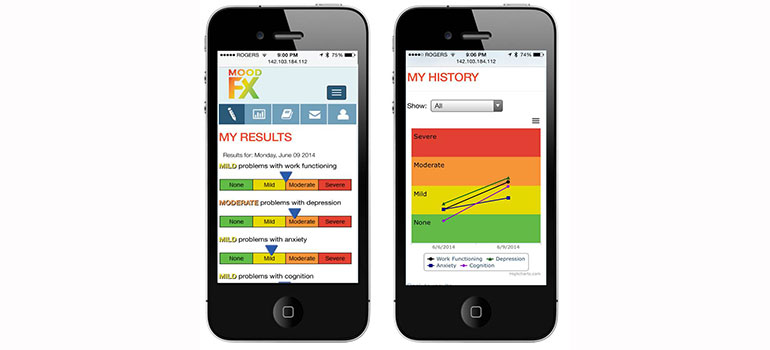
Effective help for depression and anxiety is now just a click away, thanks to a mobile-optimized website developed atUBC’s Mood Disorders Clinic. MoodFx, accessible by mobile device or computer, uses validated questionnaires to track patients’ mood, cognition and work performance.
While other mood-tracking websites and apps do exist, MoodFx, the brainchild of UBC Mood Disorders Centre director Dr. Raymond Lam, is unique. Not only was it developed by mental-health researchers and clinicians, but its checklists and questionnaires are backed by scientific research.
“A lot of mood tracking apps are based on a zero-to-ten scale,” explained Lam, a professor in the Department of Psychiatry. “We use questionnaires that have been validated in many studies to track both symptoms and functioning, with a focus on work functioning. MoodFx is the only one consolidating that type of tracking.”
In addition to tracking moods, users can set reminders to check their symptoms regularly and before health-care appointments, gain helpful tips for managing symptoms, and generate symptom charts to be printed or displayed on a mobile device. Information is stored anonymously and securely.
MoodFx was backed by a $150,000 donation from Lundbeck Canada and developed over the course of a year with help from UBC Faculty of Medicine’s eHealth Strategy Office. It was launched at the annual meeting of the Canadian Psychiatric Association in September 2014. Nine months later, it’s registered more than 500 users from across the country.
In a recent user survey, close to 70 per cent of respondents agreed or strongly agreed that MoodFx has been useful for them. Users called the program “a huge encouragement,” noting, “MoodFx has really helped me to see progress, and when there is a rough time, to be able to see visually that I can and will come back around.” Others called it “reassuring” and praised its ease of use.
Putting care in patients’ hands
The project came out of a desire to encourage measurement-based care among clinicians. Lam and his colleagues have been encouraging the use of ratings scales among physicians, but found uptake was slow.
“We know that when people use symptom rating scales, outcomes are better,” explained Lam, also an investigator at the Djavad Mowafaghian Centre for Brain Health where the Mood Disorders Centre is located. “But it’s very hard to get physicians to track outcomes using ratings scales, because they’re not used to it.”
Frustrated by a lack of progress, Lam had a Eureka moment: “Let’s put it in the hands of the patients. Have them keep track of their symptoms and show their clinicians how they’re doing over time.”
Eric Davies, a Winnipeg computer scientist, is one of them. He believes MoodFx has already had a significant impact on his life and treatment for depression. “Last year, I was in a fairly deep slump, and I didn’t realize that it was particularly bad until I started doing these MoodFx questionnaires,” said Davies. “That data prompted my doctor and I to make a change in my medication, and I’ve been great since then.”
Davies checks his symptoms on a weekly basis, and thinks MoodFx has helped him gain a clearer perspective on his moods. “It helps me realize how I’m doing, and whether my particular feelings at that moment are causing major problems in my life or whether I’m actually doing fairly well.”
Improved clinical treatment
Lam said experiences like Davies’ are exactly what the app is designed to do. “It makes patients much more active in terms of their own treatment, and aware of what’s working and what’s not working. This way patients can actually show their clinicians if things aren’t getting better.”
Lam said patients often end up in a static situation. “A lot of times we see people who are on the same treatment for a long time, and they’re still not doing well, but nobody changes anything,” he observed. “This way people know if they’re getting better or not.”
He added: “It’s hard to image treating hypertension without blood-pressure measurements, or treating diabetes without blood-sugar measurements. We don’t have lab tests for depression, but rating scales for symptoms are as close as we can get.”
Thanks to MoodFx, these important tools are making their way into the doctor’s office, and empowering patients at the same time.
A tiny (one-centimeter-square) biosensor chip developed at EPFL is designed to be implanted under your skin to continuously monitor concentrations of pH, temperature, and metabolism-related molecules like glucose, lactate and cholesterol, as well as some drugs.
The chip would replace blood work, which may take hours — or even days — for analysis and is a limited snapshot of conditions at the moment the blood is drawn.
Developer Sandro Carrara unveiled the chip Tuesday (May 26) at the International Symposium on Circuits and Systems (ISCAS) in Lisbon.
The electrochemical sensors work with or without enzymes, which means the device can react to a wide range of compounds, and it can do so for several days or even weeks.
Wireless power and monitoring
The biochip contains three main components: a circuit with six sensors, a control unit that analyzes incoming signals, and a Bluetooth module for sending the results immediately to a mobile phone. It also has an induction coil that wirelessly draws power from an external battery attached to the skin by a patch.
To ensure biocompatibility, an epoxy-enhanced polyurethane membrane was used to cover the device.
The chip was successfully tested in vivo on mice at the Institute for Research in Biomedicine (IRB) in Bellinzona, where researchers were able to constantly monitor glucose and paracetamol levels without a wire tracker getting in the way of the animals’ daily activities.
The results were promising, so clinical tests on humans could take place in three to five years — especially since the procedure is minimally invasive, the researchers say.
“Knowing the precise and real-time effect of drugs on the metabolism is one of the keys to the type of personalised, precision medicine that we are striving for,” said Carrara.
What if your handheld tools knew what needs to be done and were even able to guide and help you complete jobs that require skills? University of Bristol researchers are finding out by building and testing intelligent handheld robots.
Think of them as smart power tools that “know” what they’re doing — and could even help you use them.
The robot tools would have three levels of autonomy, said Walterio Mayol-Cuevas, Reader in Robotics Computer Vision and Mobile Systems: “No autonomy, semi-autonomous — the robot advises the user but does not act, and fully autonomous — the robot advises and acts even by correcting or refusing to perform incorrect user actions.”
The Bristol team has experimented with tasks such as picking and dropping different objects to form tile patterns and aiming in 3D for simulated painting.
The robot designs are open source and available on the university’s HandheldRobotics page.
HandheldRobotics | The Design and Evaluation of a Cooperative Handheld Robot
Disney researchers have found a way for a robot to mimic an animated character’s walk, bringing a cartoon (or other) character to life in the real world.
Beginning with an animation of a diminutive, peanut-shaped character that walks with a rolling, somewhat bow-legged gait, Katsu Yamane and his team at Disney Research Pittsburgh analyzed the character’s motion to design a robotic frame that could duplicate the walking motion. using 3D-printed links and servo motors, while also fitting inside the character’s skin. They then created control software that could keep the robot balanced while duplicating the character’s gait as closely as possible.
“The biggest challenge is that designers don’t necessarily consider physics when they create an animated character,” said Yamane, senior research scientist. Roboticists, however, wrestle with physical constraints throughout the process of creating a real-life version of the character.
“It’s important that, despite physical limitations, we do not sacrifice style or the quality of motion,” Yamane said. The robots will need to not only look like the characters, but move in the way people are accustomed to seeing those characters move.
The researchers are describing the techniques and technologies they used to create the bipedal robot at the IEEE International Conference on Robotics and Automation, ICRA 2015, May 26–30 in Seattle.
DisneyResearchHub | Development of a Bipedal Robot that Walks Like an Animation Character





 Bruce's Blog