New tech keeps your smart phone charged for 30 percent longer

Invention captures wasted cell phone energy, feeds it back to battery
May 27, 2015

Engineers  at The Ohio State University have created a circuit that makes cell phone batteries last up to 30 percent longer on a single charge. The trick: it converts some of the radio signals emanating from a phone into direct current (DC) power, which then charges the phone’s battery.

This new technology can be built into a cell phone case, adding minimal bulk and weight.

“When we communicate with a cell tower or Wi-Fi router, so much energy goes to waste,” explained Chi-Chih Chen, research associate professor of electrical and computer engineering. “We recycle some of that wasted energy back into the battery.”

“Our technology is based on harvesting energy directly from the source, explained Robert Lee, professor of electrical and computer engineering. By Lee’s reckoning, nearly 97 percent of cell phone signals never reach a destination and are simply lost. Some of the that energy can be captured.

The idea is to siphon off just enough of the radio signal to noticeably slow battery drain, but not enough to degrade voice quality or data transmission. Cell phones broadcast in all directions at once to reach the nearest cell tower or Wi-Fi router. Chen and his colleagues came up with a system that identifies which radio signals are being wasted. It works only when a phone is transmitting.

Next, the engineers want to insert the device into a “skin” that sticks directly to a phone, or better, partner with a manufacturer to build it directly into a phone, tablet or other portable electronic device.

Apple finds bug that causes iPhones to crash

Apple has found a bug which can cause iPhones to crash when a message containing a specific string of text is received.

The bug, which includes symbols and Arabic characters, was first reported by Apple news blog MacRumors on Tuesday night, adding that it was noticed on social news hub Reddit earlier in the day.

“We are aware of an iMessage issue caused by a specific series of unicode characters and we will make a fix available in a software update,” an Apple spokesperson said in an e-mail.

“If Messages was opened to the conversation list view, the app will crash when you attempt to open it. You can fix this by having someone send you a message or by sending a message to yourself. There are several options for sending a message to yourself, including sending yourself a message via Siri or through the Share sheet in any app,” adds MacRumors.

“We are aware of an iMessage issue caused by a specific series of unicode characters and we will make a fix available in a software update,” an Apple spokesperson told iMore.

Apple is addressing the bug with a software update.

With inputs from Reuters

http://tech.firstpost.com/news-analysis/apple-finds-bug-that-causes-iphones-to-crash-268641.html

These Earphones May Be Able to Record Truly 3-D Audio

OpenEars_1_LoRes copyClick to Open Overlay Gallery

Apple Store purchases gets two-step authentication

The Apple Store app for iOS has been updated with two-step authentication, meaning users will now need to enter both a password and a verification code sent to a trusted device before they can complete a purchase. Version 3.3 also lets users confirm their identity via Touch ID before gaining access to their order history and EasyPay receipts, or making reservations at brick-and-mortar Apple Stores, according to AppleInsider.

Filed by Email Rian Boden27 May 2015, 13:15

emoti-emotions

If you missed the updates recently, we’re currently running a 12-month programme for creative young people called Raspberry Pi Creative Technologists.

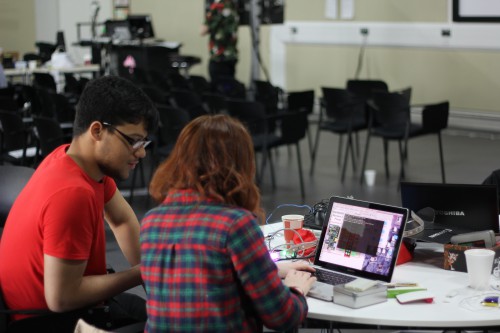
We have a Google+ community for the group to post ideas, share interesting links and ask each other for help and we hoped they would also use it to arrange to meet up outside of the organised field trips: within the first month, one of them found the Art Hackathon and suggested they go along and take part. Three of them went along and teamed up with some others. Yasmin wrote a full account of the hack…

I’ve always heard about how awesome Hackathons could be; they’re a chance to surround yourself with intelligent people who share the same interest, come up with inspiring ideas together and become engrossed in a project, with everyone chipping in to turn concept into reality over one weekend.

But I’m going to be perfectly honest with you here; however awesome this sounds, I can’t help but feel a tad intimidated by it all. There’s still so much I feel I have yet to learn and I always worry about how much of an asset (or a nuisance) I would be.

IMG_1048

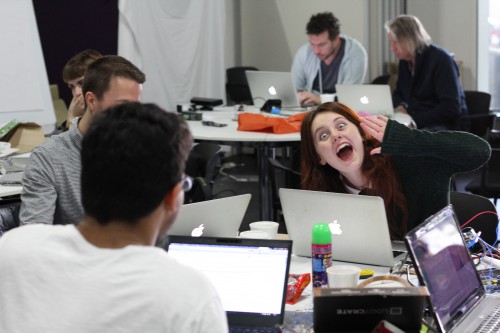
So when I saw an opportunity to go to an Art Hackathon, which aspired to mix teams with different skill sets and types, I knew that I had to attend, and I’m so glad I did! With the Hackathon holding presentations by many talented people including Joel Lewis, Di Mainstone and Nick Rothwell, as well tables full of various tech and art supplies, there were no limitations to the amount of creativity that we could muster!

Yasmin and Milton

All of this inspired a creation that managed to win 2nd Place for Peoples Choice, and I can proudly say that I was a part of its development:

EMOTI – VISUALISING OUR EMOTIONS

Emoti shows the emotional state of the world through combined visual colours and audio, resulting in a beautifully chaotic representation of the emotional state of the world – or at least the twitterverse.

Using Twitter Widgets, our team was able to pull certain keywords from tweets being posted in real time and assign them to different emotion types, which meant being able to have constantly updated data on how people were feeling on twitter through these emotion-related keywords. The emotions we assigned them to were: Happy, Sad, Surprised, Afraid and Angry.

From this data we then created a simple HTML web-page with 5 divs, or blocks, of colour relating to the different emotion states. These would constantly change width depending on the data that was being collected from the tweets to give a visual representation of how many people were tweeting under each emotion:

  • Green = Happy
  • Blue = Sad
  • Yellow = Surprised
  • Pink = Afraid
  • Red = Angry

To make this experience of witnessing how the world feels and how frequently these emotions change more immersive, these visual representations are also accompanied with audio. We chose five audio tracks, one to depict each emotion, adding them into the web-page using the HTML5 audio tag, and adjusted their volume depending on the emotion-based twitter data with some JavaScript wizardry. This ended up with the clashing music types seemingly battling against each other, reflecting how hectic the live emotion states were and how rapidly they would change at random; one moment showing solely happiness, the next ultimate anger.

The Hackathon Effect

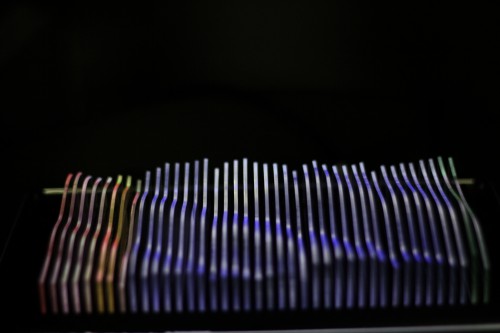
This was an Art Hackathon don’t forget, so, of course we had to present this data in a beautiful and intriguing way. What’s more intriguing than creating the illusion of 3D colour-changing ripples?!

For this effect, the designers in our team laser cut clear plastic to create the individual ripples and slotted them into a black board. I decided this would be the perfect opportunity to whip out my Raspberry Pi! We ran the web-page through the Pi and hooked it up to the HDMIPi, allowing a bright screen for our structure to be placed onto, so that the moving coloured blocks from below would shine onto the clear plastic and give the illusion of a 3D object.

Finally, the structure was put together in a dark, enclosed space, and the end product came to life, completely exceeding my expectations! Colours danced gracefully across the ripples, making us forget that there was even a web-page below. It was easy to get lost in the entrancing movement of pattern that the object seemed to create. As soon as you immerse yourself in the full experience, with audio as well as these entrancing visuals, it becomes a little overwhelming. Watching the colours is one thing, but hearing the clashes of audio really brings the message across that this is how people from around the world are feeling right now.

It’s both a marvel and a mess all at the same time; both beautiful and chaotic. Just like the emotions we feel and the complexity behind them.

https://cdn.embedly.com/widgets/media.html?src=https%3A%2F%2Fwww.youtube.com%2Fembed%2F1RyHZFXdtoo%3Ffeature%3Doembed&url=https%3A%2F%2Fwww.youtube.com%2Fwatch%3Fv%3D1RyHZFXdtoo&image=https%3A%2F%2Fi.ytimg.com%2Fvi%2F1RyHZFXdtoo%2Fhqdefault.jpg&key=c11abcc1b1e44d61afc42b3ded19bfce&type=text%2Fhtml&schema=youtube

Yes, it’s open source! Find the (somewhat messy) code here:https://github.com/itomblack/emotion-twitter

WHAT I GAINED…

Aside from the obvious: an awesome project, a better understanding of how to work in a team and improved coding skills, I managed to come away from the Hackathon feeling much more positive about what I, as an individual, can achieve. I may not be have been the most skilled coder in the room but I was still able to have meaningful input on the project, both creatively and through my development skills, which leaves me wondering what I was so worried about in the first place!

As well as this I’m so grateful to have had the pleasure of meeting many creative and genuinely lovely people. It was so interesting to see all of the various projects that everyone had made, each one entirely unique and fascinating in its own right.

Thank you to the people behind the Art Hackathon event and those intelligent folk within the Emoti Dream Team who helped bring it to life:

P.S. This is my very first blog, how am I doing? Let me know! (If you want to… No pressure…)

https://www.raspberrypi.org/emoti-visualising-our-emotions/

Dynamically reprogramming matter

Engineering switchable reconfigurations in DNA-controlled nanoparticle arrays could lead to dynamic energy-harvesting or responsive optical materials
May 26, 2015

Scientists at the U.S. Department of Energy’s Brookhaven National Laboratory have developed the capability of creating dynamic nanomaterials — ones whose structure and associated properties can be switched, on-demand. In a paper appearing in Nature Materials, they describe a way to selectively rearrange nanoparticles in three-dimensional arrays to produce different configurations, or “phases,” from the same nano-components.

“One of the goals in nanoparticle self-assembly has been to create structures by design,” said Oleg Gang, who led the work at Brookhaven’s Center for Functional Nanomaterials (CFN), a DOE Office of Science User Facility. “Until now, most of the structures we’ve built have been static.” KurzweilAI covered that development in a previous article, “Creating complex structures using DNA origami and nanoparticles.”

The new advance in nanoscale engineering builds on that previous work in developing ways to get nanoparticles to self-assemble into complex composite arrays, including linking them together with tethers constructed of complementary strands of synthetic DNA.

“We know that properties of materials built from nanoparticles are strongly dependent on their arrangements,” said Gang. “Previously, we’ve even been able to manipulate optical properties by shortening or lengthening the DNA tethers. But that approach does not permit us to achieve a global reorganization of the entire structure once it’s already built.”

DNA-directed rearrangement

“Now we are trying to achieve an even more ambitious goal,” reveal Gang: “Making materials that can transform so we can take advantage of properties that emerge with the particles’ rearrangements.”

The ability to direct particle rearrangements, or phase changes, will allow the scientists to choose the desired properties — say, the material’s response to light or a magnetic field — and switch them whenever needed. Such phase-changing materials could lead to radical new applications, such as dynamic energy-harvesting or responsive optical materials.

In the new approach, the reprogramming DNA strands adhere to open binding sites on the already assembled nanoparticles. These strands exert additional forces on the linked-up nanoparticles.

“By introducing different types of reprogramming DNA strands, we modify the DNA shells surrounding the nanoparticles,” explained CFN postdoctoral fellow Yugang Zhang, the lead author on the paper. “Altering these shells can selectively shift the particle-particle interactions, either by increasing both attraction and repulsion, or by separately increasing only attraction or only repulsion. These reprogrammed interactions impose new constraints on the particles, forcing them to achieve a new structural organization to satisfy those constraints.”

Using their method, the team demonstrated that they could switch their original nanoparticle array, the “mother” phase, into multiple different daughter phases with precision control.

DNA-based matter reprogramming

This is quite different from phase changes driven by external physical conditions such as pressure or temperature, Gang said, which typically result in single phase shifts, or sometimes sequential ones. “In those cases, to go from phase A to phase C, you first have to shift from A to B and then B to C,” said Gang. “Our method allows us to pick which daughter phase we want and go right to that one because the daughter phase is completely determined by the type of DNA reprogramming strands we use.”

The scientists were able to observe the structural transformations to various daughter phases using a technique called in situ small-angle x-ray scattering at the National Synchrotron Light Source, a DOE Office of Science User Facility that operated at Brookhaven Lab from 1982 until last September (now replaced by NSLS-II, which produces x-ray beams 10,000 times brighter). The team also used computational modeling to calculate how different kinds of reprogramming strands would alter the interparticle interactions, and found their calculations agreed well with their experimental observations.

“The ability to dynamically switch the phase of an entire superlattice array will allow the creation of reprogrammable and switchable materials wherein multiple, different functions can be activated on demand,” said Gang. “Our experimental work and accompanying theoretical analysis confirm that reprogramming DNA-mediated interactions among nanoparticles is a viable way to achieve this goal.”

This research was done in collaboration with scientists from Columbia University’s School of Engineering and Applied Science and the Indian Institute of Technology Gandhinagar. The work was funded by the DOE Office of Science.

What type of sleeper are you?

CHERRILL HICKS, THE DAILY TELEGRAPH  05.24.2015

SHAREADJUSTCOMMENTPRINT

Most of us are all too familiar with the effects of a poor night’s sleep – irritability, low energy and “brain fog” the next day, to name but a few. But for the one in three Britons who suffers from insomnia, the longer-term effects are more worrying. Studies have linked sleep problems toobesity, heart disease, high blood pressure, diabetes and depression, while recent research has found that sleeping too much, as well as too little, increases the risk of stroke.

The US study suggested that for those with high blood pressure, regularly sleeping more than eight hours a night or fewer than five respectively tripled and doubled stroke risk.

So what kind of sleeper are you? And should you be worrying about how your sleeping pattern is affecting your health?

The Under-Six-Hours Sleeper

Margaret Thatcher famously made do with four hours a night – and with so much to pack into life, you can do the same, right? Not so, says Dr Vikki Revell, from Surrey University’s Sleep Research Centre. “It’s true that sleep needs vary between individuals and are partly determined by genes as well as age and lifestyle,” she says. “Some people function well on far less sleep than others. But there is good evidence that just a single night of less than six hours’ sleep has an effect on immune cells, gene expression and metabolism.”

About a third of those getting less sleep than they need struggle to fall asleep in the first place, says Dr Neil Stanley, an independent sleep expert based in Farnley, Hampshire. In humans, he explains, sleep is essential for enabling the brain to recover so we can function and learn during the day. Unsurprisingly, less than six hours’ sleep makes us forgetful and moody and can leave us struggling to concentrate or focus.

Most experts blame sleep problems on our 24/7 lifestyle – specifically exposure to blue light from mobile phones and other gadgets, which suppresses the secretion of the sleep hormone, melatonin.

“Light exposure disrupts the circadian rhythm – the internal body clock that regulates sleep by making our bodies respond to light and darkness,” says Dr Revell. “People should switch off or reduce their blue light exposure two hours before going to bed, or get an orange filter, which cuts down on blue light.”

Peace of mind at bedtime is crucial, adds Professor Jim Horne, former head of the sleep research centre at Loughborough University. “You need to leave your worries outside the bedroom door,” he counsels. One way of doing this is through cognitive behavioural therapy – the latest treatment for poor sleep. One interactive online CBT programme called Sleepio has been found in clinical trials to achieve a 54 per cent reduction in the time taken to fall asleep.

The Napper

The Spanish thrive on a four-hour siesta, so shouldn’t power napping do the same for you? Most experts agree that regular naps can have cognitive benefits: one study from 2008 found napping was more effective than caffeine as a way of coping with the post-lunch “dip”, while US research has found that even catnaps of six minutes can improve learning and memory.

But daytime naps should be kept to less than 20 minutes, warns Prof Horne. Any longer and the “full-blown sleep cycle” kicks in, resulting in “post-sleep inertia”, a condition similar to jet lag that leads to grogginess and thick-headedness.

Daytime sleeping can sometimes be a sign of diabetes, depression or chronic pain, especially in older people. And if you’re using napping to catch up on sleep lost at night, it might be best to address the original problem.

The Disturbed Sleeper

You drift off to sleep without any problem, only to find yourself wide awake in the early hours, brooding over work, relationships or financial troubles. It’s a pattern that affects about a third of insomniacs and can be a vicious cycle: the more anxiousyou are about getting back to sleep, the less likely it is to happen.

“Waking in the early hours happens during the lighter part of each 90- to120-minute sleep cycle, known as rapid eye movement (REM) sleep,” explains Dr Revell.

Some research suggests that in the pre-industrial past, people would often wake up to eat, check the house was safe, talk or have sex, before going back to bed for a second sleep. Which will be of little comfort to those who have to get up for work the next day.

“If you’re still awake after 30 minutes, it’s best to get up, rather than stay in bed,” advises Dr Stanley. Disturbed sleepers are also advised to keep the lights dim and do something – a jigsaw, for example – to stop the mind racing.

Waking in the early hours can also be caused by conditions such as menopause,depression, diabetes, pain and heartburn. So if you suffer regularly it is best to get checked by a doctor.

The Sofa Sleeper

It’s 9pm and you’re out like a light in front of the TV – only to have trouble falling asleep later.

“People fall asleep on the sofa because that’s where they feel safe and secure,” says Dr Stanley. “The problems begin later because the body clock has been disrupted. The advice is simple: either stay awake or, if you’re that sleepy, go to bed.”

Prof Horne says falling asleep regularly in the early evening may be a sign of disturbed sleep the night before, unknown to the sufferer. Disturbed sleep can also be caused by medical conditions that need checking out, such as sleep apnea (where the throat muscles relax, interrupting normal breathing) or periodic leg movements (waking with a sudden jerk), and also by the side-effects of medication.

The Binge Sleeper

Is it possible to “catch up” by binge-sleeping at the weekend? Some research suggests that sleeping until noon on Saturday can help you bounce back, especially if you’re young. Another study, from 2013, found that “recovery” sleep at the weekend may help prevent diabetes.

Not everyone approves, though. Dr Stanley says: “You wouldn’t eat junk food all week, then only eat lettuce at the weekend to undo the damage. Sleeping in at the weekend – and maybe staying out late at night – will confuse the body clock further, which is why people then feel so awful on Monday morning. The most effective change people can make for good sleep is to stick to one wake-up time – seven days a week, 365 days a year.”

Double Trouble

Ever woken up by your partner getting up to use the bathroom, or the water running as he or she takes a late shower? You’re not alone: a 2005 survey of more than 1,500 adults found disruptive bedmates caused their partners to lose an average of 49 minutes’ sleep a night.

Partner-induced insomnia is a relatively modern malaise, according to Dr Stanley, forced on most of us by lack of space and social convention. “Couples need to negotiate their sleep roles, rather than just get irritable with each other,” he says.

“They need to discuss how to resolve issues. For example, if he comes to bed later, his pyjamas and toothbrush can be kept downstairs, or he could use a torch rather than switch on a light.

“Ideally, I believe partners should sleep separately if they have the space.”

The Vampire Sleeper

Oversleeping is very rare but (just like its opposite) has been linked to a host of medical problems, including diabetes, obesity, headaches, back pain, heart disease and depression. Extreme sleepiness during the day, coupled with sleeping for unusually long periods at night may be caused by a rare medical disorder calledhypersomnia; other possible causes include alcohol, medication side-effects and depression.

As for all-night clubbers, developing a habit of sleeping right through the day is not recommended. Research on shift workers shows that reversing our natural rhythm is associated with a host of health problems, including increased risk of breast cancer for women.

“Evolution has programmed us to sleep at night,” says Dr Stanley. “Going against that has massive negative consequences.”

How to beat insomnia:

An estimated one in three Britons suffers episodes of insomnia, with about one in 10 developing a persistent problem. Stress and anxiety are common causes. Others include depression, mental health problems, heart disease, joint and muscle problems, long-term pain, some medications and alcohol or drug misuse. In some people, no external cause is found at all.

  • Sleep hygiene: It can help to change your lifestyle to promote healthy sleep. This includes not drinking caffeine or taking exercise too close to bedtime; going to bed at the same time and getting up at the same time; and creating a regular bedtime routine – a warm bath or hot drink, for example – to wind down.
  • Cognitive behavioural therapy: Some poor sleepers find treatment to reduce anxiety about sleep and relaxation techniques is of use.
  • Sleeping pills: These can be effective, but are only advised for use for up to four weeks at a time.
  • http://www.ottawacitizen.com/health/What+type+sleeper/11081499/story.html

Nearly indestructible virus to be used to treat diseases

Scientists hope that understanding how the SIRV2 virus survives super hot environments will help them devise methods to successfully use genetic therapy to fight other diseases.
By Stephen Feller   |   May 26, 2015 at 6:37 PM
By discovering how a virus can keep it’s DNA intact in the harshest of conditions on Earth, scientists now have an idea for sneaking new DNA into cells in the human body to use genetic therapy to cure diseases. Photo: Leigh Prather/Shutterstock

CHARLOTTESVILLE, Va., May 26 (UPI) — Scientists at the University of Virginia studying the SIRV2 virus discovered how it survives in very harsh environments and hope it will help them to use genetic therapy to battle diseases.

The research spotlighted similarities between the virus and the methods which bacterial spores use to survive, including the way that SIRV2 forces itself into an A-form, which allows it to protect its DNA. The protection of its DNA is important to attempting to fight disease because the human body has several ways to degrade DNA in invading viruses and bacteria — which means that scientists may have discovered a way to overcome these protective systems in the body.

“What’s interesting and unusual is being able to see how proteins and DNA can be put together in a way that’s absolutely stable under the harshest conditions imaginable,” said Edward H. Egelman, PhD, of the UVA Department of Biochemistry and Molecular Genetics, in a press release. “We’ve discovered what appears to be a basic mechanism of resistance — to heat, to desiccation, to ultraviolet radiation. And knowing that, then, we can go in many different directions, including developing ways to package DNA for gene therapy.”

The study is published in Science.

http://www.upi.com/Health_News/2015/05/26/Nearly-indestructible-virus-to-be-used-to-treat-diseases/5281432676210/

Researchers Use Synthetic Strands of DNA to Create Nanoparticle Clusters and Arrays

Published on May 26, 2015 at 10:09 AM

Scientists built octahedrons using ropelike structures made of bundles of DNA double-helix molecules to form the frames (a). Single strands of DNA attached at the vertices (numbered in red) can be used to attach nanoparticles coated with complementary strands. This approach can yield a variety of structures, including ones with the same type of particle at each vertex (b), arrangements with particles placed only on certain vertices (c), and structures with different particles placed strategically on different vertices (d).

Researchers at Brookhaven National Laboratory of the U.S. Department of Energy (DOE) have combined the artificial strands of DNA to function in two ways: rope-like configurations of the DNA double helix were used to create a strong geometrical framework, and dangling pieces of single-strands of DNA were added to stick nanoparticles in place.

The study has been described in the journal Nature Nanotechnology. This is a new breakthrough on the use of DNA in nanoscale construction. The method resulted in arrays and clusters of nanoparticles, which represent a major milestone for designing materials with customized functions and structures for applications in medicine, optics, and energy.

These arrays of nanoparticles with predictable geometric configurations are somewhat analogous to molecules made of atoms. While atoms form molecules based on the nature of their chemical bonds, there has been no easy way to impose such a specific spatial binding scheme on nanoparticles. This is exactly the problem that our method addresses, said Brookhaven physicist Oleg Gang, who headed the project at the Lab’s Center for Functional Nanomaterials (CFN), a DOE Office of Science User Facility.

According to the researchers, the novel technique would allow them to organize the arrangements of a variety of nanoparticles and help them manipulate the synergistic or collective effects. Some of the examples comprise materials that deliver biomolecules, rotate light, or control the flow of energy. The researchers designed the nanoparticle architectures by means of an octahedral scaffold, with particles placed in accurate locations on the scaffold as per the specificity of DNA coding. These designs contained two varied arrangements of the same group of particles, with each configuration having different optical properties. Geometrical clusters were also utilized as building blocks for larger arrays such as2D-planar sheets and linear chains.

We may be able to design materials that mimic nature’s machinery to harvest solar energy, or manipulate light for telecommunications applications, or design novel catalysts for speeding up a variety of chemical reactions,” Gang said.

Our work demonstrates the versatility of this approach and opens up numerous exciting opportunities for high-yield precision assembly of tailored 3D building blocks in which multiple nanoparticles of different structures and functions can be integrated,” stated Ye Tian, CFN scientist and one of the lead authors of the paper.

This method of nanoscale construction leverages two major properties of the DNA molecule, such as the natural tendency of strands having complementary bases, and the double helix, twisted-ladder shape to combine in an accurate way. Initially, bundles of six double-helix molecules were produced, with four of these bundles combined together to form a stable and a relatively strong building material, just like the way fibrous strands are integrated together to form a rigid rope. These rope-like girders were then utilized to create the frame of 3D octahedrons, eventually combining the linear chains of DNA with countless number of short complementary strands of DNA. These were known as DNA origami octahedrons.

In order to attach the nanoparticles to the 3D frames, the researchers designed each of the six-helix bundles in such a way that a single helix had an additional piece of single-stranded DNA sticking out from either ends. When each vertex of the frame was organized into 3D octahedrons, some of these sticky end tethers were available in each vertex for adhering with objects covered with complementary strands of DNA.

When nanoparticles coated with single strand tethers are mixed with the DNA origami octahedrons, the ‘free’ pieces of DNA find one another so the bases can pair up according to the rules of the DNA complementarity code. Thus the specifically DNA-encoded particles can find their correspondingly designed place on the octahedron vertices, said Gang.

By altering the sequences of DNA encoded on the tethers, the researchers can modify what binds to the individual vertex. In one such experiment, the same sequence was encoded on all tethers of the octahedron, and the strands were fixed with a complementary sequence to gold nanoparticles. This resulted is a single gold nanoparticle fixed to individual octahedron’s six vertices.

In further experiments the sequence of certain vertices was altered and complementary strands were utilized on a range of particles. This showed that both the arrangement and assembly of the particles can be controlled in an accurate manner. In a similar experiment, two different arrangements were made from the same three pairs of particles having different sizes, which resulted in products having varied optical characteristics. The team also used DNA tethers on specified vertices to join octahedrons end to end and in 2D arrays, creating chains and sheets, respectively.

However, a major challenge was to validate the arrangement and structure of particles. This is because the DNA molecules and nanoparticles, which constitute the frames, exhibit different densities. While some microscopy methods can show the particles alone, others would change the 3D structures.

The team employed cryo-electron microscopy, also known as cryo-EM, to observe the particles and origami frames. This work was headed by Huilin Li, Brookhaven Lab and Stony Brook University biologist, and Tong Wang, the other lead co-author of the paper and who also works with Li in the Biosciences department of Brookhaven. In order to view the varied density components individually, the researchers need to subtract the data from the images and integrate the same by means of single particle 3D reconstruction and tomography to create the final images. The images thus obtained showed that the new method used to direct the placement of nanoparticles on DNA-encoded vertices of molecular frames can prove to be effective for designing new nanomaterials.

Cryo-EM preserves samples in their near-native states and provides close to nanometer resolution. We show that cryo-EM can be successfully applied to probe the 3D structure of DNA-nanoparticle clusters, Wang said.

The DOE Office of Science supported the study. DOE’s Office of Science supports the Brookhaven National Laboratory. It supports fundamental studies on the physical sciences in the US and is pursuing to tackle the most pressing complexities of today’s time.

Robots are getting smarter, and they are doing more jobs

Waterloo Region Record

SAN FRANCISCO — Willie McTuggie looks like a photocopier on wheels. But he — it, actually — has the engineered brain of a reasonably smart human, and acts like one when he rolls up to a nurse’s station, opens a drawer, retrieves a dose of pills and glides off to make a delivery.

Packed with more than 30 motion-detecting and other sensors, Willie and his automated buddies at the UCSF Medical Center can open doors, avoid collisions with doctors on rounds and perceive when to wait for a free elevator.

There are 25 mobile bots from robotics company Aethon on staff, named and decorated by mortal colleagues. Willie is wrapped in the San Francisco Giants’ team colours of orange and black, and Maybelle is designed to look like one of the city’s cable cars. They perform duties once handled by nurses, orderlies, cafeteria staff and maintenance crews, though so far no people have lost jobs to the bot corps.

“It does displace certain roles, but we can put that head count into other service roles,” says Pamela Hudson, executive director of clinical systems at the University of California, San Francisco, hospital. It is, she says, a win-win.

Not everyone is enthusiastic as contraptions and software coded with artificial intelligence invade the workplace. The human-brain mimics are becoming so clever that, according to a study by the Oxford Martin Program on Technology, 47 per cent of all U.S. jobs are at risk over the next two decades of being given over to computers.

They’re already writing sports stories, milking cows and reviewing X-ray results. Three-foot-tall cybernetic bellhops invented by Savioke, a robotics company, deliver room-service orders at Aloft hotels near Apple’s headquarters wearing painted-on black bow ties. The startup Momentum Machines is building a fast-food burger-flipping apparatus. At the University of Maryland Institute for Advanced Computer Studies, a Baxter robot from Rethink Robotics is mastering the art of making a salad.

The artificial intelligence revolution is writing a new chapter in the age-old debate over whether machines are putting people out of work or opening up new opportunities for them. “The idea of technology destroying jobs has been going on for two centuries,” says Richard Cooper, an economist at Harvard University who has studied the impact of technological advancements on employment. “Certain jobs get destroyed but other jobs get created.”

The catch in the 21st century is that the technological leaps are so big and happening so quickly, and at a time when service industry jobs are responsible for more than 40 per cent of employment growth in the U.S., where income inequality is widening.

“The bar to get entry in to the labour force is rising faster than people expected and the ability to stay there is falling,” says Sebastian Thrun, former head of the Google research laboratory Google X and a developer of the company’s driverless-car technology. “The competition from machines is getting stronger and stronger.”

That’s because they’re getting smarter and smarter. Super-fast computer-processing strengths and the information-scavenging abilities of the web make it possible for machines to quickly process huge amounts of information, learn from it and share — like when a self-driving car is in a fender-bender after going too quickly around a turn and transmits a warning to others so they don’t make the same mistake.

In so-called deep learning AI systems, tens of thousands to millions of digital neurons are stitched together and layered to create a Frankenstein version of our own neocortex. These can learn about data merely by being exposed to it, and are already widely used in cutting-edge digital imaging. At Facebook, researchers are designing software that can read simple texts and answer questions about it. At Google, engineers have built systems that allow a computer to absorb the rules of an arcade game, learn to play it and win.

Last month, Google received a patent for instilling a robot with a personality tailored to mesh with the human with whom it’s interacting — or, as the patent put it, display “states or moods representing transitory conditions of happiness, fear, surprise, perplexion (e.g., the Woody Allen robot), thoughtfulness, derision (e.g., the Rodney Dangerfield robot), and so forth.”

That future isn’t quite here yet. Androids on the payroll have varying levels of smarts and sophistication. Some, like Willie McTuggie, are loaded with navigation cunning that can follow programmed maps of a facility to get around. Others attain a refined level of dexterity and understanding of space, which is enough to replace workers on a factory floor.

Bots have been helping assemble automobiles in Detroit for decades, and other manufacturers are enlisting them to perform increasing complicated duties. In Seattle, Boeing’s planning to have KUKA AGautomatons fasten the fuselage panels of its 777 and 777X planes. The bots will handle the drilling and filing of more than 60,000 panels, which according to the aircraft maker will boost worker safety and product quality. Workers on the fuselage will transition to new roles, according to Boeing.

Meanwhile, at the University of Maryland, the Baxter robot — named Julia, after chef Julia Child — watches cooking videos on YouTube and learns, step by step, what to do. The magic is in the bot’s brain, which is loaded with advanced image-classification software and a reasoning system that translate what it “sees” through cameras positioned on pincher claws at the ends of its two big red arms. Julia observes and then pours lettuce and baby tomatoes in to a bowl, adds dressing, and then imitates how a chef’s hand grasps a spoon to mix the concoction.

Julia is years away from taking over as a line chef, but lawyers are already feeling the brunt of deep-learning advances: Software is capable of scanning documents and emails to figure out what’s admissible in trials. “What used to take a hundred attorneys can now be done with one,” says Andy Wilson, chief executive of Logikcull, which used to be a paralegal-for-hire company and now sells legal automation technology.

These days AI teams are working on systems to put some of their own out of work, as Google researchers experiment with systems that can automatically check the quality of a program’s code. “We don’t live in a world where any job last forever,” Thrun says. With technology advancing so swiftly, “people have to keep running.”

Bloomberg

http://www.therecord.com/news-story/5644193-robots-are-getting-smarter-and-they-are-doing-more-jobs/