AI: Trial And Error Empowers Reinforced Learning In Robot

Researchers have developed algorithms that enable robots to learn motor tasks through trial and error, using a process that more closely approximates the way humans learn.

They demonstrated their technique, a type of reinforcement learning, by having a robot complete various tasks — putting a clothes hanger on a rack, assembling a toy plane, screwing a cap on a water bottle, and more — without pre-programmed details about its surroundings.

Conventional, but impractical, approaches to helping a robot make its way through a 3-D world include pre-programming it to handle the vast range of possible scenarios or creating simulated environments within which the robot operates. Instead, the researchers turned to a new branch of artificial intelligence known as deep learning, which is loosely inspired by the neural circuitry of the human brain when it perceives and interacts with the world.

Read more: http://www.science20.com/news_articles/ai_trial_and_error_empowers_reinforced_learning_in_robot-155745#ixzz3atwgTYxr

Horseshoe bat-inspired sonar system could outperform current tech

A horseshoe bat, with its clever nose and ears

A horseshoe bat, with its clever nose and ears (Credit: Shutterstock)

Image Gallery (2 images)

While just about everyone knows that bats locate prey in the dark using echolocation, one thing that many people may not realize is the fact that horseshoe bats are particularly good at it. With this in mind, engineers at Virginia Tech are now developing a sonar system that emulates the system used by those bats. Once perfected, it could be a much more compact and efficient alternative to traditional manmade sonar arrays.

Bats in general hunt by emitting ultrasound squeaks from their mouths. When those sound waves strike an object, they’re reflected back to the bat and detected by its ears. By analyzing the nature of those reflections, along with the amount of time that they take to come back to the bat, the animals are able to seek out prey and avoid flying into obstacles.

Horseshoe bats are unique, in that they emit the squeaks from their noses. Within their noses are folds of tissue known as noseleaves, which they can move in order to change the characteristics of those squeaks – one particular squeak variation, for instance, is particularly well-suited to detecting the tiny frequency shifts caused by the fluttering wings of insects such as moths.

The bats are likewise able to change the shape of their ears, allowing them to filter the incoming sound depending on the task at hand. Both the noseleaf and ear adjustments occur within just a tenth of a second.

A team led by Prof. Rolf Mueller set about replicating this setup by first studying a colony of 30 horseshoe bats, analyzing their nose and ear movements using high-speed video, ultrasonic microphone arrays, and laser Doppler vibrometry. They then created computer models, and have now built a prototype (seen above). The device is made from flexible rubber, is about 2.5 times the size of an actual horseshoe bat, and uses four motors to move its “ears” and “nose” almost as quickly as the real bats do.

It is reportedly the first sonar system to feature both a dynamic emitter (the nose) and dynamic receivers (the two ears). By contrast, modern naval sonar systems can have several hundred receiving elements within receivers that measure several meters across, and still aren’t capable of gathering as much detail as is managed by the bats.

Mueller now plans on mounting the prototype on a drone, to see if it can compensate for flight motion by adjusting the frequency of its outgoing sonar pulses – just like real horseshoe bats already do.

Sources: Virginia Tech, Acoustical Society of America

http://www.gizmag.com/horseshoe-bat-inspired-sonar-system/37640/

New technology could fundamentally improve future wireless communications

Could increase data rates and network capacity, reduce power consumption, create cheaper devices, and enable global roaming
May 21, 2015

A new electronics technique that could allow a radio device to transmit and receive on the same channel at the same time (“full duplex,” or simultaneous, two-way transmission) has been developed by researchers at the University of Bristol’s Communication Systems and Networks research group. The technique can estimate and cancel out the interference from a device’s own transmission.

Today’s cell phones and other communication devices use twice as much of the radio spectrum as necessary. The new system requires only one channel (set of frequencies) for two-way communication,so it uses only half as much spectrum compared to current technology.

The new technology combines electrical balance isolation and active radio frequency cancellation. Their prototype can suppress interference by a factor of more than 100 million and uses low-cost, small-form-factor technologies, making it well suited to use in mobile devices such as smartphones.

Significant impacts on mobile and WiFi systems

For future cellular systems (such as 5G systems), the new technology would deliver increased capacity and data rates, or alternatively, the network operators could provide the same total network capacity with fewer base-station sites, reducing the cost and environmental impact of running the network.

In today’s mobile devices, a separate filtering component is required for each frequency band, and because of this, today’s mobiles phone do not support all of the frequency channels available internationally. Different devices are manufactured for different regions of the world, so there are currently no 4G phones capable of unrestricted global roaming.

In Wi-Fi systems, the new design would double the capacity of a Wi-Fi access point, allowing for more simultaneous users or higher data rates.

Replacing these filters with the research team’s duplexer circuit would create smaller and cheaper devices, and would allow manufacturers to produce a single model for the entire world. This would enable global roaming on 4G and would further decrease cost through greater economies of scale.

The team had published papers about their research in the IEEE Journal on Selected Areas in Communications special issue on full duplex radio, and in this month’s issue of the IEEE Communications Magazineand has filed patents.


Abstract of Electrical balance duplexing for small form factor realization of in-band full duplex

Transceiver architectures utilizing various self-interference suppression techniques have enabled simultaneous transmission and reception at the same frequency. This full-duplex wireless offers the potential for a doubling of spectral efficiency; however, the requirement for high transmit-to-receive isolation presents formidable challenges for the designers of full duplex transceivers. Electrical balance in hybrid junctions has been shown to provide high transmit- to-receive isolation over significant bandwidths. Electrical balance duplexers require just one antenna, and can be implemented on-chip, making this an attractive technology for small form factor devices. However, the transmit-toreceive isolation is sensitive to antenna impedance variation in both the frequency domain and time domain, limiting the isolation bandwidth and requiring dynamic adaptation. Various contributions concerning the implementation and performance of electrical balance duplexers are reviewed and compared, and novel measurements and simulations are presented. Results demonstrate the degradation in duplexer isolation due to imperfect system adaptation in user interaction scenarios, and requirements for the duplexer adaptation system are discussed.


Abstract of Optimum Single Antenna Full Duplex Using Hybrid Junctions

This paper investigates electrical balance (EB) in hybrid junctions as a method of achieving transmitter-receiver isolation in single antenna full duplex wireless systems. A novel technique for maximizing isolation in EB duplexers is presented, and we show that the maximum achievable isolation is proportional to the variance of the antenna reflection coefficient with respect to frequency. Consequently, antenna characteristics can have a significant detrimental impact on the isolation bandwidth. Simulations that include embedded antenna measurements show a mean isolation of 62 dB over a 20-MHz bandwidth at 1.9 GHz but relatively poor performance at wider bandwidths. Furthermore, the operational environment can have a significant impact on isolation performance. We present a novel method of characterizing radio reflections being returned to a single antenna. Results show as little as 39 dB of attenuation in the radio echo for a highly reflective indoor environment at 1.9 GHz and that the mean isolation of an EB duplexer is reduced by 7 dB in this environment. A full duplex architecture exploiting EB is proposed.

How to make continuous rolls of graphene for volume production

May 21, 2015

A new graphene roll-to-roll continuous manufacturing process developed by MIT and University of Michigan researchers could finally take wonder-material graphene out of the lab and into practical commercial products.

The new process is an adaptation of a chemical vapor deposition method widely used to make graphene, using a small vacuum chamber into which a vapor containing carbon reacts on a horizontal substrate, such as a copper foil. The new system uses a similar vapor chemistry, but the chamber is in the form of two concentric tubes, one inside the other, and the substrate is a thin ribbon of copper that slides smoothly over the inner tube.

Gases flow into the tubes and are released through precisely placed holes, allowing for the substrate to be exposed to two mixtures of gases sequentially. The first region is called an annealing region, used to prepare the surface of the substrate; the second region is the growth zone, where the graphene is formed on the ribbon. The chamber is heated to approximately 1,000 degrees Celsius to perform the reaction.

The researchers have designed and built a lab-scale version of the system, and found that when the ribbon is moved through at a rate of 25 millimeters (1 inch) per minute, a very uniform, high-quality single layer of graphene is created. When rolled 20 times faster, it still produces a coating, but the graphene is of lower quality, with more defects.

A “big leap”

Graphene is a material with a host of potential applications, including use in solar panels that could be integrated into windows, and membranes to desalinate and purify water. But all these possible uses face the same big hurdle: the need for a scalable and cost-effective method for continuous manufacturing of graphene films.

For these practical uses, “You’re going to need to make acres of it, repeatedly and in a cost-effective manner,” says MIT mechanical engineering Associate Professor A. John Hart, senior author of the open-access Scientific Reportspaper.

Making such quantities of graphene would represent a big leap from present approaches, where researchers struggle to produce small quantities of graphene — often laboriously pulling these sheets from a lump of graphite using adhesive tape, or producing a film the size of a postage stamp using a laboratory furnace.

The new method promises to enable continuous production, using a thin metal foil as a substrate, in an industrial process where the material would be deposited onto the foil as it smoothly moves from one spool to another. The resulting sheets would be limited in size only by the width of the rolls of foil and the size of the chamber where the deposition would take place.

Applications

Because a continuous process eliminates the need to stop and start to load and unload materials from a fixed vacuum chamber, as in today’s processing methods, it could lead to significant scale-up of production. That could finally unleash applications for graphene, which has unique electronic and optical properties and is one of the strongest materials known.

Some potential applications, such as filtration membranes, may require very high-quality graphene, but other applications, such as thin-film heaters may work well enough with lower-quality sheets, says Hart, who is the Mitsui Career Development Associate Professor in Contemporary Technology at MIT.

So far, the new system produces graphene that is “not quite [equal to] the best that can be done by batch processing,” Hart says — but “to our knowledge, it’s still at least as good” as what’s been produced by other continuous processes. Further work on details such as pretreatment of the substrate to remove unwanted surface defects could lead to improvements in the quality of the resulting graphene sheets, he says.

The team is studying these details, Hart adds, and learning about tradeoffs that can inform the selection of process conditions for specific applications, such as between higher production rate and graphene quality. Then, he says, “The next step is to understand how to push the limits, to get it 10 times faster or more.”

Hart says that while this study focuses on graphene, the machine could be adapted to continuously manufacture other two-dimensional materials, or even to growing arrays of carbon nanotubes, which his group is also studying.

“This is high-quality research that represents significant progress on the path to scalable production methods for large-area graphene,” says Charlie Johnson, a professor of physics and astronomy at the University of Pennsylvania who was not involved in this work. “I think that the concentric tube approach is very creative. It has the potential to lead to significantly lower production costs for graphene, if it can be scaled to larger copper-foil widths.”

The work was supported by the National Science Foundation and the Air Force Office of Scientific Research.

Tunable liquid-metal antennas

May extend frequency ranges for mobile devices
May 21, 2015

Using electrochemistry, North Carolina State University (NCSU) researchers have created a reconfigurable, voltage-controlled liquid metal antenna that may play a role in future mobile devices and the coming Internet of Things.

By placing a positive or negative electrical voltage across the interface between the liquid metal and an electrolyte, they found that they could cause the liquid metal to spread (flow into a capillary) or contract, changing its operating frequency and radiation pattern.

“Using a liquid metal — such as eutectic gallium and indium — that can change its shape allows us to modify antenna properties [such as frequency] more dramatically than is possible with a fixed conductor,” explained Jacob Adams, an assistant professor in the Department of Electrical and Computer Engineering at NCSU and a co-author of anopen-access paper in the Journal of Applied Physics, from AIP Publishing.

The positive voltage “electrochemically deposits an oxide on the surface of the metal that lowers the surface tension, while a negative [voltage] removes the oxide to increase the surface tension,” Adams said. These differences in surface tension dictate which direction the metal will flow.

This advance makes it possible to “remove or regenerate enough of the ‘oxide skin’ with an applied voltage to make the liquid metal flow into or out of the capillary. We call this ‘electrochemically controlled capillarity,’ which is much like an electrochemical pump for the liquid metal,” Adams noted.

Although antenna properties can be reconfigured to some extent by using solid conductors with electronic switches, the liquid metal approach greatly increases the range over which the antenna’s operating frequency can be tuned. “Our antenna prototype using liquid metal can tune over a range of at least two times greater than systems using electronic switches,” he pointed out.

Previous liquid-metal designs typically required external pumps that can’t be easily integrated into electronic systems.

Extending frequencies for mobile devices

“Mobile device sizes are continuing to shrink and the burgeoning Internet of Things will likely create an enormous demand for small wireless systems,” Adams said. “And as the number of services that a device must be capable of supporting grows, so too will the number of frequency bands over which the antenna and RF front-end must operate. This combination will create a real antenna design challenge for mobile systems because antenna size and operating bandwidth tend to be conflicting tradeoffs.”

This is why tunable antennas are highly desirable: they can be miniaturized and adapted to correct for near-field loading problems such as the iPhone 4′s well-publicized “death grip” issue of dropped calls when by holding it by the bottom. Liquid metal systems “yield a larger range of tuning than conventional reconfigurable antennas, and the same approach can be applied to other components such as tunable filters,” Adams said.

In the long term, Adams and colleagues hope to gain greater control of the shape of the liquid metal in two-dimensional surfaces to obtain nearly any desired antenna shape. “This would enable enormous flexibility in the electromagnetic properties of the antenna and allow a single adaptive antenna to perform many functions,” he added.


Abstract of A reconfigurable liquid metal antenna driven by electrochemically controlled capillarity 

We describe a new electrochemical method for reversible, pump-free control of liquid eutectic gallium and indium (EGaIn) in a capillary. Electrochemical deposition (or removal) of a surfaceoxide on the EGaIn significantly lowers (or increases) its interfacial tension as a means to induce the liquid metal in (or out) of the capillary. A fabricated prototype demonstrates this method in a reconfigurable antenna application in which EGaIn forms the radiating element. By inducing a change in the physical length of the EGaIn, the operating frequency of the antennatunes over a large bandwidth. This purely electrochemical mechanism uses low, DC voltages to tune the antenna continuously and reversibly between 0.66 GHz and 3.4 GHz resulting in a 5:1 tuning range. Gain and radiation pattern measurements agree with electromagnetic simulations of the device, and its measured radiation efficiency varies from 41% to 70% over its tuning range.

Spit it out: How saliva could reveal cause of stuttering

Scientists at the University of Alberta are trying to find a cause for stuttering and are studying spit to do it. Brad MacLeod explains…
CTVNews.ca Staff
Published Thursday, May 21, 2015 7:36AM EDT

Scientists at the University of Alberta are collecting samples of spit, hoping to analyze them to try to pinpoint the cause of stuttering.

For two years, researchers at the university’s Institute for Stuttering Treatment and Research(ISTAR) have been collecting saliva from stutterers to study their DNA in hopes of finding a cause and a cure for the poorly-understood disorder.

It’s long been known that stuttering can run in families, but the genetics of the condition have not been thoroughly studied. Researchers have found some of the gene mutations they think are involved, but they also know that some people carry the mutations, but do not develop the condition.

The DNA databank at ISTAR is the first of its kind and will help address fundamental questions about the genetic cause of stuttering, says Deryk Beal, an assistant professor in the faculty of Rehabilitation Medicine.

“The family history information we are collecting allows us to be strategic about which DNA samples we’ll go to analyzing first,” he told CTV Calgary.

“So (if) there’s a family that has a very strong history of stuttering — an aunt and an uncle and a grandfather and maybe some of the grandchildren stutter — then we know that that’s a family where the genetic influence runs particularly strong.”

ISTAR researchers say they need to study at least 150 participants for their work and started collecting saliva samples two years ago.

Josh Ukrainetz, 13, who has struggled with stuttering since he was two years old, shared his saliva for the study. His mother, Sandra, says they didn’t hesitate to participate.

“I have a family history of stuttering and I was keen to get involved in anything we can do to shed more light on stuttering and what causes it and hopefully lead to more treatments and maybe even one day, a cure,” she said.

Josh has been working with a speech pathologist for years to keep his stuttering at bay. He tries to practise what are called the Three T’s: taking time to think; taking time to breathe, then talking fluently. He is now excelling academically and even enjoys public speaking, but he says it’s not always easy.

“Sometimes, it even kind of hurts for people because you get tension in your chest or throat,” he says.

ISTAR says it needs more funding to start the DNA analysis, as they say that sequencing will cost as much as $1,000 per sample. Once the funds are secured, the testing will be done by a geneticist who specializes in developmental speech-language disorders at the Nationwide Children’s Hospital in Columbus, Ohio.

ISTAR researchers say are they hoping to compare the genetic analysis to MRI scans, which show structural differences in the brains of people who stutter, to determine whether differences in brain development in people who stutter are genetic or a reaction in the brain to stuttered speech.

http://www.ctvnews.ca/health/spit-it-out-how-saliva-could-reveal-cause-of-stuttering-1.2383648

Canadian first: Creating patient-specific nerve cells from blood

ient-specific nerve cells from blood

Extended: Converting human blood cells to neurons

‘Cell Reports’ author Mick Bhatia, discusses how scientists can make adult sensory neurons from human patients with simple a blood sample.

Dr. Steve Collins, who is not involved in the study, says the research is ‘a very big deal.’
Published Thursday, May 21, 2015 12:04PM EDT

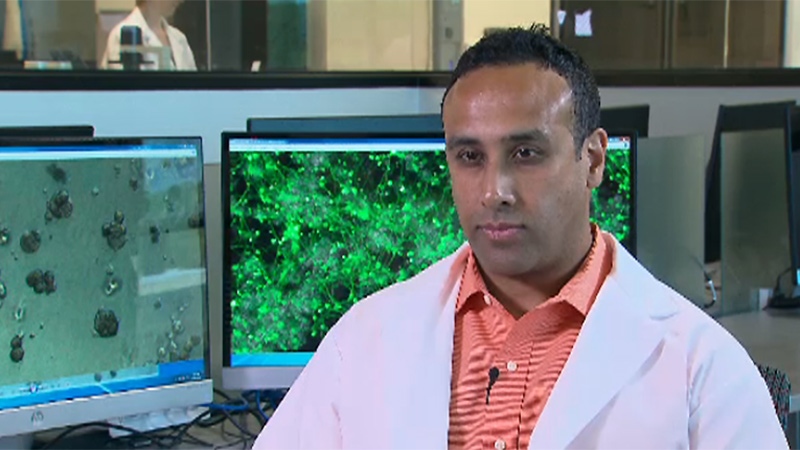
Canadian scientists say they have figured out a way to turn regular human blood cells into nerve cells, an achievement that could lead to new advances for those suffering chronic pain or nerve diseases.

Stem cell researchers from McMaster University in Hamilton, Ont. say they have learned how to convert cells from blood into both central nervous system neural cells — which are the neurons in the brain and spinal cord — as well as cells from the peripheral nervous system, which are the nerves in the rest of the body that are responsible for sensing pain, heat and itches.

The research was led by Mick Bhatia, director of McMaster’s Stem Cell and Cancer Research Institute, who says, at first, his team couldn’t believe that their method had worked.

“Neural cells have a very distinct shape, but we thought we had done something wrong to the cells. They were behaving differently to make them elongate, moving from a round shape to a very long stretched-out shape,” he told CTV News.

But after repeating the procedure several times over several months, they realized that they had achieved a first.

The idea of using stem cells to convert one kind of a cell into another isn’t new, as other research teams have already been able to turn skin cells into blood cells, for example. But no one has ever been able to create central nervous system neural cells and peripheral nervous system neural cells, “which are very, very complex,” Bhatia says.

“No one has ever done this with adult blood to make this repertoire of neural cells,” Bhatia said.

The hope is that one day, doctors would be able to take a blood sample from a patient and quickly produce a million sensory and central nervous system cells, Bhaita says, noting that it doesn’t take a lot of blood to produce a lot of neural cells.

Researchers could then study those cells to better understand why certain people feel pain or why others, such as diabetics, experience numbness.

It could also pave the way for the discovery of new pain medications that would specifically target neural cells, rather than just block the perception of pain.

“Pain is really poorly understood right now, and the drugs available are not well characterized,” Bhatia said. “Most are narcotics and opioids that are addictive and they’re not very specific to the cells you’re trying to target.”

The ideal drug that could come out of this discovery would target peripheral nervous system neurons and have no effect on the central nervous system. That could help avoid many of side effects of current pain medications, such as drowsiness and “brain fog.”

Bhatia says they decided to try to create neural cells because they are currently so difficult to obtain.

Skin cells, blood cells or tissue samples can be easily harvested and grown into larger samples in a lab, but it’s not as easy to take a piece of someone’s neural system because it runs like complex wiring throughout the body.

“This gives you access to cells you couldn’t otherwise obtain. You can’t take cells from a brain and spinal cord or the peripheral nervous system and then expand them in a dish and transplant them back in,” he said.

What’s great about blood, Bhatia says, is that it is easily accessible, it regenerates on its own, and the resulting cells would be personalized.

“And so with this technology, blood could become a building block for neural cells,” he said.

Bhatia says while they have been working quietly on their discovery for some time, they are now showing it to the world in a paper published online and featured on the cover of the journal Cell Reports.

“We know this is something that people want — scientists, people in industry want to be able to large amount of patient-specific cells. There just hasn’t been the technology,” he said.

Now, he’s excited about what is to come.

“We know there are many groups trying to come up with ways to generate these cells all over the world, so we are anxiously waiting their reaction when they see the paper and get detailed knowledge of what we’ve done,” he said.

With files from CTV medical specialist Avis Favaro and Elizabeth St. Philip

http://www.ctvnews.ca/health/canadian-first-creating-patient-specific-nerve

New class of magnets could energize the world

A new class of magnets that expand their volume when placed in a magnetic field and generate negligible amounts of wasteful heat during energy harvesting, has been discovered by researchers at Temple Univ. and the Univ. of Maryland.

The researchers, Harsh Deep Chopra, professor and chair of mechanical engineering at Temple, and Manfred Wuttig, professor of materials science and engineering at Maryland, published their findings in Nature.

This transformative breakthrough has the potential to not only displace existing technologies but create altogether new applications due to the unusual combination of magnetic properties.

“Our findings fundamentally change the way we think about a certain type of magnetism that has been in place since 1841,” said Chopra, who also runs the Materials Genomics and Quantum Devices Laboratories at Temple’s College of Engineering.

In the 1840s, physicist James Prescott Joule discovered that iron-based magnetic materials changed their shape, but not their volume when placed in a magnetic field. This phenomenon is referred to as “Joule Magnetostriction,” and since its discovery 175 years ago, all magnets have been characterized on this basis.

“We have discovered a new class of magnets, which we call ‘Non-Joulian Magnets,’ that show a large volume change in magnetic fields,” said Chopra. “Moreover, these non-Joulian magnets also possess the remarkable ability to harvest or convert energy with minimal heat loss.”

“The response of these magnets differs fundamentally from that likely envisioned by Joule,” said Wuttig. “He must have thought that magnets respond in a uniform fashion.”

Chopra and Wuttig discovered that when they thermally treated certain iron-based alloys by heating them in a furnace at approximately 760 C for 30 min, then rapidly cooled them to room temperature, the materials exhibited the non-Joulian behavior.

The researchers found the thermally treated materials contained never before seen microscopic cellular-like structures whose response to a magnetic field is at the heart of non-Joulian magnetostriction. “Knowing about this unique structure will enable researchers to develop new materials with similarly attractive properties,” Wuttig added.

The researchers noted that conventional magnets can only be used as actuators for exerting forces in one direction since they are limited by Joule magnetostriction. Actuation, even in two directions, requires bulky stacks of magnets, which increase size and reduce efficiency. Since non-Joulian magnets spontaneously expand in all directions, compact omnidirectional actuators can now be easily realized, they said.

Because these new magnets also have energy efficient characteristics, they can be used to create a new generation of sensors and actuators with vanishingly small heat signatures, said the researchers. These magnets could also find applications in efficient energy harvesting devices; compact micro-actuators for aerospace, automobile, biomedical, space and robotics applications; and ultra-low thermal signature actuators for sonars and defense applications.

Since these new magnets are composed of alloys that are free of rare-earth elements, they could replace existing rare-earth based magnetostriction alloys, which are expensive and feature inferior mechanical properties, said researchers.

“Chopra and Wuttig’s work is a good example of how basic research advances can be true game changers,” said Tomasz Durakiewicz, National Science Foundation condensed matter physics program director. “Their probing of generally accepted tenets about magnetism has led to a new understanding of an old paradigm. This research has the potential to catapult sustainable, energy-efficient materials in a very wide range of applications.”

http://www.rdmag.com/news/2015/05/new-class-magnets-could-energize-world

Bendable, Light-Emitting Nanocellulose Paper Infused with Biocompatible Quantum Dots

Published on May 21, 2015 at 3:15 AM

The rapid evolution of gadgets has brought us an impressive array of “smart” products from phones to tablets, and now watches and glasses. But they still haven’t broken free from their rigid form. Now scientists are reporting in the journal ACS Applied Materials & Interfaces a new step toward bendable electronics. They have developed the first light-emitting, transparent and flexible paper out of environmentally friendly materials via a simple, suction-filtration method.

Technology experts have long predicted the coming age of flexible electronics, and researchers have been working on multiple fronts to reach that goal. But many of the advances rely on petroleum-based plastics and toxic materials. Yu-Zhong Wang, Fei Song and colleagues wanted to seek a “greener” way forward.

The researchers developed a thin, clear nanocellulose paper made out of wood flour and infused it with biocompatible quantum dots — tiny, semiconducting crystals — made out of zinc and selenium. The paper glowed at room temperature and could be rolled and unrolled without cracking.

Source: http://www.acs.org

http://www.azonano.com/news.aspx?newsID=32825

Report: Access HomeKit Devices Via ‘Home’ App on iOS 9

Apple’s first HomeKit-enabled smart devices may be controlled via a new iOS app called “Home.”

The app, according to 9to5Mac, is “fairly basic,” allowing for things like HomeKit device setup and organization, discovery of HomeKit apps and devices, and using Apple TV as a connection hub.

Ultimately, the platform will be able to do things like unlock the front door or open the garage. Tell Siri to “get ready for bed,” and HomeKit will lower the thermostat and dim the lights before you climb under the covers, for example.

9to5Mac, citing unnamed sources, suggested that we might hear more details at next month’s Worldwide Developers’ Conference in San Francisco, where the tech giant could debut the new app alongside iOS 9. But Home’s limited functionality might also suggest that it’s not quite ready for primetime, the blog said.

Last week, conflicting reports tipped two different timelines for the first HomeKit-enabled smart devices. While Appletold The Wall Street Journal to expect the first accessories “next month,” another account said software stabilization issued were delaying product launches.

Apple first announced HomeKit at last year’s WWDC, and asked developers and home automation firms to connect their gadgets with the iPhone and iPad.

At last year’s show, Cupertino also showed off HealthKit, which allows for integration of health gadgets with iOS. That’s accessible via the Health app on iOS, so it makes sense that HomeKit devices would have a Home app.