http://betanews.com/2016/02/16/women-are-excellent-coders-according-to-github-research/

Women are excellent coders, according to GitHub research

A survey back in 2013 found that only 11.2 percent of software developers were female. Working then on the premise that males would be prejudiced against female coders work, a group of students has now studied the acceptance rate of GitHub pull-requests by gender.

A pull-request is when volunteers submit work to a project and it receives some scrutiny by the project team, they often accept the work or reject it with some advice. What the study team has discovered is that 78 percent of work submitted by women was accepted, which compared favorably to only 74 percent for men.

“Women’s acceptance rates dominate over men’s for every programming language in the top 10, to various degrees”, the researchers find.

The team then looked at submissions where the coder was clearly identifiable as a female, and to their dismay discovered that in this case females performed worse than their male colleagues did, suggesting a gender bias.

However, not all female coders related to those results. Jenny Bryan, a professor of statistics and her profile makes clear that she is a woman: “The men I interact with in the R community on GitHub know me and, if my gender has any effect at all, I feel they go out of their way to support my efforts to learn and make more contributions”.

Lorna Jane Mitchell, a software developer whose work is almost entirely based on GitHub, said, “that it was impossible to tell whether a pull request was ignored out of bias, or just because a project owner was busy or knew another developer personally”.

Elizabeth Eastaugh, a director of technology at Expedia comments: “The GitHub analysis is not only indicative of gender bias in web development, but a sign that the lack of all diversity is still a huge problem in the tech world. Looking at the approval rates at the quality of code for women compared to men when the developer’s gender is concealed is quite demoralizing. But it is crucial that these results don’t dissuade minorities from revealing their identities in the future. In fact, it should spur them on to do the opposite”.

“It’s important that people realize that minority groups do exist in the tech industry, and it’s also crucial that these minorities do not feel isolated in their respective fields. The technology industry needs more C-level role models who dispel the notion that great success is the preserve of well-educated white men”, adds Eastaugh.

“The findings should by no means justify the decision to hide your gender, because identifying yourself as female in a primarily male-dominated industry is extremely important. And the issue of inclusion and diversity shouldn’t just end with gender — it should incorporate race, sexuality and disability as well”, concludes Eastaugh.

http://youngherald.com/2016/02/elon-musk-announces-the-tesla-model-3-the-companys-new/

Elon Musk Announces the Tesla Model 3, the Company’s New $35000 auto

Rich Kids in Tiny Tesla Model S Ride-ons Will Now Be Looking Down on You Too

Investors are paying close attention to the results because the electric-car maker’s stock has tumbled 40% this year amid concerns about early sales of Tesla’s new sport utility vehicle, the Model X, and the outlook for its planned mass-market auto, the Model 3, due in 2017.

On the call, however, Musk aimed higher for Model 3 competitors.

All of this is good news for those betting on a bright future for electric cars.

Tesla also said it expects to ship 80,000 to 90,000 Model S and Model X cars in 2016, beating forecasts that the company would only ship about 76,000.

Get out those wallets and make room in your garage: the Tesla Model 3 is coming.

Here’s what we do – and don’t – know about the vehicle.

Speculation aside, Musk has confirmed the Model 3 will be less expensive with a blue-collar price target about 50 percent below Model S, or around $US30,000. Helping drive down the cost, from the Model S is the fact that the 3 will be approximately 20% smaller and some standard features on the S might be optional.

Musk has been quoted as saying 200 miles should be the minimum range for any an all-electric vehicle.

A Tesla representative told Bloomberg that “the $35,000 price tag on the Model 3 doesn’t include the significant federal and state incentives available to electric auto buyers”. The average price of all new cars today is about $34,000, according to Kelley Blue Book. And that’s why the Tesla 3 is being looked at as such an important auto: It’s Tesla’s first attempt at launching a mass market vehicle. After losing 38% of their value so far on the year -closing at $143.67 on Wednesday – Tesla shares jumped in after-hours trading as investors were heartened when Musk assured them that Model X production is on track. “In retrospect, it would have better to do fewer things with the first version of Model X, and then roll in… new technologies over time”, Musk said Wednesday. For example, the “ludicrous mode” that allows the vehicle to go 0 to 60 in only 3 seconds, adds $10,000.

http://www.digit.in/mobile-phones/apple-iphone-7-concept-renders-show-phone-without-headphone-jack-29047.html

Apple iPhone 7 concept renders show phone without headphone jack

Every rumour and leak till date suggests that Apple may drop the 3.5mm headphone jack, and these renders show the same.

Apple iPhone 7 is more than six months away from launch, but rumours and leaks about the phone have been flowing in steadily. Earlier today, concept renders of the phone suggested a build minus the 3.5mm audio jack. It should not come as a surprise, since it has been widely rumoured that Apple will be replacing the headphone jack with the Lightning port that it already uses. This means that the Lightning port will work as a charging port and audio input/output. We expect Apple to launch the iPhone 7 in September 2016.

These concept images come from Arthur Reis, and do not represent the actual product. These images merely showcase what the upcoming iPhone might look like. The iPhone 7 will have a new SoC, likely to be termed the A10. A recent report suggests that TSMC (Taiwan Semiconductor Manufacturing company) will be making these SoCs for Apple. Previously, both Samsung and TSMC were responsible for the SoCs that go into Apple devices.

Rumours also suggest that the iPhone 7 is likely to get a 3GB RAM upgrade. With the iPhone 6s, Apple finally stepped up from having 1GB of RAM, and the upcoming iPhone 7 is expected to get an upgrade over the 2GB of RAM on the iPhone 6s. As for the display, the most prominent rumour is Apple being granted a new patent for ‘flexible electronic devices’. This has led to suggestions that the upcoming iPhone 7 may have a curved edge display.

Apart from that, a different report suggested that Apple might be looking to make the iPhone 7 waterproof and remove the antennae lines as well. However, the biggest change to the exterior might still be the removal of a 3.5mm headphone jack. If it does turn out that way, many Apple-only accessories that work via the 3.5mm headphone jack will become obsolete.

Hardik SinghHardik Singh

Light at the top, this odd looking creature lives under the heavy medication of video games.

http://learnbonds.com/126925/tesla-model-x-vs-model-s-faster-race/

Tesla Motors Inc (NASDAQ:TSLA) Model X vs Model S In Ludicrous Drag Race

Tesla Motors Inc (NASDAQ:TSLA) has begun with the deliveries of the Model X electric SUV, so it’s time to see exactly what kind of performance this vehicle can deliver. After launching the insanely powerful Ludicrous mode Model S P90D, the EV firm followed it up with an equally Ludicrous Model X P90D, and someone raced the two cars to find out, which is better, says a report from Dragtimes.

Tesla Motors Inc (NASDAQ:TSLA) Model S

Tesla the winner

Tesla Motors Inc (NASDAQ:TSLA)’s Model X is the fastest SUV ever. It has two motors – front and rear –giving a combined horsepower of over 530 to the Model X P90D. And, this enables it to meet a claimed speed of going from 0 to 60 in just 3.2 seconds, thus making it the fastest SUV ever made. Though it is incredibly fast, it is not known how does it compare to the Model S P90D, which is equally fully-electric and performs mind-blowingly.

Tesla Model X’s extra size i.e. 600 pounds of extra weight ultimately slows down the SUV, when compared to its sedan sibling. But it did come quite close. Dragtimes.com states that the best time of Model X was 11.61 at 116 mph while that of Model S was 11.24 at 118.5 mph. The difference is too small of just 0.37 seconds, 2.5 mph, and this makes the 600 pounds extra weight almost negligible.

Related…   Tesla Motors Inc (NASDAQ:TSLA) Defends Sales Model, Attacks GM

The Model X P90D used in the test clocked a 0 to 60 of just 3.1 seconds.

Tesla Model 3 – What to expect?

Apart from these two speeding cars, the third Tesla will be unveiled soon. Tesla Model S lovers, who wish to own the luxury electric car, but aren’t willing to spend $71,000 will be glad to know that on March 31, the firm will unveil a more affordable version. Tesla’s CEO, Elon Musk, told Bloomberg that the car will cost $35,000. And, if federal and state tax incentives are discounted, then the cost will decline further.

raw_html_snippet id=”top yielding cds”]

Tesla Motors Inc (NASDAQ:TSLA) has not stated what the next month’s unveiling will entail. It has not even informed whether a concept car will be on display or a full spec-sheet will be made available. Jalopnik reported that Musk only guaranteed vehicle’s pictures will be released at the event, and was not very sure about whether the public will get to see the actual car or not.

Since, the Model 3 is priced comparatively low, therefore, it would have fewer features as compared with the Model S sedan and the Model X SUV. Popular Mechanics reported that the details are not clear as yet, but it is expected that the third-gen Tesla car will come with a more compact body than the earlier two vehicles.

http://phys.org/news/2016-02-alphabet-lab-chief-internet-billions.html

Google’s X lab chief sees Internet reaching billions
February 16, 2016 by Glenn Chapman
Project Loon confirmed that one of their balloon stayed up in the stratosphere for 187 days, circling the world more than a doze
Project Loon confirmed that one of their balloon stayed up in the stratosphere for 187 days, circling the world more than a dozen times
The “captain of moonshots” at Google parent company Alphabet sees widespread, world-changing wireless Internet on the horizon.

Astro Teller, head of the boundary-pushing X research team, shared his vsion of the future during a talk at the TED Conference here late Monday.
Teller shared insights into the X team’s balloon-powered high-speed Internet service known as “Project Loon,” which aims to get billions more people online by reaching remote or rural regions that are not yet connected.
“There is a lot of different technology out there, rolling them out will be complicated,” Teller said.
“But, somewhere between five and ten years, it will change the world in ways we can not possibly imagine.”
Project Loon began its first tests in Sri Lanka on Monday ahead of a planned joint venture with the government there, the country’s top IT official told AFP.
It promises to extend coverage and cheaper rates for data services.
Service providers will be able to access higher speeds and improve the quality of their existing service once the balloon project is up and running.
Once in the stratosphere, the balloons will be twice as high as commercial airliners and barely visible to the naked eye.
Astro Teller heads Alphabet’s boundary-pushing X research team
Teller told the TED audience that he expected Project Loon balloons to be tested over Indonesia this year.
Craziest idea to date
The project, he quipped, might be the craziest to date at the X lab, which was once part of Google but became a separate unit with a restructuring that created parent company Alphabet.
The name of the project was intended to remind the team how bizarre it initially seemed.
As with all their projects, members of the X team first tackled the toughest technical challenges facing Loon with an eye toward quickly scuttling the mission if the goal was not realistic, according to Teller.
“We had round silvery balloons; giant pillow-shaped balloons, balloons the size of a blue whale,” Teller said.
Project Loon balloons will fly twice as high as commercial airliners and will be barely visible to the naked eye
Visitors stand next to a high altitude WiFi internet hub, a Google Project Loon balloon, on display at the Airforce Museum in Christchurch on June 16, 2013. Google revealed top-secret plans on June 15 to send balloons to the edge of space …more
“We busted a lot of balloons.”
Each potentially terminal technology challenge for Loon has been surmounted well enough to continue the project.
The current design is a balloon within a balloon, one containing helium to keep it aloft and the other with air that can be released or added to alter the weight and, as a result, move up or down to ride the wind.
Kudos for failure
The balloons can navigate fairly well, and send Internet signals to each other in order to increase their reach into remote areas.
As a Loon balloon floats out of an area, it hands the connection off to another floating into that same area.
The current design of Project Loon is a balloon within a balloon: one containing helium to keep it aloft and the other with air
The current design of Project Loon is a balloon within a balloon: one containing helium to keep it aloft and the other with air that can be released or added to move up or down
And, Teller said, the bandwidth is good enough to stream free online TED talks for which the conference is renowned.
Last year, one of the balloon stayed up for 187 days, he said, circling the world more than a dozen times.
“Our balloons today do everything we need,” Teller said. “So we are going to keep going.”
Teller said his team refers to their base as “The Moonshot Factory” because their goal is to blend audacious ideas with the realities of getting them to market.
People on the X team get kudos, bonuses and even promotions for finding fatal flaws that kill projects and thereby let resources shift to more promising dreams.
“We use the word ‘moonshot’ to remind us to keep our vision big, and the word ‘factory’ to remind ourselves that we need concrete plans to make them real,” Teller said.
“We spend most of our time trying to break things and prove we are wrong.”
X lab’s work on an automated system for vertical farming was killed last year when the team couldn’t get it to grow staple crops such as grains or rice.
An ultra-light air-ship for hauling cargo was abandoned after the team realized the costs to build the first prototype would be astronomical.
“We can’t spend $200 million to get the first data point about whether we are on the right track,” Teller said. “So we killed it.”
The lab’s self-driving car was a natural moonshot, and is humming along, according to Teller.

http://www.macworld.com/article/3033872/apple-phone/get-ready-to-use-apple-pay-in-china-starting-feb-18.html

Reports: Apple Pay rolls out in China on Feb. 18

Apple has been steadily ramping up plans to bring its mobile payment service to China, and now it’s finally ready to launch.

Apple is slowly, steadily aiming to make Apple Pay the top mobile payment service in the world, so making the system available in China was at the forefront of the company’s expansion plans. This Thursday, Apple Pay finally goes live in Apple’s second biggest market with support from the Industrial and Commercial Bank of China.

ICBC confirmed the Apple Pay launch, though it won’t be the only bank on board to support the service. It is, however, the country’s largest lender, according toReuters. The Chinese state radio station said two more banks, China Construction Bank and China Guangfa Bank, are also planning to support Apple Pay on Thursday, and the remaining 16 banks Apple has listed on its Chinese website are expected not long after.

The fact that Apple has backing from China’s biggest banks is huge—Apple Pay wasn’t immediately popular with major banks in Britain and Australia. But Apple has stiff competition in China, where mobile payments are already popular, unlike in the U.S. The Chinese use established services like Tencent’s WeChat Payment and Alipay to pay with their phones, and it’s unclear if Apple Pay’s selling points, like its seamless integration with the iPhone hardware, are compelling enough to convince people to switch.

The story behind the story: Apple partnered with payment network UnionPay to bring Apple Pay to China this year, and Samsung announced a similar deal with the network to bring Samsung Pay to the country, too. Apple will have an easier time winning over people in China and Europe, where mobile payments are far more common than in the States, but it also faces more rivals who have more experience in those markets than Apple does.

Apple is reportedly eyeing France as its next big market, according to 9to5Mac, but that rollout might happen later this year so Apple can focus on China for now.

http://www.kurzweilai.net/3d-printing-a-new-lifelike-liver-tissue-for-drug-screening

3D-printing a new lifelike liver tissue for drug screening

Could let pharmaceutical companies quickly do pilot studies on new drugs
February 15, 2016
[+]

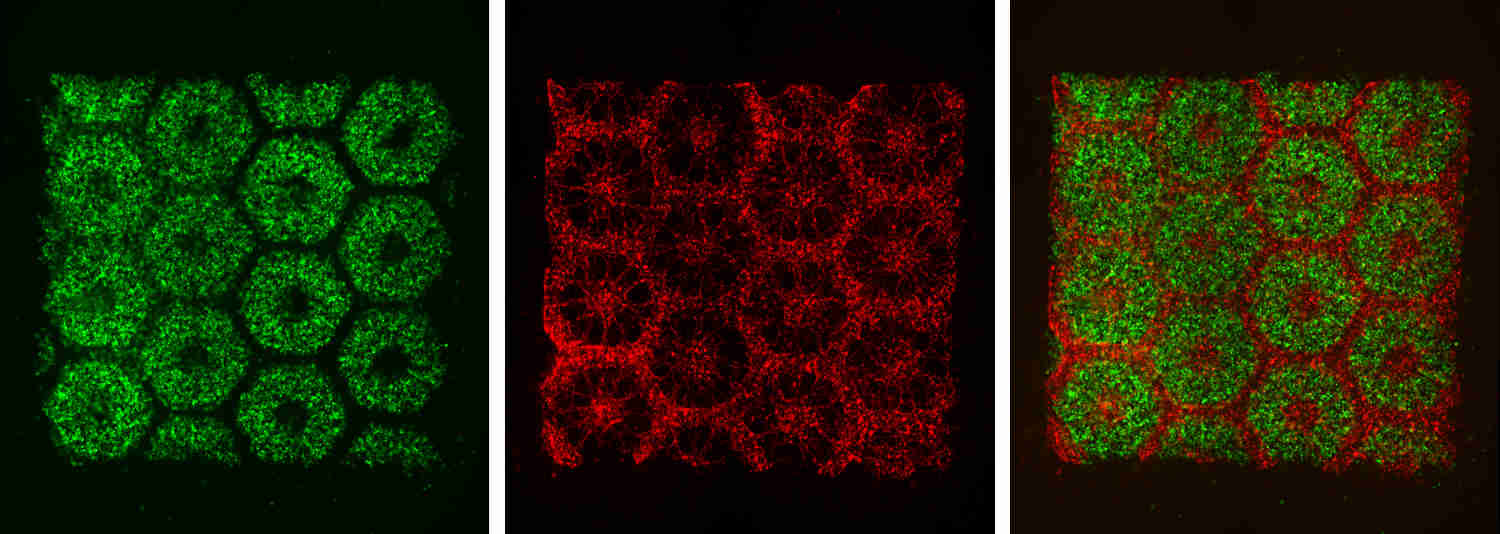
Images of the 3D-printed parts of the biomimetic liver tissue: liver cells derived from human induced pluripotent stem cells (left), endothelial and mesenchymal supporing cells (center), and the resulting organized combination of multiple cell types (right). (credit: Chen Laboratory, UC San Diego)

University of California, San Diego researchers have 3D-printed a tissue that closely mimics the human liver’s sophisticated structure and function. The new model could be used for patient-specific drug screening and disease modeling and could help pharmaceutical companies save time and money when developing new drugs, according to the researchers.

The liver plays a critical role in how the body metabolizes drugs and produces key proteins, so liver models are increasingly being developed in the lab as platforms for drug screening. However, so far, the models lack both the complex micro-architecture and diverse cell makeup of a real liver. For example, the liver receives a dual blood supply with different pressures and chemical constituents.

So the team employed a novel bioprinting technology that can rapidly produce complex 3D microstructures that mimic the sophisticated features found in biological tissues.

3D bioprinting of hydrogel-based hepatic (liver) construct. (A) Schematic diagram of a two-step 3D-bioprinting approach in which hiPSC-HPCs (human induced pluripotent stem cell-derived hepatic progenitor cells) were patterned by the first digital mask, followed by the patterning of supporting cells using a second digital mask. (B) Grayscale digital masks corresponding to polymerizing lobule structure (Left) and vascular structure (Right) designed for two-step bioprinting. The white patterns represent the light-reflecting patterns for photo-polymerization. (C) Images (5x) taken under fluorescent and bright field channels showing patterns of hiPSC-HPCs  (green) and supporting cells (red). (credit: Xuanyi Ma et al./PNAS)

The liver tissue was printed in two steps.

  • The team printed a honeycomb pattern of 900-micrometer-sized hexagons, each containing liver cells derived fromhuman induced pluripotent stem cells. An advantage of human induced pluripotent stem cells is that they are patient-specific, which makes them ideal materials for building patient-specific drug screening platforms. And since these cells are derived from a patient’s own skin cells, researchers don’t need to extract any cells from the liver to build liver tissue.
  • Then, endothelial and mesenchymal supporting cells were printed in the spaces between the stem-cell-containing hexagons.

The entire structure — a 3 × 3 millimeter square, 200 micrometers thick — takes just seconds to print. The researchers say this is a vast improvement over other methods to print liver models, which typically take hours. Their printed model was able to maintain essential functions over a longer time period than other liver models. It also expressed a relatively higher level of a key enzyme that’s considered to be involved in metabolizing many of the drugs administered to patients.

“It typically takes about 12 years and $1.8 billion to produce one FDA-approved drug,” said Shaochen Chen, NanoEngineering professor at the UC San Diego Jacobs School of Engineering. “That’s because over 90 percent of drugs don’t pass animal tests or human clinical trials. We’ve made a tool that pharmaceutical companies could use to do pilot studies on their new drugs, and they won’t have to wait until animal or human trials to test a drug’s safety and efficacy on patients. This would let them focus on the most promising drug candidates earlier on in the process.”

The work was published the week of Feb. 8 in the online early edition of Proceedings of the National Academy of Sciences.


Abstract of Deterministically patterned biomimetic human iPSC-derived hepatic model via rapid 3D bioprinting

The functional maturation and preservation of hepatic cells derived from human induced pluripotent stem cells (hiPSCs) are essential to personalized in vitro drug screening and disease study. Major liver functions are tightly linked to the 3D assembly of hepatocytes, with the supporting cell types from both endodermal and mesodermal origins in a hexagonal lobule unit. Although there are many reports on functional 2D cell differentiation, few studies have demonstrated the in vitro maturation of hiPSC-derived hepatic progenitor cells (hiPSC-HPCs) in a 3D environment that depicts the physiologically relevant cell combination and microarchitecture. The application of rapid, digital 3D bioprinting to tissue engineering has allowed 3D patterning of multiple cell types in a predefined biomimetic manner. Here we present a 3D hydrogel-based triculture model that embeds hiPSC-HPCs with human umbilical vein endothelial cells and adipose-derived stem cells in a microscale hexagonal architecture. In comparison with 2D monolayer culture and a 3D HPC-only model, our 3D triculture model shows both phenotypic and functional enhancements in the hiPSC-HPCs over weeks of in vitro culture. Specifically, we find improved morphological organization, higher liver-specific gene expression levels, increased metabolic product secretion, and enhanced cytochrome P450 induction. The application of bioprinting technology in tissue engineering enables the development of a 3D biomimetic liver model that recapitulates the native liver module architecture and could be used for various applications such as early drug screening and disease modeling.

https://www.raspberrypi.org/blog/raspberry-pi-controlled-book-scanner/

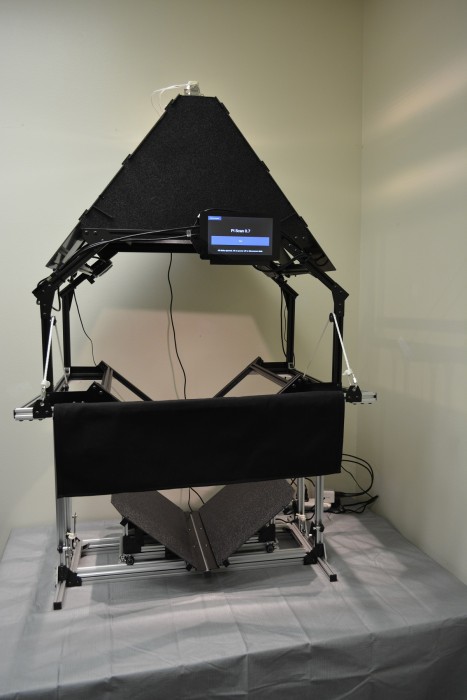
Today we’ve an excellent project from our forums to share with you: JonathonDuerig, known as duerig on the forums, posts about the standalone book scannerhe has built, controlled by a Raspberry Pi 2 and using the Raspberry Pi TouchDisplay as an interface. It’s a large and fairly imposing object, based on TheArchivist DIY book scanner and using Tenrec Builders‘ open source book-scanningsoftware, Pi Scan.

Pi Scan book scanner

Books rest on a V-shaped cradle that the scanner’s operator lifts up towards asimilarly shaped 3mm glass platen by pulling down on a handlebar, thus pressingflat the pages, which are evenly lit from above. The Raspberry Pi controls twoCanon PowerShot ELPH 160 cameras, each angled perfectly to capture one of thevisible pages of the book. The Pi allows the user to set the zoom level for eachcamera, automatically sets and locks focus, and captures the images, saving themto an external SD card. The scanner’s touchscreen interface is made with Kivy, aPython GUI development system for touchscreen devices.

Looking at this build and the projects it draws on, I was pretty astonished bysomething that regularly bowls me over when I’m looking at open source projects,and by which I hope I never stop feeling awed. The level of duerig and others’commitment to the overall open book scanning project and its quality and integrityis remarkable. We are proud that Raspberry Pi is a useful tool to communities likeyours and projects like this.

http://www.nzherald.co.nz/lifestyle/news/article.cfm?c_id=6&objectid=11590249

Duck or rabbit? What this optical illusion says about you

This classic optical illusion reveals much about your brain.

It was created more than 100 years ago, but this image of a duck and a rabbit is sparking a huge response on social media.

Depending on what you see and how quickly you register the two images is said to be an indication of how creative you are.

The drawing first appeared in a German magazine in 1892 and was first used by American psychologist Joseph Jastrow, who used the sketch to make the point that perception is not only what you see but is also telling of brain activity.

Jastrow’s research and other subsequent studies were based on how fast a person can make out two animals and how quickly participants could change their perception between the duck and the rabbit.

Research participants who found it easy to flip between rabbit and duck, came up with an average of almost five novel uses for an everyday item. But those who couldn’t switch between the animals at all came up with less than two novel uses.

The results suggest the ease and pace at which you can move between the two visuals indicates how creative you are. Highly creative people display a talent for finding new uses for existing objects or are able to make connections between previously unconnected concepts or material things.

Research has also noted different animals will appear more prominent depending on the time of year. So with Easter approaching, it is suggested you’ll be more inclined to see the rabbit first.

– nzherald.co.nz

http://9to5mac.com/2016/02/15/how-to-stream-58th-annual-grammy-awards-macbook-apple-tv-ios-device-free/

How-To: Stream the 58th Annual Grammy Awards on your Mac, Apple TV, or iOS device for free

The 58th Annual Grammys are broadcasting tonight and thanks to CBS All Access, nearly anyone canwatch it for free without a cable subscription or TV set. The show starts at 8PM ET, with a pre-telecastred carpet show at 7PM ET. Viewers can catch the show on CBS’s site, or by using the iOS or Apple TVapp. Here’s how to do it for free:

New subscribers to CBS’s All Access can get a free week trial inpreparation for tonight’s show using their current Apple IDs. WhileCBS’ CEO has declined that there have been recent talks with Appleabout a streaming TV service, the current state of CBS’ All Access isas close as a user can get today.

This is CBS’ second major broadcast event they will be streaming,after this year’s Super Bowl 50. Having traditionally cable-orientedlive events accessible through streaming has helped to bridge thegap many cord-cutters felt in previous years. By making these liveevents viewable on so many platforms, not only is CBS increasingtheir viewership reach, but they are providing data to the oft-missedNielsen ratings that so many networks rely on.

58th Annual Grammy (CBS All Access)

To get ready for the show tonight, be sure to download the CBS app onto your Apple TV or iOS device. Ifound that the quickest way to create a CBS All Access account was right from the ‘Settings’ screenwithin the app. From here, a user can select ‘Sign In/ Purchase/ Restore’ and then select ‘Start YourOne Week Free Trial’. The app will use your currently registered Apple ID to start the free trial, which itwill then automatically charge $5.99 at the end of the week. Users are also able to link current CBSaccounts to the new subscription so that they may use it access the live show online with theircomputers.

Remember, if you’re not happy with the overall CBS subscription, the cancellation process is very similarto canceling Apple Music.

Also Be sure to keep an eye out on the @CBSThisMorning’s Twitter account as Apple Music takes overit for the Grammys.

Will you be streaming the Grammys tonight using the Apple TV, iOS device, or your computer? How doyou think this benefits or takes away from a traditional cable subscription in terms of experience orvalue? Does CBS streaming the Super Bowl 50 and 58th Annual Grammys signify a better or worsefuture for cord cutters? Let us know in the comments below, we’d love to hear your thoughts.

The CBS iOS and Apple TV apps are available for free in the App Store, and CBS’s All Access streamingis available for $5.99/month. The monthly price includes over 7,500 CBS episodes on demand, and theability to watch CBS live in select markets. New users to the platform are able to get a one week freetrial, perfect for tonight’s Grammys.