http://news.ubc.ca/2016/02/15/b-c-labs-metallic-glass-creates-smarter-windows/

B.C. lab’s metallic glass creates smarter windows

Times Colonist and Kelowna Capital News featured a UBC Okanagan discovery that could lead to new applications for glass. UBCO engineer and lead investigator Ken Chau found that adding a very thin coat of silver on glass enhanced the light coming through and that, combined with electronics, could pave the way for smart glass applications like large screen TVs and self-regulating thermostats.

http://www.ctvnews.ca/sci-tech/earthquake-app-promises-detection-and-early-warning-system-1.2775864

Earthquake app promises detection and early-warning system

SmartphoneSmarthphone technology is shaking up earthquake research. (D. Hammonds/shutterstock.com)

Geordon Omand, The Canadian Press
Published Friday, February 12, 2016 2:25PM EST

VANCOUVER — Smarthphone technology is shaking up earthquake research with a new app that may soon connect millions of users around the world to create an early-warning network.

Researchers at the University of California, Berkeley, have released a crowdsourcing Android application called MyShake that uses data from a smartphone’s built-in vibration sensor to detect the presence of a quake.

The program uses a smartphone’s accelerometer to detect the shaking. It’s the same device that fitness apps use to count footsteps. An iPhone app is also planned.

The end goal is to develop the technology into a global, seismic-detection system that provides advance warning to the public and to emergency personnel about the speed, direction, power and arrival time of an incoming earthquake.

Richard Allen, senior researcher on the app project, said he hopes to incorporate public alerts within a year or two.

“The brains of the system, what makes this possible … is how do you distinguish between earthquake shaking and everyday shaking,” said Allen, who is also director of the Berkeley Seismological Laboratory.

A team of academics spent several years advancing the project, using shake tables and human subjects to identify the 20 unique characteristics of earthquake quavers compared to movement from routine activities, such as running or riding a bus.

A number of traditional seismic stations have long been installed across the Pacific Northwest to detect tremors. While smartphones will never replace these more sensitive terminals, Allen said the app could complement and strengthen the existing technology.

There are about 400 seismic stations in California compared to the state’s 16 million smartphones, which Allens said means MyShake could more than make up for what it lacks in sensitivity with sheer numbers.

On the Canadian side, research from digital-marketing firm Catalyst revealed a 68-per-cent smartphone penetration rate in 2015, which translates to roughly 24 million devices in the country.

One especially valuable possible application for MyShake is the potential to offer earthquake early warning to shake-prone regions not equipped with traditional seismic-detection systems.

“That’s the real power here. You go to places like Nepal where there were these big earthquakes earlier this year and there are very few seismic stations in that country. But there are six million smartphones,” Allen said.

“In the city of Kathmandu, where most of the damage occurred, alone there are 600,000 smartphones.”

The app’s release follows last week’s announcement of more than $8 million in both government and charitable funding to American universities along the Pacific coast for ShakeAlert, a chain of fixed detection stations.

“The way it works is we take the (seismic) network we have and basically put it on steroids,” said John Vidale, a University of Washington professor and director of the Pacific Northwest Seismic Network.

Hundreds of upgraded and additional stations along the coast would provide seconds to minutes of valuable warning time, which Vidale estimated could reduce between 10 and 50 per cent of injuries and damage.

Some data sharing takes place between Canada and the United States, but so far no conclusions have been reached over what a region-wide warning system might look like.

“We need to consider British Columbia when we’re looking at (early) warning for the U.S. because the earthquakes in Cascadia could start off Vancouver Island,” Vidale said.

“We need to be watching the whole thing if we want to get the maximum warning and the most accurate picture of what’s happening.”

Teron Moore of Victoria-based Ocean Networks Canada said both his group and Emergency Management British Columbia are beta-testers for the ShakeAlert software.

Progress on either side of the border supports the bigger picture of earthquake early warning, Moore said.

“We’re all on the same team bringing these puzzle pieces together,” he said. “Earthquakes really don’t recognize borders.”

http://www.marketwatch.com/story/what-the-affordable-tesla-model-3-rollout-means-for-car-buyers-2016-02-12

What the ‘affordable’ Tesla Model 3 rollout means for car buyers

Published: Feb 12, 2016 10:44 a.m. ET
Getty Images
By
KATHLEEN
BURKE
REPORTER

Whether you’re planning on going electric or not, the introduction of the Tesla Model 3 could be good news for any luxury car fan on a low budget.

During its quarterly earnings call on Wednesday, Tesla TSLA, +0.38% confirmed the $35,000 electric vehicle will be available for preorder on March 31, adding to its current lineup of the Model S sedan (which retails at $75,000 before incentives) and the Model X SUV (which begins deliveries in the second half of 2016 and starts at $80,000 before incentives).

Tesla has gallery and store locations in 26 states and the District of Columbia, though you can purchase their vehicles online as well. Because of dealership franchise laws, the direct sale of Tesla vehicles is outlawed in five states.
An affordable vehicle from a luxury car brand isn’t a new concept; however, the hype surrounding Tesla’s newest addition could put pressure on other high-end brands to beef up their entry-level offerings.
Brands like Audi, Mercedes-Benz and BMW currently offer vehicles within the $30,000 to $35,000 price range. The 2016 Audi A3 retails for $30,900, the Mercedes CLA Class starts at $32,050 and the BMW 3 series is available at $33,150. These vehicles are typically marketed to younger customers who could potentially become brand loyalists as they accumulate more disposable income. “Brand loyalty [for cars] is at an all-time low,” says Karl Brauer, a senior analyst at Kelley Blue Book. “More companies are starting to market to customers at an early age with a low-priced car.”

Gravity waves detected, verifying Einstein’s theory(3:13)
Scientists announced they have directly detected gravitational waves for the first time, verifying an unproven portion of Einstein’s Theory of General Relativity.

Despite the lower price tag, auto makers don’t skimp on vehicle quality when it comes to attracting entry-level buyers, Brauer says. “Car makers have been able to pack a fairly high level of content and luxury features into these lower-priced models,” he says. “You don’t feel like you’ve compromised as a buyer.”

However, as volume brands like Honda 7267, -5.51% and Toyota TM, +0.11% have begun to catch up to the technology and quality of luxury brands, these affordable offerings are beginning to feel more pressure. Over the past few years, the affordable luxury space has become “squeezed” by these upgraded volume models, forcing high-end brands to maintain and improve upon the current quality of these vehicles to keep the upper hand as profit margins decrease, says Jessica Caldwell, director of industry analysis at automotive research site Edmunds.com.

Biting the bullet on profits on entry-level cars could be a boon to luxury auto makers in the long run, especially if buyers lease the cars. Lease deals allow companies to anticipate when the buyer will be back on the market so they can cater advertisements and special offers to keep them within the brand. “This has been a bread and butter product for the German auto makers,” Caldwell says.

The rollout of the Model 3 could further tighten the category and force traditional luxury brands to innovate further to maintain competitiveness, giving consumers more options for quality vehicles at a lower price point. Few details on the Model 3 have been released — including what the car will look like — however industry experts are expecting high demand, especially with the likelihood that the price will dip below $35,000 with electric vehicle incentives figured in.

“Tesla is very aspirational, especially for people who have been waiting to get into a Tesla because they couldn’t afford to buy a Model S or a Model X and they believe in Elon Musk’s vision” Caldwell says. “Many car buyers would be hard-pressed to name the heads of other luxury car companies.”

While traditional luxury auto makers may not have the same hype surrounding them that Tesla has, they have the resources to evolve while keeping prices low to stay competitive. Tesla has a limited product line and a history of delayed vehicle launches, making potential modifications and upgrades more difficult. The company has also yet to report a net profit, however it expects to in coming quarters, according to its earnings report. “There’s a lot of uncertainty on what will be the technology of the future,” Caldwell says. “These companies must evolve with threats and that would be the strategy that’s going to move them forward to conquer the market.”

http://news.ubc.ca/2016/02/12/do-teething-toys-disrupt-how-babies-learn-language/

Do teething toys disrupt how babies learn language?

Scientific American featured the work of UBC cognitive scientist Alison Bruderer in an article on the link between our perception of speech and the brain areas that control mouth movements.

In an experiment, Bruderer found that teething toys that immobilized babies’ tongues also made them unable to perceive a difference in sounds. This result indicates that even infants who don’t yet talk use their tongue to figure out speech.

http://www.bignewsnetwork.com/news/241220193/japan-to-launch-x-ray-telescope-into-space

Japan to launch X-ray telescope into space

UPIFriday 12th February, 2016

japan-to-launch-x-ray-telescope-into-space
GREENBELT, Md. — A powerful space telescope designed to probe the universe is to be launched from Japan’s Tanegashima Space Center in Kagoshima.The Japanese Aerospace Exploration Agency, or JAXA, is expected to send the ASTRO-H, a new X-ray observatory, into space Friday, Space.com reported.

The ASTRO-H is to collect information that could help scientists understand the evolution of galaxies, supernova explosions and other energetic events, NASA officials said.

The launch is the result of collaboration between the space agency’s Goddard Space Flight Center in Greenbelt, Md., and Japan.

The United States provided one scientific instrument and two telescope mirrors.

The new telescope will be 10 times more sensitive to X-ray light than the Suzaku spacecraft that was in operation between 2005 and 2015.

The ASTRO-H is to study a wide range of high-energy light, using four co-aligned focusing telescopes.

Project scientist Robert Petre said that X-rays can be seen from sources throughout the universe, and “where the particles in matter reach sufficiently high energies.”

“These energies arise in a variety of settings, including stellar explosions, extreme magnetic fields, or strong gravity, and X-rays let us probe aspects of these phenomena that are inaccessible by instruments observing at other wavelengths,” Petre said.

The ASTRO-H would be the sixth X-ray observatory Japan launches into space, South Korea’s News 1 reported.

The object is to travel in a circular orbit at an altitude of about 350 miles, and is to transmit information on the universe’s evolution, and the formation of black holes.

Japan is to use a H-IIA Launch Vehicle to send the telescope into orbit. Elizabeth Shim

http://www.the-scientist.com/?articles.view/articleNo/45316/title/Same-Gene–Different-Functions/

Same Gene, Different Functions

Proteins encoded by the same gene can play very different roles in the cell, scientists show.

By Catherine Offord | February 12, 2016

CD46, a type I membrane protein, has at least 14 different isoforms.WIKIMEDIA, EMWThe human genome contains roughly 20,000 protein-coding genes, yet the number of proteins in human cells is thought to be more like 100,000. Researchers from three institutions in North America have now shown that at least some of the diversity of proteins’ functions in the cell may be due to the widely diverging roles of protein isoforms—structurally similar variants produced as a result of slight differences during the translation of a single gene. The findings were published yesterday (February 11) in Cell.

“The exciting discovery was that isoforms coming from the same gene often interacted with different protein partners,” study coauthor Gloria Sheynkman of the Dana-Farber Cancer Institute said in astatement. “This suggests that the isoforms play very different roles within the cell.”

Unlike previous functional studies of isoforms, which have generally focused on one or a handful of genes, this project systematically analyzed the interactions of multiple isoforms from hundreds of genes.

The researchers found that, on average, two related isoforms shared less than 50 percent of interacting proteins; 16 percent of related isoforms shared none at all. These differences in interaction partners were often associated with only tiny alterations in DNA sequence—sometimes just a single base pair.

“From the perspective of all the protein interactions within a cell, related isoforms behave more like distinct proteins than minor variants of one another,” study coauthor Tong Hao of Dana-Farber said in the statement.

“A more detailed view at protein interaction networks, as presented in our paper, is especially important in relation to human diseases,” added study coauthor Lilia Iakoucheva of the University of California, San Diego. “Drastic differences in interaction partners among splicing isoforms strongly suggest that identification of the disease-relevant pathways at the gene level is not sufficient. . . . It’s time to take a deeper dive into the networks that we are building and analyzing.”

http://www.theguardian.com/technology/2016/feb/11/google-self-driving-cars

Want a job at Google’s new self-driving car company? They’re hiring
New job postings reveal how the company plans to bring its autonomous cars to market, pointing to a large manufacturing operation
The spin-off goes against Google’s earlier talk of partnering with established global car makers.
The spin-off goes against Google’s earlier talk of partnering with established global car makers. Photograph: Tony Avelar/AP
Mark Harris in Seattle
@meharris
Thursday 11 February 2016 19.41 GMT Last modified on Thursday 11 February 2016 22.48 GMT

Alphabet, the holding company for Google, is pushing forward with plans to spin-out its self-driving car project into a standalone business making and marketing autonomous vehicles, according to new job listings.

An advert posted last week for a marketing manager reveals that Alphabet – now the world’s most valuable technology company – intends to bring “self-driving cars to market” and “apply [a] new brand identity” after the project “graduates” from the company’s secretive X division, dedicated to moonshot projects such as airborne power generators and drones providing internet access.
Google computers qualify as drivers in automated cars, US government says

A job posting for an operations manager talks about building automated assembly lines and managing manufacturing partners, while another for a manufacturing process engineer involves “designing factory assembly stations … automating critical manufacturing processes and approving fixture designs used in the assembly of electronic modules for the self-driving car.”

“Obviously, they are planning to scale up,” says Mark Stevens, a former plant manager for General Motors and now a project manager at the Centre for Automotive Research. “But they are planning to stay with plastics, polymers or some sort of composite material.”

Many of the jobs listed require experience of working in Asia, which Stevens think suggests that the new company will outsource the manufacture of tooling to build the next generation of autonomous vehicles.

Self-driving cars will not be the first project to be spun out of Alphabet’s X division. Verily, focusing on life sciences, left Alphabet last year to develop diagnostic contact lenses, robotic surgery tools and clinical software.

But the departure of self-driving cars goes against Google’s earlier talk of partnering with established global car makers. In an interview with Reuters last year, Chris Urmson, the project’s technical lead said, “The biggest auto manufacturers [have] got a lot to offer. For us to jump in and say that we can do this better, that’s arrogant.”

Last summer, the Guardian revealed that Google had quietly set up its own car company, Google Auto LLC, to make a few hundred prototypes of self-driving cars. Those plans seem to now have advanced to the point where Alphabet envisages an increase in manufacturing.

A materials program manager will be “responsible for planning, procuring, warehousing, and conveying advanced materials across a global supply chain,” with projects that “will span time zones”.

Meanwhile, a marketing manager with experience of “large scale product launches” will be helping to “win the hearts and minds of local communities, opinion formers and governments”.

However, Stevens does not believe that the adverts indicate a shift to mass manufacture just yet. “Composites are typically not deployed on high volume vehicles,” he says, “And Google’s specifying of expertise in the accuracy and utilization of assets also implies lower volume production.”

It looks as though Google will not jump straight into selling passenger vehicles to consumers, a notoriously competitive and price-sensitive market.

More likely is that Google will start by offering robotic taxi services in cities that already welcome autonomous vehicles. Austin, Texas, would fit that bill. Google has been testing its self-driving cars there since July 2015, and the state has no special rules or regulations for driverless cars.

In January, Kara Kockelman, a professor of engineering at the University of Texas at Austin, published a paper describing a possible shared autonomous vehicle system in Austin. The system would use 400 fully driverless electric vehicles to take passengers to their destinations from 10 fixed recharging stations.

Kockelman calculated that such a system could provide trips at less than half the price of today’s Uber or cab services, and reduce congestion by displacing over 5,000 traditional vehicles. Kockelman received a $70,000 research award from Google in 2014 for research into autonomous vehicles, but says that her current paper is just a coincidence.

Google declined to comment on future plans for its self-driving cars.

http://esciencenews.com/articles/2016/02/11/lasers.rewired.scientists.find.a.new.way.make.nanowire.lasers

‘Lasers rewired’: Scientists find a new way to make nanowire lasers

Published: Thursday, February 11, 2016 – 15:54 in Physics & Chemistry

Related images
(click to enlarge)

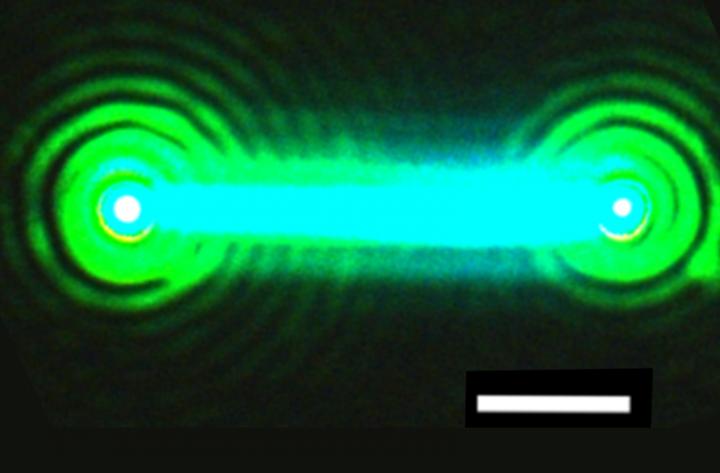
A nanowire, composed of cesium, lead and bromide (CsPbBr3), emits bright laser light after hit by a pulse from another laser source. The nanowire laser proved to be very stable, emitting laser light for over an hour. It also was demonstrated to be broadly tunable across green and blue wavelengths. The white line is a scale bar that measures 2 microns, or millionths of an inch.

Credit: Sam Eaton/UC Berkeley
This scanning electron microscope image shows a collection of cesium lead bromide (CsPgbBr3) nanowires and nanoplates grown from a chemical-dipping process. To produce these structures, researchers dipped a thin lead-containing film into a methanol solution containing cesium, bromine and chlorine heated to about 122 degrees. The white scale bar at the lower right represents 10 microns. The image at the bottom left shows the well-formed rectangular end of a nanowire--the white scale bar associated with it represents 500 nanometers in length.

Credit: Sam Eaton/UC Berkeley

The nanowires, with diameters as small as 200 nanometers (billionths of a meter) and a blend of materials that has also proven effective in next-generation solar cell designs, were shown to produce very bright, stable laser light. Researchers say the excellent performance of these tiny lasers is promising for the field of optoelectronics, which is focused on combining electronics and light to transmit data, among other applications. Light can carry far more data, far more rapidly than standard electronics–a single fiber in a fiber-optic cable, measuring less than a hair’s width in diameter, can carry tens of thousands of telephone conversations at once, for example. And miniaturizing lasers to the nanoscale could further revolutionize computing by bringing light-speed data transmission to desktop and ultimately handheld computing devices.

“What’s amazing is the simplicity of the chemistry here,” said Peidong Yang, a chemist in Berkeley Lab’s Materials Sciences Division who led the research, published Feb. 9 inProceedings of the National Academy of Sciences. More standard techniques that produce nanowires can require expensive equipment and exotic conditions, such as high temperatures, and can suffer from other shortcomings.

The research team developed a simple chemical-dipping solution process to produce a self-assembled blend of nanoscale crystals, plates and wires composed of cesium, lead and bromine (with the chemical formula: CsPbBr3). The same chemical blend, with a molecular architecture composed of cube-like crystal structures, has also proven effective in an emerging wave of new designs for high-efficiency solar cells.

“Most of the earlier work with these types of materials is focused on these solar energy applications,” said Yang, who also holds appointments with UC Berkeley and the Kavli Energy NanoScience Institute at Berkeley Lab and UC Berkeley. “There has been so much progress with these materials in just the past several years–I have a feeling these materials will open a new research frontier for optoelectronics as well,” he said, and in the broader field of photonics, which is focused on using light for a range of applications.

“The whole purpose of developing nano-sized lasers is to interface photonic (light-based) devices with electronic devices seamlessly,” Yang said, “at scales relevant to today’s computer chips. Today, these photonic devices can be bulky.”

Yang’s research team pioneered the development of nanowire lasers almost 15 years ago using a different blend of materials, including zinc oxide (ZnO) and gallium nitride (GaN). But these and other, more conventional combinations of materials used to make nanolasers have shortcomings that can include limited tunability, low brightness or costly manufacturing processes.

In this latest work, the research team discovered how to produce nanowires by dipping a thin lead-containing film into a methanol solution containing cesium, bromine and chlorine heated to about 122 degrees Fahrenheit. A mix of cesium lead bromide crystalline structures formed, including nanowires with a diameter from 200 to 2,300 nanometers (0.2 to 2.3 microns) and a length ranging from 2 to 40 microns.

Select nanowires used in the experiment were placed on a quartz base and excited by another laser source that caused them to emit light. Researchers found that the nanowire lasers emitted light for over 1 billion cycles after being hit by an ultrafast pulse of visible, violet light that lasted just hundredths of quadrillionths of seconds, which Yang said demonstrated remarkable stability.

Yang said to his knowledge these nanowires may be the first to emit laser light using a totally inorganic (not containing carbon) blend of materials. Researchers demonstrated that the nanowire lasers could be tuned to a range of light including visible green and blue wavelengths.

The nanowires have a crystal structure that resembles that of a naturally occurring mineral known as perovskite. Researchers studied their structure with a technique known as transmission electron microscopy at the National Center for Electron Microscopy, part of Berkeley Lab’s Molecular Foundry. The Molecular Foundry is a DOE Office of Science User Facility.

The nanowires’ crystalline structure is a lot like salt, which does make them susceptible to damage from moisture in the air, Yang said.

“That is one weakness–something we have to study and understand how to improve,” he said. It may be possible to coat the nanowires with polymers or other material to make them more damage-resistant, he said. There are also opportunities to test out other materials and learn whether they improve performance, he said, such as substituting tin for lead.

Ted Sargent, a nanotechnology researcher and professor at University of Toronto who is familiar with the study, said, “The results indicate significant promise for perovskite nanomaterials in lasing.” Also, he said, the stability of the nanolasers, which were shown to operate in air for more than an hour, was “impressive.”

Yang said, “This field is rapidly evolving. We just jumped into this field only 12 months ago, and these lasers are already amazing, bright emitters. It’s just so exciting.”

Source: DOE/Lawrence Berkeley National Laboratory