Month: February 2016
http://news.ubc.ca/2016/02/11/ubc-researchers-discover-new-glass-technology/
UBC researchers discover new glass technology
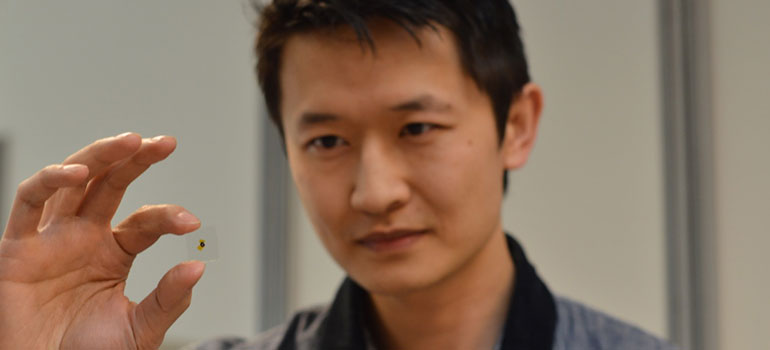
UBC’s Kenneth Chau holds a glass sample used in his latest research, which proved that putting thin layers of metal over glass increases light transmission.
Imagine if the picture window in your living room could double as a giant thermostat or big screen TV. A discovery by researchers at the University of British Columbia has brought us one step closer to this becoming a reality.
Researchers at UBC’s Okanagan campus in Kelowna found that coating small pieces of glass with extremely thin layers of metal like silver makes it possible to enhance the amount of light coming through the glass. This, coupled with the fact that metals naturally conduct electricity, may make it possible to add advanced technologies to windowpanes and other glass objects.
“Engineers are constantly trying to expand the scope of materials that they can use for display technologies, and having thin, inexpensive, see-through components that conduct electricity will be huge,” said UBC Associate Professor and lead investigator Kenneth Chau. “I think one of the most important implications of this research is the potential to integrate electronic capabilities into windows and make them smart.”
The next phase of this research, added Chau, will be to incorporate their invention onto windows with an aim to selectively filter light and heat waves depending on the season or time of day.
The theory underlying the research was developed by Chau and collaborator Loïc Markley, an assistant professor of engineering at UBC. Chau and Markley questioned what would happen if they reversed the practice of applying glass over metal—a typical method used in the creation of energy efficient window coatings.
“It’s been known for quite a while that you could put glass on metal to make metal more transparent, but people have never put metal on top of glass to make glass more transparent,” said Markley. “It’s counter-intuitive to think that metal could be used to enhance light transmission, but we saw that this was actually possible, and our experiments are the first to prove it.”
Chau and Markley’s research was published this week in the Nature Publishing Group’s open access journal Scientific Reports.
A high-resolution version of the main photo can be downloaded here
How we can make crops survive without water
Published on Feb 9, 2016
As the world’s population grows and the effects of climate change come into sharper relief, we’ll have to feed more people using less arable land. Molecular biologist Jill Farrant studies a rare phenomenon that may help: “resurrection plants” — super-resilient plants that seemingly come back from the dead. Could they hold promise for growing food in our coming hotter, drier world?
TEDTalks is a daily video podcast of the best talks and performances from the TED Conference, where the world’s leading thinkers and doers give the talk of their lives in 18 minutes (or less). Look for talks on Technology, Entertainment and Design — plus science, business, global issues, the arts and much more.
Find closed captions and translated subtitles in many languages at http://www.ted.com/translate
Follow TED news on Twitter: http://www.twitter.com/tednews
Like TED on Facebook: https://www.facebook.com/TED
Subscribe to our channel: http://www.youtube.com/user/TEDtalksD…
http://ubyssey.ca/science/how-to-get-involved-in-research-at-ubc/?ref=frontpage
How to get involved in research as an undergrad
By Arianna Leah Fischer · Feb. 10, 2016, 4:06 p.m. Share Tweet
File photo Horia Andrei / The Ubyssey
At some point in students’ academic careers, many people contemplate volunteering in a lab. What many students don’t realize is that many professors are on the lookout for enthusiastic, willing and able students to participate in their research.
Toward the end of his physics courses, Assistant Professor Valery Milner in UBC’s department of physics and astronomy extends an invitation to all his students for a lab tour. He spends about an hour enthusiastically explaining his research in atomic, molecular and optical physics, where he and his team try to control molecular dynamics with laser light.
Milner’s research team is composed of both undergraduate and graduate students, all of whom are vital to his research, according to Milner. What is it actually like to be in a research lab? What does a good day in a research lab look and feel like?
“A good day would be a day where some time is spent in the lab and some time is spent with students,” said Milner. “We discuss what to do in the short term to accomplish something in the project that they’re pursuing. We also to discuss longer term goals where things are not as well understood yet, but are nevertheless interesting.”
Research doesn’t necessarily need to have an immediate outcome like saving lives through medical advancements or making money. It can also be about the pursuit of knowledge or, in Milner’s case, “pushing the fundamental understanding of light matter interaction and how one can possibly control matter with light.” Despite having no immediate commercial goals, Milner has no doubt that the team’s endeavors will eventually affect everyday life.
Research does not necessarily have to point to a definite outcome. Some of the most important discoveries, where the main purpose was to push the boundaries of human understanding, were initially deemed unimportant and brushed aside.
“The transistor was first invented as something which people thought would be completely useless,” Milner commented. “When the laser was invented, nobody quite understood what it was good for.”
But both of these eventually became critically important in our lives. Milner and his team are “the front line soldiers” in their specific field of research.
If you’re interested in getting involved in research, don’t be shy. Reach out, learn more and gain an invaluable experience. Professors also benefit as Milner believes that for a professor to see an interested student is a compliment. It means that hopefully their teaching changed them somehow and got them more involved.
“It’s a big reward for us. Don’t be shy about showing that because it will pay off. The professor might not offer you a position volunteering in the lab, but maybe he or she may give you direction of where to go and who to ask [or] what other course to take. If you are excited about it, if you are interested, don’t let it sit. Be proactive about it. I experienced it with my work in my own group with quite a few undergraduate students. It was a rewarding experience for me and for them as well, so don’t postpone it. Even if [they are] in first year.”
http://www.forbes.com/sites/jeffmcmahon/2016/02/10/teslas-battery-business-profits-in-its-first-quarter-elon-musk-says/#4ba2a1726ab4
Tesla’s Battery Business Profits In Its First Quarter, Elon Musk Says

The battery division of Tesla Motors Co. turned a profit in its first quarter shippingPowerwall and Powerpack batteries from the company’s Nevada Gigafactory,Tesla CEO Elon Musk said today.
“Even during this initial product launch, Tesla Energy achieved positive grossmargin for the quarter,” Musk said in a shareholder letter released today. “We areon track for a steady increase in gross margins throughout the year as volumesramp up and costs reduce, allowing a positive cash contribution to Tesla overalleven with rapid growth.”
Profits from the sales of Powerwalls and Powerpacks helped offset losses fromTesla’s declining sales of automotive powertrain components to Toyota andMercedes.
Battery “production is on track, we feel really good about that,” said J.B Straubel,Tesla’s chief technology officer, in a followup call with analysts. “Production startedoff as planned in the Gigafactory in Q4. Deliveries are on track. We’re startingshipments of Powerwalls and Powerpacks worldwide. We’re growing out the salesoperations and sales teams around the world, so from an execution point of view, Ithink we feel really good with where we’re at.”
Initial sales have been concentrated in Australia and Germany.
“In our first main markets, Australia and Germany, we have seen Tesla Energyinbound sales leads quickly exceeding vehicle sales leads, more than doubling ourtotal potential Tesla customer inquiries,” Musk writes in the shareholder letter.“We are excited about the potential growth in vehicle sales this new energycustomer base could also represent.”
Asked if Tesla was on track to meet his predicted $400-$500 million in batterysales this year, Musk reiterated his view that the energy storage market is“staggeringly gigantic,” but said it’s difficult to predict exactly when sales willblossom:
http://www.kurzweilai.net/new-implantable-stentrode-may-allow-paralyzed-patients-to-control-an-exoskeleton-with-their-mind
Implantable ‘stentrode’ to allow paralyzed patients to control an exoskeleton with their mind
UC Berkeley spinoff also announces lighter, lower-cost Phoenix exoskeleton
February 10, 2016

A DARPA-funded research team has created a novel new minimally invasive brain-machine interface and recording device that can be implanted into the brain through blood vessels, reducing the need for invasive surgery and the risks associated with breaching the blood-brain barrier when treating patients for physical disabilities and neurological disorders.

The new technology, developed by University of Melbourne medical researchers under DARPA’s Reliable Neural-Interface Technology (RE-NET) program, promises to give people with spinal cord injuries new hope to walk again.
The brain-machine interface consists of a stent-based electrode (stentrode), which is implanted within a blood vessel next to the brain, and records the type of neural activity that has been shown in pre-clinical trials to move limbs through an exoskeleton or to control bionic limbs.
The new device is the size of a small paperclip and will be implanted in the first in-human trial at The Royal Melbourne Hospital in 2017.
The research results, published Monday Feb. 8 in Nature Biotechnology, show the device is capable of recording high-quality signals emitted from the brain’s motor cortex without the need for open brain surgery.
“We have been able to create the world’s only minimally invasive device that is implanted into a blood vessel in the brain via a simple day procedure, avoiding the need for high risk open brain surgery,” said Thomas Oxley, principal author and neurologist at The Royal Melbourne Hospital and Research Fellow at The Florey Institute of Neurosciences and the University of Melbourne.
Stroke and spinal cord injuries are leading causes of disability, affecting 1 in 50 people. There are 20,000 Australians with spinal cord injuries, with the typical patient a 19-year old male, and about 150,000 Australians left severely disabled after stroke.
The University of Melbourne | Stentrode in action
Implantable stent with electrodes
Co-principal investigator and biomedical engineer at the University of Melbourne, Nicholas Opie, said the concept was similar to an implantable cardiac pacemaker — electrical interaction with tissue using sensors inserted into a vein, but inside the brain.

“The electrode array self-expands to stick to the inside wall of a vein, enabling the researchers to record local brain activity. By extracting the recorded neural signals, we can use these as commands to control wheelchairs, exoskeletons, prosthetic limbs or computers. In our first-in-human trial, that we anticipate will begin within two years, we are hoping to achieve direct brain control of an exoskeleton for three people with paralysis,” he said.
Thought control
“Currently, exoskeletons are controlled by manual manipulation of a joystick to switch between the various elements of walking — stand, start, stop, turn. The stentrode will be the first device that enables direct thought control of these devices.”
Professor Clive May, neurophysiologist at The Florey, said the data from the pre-clinical study highlighted that the implantation of the device was safe for long-term use. “Our study also showed that it was safe and effective to implant the device via angiography, which is minimally invasive compared with the high risks associated with open-brain surgery.
The authors note that “avoiding direct contact with cortical neurons may mitigate brain trauma and chronic local inflammation,” subject to additional evaluation.
The University of Melbourne | Stentrode: Moving with the power of thought
In addition to DARPA, the research was supported by Australia’s National Health and Medical Research Council, the U.S. Office of Naval Research Global, The Australian Defence Health Foundation, The Brain Foundation, and The Royal Melbourne Hospital Neuroscience Foundation.
Lighter, more agile exoskeleton helps the paralyzed to walk

Meanwhile, in related research (also based on initial funding from DARPA), SuitX, a spinoff of UC Berkeley’s Robotics and Human Engineering Laboratory robotics lab, introduced last week the Phoenix — a new lighter, more agile and lower-cost manually controlled exoskeleton.
The Phoenix is lightweight and has two motors at the hips and electrically controlled tension settings that tighten when the wearer is standing and swing freely when they’re walking. Users can control the movement of each leg and walk up to 1.1 miles per hour by pushing buttons integrated into a pair of crutches. It’s powered for up to eight hours by a battery pack worn in a backpack.
Developed from the Berkeley Lower Extremity Exoskeleton (BLEEX), the Phoenix is one of the lightest and most accessible exoskeletons available, according to SuitX. It can be adjusted to fit varied weights, heights, and leg sizes and can be used for a range of mobility hindrances. At $40,000, it’s about the half the cost of other exoskeletons that help restore mobility.
Abstract of Minimally invasive endovascular stent-electrode array for high-fidelity, chronic recordings of cortical neural activity
High-fidelity intracranial electrode arrays for recording and stimulating brain activity have facilitated major advances in the treatment of neurological conditions over the past decade. Traditional arrays require direct implantation into the brain via open craniotomy, which can lead to inflammatory tissue responses, necessitating development of minimally invasive approaches that avoid brain trauma. Here we demonstrate the feasibility of chronically recording brain activity from within a vein using a passive stent-electrode recording array (stentrode). We achieved implantation into a superficial cortical vein overlying the motor cortex via catheter angiography and demonstrate neural recordings in freely moving sheep for up to 190 d. Spectral content and bandwidth of vascular electrocorticography were comparable to those of recordings from epidural surface arrays. Venous internal lumen patency was maintained for the duration of implantation. Stentrodes may have wide ranging applications as a neural interface for treatment of a range of neurological conditions.
http://www.kurzweilai.net/could-humans-ever-regenerate-limbs
Could humans ever regenerate limbs?
February 10, 2016
Just lopped off your ring finger slicing carrots (some time in the future)? No problem. Just speed-read this article while you’re waiting for the dronebulance. …
“Epimorphic regeneration” — growing digits, maybe even limbs, with full 3D structure and functionality — for the 185,000 people who have limb amputations in the U.S. every year (due to disease or injury) may one day be possible. So say scientists at Tulane University, the University of Washington, and the University of Pittsburgh, writing in a review article just published in Tissue Engineering, Part B, Reviews (open access until March 8).

The process of amphibian epimorphic regeneration may offer hints for humans. After amputation, the wound heals to form an epidermal layer, the underlying tissues undergo matrix remodeling, and cells in the region secrete soluble factors. A heterogeneous cell mass, or blastema, forms from the proliferation and migration of cells from the adjacent tissues. The blastema then gives rise to the various new tissues that are spatially patterned to reconstruct the original limb structure. (credit: Lina M. Quijano et al./Tissue Engineering Part B)
Epimorphic generation occurs in certain animals, such as salamanders and frogs, which are able to regenerate limbs, tails, jaws, and even eye lenses; and in deer antlers and mouse ears.
Turns out there are also rare cases of children and young adults who have had tips of digits regenerated. And there are specific “steps of epimorphic regeneration to promote the partial or complete restoration of a biological digit or limb after amputations,” the scientists believe.

Epimorphic regeneration in the murine (type of mouse) digit is level-specific and provides an opportunity for comparative studies of mammalian epimorphic regeneration. Transection through the P2 element results in the frequent outcome of fibrotic scar tissue formation. Transection through the more distal P3 element instead results in the regeneration of missing tissue. (credit: Lina M. Quijano et al./Tissue Engineering Part B)
Some of those steps are suggested by what’s possible in mice, where the digit tip has been found capable of regrowing multiple structures, including bone, after amputation.
What about humans?
The highly ambitious goal of epimorphic regeneration for humans would require the regrowth of multiple tissues that have been assembled in the proper conformation and patterns to create a fully functional limb, according to the authors.

Epimorphic regeneration has been observed in distal finger tips of children and young adults. Converting such random events into designed clinical outcomes will require altering the default postamputation progression. It may include the transplantation of cells, scaffolds, and/or soluble factors, as well as controlling microenvironmental aspects, such as oxygen concentration, tissue hydration, mechanical, and electrical cues. (credit: Lina M. Quijano et al./Tissue Engineering Part B)
They note that “it may be possible to suture an engineered epithelial layer, much like the present skin grafts, across the injury site. In-depth understanding of the proper soluble factor communication necessary, however, could lead to a more direct approach of delivering growth factors to the region, leveraging drug delivery paradigms that create spatiotemporal gradients.These interventions are intended to mimic the signals that induce a stable cell mass that functions as a blastema [a mass of cells capable of growth and regeneration into organs or body parts].
“Initial studies in mice have already shown the promise of introducing solubilized [extra-cellular matrices, bone morphogenetic proteins,and matrix metalloproteinases, generated by immune cells] in promoting recruitment/mobilization of endogenous cells to proliferate at the transected bone front. Furthermore, the injury response may also be influenced with external bioreactors … that can control parameters, such as hydration, pH, oxygen concentration, and electrical stimulation.”
The research was supported by the National Institutes of Health and the Fulbright Scholars Program.
Abstract of Looking Ahead to Engineering Epimorphic Regeneration of a Human Digit or Limb
Approximately 2 million people have had limb amputations in the United States due to disease or injury, with more than 185,000 new amputations every year. The ability to promote epimorphic regeneration, or the regrowth of a biologically based digit or limb, would radically change the prognosis for amputees. This ambitious goal includes the regrowth of a large number of tissues that need to be properly assembled and patterned to create a fully functional structure. We have yet to even identify, let alone address, all the obstacles along the extended progression that limit epimorphic regeneration in humans. This review aims to present introductory fundamentals in epimorphic regeneration to facilitate design and conduct of research from a tissue engineering and regenerative medicine perspective. We describe the clinical scenario of human digit healing, featuring published reports of regenerative potential. We then broadly delineate the processes of epimorphic regeneration in nonmammalian systems and describe a few mammalian regeneration models. We give particular focus to the murine digit tip, which allows for comparative studies of regeneration-competent and regeneration-incompetent outcomes in the same animal. Finally, we describe a few forward-thinking opportunities for promoting epimorphic regeneration in humans.
http://www.design-engineering.com/new-arterial-implant-allows-thought-control-of-bionic-limbs-1004022566/
New arterial implant allows thought-control of bionic limbs
Collaboration in Melbourne leads to ‘holy grail’ mobility device for disabled.

This tiny device, known as a stentrode, can read signals from the brain’s motor cortex. It will be implanted into humans in 2017 to use these signals to control an exoskeleton. (Photo: University of Melbourne)
Melbourne medical researchers have developed a stent-based electrode (stentrode) that records neural activity which can be used to control an exoskeleton or bionic limbs. Currently, exoskeletons are controlled by manual manipulation of a joystick, but the new device, the researchers say, will be the first of its kind to enable direct thought control of these devices.“We have been able to create the world’s only minimally invasive device that is implanted into a blood vessel in the brain via a simple day procedure, avoiding the need for high risk open brain surgery,” explains Dr. Thomas Oxley, principal author and Neurologist at The Royal Melbourne Hospital and Research Fellow at The Florey Institute of Neurosciences and the University of Melbourne.
“Our vision, through this device, is to return function and mobility to patients with complete paralysis by recording brain activity and converting the acquired signals into electrical commands, which in turn would lead to movement of the limbs through a mobility assist device like an exoskeleton. In essence this a bionic spinal cord.” Currently, the minimally invasive brain-machine interface is set to be implanted in the first in-human trial at The Royal Melbourne Hospital in 2017.
The concept is similar to an implantable cardiac pacemaker—electrical interaction with tissue using sensors inserted into a vein, but inside the brain, explains Dr. Nicholas Opie, co-principal investigator and biomedical engineer at the University of Melbourne. The device itself measures only three millimeters wide and
“Utilizing stent technology, our electrode array self-expands to stick to the inside wall of a vein, enabling us to record local brain activity. By extracting the recorded neural signals, we can use these as commands to control wheelchairs, exoskeletons, prosthetic limbs or computers,” Dr Opie said.
The development of the stentrode has been the “holy grail” for research in bionics, says Professor Terry O’Brien, Head of Medicine at Departments of Medicine and Neurology, The Royal Melbourne Hospital and University of Melbourne.
“To be able to create a device that can record brainwave activity over long periods of time, without damaging the brain is an amazing development in modern medicine,” Professor O’Brien said.
“The device has gone through a number of iterations; there have been a large number of challenges that we’ve had to overcome to manufacture the device that is suitable and safe for implementation,” Opie adds. The stentrode is made of nitinol, a nickel-titanium composite, which provides greater resilience when being flexed and compressed over other more commonly used materials.
The possibilities for such a device are endless, with O’Brien adding that it has the potential to be used in people with a wide range of diseases, not just spinal cord injuries, but epilepsy, Parkinson and other neurological disorders.
www.unimelb.edu.au
Jeff Dean From Google – Deep Learning for Building Intelligent Computer Systems
Published on Feb 10, 2016
Talk held on Feb, 3rd 2016
“Four years ago we started the Google Brain project, a small effort to see if we could build training systems for large-scale deep neural networks and use these to make significant progress on various perceptual tasks. Since then, our software systems and algorithms have been used by dozens of different groups at Google to train state-of-the-art models for speech recognition, image recognition, various visual detection tasks, language modeling, search ranking, language translation, and various other tasks.
We have recently open-sourced TensorFlow, our second generation software system for developing and deploying models. In this talk, I’ll highlight some of the distributed systems and algorithms that we use in order to train large models quickly. I’ll then discuss ways in which we have applied this work to a variety of problems in Google’s products, usually in close collaboration with other teams.”
http://www.niagarathisweek.com/opinion-story/6271840-there-s-nothing-that-can-match-joy-of-having-a-pet/
There’s nothing that can match joy of having a pet
Homeward Bound:

Sam
Sam is a gentle, obedient little guy and a pleasure to walk. He is handsome and affectionate, and learns quickly.
Niagara This Week – Niagara Falls
By Cathy Fugler
Is there anything better than that four-legged happy dance at the end of a long day? Or a lap full of a purring bundle of fur? Who doesn’t love the unself-conscious enthusiasm and outpouring of unconditional love? It’s an amazing gift in a busy world, that’s for sure.
Having a pet can bring so much to anyone’s life. Your animal can comfort you when you are sad or upset, and they are always on your side. When you’re happy, they share your mood. They help you not to feel lonely and they can help you stay active (by begging mercilessly for walks). Your pets will forgive you when you’re cranky, will help you reduce your stress levels, and will be faithful companions when you’re sick. Children raised with pets learn gentleness, kindness, patience and tolerance. They learn to speak for and look after someone more vulnerable than themselves. They learn that everyone is different, and special.
The animals that come into our shelter often have a sad, sometimes tragic story, and they usually come in through no fault of their own. Dogs that are so neglected that their breed is unrecognizable. Dogs that are so afraid that they tremble when spoken to. Cats that hide away, wide eyed with fear. Too often we see that the pet owners have been cruel, negligent, or too wrapped up in their own problems to care about the suffering of their animals.
The flip side of that is that we also see what is possible with patience and kindness. We see people who come in to adopt an animal and deliberately choose the scared, challenging or abused ones. They have faith in their ability to help the troubled animal and confidence in the outcome of the adoption. Very often we hear from these families because they love to tell their success stories and always, we hear how much the animal has brought to their lives. It makes you feel that anything is possible with enough time and caring and belief.
I think of that observation made by Gandhi that says, “the greatness of a nation and its moral progress can be judged by the way its animals are treated.” If all vulnerable creatures in our community could be treated with understanding and support and acceptance, so much could change.
Spend some time with an animal. Let them teach you a thing or two.
•••
Cupcakes to the Rescue! February is Cupcake month and you can host your own event, or help out with ours on Feb. 29. Watch the website for more information, or email me at cathy@niagarafallshumanesociety.com. Plan to attend my personal cupcake event, Cupcakes and Inspiration, on Feb. 22 in my office at the shelter from 10 a.m. to 4 p.m. For a donation, you can sample my homemade goodies, and I promise to provide you with some personal inspiration and encouragement. And if you can inspire me, I will donate $5 to the cause!
Cathy Fugler is communications director for the Niagara Falls Humane Society.
 Bruce's Blog