http://www.kurzweilai.net/quantum-dot-solids-a-new-era-in-electronics

Quantum dot solids: a new era in electronics?

February 26, 2016
[+]

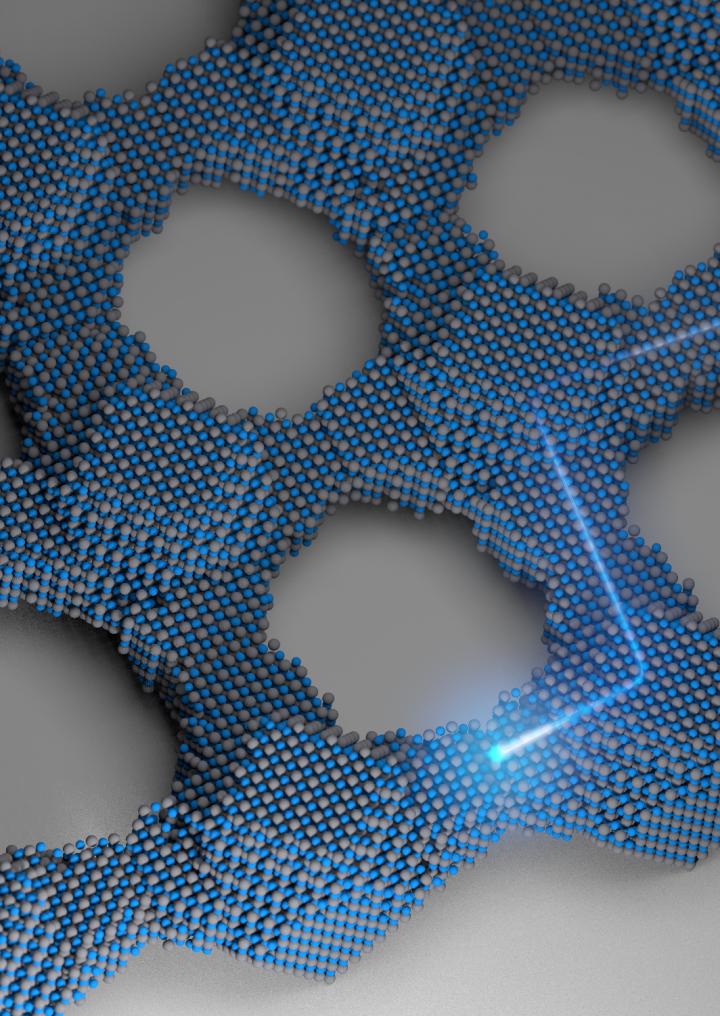
Connecting the dots: Playing ‘LEGO’ at the atomic scale to build atomically coherent quantum dot solids (credit: Kevin Whitham, Cornell University)

Just as the single-crystal silicon wafer forever changed the nature of communication 60 years ago, Cornell researchers hope their work with quantum dot solids — crystals made out of crystals — can help usher in a new era in electronics.

The team has fashioned two-dimensional superstructures out of single-crystal building blocks. Using a pair of chemical processes, the lead-selenium nanocrystals are synthesized into larger crystals, then fused together to form atomically coherent square superlattices.

http://www.cornell.edu/video/quantum-dot-solids/embed
Cornell University | Quantum dot solids

The difference between these and previous crystalline structures is the atomic coherence of each 5-nanometer crystal (a nanometer is one-billionth of a meter). They’re not connected by a substance between each crystal — they’re connected to each other directly. The electrical properties of these superstructures are potentially superior to existing semiconductor nanocrystals, with anticipated applications in energy absorption and light emission.

“As far as level of perfection, in terms of making the building blocks and connecting them into these superstructures, that is probably as far as you can push it,” said Tobias Hanrath, associate professor in the Robert Frederick Smith School of Chemical and Biomolecular Engineering, referring to the atomic-scale precision of the process.

The Hanrath group’s paper, “Charge transport and localization in atomically coherent quantum dot solids,” is published in this month’s issue of Nature Materials.

The strong coupling of the nanocrystals leads to formation of energy bands that can be manipulated based on the crystals’ makeup, and could be the first step toward discovering and developing other artificial materials with controllable electronic structure.

The structure of the Hanrath group’s superlattice, while superior to ligand-connected nanocrystal solids, still has multiple sources of disorder due to the fact that all nanocrystals are not identical. This creates defects, which limit electron wave function.

This work made use of the Cornell Center for Materials Research, which is supported by the National Science Foundation through its Materials Research Science and Engineering Center program. X-ray scattering was conducted at the Cornell High Energy Synchrotron Source, which is supported by the NSF and the National Institutes of Health.


Abstract of Charge transport and localization in atomically coherent quantum dot solids

Epitaxial attachment of quantum dots into ordered superlattices enables the synthesis of quasi-two-dimensional materials that theoretically exhibit features such as Dirac cones and topological states, and have major potential for unprecedented optoelectronic devices. Initial studies found that disorder in these structures causes localization of electrons within a few lattice constants, and highlight the critical need for precise structural characterization and systematic assessment of the effects of disorder on transport. Here we fabricated superlattices with the quantum dots registered to within a single atomic bond length (limited by the polydispersity of the quantum dot building blocks), but missing a fraction (20%) of the epitaxial connections. Calculations of the electronic structure including the measured disorder account for the electron localization inferred from transport measurements. The calculations also show that improvement of the epitaxial connections will lead to completely delocalized electrons and may enable the observation of the remarkable properties predicted for these materials.

http://www.kurzweilai.net/study-finds-only-a-small-portion-of-synapses-may-be-active-during-neurotransmission

The case of the silent synapses: Why are only 20% of synapses active during neurotransmission?

Unknown information coding in the brain?
February 26, 2016
[+]

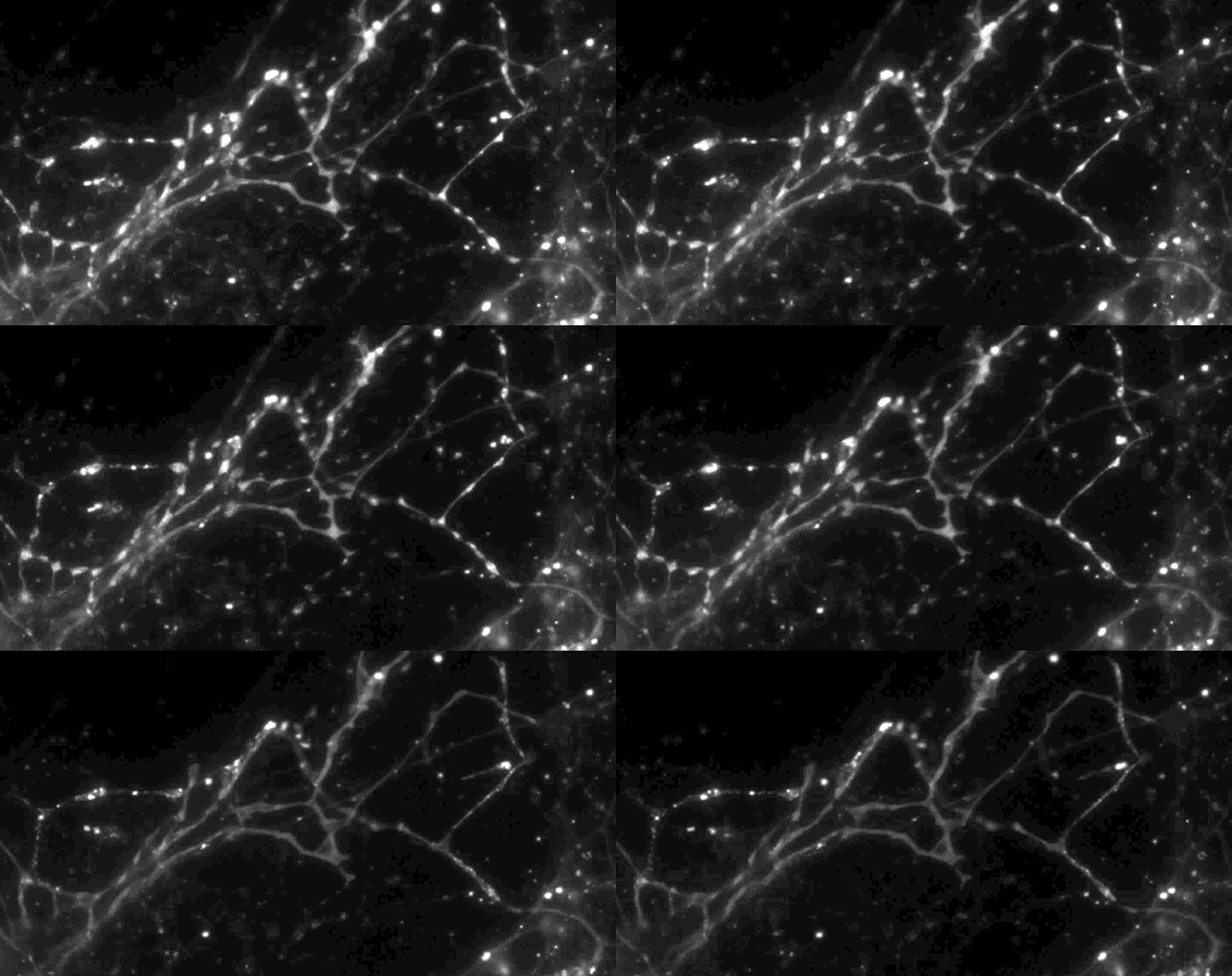
Using a fluorescent molecule to track neurotransmission of dopamine in mouse synapses, scientists made a puzzling discovery. … (credit: Sulzer Lab/Columbia University Medical Center)

Columbia University scientists tested a new optical technique to study how information is transmitted in the brains of mice and made a surprising discovery: When stimulated electrically to release dopamine (a neurotransmitter or chemical released by neurons (nerve cells) to send signals to other nerve cells), only about 20 percent of synapses — the connections between cells that control brain activity — were active at any given time.

The effect had never been noticed. “Older techniques only revealed what was going on in large groups of synapses,” explained David Sulzer, PhD, professor of neurobiology in Psychiatry, Neurology, and Pharmacology at Columbia University Medical Center (CUMC). “We needed a way to observe the neurotransmitter activity of individual synapses, to help us better understand their intricate behavior.”

So Sulzer’s had team turned to Dalibor Sames, PhD, associate professor of chemistry at Columbia, to develop a novel compound called “fluorescent false neurotransmitter 200″ (FFN200). When added to brain tissue or nerve cells from mice, FFN200 mimicked the brain’s natural neurotransmitters, allowing the researchers to spy on chemical messaging in action in complex tasks such as learning and memory.

[+]

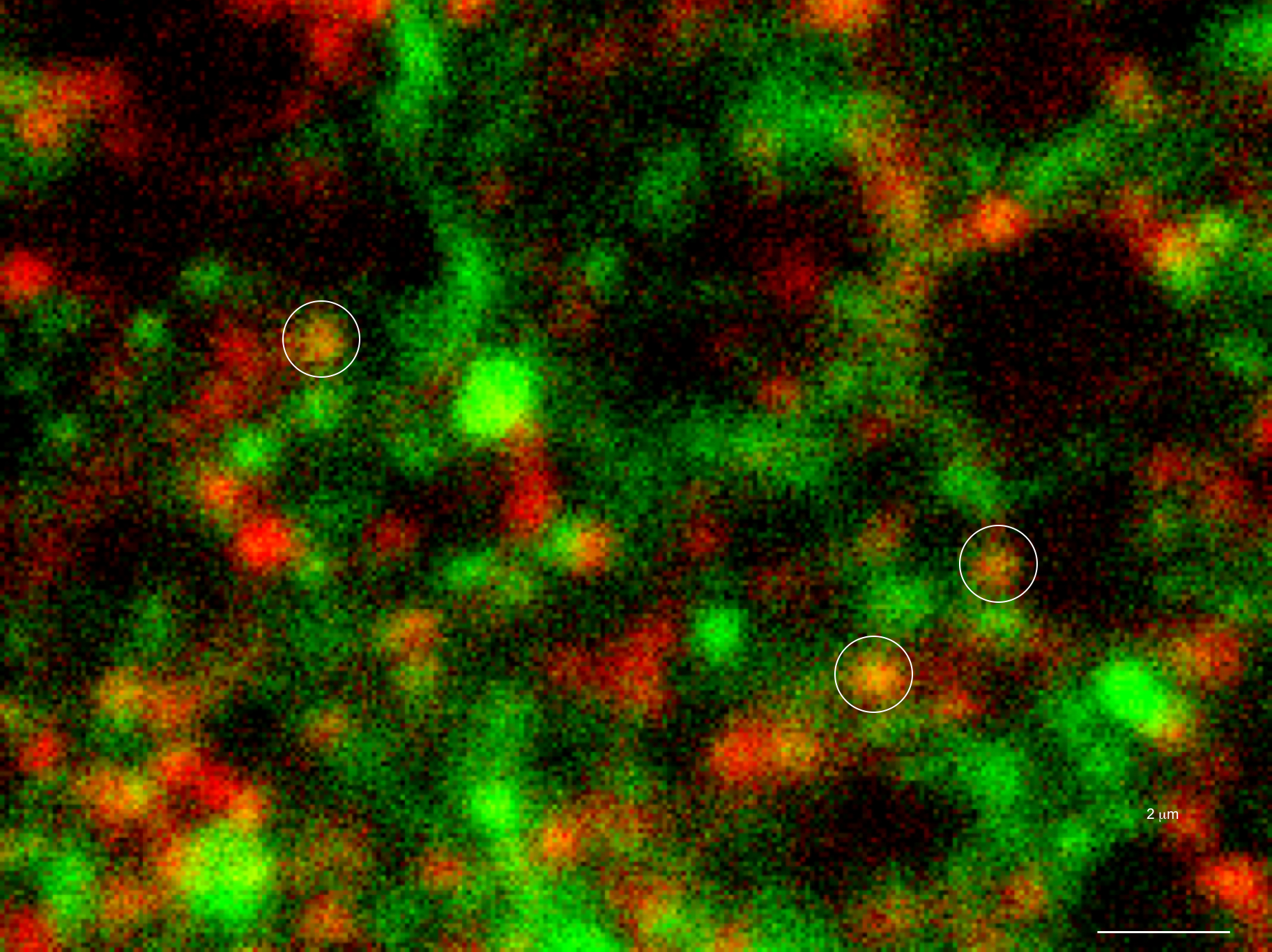
Only 20% of synapses (red) were observed to transmit dopamine. The rest (green) were found to be silent. (credit: Sulzer Lab/Columbia University Medical Center)

Silent synapses: unknown information coding?

Using a fluorescence microscope, the researchers were able for the first time to view the release and re-uptake of dopamine — a neurotransmitter involved in motor learning, habit formation, and reward-seeking behavior — in individual synapses. When all the neurons were electrically stimulated in a sample of brain tissue, the researchers expected all the synapses to release dopamine.

Instead, they found that less than 20 percent of dopaminergic synapses were active following a pulse of electricity. One possibility: these silent synapses hint at a mechanism of information coding in the brain that’s yet to be revealed, the researchers hypthesize.

The study’s authors plan to pursue that hypothesis in future experiments and examine how other neurotransmitters behave. “If we can work this out, we may learn a lot more about how alterations in dopamine levels are involved in brain disorders such as Parkinson’s disease, addiction, and schizophrenia,” Sulzer said.

The study was published in the latest issue of Nature Neuroscience.

The authors note in the paper that “the state of silent vesicle clusters may be important in disorders such as schizophrenia, which show striatal hyperdopaminergia [excessive release of dopamine in the brain’s reward center] and cortical hypodopaminergia [low amounts of dopamine in the cortex] and processes of  ‘unsilencing’ may have clinical applications for diseases such as Parkinson’s disease.”


Columbia Medical | Study Finds Only a Small Portion of Synapses May Be Active During Neurotransmission


Abstract of Fluorescent false neurotransmitter reveals functionally silent dopamine vesicle clusters in the striatum

Neurotransmission at dopaminergic synapses has been studied with techniques that provide high temporal resolution, but cannot resolve individual synapses. To elucidate the spatial dynamics and heterogeneity of individual dopamine boutons, we developed fluorescent false neurotransmitter 200 (FFN200), a vesicular monoamine transporter 2 (VMAT2) substrate that selectively traces monoamine exocytosis in both neuronal cell culture and brain tissue. By monitoring electrically evoked Ca2+ transients with GCaMP3 and FFN200 release simultaneously, we found that only a small fraction of dopamine boutons that exhibited Ca2+ influx engaged in exocytosis, a result confirmed with activity-dependent loading of the endocytic probe FM1-43. Thus, only a low fraction of striatal dopamine axonal sites with uptake-competent VMAT2 vesicles are capable of transmitter release. This is consistent with the presence of functionally ‘silent’ dopamine vesicle clusters and represents, to the best of our knowledge, the first report suggestive of presynaptically silent neuromodulatory synapses.

http://www.nanowerk.com/nanotechnology-news/newsid=42709.php

Artificial control of exciplexes opens possibilities for new electronics

(Nanowerk News) Demonstrating a strategy that could form the basis for a new class of electronic devices with uniquely tunable properties, researchers at Kyushu University were able to widely vary the emission color and efficiency of organic light-emitting diodes based on exciplexes simply by changing the distance between key molecules in the devices by a few nanometers. This new way to control electrical properties by slightly changing the device thickness instead of the materials could lead to new kinds of organic electronic devices with switching behavior or light emission that reacts to external factors.

Organic electronic devices such as OLEDs and organic solar cells use thin films of organic molecules for the electrically active materials, making flexible and low-cost devices possible.
A key factor determining the properties of organic devices is the behavior of packets of electrical energy called excitons. An exciton consists of a negative electron attracted to a positive hole, which can be thought of as a missing electron.
In OLEDs, the energy in these excitons is released as light when the electron loses energy and fills the vacancy of the hole. Varying the exciton energy, for example, will change the emission color.
However, excitons are commonly localized on a single organic molecule and tightly bound with binding energies of about 0.5 eV. Thus, entirely new molecules must usually be designed and synthesized to obtain different properties from these Frenkel-type excitons, such as red, green, or blue emission for displays.
Researchers at Kyushu University’s Center for Organic Photonics and Electronics Research (OPERA) instead focused on a different type of exciton called an exciplex, which is formed by a hole and electron located on two different molecules instead of the same molecule.
By manipulating the molecular distance between the electron-donating molecule (donor) and the electron-accepting molecule (acceptor) that carry the exciplex’s hole and electron, respectively, the researchers could modify the properties of these weakly bound excitons.
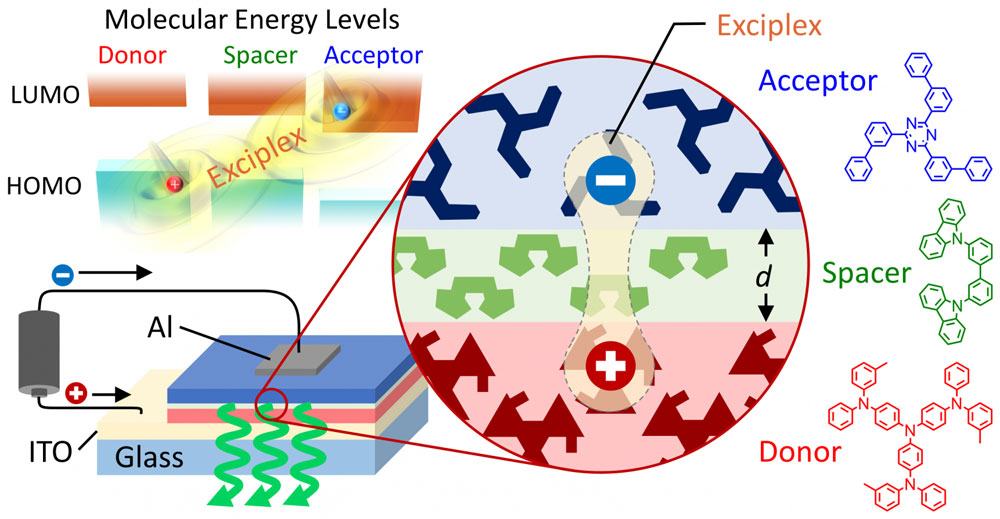
basic structure of an exciplex-based OLED with emission color and efficiency that can be controlled simply by changing the spacer thickness
This schematic shows the basic structure of an exciplex-based OLED with emission color and efficiency that can be controlled simply by changing the spacer thickness. An exciplex forms when a hole in the highest occupied molecular orbital (HOMO) of a donor molecule is attracted to an electron in the lowest unoccupied molecular orbital (LUMO) of an acceptor molecule. Light is emitted when the electron releases energy as light and transfers across the spacer layer to the donor molecule, thus replacing the missing electron represented by the hole. The thickness of the spacer can be used to modify the attraction between the hole and electron and tune the exciplex energy. Without changing any of the molecules, emission color could be varied from orange to yellowish green and the efficiency enhanced eight fold by increasing the spacer thickness to 5 nm. (click on image to enlarge)
“What we did is similar to placing sheets of paper between a magnet and a refrigerator,” said Associate Professor Hajime Nakanotani, lead author of the paper reporting these results published online February 26, 2016, in the journal Science Advances (“Long-range coupling of electron-hole pairs in spatially separated organic donor-acceptor layers”).
“By increasing the thickness of an extremely thin layer of organic molecules inserted as a spacer between the donor and acceptor, we could reduce the attraction between the hole and electron in the exciplex and thereby greatly influence the exciplex’s energy, lifetime, and emission color and efficiency.”
Indeed, the changes can be large: by inserting a spacer layer with a thickness of only 5 nm between a donor layer and an acceptor layer in an OLED, the emission color shifted from orange to yellowish green and the light emission efficiency increased 700%.
For this to work, the organic molecule used for the spacer layer must have an excitation energy higher than those of the donor and acceptor, but such materials are already widely available.
While the molecular distance is currently determined by the thickness of the vacuum-deposited spacer layer, the researchers are now looking into other ways to control the distance.
“This gives us a powerful way to greatly vary device properties without redesigning or changing any of the materials,” said Professor Chihaya Adachi, director of OPERA. “In the future, we envision new types of exciton-based devices that respond to external forces like pressure to control the distance and electrical behavior.”
In addition, the researchers found that the exciplexes were still formed when the spacer was 10 nm thick, which is long on a molecular scale.
“This is some of the first evidence that electrons and holes could still interact like this across such a long distance,” commented Professor Adachi, “so this structure may also be a useful tool for studying and understanding the physics of excitons to design better OLEDs and organic solar cells in the future.”
“From both scientific and applications standpoints, we are excited to see where this new path for exciton engineering takes us and hope to establish a new category of exciton-based electronics.”
Source: Kyushu University

Read more: Artificial control of exciplexes opens possibilities for new electronics

http://zeenews.india.com/news/space/see-pic-nasas-hubble-spots-blue-bubble-encircling-wolf-rayet-star_1859965.html

See pic: NASA's Hubble spots blue bubble encircling Wolf-Rayet star!

See pic: NASA’s Hubble spots blue bubble encircling Wolf-Rayet star!

Many Hubble observations have led to breakthroughs in astrophysics, such as accurately determining the rate of expansion of the universe.

Object located around black hole 5bn light-years from earth measured

Object located around black hole 5bn light-years from earth measured

It’s the most accurate measure achieved until now of such a small and distant object, and it has been achieved thanks to the so-called gravitational microlensing effect, caused by stars belonging to a galaxy between us and the quasar, and which may magnify tiny regions within the quasar.

See pic: NASA's Mars rover Opportunity scales challenging terrains!

See pic: NASA’s Mars rover Opportunity scales challenging terrains!

Opportunity is NASA’s senior rover, which has been on Mars for 12 years now.

See pic: NASA's New Horizons captures image of Pluto's North Pole!

See pic: NASA’s New Horizons captures image of Pluto’s North Pole!

In another image beamed back to NASA, New Horizons gives us another proof of Pluto’s diversity in terms of its geological and compositional features, this time in an enhanced color image of the north polar area.

Space mission: India, US explore collaboration avenues

Space mission: India, US explore collaboration avenues

The Mars Working Group of the two countries, which met Thursday, sought to identify and implement goals that NASA and ISRO share on Mars exploration.

Milky Way's cold clouds shine in new in-depth cosmic map

Milky Way’s cold clouds shine in new in-depth cosmic map

The new ATLASGAL maps cover an area of sky 140 degrees long and 3 degrees wide, more than four times larger than the first ATLASGAL release.

Watch: Tim Peake chased by a gorilla in space! Really?

Watch: Tim Peake chased by a gorilla in space! Really?

The video shows British astronaut Tim Peake being chased around the International Space Station by a gorilla.

NASA to air live coverage of Scott Kelly's and Mikhail Kornienko's return to Earth!

NASA to air live coverage of Scott Kelly’s and Mikhail Kornienko’s return to Earth!

As per the schedule, NASA Television coverage will begin at 3:10 p.m. EST on Monday, Feb. 29, when Kelly hands over command of the station to fellow NASA astronaut Tim Kopra.

Check out Tim Peake's amazing photo of glowing aurora taken from space station!

Check out Tim Peake’s amazing photo of glowing aurora taken from space station!

Peake captured this remarkable scene of the aurora on February 23, 2016.

See pic - Patagonia's shrinking ice fields seen from space!

See pic – Patagonia’s shrinking ice fields seen from space!

The image, acquired by the satellite’s Operational Land Imager (OLI) on January 14, 2015, shows the glaciers of Sierra de Sangra, an icy stratovolcano spanning the border of Chile and Argentina.

LIGO's twin black holes may have been born inside single star

LIGO’s twin black holes may have been born inside single star

On September 14 last year, the Laser LIGO in the US detected gravitational waves from the merger of two black holes 29 and 36 times the mass of the Sun.

NASA asks people to help its humanoid robot see better

NASA asks people to help its humanoid robot see better

Existing algorithms assume that high-resolution images are always available but new algorithms are needed that can determine differences in objects based on noisy, stereo vision data.

NASA's #YearInSpace mission: Eight things to know!

NASA’s #YearInSpace mission: Eight things to know!

The space mission has been a huge help to US space agency NASA, in terms of research and findings.

Revealed: The truth behind Apollo 10's mysterious 'space music'

Revealed: The truth behind Apollo 10’s mysterious ‘space music’

The three astronauts – Thomas Stafford, John Young and Eugene Cernan, recorded the sounds, which they described as “outer space type” music.

NASA astronaut coming back to Earth but efforts on to reach Mars

NASA astronaut coming back to Earth but efforts on to reach Mars

This new field of study, akin to personalised medicine, produces so much information and data to analyse that it’s hard to imagine.

NASA working on laser technology that could send humans to Mars in 3 days!

NASA working on laser technology that could send humans to Mars in 3 days!

NASA scientists are currently working on a new laser technology that can take humans to Mars in flat three days.

See pic - Hubble spots a diamond in the dust!

See pic – Hubble spots a diamond in the dust!

The image shows the star illuminating a wispy reflection nebula known as IRAS 00044+6521.

NASA's 'flying' telescope begins studying asteroids, stars

NASA’s ‘flying’ telescope begins studying asteroids, stars

SOFIA’s instruments observe infrared energy – one part of the electromagnetic spectrum which includes visible light, x-rays, radio waves and others.

X-ray observatory launched by Japan to study deep space

X-ray observatory launched by Japan to study deep space

The satellite has been released from the upper stage of the H-2A rocket to begin a three-year mission.

Earth is special, indeed

Earth is special, indeed

The team discovered that if you bring the model forward 13.8 billion, none of the known 700 quintillion possible planets look like Earth.

NASA receives record number of applications for astronauts

NASA receives record number of applications for astronauts

NASA hopes to announce its selections in mid-2017.

Space lover? NASA's asking for your artwork to be sent to an asteroid!

Space lover? NASA’s asking for your artwork to be sent to an asteroid!

This US mission includes collecting a sample of an asteroid and return it to Earth for study and it will be the first of its kind.

See pic - Jarosite in the Noctis Labyrinthus region of Mars!

See pic – Jarosite in the Noctis Labyrinthus region of Mars!

The image was acquired on November 24, 2015 by the High Resolution Imaging Science Experiment (HiRISE) camera aboard NASA’s Mars Reconnaissance Orbiter.

NASA sees record number of astronaut applications

NASA sees record number of astronaut applications

The number of applications for a spot in NASA’s 2017 class is almost triple the amount that came in during the last recruitment call for the 2012 class.

Watch: NASA to keep an eye on the universe through its latest telescope!

Watch: NASA to keep an eye on the universe through its latest telescope!

Slated to be launched in the mid-2020s, the observatory will also discover new worlds outside our solar system and advance the search for worlds that could be suitable for life.

Do aliens exist? UK to disclose secret UFO files in March this year

Do aliens exist? UK to disclose secret UFO files in March this year

The UK government is all set to release shocking evidence of alien contact, when 18 classified files will be released in March 2016.

NASA's Hubble directly measures rotation of cloudy 'super-Jupiter

NASA’s Hubble directly measures rotation of cloudy ‘super-Jupiter

The planet, called 2M1207b, is about four times more massive than Jupiter and is dubbed a “super-Jupiter.”

Pluto's moon Charon may have had subsurface ocean

Pluto’s moon Charon may have had subsurface ocean

Images from New Horizons suggest Pluto’s moon Charon may have had an ancient ocean.

Gravitational waves: World's third LIGO facility to be built in India!

Gravitational waves: World’s third LIGO facility to be built in India!

The proposal, known as LIGO-India project (Laser Interferometer Gravitational-wave Observatory in India), is piloted by Department of Atomic Energy and Department of Science and Technology (DST).

http://www.kurzweilai.net/rapidly-building-artificial-arteries-for-testing-drugs

Rapidly building artificial arteries for testing drugs

Could also help research in creating replacement arteries for patients
February 27, 2016
[+]

The muscle layer of the engineered human arteries function well. After just one week, the arteries contain two types of proteins important for muscle contraction — actin (stained red, left) and calponin (stained red, right). These two protein molecules allow the arteries to contract and dilate in response to environmental stimuli. (credit: George Truskey Lab, Duke University)

Duke University researchers have developed a rapid new technique for making small-scale artificial human arteries for use in a system for testing drugs — one that is more accurate and reliable than using animal models. That means promising drugs could be better tested before entering human trials.

The new technique produces the artificial arteries ten times faster than current methods and the arteries are functional.

Arterial blood vessel walls have multiple layers of cells, including the endothelium and media. The endothelium is the innermost lining that interacts with circulating blood. The media is made mostly of smooth muscle cells that help control the flow of blood and blood pressure. These two layers communicate and control how blood vessels react to stimuli such as drugs and exercise. (credit: Wikimedia Commons)

The researchers successfully engineered artificial arteries containing the lining (endothelium) and muscle (media) layers of arteries. They also showed that both layers could communicate and function normally.

“We wanted to focus on arteries because that’s where most of the damage is caused in coronary diseases,” said George Truskey, senior author, Professor of Biomedical Engineering and Dean of the Pratt School of Engineeringat Duke University.

 How to create an artificial artery

To rapidly construct strong human artificial arteries, cells were embedded in collagen gels (top) and then more than 90 per cent of the water was removed (bottom). These arteries were prepared in only three hours. The mechanical strength of these engineered arteries means researchers no longer need to wait six to eight weeks for the tissues to mature. (credit: George Truskey Lab, Duke University)

Graduate student Cristina Fernandez developed the technique to create arteries; but instead of full-size arteries, they were scaled down to one-tenth the size of a typical human artery. With this smaller diameter, the researchers were able to make a lot of these artificial vessels in a short amount of time and use them in experiments in just a few hours, instead of spending several weeks developing each one.

Despite the smaller size, these engineered arteries behaved normally, with statin drugs blocking inflammation just as they do in patients. The endothelial cells also released chemical signals to relax and constrict the media layer, again just like they do in the normal human body.

“Many of the [previous] techniques for creating artificial tissue also were rather lengthy, which was frustrating,” said Truskey. The previous studies also focused on the media cells rather than the endothelial cells, and “nobody had shown how the two would interact,” he added.

 Replacing arteries in patients

“While our arteries are small and intended for testing, they’re just as mechanically strong as those intended to be put inside of the body,” said Truskey. “So the technique could be beneficial to researchers trying to create artificial arteries to replace damaged ones in patients as well.” The arteries could also be used to look at how some select rare genetic diseases affect arteries, he added.

The study was reported online (open access) in Nature Scientific Reports. The work was supported by the National Institutes of Health and the American Heart Association.


Abstract of Human Vascular Microphysiological System for in vitro Drug Screening

In vitro human tissue engineered human blood vessels (TEBV) that exhibit vasoactivity can be used to test human toxicity of pharmaceutical drug candidates prior to pre-clinical animal studies. TEBVs with 400–800 μM diameters were made by embedding human neonatal dermal fibroblasts or human bone marrow-derived mesenchymal stem cells in dense collagen gel. TEBVs were mechanically strong enough to allow endothelialization and perfusion at physiological shear stresses within 3 hours after fabrication. After 1 week of perfusion, TEBVs exhibited endothelial release of nitric oxide, phenylephrine-induced vasoconstriction, and acetylcholine-induced vasodilation, all of which were maintained up to 5 weeks in culture. Vasodilation was blocked with the addition of the nitric oxide synthase inhibitor L-NG-Nitroarginine methyl ester (L-NAME). TEBVs elicited reversible activation to acute inflammatory stimulation by TNF-α which had a transient effect upon acetylcholine-induced relaxation, and exhibited dose-dependent vasodilation in response to caffeine and theophylline. Treatment of TEBVs with 1 μM lovastatin for three days prior to addition of Tumor necrosis factor – α (TNF-α) blocked the injury response and maintained vasodilation. These results indicate the potential to develop a rapidly-producible, endothelialized TEBV for microphysiological systems capable of producing physiological responses to both pharmaceutical and immunological stimuli.

http://blog.wolfram.com/2016/02/26/academy-award-winning-interstellar-visuals-prototyped-with-the-wolfram-language/

Emily Suess

Academy Award-Winning Interstellar Visuals Prototyped with the Wolfram Language

February 26, 2016 — Emily Suess, Technical Writer, Technical Communications and Strategy Group

Kip Thorne, physicist, New York Times bestselling author, and professor emeritus at Caltech, ignited fans’ passion for science through his work on the movie Interstellar. The sci-fi adventure won the 2015 Academy Award for Best Visual Effects, and the first cuts of some of those stunning visuals were created with Mathematica and the Wolfram Language.

“Mathematica was my way of testing whether or not I had the equations right,” says Thorne, whose computational approach to producing images led to publication in the American Journal of Physics and Classical and Quantum Gravity.

Gravitational lensing of the Prawn Nebula by a black hole
Gravitational lensing of the Prawn Nebula by a black hole, computed with Mathematica by Kip Thorne. Photograph of unlensed Prawn Nebula by Martin Pugh.

Thorne has a history with Wolfram technologies that reaches beyond Interstellar. During his early career, he did all his programming in Fortran. But when Mathematica came along, he quickly switched over. By the 1990s, Mathematica was his go-to tool for numerical work and manipulations.

He also used Mathematica to help generate many of the illustrations in his book, The Science of Interstellar. Written for a general audience, the book contains more than 50 illustrations generated with the assistance of Mathematica. It spent five weeks on the New York Times Best Seller list and piqued moviegoers’ interest in science and physics.

For more on this story, read Creating Academy Award-Winning Visuals Starts with Mathematica and the Wolfram Language.

http://www.fastcompany.com/3057146/can-googles-deepmind-help-fix-a-broken-healthcare-system

Can Google’s DeepMind Help Fix A Broken Health Care System?
Though it’s promising, some experts say that artificial intelligence won’t be more than just a Band-Aid.
[Photo: Flickr user NIH Image Gallery/Clinical Center, National Institutes of Health]
CHRISTINA FARR 02.25.16 12:45 PM
Google wants to put its artificial intelligence technology to use in top hospitals. Earlier this week, the search giant announced it would work with the U.K.’s National Health Service, or NHS, to alert staff to patients at risk of serious complications due to kidney failure.

Details about the technology are fairly thin on the ground at this stage. But it is known that Google DeepMind recently acquired an app called Hark, which is a task management app that aims to replace paper-based systems and pagers. Hark was developed over four years by a team at Imperial College London, which is one of the U.K.’s top medical schools. That effort was led by Ara Darzi, a high-profile surgeon who who runs Imperial’s Institute of Global Health Innovation.

“The app is quite a good one,” says Cosima Gretton, a junior doctor with the NHS in London, who spoke to Fast Company via Skype. “If a patient is in trouble, the nurse will message the doctor on Hark and indicate the level of priority.” The initial focus for the app is acute kidney injuries.
Hark App
Hark, which has been piloted at Imperial College’s hospitals, has been used by doctors to prioritize tasks and communicate with nurses. For the time being, Hark doesn’t leverage artificial intelligence to predict which patients are most likely to get seriously ill and determine the best course of action. But Mustafa Suleyman, cofounder and head of applied artificial intelligence at DeepMind, told the Guardian “that may change in the future.”

But some health experts fear that this kind of technology is just putting a Band-Aid on a broken system. The NHS is facing myriad problems with its IT systems compounded by a string of failed software investments.

“Some people have this utopian plan that you can sprinkle some AI on a broken health system and make things better,” says Jordan Shlain, a Bay Area-based doctor and entrepreneur who has advised the NHS.

Moreover, as Shlain points out, it will be a challenge for this technology to scale to other NHS hospitals. Gretton agrees: Each individual hospital has control over the kind of software they buy, she says, and these contracts often last 10 or 15 years. In Gretton’s hospital alone, there are 19 different systems that don’t communicate with each other.

But in the future, she says, it’s a “powerful offer” if Google DeepMind can help existing software communicate and incorporate basic artificial intelligence, that may have a real impact on improving patient safety.

http://www.kurzweilai.net/a-magic-wand-to-simplify-network-setup-and-improve-security

A ‘magic wand’ to simplify network setup and improve security

February 24, 2016

Dartmouth College Professor David Kotz demonstrates a commercial prototype of “Wanda” imparting information such as the network name and password of a WiFi access point onto a blood pressure monitor (credit: Dartmouth College)

Ever just want to wave a magic wand instead of dealing with a complex home network setup?

Well, Dartmouth College computer science professor David Kotz has figured out how to do just that. Called “Wanda,” it’s a small rod that makes it simple to link a new device (such as a blood-pressure meter or smartphone) to a WiFi network by just pointing the rod at the device.

The system is part of a National Science Foundation-funded project led by Dartmouth called “Trustworthy Health and Wellness” aimed at protecting patients and their confidentiality as medical records move from paper to electronic form and as health care increasingly moves out of doctors’ offices and hospitals and into the home.

Kotz says wireless and mobile health technologies have great potential to improve quality and access to care, reduce costs and improve health, “but these new technologies, whether in the form of software for smartphones or specialized devices to be worn, carried or applied as needed, also pose risks if they’re not designed or configured with security and privacy in mind.”

Setting up a secure network at home

Most people don’t know how to set up and maintain a secure network in their home, which can lead to compromised or stolen data or potentially allow hackers access to critical devices such as heart rate monitors or dialysis machines.

There are three basic operations when bringing a new mobile device into the home, workplace or clinic: configure the device to join the wireless local-area network (such as enter a Wi-Fi SSID and password); partner the device with other nearby devices so they can work together; and configure the device so it connects to the relevant individual or organizational account in the cloud.

“Wanda” is a small hardware device with two antennas. To add a new device to their home (or clinic) Wi-Fi network, users simply pull the wand from a USB port on the Wi-Fi access point, carry it close to the new device, and point it at the device. Within a few seconds, the wand securely beams the secret Wi-Fi network information to the device.*

The same method can be used to transfer any information from the wand to the new device without anyone nearby capturing the secrets or tampering with the information.

Kotz says the technology could be useful for a wide range of device management tasks and in a wide variety of applications in addition to healthcare.

Supported by a $10-million, five-year grant from the NSF’s Secure and Trustworthy Cyberspace program, the Frontier-scale project includes experts in computer science, business, behavioral health, health policy and healthcare information technology at Dartmouth College, Johns Hopkins University, the University of Illinois Urbana-Champaign (UIUC), the University of Michigan and Vanderbilt University.

Wanda will be presented at the IEEE International Conference on Computer Communications in April.

* Wanda builds on pioneering work done by Cai et al. in  “Good neighbor: Ad hoc pairing of nearby wireless devices by multiple antennas” in NDSS, 2011). It determines when it is in close proximity to another transmitting device by measuring the difference in received  signal  strength on the  two antennas.


Abstract of Wanda: securely introducing mobile devices

Nearly every setting is increasingly populated with wireless and mobile devices – whether appliances in a home, medical devices in a health clinic, sensors in an industrial setting, or devices in an office or school. There are three fundamental operations when bringing a new device into any of these settings: (1) to configure the device to join the wireless local-area network, (2) to partner the device with other nearby devices so they can work together, and (3) to configure the device so it connects to the relevant individual or organizational account in the cloud. The challenge is to accomplish all three goals simply, securely, and consistent with user intent. We present a novel approach we call Wanda – a ‘magic wand’ that accomplishes all three of the above goals – and evaluate a prototype implementation.

references:

  • Timothy J. Pierson, Xiaohui Liang, Ronald Peterson, and David Kotz. Wanda: securely introducing mobile devices. Proceedings of IEEE International Conference on Computer Communications (INFOCOM), April, 2016. (In Press)

http://www.kurzweilai.net/new-electronic-stethoscope-and-app-diagnose-lung-conditions

New electronic stethoscope and app diagnose lung conditions

February 24, 2016
[+]

1. Electronic stethoscope records patient’s breathing. Lung sounds are sent to a phone or tablet and analyzed by an app. 3. Medical professionals can listen and see the results in real time from any location to diagnose the patient. (credit: Hiroshima University)

The traditional stethoscope has just been superseded by an electronic stethoscope and an app called Respiratory Sounds Visualizer, which can automatically classify lung sounds into five common diagnostic categories.* The system was developed by three physician researchers at Hiroshima University and Fukushima Medical University in collaboration with Pioneer Corporation.

The respiratory specialist doctors recorded and classified lung sounds of 878 patients, then turned these diagnoses into templates to create a mathematical formula that evaluates the length, frequency, and intensity of lung sounds. The resulting app can recognize the sound patterns consistent with five different respiratory diagnoses.

How the Respiratory Sounds Visualizer app works

Based on an analysis of the characteristics of respiratory sounds, the Respiratory Sounds Visualizer app generates this diagnostic chart. The total area in red represents the overall volume of sound, and the proportion of red around each line from the center to each vertex represents the proportion of the overall sound that each respiratory sound contributes. (credit: Shinichiro Ohshimo et al./Annals of Internal Medicine)

The app analyzes the lung sounds and maps them on a five-sided chart. Each of the five axes represents one of the five types of lung sounds. Doctors and patients can see the likely diagnosis based on the length of the axis covered in red.

A doctor working in less-than-ideal circumstances, such as a noisy emergency room or field hospital, could rely on the computer program to “hear” what they might otherwise miss, and the new system could help student doctors learn.

The results from the computer program are simple to interpret and can be saved and shared electronically. In the future, this convenience may allow patients to track and record their own lung function during chronic conditions, like chronic obstructive pulmonary disease (COPD) or cystic fibrosis.

“We plan to use the electronic stethoscope and Respiratory Sounds Visualizer with our own patients after further improving [the mathematical calculations]. We will also release the computer program as a downloadable application to the public in the near future,” said Shinichiro Ohshimo, MD, PhD, an emergency physician in the Department of Emergency and Critical Care Medicine at Hiroshima University Hospital and one of the researchers involved in developing the technology.

* Despite advances in technology, respiratory physiology still depends primarily on chest auscultation, [which is] subjective and requires sufficient training. In addition, identification of the five respiratory sounds specified by the International Lung Sounds Association is difficult because their frequencies overlap:The frequency of normal respiratory sound is 100 to 1000 Hz, wheeze is 100 to 5000 Hz, rhonchus is 150 Hz, coarse crackle is 350 Hz, and fine crackle is 650 Hz. — Shinichiro Ohshimo et al./Annals of Internal Medicine.

http://www.kurzweilai.net/regenerative-medicine-scientists-print-replacement-tissue

Regenerative medicine scientists ‘print’ replacement tissue

February 24, 2016
[+]

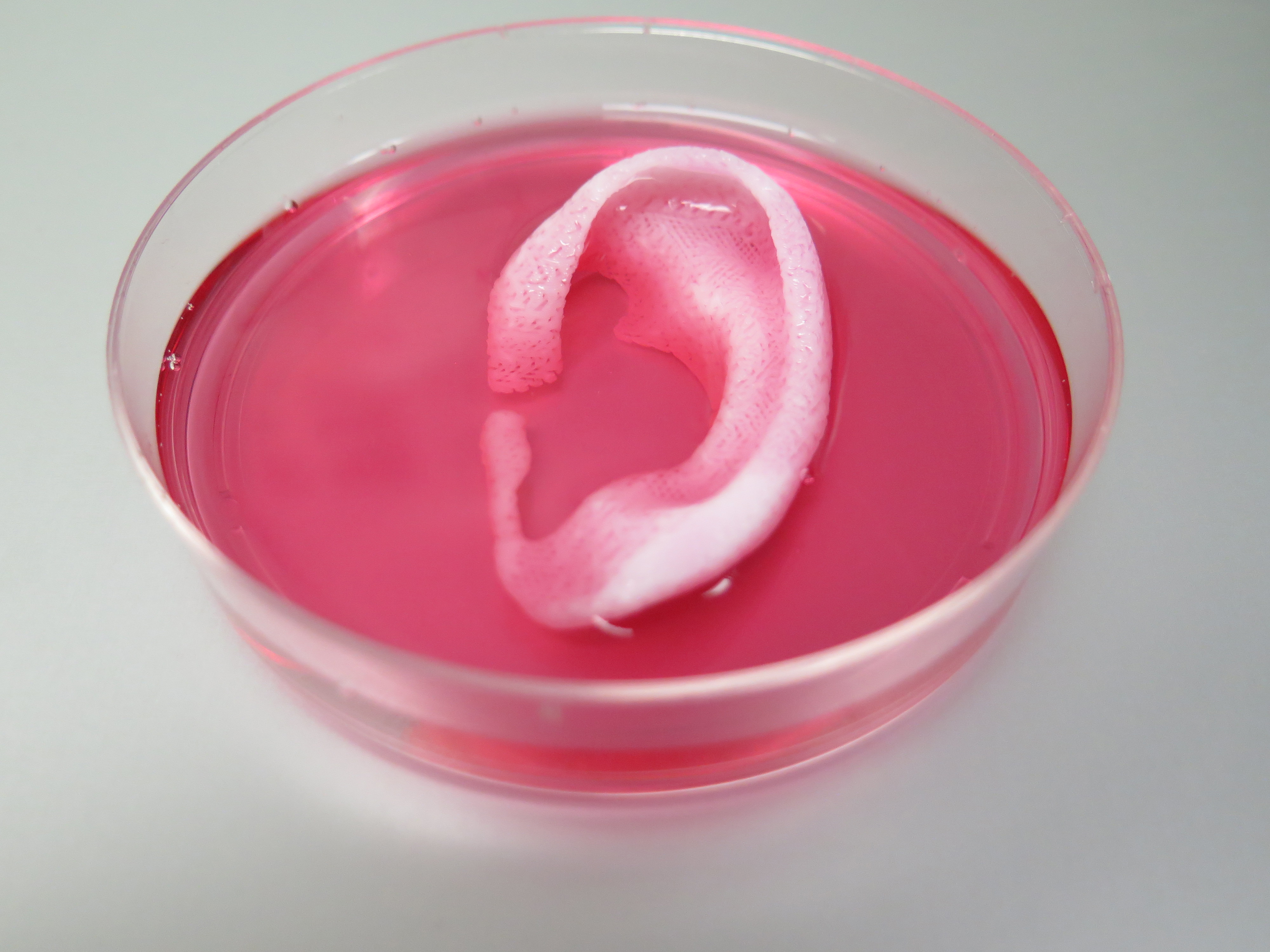
Completed ear and jaw bone structures printed with the Integrated Tissue-Organ Printing System (credit: Wake Forest Baptist Medical Center)

Using a sophisticated, custom-designed 3D printer, regenerative medicine scientists at Wake Forest Baptist Medical Center have proved that it is feasible to print living tissue structures to replace injured or diseased tissue in patients.

Reporting in Nature Biotechnology, the scientists said they printed ear, bone and muscle structures. When implanted in animals, the structures matured into functional tissue and developed a system of blood vessels. Most importantly, these early results indicate that the structures have the right size, strength and function for use in humans.

“This novel tissue and organ printer is an important advance in our quest to make replacement tissue for patients,” saidAnthony Atala, M.D., director of the Wake Forest Institute for Regenerative Medicine (WFIRM) and senior author on the study. “It can fabricate stable, human-scale tissue of any shape. With further development, this technology could potentially be used to print living tissue and organ structures for surgical implantation.”

With funding from the Armed Forces Institute of Regenerative Medicine, a federally funded effort to apply regenerative medicine to battlefield injuries, Atala’s team aims to implant bioprinted muscle, cartilage and bone in patients in the future.

Designing a 3D bioprinter

Tissue engineering is a science that aims to grow replacement tissues and organs in the laboratory to help solve the shortage of donated tissue available for transplants. The precision of 3D printing makes it a promising method for replicating the body’s complex tissues and organs. However, current printers based on jetting, extrusion and laser-induced forward transfer cannot produce structures with sufficient size or strength to implant in the body.

The Integrated Tissue and Organ Printing System (ITOP), developed over a 10-year period by scientists at the Institute for Regenerative Medicine, overcomes these challenges. The system deposits both bio-degradable, plastic-like materials to form the tissue “shape” and water-based gels that contain the cells. In addition, a strong, temporary outer structure is formed. The printing process does not harm the cells.*

A major challenge of tissue engineering is ensuring that implanted structures live long enough to integrate with the body. The Wake Forest Baptist scientists addressed this in two ways. They optimized the water-based “ink” that holds the cells so that it promotes cell health and growth and they printed a lattice of micro-channels throughout the structures. These channels allow nutrients and oxygen from the body to diffuse into the structures and keep them live while they develop a system of blood vessels.

It has been previously shown that tissue structures without ready-made blood vessels must be smaller than 200 microns (0.007 inches) for cells to survive. In these studies, a baby-sized ear structure (1.5 inches) survived and showed signs of vascularization at one and two months after implantation.

“Our results indicate that the bio-ink combination we used, combined with the micro-channels, provides the right environment to keep the cells alive and to support cell and tissue growth,” said Atala.

Another advantage of the ITOP system is its ability to use data from CT and MRI scans to “tailor-make” tissue for patients. For a patient missing an ear, for example, the system could print a matching structure.

The research was supported, in part, by grants from the Armed Forces Institute of Regenerative Medicine, the Telemedicine and Advanced Technology Research Center at the U.S. Army Medical Research and Material Command, and the Defense Threat Reduction Agency.

* Several proof-of-concept experiments demonstrated the capabilities of ITOP. To show that ITOP can generate complex 3D structures, printed, human-sized external ears were implanted under the skin of mice. Two months later, the shape of the implanted ear was well-maintained and cartilage tissue and blood vessels had formed.

To demonstrate the ITOP can generate organized soft tissue structures, printed muscle tissue was implanted in rats. After two weeks, tests confirmed that the muscle was robust enough to maintain its structural characteristics, become vascularized and induce nerve formation.

And, to show that construction of a human-sized bone structure, jaw bone fragments were printed using human stem cells. The fragments were the size and shape needed for facial reconstruction in humans. To study the maturation of bioprinted bone in the body, printed segments of skull bone were implanted in rats. After five months, the bioprinted structures had formed vascularized bone tissue.

Ongoing studies will measure longer-term outcomes.


Abstract of A 3D bioprinting system to produce human-scale tissue constructs with structural integrity

A challenge for tissue engineering is producing three-dimensional (3D), vascularized cellular constructs of clinically relevant size, shape and structural integrity. We present an integrated tissue–organ printer (ITOP) that can fabricate stable, human-scale tissue constructs of any shape. Mechanical stability is achieved by printing cell-laden hydrogels together with biodegradable polymers in integrated patterns and anchored on sacrificial hydrogels. The correct shape of the tissue construct is achieved by representing clinical imaging data as a computer model of the anatomical defect and translating the model into a program that controls the motions of the printer nozzles, which dispense cells to discrete locations. The incorporation of microchannels into the tissue constructs facilitates diffusion of nutrients to printed cells, thereby overcoming the diffusion limit of 100–200 μm for cell survival in engineered tissues. We demonstrate capabilities of the ITOP by fabricating mandible and calvarial bone, cartilage and skeletal muscle. Future development of the ITOP is being directed to the production of tissues for human applications and to the building of more complex tissues and solid organs.