http://www.metronews.ca/news/vancouver/2016/02/22/ubc-unveils-future-of-student-housing-140-sq-ft-nano-suites.html

UBC unveils future of student housing: 140-sq-ft nano suites

The plan for the pilot project is to build 70 of the micro suites in the Gage South Student Residence by 2019.

A mock up of the 140-square-foo nano suite proposed for UBC student residences.

COURTESY UBC

A mock up of the 140-square-foo nano suite proposed for UBC student residences.

The University of B.C. unveiled Monday the future of on-campus student housing: tiny 140-square-foot fully-furnished “nano” suites.

It’s roughly the size of an average parking stall but appears to be surprising liveable with a mini kitchen, double bed and small bathroom.

The plan for the pilot project is to build 70 of the micro suites in the Gage South Student Residence by 2019.

The suite features a desk that stows underneath the bed.

COURTESY UBC

The suite features a desk that stows underneath the bed.

The university came up with the idea to try to meet student demand for more affordable campus housing.

The nano suites are expected to rent for about $700 a month when ready for occupancy in 2019. That compares to current 230-sq.-ft. studio suites that will rent for about $1,100 in 2019.

The nano suites will have a double bed that folds up in six seconds to become a 21-sq-ft computer desk/study area. The desk remains level when the bed folds down, so you can leave a laptop on it without falling off.

“I would say the student feedback has been really positive,” Andrew Parr, managing director of UBC student housing, said Monday.

“There’s a huge demand for more housing on campus,” he said, adding there are currently more than 10,000 student beds on campus, with five new projects, including the micro suites, that will add another 2,000 beds.

The display unit is currently on display at the Nest, UBC's new student union building.

COURTESY UBC

The display unit is currently on display at the Nest, UBC’s new student union building.

The new residence building with the micro suites will be at the core of the campus, allowing a 10-minute walk to most classes on campus and three minutes to the swimming pool and fitness centre, Parr said.

Each nano suite will be wired with high-speed Internet but will not be furnished with TVs. Instead, TVs with basic cable will be located in common lounge areas on each floor.

There is currently a nano display unit in the Nest, the UBC student union building, to get feedback from students. A video tour of the suite is online here.

http://arstechnica.com/gadgets/2016/02/arms-cortex-a32-is-a-tiny-cpu-for-wearables-and-raspberry-pi-like-boards/

ARM’s Cortex A32 is a tiny CPU for wearables and Raspberry Pi-like boards

32-bit-only ARMv8 chip is designed to consume as little as 4mW of power.

ARM’s Cortex A32 is a tiny CPU for wearables and Raspberry Pi-like boards
32-bit-only ARMv8 chip is designed to consume as little as 4mW of power.

by Andrew Cunningham – Feb 22, 2016 4:01pm PST

ARM’s Cortex CPU core designs are widely used by all kinds of chipmakers who don’t want to create their own ARM CPU designs from scratch, so it’s important to pay attention when the company announces a new one. The ones we see the most often around here are the mainstream 64-bit cores for smartphones and tablets—the high-end Cortex A72 and A57 and the mid-end Cortex A53—but ARM produces a variety of smaller designs for ultra-low-power and embedded applications, too.

Enter the Cortex A32, a new super-small ARM core designed specifically for wearables, Internet of Things things, embedded systems, low-cost boards like the Raspberry Pi or Pi Zero, and other places where power, space, and cost savings are more important than raw performance. It uses the ARMv8 instruction set and is intended as a replacement for the older Cortex A7 and A5 architectures, both of which use the ARMv7 instruction set. However, the Cortex A32 can only run 32-bit code—to save space and power, the ability to run 64-bit code has been removed.

This is ARM’s first CPU with the ARMv8 instruction set that doesn’t include 64-bit support. So far, ARMv8 and 64-bit support have gone hand-in-hand. But the new instructions still give the A32 a good performance boost over the Cortex A5 and A7, particularly in cryptography performance. As we’ve seen in ARMv8-based smartphones, better cryptography performance can drastically reduce the performance hit you take when you encrypt a device’s storage. For people who still want 64-bit support, the Cortex A35 CPU core offers similar performance and 64-bit instructions in a slightly larger package (ARM says the A32 is about 10 percent faster than the A35 at 32-bit operations, though, so there’s a tradeoff either way).

ARM says the Cortex A32 is about 25 percent more efficient than the older Cortex A7 architecture, thanks to a combination of speed improvements and reductions in power consumption. Like other ARM designs, it’s also designed to be scalable—a 100MHz single-core version of the CPU can consume as little as 4mW of power, while a quad-core design at 1GHz can consume “less than 75mW per core” (or around 300mW in total).

http://www.kurzweilai.net/smart-skin-made-of-recyclable-materials-may-transform-medicine-and-robotics

Could ‘smart skin’ made of recyclable materials transform medicine and robotics?

How to create sophisticated sensors in your kitchen with aluminum foil, scotch tape, sticky-notes, napkins, and sponges and a $25 computer
February 19, 2016
[+]

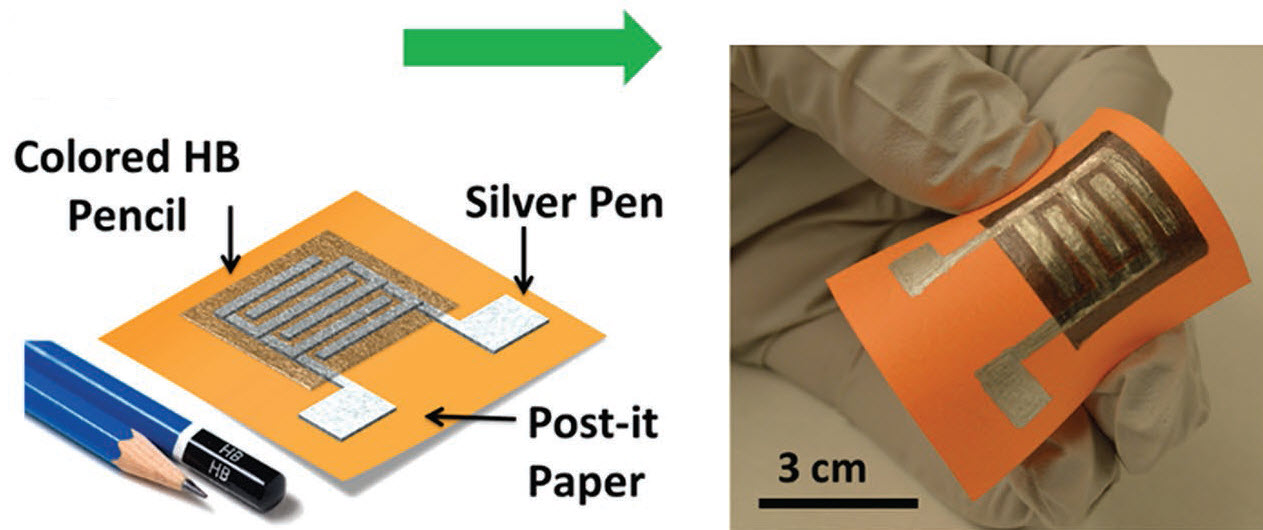
Capacitive-based disposable pH sensor. The silver pen could be replaced with aluminum foil. (credit: Joanna M. Nassar et al./Advanced Materials Technologies)

Here’s a challenge: using only low-cost materials available in your house (such as aluminum foil, pencil, scotch tape, sticky-notes, napkins, and sponges), build sensitive sensors (“smart skin”) for detecting temperature, humidity, pH, pressure, touch, flow, motion, and proximity (at a distance of 13 cm). Your sensors must show reliable and consistent results and be capable of connecting to low-cost, tiny computers such as Arduino and Raspberry Pi devices.

The goal here is to replace expensive manufacturing processes for creating paper-based sensors with a simple recyclable 3D stacked 6 × 6 “paper skin” array for simultaneous sensing, made solely from household resources, according to Muhammad Mustafa Hussain, senior author of an Advanced Materials Technologies journal open-access paper and professor at King Abdullah University of Science and Technology (KAUST) in Saudi Arabia.

How to create a temperature sensor

Schematic of temperature sensors using aluminum foil or silver ink pen (credit: Joanna M. Nassar/Advanced Materials Technologies)

Creating a highly sensitive temperature sensor requires just two things: a Post-It note and a piece of aluminum foil (a silver ink pen would be more sensitive).  A change of temperature would change the resistance of an aluminum strip. To measure the resistance change, connect the sensor to a highly sensitive ohmmeter, using an Arduino Uno, for example. (The output of the Arduino could trigger an alarm, for example.)

Arduino Uno and ohmmeter circuit. The sensor would replace the “resistor to be measured” in the schematic. The bottom resistor value would depend on the sensor resistance range. (credit: Adafruit and Learning About Electronics)

 Two designs for a simple pressure sensor

Two designs for a pressure sensor using a parallel-plate structure: (top) Microfiber wipe and sponge; (bottom) more sensitive air-gap structure with sponge. As applied pressure increases, the dielectric thickness decreases, increasing the output capacitance. To measure it, the aluminum foil is connected to a resistor–capacitor circuit (RC circuit), which is connected to an Arduino or Raspberry Pi device to calculate associated pressure change. (credit: Joanna M. Nassar et al./Advanced Materials Technologies)

The simple fabrication process and low-cost materials used “make this flexible platform the lowest cost and accessible to anyone, without affecting performance in terms of response and sensitivity,” Hussain says.

“Democratization of electronics will be key in the future for its continued growth. … This is the first time a [single] platform shows multi-sensory functionalities close to that of natural skin.”


Abstract of Paper Skin Multisensory Platform for Simultaneous Environmental Monitoring

Human skin and hair can simultaneously feel pressure, temperature, humidity, strain, and flow—great inspirations for applications such as artificial skins for burn and acid victims, robotics, and vehicular technology. Previous efforts in this direction use sophisticated materials or processes. Chemically functionalized, inkjet printed or vacuum-technology-processed papers albeit cheap have shown limited functionalities. Thus, performance and/or functionalities per cost have been limited. Here, a scalable “garage” fabrication approach is shown using off-the-shelf inexpensive household elements such as aluminum foil, scotch tapes, sticky-notes, napkins, and sponges to build “paper skin” with simultaneous real-time sensing capability of pressure, temperature, humidity, proximity, pH, and flow. Enabling the basic principles of porosity, adsorption, and dimensions of these materials, a fully functioning distributed sensor network platform is reported, which, for the first time, can sense the vitals of its carrier (body temperature, blood pressure, heart rate, and skin hydration) and the surrounding environment.

https://cosmosmagazine.com/physical-sciences/different-picture-quantum-surrealism

A different picture of quantum surrealism

New research supports an old, more intuitive theory of how sub-atomic particles behave. Cathal O’Connell explains.

With its ideas of particles zipping in and out of existence, quantum mechanics is probably the kookiest-sounding theory in science. And our understanding of it is little helped by the mysterious “probability fields” most physicists say dictate the zipping.

But a more intuitive picture may lie beneath. As new research demonstrates, beneath the shroud of probability, particles can in fact be viewed as behaving like billiard balls rolling along a table – although in surreal fashion.

The result helps resurrect an 80-year-old picture of quantum mechanics, and provides one of the most stirring demonstrations yet of an effect Einstein called “spooky action at a distance”.

The work, reported in Science Advances, is a new version of the most famous experiment in quantum mechanics, in which particles of light, called photons, are fired at two slits before being detected on a screen.

Hog-tied by Heisenberg’s uncertainty principle, for decades physicists thought they could never know which slit a particular photon went through – any attempted measurement stops it in its tracks.

But in 2011, physicist Aephraim Steinberg at the University of Toronto achieved the seemingly impossible by tracking the trajectories of photons using a series of “weak” measurements, gentle enough not to disturb their position.

This method showed trajectories that looked similar to classical ones – like those of balls flying through the air.

Although it was a seemingly outstanding result, some physicists were not convinced, highlighting the experiment’s inability to deal with “entanglement” (where two particles, in this case photons, are intimately connected so that measurement on one instantly affects the other, no matter how far away it is).

The critics pointed out that doing the same experiment with two entangled photons would lead to a contradiction – such as the photon’s trajectory being measured as going through the top slit, but the photon itself hitting the bottom of the detector (as if it came from the bottom slit). They coined the term “surreal trajectories” to describe this result.

Now Steinberg’s team has achieved the experiment for entangled photons, and shown how the surreal behaviour is caused by the “spooky” influence of the other particle.

The team team first entangled two photons, then sent one of the pair through the regular two-slit apparatus, and the other through an apparatus that monitored polarisation – the plane the light waves are travelling in.

Weirdly, the choice made by the experimenters in how to measure the polarisation determined which slit the first photon went through – as if interfering with one particle caused the other to change direction instantaneously.

This kind of bizarre phenomenon is exactly what Einstein had in mind when he dubbed it “spooky action”. Physicists have seen evidence of it before, but never in such a direct fashion.

The results bolster a non-standard interpretation of quantum mechanics, which throws out the notion of abstract probability fields altogether.

First put forward by Charles de Broglie in 1927, the interpretation treats quantum objects just like classical particles, but imagines them riding like a surfer on top of a so-called pilot wave.

The wave is still probabilistic, but the particle does take a real trajectory from source to target.

The new work does not disprove the standard “probabilistic” view of quantum mechanics, but it does highlight that the pilot-wave interpretation is perfectly valid too. That is “something that’s not recognised by a large part of the physics community”, says Howard Wiseman, a physicist at Griffith University who proposed the experiment.

It may be easier to visualise real trajectories, rather than abstract wave function collapses.

“I would phrase it in terms of having different pictures,” says Steinberg. “Different pictures can be useful. They can help shape better intuitions.”

Cathal O’Connell is a science writer based in Melbourne.

http://fortune.com/2016/02/21/nyc-wifi-hotspots/

New York Launches Free Wi-Fi Hotspots

http://www.thespec.com/news-story/6326933-texting-brings-out-passive-aggressive-in-people/

Texting brings out passive-aggressive in people

Hi. Message me. K. Your texts have many, many periods. No emojis.

Hamilton Spectator

What’s not to love about texting? It’s convenient, quick and quiet. Best — or worst — of all, text messaging enables us to hide behind our true feelings.

Between all of those hashtags and emojis, a new phenomenon has surfaced: passive-aggressive texting. This modern convenience easily can morph into an anxiety-ridden mystery as you look for signs behind a text’s real meaning, question nonsensical acronyms and wonder if using an exclamation mark or a period will change the receiver’s interpretation of your text. (The answer is yes.)

“These delicate decisions consume far too much of my attention, so much that a brief exchange of texts or emails can leave me psychologically depleted for the rest of the day,” said Paul Scott, 52, of Rochester, Minn. “The exclamation point seems to have become officially required in order to not look like you have produced a passive-aggressive text.”

The problem isn’t just rampant in the land of Minnesota nice. Texters everywhere are texting Minnesotan.

“Yes” doesn’t mean “yes!” “K” signals annoyance and “hi.” with a period usually means, “We need to talk and you’re probably not going to like what I have to say.”

“Texts have such a variety of meanings with a simple change of punctuation,” said Sara Kerr, a business professor at St. Catherine University. “Text messaging makes passive-aggressiveness worse in the same way Internet comment boards breed nasty trolls and vitriolic comments.”

Even when we try to be direct in our messages, texting is limiting. Without facial expressions, body language and the tone of someone’s voice, we often assume the worst.

“There’s so much misunderstanding that occurs through this medium just because there’s not a universal approach to it,” said Luke Youngvorst, a doctoral student/instructor at the University of Minnesota. “There is ambiguity to texting and we’re left to our own perceptions.”

Academic research has tried to help by interpreting the effect of punctuation (hint: don’t use periods) in text messages, and the impact of emojis (hint: use them!).

Jimmy Kimmel even tried to break down the confusion on one of his recent shows. “The letter ‘K’ is like the text equivalent of rolling your eyes at someone,” he said.

Think “yep” and “yup” mean the same thing? Wrong.

“Yup should never be confused with yep. Yep is OK, yep is friendly, yep is upbeat,” Kimmel said. “But if the ‘e’ changes to a ‘u’ that person probably wants to put you into a woodchipper.”

So, can the problem be fixed? With the help of expert communicators and millennials (after all, they send 67 texts a day, on average) we came up with a universal approach on how not to text:

1. Lose the attitude, i.e. the period. If you want to be less passive-aggressive, start by rejecting the most basic punctuation mark. A Binghampton University study found that text messages ending with a period are perceived as less sincere. Study participants said that “Sure” is a term of agreement, whereas “Sure.” with a period is passive-aggressive indifference.

“Ending a text with a period seems like cutting off communication entirely, as if to say, ‘conversation over,’?” Youngvorst said. “We read into the use of periods, because it shows the sender purposefully went out of their way to add a period to a message that otherwise would’ve been fine without it.”

2. Use more emojis. Love them or hate them, emojis are here to stay. We now have hundreds of tiny icons to help convey everything from sadness to applause.

“Emojis can soften or accentuate the meaning of something,” Kerr said. They help reduce ambiguity.”

Use them purposefully in addition to text, but not alone, Youngvorst said. Sending a lone thumbs-up emoji after a friend cancels plans could lead the friend to believe you’re being passive-aggressive even if you’re not.

3. Use the exclamation mark. Intended or not, periods and exclamation marks change our messages’ meanings. The exclamation point is similar to an emoji — it implies an opinion or feeling. Example: “Yes” vs. “Yes!”

“I always try to convey enthusiasm, happiness in excitement. For that reason I use a lot of emojis and exclamation points,” said Emma Dunn, a sophomore at the University of Minnesota. “If I read a text message from someone else and I am unsure of meaning or tone, I have to text for reassurance that nothing is wrong.”

4. A letter isn’t just a letter. A text with a single letter can imply that the sender doesn’t have time for you. A “K” with a period might as well be a middle-finger emoji.

“It is common knowledge among people my age that ‘K’ is not a good response to receive,” said Dunn. “This usually means a conflict is happening.”

5. Change your expectations. Text messages are intended to be short. They’re a quick way to communicate, so unless you’re texting your boss, you don’t have to be formal, and neither does the sender. Unless it’s being used to convey emotion, punctuation is pointless. If you do receive a text chock-full of K’s, yups and periods, calm down — everything is probably OK.

When it doubt, just make a phone call.

http://www.kurzweilai.net/new-method-enables-discovery-of-3d-structures-for-molecules-important-to-medicine

New method enables discovery of 3D structures for molecules important to medicine

February 19, 2016

If you zap a crystal (green, left) containing highly ordered protein molecules with X-rays, the X-rays scatter and produce useful regular patterns of spots known as Bragg peaks (red dots). But if the protein in the crystal is less ordered or disordered (right), the X-rays produce some spots along with patterns of light and shade known as a continuous diffraction pattern that’s not useful. (credit: Eberhard Reimann/DESY)

Researchers have overcome a long-standing technical barrier to imaging 3D structures of thousands of molecules important to medicine and biology.

The 3D structures of many protein molecules have been discovered using a technique called X-ray crystallography, but the method relies on scientists being able to produce highly ordered crystals containing the protein molecules in a regular arrangement. When X-rays are shone on highly ordered crystals, the X-rays scatter and produce regular patterns of spots called Bragg peaks (see figure above, left). High-quality Bragg peaks contain the information to produce high-resolution 3D structures of proteins.

Unfortunately, many important and complex biomolecules do not form highly ordered crystals; instead, the protein arrangements are slightly disordered. When X-rays are shone on these more disordered crystals, a smaller number of Bragg peaks are produced, along with a vague pattern of light and shadow known as a continuous diffraction pattern (right).

In the past, scientists discarded these less-than-perfect crystals. Unfortunately, many of the molecules forming disordered crystals are important molecular complexes such as those that span cell membranes.

X-raying crystal patterns to detect hidden protein structures

Analysis of Bragg peaks alone (top) reveals far less details than analysis of the high-res continuous diffraction pattern (bottom). Magnifying glasses show actual data. (credit: DESY, Eberhard Reimann)

So a team led by Professor Henry Chapman from the Center for Free-Electron Laser Science at DESY in Hamberg, Germany turned to the world’s most powerful X-ray laser: the SLAC LCLS at Stanford University.

Kartik Ayyer, PhD., lead author of the article in Nature, explains that the method uses an approach similar to that used to image a single molecule.

“If you would shoot X-rays on a single molecule, it would produce a continuous diffraction pattern free of any Bragg spots,” he says. “The pattern would be extremely weak, however, and very difficult to measure. But the ‘background’ in our crystal analysis is like accumulating many shots from individually aligned single molecules. We essentially just use the crystal as a way to get a lot of single molecules, aligned in common orientations, into the beam.”

As the model protein, the researchers crystallized photosystem II (PSII), a large membrane–protein complex of photosynthesis that plants use to produce oxygen for life on Earth.

After exposing the crystal to X-rays, the researchers first analyzed the Bragg peaks of PSII to produce a low-resolution outline of the 3D structure (figure above, top). They then improved this data, using an algorithm, to analyze the continuous diffraction pattern and produced a higher-resolution 3D structure (figure, bottom).

This novel method means that imperfect crystals containing a slightly disordered protein arrangement can now be used to “directly view large protein complexes in atomic detail,” says Chapman. “This kind of continuous diffraction has actually been seen for a long time from many different poorly diffracting crystals,” says Chapman. “It wasn’t understood that you can get structural information from it and so analysis techniques suppressed it.

“We’re going to be busy to see if we can solve [additional] structures of molecules from old discarded data.”


Abstract of Macromolecular diffractive imaging using imperfect crystals

The three-dimensional structures of macromolecules and their complexes are mainly elucidated by X-ray protein crystallography. A major limitation of this method is access to high-quality crystals, which is necessary to ensure X-ray diffraction extends to sufficiently large scattering angles and hence yields information of sufficiently high resolution with which to solve the crystal structure. The observation that crystals with reduced unit-cell volumes and tighter macromolecular packing often produce higher-resolution Bragg peaks suggests that crystallographic resolution for some macromolecules may be limited not by their heterogeneity, but by a deviation of strict positional ordering of the crystalline lattice. Such displacements of molecules from the ideal lattice give rise to a continuous diffraction pattern that is equal to the incoherent sum of diffraction from rigid individual molecular complexes aligned along several discrete crystallographic orientations and that, consequently, contains more information than Bragg peaks alone. Although such continuous diffraction patterns have long been observed—and are of interest as a source of information about the dynamics of proteins—they have not been used for structure determination. Here we show for crystals of the integral membrane protein complex photosystem II that lattice disorder increases the information content and the resolution of the diffraction pattern well beyond the 4.5-ångström limit of measurable Bragg peaks, which allows us to phase the pattern directly. Using the molecular envelope conventionally determined at 4.5 ångströms as a constraint, we obtain a static image of the photosystem II dimer at a resolution of 3.5 ångströms. This result shows that continuous diffraction can be used to overcome what have long been supposed to be the resolution limits of macromolecular crystallography, using a method that exploits commonly encountered imperfect crystals and enables model-free phasing.

http://esciencenews.com/articles/2016/02/19/cu.boulder.ultrafast.microscope.used.make.slow.motion.electron.movie

CU-Boulder ultrafast microscope used to make slow-motion electron movie

Published: Friday, February 19, 2016 – 17:53 in Physics & Chemistry

Related images
(click to enlarge)

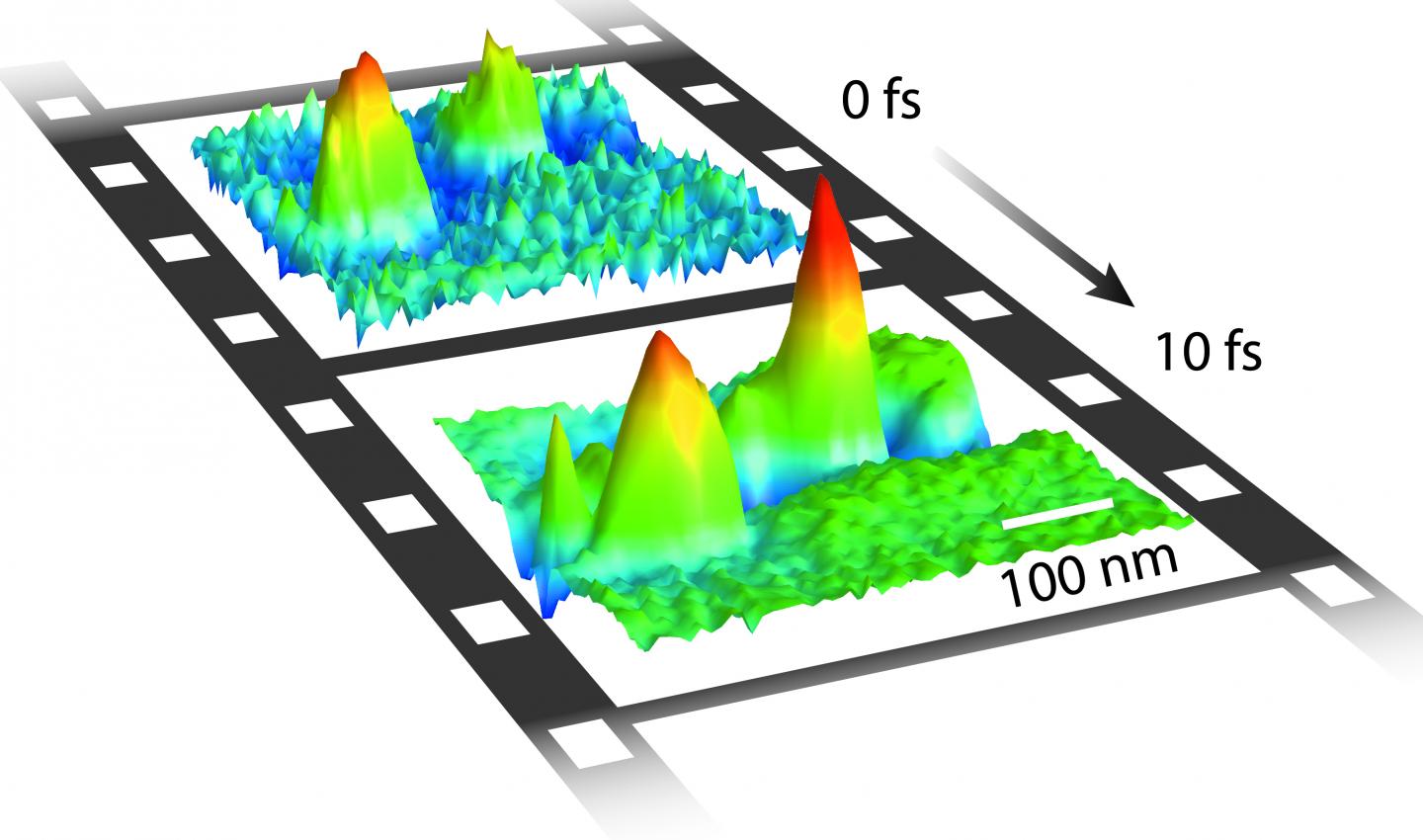
This is an image captured by CU-Boulder researchers using an ultrafast optical microscope shows clouds of electrons oscillating in gold material in space and time. The width of the image is 100 nanometers (about the size of a particle that will fit through a surgical mask), while the time between the top and bottom frame (10 fs, or femtoseconds) is less than 1 trillionth of a second.

University of Colorado

University of Colorado Boulder researchers have demonstrated the use of the world’s first ultrafast optical microscope, allowing them to probe and visualize matter at the atomic level with mind-bending speed. The ultrafast optical microscope assembled by the research team is 1,000 times more powerful than a conventional optical microscope, said CU-Boulder physics Professor Markus Raschke, lead study author. The “image frame” rate, or speed captured by the team, is 1 trillion times faster than the blink of an eye, allowing the researchers to make real-time, slow-motion movies of light interacting with electrons in nanomaterials – in this case a thin gold film.

“This is the first time anyone has been able to probe matter on its natural time and length scale,” said Raschke. “We imaged and measured the motions of electrons in real space and time, and we were able to make it into a movie to help us better understand the fundamental physical processes.”

A paper on the subject appears in the Feb. 8 issue of Nature Nanotechnology.

Matter is sometimes described as the “stuff of the universe” – the molecules, atoms and charged particles, or ions, that make up everything around us. Matter has several states, most prominently solid, liquid and gas.

According to the CU-Boulder researchers, a number of important processes like photosynthesis, energy conversion and use, and biological functions are based on the transfer of electrons and ions from molecule to molecule. The team used a technique called “plasmonic nanofocusing” to focus extraordinarily short laser pulses into tiny bits of gold film matter using a nanometer-sized metal tip.

“Our study brings nanoscale microscopy to the next level, with the ability to capture detailed images evolving on extremely fast time scales,” said Vasily Kravtsov, a CU-Boulder graduate student in physics and first author of the paper.

Other co-authors on the Nature Nanotechnology paper include CU-Boulder postdoctoral researcher Ronald Ulbricht and former CU-Boulder postdoctoral researcher Joanna Atkin, now a faculty member at the University of North Carolina-Chapel Hill.

“This work expands the reach of optical microscopes,” said Raschke. “Using this technique, researchers can image the elementary processes in materials ranging from battery electrodes to solar cells, helping to improve their efficiency and lifetime.”

Unlike electron microscope approaches, the new technique does not require ultra-high vacuum techniques and is particularly promising for studying ultrafast processes like charge and energy transport in soft matter, including biological materials, said Kravtsov.

Source: University of Colorado at Boulder

http://www.apextribune.com/tag/ted-2020/

PROVE AI CAN BE POSITIVE FOR HUMANS FOR A $5 MILLION PRIZE

"artificial intelligence"

Prove AI Can Be Positive For Humans For A $5 Million Prize

IBM Watson and X Prize Foundation are urging teams to prove AI canbe positive for humans for a $5 million prize that will be awarded tothe winners at the TED conference in 2020. If you wish to dismantlethe words of Stephen Hawking and Elon Musk, here’s your chance.

  • Teams can sign up at X Prize’s website, and the official rules andguidelines will be posted in May of this year
  • The final three contestants will present their projects at the TEDconference in 2020
  • There will be yearly interim prizes in the meantime
  • The projects can range from fields such as climate change toeducation and healthcare

At the TED 2016 conference, Peter Diamandis from X Prize and DavidKenny from IBM have placed forward a new challenge: show howartificial intelligence (AI) can be good for mankind. The topic hasbeen widely debated in the last couple of years. It could be anexcellent way for technology to lend a hand in major global problemsor it could destroy us. Most have seen Terminator, so one doesn’teven need to use their imagination to figure out how.

However, the two companies are willing to sway the debate in favorof artificial intelligence. In fact, they’re offering a prize of $5 millionto the team that best represents the futuristic technology. Thepremise is for anyone around the world to create an AI system meantto “tackle some of the world’s grand challenges”. The emphasis willbe placed on its positive effect on human kind and, in essence, showthat the systems will help us instead of bringing a movie-worthyapocalypse.

The participants will have until 2020’s TED conference to create theirinnovating technology, where only three teams will take the stage tomake their final presentation. It’s fairly open competition, withcontestants urged to take on issues ranging from climate change, toeducation and healthcare. Wherever they believe their technology canhelp the most, that’s where their efforts and engineering ingenuityshould focus.

The grand prize is 4 years away, so there is time for teams to getcreative and start working on the AI that will help make the world abetter place. In the meantime though, X Prize will be offering awardseach year. So, those participating can still win money while theirproject is in development, which would be excellent at furtherfunding their technology.

In the press release, IBM stated that they believe artificial intelligencewill be the most important technology of our lifetime. There istremendous potential in the field with so little of it developed. This“cognitive computing competition” is going to challenge teams toshow how AI and humans could collaborate with positive effects. Thepoint is to show that it’s not a tool of evil, and it can be beneficial tomankind.

Of course, it’s also in the wake of numerous discussions on how farscientists should take it. There is a lot of controversy surrounding theconstruction of autonomous AI weapons that will target and firewithout human consent. That, in particular, has been the cause of anuproar from the scientific community. They claimed that a machinewill be too objective, and will be unable to register that the amountof collateral victims will not be worth killing their target.

It cannot be created into algorithm. How can one make a formula ofhow many innocents could be killed for the purpose of eliminatingone threat? The answer should be ‘none’, but unfortunately that’s nowhow things work. An AI could make matters worse, by being unable tocomprehend mercy or compassion.

IBM and X Prize mean to show that there is a good side to AI. It couldhelp us, do some good, and those who are willing to take on thechallenge have a hefty award waiting for them.

http://www.kurzweilai.net/physical-rehab-and-athlete-training-in-vr

Physical rehab and athlete training in VR

February 19, 2016

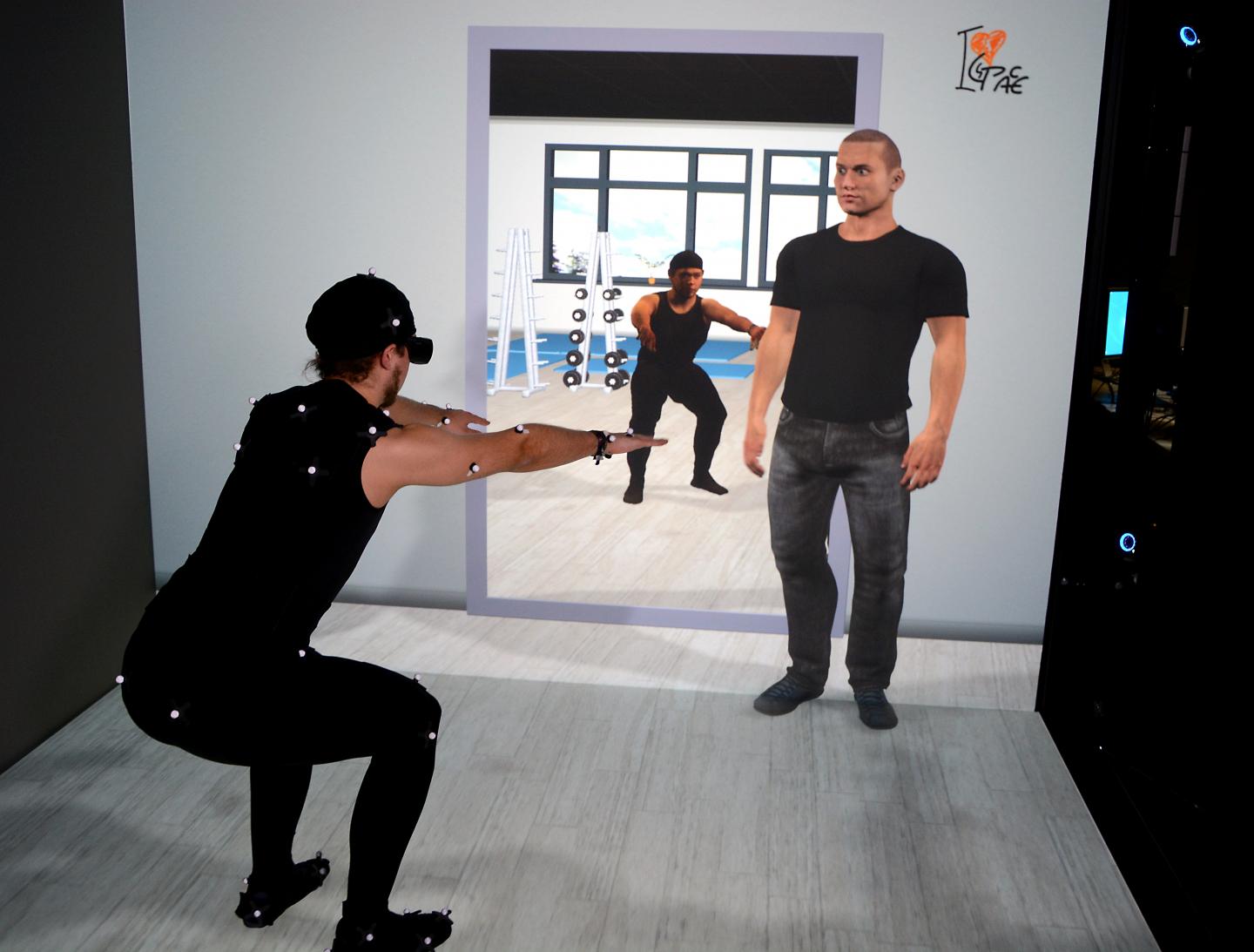
ICSPACE exercise feedback display (credit: ICSPACE)

A virtual “intelligent coaching space” (ICSPACE) developed by Cluster of Excellence Cognitive Interaction Technology (CITEC) at Bielefeld University in Germany is assisting patients with physical rehabilitation and helping athletes improve their performance with sports exercises.

The user is 3D-scanned in advance and used to create an avatar. Participants wear 3D stereoscopic glasses, which create the impression of working out in a gym with a coach. Reflective markers attached to the user are tracked by infrared cameras and a virtual display allows users to watch themselves from various angles to see how they are performing the exercises and make improvements.

Mistakes made during movement exercises, such as bending one’s neck too far during a squat, are depicted in the display in an exaggerated way to draw attention to the error.

[+]

A virtual coach instructs a user how to do a squat (credit: CITEC/Bielefeld University)

A virtual coach is also available and can mark individual body areas on the display to show needed improvement. A slow-motion video of the user performing the exercise can demonstrate correct motions.

“The planned range of activities will include gymnastics exercises, tai chi, yoga, or, for example, how to swing a golf club,” says cognitive scientist Professor Thomas Schack.

The research is funded by the German Research Foundation (DFG).


Research TV Bielefeld University | ICSPACE: Exercise training in virtual reality


Abstract of Multi-Level Analysis of Motor Actions as a Basis for Effective Coaching in Virtual Reality

In order to effectively support motor learning in Virtual Reality, real-time analysis of motor actions performed by the athlete is essential. Most recent work in this area rather focuses on feedback strategies, and not primarily on systematic analysis of the motor action to be learnt. Aiming at a high-level understanding of the performed motor action, we introduce a two-level approach. On the one hand, we focus on a hierarchical motor performance analysis performed online in a VR environment. On the other hand, we introduce an analysis of cognitive representation as a complement for a thorough analysis of motor action.