http://www.winnipegfreepress.com/local/brain-laser-inventors-win-inaugural-innovation-award-377489581.html

Brain laser inventors win inaugural innovation award

Richard Tyc, left, (an engineer who works at Monteris, a high-tech medical device company) and Dr. Mark Torchia (a medical research scientist) have won the Manning Award, the largest Canadian prize for scientific innovation that becomes commercialized . They developed a laser device that can blast deep-seated brain tumours without damaging other brain tissue that is now being built by Monteris Medical. SUPPLIED PHOTO – for Martin Cash story / Winnipeg Free Press 2015 Purchase Photo Print

Prof. Mark Torchia and Richard Tyc started off buying chunks of meat in a Winnipeg supermarket to test an idea for a gizmo in their lab — now it’s performing brain surgery in 35 medical centres across North America.

University of Manitoba alumni Torchia and Tyc are one of six teams receiving the inaugural Governor General’s Innovation Awards May 19 for their development of the NeuroBlate System.

MONTERIS.COM</p><p>NeuroBlate System for MRI guided neurosurgical ablation.</p>
MONTERIS.COM

NeuroBlate System for MRI guided neurosurgical ablation.

Their NeuroBlate device, two decades in the making, drills through the skull to deliver a laser beam on a lesion, with the minimal possible damage to brain tissue. It’s about two millimetres wide of a polymer and sapphire construction whose details are proprietary. The name is a combination of the words neuropathy and oblation.

Torchia is an associate professor of surgery in the U of M’s College of Medicine and the director of the University’s Centre for the Advancement of Teaching and Learning. Tyc is vice-president, technology and advanced technology, at Monteris Medical, a spinoff company established in 1999 to create groundbreaking neurosurgical technologies.

“The idea about using lasers in brain surgery has been around a long time,” Torchia said Thursday, but perfecting it to allow surgeons to work with the least possible damage has been the key. “Rich and I have been working on it, you’re probably looking at two decades.”

The amount of evidence and documentation needed for government approval, that amount of time “is not atypical for sticking something in the brain,” Torchia said.

Tyc said it was 2009 before they were allowed to experiment on a human brain.

Before that, “We were using meat we could buy at the butcher shop,” Torchia said. “You get into a model that mimics live tissue.”

Then came approval for a clinical study in Cleveland.

“These were real people, quite terrifying,” Torchia said. “You get people with a bad disease, no option, and they volunteer.”

Since then, said Tyc, “We’ve had over 700 patients treated to date in 35 centres in North America,” but that number started very slowly and has grown to the point that there are several procedures each day. “We almost doubled our case load since last year.”

The company is headquartered in Minneapolis, Tyc said, but “all the hardware and software design is done in Winnipeg.”

Torchia said they can’t discuss cost, which is “somewhere between a plaster bandage and an MRI.”

Tyc said the device’s use increases as evidence of its success mounts and doctors talk among themselves about it. Regulations preclude their talking in terms of a rate of cure, he said. “It’s minimally invasive,” and patients are going home much sooner compared to other forms of brain surgery.

So far, it’s only being used in the U.S., though it will soon come to Vancouver General Hospital. Regulatory approval came faster in the U.S. than in Canada, said Tyc.

NeuroBlate also won the Ernest C. Manning Principal Award in October 2015.

The NeuroBlate System, developed at the St-Boniface Hospital Albrechtsen Research Centre, is a unique technology that encapsulates the criteria for the Governor General’s Innovation Awards: exceptional technology that transforms a field and positively impacts the quality of life in Canada, the U of M said Thursday.

Torchia and Tyc will receive their award at the inaugural ceremony at Rideau Hall, in Ottawa, on May 19.


http://www.irishtimes.com/news/science/irish-based-geologists-make-zircon-crystals-breakthrough-1.2628499

Irish-based geologists make zircon crystals breakthrough

TCD researchers discover oldest pieces of rock are found in asteroid impact craters

Geologists at Trinity College Dublin have discovered that the very oldest pieces of rock on Earth are to be found at the bottom of craters left by asteroid impacts.

The finding may overturn previous research suggesting these rock components – zircon crystals – form where pieces of the Earth’s crust smash together to build mountains.

Zircon crystals are found in all kinds of rocks across the planet, said Dr Gavin Kenny, based in Trinity’s school of natural sciences.

The Earth formed about 4.5 billion years ago and the crystals represent the oldest constituent of rock found anywhere in the world.

The oldest crystals are found in Australia and may be 4.3 or 4.4 billion years old, but the big question is where they came from.

The Trinity team and colleagues from the Swedish Museum of Natural History in Stockholm believe they have the answer following their research, which was published on Thursday evening by the journal Geology.

“People want to study these crystals to see what they can tell us from that time,” said Dr Kenny, who is first author on the paper.

The crystals are tiny, about the width of a human hair. But scientists have learned to get a great deal of information from them, including their age and the conditions in which they formed.

Tremendous heat must first melt rock and then cool to allow the formation of zircon crystals, leading US researchers to suggest the oldest crystals must have come from plate tectonics.

This is when pieces of the earth’s crust crash together, forcing one plate under the other and melting large amounts of rock.

Impact craters

The Trinity group took a different approach, looking at the bottom of impact craters.

The Earth would have been pummelled by asteroids and orbiting space debris when young and the Earth’s surface was solidifying.

In 2014 the scientists travelled to the Sudbury impact crater in Ontario with funding from the Irish Research Council and Science Foundation Ireland.

There they collected thousands of zircons that matched in age the two-billion-year-old impact crater.

“When an impactor hits it melts a huge batch of the crust. In the crater we studied a pool of molten rock that would have been 3-4km thick. As that cooled the zircons formed.” Dr Kenny said.

The crystals were sent to Stockholm for chemical analysis and the researchers found the Sudbury zircons were an exact match for the much older Australian zircons.

This greatly bolsters their view that asteroid impact and not tectonics is the source of the zircons seen in rocks all across the world.

And it shows that impacts were happening very early in Earth’s formation, as reflected in the age of the crystals from Australia.

http://www.iclarified.com/54992/apple-launches-carekit-starting-with-four-health-apps

Apple Launches CareKit Starting With Four Health Apps

 Apple launched CareKit today, an open source software framework that lets developers build apps that help you manage your medical conditions.

Rather than relying solely on doctor visits, you’ll be able to regularly track your symptoms and medications, and even share the information with your care team for a bigger — and better — picture of your health.

CareKit has gone live in four launch partner apps…

Grow Nurture:
Glow Nurture is the world’s most advanced and comprehensive pregnancy tracker. Powered by data, designed for simplicity, this app rewrites the rules for what a pregnancy app should be. It is completely customizable so that we nurture YOUR pregnancy and your baby.
Apple Launches CareKit Starting With Four Health Apps

Glow Baby:
Glow Baby will help you log and time all aspects of your baby’s care: from bottle feeds, to breastfeeding, to diaper changes, sleep schedules, developmental milestones, medication and growth charts. Glow Baby has it all and is the single best resource for new parents!
Apple Launches CareKit Starting With Four Health Apps

Start:
Take a depression test, track your progress and side effects, and see yourself get better. Start helps you you decide if your new antidepressant works for you.
Apple Launches CareKit Starting With Four Health Apps

One Drop:
Track what’s important in diabetes — Glucose, Food, Meds, and Activity — all in one place. One Drop makes managing diabetes an integrated part of your lifestyle — something that empowers, keeps you mindful, and helps to motivate.
Apple Launches CareKit Starting With Four Health Apps

Apple is expected to post CareKit to its GitHub later today. The company says it will work with the developer community to continue building on the first four modules they’ve designed, that include:
● Care Card helps people track their individual care plans and action items, such as taking medication or completing physical therapy exercises. Activities can automatically be tracked and entered using sensors in Apple Watch or iPhone;
● Symptom and Measurement Tracker lets users easily record their symptoms and how they’re feeling, like monitoring temperature for possible infections or measuring pain or fatigue. Progress updates could include simple surveys, photos that capture the progression of a wound or activities calculated by using the iPhone’s accelerometer and gyroscope, like quantifying range of motion;
● Insight Dashboard maps symptoms against the action items in the Care Card to easily show how treatments are working; and
● Connect makes it easy for people to share information and communicate with doctors, care teams or family members about their health and any change in condition.

http://xbox360asylum.ca/uncategorized/a-battery-that-will-never-die/326341

In these researchers’ tests, their gold nanowire battery quality declined 5% after 200,000 recharge cycles.Currently, one of the many problems with the rechargeable lithium battery technology that smartphones use, is that the materials on the inside become corroded and then fail to last a long time.Batteries in discarded electronics continue to pile up due to society’s technological demands. It’s been long-theorized that nanowire might help increase longevity, as their high surface area can hold an electric charge.


http://news.ubc.ca/2016/04/27/why-dogs-actually-hate-being-hugged/

Why dogs actually hate being hugged

Dogs hate hugs, according to a UBC psychology study, USA Today reported.

UBC’s Stanley Coren, a canine expert, looked at more than 200 photos of dogs being hugged, and found the dogs showed signs of stress, such as visible whites of the eyes and the animal turning its head away, in more than 81 per cent of the photos.

A similar story also appeared in US News, Yahoo Australia, Telegraph UK, The Times UK, Independent UK, Metro UK, IB Times UK, The Irish Times, New Zealand Herald, Newsweek, Global News, CTV News, and News 1130.

http://esciencenews.com/articles/2016/04/26/light.echoes.give.clues.planet.nursery.around.star

Light echoes give clues to planet nursery around star

Published: Tuesday, April 26, 2016 – 21:15 in Astronomy & Space

Related images
(click to enlarge)

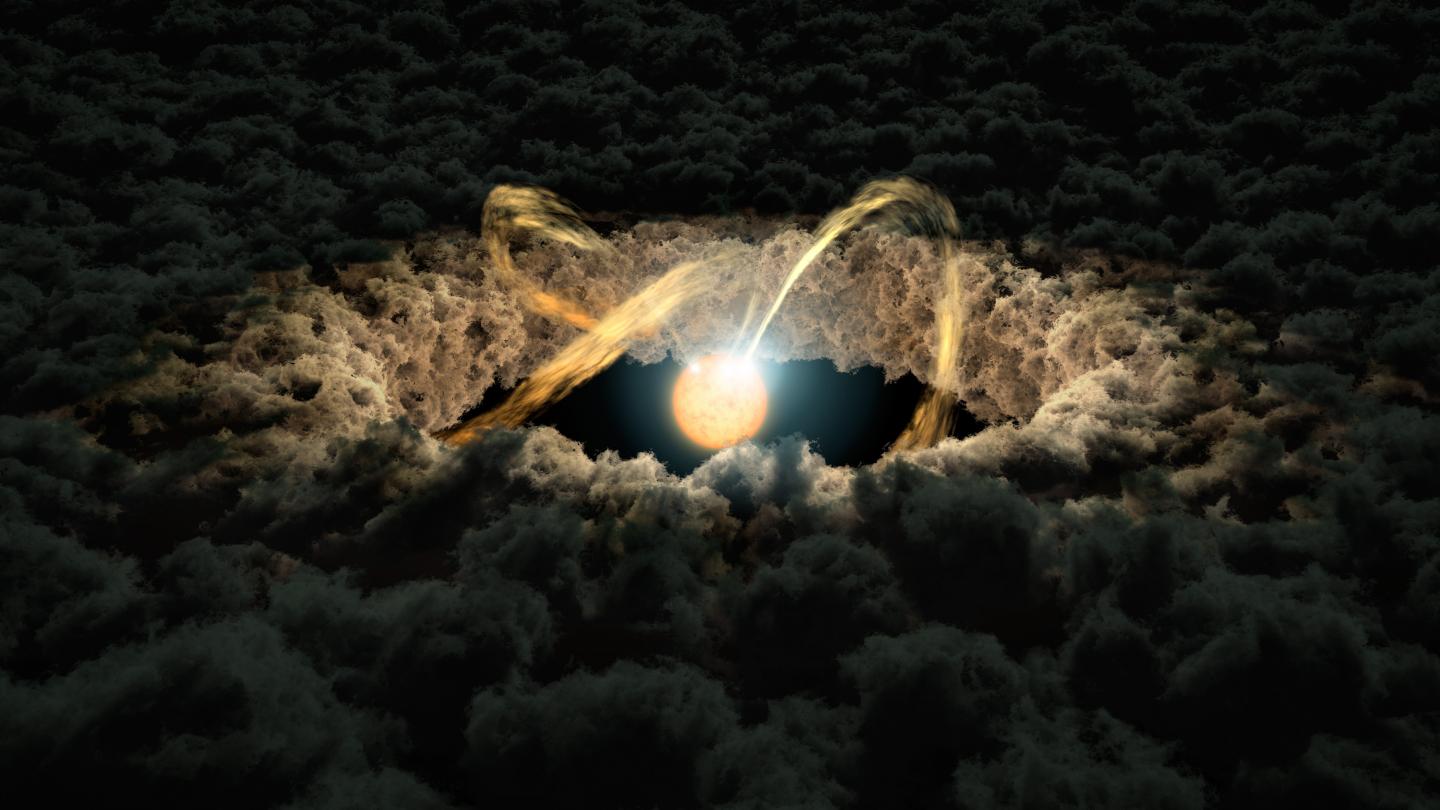
This illustration shows a star surrounded by a protoplanetary disk. Material from the thick disk flows along the star's magnetic field lines and is deposited onto the star's surface. When material hits the star, it lights up brightly.&nbsp;The star's irregular illumination allows astronomers to measure the gap between the disk and the star by using a technique called "photo-reverberation" or "light echoes." First, astronomers look at how much time it takes for light from the star to arrive at Earth. Then, they compare that with the time it takes for light from the star to bounce off the inner edge of the disk and then arrive at Earth. That time difference is used to measure distance, as the speed of light is constant.

NASA/JPL-Caltech

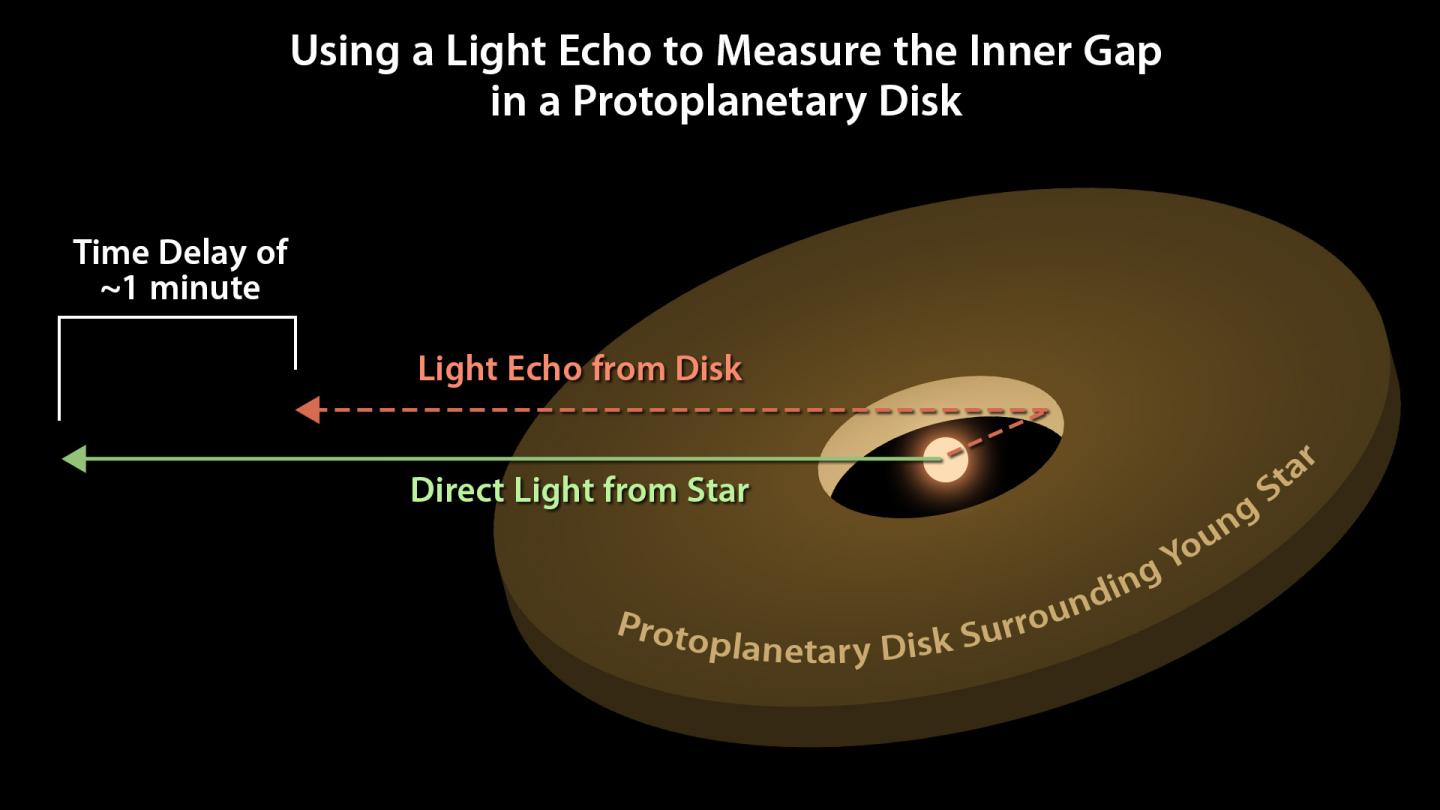
Astronomers can use light echoes to measure the distance from a star to its surrounding protoplanetary disk. This diagram illustrates how the time delay of the light echo is proportional to the distance between the star and the inner edge of the disk.

NASA/JPL-Caltech

Imagine you want to measure the size of a room, but it’s completely dark. If you shout, you can tell if the space you’re in is relatively big or small, depending on how long it takes to hear the echo after it bounces off the wall. Astronomers use this principle to study objects so distant that they can’t be seen as more than points. In particular, researchers are interested in calculating how far young stars are from the inner edge of their surrounding protoplanetary disks. These disks of gas and dust are sites where planets form over the course of millions of years.

“Understanding protoplanetary disks can help us understand some of the mysteries about exoplanets, the planets in solar systems outside our own,” said Huan Meng, postdoctoral research associate at the University of Arizona’s Department of Astronomy and Steward Observatory. “We want to know how planets form and why we find large planets called ‘hot Jupiters’ close to their stars.”

Meng is the first author on a new study published in the Astrophysical Journal using data from NASA’s Spitzer Space Telescope and four ground-based telescopes to determine the distance from a star to the inner rim of its surrounding protoplanetary disk.

Making the measurement wasn’t as simple as laying a ruler on top of a photograph. Doing so would be as impossible as using a satellite photo of your computer screen to measure the width of the period at the end of this sentence.

Instead, researchers used a method called “photo-reverberation,” also known as “light echoes.” When the central star brightens, some of the light hits the surrounding disk, causing a delayed “echo.” Scientists measured the time it took for light coming directly from the star to reach Earth, then waited for its echo to arrive.

Thanks to Albert Einstein’s theory of special relativity, we know that light travels at a constant speed. To determine a given distance, astronomers can multiply the speed of light by the time light takes to get from one point to another.

To take advantage of this formula, scientists needed to find a star with variable emission — that is, a star that emits radiation in an unpredictable, uneven manner. Our own sun has a fairly stable emission, but a variable star would have unique, detectable changes in radiation that could be used for picking up corresponding light echoes. Young stars, which have variable emission, are the best candidates.

The star used in this study is called YLW 16B, which lies about 400 light-years from Earth. YLW 16B has about the same mass as our sun, but at one million years old, it’s just a baby compared to our 4.6-billion-year-old home star.

Astronomers combined Spitzer data with observations from ground-based telescopes: the Mayall telescope at Kitt Peak National Observatory in Arizona, the SOAR and SMARTS telescopes in Chile, and the Harold L. Johnson telescope in Mexico. During two nights of observation, researchers saw consistent time lags between the stellar emissions and their echoes in the surrounding disk. The ground-based observatories detected the shorter-wavelength infrared light emitted directly from the star, and Spitzer observed the longer-wavelength infrared light from the disk’s echo. Because of thick interstellar clouds that block the view from Earth, astronomers could not use visible light to monitor the star.

Researchers then calculated how far this light must have traveled during that time lag: about 0.08 astronomical units, which is approximately 8 percent of the distance between Earth and its sun, or one-quarter the diameter of Mercury’s orbit. This was slightly smaller than previous estimates with indirect techniques, but consistent with theoretical expectations.

Although this method did not directly measure the height of the disk, researchers were able to determine that the inner edge is relatively thick.

Previously, astronomers have used the light echo technique to measure the size of accretion disks of material around supermassive black holes. Since no light escapes from a black hole, researchers compare light from the inner edge of the accretion disk to light from the outer edge to determine the disk size. This technique is also used to measure the distance to other features near the accretion disk, such as dust and the surrounding fast-moving gas.

While light echoes from supermassive black holes represent delays of days to weeks, scientists measured the light echo from the protoplanetary disk in this study to be a mere 74 seconds.

The Spitzer study marks the first time the light echo method was used in the context of protoplanetary disks. The approach can be applied to other systems of stars with planet-forming disks around them, the scientists pointed out.

“Knowing the exact position of the inner boundary of a protoplanetary disk is important to anyone who wants to understand planet evolution,” Meng says.

Most stars are born with a protoplanetary disk around them, and astronomers have known for a long time that there is a gap between the star and its disk because of two competing processes: Close to the star, its strong radiation ionizes gas particles in the disk, diverting them along the star’s magnetic field lines above and below the plane of the disk. The other mechanism that prevents the disk from reaching all the way to the star’s surface is heat. Once a dust particle gets too close to the star, it simply vaporizes and either falls onto the star or gets blown out of the system.

“The predominant one of those two mechanisms plays an important role in the evolution of the disk, and right now, we don’t know which it is,” Meng says.

Until now, astronomers used a technique called interferometry to determine the position of the inner edge of protoplanetary disks, but that method requires assumptions about the shape of the disk, resulting in controversial findings.

“Our method provides a completely independent measurement of which mechanism plays the predominant role now and in the future,” Meng says.

Source: University of Arizona

http://www.montrealgazette.com/news/local+news/study+finds+psychedelic+drugs+help+curb+domestic+violence/11878109/story.html

UBC study finds psychedelic drugs may help curb domestic violence

TIFFANY CRAWFORD, VANCOUVER SUN  04.25.2016

Now researchers at the University of B.C. say the drugs may help curb domestic violence committed by men with substance abuse problems.

The UBC Okanagan study, published last week in the Journal of Psychopharmacology, found that 42 per cent of U.S. adult male prisoners who did not take psychedelic drugs after their release were arrested within six years for domestic battery, compared to 27 per cent for those who had taken drugs such as LSD, psilocybin (magic mushrooms) and MDMA (ecstasy).

The observational study followed 302 inmates ages 17 through 40 for an average of six years after they were released. All those observed were serving sentences of one year or less at a county jail in Illinois, and all had histories of substance use disorders, according to the study. Seventy-two per cent of all participants had prior charges for violent crimes.

The participants were interviewed during their period in jail about their hallucinogen use.  Of those who had experimented with hallucinogenic drugs, 87 per cent had tried more than one of the more well-known psychedelic drugs, such as magic mushrooms, LSD and MDMA.

Following release from jail, researchers used a U.S. law enforcement database, including FBI data, to monitor arrests for domestic violence. The researchers were unable to account for violence that was not reported to police.

One of the researchers was Zach Walsh, the co-director for UBC Okanagan’s Centre for the Advancement of Psychological Science and Law. He said overall the study speaks to the public health potential of psychedelic drugs in contrast to prevailing attitudes that they are harmful.

“As existing treatments for intimate partner violence are insufficient, we need to take new perspectives such as this seriously,” he said.

Walsh said with proper dosage and setting, scientists might see “even more profound effects.”

Since most of the participants who had tried psychedelics, had tried more than one type, the team did not extrapolate which drug they believed to be having the most impact on reducing violence.  It does note, however, that there is evidence to suggest that MDMA may foster intimacy and improve communication, which may lead to less violence against family members.

“That’s one thing that we would like to look at more closely,” he said. “With MDMA, maybe you stop drinking and that leads to better functioning in relationships. We know it’s associated with increasing empathy.”

Scientists are studying whether hallucinogens can lead to what they call quantum change, rapid change in an individual’s behaviour based on a profound experience, said Walsh.

“The experiences of unity, positivity, and transcendence that characterize the psychedelic experience may be particularly beneficial to groups that are frequently marginalized and isolated, such as the incarcerated men who participated in this study,” said Walsh.

However, Walsh noted that this was not a clinical study and the area needs much more research.

The findings challenge the stigmatization and criminalization of hallucinogens due to putatively harmful social effects, and add to the re-emerging literature on the therapeutic potential of these ancient medicines, the study concludes.

The study was co-authored by University of Alabama associate professor Peter Hendricks, who said although the research is still new, one explanation is that these drugs can provide profoundly meaningful spiritual experiences that highlight what matters most.

“Often, people are struck by the realization that behaving with compassion and kindness toward others is high on the list of what matters,” he said, in a UBC statement.

While research on the benefits of psychedelic drugs took place in the 1950 to the 1970s, primarily to treat mental illness, it was stopped because of the reclassification of the drugs to a controlled substance in the mid-1970s. LSD, MDMA and psilocybin continue to be classified as illegal substances in Canada.

However, there has been a renewed interest in psychedelic medicine in recent years, with studies being conducted around the world. In Vancouver, for example, scientists with the Canadian Multidisciplinary Association of Psychedelic Studies are about to begin Phase 3 of a clinical trial using MDMA to treat PTSD, after recording a high rate of success in the Phase 2 trial, particularly with military veterans.

Substances sold on the street as ecstasy or molly are not the same thing as MDMA, but can contain dangerous adulterants. According to MAPS, pure MDMA has been proven safe for human consumption when taken a limited number of times in moderate doses.

http://www.upi.com/Science_News/2016/04/26/Ravens-and-crows-are-as-clever-as-chimpanzees/2431461690496/

Ravens and crows are as clever as chimpanzees

“This shows that bird brains are quite efficient, despite having a smaller absolute brain size,” researcher Can Kabadayi said.
Crows pack a lot of valuable neurons in their small brains, allowing them to be just as clever as chimpanzees. Photo by Helena Osvath/Lund University

LUND, Sweden, April 26 (UPI) — Call someone a birdbrain and they’re liable to be offended. Despite their diminutive noggins, many bird species are quite intelligent.

In fact, new research suggests ravens and crows are just as clever as chimpanzees.

“Absolute brain size is not the whole story. We found that corvid birds performed as well as great apes, despite having much smaller brains,” Can Kabadayi, a researcher at Lund University in Sweden, said in a news release.

Measuring intelligence is a tricky task, but measuring inhibitory control, an important aspect of cleverness, is more straightforward. In 2014, Duke researchers tested the inhibition of several mammal species — mostly apes, monkeys and other primates — using the so-called cylinder test, whereby food is placed in a transparent tube with side openings.

Instead of reaching for the food through the tube’s end openings, more clever test-takers used the side openings. Their success relied on the ability to control the urge to reach directly for the food and use a less obvious but more efficient strategy.

The findings suggested brain size predicted cleverness. The primate species who passed the cylinder test were more likely to boast big brains.

But the study didn’t test corvids, birds in the crow family. Corvids are well known for their intelligent use of tools.

When researchers at Lund replicated the test for corvid species, they found jackdaws and common ravens passed at a rate close to 100 percent. Their performance was comparable to bonobos, gorillas and chimps.

“This shows that bird brains are quite efficient, despite having a smaller absolute brain size,” Kabadayi said. “As indicated by the study, there might be other factors apart from absolute brain size that are important for intelligence, such as neuronal density.”

Kabadayi and his colleagues published their latest findings in the journal Royal Society Open Science.

“There is still so much we need to understand and learn about the relationship between intelligence and brain size, as well as the structure of a bird’s brain, but this study clearly shows that bird brains are not simply birdbrains after all!”

http://arstechnica.com/science/2016/04/y-chromosomes-history-shows-links-to-migration-tech-developments/

Human history traced via the Y chromosome

Male lineages expand rapidly at key points in our past.

The history of humanity, as we’ve read it through DNA, has been written largely by females.Mitochondrial DNA, which is inherited only from our mothers, is short and easy to sequence, soresearchers have frequently relied on it to study human DNA, both in present populations and in oldbones.

But as DNA sequencing technology has improved, it has become progressively easier to sequence allthe DNA that an individual carries. If said individual is a male, the resulting sequence will include the Ychromosome, which is inherited only from fathers. With more data in hand, researchers have been ableto perform an analysis of the Y chromosome’s history, and they’ve found that its sequence retains theimprint of both the migrations and technological innovations that have featured in humanity’s past.

How to read a Y

Most chromosomes in the cell are present as two copies, which allows them to swap genetic material.Over time, this swapping will mix up the mutations that occur on the chromosome, making their historydifficult to untangle.

The Y chromosome is different in that males only have a single copy, and most of it doesn’t undergoany genetic shuffling (a small region can recombine with the X chromosome). As a result, anymutations that occur on a single Y chromosome will always be inherited together. This makes the Ygreat for reconstructing history.

Let’s say that, deep in our past, a mutation we call A occurred and gradually expanded in thepopulation. Later, one of the descendants who carried A experienced a second mutation, B, which alsoexpanded a bit. If we sequenced a population of 100 today, we might see 50 people who carry A and30 who carry B. But every single person with B would also carry A. This idea allows us to infer the orderin which these changes occurred and, given the average rate at which mutations appear, their timing.

Now, layer a bit of history on top of that. If A occurred after humans migrated out of Africa, it might bewidespread in populations elsewhere around the globe. But if B occurred later, after further migrations,it might only show up in a specific region—say, Australia. So we can not only learn about the timing ofdifferent mutations, we can often figure out where they must have occurred.

But wait, there’s more. If a population is relatively steady, there won’t be much change in the number ofmutations—for each new one that appears, another is likely to die out. But when a population isexpanding, new mutations are more likely to be retained and show up in modern lineages. Whenmaking a Y chromosome family tree, this process will appear as a sudden burst of branches in a shortamount of time.

Y history

To read this history of the Y, a large team of researchers took advantage of the sequences generatedby the 1,000 genomes project, which has now gone well past its initial goal of completing 1,000 humangenomes. The researchers found 1,244 genomes with a Y in the database and were able to identifymore than 60,000 individual base differences they could track. These differences were subjected to thesorts of analysis described above.

First, the researchers found that the common Y ancestor dates to 200,000 years ago—much earlierthan the most likely time of the last female common ancestor. The last non-African common ancestordates to 75,000 years ago, shortly before the migration out of Africa is thought to have occurred. Therewas also a large boom in population, with many new lineages appearing about 50,000 years ago, whenhumanity’s global migration was in full swing.

One oddity here is that the most common lineage in Africa didn’t start there; it likely originated in theMiddle East and was taken back to Africa by counter-migration. The Y chromosome data also suggeststhat humans first migrated along the southern coast of Asia to Southeast Asia and then spread fromthere to populate areas as distant as Europe and the Americas.

The authors identified times and places where the Y chromosome saw many new lineages arise, a signof rapid population expansion. These instances of new lineages were numerous and rather excessive.”Such extreme expansions are seldom seen in the [mitochondrial] DNA phylogeny,” the authors note,before going on to argue that as “the [lineage] expansions we report are among the most extreme yetobserved in humans, we think it more likely than not that such events correspond to historicalprocesses that have also left archaeological footprints.

What are those historical processes? One is the arrival of humans in the Americas, which appears tohave occurred about 15,000 years ago—consistent with the archeological evidence. Another bigexpansion occurred just prior to the Bantu expansion in Africa, a large internal migration that spreadacross much of the continent.

Other expansions occurred just prior to the onset of the Indus Valley civilization, and two occurred inEurope associated with the migration of people in from the Asian steppes and the development of anew technological culture about 4,800 years ago. The big exception to this pattern? “East Asia standsout from the rest of the Old World for its paucity of sudden expansions,” the authors write, “perhapsreflecting a larger starting population or the coexistence of multiple prehistoric cultures wherein onelineage could rarely dominate.”

Overall, the picture drawn from the Y chromosome is consistent with things we knew about fromarcheology, and it’s broadly consistent with the picture we’ve derived from studying female lineages.But because male lineages can expand much faster, the Y provides some extra details about some ofthe more turbulent moments in humanity’s past.

Nature Genetics, 2016. DOI: 10.1038/ng.3559  (About DOIs).

http://ca.reuters.com/article/technologyNews/idCAKCN0XN1F1

Google, Ford, Uber launch coalition to further self-driving cars

Tue Apr 26, 2016 3:26pm EDT
By David Shepardson
WASHINGTON (Reuters) – Alphabet Inc’s Google unit GOOGL.O, Ford Motor Co F.N, the ride-sharing service Uber [UBER.UL] and two other companies said on Tuesday they are forming a coalition to push for federal action to help speed self-driving cars to market.

Sweden-based Volvo Cars, which is owned by China’s Zhejiang Geely Holding Group Co GEELY.UL, and Uber rival Lyft also are part of the Self-Driving Coalition for Safer Streets. The group said in a statement it will “work with lawmakers, regulators and the public to realize the safety and societal benefits of self-driving vehicles.”

The coalition said David Strickland, the former top official of the U.S. National Highway Traffic Safety Administration (NHTSA), the top U.S. auto safety agency that is writing new guidance on self-driving cars, will be the coalition’s counsel and spokesman.

“What people are looking for is clear rules of the road of what needs to be done for (fully autonomous) vehicles to be on the road,” Strickland said in an interview Tuesday, emphasizing the companies want to deploy them safely. “Nobody wants to take a shortcut on this.”

Strickland, who has advised Google on self-driving car issues, said the group is “a full policy and messaging campaign and movement” and not just about lobbying lawmakers or regulators.

In 2014 there were 32,675 fatalities and 2.3 million injured in 6.1 million crashes on U.S. roads. NHTSA says about 94 percent of all traffic crashes are caused by human error.

On Wednesday, NHTSA is holding the second of two public forums on its self-driving car guidelines that will feature comments from tech companies and automakers at Stanford University.

NHTSA did not immediately return a message seeking comment on the coalition.

Ford said in a statement the group will “work together to advocate for policy solutions that will support the deployment of fully autonomous vehicles.”

NHTSA hopes to release its guidance to states, policymakers and companies on self-driving vehicles in July.

California has proposed barring self-driving cars that do not have steering wheels, pedals and a licensed driver ready to take over in an emergency, which Google has opposed. Under current regulations, fully autonomous vehicles without human controls are not legal.

NHTSA Administrator Mark Rosekind has said policymakers should avoid a “patchwork” of state regulations on self-driving cars but has not taken a position on California’s proposal.

In February, NHTSA said the artificial intelligence system piloting a self-driving Google car could be considered the driver under federal law, a major step toward winning approval for autonomous vehicles.

The five companies, which all are working on self-driving cars, say one of the group’s first tasks is to “work with civic organizations, municipalities and businesses to bring the vision of self-driving vehicles to America’s roads and highways.”

(Reporting by David Shepardson; Editing by Bill Trott and Alan Crosby)