Month: May 2016
http://www.labmanager.com/news/2016/05/scientists-determine-fountain-of-youth-gene-helps-prevent-heart-attack-stroke#.Vz4KK5PysmI
Scientists Determine ‘Fountain of Youth’ Gene Helps Prevent Heart Attack, Stroke
A gene that scientific dogma insists is inactive in adults actually plays a vital role in preventing the underlying cause of most heart attacks and strokes, researchers at the University of Virginia School of Medicine have determined.
The findings open a new avenue for battling those deadly conditions and raise the tantalizing prospect that doctors could use the gene to prevent or delay at least some of the effects of aging.
Related Article: Scientists Discover Key Driver of Human Aging
“Finding a way to augment the expression of this gene in adult cells may have profound implications for promoting health and possibly reversing some of the detrimental effects with aging,” said researcher Gary K. Owens, director of UVA’s Robert M. Berne Cardiovascular Research Center.
 UVA researchers Olga A. Cherepanova and Gary Owens are exploring the role of the Oct4 gene, which was thought to have been inactive after embryonic development, but may play a key role in preventing many diseases of aging.PHOTO COURTESY OF THE UNIVERSITY OF VIRGINIAThe gene, Oct4, plays a key role in the development of all living organisms, but scientists have, until now, thought it was permanently inactivated after embryonic development. Some controversial studies have suggested it might have another function later in life, but the UVA researchers are the first to provide conclusive evidence of that: Owens and his colleagues have determined the gene plays a critical protective role during the formation of atherosclerotic plaques inside blood vessels. The rupturing of these plaques is the underlying cause of many heart attacks and strokes.
The researchers found that Oct4 controls the movement of smooth muscle cells into protective fibrous “caps” inside the plaques—caps that make the plaques less likely to rupture. The researchers also have provided evidence that the gene promotes many changes in gene expression that are beneficial in stabilizing the plaques. This is exciting, because studies suggest that it may be possible to develop drugs or other therapeutic agents that target the Oct4 pathway as a means to reduce the incidence of heart attacks or stroke.
Releated Article: In Landmark Study of Cell Therapy for Heart Attack, More Cells Make a Difference
“Our findings have major implications regarding possible novel therapeutic approaches for promoting stabilization of atherosclerotic plaques,” said Olga A. Cherepanova, a senior research scientist in Owens’ lab.
One surprising finding from UVA’s research: When the researchers blocked the effect of Oct4 in mice, they thought the atherosclerotic plaques might become smaller, because of the reduced number of smooth muscle cells inside. Instead, the plaques grew larger, less stable and more dangerous, stuffed with lipids, dead cells and other damaging components.
 The Oct4 gene plays a role in stabilizing atherosclerotic plaques like this one, which, if they rupture, can cause heart attacks and strokes.IMAGE COURTESY OF THE UNIVERSITY OF VIRGINIAWhile UVA’s research has focused on how Oct4 offers cardiovascular protection, Owens and his colleagues believe the gene could also prove critical to the field of regenerative medicine, which investigates the growth and replacement of tissues and organs. The researchers believe that Oct4 and its family of target genes are activated in other somatic cells—the non-reproductive cells in the body—and play a key role in the cells’ ability to repair damage and heal wounds. Studies to test this are underway in Owens’ lab.
Oct4 is one of the “stem cell pluripotency factors” described by Dr. Shinya Yamanaka of Kyoto University, for which he received the 2012 Nobel Prize. His lab and many others have shown that artificial over-expression of Oct4 within somatic cells grown in a lab dish is essential for reprogramming these cells into induced pluripotential stem cells, which can then develop into any cell type in the body or even an entire organism.
The UVA researchers suspect that at least some of the detrimental effects of aging, including the increased possibility of a plaque rupture, stem from a decrease in the body’s ability to reactivate Oct4.
“Finding a way to reactivate this pathway may have profound implications for health and aging,” Owens said. “We think this is just the tip of the iceberg for controlling plasticity of somatic cells, and this could impact many human diseases and the field of regenerative medicine. Who knows, this may end up being the ‘fountain-of-youth gene,’ a way to revitalize old and worn-out cells. Only time will tell.”
Related Article: Research Identifies Key Genetic Link in the Biology of Aging
The discovery has been described in a paper published online by the scientific journal Nature Medicine. It was authored by Cherepanova, Delphine Gomez, Laura S. Shankman, Pamela Swiatlowska, Jason Williams, Olga F. Sarmento, Gabriel F. Alencar, Daniel L. Hess, Melissa H. Bevard, Elizabeth S. Greene, Meera Murgai, Stephen D. Turner, Yong-Jian Geng, Stefan Bekiranov, Jessica J. Connelly, Alexey Tomilin and Owens.
The work was funded by the National Institutes of Health (grants R01 HL057353, R01 HL087867 and R01 HL098538), the Russian Science Foundation, the Federal Agency of Scientific Organization, and the U.S. Department of Defense.
http://www.courthousenews.com/2016/05/19/researchers-find-possible-fountain-of-youth-gene.htm
Researchers Find Possible ‘Fountain of Youth’ Gene
http://news.discovery.com/tech/ipad-mini-transformed-into-invisibility-cloak-160519.htm
iPad Mini Transformed Into Invisibility Cloak
Unlike previous cloaks, this new method works on all viewing angles and colors of light — no magic required.
Top 10 Uses for Invisibility Tech
The method was created by Joseph S. Choi and John C. Howell, researchers in the University of Rochester’s Institute of Optics. You might remember Choi from the invisibility cloak he made two years ago out of standard optical lenses.
This time, rather than guiding light around an object, the researchers collected light rays digitally — for example, via a digital camera — at one position and then displayed them digitally at another — such as on an iPad.
For their demonstration, Choi and Howell used the video function of a digital camera to capture light rays from a background scene. By placing the camera on a mechanical slider, they were able to move the camera horizontally and capture numerous positions. That video got transmitted to a laptop for processing with a sophisticated computer program before being displayed on an Apple iPad mini covered in an array of cylindrical lenses for 3-D effect.The computer program ran calculations on the light rays in order to transfer the right pixels, colors, and angles to the correct positions onto the output display, according to the researchers.
“We used currently available commercial digital technology, which is only going to improve over time, to make a good approximation to what you would expect from a cloak like Harry Potter’s,” Choi said in a university press release. The researchers just published a paper describing their approach in the journal Optica (abstract).
The Invisibility Cloak You’ve Been Waiting For
Such a method wouldn’t have been enough to hide Harry Potter from Death Eaters, but the researchers have interesting potential applications in mind. One, which I’ve heard about before, is a way to make a surgeon’s hand see-through during delicate procedures. Another is a cloaking device for car interiors that would eliminate blind spots.
So far the biggest downside is that the scanning and processing Choi and Howell used for their demonstration created a lag time around one minute long. Not ideal. Fortunately, the researchers think a real-time version could be achieved with an array of detectors, improved hardware interfaces, and automated data processing.
Invisibility Cloak Turns Any Object into a Mirror
They also sound confident about creating a flexible version based on their method. Howell said in the press release that he thinks that’s possible in theory, although such a cloak would require heavy engineering and significant computational power to constantly recognize the position and orientation of the detector and display.
That will be tough, but not impossible. Next the researchers plan to continue developing their cloak with an eye on making it wearable. Not bad for muggles.
http://www.theverge.com/2016/5/19/11711858/robobee-electrostatic-perching
Tiny robot bees can now land anywhere thanks to static electricity

(Carla Schaffer / AAAS)
Flying can be exhausting when you’re a tiny, bee-sized robot, but researchers from MIT have created a new way to let little winged bots take a break. Using static electricity, robots no bigger than a quarter can latch onto the underside of any flat surfaces, a process that uses between 500 and 1,000 times less power than flying. In a study published in this week’s issue of Science, researchers say this new perching ability could be key to creating insect-sized aerial robots that can help with a long-term observational tasks — traffic control, to search-and-rescue.
THE ROBOBEE IS 31 TIMES LIGHTER THAN A PENNY
The mechanism was developed by researchers from MIT for the RoboBee: a tiny flying robot first unveiled in 2013. The RoboBee weighs just 0.08 grams (that’s 31 times lighter than a penny), and has a pair of tiny wings that can beat up to 120 times per second. Previously, the bot relied on miniature tripod on its base for landings — but that meant it could only set down on the top of flat surfaces. The new mechanism will instead let it fix onto the underside of pretty much any material, including leaves, glass, wood, and brick.
/cdn0.vox-cdn.com/uploads/chorus_asset/file/6510615/robobee.0.jpg)
A partial swarm of Robobees at rest. (Image credit: Wyss Institute)Perching isn’t a trivial skill, either. It could be vital to create small robots designed for medium and long-term observations. You can’t use a quadcopter to survey an area for longer than 20 or so minutes, for example, as it simply runs out of power. But if a robot (even a tiny one) can perch somewhere without using much energy, it can stick around for longer. Mirko Kovac, an aerial roboticist who wrote an accompanying essay in the same issue of Science, suggests that if scientists can incorporate renewable energy sources into their designs (like solar panels), then a robot could literally recharge its batteries while taking five on branch.
MONITORING EVERYTHING FROM RAIN FORESTS TO TRAFFIC JAMS
“This incredibly important for inspection tasks,” says Kovac. “Industrial inspection, for example, or environmental monitoring, like in the rainforest. Another one would be traffic control. There are many different applications, but it always comes back to the benefits of using much less energy.”
The electrostatic pad itself sits on the top of the RoboBee, making it look a little like a rubber dart, and is connected to the bot via a polyurethane mount that’s essentially a squidgy ear plug. This allows the circular contact to bend and flex, meaning the microrobot can approach its target surface at an angle, rather than having to line exactly parallel.
The static electricity that is used to stick the bot to its target is the same force that makes a balloon attract your hair after you’ve rubbed it on a sweater. An electric current is run through the circular pad to create the charge, and when it touches the target surface, it induces the opposite charge there, creating electrostatic attraction between the two materials. Voila: the robot sticks in place.
/cdn0.vox-cdn.com/uploads/chorus_asset/file/6510639/Screen_Shot_2016-05-19_at_5.23.32_PM.0.png)
An illustration of how the Robobee attaches to a target surface. The circular pad is the electrostatic mechanism and the yellow cylinder is the polyurethane mount. (Image credit: Science)This might seem like an unnecessarily complex mechanism to use, but it’s ideal for a bot the size of the RoboBee. Because the electrostatic attraction can be turned on and off, the robot doesn’t need to pull itself away from any surface, as it might with a chemical adhesive. (Just think of flies stuck in fly paper!) Maintaining the charge also takes very little power — 500 to 1,000 times less power than flying.
In his essay, Kovac describes how animals of different sizes use different methods to perch, and how the same lessons can be applied to robot design. Large birds have to use visual feedback and the precise deployment of talons to grip on to something, writes Kovac, while smaller insects like flies, meanwhile, simply run into something and the design of their bodies allows them to stick in place. (In the case of flies, this “stickiness” comes from a huge number of tiny bristles on their feet that work like velcro.)
“NATURE IS VERY GOOD AT THIS SORT OF EMBODIED INTELLIGENCE.”
You can’t scale down mechanical grips to the micro-level, Kovac tells The Verge, so you have to find some sort of passive mechanism. “Nature is very good at this sort of embodied intelligence,” says Kovac. “And as you get smaller, you have to rely more and more on this sort of smart design.” This also means there’s less computation involved, which means you don’t have to burden the robots with too many sensors or hardware to control them.
/cdn0.vox-cdn.com/uploads/chorus_asset/file/6510617/Screen_Shot_2016-05-19_at_5.17.46_PM.0.png)
A diagram showing how larger flying animals and robots require more sensors and mechanical parts to perch on things.(Image credit: Science)The RoboBee platform is far from complete, though. Both the power source used to create the electrostatic charge and the computer smarts that guide the bot are not incorporated into its design — both data and power have to be fed to it via wires. The RoboBee is also very susceptible to disturbances, says Mortiz Graule, one of the paper’s authors. “If someone in the lab runs past it, it affects the flight,” he tells The Verge. He says that the engineers had to program the bot to hover, briefly, under surfaces it wants to attach to, as flying at them too quickly would create air currents that might knock it off course. “At this scale,” says Graule, “even flying close to a ceiling is very challenging.”
The next step is integrating both power source and control systems, meaning they could achieve untethered flight. This could take another two years, in laboratory conditions, and then it would be another five to 10 years before the RoboBee might be ready for use in the real world. Just remember: 20 years from now, if you see a tiny insect stuck onto the side of a building, think twice before you take a swat at it — it might be doing more than just hanging out.
http://www.afr.com/technology/gadgets/wearable-technology/tech-review-what-the-fitbit-blaze-does-better-than-the-apple-watch-20160518-goyhsn
Tech Review: What the Fitbit Blaze does better than the Apple Watch

by Jim RossmanAfter a decade of not wearing a watch, I’ve slipped back into the habit since receiving an Apple Watch as an anniversary present from my wife. (Thanks, Dear.) And while the techie in me loves the idea of a smartwatch, I’m still struggling to find the best uses for it.
Smartwatches can, for example, be used to read texts and emails, and many people are familiar with their fitness-tracking capabilities. I’ve been using fitness bands from Garmin for a few years but only when working out or when I wanted to track steps.
For the last week, I’ve been testing the Fitbit Blaze, which is Fitbit’s first smartwatch. The Blaze ($199, fitbit.com) looks to be the largest fitness band Fitbit has produced. It has a nifty design that allows the watch face to pop out for very easy band swaps.
This is a good time to mention that the Blaze has to be removed from its band to be charged. The Blaze can last up to five days on a charge.

THE FITNESS
The Blaze is first and foremost a fitness tracker, but Fitbit designed it to look like a watch. Every other Fitbit model looks like a fitness band. The Blaze is a great fitness tracker and its colour touchscreen can show you a lot of information, but you’ll need to set it up via the free Fitbit app and pair it to your smartphone.
The app presents all your data very clearly and allows you to configure the Blaze’s appearance – changing the watch face, for example. On the Blaze, you move from tab to tab by swiping left on the screen. The first swipe brings you to the “today” tab, which will show you up-to-date stats on your day’s activities.
Like every other Fitbit, the Blaze will track your steps, but it will also measure your continuous heart rate. Fitbit has a nice display that shows how much time you spend in different heart rate zones. It can also keep track of how many flights of stairs you climb each day.

The Blaze does not have a built-in GPS. It relies on a paired smartphone’s GPS to keep track of your run, walk or bike ride. From the main watch screen, swipe left again to show the “exercise” screen, where you can choose “run,” “bike,” “weights,” “treadmill,” “elliptical,” or, for exercises that don’t fall into one of those categories, “workout.” For exercises involving distance (biking, running), the device will, using your phone’s GPS, display such stats alongside figures for exercise duration and heart rate.
For other workouts, the device will show you a combination of distance (steps), duration, heart rate and calories burned. The Blaze has a feature called SmartTrack, which, in case you’ve forgotten to select a workout on the device, senses that you’ve been working hard and begins logging the information.
There’s also a tab for FitStar workouts, very simple workouts that are demonstrated on the Blaze’s screen with a silhouette showing you how to do the moves alongside a timer that keeps track of how long each set lasts. The remaining tabs are for a stopwatch and alarms.
The Blaze can track your sleep if you wear it overnight. It keeps track of when you fall asleep, when you stir during the night and when you wake up. All the sleep information is nicely displayed in the app.
THE SMARTS
The Blaze pairs to your smartphone to allow for the display of incoming caller ID information on your wrist. You can accept or reject calls from the watch, but you can’t speak through it like you can with an Apple Watch.
The Blaze displays incoming texts, but you can’t reply back. It can also display calendar alerts. Alas, email isn’t an option on the Blaze.
There are controls for selecting music playback on your paired smartphone.
ACCESSORISE
Users can personalise the Blaze with different watch bands. The Blaze ships with a slightly stiff rubber band called the Classic Band ($29.95), available in black, blue or purple. You can step up to a leather band and frame for $99.95 or buy a metal link band and frame for $129.95. Swapping the watch face to another band takes about 10 seconds.
IN USE
I thought the Blaze was very comfortable to wear and easy to use. The classic band stayed in place, and the leather band gave the Blaze a very dressy look. There are four watch faces available, and all of them are pretty good looking. The device can withstand some moisture but not submersion. So while you can sweat on it or wear it in the rain, keep it out of the shower and out of the pool.
I’m not a huge exerciser, but I do walk a lot, and it’s great to have my steps counted so accurately. The Blaze never failed to find and pair to my phone after the initial pairing. Notifications from the phone were fast and unobtrusive.
The Blaze is almost the same size as my Apple Watch, but it seems thinner on my wrist, and I didn’t have a problem wearing it for days at a time. In fact, sleep tracking was my favourite Blaze feature, and it’s not offered at all on the Apple Watch.
So if you want to dip your toe into the smartwatch waters, the Blaze is not terribly expensive and has almost all the desirable features.
The advantages over the Apple Watch – better battery life, lower price, sleep tracking – make it a compelling choice if you’re a frequent exerciser.
The Apple Watch may have more goodies – apps, email and text replies – but the Blaze does a better job tracking your workout.
Pros: Good price, very accurate exercise tracker, sleep tracking, great battery life.
Cons: No email, can’t reply to texts.
Bottom line: Great fitness watch with some very handy smartwatch features.
http://www.kurzweilai.net/using-animal-training-techniques-to-teach-robots-household-chores
Using animal training techniques to teach robots household chores
May 18, 2016

Virtual environments for training a robot dog (credit: Washington State University)
Researchers at Washington State University are using ideas from animal training to help non-expert users teach robots how to do desired tasks.
As robots become more pervasive in society, humans will want them to do chores like cleaning house or cooking. But to get a robot started on a task, people who aren’t computer programmers will have to give it instructions. “So we needed to provide a way for everyone to train robots, without programming,” said Matthew Taylor, Allred Distinguished Professor in the WSU School of Electrical Engineering and Computer Science.
User feedback improves robot performance
With Bei Peng, a doctoral student in computer science, and collaborators at Brown University and North Carolina State University, Taylor designed a computer program that lets humans without programming expertise teach a virtual robot that resembles a dog in WSU’s Intelligent Robot Learning Laboratory.
For the study, the researchers varied the speed at which their virtual dog reacted. As when somebody is teaching a new skill to a real animal, the slower movements let the trainer know that the virtual dog was unsure of how to behave, so trainers could provide clearer guidance to help the robot learn better.
The researchers have begun working with physical robots as well as virtual ones. They also hope to eventually also use the program to help people learn to be more effective animal trainers.
The researchers recently presented their work at the international Autonomous Agents and Multiagent Systems conference, a scientific gathering for agents and robotics research. Funding for the project came from a National Science Foundation grant.
Bei Peng/WSU | Dog Training — AAMAS 2016
Abstract of A Need for Speed: Adapting Agent Action Speed to Improve Task Learning from Non-Expert Humans
As robots become pervasive in human environments, it is important to enable users to effectively convey new skills without programming. Most existing work on Interactive Reinforcement Learning focuses on interpreting and incorporating non-expert human feedback to speed up learning; we aim to design a better representation of the learning agent that is able to elicit more natural and effective communication between the human trainer and the learner, while treating human feedback as discrete communication that depends probabilistically on the trainer’s target policy. This work entails a user study where participants train a virtual agent to accomplish tasks by giving reward and/or punishment in a variety of simulated environments. We present results from 60 participants to show how a learner can ground natural language commands and adapt its action execution speed to learn more efficiently from human trainers. The agent’s action execution speed can be successfully modulated to encourage more explicit feedback from a human trainer in areas of the state space where there is high uncertainty. Our results show that our novel adaptive speed agent dominates different fixed speed agents on several measures of performance. Additionally, we investigate the impact of instructions on user performance and user preference in training conditions.
references:
- Bei Peng, James MacGlashan, Robert Loftin, Michael Littman, David Roberts, Matthew Taylor. A Need for Speed: Adapting Agent Action Speed to Improve Task Learning from Non-Expert Humans. Proceedings of the 15th International Conference on Autonomous Agents and Multiagent Systems (AAMAS 2016), May 9–13, 2016 (in press)
http://www.kurzweilai.net/self-healing-flexible-electronic-material-restores-functions-after-multiple-breaks
Self-healing, flexible electronic material restores functions after multiple breaks
May 18, 2016
[+]
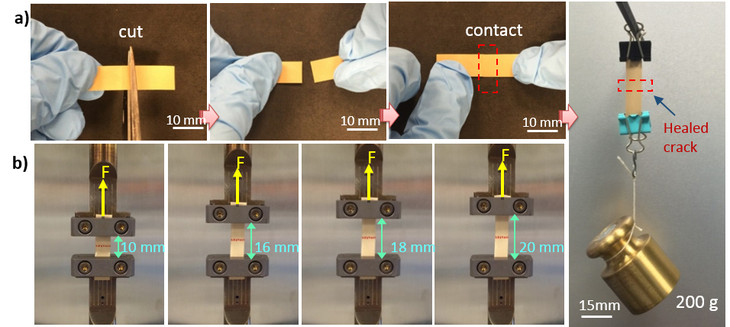
Penn State researchers have developed a flexible electronic material that self-heals to restore multiple functions, even after repeated breaks. (Top row) The material is cut in half, then reattached. After healing for 30 minutes, the material is still able to be stretched and hold weight. (credit: Qing Wang, Penn State)
A new electronic material created by an international team headed by Penn State scientists can heal all its functions automatically, even after breaking multiple times. The new material could improve the durability of wearable electronics.
Electronic materials have been a major stumbling block for the advance of flexible electronics because existing materials do not function well after breaking and healing.
“Wearable and bendable electronics are subject to mechanical deformation over time, which could destroy or break them,” said Qing Wang, professor of materials science and engineering, Penn State. “We wanted to find an electronic material that would repair itself to restore all of its functionality, and do so after multiple breaks.”
In the past, researchers have been able to create self-healable materials (such as these, covered on KurzweilAI) that can restore a single function after breaking. But restoring a suite of functions is critical for creating effective wearable electronics. For example, if a dielectric material retains its electrical resistivity after self-healing but not its thermal conductivity, that could put electronics at risk of overheating.
The material that Wang and his team created restores all properties needed for use as a dielectric in wearable electronics — mechanical strength, breakdown strength to protect against surges, electrical resistivity, thermal conductivity, and dielectric (insulating) properties. They published their findings online in Advanced Functional Materials.
“Most research into self-healable electronic materials has focused on electrical conductivity but dielectrics have been overlooked,” said Wang. “We need conducting elements in circuits but we also need insulation and protection for microelectronics.” Most self-healable materials are also soft or “gum-like,” said Wang, but the material he and his colleagues created is very tough in comparison.

SEM images of healing process of polymer nanocomposite with 8% volume boron nitride nanosheets: (i) freshly cut, (ii) healing in 15 min, and (iii) completely healed in 30 min (credit: Lixin Xing et al./Advanced Functional Materials)
His team added boron nitride nanosheets to a base material of plastic polymer. The material is able to self-heal because boron nitride nanosheets connect to one another with hydrogen bonding groups functionalized onto their surface. When two pieces are placed in close proximity, the electrostatic attraction naturally occurring between both bonding elements draws them close together. When the hydrogen bond is restored, the two pieces are “healed.”
Depending on the percentage of boron nitride nanosheets added to the polymer, this self-healing may require additional heat or pressure, but some forms of the new material can self-heal at room temperature when placed next to each other.
Unlike other healable materials that use hydrogen bonds, boron nitride nanosheets are impermeable to moisture. This means that devices using this dielectric material can operate effectively within high humidity contexts such as in a shower or at a beach.
“This is the first time that a self-healable material has been created that can restore multiple properties over multiple breaks, and we see this being useful across many applications,” said Wang.
Harbin Institute of Technology researches also collaborated on this research, which was supported by the China Scholarship Council.
Penn State Research Communications | Flexible Insulator
Abstract of Self-Healable Polymer Nanocomposites Capable of Simultaneously Recovering Multiple Functionalities
The continuous evolution toward electronics with high power densities and integrated circuits with smaller feature sizes and faster speeds places high demands on a set of material properties, namely, the electrical, thermal, and mechanical properties of polymer dielectrics. Herein, a supramolecular approach is described to self-healable polymer nanocomposites that are mechanically robust and capable of restoring simultaneously structural, electrical, dielectric, and thermal transport properties after multiple fractures. With the incorporation of surface-functionalized boron nitride nanosheets, the polymer nanocomposites exhibit many desirable features as dielectric materials such as higher breakdown strength, larger electrical resistivity, improved thermal conductivity, greater mechanical strength, and much stabilized dielectric properties when compared to the pristine polymer. It is found that the recovery condition has remained the same during sequential cycles of cutting and healing, therefore suggesting no aging of the polymer nanocomposites with mechanical breakdown. Moreover, moisture has a minimal effect on the healing and dielectric properties of the polymer nanocomposites, which is in stark contrast to what is typically observed in the hydrogen-bonded supramolecular structures.
http://www.kurzweilai.net/a-simple-home-urine-test-could-scan-for-diseases
A simple home urine test could scan for diseases
May 18, 2016
Stanford University School of Engineering | This easy-to-assemble black box is part of an experimental urinalysis testing system designed by Stanford engineers. The black box is meant to enable a smartphone camera to capture video that accurately analyzes color changes in a standard paper dipstick to detect conditions of medical interest.
Two Stanford University electrical engineers have designed a simple new low-cost, portable urinalysis device that could allow patients to get consistently accurate urine test results at home.
The system uses a black box and smartphone camera to analyze a standard color-changing paper test, using a medical dipstick dipped into the urine specimen, to measure levels of glucose, blood, protein, and other chemicals — which can indicate evidence of kidney disease, diabetes, urinary tract infections and even signs of bladder cancer.
The current standard dipstick test uses a paper strip with 10 square pads. Dipped in a sample, each pad changes color to screen for the presence of a different disease-indicating chemical. After waiting the appropriate amount of time, a medical professional — or, increasingly, an automated system — compares the pad shades to a color reference chart for results.
But the test takes time, costs money, and creates backlogs for clinics and primary care physicians. The results are often inconclusive, requiring both patient and doctor to book another appointment. So patients with long-term conditions like chronic urinary tract infections must wait for results to confirm what both patient and doctor already know before getting antibiotics. Tracking patients’ progress with multiple urine tests a day is out of the question.
Some innovators have tried to create simple, do-it-yourself systems, but they can be error-prone, said Audrey (Ellerbee) Bowden, assistant professor of electrical engineering at Stanford. “You think it’s easy — you just dip the stick in urine and look for the color change, but there are things that can go wrong,” she said. “Doctors don’t end up trusting those results as accurate.”
A simplified home urinanalysis system

Prototype urinalysis device (credit: Gennifer T. Smith et al./Lab on a Chip)
Writing in Lab on a Chip, a journal of the Royal Society of Chemistry, Bowden and Gennifer Smith, a PhD student in electrical engineering, explain they designed their system to overcome three main potential errors in a home test: inconsistent lighting, urine volume control, and timing.
To fix this, the engineers designed a multi-layered system to load urine onto the dipstick. A dropper squeezes urine into a hole in the first layer, filling up a channel in the second layer, and ten square holes in the third layer. Some clever engineering ensures that a uniform volume of urine is deposited on each of the ten pads on the dipstick at just the right time.
Finally, a smartphone is placed on top of the black box with the video camera focused on the dipstick inside the box. Custom software reads video from the smartphone and controls the timing and color analysis.
To perform the test a person would load the urine and then push the third layer into the box. When the third layer hits the back of the box, it signals the phone to begin the video recording at the precise moment when the urine is deposited on the pads.
Timing is critical to the analysis. Pads have readout times ranging from 30 seconds to 2 minutes. Once the two minutes are up, the person can transfer the recording to a software program on their computer. For each pad, it pulls out the frames from the correct time and reads out the results.
The engineers also plan to design an app to send the results directly to the doctor.
Funding for this research came from the National Institutes of Health, the Rose Hills Foundation Graduate Engineering Fellowship, the Electrical Engineering Department New Projects Graduate Fellowship, the Oswald G. Villard Jr. Engineering Fellowship, the Stanford Graduate Fellowship and the National Science Foundation Graduate Research Fellowship.
Abstract of Robust dipstick urinalysis using a low-cost, micro-volume slipping manifold and mobile phone platform
We introduce a novel manifold and companion software for dipstick urinalysis that eliminate many of the aspects that are traditionally plagued by user error: precise sample delivery, accurate readout timing, and controlled lighting conditions. The proposed all-acrylic slipping manifold is reusable, reliable, and low in cost. A simple timing mechanism ensures results are read out at the appropriate time. Results are obtained by capturing videos using a mobile phone and by analyzing them using custom-designed software. We show that the results obtained with the proposed device are as accurate and consistent as a properly executed dip-and-wipe method, the industry gold-standard, suggesting the potential for this strategy to enable confident urinalysis testing in home environments.
http://www.forbes.com/sites/ewanspence/2016/05/18/apple-iphone-7-qi-wireless-charing/#cbbdb9d472cc
Apple’s Secret Weapon To Create A Seductive iPhone 7
Ewan Spence
CONTRIBUTOR
I look at the impact of mobile technology and online media.
Opinions expressed by Forbes Contributors are their own.
Every week seems to bring another note from the supply chain about Apple dropping another key feature from the upcoming iPhone 7. With many popular features from rival handsets not expected to arrive until 2017′s presumptively titled iPhone 8, it’s nice to read about one technology that I hope Apple will bring to the iPhone 7. With so much ‘gee whizz’ delayed a year, could wireless charging be the big attraction of this year’s flagship iPhone launch?
Apple already has experience with wireless charging – the Apple Watch uses an inductive charging system that removes the need for a wires connection between the device and the charger, although it does required the transmitting and receiving coils to be in close proximity to each other. Beyond the Apple Watch, Cupertino’s recent hires show the company is continuing to explore this space. The Verge’s Ben Popper has been scouting around LinkedIn to find a number of key hires in the wireless space moving to Apple:
In the last four months two former uBeam engineers with expertise in wireless charging and ultrasonic technology had been hired by Apple. In fact, public LinkedIn data on Apple’s recent hires shows these former uBeam staffers were part of a much broader trend. In the last two years Apple has hired more than a dozen staffers with expertise in wireless charging.
While uBeam’s promise of wireless charging at a distance still needs to be commercially validated, my experience of wireless charging through charging pads and embedded coils in my office furniture has convinced me that this is a technology every smartphone would benefit from.
Looking back through my mobile history, the Nokia Lumia 800 was the first smartphone I had that embraced wireless charging. it used the popular Qi standard and worked not only with Nokia’s own charing pads, but any pad that used the Qi standard. It untethered me from the USB cable, and meant that the phone was always charging when sitting on my desk. Whenever I picked it up, I was good to go with the most charge possible in the handset.
While a number of other smartphones added wireless charging over the years, it didn’t really hit the mainstream public until last year’s release of the Galaxy S6 and S6 Edge. With compatibility for both wireless standards in the device, a significant volume of devices that accessory manufacturers could rely on as a target market, and Samsung’s marketing machine pushing the message, wireless charing became a mainstream feature.
From a practical point of view it took away much of the fear I had of running out of charge on the Galaxy S6 during the working day. The smartphone sat on my desk where I could see the screen, and whenever I needed to go somewhere I simply picked it up and into my pocket it went. I know the stock answer is ‘just unplug a USB cable’ but the reduced friction of charging by using wireless is immense. You either understand this, or haven’t used wireless charing in anger yet.
The flip side of that was I was incredibly conscious of the falling battery gauge when I was travelling and relying on portable USB-based charging batteries. Still, you can’t have everything, and I’m at my desk more often than I travel.
 Bruce's Blog