http://www.dailymail.co.uk/news/article-3595796/Half-million-Britons-vegans-Number-no-longer-eat-diary-meat-fish-soars-350-000-decade.html

Half a million Britons are now vegans: Number who now no longer eat diary, meat or fish soars by 350,000 in a decade

  • There has been a dramatic rise in the number of vegans in the past decade
  • Those sticking to a non-meat and dairy diet has gone up 247 per cent 
  • Young people are largely behind the increase with 42% of vegans 15 to 34  

More than half a million Britons are now vegans, a survey has revealed.

The dramatic rise in those sticking to the strict no-meat, fish or dairy diet – up 247 per cent from 150,000 a decade ago – has been put down to more people trying for a healthy lifestyle and growing concerns about the treatment of animals by the food industry.

Young people were largely behind the increase, with 42 per cent of all vegans aged 15 to 34, according to the research by Ipsos MORI and The Vegan Society in partnership with Vegan Life magazine. It found there were 521,000 vegans across Britain and 1.68million vegetarians.

The dramatic rise in those sticking to the strict no-meat, fish or dairy diet ¿ up 247 per cent from 150,000 a decade ago (file picture) 

The dramatic rise in those sticking to the strict no-meat, fish or dairy diet – up 247 per cent from 150,000 a decade ago (file picture)

Two time world boxing champion David Haye became a vegan for the health benefits and there is a growing list of elite meat-free athletes, including squash champion James Willstrop, Olympic cyclist Lizzie Armitstead and former footballer Phil Neville.

The research commissioned by The Vegan Society in partnership with Vegan Life magazine showed 42 per cent all vegans are aged 15-34. Just 14 per cent who are aged over 65.

Chief executive of The Vegan Society Jasmijn de Boo said: ‘To have over half a million vegans in Britain is fantastic.

‘More people than ever are now acting upon the health and environmental benefits of veganism, and finding out what really goes on in the meat and dairy industries and deciding they do not want to contribute to the pain and suffering of animals.’

The survey also found that nearly half of vegetarians who are not vegan would like to reduce their consumption animal products.

This equates to 521,000 people across Britain, meaning the popularity of veganism is set to rise further.

More than 850,000 of vegetarians and vegans also avoid leather, wool and other animal products.

The vast majority of vegans live in urban or suburban areas – 88 per cent – compared with rural areas – just 12 per cent.

Some 22 per cent of Britain’s vegans live in London – more than any other region.

The survey also found that nearly half of vegetarians who are not vegan would like to reduce their consumption animal products (file picture) 

The survey also found that nearly half of vegetarians who are not vegan would like to reduce their consumption animal products (file picture)

Vegan Life magazine publishing director Keith Coomber said: ‘The public perception of veganism is changing fast. It’s no longer an extreme lifestyle.

‘It’s easy and accessible and you can walk into any supermarket and be confronted by a huge range of dairy-free milks and other vegan-friendly products.

‘As consumers become more savvy about the reality of the farming industry, and the health implications of meat and dairy products, this boom will only continue.”

While Ms De Boo added: ‘The reasons behind the rise of veganism are numerous.

‘The positive portrayal in the media has contributed to its changing image and documentaries on the shocking realities and consequences of animal agriculture have gained prominence.

‘Delicious-looking vegan recipes have multiplied online and on social media as society has becomes increasingly health-conscious and top vegan athletes keep proving that you can be fit and healthy.

‘Going vegan is the best thing any individual can do for the animals, the planet and your health.’
 

http://www.gizmodo.com.au/2016/05/spider-silk-inspires-creation-of-liquid-wire/

Spider Silk Inspires Creation Of ‘Liquid Wire’

Spider Silk Inspires Creation of 'Liquid Wire'

Scientists have discovered a previously unknown property of spider silk, and used it to create a remarkable new “hybrid” material. The new bio-inspired thread, which acts like both a solid and a liquid, could lead to a host of new materials and technologies.

Spider silk is one of the most extraordinary materials found in nature, featuring tensile strengths comparable to steel, and elasticity commensurate with rubber (at least on a weight-to-weight basis). Together, these two properties make it two to three times tougher that some of the strongest synthetic materials, including Kevlar and nylon. What’s more, spider silk is sticky (to catch unsuspecting prey), antimicrobial, hypoallergenic and biodegradable. So scientists and engineers would like to understand as much about it as possible to develop similarly robust synthetic materials.

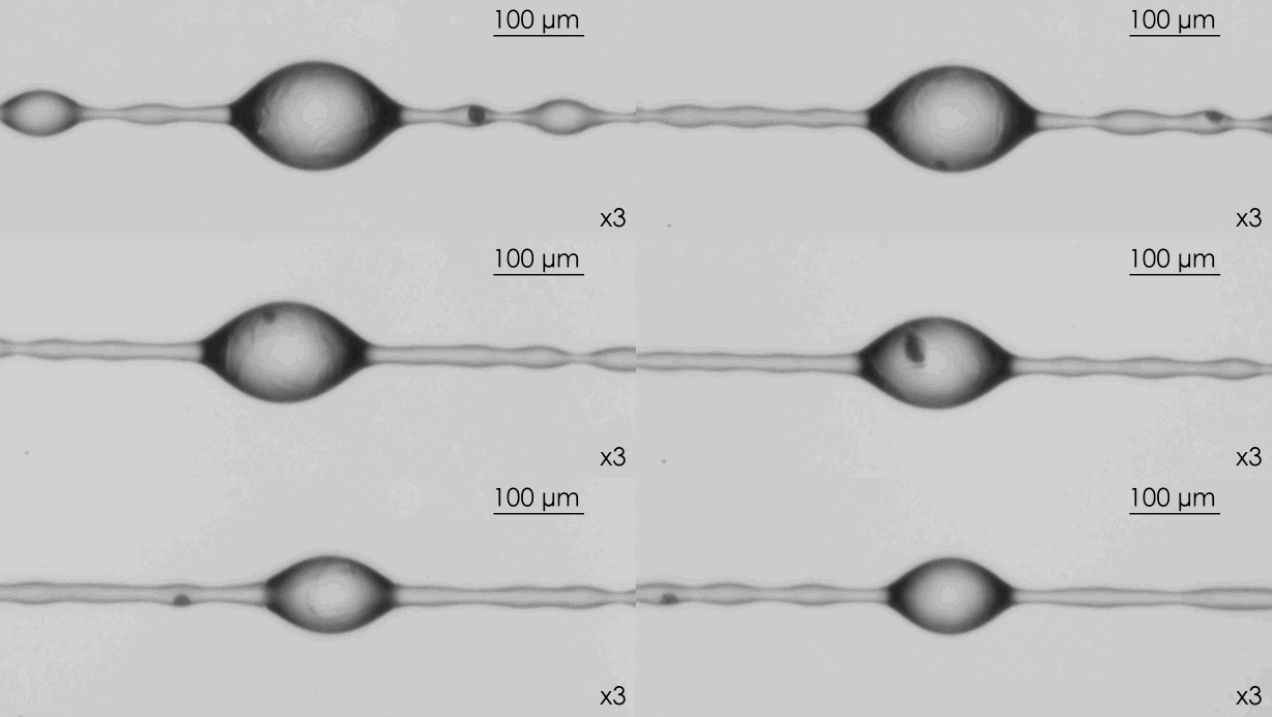
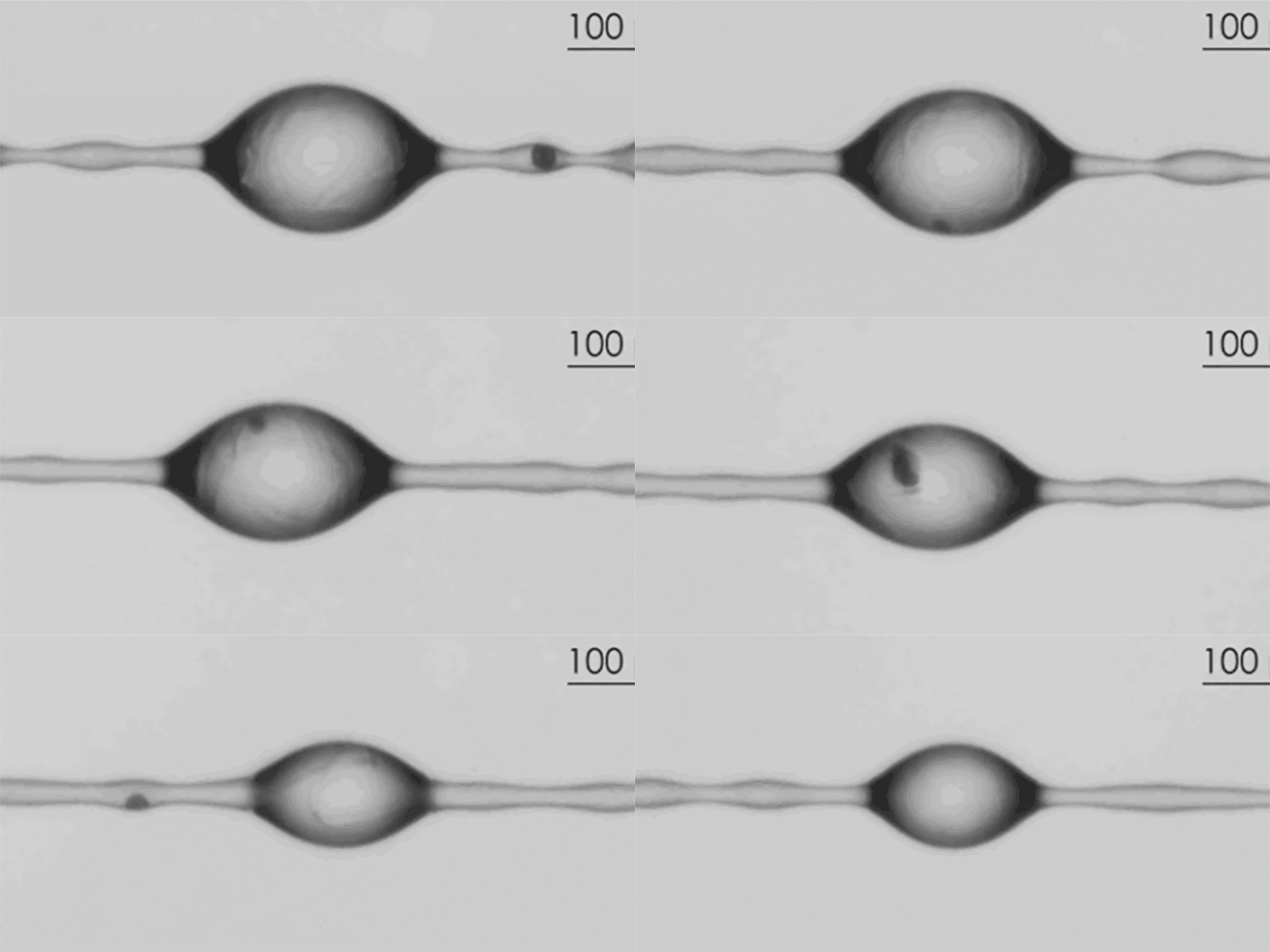
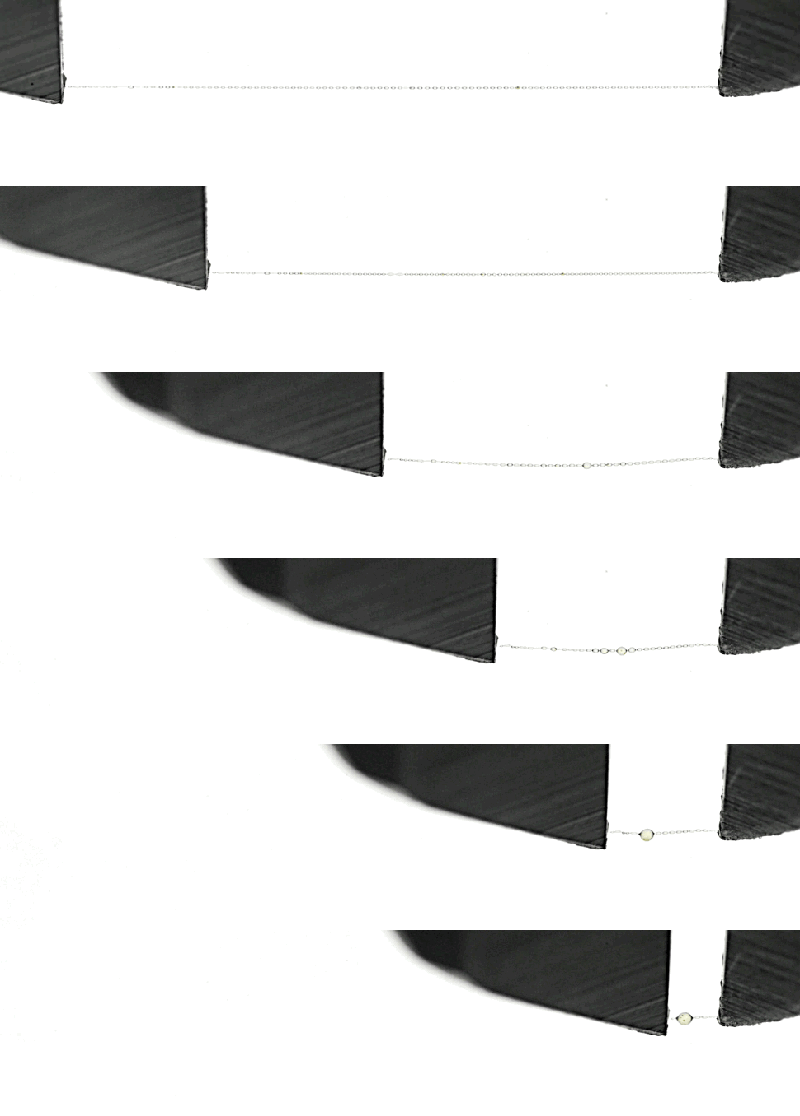
In this video, the thread can be seen contracting in a process that’s very liquid-like. (Credit: Hervé Elettro et al., 2016)

New research conducted by scientists at the University of Oxford and the Université Pierre et Marie Curie, Paris, France, has uncovered yet another remarkable attribute. The capture silk produced by orb spiders (a common garden spider) is always taut, even after it has been stretched to many times its original length. What’s more, it contracts in a way that’s quite liquid-like.

When spider silk is compressed, its filaments shorten by spooling inside tiny droplets of watery glue that cling to the threads, allowing the web to remain under tension. The process is reversible, allowing the thread to be extended. These findings now appear in the Proceedings of the National Academy of Sciences.

“The thousands of tiny droplets of glue that cover the capture spiral of the spider’s orb web do much more than make the silk sticky and catch the fly,” said study co-author and Oxford scientist Fritz Vollrath in a statement. “Surprisingly, each drop packs enough punch in its watery skins to reel in loose bits of thread. And this winching behaviour is used to excellent effect to keep the threads tight at all times, as we can all observe and test in the webs in our gardens.”

Vollrath and his team were inspired by this “liquid wire” to create their own composite fibres in the lab. They tapped into the delicate and subtle balance that exists between fibre elasticity and droplet surface tensions. The resulting artificial spider silk worked just like the spider’s natural winch silk; the spools of filament reeled and unreeled inside the oil droplets as the thread expanded and contracted. The material is considered a hybrid because it extends like a solid and compresses like a liquid. (The process is similar to what’s observed when water droplets come into contact with one another.)

A thin polyurethane fibre instantly turns into a liquid wire when coated with oil droplets. (Credit: Hervé Elettro et al., 2016)

Eventually, these hybrid threads could lead to advancements in materials science, engineering and medicine.

“Our bio-inspired hybrid threads could be manufactured from virtually any components,” said first author Hervé Elettro. “These new insights could lead to a wide range of applications, such as microfabrication of complex structures, reversible micro-motors, or self-tensioned stretchable systems.”

http://gizmodo.com/the-biggest-source-of-air-pollution-in-your-area-may-su-1776903944

The Biggest Source of Air Pollution In Your Area May Surprise You

The largest source of deadly air pollution in many parts of the world isn’t cars or power plants—it’s farms. That’s the unsettling conclusion of astudy conducted by researchers at Columbia University, who found that agricultural nitrogen emissions are a major contributor to fine particulate matter, tiny particles that cause heart disease and respiratory problems.

The trouble starts when fertilizers and manure release ammonia, or NH3, into the air. As ammonia is swept downwind of farms, it encounters pollutants produced by vehicles and factories, including nitrogen oxides and sulfates. Through a series of chemical reactions, these molecules combine to generate tiny, gag-inducing particles that are less than 2.5 microns in diameter (often referred to as “PM 2.5″).

PM 2.5 is notoriously dangerous—a recent study estimated that these particles are responsible for up 5.5 million premature deaths each year. Just last week, an analysis by the World Health Organization revealed that PM 2.5 and larger particles create unsafe air for more than 80 percent city dwellers, especially in the developing world.

But in the United States, Europe, Russia and China, folks living near farms may be at the greatest risk.

The role of farms as a source of local air pollution spikes has been studied for years. But the new study, published this week in Geophysical Research Letters, highlights just how widespread of an issue ammonia emissions are on a global scale. In much of the eastern and central United States, ammonia is responsible for over half of all aerosol precursors. In parts of Europe and China, farms are an even bigger contributor to foul air.

There is, however, a silver lining to understanding the cause of air pollution: figuring out how to clean it up. Indeed, since it’s the combination of ammonia and industrial pollutants that produce particulate matter, air pollution near farms should start to fall as we transition to clean energy vehicles and impose stricter regulations on power plants.

That’s very good news, because it’s unlikely the world is going to wean itself off nitrogen fertilizers anytime soon—not if we hope to feed an extratwo billion people by 2050.

http://www.bbc.com/news/technology-36311668

Random number generator ‘improved’

A new method for computer-generating random numbers is being called”remarkable”, and could help improve computer security.

Random numbers are important for computer encryption, lotteries, scientificmodelling, and gambling.

Current methods of generating random numbers can produce predictable results.

Researchers said the new method could generate higher-quality random numberswith less computer processing.

The problem of generating random numbers lies in the fact that computers arefundamentally predictable machines, running calculations and delivering answersbased on mathematics.

Slow and predictable

There are currently two main methods for generating random numbers.

In the first, a computer picks numbers according to an algorithm or from a pre-generated list.

This method, while fast and not requiring much computer power, is not trulyrandom, because the results are predictable.

The second method introduces an unpredictable element from the real world intothe algorithm.

This might be a reading of air temperature, a measurement of backgroundradiation, or variations in atmospheric noise.

Some of these measurements, however, have their own patterns – and may not betruly random.

They can also be difficult to acquire.

The new solution takes two “weak” random sources to generate a single, high-quality random number.

That made it a faster, more practical solution for an almost-perfectly randomnumber, said Prof Alan Woodward, of Surrey University, and it could haveimplications for encryption and security.

“In cryptography, random numbers are essential,” he said.

“Given enough time, all algorithms can be reverse-engineered.

“You have to build the algorithm so that it takes so long to reverse-engineer it’s notworth it.

“Random number equations are central to injecting this randomness.”

“It’s not often that cryptographers and mathematicians get excited… but it does looklike party time.

“It’s remarkable.”

Cornerstone of security

Dr Mads Haahr of Trinity College Dublin, who created the online random numbergenerator random.org, said the development was an improvement in efficiency, butnot a fundamental leap forward.

“While the paper might be a good contribution in the specific research area ofrandomness extraction, I would not call it a breakthrough… all those things arealready possible with existing methods and have been for many years,” he said.

“If the authors’ claims hold up, we will be able to do these things faster than before,and with equipment of poorer quality, which is great, but the method doesn’t enableany applications that weren’t possible before.

“I’m glad to see there is good research going on to improve the state of the art.

“In many ways, randomness is the under-appreciated cornerstone of data security.

“As regular users of information technology, we tend not to appreciate howimportant it is.”

The new method was detailed in a paper by two researchers from the University ofTexas, published online in July 2015.

It has taken almost a year for other researchers to examine its findings, expandupon the method, and for the original authors to add revisions.

The team will now present its research at the annual Symposium on Theory ofComputing in June, where it will be one of three recipients of the best paper award.

http://patch.com/connecticut/danbury/danbury-area-students-earn-awards-intels-global-science-competition-0

Danbury Area Students Earn Awards at Intel’s Global Science Competition

The students went all expenses paid as part of their prize for earning top awards at this year’s Connecticut Science & Engineering fair.

http://www.kurzweilai.net/ingestible-origami-robot-lets-doctors-operate-on-a-patient-remotely

Ingestible ‘origami robot’ lets doctors operate on a patient remotely

May 17, 2016

An “origami robot” unfolds itself from an ingestible capsule. It could be used by a physician to perform a remote-controlled operation (credit: Melanie Gonick/MIT)

MIT researchers and associates have developed a tiny “origami robot” that can unfold itself from a swallowed capsule and, steered by a physician via an external magnetic field, crawl across the stomach wall to operate on a patient. For example, it can remove a swallowed button battery or patch a wound.

System for remote-controlled clinical procedures via origami-based robot. A patient swallows an iced capsule, which melts when it reaches the stomach, releasing the robot from a folded origami structure. To remove a foreign body (such as a button battery), the physician controls the robot from outside the body via a magnetic field that affects the magnet inside the delivery structure, allowing the robot to push the foreign body into the GI system. The robot can also treat an inflammation by releasing a drug contained in the delivery structure. (credit: Shuhei Miyashita et al./ICRA Proceedings)

Every year, 3,500 swallowed button batteries are reported in the U.S. alone. Frequently, the batteries are digested normally, but if they come into prolonged contact with the tissue of the esophagus or stomach, they can cause an electric current that produces hydroxide, which burns the tissue.

The researchers at MIT, the University of Sheffield, and the Tokyo Institute of Technology presented the work last week at the International Conference on Robotics and Automation. The design built on previous work (see related links below) from the research group of Daniela Rus, the Andrew and Erna Viterbi Professor in MIT’s Department of Electrical Engineering and Computer Science. The new robot is a successor to one reported at this conference last year, with an improved design, tested in a pig stomach.

Rus and the team plan further developments, including the robot’s ability to perform procedures without physician remote control.


MIT | Ingestible origami robot


Abstract of Ingestible, Controllable, and Degradable Origami Robot for Patching Stomach Wounds

Developing miniature robots that can carry out versatile clinical procedures inside the body under the remote instructions of medical professionals has been a long time challenge. In this paper, we present origami-based robots that can be ingested into the stomach, locomote to a desired location, remove a foreign body, deliver drugs, and biodegrade. We designed and fabricated composite material sheets for a biocompatible and biodegradable robot that can be encapsulated in ice for delivery through the esophagus, embed a drug layer that is passively released to a wounded area, and be remotely controlled to carry out underwater maneuvers specific to the tasks using magnetic fields. The performances of the robots are demonstrated in a simulated physical environment consisting of an esophagus and stomach with properties similar to the biological organs.

references:

  • Shuhei Miyashita, Steven Guitron, Kazuhiro Yoshida, Shuguang Li, Dana D. Damian, and Daniela Rus. Ingestible, Controllable, and Degradable Origami Robot for Patching Stomach Wounds. Proceedings from ICRA 2016 – 2016 IEEE International Conference on Robotics and Automation (in press)

http://news.ubc.ca/2016/05/17/inattentive-much-heres-why-smartphones-may-be-to-blame/

Inattentive much? Here’s why smartphones may be to blame

A University of Virginia-UBC study links smartphone alerts to symptoms of attention deficit hyperactivity disorder, reports theDaily Mail.

The study followed 221 UBC students and found that when they had their phones’ notification alerts on and kept their phones within reach, they were more inattentive and hyperactive than when interruptions were kept to a minimum.

A similar story also appeared on CTV NewsInternational Business Times, CNET and Georgia Straight.

http://www.laptopmag.com/articles/hp-elitebook-1030-announcement

HP EliteBook 1030 Promises 13 Hours of Battery Life

If you love the look of HP’s new, slim EliteBook Folio but need something with a bigger battery and display, the newly announced HP EliteBook 1030 could be for you. The company has just unveiled the laptop, which sports a 13-inch display and  a battery that’s supposed to  last for 13 hours — a number we hope to see replicated on our battery tests.

1030elitebook

The new laptop will release in May, but HP hasn’t set a firm date, and will start at $1,249.  Consumers will be able to pick from a variety of Core m processors, up t0 16GB of RAM, SSD storage up to 512GB and a display up to 3200 x 1800. The EliteBook 1030 will continue HP’s partnership with Bang & Olufsen for speakers.

HP claims that the aluminum notebook will weigh just 2.55 pounds and is 15.7 mm thick. Additionally, it’s designed to pass MIL-STD tests for shock, vibrations and extreme temperatures. Its edge-to-edge display suggests that HP may finally be ready to take on the XPS 13, but we’ll have to see it ourselves to be sure.

We’re looking forward to testing the EliteBook 1030 when it launches later this month.