http://www.kurzweilai.net/a-robot-with-human-like-grace-and-precision

A robot with human-like grace and precision

Teleoperated system can thread a needle, pick up an egg
May 11, 2016
[+]

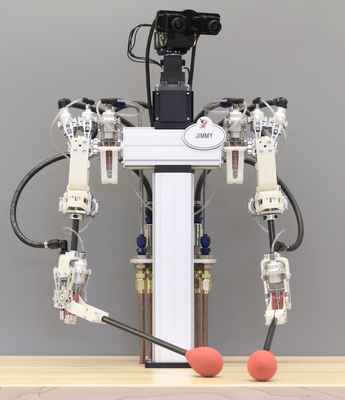
A hybrid hydrostatic transmission and human-safe haptic telepresence robot (credit: Disney Research)

A human-safe lifelike telepresence robot with the delicacy and precision needed to pick up an egg without breaking it or thread a sewing needle has been developed by researchers at Disney Research, the Catholic University of America, and Carnegie Mellon University.

The secret: a hydrostatic transmission that precisely drives robot arms, offering extreme precision with almost no friction or play.

The hybrid transmission design also makes it possible to halve the number of bulky hydraulic lines that a fully hydraulic system would require and allows for making its robotic limbs lighter and smaller, said John P. Whitney, an assistant professor of mechanical and industrial engineering at Northeastern University, who led the development of the transmission while an associate research scientist at Disney Research.

Whitney said a robot joint normally would have two hydraulic cylinders, balanced against each other. But in this latest design, the researchers paired each water-filled cylinder with an air-filled cylinder instead. The pneumatic cylinder serves as a constant force air-spring, providing the necessary preload force and allowing the joint to move in both directions with only half the number of bulky hydraulic lines.

Lifelike interaction with people

The researchers used the new transmission to build a simple humanoid robot with two arms, with stereo cameras mounted in the head, streaming their video signal to an operator wearing a head-mounted display. The arms are coupled to an identical control figure to enable the robot to be used for human-robot interaction research.

“This technology enabled us to build robot arms that are light, fast, and dexterous,” Whitney said. “They have an incredible lifelike nature, offering a combination of small mass, high speed, and precise motion not seen before.”

Robots using this technology are ideally suited for naturally compliant and lifelike interaction with people. When tele-operated, the low friction and lack of play allow the transmission to faithfully transmit contact forces to the operator, providing a high-fidelity remote sense of touch.

Whitney and colleagues will report on the new transmission and the upper body humanoid robot they built with it at the IEEE Conference on Robotics and Automation, ICRA 2016, May 17 in Stockholm, Sweden.


Disney Research | A Hybrid Hydrostatic Transmission and Human Safe Haptic Telepresence Robot


Abstract of A Hybrid Hydrostatic Transmission and Human-Safe Haptic Telepresence Robot

We present a new type of hydrostatic transmission that uses a hybrid air-water configuration, analogous to N+1 cable-tendon transmissions, using N hydraulic lines and 1 pneumatic line for a system with N degrees of freedom (DOFs). The common air-filled line preloads all DOFs in the system, allowing bidirectional operation of every joint. This configuration achieves the high stiffness of a water-filled transmission with half the number of bulky hydraulic lines. We implemented this transmission using pairs of rolling-diaphragm cylinders to form rotary hydraulic actuators, with a new design achieving a 600-percent increase in specific work density per cycle. These actuators were used to build a humanoid robot with two 4-DOF arms, connected via the hydrostatic transmission to an identical master. Stereo cameras mounted on a 2-DOF servo-controlled neck stream live video to the operator’s head-mounted display, which in turn sends the real-time attitude of the operator’s head to the neck servos in the robot. The operator is visually immersed in the robot’s physical workspace, and through the bilateral coupling of the low-impedance hydrostatic transmission, directly feels interaction forces between the robot and external environment. We qualitatively assessed the performance of this system for remote object manipulation and use as a platform to safely study physical human-robot interaction.

http://news.ubc.ca/2016/05/13/eyewitnesses-memories-darken-skin-colour-when-recalling-black-crimes/

Eyewitnesses’ memories darken skin colour when recalling ‘black’ crimes

Castanet News reported on a study showing that eyewitness accounts are influenced by the types of crime.

“Eyewitness testimony is very compelling and may have the ability to sway a jury,” said study co-author Paul Davies of the UBCO psychology department. “However, if we know that witnesses’ memories are inherently biased in the case of black male suspects, our justice system may want to take that into account to aid them in avoiding wrongful convictions.”

http://blog.wolfram.com/2016/05/13/special-event-new-wolfram-language-resources-for-the-classroom/

Rob Morris

Special Event: New Wolfram Language Resources for the Classroom

May 13, 2016 — Rob Morris, Education Product Analyst, Business Analysis

Earlier this year we launched Wolfram Programming Lab as the place to start learning the Wolfram Language. And since launch, we’ve received a lot of feedback and support from educators and students interested in using Programming Lab in their classrooms.

Programming Lab was conceived and designed with teaching in mind, and to help make Programming Lab the best possible learning environment, we’ve developed some new tools for both students and teachers. We invite you to preview these new materials at a special virtual event,New Resources for the Classroom: Virtual Workshop for Educators.

New Resources for the Classroom: Virtual Workshop for Educators

Programming Lab is built on two major components utilizing two different learning styles to teach coding in the Wolfram Language—Explorations are based on a jump-right-in-and-explore approach, and Stephen Wolfram’s book An Elementary Introduction to the Wolfram Language provides the basis for a systematic approach. We are introducing new educator-focused functionality for both of these components.

First are the Explorations. These are bite-sized coding exercises designed to create something or answer a specific question. We are enhancing these by introducing Teacher’s Editions, which provide goals, procedures, and helpful comments for each step within an Exploration. In addition to these, we have also developed “Programming Lab modules.” These are handy planning guides that are tailor-made to fit a specific duration: a three-day introduction, a five-day series, and so on. They range across topics that include astronomy, geography, math, and many others. These modules provide educators with the material they need to present Explorations that will complement the curriculum, or as a fun way to introduce a topic while simultaneously adding a programming language to their toolkits.

Wolfram Programming Lab

Explorations work well as targeted activities for students, but some students will want a more rigorous framework for learning the Wolfram Language. Those students will benefit from working through Stephen Wolfram’s An Elementary Introduction to the Wolfram Language, which is built into Programming Lab. At the end of each section of the book, there are exercises to help solidify your understanding. We’re enhancing these exercises by providing instant, automated grading of your answers.

To preview these new materials and to be the first to try them out, please join us at the virtual event on May 17, 2016, from 4–5pm US EDT (8–9pm GMT). All are welcome, as no programming experience is necessary! This event is part of a series of workshops for educators, ranging in focus from how to use Programming Lab to teaching computational thinking principles. Recordings ofpast events are available online. You can register for the latest educator workshop here.

http://business.financialpost.com/fp-tech-desk/google-incs-ai-guru-ray-kurzweil-talks-failure-nano-robots-and-the-singularity-in-waterloo?__lsa=1b9d-38b8

Google Inc’s AI guru Ray Kurzweil talks failure, nano-robots, and the singularity in Waterloo

Kurzweil said he visits many communities and gives many speeches like the one he delivered Thursday at the Tech Leadership Conference, hosted by the innovation hub Communitech. Wherever he goes, people tell him he’s visiting the region’s equivalent of Silicon Valley: “Our community is the Silicon Valley of the Left Bank of Paris, our community is the Silicon Valley of Tel Aviv.”

“Kitchener-Waterloo and the Toronto area really are a Silicon Valley, second only maybe to the actual Silicon Valley. A place that celebrates the idea that failure is something to be, if not encouraged, at least accepted,” he said. “We have a word for failure. It’s called experience. The only way to make these innovations in the world is to accept these frustrations and setbacks.”

Waterloo’s major frustration and setback, of course, would be BlackBerry Ltd.’s decline. Once one of the world’s leading handset makers, it has gone from selling more than 12 million handsets each quarter to about 700,000, after it was dethroned by Apple Inc.’s iPhone.

But if Kurzweil is right, we shouldn’t worry too much about such things, since new technological wonders — including indefinitely prolonged life — are much closer than most people think.

Kurzweil has a long and colourful resume. He invented the flatbed scanner, the text-to-speech machine and the musical synthesizer, making the first one capable of reproducing the sounds of musical instruments like the grand piano.

Lately, he is best known as a public intellectual, writing best-selling books such as The Singularity is Near and How to Create a Mind that make predictions about advances in artificial intelligence and human health. He has made accurate predictions on topics ranging from growth in Internet usage and wireless communications, pegging his accuracy rate at 86 per cent (a figure disputed by critics).

That track record makes people more willing to listen to the predictions he’s making now, many of which sound more like the plot of a science fiction movie than reality.

Kurzweil believes that two decades from now, our bloodstreams will be filled with robots the size of blood cells fighting diseases and improving our cognitive functions, allowing humans to radically extend their life spans.

By 2029, he predicts humans will be unable to tell if they are conversing with a machine or another human, known as the Turing test for artificial intelligence. Fifteen years beyond that, he says humans will merge their intelligence with machines in an event known as the singularity.

Google, for one, is listening to what he has to say, putting him in charge of a team working on machine intelligence and natural language understanding. Kurzweil said the difference between himself and his critics — and one of the main reasons predictions about technological progress usually turn out to be completely wrong — is that he works on the assumption the pace of change will be exponential, not linear.

“This trickle of applications now coming into practice will be a flood over the next decade,” Kurzweil said. “These technologies will be another 1,000 times more powerful in 10 years, one million times more powerful in 20 years.”

Kurzweil said investors are often frustrated when hyped technology, from e-commerce during the dot-com bubble of the early ‘00s to three dimensional printing today, takes longer to catch on than people hoped. That’s because exponential growth curves start off slowly before taking off at huge rates of change.

When that happens, both technology and the value of companies that own and develop it grow at rapid paces, he said. Kurzweil cited Google and Apple, now the world’s two biggest companies by market capitalization, as examples.

Kurzweil pulled a smartphone out of his pocket to make his point.

“This is several billion times more powerful in terms of computation and communication than the computer I used when I went to the Massachusetts Institute of Technology, he said. “I actually went to MIT because it was so advanced at the time, it actually had a computer.”

// <![CDATA[
(function(){var h,k=this,l=function(a,b){var c=a.split("."),d=k;c[0]in d||!d.execScript||d.execScript("var "+c[0]);for(var e;c.length&&(e=c.shift());)c.length||void 0===b?d=d[e]?d[e]:d[e]={}:d[e]=b},m=function(a){var b=typeof a;if("object"==b)if(a){if(a instanceof Array)return"array";if(a instanceof Object)return b;var c=Object.prototype.toString.call(a);if("[object Window]"==c)return"object";if("[object Array]"==c||"number"==typeof a.length&&"undefined"!=typeof a.splice&&"undefined"!=typeof a.propertyIsEnumerable&&!a.propertyIsEnumerable("splice"))return"array";if("[object Function]"==c||"undefined"!=typeof a.call&&"undefined"!=typeof a.propertyIsEnumerable&&!a.propertyIsEnumerable("call"))return"function"}else return"null";else if("function"==b&&"undefined"==typeof a.call)return"object";return b},aa=function(a){var b=m(a);return"array"==b||"object"==b&&"number"==typeof a.length},p=function(a){return"string"==typeof a},q=function(a){var b=typeof a;return"object"==b&&null!=a||"function"==b},ba=function(a,b,c){return a.call.apply(a.bind,arguments)},ca=function(a,b,c){if(!a)throw Error();if(2<arguments.length){var d=Array.prototype.slice.call(arguments,2);return function(){var c=Array.prototype.slice.call(arguments);Array.prototype.unshift.apply(c,d);return a.apply(b,c)}}return function(){return a.apply(b,arguments)}},t=function(a,b,c){t=Function.prototype.bind&&-1!=Function.prototype.bind.toString().indexOf("native code")?ba:ca;return t.apply(null,arguments)};var u=function(a,b){var c=parseInt(a,10);return isNaN(c)?b:c};var x;var y=String.prototype.trim?function(a){return a.trim()}:function(a){return a.replace(/^[\s\xa0]+|[\s\xa0]+$/g,"")},z=function(a,b){return ab?1:0};var da=Array.prototype.indexOf?function(a,b,c){return Array.prototype.indexOf.call(a,b,c)}:function(a,b,c){c=null==c?0:0>c?Math.max(0,a.length+c):c;if(p(a))return p(b)&&1==b.length?a.indexOf(b,c):-1;for(;c<a.length;c++)if(c in a&&a[c]===b)return c;return-1},ea=Array.prototype.forEach?function(a,b,c){Array.prototype.forEach.call(a,b,c)}:function(a,b,c){for(var d=a.length,e=p(a)?a.split(""):a,f=0;f<d;f++)f in e&&b.call(c,e[f],f,a)},fa=function(a){var b=a.length;if(0<b){for(var c=Array(b),d=0;dparseFloat(L)){K=String(N);break a}}K=L}var O=K,P={},Q=function(a){var b;if(!(b=P[a])){b=0;for(var c=y(String(O)).split("."),d=y(String(a)).split("."),e=Math.max(c.length,d.length),f=0;0==b&&f<e;f++){var g=c[f]||"",n=d[f]||"",v=RegExp("(\\d*)(\\D*)","g"),va=RegExp("(\\d*)(\\D*)","g");do{var r=v.exec(g)||["","",""],w=va.exec(n)||["","",""];if(0==r[0].length&&0==w[0].length)break;b=z(0==r[1].length?0:parseInt(r[1],10),0==w[1].length?0:parseInt(w[1],10))||z(0==r[2].length,0==w[2].length)||z(r[2],w[2])}while(0==b)}b=P[a]=0<=b}return b},R=k.document,ka=R&&H?J()||("CSS1Compat"==R.compatMode?parseInt(O,10):5):void 0;var S;if(!(S=!I&&!H)){var T;if(T=H)T=9<=Number(ka);S=T}S||I&&Q("1.9.1");var la=H&&!Q("9");var ma=function(a){var b=document;return p(a)?b.getElementById(a):a},oa=function(a,b){var c=b||document;return c.querySelectorAll&&c.querySelector?c.querySelectorAll("."+a):na(a,b)},na=function(a,b){var c,d,e,f;c=document;c=b||c;if(c.querySelectorAll&&c.querySelector&&a)return c.querySelectorAll(""+(a?"."+a:""));if(a&&c.getElementsByClassName){var g=c.getElementsByClassName(a);return g}g=c.getElementsByTagName("*");if(a){f={};for(d=e=0;c=g[d];d++){var n=c.className,v;if(v="function"==typeof n.split)v=0<=da(n.split(/\s+/),a);v&&(f[e++]=c)}f.length=e;return f}return g},qa=function(a,b,c){function d(c){c&&b.appendChild(p(c)?a.createTextNode(c):c)}for(var e=1;e<c.length;e++){var f=c[e];!aa(f)||q(f)&&0<f.nodeType?d(f):ea(pa(f)?fa(f):f,d)}},ra={SCRIPT:1,STYLE:1,HEAD:1,IFRAME:1,OBJECT:1},sa={IMG:" ",BR:"\n"},ua=function(){var a=document.getElementById("feedback-closing-template");if(la&&null!==a&&"innerText"in a)a=a.innerText.replace(/(\r\n|\r|\n)/g,"\n");else{var b=[];ta(a,b,!0);a=b.join("")}a=a.replace(/ \xAD /g," ").replace(/\xAD/g,"");a=a.replace(/\u200B/g,"");la||(a=a.replace(/ +/g," "));" "!=a&&(a=a.replace(/^\s*/,""));return a},ta=function(a,b,c){if(!(a.nodeName in ra))if(3==a.nodeType)c?b.push(String(a.nodeValue).replace(/(\r\n|\r|\n)/g,"")):b.push(a.nodeValue);else if(a.nodeName in sa)b.push(sa[a.nodeName]);else for(a=a.firstChild;a;)ta(a,b,c),a=a.nextSibling},pa=function(a){if(a&&"number"==typeof a.length){if(q(a))return"function"==typeof a.item||"string"==typeof a.item;if("function"==m(a))return"function"==typeof a.item}return!1},wa=function(a){this.w=a||k.document||document},xa=function(a,b){return oa("feedback_description",b||a.w)};h=wa.prototype;h.createElement=function(a){return this.w.createElement(a)};h.createTextNode=function(a){return this.w.createTextNode(String(a))};h.appendChild=function(a,b){a.appendChild(b)};h.append=function(a,b){qa(9==a.nodeType?a:a.ownerDocument||a.document,a,arguments)};h.canHaveChildren=function(a){if(1!=a.nodeType)return!1;switch(a.tagName){case "APPLET":case "AREA":case "BASE":case "BR":case "COL":case "COMMAND":case "EMBED":case "FRAME":case "HR":case "IMG":case "INPUT":case "IFRAME":case "ISINDEX":case "KEYGEN":case "LINK":case "NOFRAMES":case "NOSCRIPT":case "META":case "OBJECT":case "PARAM":case "SCRIPT":case "SOURCE":case "STYLE":case "TRACK":case "WBR":return!1}return!0};h.removeNode=function(a){return a&&a.parentNode?a.parentNode.removeChild(a):null};h.contains=function(a,b){if(!a||!b)return!1;if(a.contains&&1==b.nodeType)return a==b||a.contains(b);if("undefined"!=typeof a.compareDocumentPosition)return a==b||!!(a.compareDocumentPosition(b)&16);for(;b&&a!=b;)b=b.parentNode;return b==a};var ya=function(a){var b={};if(a&&a.key_value){a=a.key_value;for(var c=0;c<a.length;c++){var d=a[c];if("key"in d&&"value"in d){var e=d.value;b[d.key]=null==e?null:String(e)}}}return b};var za=function(a){a=String(a);if(/^\s*$/.test(a)?0:/^[\],:{}\s\u2028\u2029]*$/.test(a.replace(/\\["\\\/bfnrtu]/g,"@").replace(/(?:"[^"\\\n\r\u2028\u2029\x00-\x08\x0a-\x1f]*"|true|false|null|-?\d+(?:\.\d*)?(?:[eE][+\-]?\d+)?)[\s\u2028\u2029]*(?=:|,|]|}|$)/g,"]").replace(/(?:^|:|,)(?:[\s\u2028\u2029]*\[)+/g,"")))try{return eval("("+a+")")}catch(b){}throw Error("Invalid JSON string: "+a);},Ba=function(a){var b=[];U(new Aa,a,b);return b.join("")},Aa=function(){this.o=void 0},U=function(a,b,c){if(null==b)c.push("null");else{if("object"==typeof b){if("array"==m(b)){var d=b;b=d.length;c.push("[");for(var e="",f=0;f=this.h.bottom&&this.h.left>=this.h.right)},Ga=function(){var a=new Fa;return a.O&&(!a.$||a.P>=a.Z)};var V=function(a,b,c){this.G=a;this.S=b;this.m=0;this.l=document.getElementById("mtadmas");this.M=document.getElementById("mtadmaundo");this.C=document.getElementById("mtadmac");this.D=document.getElementById("mtadmback");this.J=document.getElementById("mtadmpc");this.N=document.getElementById("mtadmpundo");this.A=document.getElementById("mtadmpunclose");this.L=this.u=this.H=this.F=null;this.v=0;this.i=null;this.j=!1;this.s=null;this.V=c?c.getAdsLength():1;(this.g=c)&&this.g.registerWidget(this,0);this.I=0},Ha=function(a){for(var b=document.getElementsByName("surveyOptions"),c=0;c<b.length;c++)F(b[c],t(a.W,a,b[c].value));a.M&&F(a.M,t(a.B,a,"1"));a.N&&F(a.N,t(a.B,a,"3"));a.A&&F(a.A,t(a.X,a));a.D&&F(a.D,t(a.back,a));a.g&&(a.g.listenOnObject("mute_option_selected",t(a.K,a)),a.g.forEachAd(t(function(a){a.listenOnObject("multislot_mute_collapse",t(this.U,this));a.listenOnObject("multislot_mute_collapse_undo",t(this.T,this))},a)))};V.prototype.K=function(a){this.F=a.close_button_token;this.H=a.creative_conversion_url;this.u=a.ablation_config;this.L=a.undo_callback;this.v=a.creative_index||0;this.g&&(this.s=this.g.getAd(this.v));if(1===a.type){a=oa("survey");for(var b="survey_"+this.v,c=0;c<a.length;c++)a[c].style.display=a[c].id==b?"block":"none";a=document.getElementsByName("surveyOptions");for(b=0;b<a.length;b++)a[b].checked=!1;this.l.style.display="block";W(this);X(this)}else 0===a.type&&(this.J.style.display="block",this.l.style.display="none",W(this),Ia(this,document.getElementById("pub-feedback-closing"),this.u))};var Y=function(a){a.i&&(window.clearInterval(a.i),a.i=null,a.j=!1);ma("pub-feedback-closing").style.display="none";ma("ad-feedback-closing").style.display="none"};V.prototype.B=function(a){this.j||(Y(this),G(Z(this,"user_feedback_undo",a)),this.L())};V.prototype.X=function(){var a={msg_type:"resize-me"};a.key_value=[{key:"r_nh",value:String(this.I)},{key:"r_str",value:"animate"}];a=Ba(a);window.top.postMessage(a,"*");this.j=!1;this.B("3")};V.prototype.back=function(){this.j||(Y(this),this.l.style.display="block",W(this),X(this))};V.prototype.W=function(a){this.C.style.display="block";this.l.style.display="none";X(this);G(Z(this,"mute_survey_option",a));a=document.getElementById("ad-feedback-closing");this.me||e>g||a.i)){var n=ua();c=t(function(){var a="";g<=d&&0=g&&Y(this);g–},a);c();0<=g&&(a.i=window.setInterval(c,1E3))}},Ia=function(a,b,c){if(c&&window.top&&window.top.postMessage){var d=za(c),e=ya(d),f="resize-me"==d.msg_type&&"animate"==e.r_str;if("ablate-me"==d.msg_type&&e["collapse-after-close"]||f&&!Ga())a.A&&(a.I=window.innerHeight,f=document.getElementById("cbtf"),f=xa(x||(x=new wa),f)[1],f=La(a.R,f),c=Ma(d,f)),Ka(a,b,u(e["secs-to-countdown"],1),u(e.countdown,0),u(e["message-tick"],1),function(){window.top.postMessage(c,"*")})}},Ma=function(a,b){if(!isNaN(b)&&isFinite(b)){var c=!1;if(a.key_value){for(var d=a.key_value,e=0;e<d.length;e++){var f=d[e];if("key"in f&&"value"in f&&"r_nh"==f.key){c=!0;f.value=b.toString();break}}c||d.push({key:"r_nh",value:b.toString()})}}return Ba(a)};V.prototype.R=function(a){var b=E(a);a=E(a.parentNode.parentNode);return parseInt(b.height,10)+parseInt(b.marginTop,10)+parseInt(a.marginTop,10)};var La=function(a,b){for(var c=[],d=b;d&&"BODY"!=d.tagName;d=d.parentNode)d.style&&"block"!=d.style.display&&(c.push({el:d,val:d.style.display}),d.style.display="block");for(var d=a(b),e;e=c.pop();)void 0!==e.Y&&(e.aa.style.display=e.Y);return d},Ja=function(a,b){Ka(a,b,1,a.S,0,t(function(){var a={creative_index:this.s.getIndex(),undo_pingback_url:Z(this,"user_feedback_undo","1")};this.s.fireOnObject("multislot_mute_collapse",a)},a))};h=V.prototype;h.U=function(){this.m++;this.g.resetAll()};h.T=function(){0

http://qz.com/683078/you-can-now-google-search-right-from-your-apple-iphones-keyboard/

You can now Google search right from your Apple iPhone’s keyboard

Gboard, which is unfortunately not a Google-branded self-driving hoverboard, but rather a new keyboard for AppleiOS devices.

The new keyboard essentially brings the Android experience to theiPhone, with a few additional benefits. Users can swipe across thekeyboard (instead of typing out each letter) to get their messages outmore quickly. While Gboard is not the only third-party keyboard thatbrings this functionality to the iPhone (SwiftKey is a popular keyboardthat does this), Google’s keyboard does have a feature others don’t: Itbrings the power of Google search to every app.

Users can type something, press the Google logo, and start a search,without leaving whatever conversation they’re having. If they’remaking dinner plans with a friend in Facebook Messenger, for example,they can tap the logo, search for “tacos in West Village,” and make aplan. This saves a few steps that, while not terribly onerous, are ratherclunky: having to switch out of the app, open Google search or a webbrowser, find the answer, and then go back to the text conversation. Thekeyboard also lets you search for images and GIFs, for handy insertioninto chats, and saves your recent searches.

http://www.itpro.co.uk/mobile/25916/apple-watch-2-release-date-news-features-apps-and-specs-6

Apple Watch 2 release date, news, features, apps and specs: Apple uses full-time nurses to improve health apps

Apple is testing its health apps on its own employees

Apple Watch 2 at a glance

  • Apple Watch 2 expected to launch in September 2016
  • Up to five Apple Watch 2 models expected to feature, including existing Apple Watch Sport, Apple Watch, and Apple Watch Edition ranges
  • Apple Watch 2 price likely to range from £300 to £14,000 inc VAT
  • Over 3,500 Apple Watch apps are available to download now
  • WatchOS 2, the updated Apple Watch operating system, is available now

Jump to:


Image credit: Anders Kjellberg

Apple Watch 2: latest news

10/05/2016: Apple has enlisted seven full-time nurses to help advance the Apple Watch’s health and fitness capabilities, Time reports.

According to the report from analyst Tim Bajarin, Apple also uses existing employees of various sizes, fitness levels and ethnicities to use the medical monitoring equipment at its dedicated sports and health lab, and monitors this for 12 hours a day across six days a week.

Other parts of the lab include special chambers to simulate certain temperatures and weather conditions, and how this effects certain activities.

All of this is done to improve the sensors, radios and other technologies used in the Apple Watch and iPhone, demonstrating the company’s continued committment to healthcare apps and services.

04/05/2016: The Apple Watch will account for 40 per cent of sales in the luxury watch market by 2020, according to new reports (via 9to5Mac).

Fitness bands’ share of the wearables market has fallen slightly since 2014, from 53 per cent to 48 per cent, making room for more high-end devices such as the Apple Watch. According to the Business Insiderreport, this is predicted to fall to 42 per cent by 2020.

In addition, 27 per cent of consumers who already wear a watch said that Apple’s offering appealed to them, and three times as many prefer the Apple Watch to one of its Android competitors.

Luxury watches are defined as those priced at or above $350.

2/05/2016: Apple CEO Tim Cook let slip in an interview with CNBC that the company is working on making the next Apple Watch so much better than the last that it will make people wonder how people ever survived without one.

He also stated that the Watch will keep getting better because the company is still learning.

“You’ll see the Apple Watch getting better and better. We’re still in learning mode. We’re learning fairly quickly, though. We know a lot more than we did a year ago,” said Cook.

“I think that in a few years we will look back and people will say, ‘How could I have ever thought about not wearing this watch?”

Many have said that there is a lot of room for improvement in Apple’s first Watch, but it seems the Cupertino firm is attempting to do a lot more with its future smartwatch releases.

25/04/2016: The Apple Watch 2 could be entirely independent from the iPhone, with watchOS apps submitted to the App Store following 1 June required to be native apps.

After this date, developers will need to build apps with the watchOS 2 SDK or later, according to an announcement on Apple’s developer site.

This change will remove problems such as lag as well as allowing third-party apps for the Apple Watch 2 to run without a companion app on the iPhone, reports Gadgets360. Previously, the iOS app had to handle the processing before an app would display on the Watch.

20/04/2016: Apple has confirmed the dates for its annual developer’s conference, WWDC, which will run from 13-17 June in San Francisco’s Bill Graham Civic Auditorium.

The conference focuses primarily on the company’s software and operating systems, and invitations have confirmed that “the future of… watchOS” will be on the agenda.

It’s possible that this means the arrival of watchOS 3, and a raft of new features for the device. However, this doesn’t fit the company’s release pattern up to this point.

The first version of watchOS launched (unsurprisingly) alongside the Apple Watch in September 2014, while watchOS 2 was announced last September alongside the iPhone 6s.

It follows, then, that the next major iteration of the software will fall in September 2016 — which is coincidentally the date Apple is expected to launch the Apple Watch 2.

Instead, Tim Cook and co. will likely devote their attention to Apple Watch apps. The invitation mentions “love at first swipe”, “double tap heart” and “self-combusting selfies”, which are thinly-veiled references to Tinder, Instagram and Snapchat, respectively.

Although Instagram and Tinder both have existing Apple Watch apps, WWDC would be an excellent platform from which to shout about greater support and integration.

No details are officially confirmed yet, but we’ll know more about Apple’s WWCD plans closer to the time. In the meantime, however, check out our WWDC roundup for all the news from Apple’s developer conference.

11/04/2016: The Apple Watch 2 is predicted to be 40 per cent thinner, according to reported from MacRumors.

The publication cited a research note from Apple analyst Brian White of Wall Street firm Drexel Hamilton, who said the wearable could be unveiled in June at Apple’s annual WWDC.

Hamilton also predicted that the device could be between 20 and 40 per cent thinner than the original Apple Watch. This was based on meetings Hamilton had with Chinese companies in the Apple supply chain.

02/02/2016: Rumours have begun circulating that the Apple Watch 2 could make an appearance in June, with the device’s existence seemingly confirmed by supplier Quanta.

The speculation is based on a report on Chinese site United Daily News, which quotes the chairman of Quanta, Barry Lam, as saying the company is currently working with Apple on the second generation smartwatch, with a release date of late in the second quarter of 2016.

However, further investigation by IT Pro has shown this is not quite the whole story.

Lam, in fact, said that a “small number of devices are expected to begin shipping at the end of the second quarter [of 2016], with bulk shipments in the third quarter”.

This would fit with rumours that Apple will release an ‘s’ update to the Apple Watch in spring, along the lines of its previous collaboration with French Fashion house Hermès, with the main event for the second watch release coming in September.

Lam also said he expected demand for the Apple Watch 2 to be stronger than demand for the first device, thanks to an established business model and a more mature wearables market.

Cryptically, he added: “We want to change user behaviour while still creating a product the user will buy.”

25/01/2016: A new Apple Watch range is set to launch in March, according to rumours, but the Apple Watch 2 release date is not thought to be until September.

Apple’s wearable will receive an update in March similar to the refresh it had in September 2015, with new watch straps, new casing and potentially a partnership with high-fashion brands other than Hermès,according to 9to5Mac.

It is also likely that WatchOS 2.2, which may initially power the Apple Watch 2, will make an appearance this spring, potentially at Apple’s annual WWDC conference.

A full second-generation redesign in the shape of Apple Watch 2 will not appear until the autumn, however, with 9to5Mac speculating on a September release.

The launch of Apple Watch 2 in September would fit with the launch of the original Apple Watch, which made its debut in September 2014 alongside the iPhone 6. It is thought the iPhone 7 will also launch in early September.

It is rumoured that the Watch 2 will introduce additional lines alongside the existing Sport, Watch and Edition ranges. According to MacWorld, the company is targeting the £1,000 to £8,000 range, sitting between the Watch and Edition, with new materials including platinum, palladium, tungsten and titanium.

A FaceTime camera could also feature, which would provide additional functionality already seen on some AndroidWear-powered smartwatches.

While consumers continue to wait for the Watch 2, it is worth noting Apple has not stood still since the release of the Apple Watch, introducing incremental updates, such as the Apple Watch Hermès and new Apple Watch Sport cases, introduced in September 2015 alongside the iPhone 6s and iPhone 6s Plus.

Most recently, it has introduced two limited edition Apple Watch Sport models for the Chinese New Year, both featuring red wrist straps, but with different colour aluminium casing – one gold, one silver.

Ahead of the launch of the Apple Watch 2, read all about the existing Apple Watch range here.

13/01/2016: Juniper Research has revealed the Apple Watch was responsible for more than half of all smartwatch shipments in 2015, despite only going on sale in September.

James Moar, who wrote the report, said 17.1 million smart watches shipped last year, of which 8.8 million were Apple Watches. Android Wear-branded competitors accounted for less than 10 per cent of sales.

Juniper attributed the watch’s success to its wealth of apps, with 10,000 available on Apple’s device compared to only 4,000 for its Android-powered counterparts.

“The smartwatch is now a category waiting for a market,” Moar said. “Newer devices have offered more polished looks and subtly different functions, but no large changes in device capabilities or usage. With smartwatch functions established, it is now up to consumers to decide if they want them, rather than technology companies providing more reasons.”

The report added that there are still barriers against smartwatch adoption, including that people still don’t see the need for one. In fact, of those surveyed, 30 per cent said they probably wouldn’t use one even if they bought one.

Apple Watch 2 release date

Apple Watch 2 is expected to launch in early September 2016 alongside the iPhone 7. While the original Apple Watch took seven months to hit shelves after making its first appearance, the refresh it had in autumn 2015 saw no such hold up. Therefore, much like the iPhone, we can expect to see the Apple Watch go on sale in autumn shortly after launch.

Apple Watch 2 price and different versions

Apple Watch 2 will, according to rumours, feature the Sport, Watch and Edition ranges seen in the first Apple Watch, but could also add another two device models, apparently to capture more of the mid-market. Another collaboration with a high-end fashion company, as previously seen with the Apple Watch Hermès, is also said to be on the cards. The Edition could also get an additional case, according to rumours, with the 18 karat gold models that have been available since day one being supplemented with a platinum option.

Potential pricing for Apple Watch 2, therefore, we have estimated as follows:

38mm screen 42mm screen
Apple Watch 2 Sport £300 £350
Apple Watch 2 ‘X’ £380 £450
Apple Watch 2 £480 £950
Apple Watch 2 ‘Design’ £1,000 £1,500
Apple Watch 2 Edition £8,000 £16,000

All prices include VAT.

By our estimation, the price of the Apple Watch 2 Sport is unlikely to rise much, if at all, from the cost of the original Apple Watch Sport at launch partly due to a lack of a rise in interest rates, which would naturally lift the price, and also because of Apple’s apparent desire to target as broad a market as possible. For this reason, we have kept the price of the Apple Watch 2 the same as the Apple Watch as well, but have estimated a rise in the top-end price of the Apple Watch 2 Edition in anticipation of the platinum case.

What we have dubbed the Apple Watch 2 Design (it was snappier than ‘Y’) will inhabit the slot currently occupied by the Apple Watch Hermès, which sits nicely between the Apple Watch and Apple Watch Edition.

The Apple Watch 2 ‘X’ (sadly, a better name escaped us) will fill the not insignificant price gap between the Apple Watch 2 Sport and Apple Watch 2.

Apple Watch 2 Sport in depth

Apple Watch 2 Sport is expected to once again be the entry-level Apple Watch, coming with a number of different case styles, including the extant silver, Space Gray, rose gold aluminium and yellow gold aluminium versions.

The original Apple Watch Sport was only available with a fluoroelastomer band with pin-and-tuck fastening at the point of purchase, although customers can choose from eight different colours, including blue, orange, lavender and midnight blue.

While this may change somewhat with the Apple Watch 2, such as a rumoured fluoroelastomer band with magnetic fastening, it is unlikely that this entry-level device will suddenly feature the premium leather and metal straps seen on the Apple Watch and Apple Watch Edition.

Apple Watch 2 “X”

Image Credit: Erik Huissmann

The Apple Watch 2 “X”, if Apple decides to take this strategy, will blend together some of the more premium elements associated with Apple Watch with features from the Apple Watch Sport.

Pairing the anodised aluminium cases of the Apple Watch sport with the leather strap options of the Apple Watch would be a fairly straightforward way of achieving this, as it wouldn’t require any additional design or production time, as both are already available, just not out of the box together.

We would suggest it is less likely that the link or Milanese loop bracelets would make an appearance, however, as both are made from steel – the same material as the Apple Watch case – so making them from aluminium would take a degree of reengineering that could cost over the odds.

It also wouldn’t make sense for any Apple Watch 2 “X” to have a steel body like the mid-tier Apple Watch paired with the Sport’s fluoroelastomer band, as this is already an option on the Apple Watch.

Apple Watch 2

Apple Watch is the solid mid-market offering from Apple and it’s unlikely the company will ditch it in the second round.

Apple Watch is available with various styles and colours of wristbands made from fluoroelastomer, leather and steel and we would expect the Apple Watch 2 to add to this, rather than take away from it.

This could include new colours or different designs using the same materials. There is some precedent for this, as Apple has added new colours to the fluoroelastomer bands of the mid-tier Apple Watch incrementally over 18 months it has been on sale and the Apple Watch Hermès used an existing material – leather – but in different styles.

Apple Watch 2 Design

Image Credit: David Lo/highsnobiety

What we have called the “Apple Watch 2 Design” would fill the high-end (but not luxury) segment that Apple is widely rumoured to be targeting. The reason we’ve named it “Design” is because this would likely fill the same role as the Apple Watch Hermès, which was launched in September 2015 alongside the iPhone 6s and iPhone 6s Plus.

The Hermès introduced new straps, designed by the French fasion house, and three exclusive digital typefaces. Much like the Edition, the Apple Watch Hermès could only be bought in select outlets, such as Selfridges and Hermès’ own shop, but is now available to buy online.

This version of Apple Watch cost from £1,000 to £1,350, depending on specifications, and we would expect the Apple Watch 2 Design to be in roughly the same price range. It’s also thought this particular version of Apple Watch 2 could involve collaboration with another fashion house, although no names have been put forward as yet.

Apple Watch 2 Edition

Apple Watch Edition is the top of the range version of Apple’s first smartwatch, costing from £8,000 for the 38mm 18-carat rose gold case version with a white fluoroelastomer band, all the way up to £13,500 for the 38mm 18-carat yellow gold case with bright red Modern Buckle and 38mm 18-carat rose gold case with rose grey Modern Buckle.

According to MacRumors, just under 2,000 units of the first version of the Apple Watch Edition were sold online in the US in the first three months it was on sale.

This may seem puny compared to the Apple Watch Sport’s 1,950,909 units and Apple Watch’s 1,086,569, but bearing in mind the cost and the fact this is purely US sales figures and that there was only a limited number produced, this isn’t bad at all. Additionally, the fact the Edition was only available in store at first means a chunk of sales are missing from these stats, as they only cover online purchases.

An Apple Watch 2 Edition is highly likely to make an appearance in September, particularly as Apple is still angling its wearable as a fashion and lifestyle device. What will separate it from the original Edition, other than enhanced specs, would likely be new casing materials, with titanium, palladium and platinum all having been suggested so far.

Special Editions

In January 2016, Apple released a special model of the Apple Watch Sport for the Chinese market ahead of the Chinese New Year. The device features a red fluoroelastomer strap – considered an auspicious colour in Chinese culture and also deeply associated with the Chinese New Year – and a choice of silver aluminium or gold aluminium case.

Could we see such special editions in the Apple Watch 2? Potentially, yes, but it’s unlikely they will appear straight off the bat.

Apple Watch specs and features

Apple Watch 2 iPhone support

In the same way that the original Apple Watch was not self-sufficient, requiring an iPhone 5c, 5s, 6, 6 Plus, 6s, or 6s Plus running iOS 8.2 or later in order to work, the Apple Watch 2 will almost certainly depend the owner’s iPhone too – probably the iPhone 6, iPhone 6s, iPhone 7 and either the iPhone 5s and 5c again, or the rumoured iPhone 5se.

The reason Apple Watches are dependent on the smartphone is because much of the “heavy lifting” is done by the phone, which then pushes information to the device.

It is extremely unlikely the Apple Watch 2 will be completely self-sufficient, unless Apple has managed to achieve a major technological breakthrough and then keep it quiet. However, it has been rumoured that the second version of Apple Watch will be able to do a bit more by itself than the original, although how much remains to be seen.

Since the release of iOS 8.2, all iPhones have been primed and ready to pair with an Apple Watch through a pre-installed app. So, if you have a compatible phone and buy an Apple Watch, there is minimal set-up to get it up and running.

Apple Watch 2 specs

Apple Watch boasted a significant amount of new technology and design features, such as the Digital Crown, Force Touch sensor, Taptic Engine and customisable watch faces.

Features that are likely to remain largely the same on the Apple Watch 2 include the Digital Crown and Taptic Engine.

We would also expect some incremental improvements, such as 3D touch (as seen on the iPhone 6s) replacing Force Touch and additional watch faces.

Several of the new features of the original Apple Watch were unforeseen, so it is quite possible the Apple Watch 2 will include technology that no one has yet speculated on.

The original Apple Watch featured the S1 “system-on-a-chip”, which was built specifically for the smartwatch, as well as an optical heart rate sensor on the rear of the case and standard fitness sensors including an altimeter, gyroscope, pedometer and accelerometer. The Apple Watch 2 will likely feature a new SoC (we would imagine this would be called the S2, as per the naming convention for Apple’s iPhone SoCs, which follow a standard numerical pattern).

Existing sensors are likely to remain, but others could be introduced as well.

Apple Watch 2 battery life and charger

Much like smartphones, longer battery life is something users hanker for on their smartwatches, so an extended battery life on the Apple Watch 2 would be a much desired feature.

Research carried out on Twitter and Facebook by IT Pro shows that most people consider smartwatch battery life to be either “quite important” or “very important”, with one respondent noting that the need to charge smartwatches overnight is particularly annoying when travelling.

If Apple managed to up the battery life from the current 18 hours, this would doubtless be an attractive feature for those considering buying an Apple Watch 2.

Apple Watch 2 will almost certainly use the same “wireless” magnetic induction technology to charge, rather than a plug-in cable like the iPhone. We’ve put wireless in quotation marks as the charger is attached to the mains electric supply by a cable and adheres to the back of the smartwatch while charging using MagSafe technology.

The first Apple Watch is compatible with wireless Qi charging pads as well – a feature that will likely be retained in the Apple Watch 2.

Apple Pay and NFC

Apple Pay, which features on the iPhone 6 and above, has been a qualified success in the UK – while it hasn’t taken off like a rocket, its use is growing, particularly among the young.

A survey of 5,000 by nVest Ventures in summer 2015 found 11 per cent of respondents had already made a purchase in a store with their phone or an app on their smartphone, while 18 per cent said they would be interested in doing so in the future.

Kerry Rheinstein, head of nVest said: “Consumers are looking for alternative payment methods such as Apple Pay for speed and convenience, but also for more control over their finances using synced systems and smart prediction methods.”

“Cashless systems allow for greater personalisation of perks and services which underlines the thrust of UK consumer expectation over the coming years,” she added.

Additionally, MasterCard’s chief emerging payments officer, Ed McLaughlin, told Fortune: “In the UK, I can tap my Apple Watch to pay to get onto the Tube, and that is a great experience. And I think it’s those anchor experiences that will build usage around contactless payments.”

With more and more retailers and banks supporting Apple Pay transactions, this will likely remain a prime feature in the Apple Watch 2.
Apple Watch 2 Apps

There are already thousands of apps available for Apple Wathc, from proprietary Apple apps, such as iTunes and Mail, to significant third-party offerings from the likes of Salesforce and even Starbucks, with more likely to come with the launch of Apple Watch 2.

Health and Fitness

Apple Watch has been positioned as a health and fitness companion, as well as a mobile device, with the HealthKit developer platform underpinning it all.

As well as built-in fitness tracking and motivation apps like Workout, Move and Activity, third-party apps like Nike+ Running, Runtastic, Strava, and Lifesum are also available straight away. Apps for more holistic exercise regimes, such as yoga, are available as well.

Travel

Travel companies were very quick to develop apps for Apple Watch, with airline apps such as British Airways and EasyJet allowing the user to track their flight status in real time, as well as informing them of when their gate has opened and providing a weather forecast for their destination.

Expedia and TripAdvisor also have Apple Watch apps. The former lets users check their upcoming travel itineraries, including flights and hotel information, while the latter can provide them of things to do, restaurants to visit and other important tourist information in their surroundings.

Other travel apps include National Rail, Uber, and remote car unlocking for VW and BMW cars and all will likely feature on the Apple Watch 2 as well.

Social Media

Facebook, Twitter, Instagram and Pinterest all developed Apple Watch apps, which should all be available on Apple Watch 2.

The Twitter app notifies users of new tweets or retweets via a tap on the wrist, which they can also read in full on the Apple Watch Screen. Wearers can also use the app to compose tweets via voice and follow trending topics.

Instagram, meanwhile, lets users browse their feeds, like photos, and leave emoji comments, as well as delivering notifications.

Business

There is already a significant number of productivity-focused apps available for Apple Watch, including Salesforce and over 20 Salesforce partners, Invoice2go, Wunderlist and OfficeTime. These will certainly be available on Apple Watch 2 as well, with more likely to come along in the future.

Will Apple Watch 2 be a success?

Because of the way Apple reports its quarterly and annual earnings, which don’t break Apple Watch out into a separate segment, it’s difficult to be certain how successful the original device has been. However, analysts have interpreted what was divulged by the company – including Tim Cook’s statement that sales were up against internal forecasts – to mean that it has been a success so far.

The success of the Apple Watch 2 will largely depend on what extra goodies it brings – extra battery life and greater independence from the iPhone will doubtless prove attractive, although these two things could be mutually exclusive. Other suggested features like 3D Touch and a wider spread of prices could also attract customers. Finally there’s also the fact that people often want to wait for the second version of a device – when some of the creases have been ironed out – that could also drive up sales.

Ultimately, though, we will have to wait until the Apple Watch 2 is released in September to find out if it has the pull factor Apple and its shareholders will be hoping for.

Image Credits: Main image and Apple Watch 2 X, Erik Huissmann. Boxed iWatch, Anders Kjellberg, Apple Watch Chanel, David Lo/Highsnobeity. All other images, Apple. All rights remain with the original creators.

http://www.npr.org/sections/health-shots/2016/05/12/477691018/look-ma-no-mitochondria

Look, Ma! No Mitochondria

http://www.space.com/32866-explosive-magnetic-reconnection-storms-spotted-nasa-probes.html

NASA Probes Witness Powerful Magnetic Storms Near Earth, a Space First

NASA Probes Witness Powerful Magnetic Storms Near Earth, a Space First

This artist’s illustration shows NASA’s four identical Magnetospheric Multiscale mission satellites flying in near the sun-facing edge of the Earth’s magnetic field. The spacecraft have made the first-ever detection of a magnetic reconnection, an explosive energy burst, between the magnetic fields of Earth and the sun.

Credit: NASA

Explosive storms spawned by interactions between the magnetic fields of Earth and the sun can endanger satellites, spacecraft and astronauts in space, as well as power grids on Earth. Now, a fleet of NASA spacecraft has for the first time directly witnessed the mysterious way in which these magnetic explosions occur.

This work could help shed light on dangerous solar outbursts and help improve the design of advanced nuclear reactors, researchers said. The discovery was made using NASA’s  Magnetospheric Multiscale mission (or MMS for short), which launched four spacecraft into Earth’s magnetosphere, the bubble of plasma controlled by the planet’s magnetic field.

“We hit the jackpot,” study co-author Roy Torbert, deputy principal investigator of MMS, said in a statement. “We were able to perform the first-ever physics experiment in this environment.” [NASA’s Magnetospheric Multiscale Mission in Pictures]

Pmena makes up the sun and stars, and is the most abundant form of ordinary matter in the universe, consisting of approximately equal numbers of positively and negatively electrically charged particles. Ordinary matter, the kind that makes up people, planets, the sun and stars, makes up only about one-sixth of the universe’s matter, while mysterious dark matter makes up the rest.

A constellation of four satellites orbit through Earth's magnetic field to study the mysterious phenomenon called magnetic reconnection. <a href="http://www.space.com/28778-nasa-mms-satellites-magnetic-fields-infographic.html">See how NASA's Magnetospheric Multiscale mission works in our infographic</a>.
A constellation of four satellites orbit through Earth’s magnetic field to study the mysterious phenomenon called magnetic reconnection.See how NASA’s Magnetospheric Multiscale mission works in our infographic.

Credit: By Karl Tate, Infographics Artist

Plasmas are often permeated by powerful forests of magnetic field lines. When one magnetic region encounters another whose magnetic field lines are oriented differently, their magnetic field lines can clash, break and reconnect with each other, explosively converting magnetic energy to heat and kinetic energy. These encounters can happen, for instance, when a gust of plasma from the sun collides with Earth’s magnetosphere.

“Imagine two trains traveling toward each other on separate tracks, but the trains are switched to the same track at the last minute,” study co-author James Drake, at the University of Maryland, said in a statement. “Each track represents a magnetic field line from one of the two interacting magnetic fields, while the track switch represents a reconnection event. The resulting crash sends energy out from the reconnection point like a slingshot.”

Magnetic reconnection can have major impacts on Earth. For example, it drives explosive solar events such as solar flares and coronal mass ejections. These, in turn can generate not only spectacular auroras, but also geomagnetic storms. In 1989, a geomagnetic storm blacked out the entire Canadian province of Quebec, leaving millions of people in the dark and damaging transformers as far away as New Jersey. Storms 10 times worse are possible, such as an 1859 solar superstorm known as the Carrington Event.

“Since reconnection drives space weather, a better understanding of it could lead to better space-weather forecasting,” said study lead author James Burch, a space physicist at the Southwest Research Institute in San Antonio, Texas.

Magnetic reconnection can also hamper experimental nuclear-fusion reactors that aim to re-create the power that drives the sun and stars here on Earth. These reactors often attempt to use magnetic fields to confine and heat plasmas to the point where nuclear fusion is triggered. “If this can be done, it would solve the energy crisis permanently,” Burch told Space.com.

“One of the main things that is keeping magnetic-confinement fusion from working is reconnection, which causes ‘sawtooth crashes’ — these are periodic reductions in electron temperature, which keep the temperature below the fusion trigger point,” Burch explained. “A better understanding of reconnection could lead to methods of quenching it in these devices.” [Watch: NASA Video Explains Magnetic Reconnection]

This diagram of the Earth's magnetic field shows where magnetic reconnections occur between oppositely directed fields (in box). NASA's Magnetospheric Multiscale mission spacecraft are studying this region to monitor the explosive magnetic reconnection events.

This diagram of the Earth’s magnetic field shows where magnetic reconnections occur between oppositely directed fields (in box). NASA’s Magnetospheric Multiscale mission spacecraft are studying this region to monitor the explosive magnetic reconnection events.

Credit: James Burch

Scientists want to pinpoint exactly what triggers magnetic reconnection, but until now, researchers have seen reconnection only in the laboratory. MMS is the first space mission focused on understanding how this phenomenon works not just on Earth, but also on the sun, other stars and throughout space.

“We’ve studied it theoretically, and we’ve simulated it with supercomputers, but up to now we haven’t known what controls the conversion of magnetic energy into particle energy,” Burch said in a statement. “We designed the MMS mission to use Earth’s magnetosphere as a giant laboratory to perform the definitive experiment on reconnection.”

MMS is made up of four identical solar-powered spacecraft, each equipped with an identical set of 11 instruments made of 25 sensors, the fastest-responding sensors that NASA has ever flown. The octagonal, 3,000-lb. (1,360 kilograms) probes are flying in a near-equatorial orbit, ranging from about 6 to 250 miles (10 to 400 kilometers) from each other.

Magnetic reconnection is an extremely fast event that shoots out protons and electrons. Previous research had analyzed the motions of protons during magnetic reconnection, but now MMS has for the first time captured direct measurements of the movements of the electrons during magnetic reconnection.

“There have been theories about the movement of electrons in magnetic reconnection for decades, but this is the first real proof of what they do,” study co-author Jonathan Eastwood, at Imperial College London, said in a statement. “We have known what should be there, but knowing and actually measuring are two very different things.”

The spacecraft not only examined electron motions on a minute scale, but also tracked electrons much faster than previous satellites had, imaging the particles once every 30 milliseconds.

“Satellite measurements of electrons have been too slow by a factor of 100 to sample the magnetic reconnection region,” study co-author Tom Moore, at NASA’s Goddard Space Flight Center in Greenbelt, Maryland, said in a statement. “The precision and speed of MMS, however, opened up a new window on the universe.”

“The level of detail allows us to see things that were previously a blur,” Drake said in a statement.

This NASA graphic depicts the tetrahedral (or pyramid-like) formation NASA's four Magnetospheric Multiscale mission spacecraft fly in to monitor magnetic reconnection events.

This NASA graphic depicts the tetrahedral (or pyramid-like) formation NASA’s four Magnetospheric Multiscale mission spacecraft fly in to monitor magnetic reconnection events.

Credit: NASA GSFC

On Oct. 16, 2015, MMS flew directly through the heart of a reconnection region in Earth’s magnetosphere.

For reconnection to occur, plasma has to become de-magnetized. The final critical stage in this event happens in a relatively small patch of space known as the electron-dissipation region. “The spacecraft passed directly through the electron-dissipation region,” Torbert said in a statement.

The data showed a drop in the magnetic field to near zero, ions flowing in opposite directions, accelerated electrons, a strong electrical current and an enhanced electric field — all signs that the spacecraft had entered an electron-dissipation region, the researchers said.

However, the key signature of reconnection was a spike detected in the electric power generated by the electrons, the researchers said.

“This was the ‘smoking gun’ for reconnection,” Burch said in a statement. “It was theoretically predicted, but never seen until MMS.”

The spacecraft also saw electrons in the electron-dissipation region rapidly accelerate outward along magnetic field lines opened during reconnection. The researchers said this was due to the interconnection of the solar and terrestrial magnetic fields, the first time scientists have definitively measured such an event.

“These data have truly opened a new window on the part of the universe where reconnection occurs,” Burch said. “Where before we had ‘telescopes’ to view the results of reconnection, we now have a ‘microscope’ that for the first time allows us to see reconnection in action.”

It remains a mystery how electric fields are generated during magnetic reconnection. “There are several theories, and choosing among them require measurements with all four spacecraft within the reconnection region simultaneously,” Burch said. “So far, we have had three inside it simultaneously, with the fourth one coming in slightly later. We plan to reduce the spacecraft separation from 10 km [6.2 miles] to closer to 5 km [3.1 miles] to address this issue.”

The MMS mission is currently in its first phase, with spacecraft flying through reconnection sites on Earth’s dayside, where matter from the sun connects with Earth’s magnetic field.

During its second phase, MMS will zip through reconnection sites on Earth’s nightside, where that solar material can flow to the teardrop-shaped tail of Earth’s magnetic field. Magnetic reconnection events on Earth’s nightside are expected to be more explosive, Eastwood said.

“In the tail, we should have no problem getting all four spacecraft in the reconnection region at once,” Burch said.

The scientists detailed their findings online May 12 in the journal Science.

– See more at: http://www.space.com/32866-explosive-magnetic-reconnection-storms-spotted-nasa-probes.html#sthash.LWjXRDzC.dpuf

http://www.ottawacitizen.com/business/cnw/release.html?rkey=20160512C2951&filter=5609

Samsung Galaxy TabPro S: The Best of a Tablet and a Laptop

Featuring Microsoft Windows 10 Pro, Samsung Canada introduces the Galaxy TabPro S, the two-in-one device that lets you enjoy both worlds

MISSISSAUGA, ON, May 12, 2016 /CNW/ – Samsung Electronics Canada, one of the leading suppliers of mobile technology in Canada, announced today the Canadian availability of the Galaxy TabPro S, a two-in-one device designed for on-the-go consumers and business professionals seeking the productivity of a laptop with the ultra-portability of a tablet. The Galaxy TabPro S is the first in the Galaxy family of devices to run on the Windows 10 Pro operating system, offering a full-size ergonomic keyboard with trackpad along with a 12″ Super AMOLED touch screen display that delivers an unparalleled mobile office experience.

“Our world is more mobile than ever and there is a demand for a device that meets both the personal and business consumption needs of Canadians,” said Paul Brannen, Senior Vice President Mobile, Samsung Electronics Canada. “Whether you’re working, browsing, streaming or gaming, the Samsung Galaxy TabPro S lets you do all those things, delivering excellent productivity and functionality within an ultra-portable, two-in-one design.”

The Galaxy TabPro S with Windows 10 Pro combines the convenience of a tablet with the high performance of a laptop to deliver the ultimate style, speed and power that can be easily adapted to the home and business environments for maximum efficiency and enjoyment. With a 12-inch Super AMOLED display, a long-lasting 10.5 hour battery*, Adaptive Fast-Charging* and a streamlined, compact tablet form factor, Tab Pro S provides true mobile business productivity. Windows 10 Pro offers innovative features such as Cortana, a personal digital assistant; Microsoft Edge, designed to deliver a better web experience; and streaming Xbox One game content to Windows PCs.

“The Galaxy TabPro S is a Windows-based two-in-one, perfect for Canadians who want the functionality of a Windows 10 Pro device,” said Jason Hermitage, General Manager, Microsoft Canada. “The Windows 10 Pro-based Galaxy TabPro S is a great companion for someone in the office, between meetings, or at home relaxing.”

About the Galaxy TabPro S:

  • Super AMOLED display: The lightweight, power-efficient 12-inch AMOLED display allows users to work efficiently and enjoy entertainment with exceptional clarity and colour accuracy. The Galaxy TabPro S features a multi-touch screen and deep colour contrast to show true-to-life colours and precise details for an optimal viewing experience whether indoors or outdoors.
  • Powerful PC Performance: Bringing PC performance to a tablet, the Galaxy TabPro S runs Windows 10 Pro from Microsoft. It combines an Intel® Core™ m3 processor with 4 GB RAM + 128 GB solid state drive so you’ll have the power to work and a faster, with a more reliable place to store your data. The fanless design features 4.5W of power consumption, reducing noise disruption and at 2.5 hours charging time, the innovative battery technology allows for up to 10.5 hours of work and play*.
  • Productivity Where You Need it: Working from home and work and everywhere in between is now easy. The Galaxy TabPro S comes with a full-size, detachable keyboard and integrated touchpad, so you can do just about everything you need to do on your tablet, from polishing a presentation to writing an email.
  • Slim. Sleek. Stylish: Thin and light, the Galaxy TabPro S is designed with the sleek lines you expect from Samsung. At .25 inches thin and weighing only 1.5 pounds, Galaxy TabPro S is designed to be easily carried around all day.


Retail Availability

The Samsung Galaxy TabPro S will be offered in black and available for pre-order beginningMay 13th at Samsung Experience Stores and available at major retailers across Canada onMay 25th. The device will retail for $1,399 CDN (MRSP) and the detachable keyboard is included in the price.

For more information, visit: http://www.samsung.com/ca/tabpro-s/

Samsung Galaxy TabPro S Product Specification

Model Code

SM-W703NZKAXAC

Attribute

Value

UPC Code

887276169064

Operating System

Windows 10 Pro

Processor

CPU Speed

2.2GHz

CPU Type

Dual-Core

Display

Size (Main Display)

12.0″ (303.7mm)

Resolution (Main Display)

2160 x 1440 (FHD+)

Technology (Main Display)

Super AMOLED

Colour Depth (Main Display)

16M

C-Pen

Optional

Camera

Video Recording Resolution

FHD (1920 x 1080)@30fps

Main Camera – Resolution

CMOS 5.0 MP

Front Camera – Resolution

CMOS 5.0 MP

Main Camera – Flash

No

Main Camera – Auto Focus

Yes

Memory

RAM Size (GB)

4 GB

Network/Bearer

Multi-SIM

N/A

SIM size

N/A

Infra

Wi-Fi Only

Connectivity

ANT+

No

USB Version

USB 3.1

Location Technology

GPS, Glonass

Earjack

3.5mm Stereo

MHL

No

Wi-Fi

802.11 a/b/g/n/ac 2.4G+5GHz, VHT80 MIMO

Wi-Fi Direct

Yes

Bluetooth Version

Bluetooth v4.1

NFC

Yes

Bluetooth Profiles

A2DP,AVRCP,DI,DUN,HFP,HID,HOGP,OPP,PAN

PC Sync.

N/A

General Information

Form Factor

Tablet

Sensors

Accelerometer, Hall Sensor, Light Sensor

Physical specification

Dimension (HxWxD, mm)

198.8 x 290.3 x 6.3

Weight (g)

693

Video Playback Time (Hours)

Up to 10.5

Standard Battery Capacity (mAh)

5200

Removable

No

Audio and Video

Video Playing Format

MP4,WMV

Video Playing Resolution

UHD 4K (3840 x 2160)@24fps

Audio Playing Format

MP3,M4A,AAC,WAV,WMA,FLAC

Services and Applications

Gear Support

N/A

S-Voice

No

Mobile TV

No

Colour

BLACK

ROM Size (GB)

128GB

Expandable Memory

N/A


*Recharge time and duration may vary according to individual usage patterns. This data was compiled from testing performed by Samsung under specific test conditions.  Results may vary based on testing conditions.  Based on laboratory testing.  Battery power consumption depends on factors such as network configuration, signal strength, operating temperature, features selected, vibrate mode, backlight settings, browser use, and voice, data and other application-usage patterns

About Samsung Electronics Canada
Samsung Electronics Canada inspires the world and shapes the future with transformative ideas and technologies, redefining the worlds of TVs, smartphones, wearable devices, tablets, cameras, digital appliances and printers. Samsung is a leader in the Internet of Things space through, among others, our Smart Home initiatives. In 2015, Samsung was ranked one of the top 10 most influential brands in Canada, based on a study by Ipsos Reid. Committed to making a difference in communities across Canada, its Samsung Hope for Children corporate giving program supports children’s education, sustainability and health-related issues. Globally, Samsung employs 319,000 people across 84 countries with annual sales of $196 billion.

To discover more, please visit www.samsung.com.

http://canadajournal.net/technology/ibms-watson-will-soon-become-a-cyber-security-expert-report-47435-2016/

IBM’s Watson will soon become a cyber-security expert, Report

IBM, the world’s largest multinational technology and consulting corporation, has big plans for its Watson computer system, asking eight world-class universities, including three from Canada, to help them teach it how to fight impending cyber threats.

Watson, a technology platform made by IBM that uses natural language processing and machine learning, will need to first be taught key terms and definitions, like “malware,” “threat,” and “ransomware.” Armed with those basics, it’ll then be able to ingest and understand thousands of documents, including articles, blogs and studies about cybercrime.

This “unstructured data,” which includes the more than 60,000 security blogs that pop up on the internet every month, is what human security analysts spend hours pouring over to make faster and more informed decisions.

The difference between humans and Watson, though, is that Watson isn’t as susceptible to memory loss, and it can ingest and understand unstructured data after some training. And so, the goal is for Watson to eventually become one of the most powerful technologies available to companies and humans in the effort to combat cybercrime.

The Watson for Cybersecurity project is being undertaken by Cambridge-based IBM Security, a division of New York-based computer technology giant IBM (NYSE: IBM), MIT and seven other universities including New York University and California State Polytechnic University.

It’s a project aimed at addressing an enormous problem that’s compounded by the lack of cybersecurity talent to keep up with demand.

“The concerns are increasing dramatically, but the supply of trained workforces who understand how to deal with these issues is lacking,” said Stuart Madnick, a professor of engineering systems at MIT’s School of Engineering and a partner on the IBM Watson project. “We incorporate it into our curriculum and are improving the quality of education to our students, but that’s going to be nowhere near enough to close the gap.”

Adding Watson, Madnick said, increases the number of both humans and automated machines to address the problem.

The average enterprise-level business deals with more than 200,000 security events per day, leading 32 separate potential attacks daily, said Caleb Barlow, vice president of IBM Security. About $1.3 million is wasted, on average, annually, by businesses pursuing “false positives,” or cyber threats that don’t turn out to be legitimate threats, he said.

In the same way that Watson is being used to analyze massive amounts of patient data to diagnose rare diseases in the health care space, there is hope that Watson will be able to uncover new insights in the world of cybersecurity.

“It’s possible that with all the information digesting (Watson) is doing, it may come up with a cure, because there’s the possibility of discovering things that no one individual would notice,” Madnick said. “I could see the rise of a whole industry around discovering new ‘cures’ for cybersecurity in the same way as the pharmaceutical industry.”

Information about how much the Watson for Cybersecurity project costs was not disclosed, and Barlow said he’s unsure.

Agencies/Canadajournal