http://arstechnica.com/cars/2016/05/report-google-and-fiat-chrysler-team-up-to-build-self-driving-minivans/

Self-driving minivan reportedly coming from Fiat Chrysler and Google

Google’s new round of self-driving prototypes will be ready for soccer practice.

A report from Bloomberg claims that we’ll soon see a self-driving car deal between Google and FiatChrysler. The two companies are reportedly teaming up for a new round of self-driving car prototypesusing a minivan, the Chrysler Pacifica.

The report describes the Pacifica as “the first phase of a joint project” to create self-driving cars. FiatChrysler would equip the Pacifica with Google’s autonomous tech “starting this year.” Bloomberg saysthe deal would not be exclusive for either company, allowing both to pursue other partners.

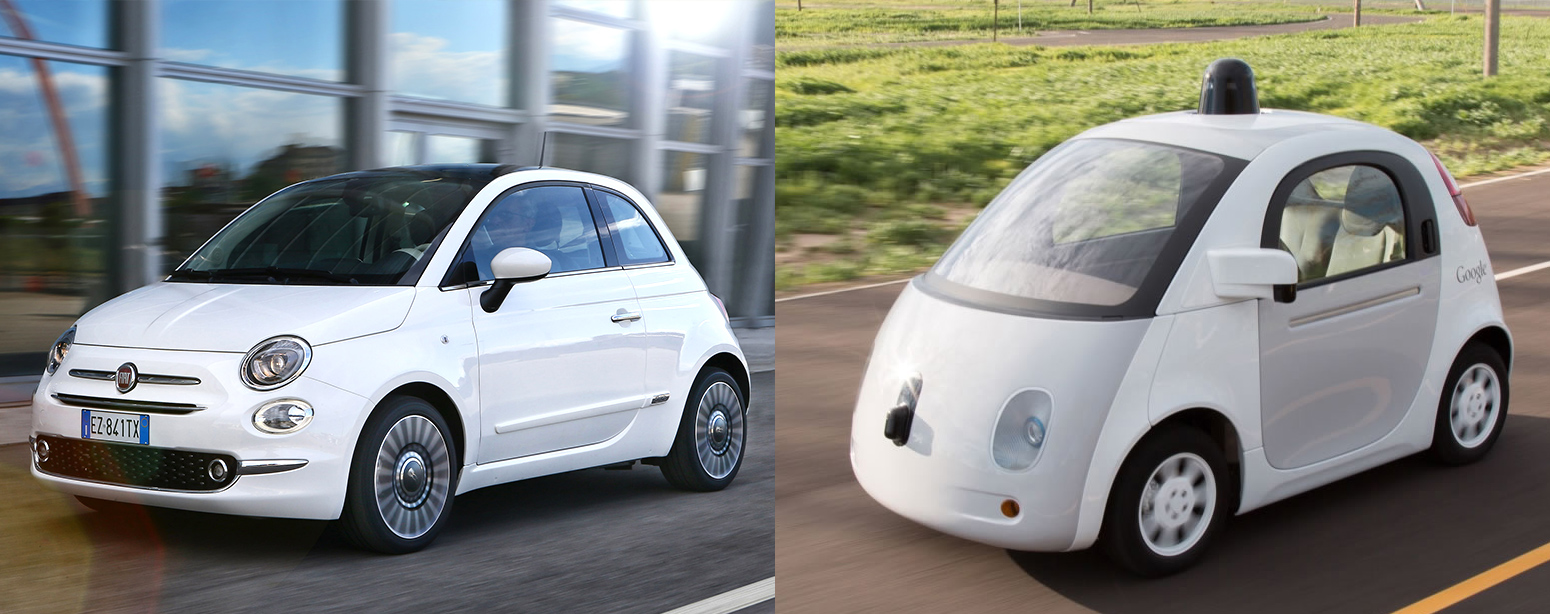
If the report turns out to be true, going with minivans would be an interesting choice. Google’snewest self-driving prototype is a tiny two-seater the company designed itself. The 2017 ChryslerPacifica is a comparatively giant vehicle that seats seven people. Google’s self-driving fleet alsocontains several Lexus RX450Hs and Toyota Priuses, making the Pacifica the company’s largestautonomous car. We were really hoping for a Fiat 500 mod, as it looks like a close cousin of Google’scustom cars.

At the North American International Auto Show, Fiat Chrysler CEO Sergio Marchionne confirmed thecompany had “continuing conversations going on in Silicon Valley” when asked about Google andApple. Google has stated multiple times it does not want to become a car manufacturer, making a dealwith an existing auto maker a necessity.

The last Google/auto maker team-up we heard about was via a Yahoo Autos report that claimedGoogle and Ford were going to partner on self-driving cars. The terms of that supposed deal sounded alot like this one—Google’s technology deal was “nonexclusive,” allowing it to seek other partners. Thatreport said the Google-Ford deal would be announced at CES 2016, but no announcement followed,calling into question the accuracy of the report.

Bloomberg says this deal would be Google’s first with a car maker. The report also says Google alsotried to ink a deal with General Motors, but the deal fell through over “disagreements over ownership oftechnology and data.” Bloomberg says we could see the official Google/Fiat Chrysler announcement asearly as today.

https://www.entrepreneur.com/article/274417

5 Habits That Made Elon Musk an Innovator

Apply now to be an Enterpreneur360™ company and let us tell the world your success story. Get Started »

There are only 24 hours in every day, and you can’t squeeze out an extra second. Yet some people manage to be so productive and innovative they become billionaires at an age when most of us are still struggling to make ends meet. Even among billionaires, some stand out more than others, capturing the hearts of admirers everywhere.

Elon Musk is arguably one of the most well-liked and respected billionaires today. With Tesla’s recent Model 3 announcement, he continues to stay relevant. Let’s take a look at how Musk has stayed one step ahead of a very elite pack. What habits set him apart from his peers?

1. He reads the way most people watch TV.
Like Buffett, who claims to read around 500 pages a day, Musk is the definition of a bookworm. When he was in grade school, he was reading ten hours a day, devouring everything in his library and the entire Encyclopedia Britannica, and completed a six-month BASIC course in just three days.

Here’s a list of some of his favorite books, just in case you’re interested.

Related: How Reading Books Reduces Stress and Makes You Smarter at the Same Time
2. He doggedly pursues his own interests.
If his healthy reading habits weren’t already a giveaway, Musk is a true believer in self-guided learning. At the age of 12, he used his BASIC skills to program Blastar, a self-made video game which he sold to PC and Office Technology for $500. Musk also doubled majored in physics and economics, then interned for both ultracapacitor research and video game companies.

Today, he’s worth $14.5 billion and runs businesses that seem to have nothing to do with one another. Except they all do, of course — Musk is genuinely interested in them. It’s no surprise that he’s the main inspiration behind Robert Downey Jr.’s Iron Man character.

3. He is tirelessly, unflaggingly optimistic.
While the first two traits are true for most successful businesspeople, Musk also has an ace up his sleeve — he has a strong glass-half-full mentality. His Forbes profile sums this up best by describing two of his companies as “moonshot tech companies.” Except Musk doesn’t think of them as moonshots at all.

The secret to his innovation lies in his enthusiasm. This is a guy who grew up with an emotionally abusive father and was once bullied and beat up so bad that he needed to go to the hospital. “If you wake up in the morning and think the future is going to be better, it is a bright day. Otherwise, it’s not.”

Related: Entrepreneurs: Your Irrational Optimism Is Necessary

Musk genuinely believes that what he’s doing is good for the world, and that it’s making a positive difference. In fact, he believes so much in SpaceX that there are two giant posters in his office: before and after scenarios of what Mars will look like once he’s colonized the planet. “I want to die on Mars. Just not on impact.”

4. Yet he still believes failure is an option.
Countless people — some of them very qualified experts — told Musk his ideas were ridiculous and bound to fail. Yet Musk managed to ignore them all and do things the way he wanted.

Granted, some of his ideas never quite took off. But many more succeeded and are dazzling investors and consumers alike. “Failure is an option here. If you’re not failing, you’re not innovating enough.” Or, put another way, “There’s a tremendous bias against taking risks. Everyone is trying to optimize their ass-covering.”

Related: Despite the Risks, Entrepreneurship Will Always Beat a 9-to-5 Job

5. And he really, really knows how to party.
Businessweek writer Ashlee Vance wrote a book about Musk titled Elon Musk: Tesla, SpaceX, and The Quest for a Fantastic Future that revealed some interesting insights into Elon’s private life — especially how much of a party animal he is.

Here are some of the more fascinating factoids:

He paid for college in Ontario by turning his frat house into a well-run nightclub.

On his 30th birthday celebration, he rented out an English castle for a party of 20 and played hide-and-seek games until 6 am.

He once threw a costume party in Venice (of course) and came dressed as a knight. Then he dueled a mini Darth Vader with a parasol.

Parties aside, Musk also just knows how to have a really good time in general:

After selling his first video game, he started a video game arcade in South Africa as a teenager.

He totaled an uninsured McLaren F1 doing tricks on Sand Hill Road en route to an investor meeting, and ended up hitching a ride instead. The sports car was worth $1 million.

He’s going to build a roller coaster around the SpaceX HQ, just because.

You don’t have to have a PhD to be a pioneer.
Before he sold PayPal and became the multi-billionaire innovator we all admire, Musk decided to give graduate school a shot. He enrolled in a Stanford PhD program — and dropped out after just two days. That’s all it took for him to realize that there probably wasn’t too much he could learn from the class that he couldn’t learn on his own.

Most of us, if we were fortunate and talented enough to be accepted by a PhD program at Stanford, probably would have attended. Musk didn’t because he already had all the skills he needed to be successful. He was laser-focused on his interests, intensely curious, unflaggingly optimistic, and unafraid to fail.

http://www.kurzweilai.net/skull-echoes-could-become-the-new-passwords-for-augmented-reality-glasses

Skull echoes could become the new passwords for augmented-reality glasses

May 2, 2016

SkullConduct uses the bone conduction speaker and microphone integrated into some augmented-reality glasses and analyzes the characteristic frequency response of an audio signal sent through the user’s skull as a biometric system. (credit: Stefan Schneegass et al./Proc. ACM SIGCHI Conference on Human Factors in Computing Systems)

German researchers have developed a biometric system called SkullConduct that uses bone conduction of sound through the user’s skull for secure user identification and authentication on augmented-reality glasses, such as Google Glass, Meta 2, and HoloLens.

SkullConduct uses the microphone already built into many of these devices and adds electronics (such as a chip) to analyze the frequency response of sound after it travels through the user’s skull. The researchers, at the University of Stuttgart, Saarland University, and Max Planck Institute for Informatics, found that individual differences in skull anatomy result in highly person-specific frequency responses that can be used as a biometric system.

The recognition pipeline used to authenticate users: (1) white noise is played back using the bone conduction speaker, (2) the user’s skull influences the signal in a characteristic way, (3) MFCC features are extracted, and (4) a neuron-network algorithm is used for classification. (credit: Stefan Schneegass et al./Proc. ACM SIGCHI Conference on Human Factors in Computing Systems)

The system combines “Mel Frequency Cepstral Coefficient” (MFCC) (a feature extraction method used in automatic speech recognition) with a lightweight neural-network classifier algorithm that can directly run on the augmented-reality device.

The researchers also conducted a controlled experiment with ten participants that showed that skull-based frequency response serves as a robust biometric, even when taking off and putting on the device multiple times. The experiments showed that the system could identify users with 97.0% accuracy and authenticate them with an error rate of 6.9%.

It’s not as accurate as the CEREBRE biometric system (see You can now be identified by your ‘brainprint’ with 100% accuracy), but it’s low-cost, portable, and doesn’t require a complex system and extensive user testing.


Abstract of SkullConduct: Biometric User Identification on Eyewear Computers Using Bone Conduction Through the Skull

Secure user identification is important for the increasing number of eyewear computers but limited input capabilities pose significant usability challenges for established knowledge-based schemes, such as a passwords or PINs. We present SkullConduct, a biometric system that uses bone conduction of sound through the user’s skull as well as a microphone readily integrated into many of these devices, such as Google Glass. At the core of SkullConduct is a method to analyze the characteristic frequency response created by the user’s skull using a combination of Mel Frequency Cepstral Coefficient (MFCC) features as well as a computationally light-weight 1NN classifier. We report on a controlled experiment with 10 participants that shows that this frequency response is person-specific and stable – even when taking off and putting on the device multiple times – and thus serves as a robust biometric. We show that our method can identify users with 97.0% accuracy and authenticate them with an equal error rate of 6.9%, thereby bringing biometric user identification to eyewear computers equipped with bone conduction technology.

http://www.kurzweilai.net/harold-cohen-in-memoriam

Harold Cohen: in memoriam

Artist and pioneer in the field of computer-generated art
May 2, 2016

TCM#2 (1995) 45×58 — Dye on paper, painted with the AARON painting machine (credit: Howard Cohen)

By Paul Cohen

Harold Cohen, artist and pioneer in the field of computer-generated art, died on April 27, 2016 at the age of 87. Cohen is the author of AARON, perhaps the longest-lived and certainly the most creative artificial intelligence program in daily use.

Cohen viewed AARON as his collaborator. At times during their decades-long relationship, AARON was quite autonomous, responsible for the composition, coloring and other aspects of a work; more recently, AARON served Cohen by making drawings that Cohen would develop into paintings. Cohen’s death is the end of a lengthy partnership between an artist and an artificial intelligence.

Cohen grew up in England. He studied painting at the Slade School of Fine Arts in London, and later taught at the Slade as well as Camberwell, Nottingham and other arts schools. He represented Great Britain at major international festivals during the 60′s, including the Venice Biennale, Documenta 3, and the Paris Biennale. He showed widely and successfully at the Robert Fraser Gallery, the Alan Stone Gallery, the Whitechapel Gallery, the Arnolfini Gallery, the Victoria and Albert Museum, and many other notable venues in England and Europe.

Then, in 1968, he left London for a one-year visiting faculty appointment in the Art Department at the University of California, San Diego. One year became many,  Cohen became Department Chair, then Director of the Center for Research in Computing and the Arts at UCSD, and eventually retired emeritus in 1994.

The Last Machine Age (2015) 35.75×65.75 — Pigment ink on canvas was finger painted using Harold Cohen’s finger painting system (credit: Howard Cohen)

A scientist and engineer of art

Leaving the familiar, rewarding London scene presaged a career of restless invention. By 1971, Cohen had taught himself to program a computer and exhibited computer-generated art at the Fall Joint Computer Conference. The following year, he exhibited not only a program but also a drawing machine at the Los Angeles County Museum. A skilled engineer, Cohen built many display devices: flatbed plotters, a robotic “turtle” that roamed and drew on huge sheets of paper, even a painting robot that mixed its own colors.

These machines and the museum-goers’ experiences were always important to Cohen, whose fundamental question was, “What makes images evocative?”  The distinguished computer scientist and engineer Gordon Bell notes that “Harold was really a scientist and engineer of art.”

Indeed, AARON was a thoroughly empirical project: Cohen studied how children draw, he tracked down the petroglyphs of California’s Native Americans,  he interviewed viewers and he experimented with algorithms to discover the characteristics of images that make them seem to stand for something. Although AARON went through an overtly representational phase, in which images were recognizably of people or potted plants,  Cohen and AARON returned to abstraction and evocation and methods for making images that produce cascades of almost-recognition and associations in the minds of viewers.

Harold Cohen and AARON: Ray Kurzweil interviews Harold Cohen about AARON (credit: Computer History Museum/Kurzweil Foundation)

“Harold Cohen is one of those rare individuals in the Arts who performs at the highest levels both in the art world and the scientific world,” said Professor Edward Feigenbaum of Stanford University’s Artificial Intelligence Laboratory, where Cohen was exposed to the ideas and techniques of artificial intelligence. “All discussions of creativity by computer invariably cite Cohen’s work,” said Feigenbaum.

Cohen had no patience for the “is it art?” question. He showed AARON’s work in the world’s  galleries, museums and science centers — the Tate, the Stedelijk, the San Francisco Museum of Art, Documenta, the Boston Computer Museum, the Ontario Science Center, and many others. His audiences might have been drawn in by curiosity and the novelty of computer-generated art, but they would soon ask, “how can a machine make such marvelous pictures? How does it work?” The very questions that Cohen asked himself throughout his career.

AARON’s images and Cohen’s essays and videos can be viewed at www.aaronshome.com.

Cohen is survived by his partner Hiromi Ito; by his brother Bernard Cohen; by Paul Cohen, Jenny Foord and Zana Itoh Cohen; by Sara Nishi, Kanoko Nishi-Smith, and Uta and Oscar Nishi-Smith; by Becky Cohen; and by Allegra Cohen, Jacob and Abigail Foord, and Harley and Naomi Kuych-Cohen.


ACM SIGGRAPH Awards | Harold Cohen, Distinguished Artist Award for Lifetime Achievement

http://www.kurzweilai.net/skull-echoes-could-become-the-new-passwords-for-augmented-reality-glasses

Skull echoes could become the new passwords for augmented-reality glasses

May 2, 2016

SkullConduct uses the bone conduction speaker and microphone integrated into some augmented-reality glasses and analyzes the characteristic frequency response of an audio signal sent through the user’s skull as a biometric system. (credit: Stefan Schneegass et al./Proc. ACM SIGCHI Conference on Human Factors in Computing Systems)

German researchers have developed a biometric system called SkullConduct that uses bone conduction of sound through the user’s skull for secure user identification and authentication on augmented-reality glasses, such as Google Glass, Meta 2, and HoloLens.

SkullConduct uses the microphone already built into many of these devices and adds electronics (such as a chip) to analyze the frequency response of sound after it travels through the user’s skull. The researchers, at the University of Stuttgart, Saarland University, and Max Planck Institute for Informatics, found that individual differences in skull anatomy result in highly person-specific frequency responses that can be used as a biometric system.

The recognition pipeline used to authenticate users: (1) white noise is played back using the bone conduction speaker, (2) the user’s skull influences the signal in a characteristic way, (3) MFCC features are extracted, and (4) a neuron-network algorithm is used for classification. (credit: Stefan Schneegass et al./Proc. ACM SIGCHI Conference on Human Factors in Computing Systems)

The system combines “Mel Frequency Cepstral Coefficient” (MFCC) (a feature extraction method used in automatic speech recognition) with a lightweight neural-network classifier algorithm that can directly run on the augmented-reality device.

The researchers also conducted a controlled experiment with ten participants that showed that skull-based frequency response serves as a robust biometric, even when taking off and putting on the device multiple times. The experiments showed that the system could identify users with 97.0% accuracy and authenticate them with an error rate of 6.9%.

It’s not as accurate as the CEREBRE biometric system (see You can now be identified by your ‘brainprint’ with 100% accuracy), but it’s low-cost, portable, and doesn’t require a complex system and extensive user testing.


Abstract of SkullConduct: Biometric User Identification on Eyewear Computers Using Bone Conduction Through the Skull

Secure user identification is important for the increasing number of eyewear computers but limited input capabilities pose significant usability challenges for established knowledge-based schemes, such as a passwords or PINs. We present SkullConduct, a biometric system that uses bone conduction of sound through the user’s skull as well as a microphone readily integrated into many of these devices, such as Google Glass. At the core of SkullConduct is a method to analyze the characteristic frequency response created by the user’s skull using a combination of Mel Frequency Cepstral Coefficient (MFCC) features as well as a computationally light-weight 1NN classifier. We report on a controlled experiment with 10 participants that shows that this frequency response is person-specific and stable – even when taking off and putting on the device multiple times – and thus serves as a robust biometric. We show that our method can identify users with 97.0% accuracy and authenticate them with an equal error rate of 6.9%, thereby bringing biometric user identification to eyewear computers equipped with bone conduction technology.

http://www.ft.com/cms/s/0/1af0efea-1045-11e6-bb40-c30e3bfcf63b.html#axzz47YwZpqwY

Scientists build world’s tiniest engine

Driving force: an Ant combines microscopic gold balls with a polymer gel to propel nanobots. Medicine is one potential application

Scientists have developed a microscopic engine, the smallest in the world, that they say is the first one capable of driving nanobots, including medical robots that could travel through the body.

From Monday, read how robots will change our world. The FT meets the robots, talks to people already living and working with them, and consults the best brains in the field.

The prototype device, known as an actuating nano-transducer or Ant, combines microscopic gold balls with a special polymer gel. It generates a propulsive force on a microscopic scale that is a hundred times greater per unit weight than any known motor or muscle.

“People have been talking about making nanobots for many years but they do not exist yet,” said Professor Jeremy Baumberg, leader of the project at Cambridge university. “Why not? Because so far there has been no way of making them move through liquids — which is like swimming through treacle on the nanoscale because the molecular forces are so strong.”

He says Ant engines, described for the first time in Proceedings of the National Academy of Sciences, would provide sufficient power. “Like real ants they provide large forces for their weight,” he said. “The challenge we now face is how to control the force for nano-machinery applications.”

The Ant is powered by physical rather than chemical reactions. It contains gold nanoparticles, each about 0.06 microns, or a thousandth of the width of a human hair, in diameter in water with a gel-like polymer called pNIPAM.

When the temperature is above the critical temperature of 32C, the gold particles are bound tightly together with the polymer through intermolecular attraction. When it falls below 32C, the polymer suddenly absorbs water and expands — and the gold particles are pushed rapidly apart like a spring.

“It’s like an explosion,” said Tao Ding, another member of the team. “We have hundreds of gold balls flying apart in a millionth of a second when water molecules inflate the polymers around them.”

The reaction is completely and rapidly reversible, experiments show. When the temperature rises again, the Ant stores a large amount of elastic energy in a fraction of a second as the polymer coating expels water from the gel and contracts around the gold particles. “The whole process is like a nano-spring,” said Prof Baumberg.

The prototype Ant uses laser light to control the system’s temperature but other mechanisms could be used instead. The transition point could also be adjusted, for example to set the energy release point close to 37C — the human body’s normal temperature.

The Ant might drive a nanobot through a series of piston strokes, rather like a car engine but on a scale many billions of times smaller.

“The concept can underpin a plethora of future designs,” Prof Baumberg said. The team is working with Cambridge Enterprise, the university’s commercialisation arm, to develop practical applications for the technology.

http://www.cantechletter.com/2016/05/cactus-inspired-skin-mean-serious-improvement-fuel-cell-electric-cars/

Cactus-inspired skin could mean serious improvement for fuel cell electric cars

Scientists with the CommonwealthScientific and Industrial ResearchOrganisation (CSIRO) and HanyangUniversity in Korea have developed amethod of regulating water retentionin polymeric membranes, which couldhave significant impact on making fuelcells smaller and more efficient.

In solving the problem of size thatthermal and water systems add to fuel-cell systems, the scientists drewinspiration from nature, noticing theway a cactus keeps itself regulated forwater and heat in extreme conditions.

“A cactus plant has tiny cracks, called stomatal pores, which open at night when it is cool and humid, and closeduring the day when the conditions are hot and arid. This helps it retain water,” said CSIRO researcher andco-author Dr. Cara Doherty. “This membrane works in a similar way. Water is generated by anelectrochemical reaction, which is then regulated through nano-cracks within the skin. The cracks widenwhen exposed to humidifying conditions, and close up when it is drier.”

According to Dr. Doherty, this new research asserts that a fuel cell can be made up to more than four timesmore efficient in hot and dry conditions, remaining hydrated without the need for external humidifierequipment bulking out its form.

The multi-continent research research project, 10 years in the making and published in the journal Nature,demonstrates how a membrane using what the team calls “nano-cracks”, or tiny fissures in a hydrocarbonpolymer membrane that retards water desorption and maintains ion conductivity, should mean improvedperformance while shrinking fuel cell bulk.

“Fuel cells, like the ones used in electric vehicles, generate energy by mixing together simple gases, likehydrogen and oxygen. However, in order to maintain performance, proton exchange membrane fuel cells – orPEMFCs – need to stay constantly hydrated,” said co-author Dr. Aaron Thornton. “At the moment this isachieved by placing the cells alongside a radiator, water reservoir and a humidifier. The downside is thatwhen used in a vehicle, these occupy a large amount of space and consume significant power.”

The research could have significant impact in Canada, which is a world leader in fuel cells, being home to bothBallard Power Systems (NASDAQ:BLDP) (TSX:BLD) and Hydrogenics Corporation (NASDAQ:HYGS)(TSX:HYG).

http://techcrunch.com/2016/05/02/tesla-bioweapon-mode-for-whiffy-cities/

Tesla’s bioweapon mode is a stroke of genius for developing markets