FORUMS PROJECT: HUMIDITY-CONTROLLED CELLAR VENTILATION
The Raspberry Pi official forums are the central online meeting place for theRaspberry Pi community. They’re where you’ll find support from hundreds ofthousands (141,183, as of this morning) of other Pi users, including people fromour own engineering team; lots of inspiration for your own projects, and loads ofadvice. You can chat to a selection of those of us who work at Raspberry Pi theretoo – we’re usually poking around in there for part of the day.
Commence to poking.
We found this rather brilliant hack to ventilate and maintain a cellar’s humidity onthe forums. Forum member DasManul, from Frankfurt, put this together tomeasure temperature and relative humidity inside and outside his cellar, and to usethose values to calculate absolute humidity. The setup then ventilates the space ifthe humidity inside is higher than it is outside.
On reading what he was up to, I assumed DasManul was looking after a cellarful ofwine. Then I saw his pictures. He’s actually tending bottles of fabric softener andyoghurt.
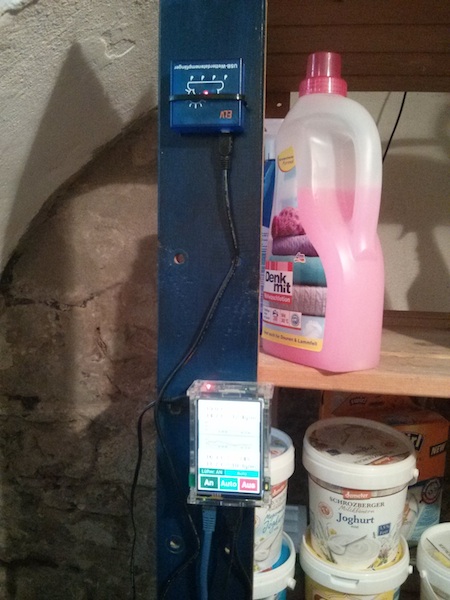
Nestled next to the nonalcoholic liquids, you’ll find a touchscreen controller for thesystem, along with a USB receiver. Here’s a closer look at the display:
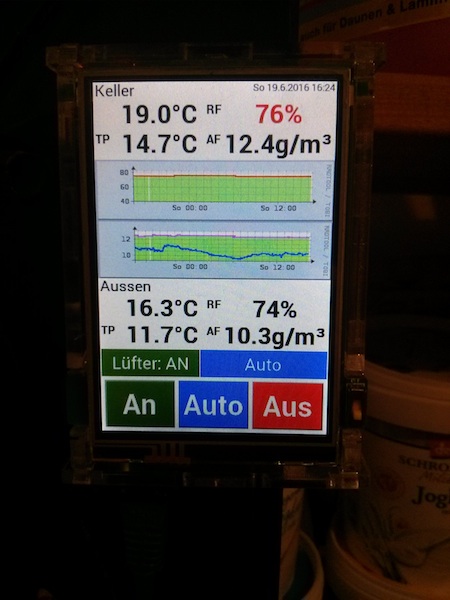
(For non-German speakers, DasManul says: “Keller – cellar, Aussen – outside, TP(Taupunkt) – dew point, RF/AF (Relative/Absolute Feuchte) – relative/absolutehumidity, Lüfter – fan, An/Aus – on/off”.)
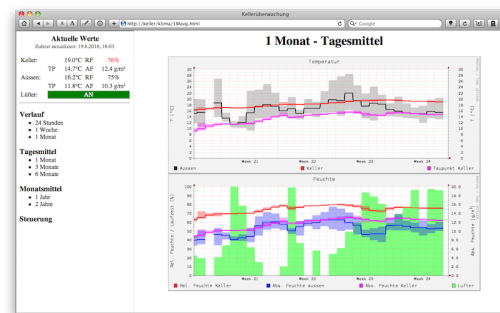
The system also outputs more detailed graphs (daily, weekly, or monthly) to awebsite served by ngnix, which allows you to control the system remotely if youdon’t happen to be down in the cellar conditioning your fabric.
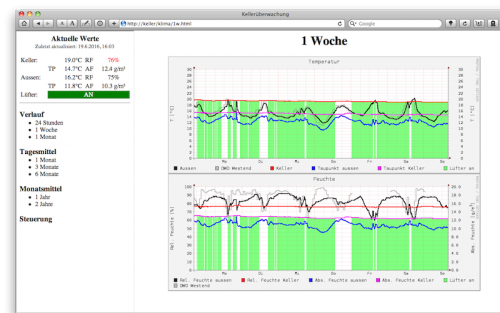
DasManul says that he’s not much for hardware tinkering, and didn’t want to startdrilling into his house’s infrastructure, so he used off-the-shelf parts for sensingand controlling. Two inexpensive wireless sensors, one indoors and one outdoors,from elv.de, do all the work checking the humidity; they feed information to the USBreceiver, and intake and exhaust fans are controlled with an Energenie plug strip.(These things are great – I use an Energenie plug strip to turn lamps on and off viaa remote PIR sensor in my living room).
DasManul has made all the code available (with German and Englishdocumentation) over at BitBucket so you can replicate the project. There’s plentymore like this over at the Raspberry Pi Forums – get stuck in!
 Bruce's Blog