New material may revolutionise prosthetics, wearable technologies
Jerusalem: A team of researchers have developed new “metamaterials” that can solve problems like ill-fitting joint sockets, contact dermatitis and sebaceous cysts plaguingprosthetic patients for a long time.
Metamaterials are synthetic composite materials with structures and properties not usually found in natural materials — that can be programmed to deform in a uniquely complex manner.
Is the iPhone 7 set to replace buttons with a dial? Apple patents ‘digital crown’ used in its Watch for phones and tablets
Patent filed March 2014 and published July 28
Hardware would replace the actions of the physical tab buttons
Could be volume knob to increase or decrease volume output by speakers
Also discusses a button and slide switch used for other functions
Apple’s recent application describes a ‘rotary input’ attached to iOS-based devices that would be used to adjust the volume, scroll, resize text and a wide rang of other actions.
+10
A new patent suggests it could make a comeback in a future iPhone or iPad. Apple’s recent application describes a ‘rotary input’ attached to iOS-based devices that would be used to adjust the volume, scrolling, resizing text, among other actions. Pictures is a concept drawing of the digital crown
WHAT DOES THE PATENT REVEAL?
Apple’s recent application describes a ‘rotary input’ attached to iOS-based devices that would be used to adjust the volume, scrolling, resizing text, among other actions.
This hardware would replace the actions of the physical tab buttons, currently being used in the iPhone and iPad devices.
Although the new document could change how users interact with their phones, it also reveals that Apple might not give up the physical buttons just yet.
The pages discuss a button and slide switch that would be used for other functions.
For example, the button would be used as ‘a power button’ to turn the device on and off.
And the slide switch would mute the device.
Blackberry Electron was one of the last smartphones to hold on to the digital crown, which was eventually traded in for the iconic track ball in 2006.
However, this hardware isn’t new to the Cupertino firm, as it is used to interact with the Apple Watch – which may be why the firm is toying with the idea of removing the physical tabs.
The tech giant believed this method would make it easier to scroll, zoom in and out and send message with the Watch.
The patent, first spotted by Patently Apple, suggests that the ‘rotary input can be a volume knob by which a user’s can increase or decrease a volume output by speakers that can be included in devices’, reads the application called ‘Capacitive Touch Panel for Sensing Mechanical Inputs to a Device’, which was filed back in March 2014.
Although the new document could change how users interact with their phones, it also reveals that Apple might not get rid of the physical buttons completely.
Activation of brain receptors may motivate for physical activity
Activation of brain receptors in its pleasure centre may serve as a future treatment to improve motivation for physical activity inpostmenopausal women, a new study has revealed.
The brain’s pleasure centre is a hotspot in the brain that processes and reinforces messages related to reward, pleasure, activity and motivation for physical exercise.
“Postmenopausal women are more susceptible to weight gain and health issues. This is especially frustrating for women who already are dealing with significant changes to their bodies. We found that the decrease in physical activity that leads to weight gain may be caused by changes in brain activity,” said Victoria Vieira-Potter, Assistant Professor at the University of Missouri in a statement.
The researchers compared the physical activity of rats that were highly fit to rats which had lower fitness levels. They studied the rats’ use of running wheels set up in the cages before and after the rats had their ovaries removed.
They also examined gene expression changes of dopamine receptors within the brain’s pleasure centre.
The high-fit rat group had more activity in the brain’s pleasure centre, which correlated with greater wheel running before and after the loss of ovarian hormones.
However, the high-fit rats still saw a significant reduction in wheel running after their ovaries were removed.
This reduction in wheel running also correlated significantly with a reduction in their dopamine signaling levels, indicating that the brain’s pleasure centre could be involved, suggested the research.
“We found that in both groups of rats, the hormonal changes from menopause led to changes in the brain that translated to less physical activity. The findings confirm previous evidence in humans and rodents that weight gain that occurs after menopause is likely due to decreased overall physical activity rather than increased energy intake from diet,” added Vieira-Potter.
Apple Watch 2 rumored to have a “one glass solution” to make it thinner
We’ve been hearing essentially since the original Apple Watch was announced that Apple would be making a concerted effort to make its second generation smartwatch thinner. At 10.5mm, the Apple Watch isn’t really too thick compared to other popular smartwatches, but we all know Apple has device dysmorphia issues.
Now, we’re getting a bit of info on how Apple intends to make the Watch 2 thinner without compromising important things like battery life. According to a new report, Apple will be switching from the glass-to-glass construction with the OLED display and adopt a new “one glass solution”, which as you might be able to guess from the name would remove a layer of glass in the display thereby making the whole thing thinner. Of course, it’s unclear how much one layer of glass adds to the overall thickness of an Apple Watch, but theoretically Apple has other ways to make things smaller as well.
All of that sounds pretty solid, but the trouble is that Apple partner TPK has apparently been having trouble keeping up the yield rates of these new “one glass solution” OLED displays. The report doesn’t mention these troubles leading to any delays in the release of the Apple Watch 2, which is still expected before the end of the year, but it has cost TPK quite a bit of money.
Researchers apply quantum theory and Einstein’s special relativity to plasma physics issues
July 29, 2016
Sketch of a pulsar, center, in binary star system. Credit: NASA Goddard Space Flight Center
Among the intriguing issues in plasma physics are those surrounding X-ray pulsars—collapsed stars that orbit around a cosmic companion and beam light at regular intervals, like lighthouses in the sky. Physicists want to know the strength of the magnetic field and density of the plasma that surrounds these pulsars, which can be millions of times greater than the density of plasma in stars like the sun.
Researchers at the U.S. Department of Energy’s (DOE) Princeton Plasma Physics Laboratory (PPPL) have developed a theory of plasma waves that can infer these properties in greater detail than in standard approaches. The new research analyzes the plasma surrounding the pulsar by coupling Einstein’s theory of relativity with quantum mechanics, which describes the motion of subatomic particles such as the atomic nuclei—or ions—and electrons in plasma. Supporting this work is the DOE Office of Science.
Quantum field theory
The key insight comes from quantum field theory, which describes charged particles that are relativistic, meaning that they travel at near the speed of light. “Quantum theory can describe certain details of the propagation of waves in plasma,” said Yuan Shi, a graduate student in the Princeton Program in Plasma Physics and lead author of a paper published July 29 in the journal Physical Review A. Understanding the interactions behind the propagation can then reveal the composition of the plasma.
Shi developed the paper with assistance from co-authors Nat Fisch, director of the Program in Plasma Physics and professor and associate chair of astrophysical sciences at Princeton University, and Hong Qin, a physicist at PPPL and executive dean of the School of Nuclear Science and Technology at the University of Science and Technology of China. “When I worked out the mathematics they showed me how to apply it,” said Shi.
In pulsars, relativistic particles in the magnetosphere, the magnetized atmosphere that surrounds the body, absorb light waves, and this absorption displays peaks against a blackbody background. “The question is, what do these peaks mean?” asks Shi. Analysis of the peaks with equations from special relativity and quantum field theory, he found, can determine the density and field strength of the magnetosphere.
Combining physics techniques
The process combines the techniques of high-energy physics, condensed matter physics, and plasma physics. In high-energy physics, researchers use quantum field theory to describe the interaction of a handful of particles. In condensed matter physics, people use quantum mechanics to describe the states of a large collection of particles. Plasma physics uses model equations to explain the collective movement of millions of particles. The new method utilizes aspects of all three techniques to analyze the plasma waves in pulsars.
The same technique can be used to infer the density of the plasma and strength of the magnetic field created by inertial confinement fusion experiments. Such experiments use lasers to ablate—or vaporize —a target that contains plasma fuel. The ablation then causes an implosion that compresses the fuel into plasma and produces fusion reactions.
Standard formulas give inconsistent answers
Researchers want to know the precise density, temperature and field strength of the plasma that this process creates. Standard mathematical formulas give inconsistent answers when lasers of different color are used to measure the plasma parameters. This is because the extreme density of the plasma gives rise to quantum effects, while the high energy density of the magnetic field gives rise to relativistic effects, says Shi. So formulations that draw upon both fields are needed to reconcile the results.
For Shi, the new technique shows the benefits of combining physics disciplines that don’t often interact. Says he: “Putting fields together gives tremendous power to explain things that we couldn’t understand before.”
Explore further: New imaging technique provides improved insight into controlling the plasma in fusion experiments
More information: Yuan Shi, Nathaniel J. Fisch, and Hong Qin Effective-action approach to wave propagation in scalar QED plasmas, Phys. Rev. A 94, 012124 – Published 29 July 2016. DOI: 10.1103/PhysRevA.94.012124
Journal reference: Physical Review A
Provided by: Princeton Plasma Physics Laboratory
How an eye scan can identify Alzheimer’s disease early
An eye scan can help identify early indicators of Alzheimer’s disease, according to new Canadian research. (Shutterstock.com / maxriesgo)
A Canadian researcher has developed a non-invasive way to test for Alzheimer’s disease years before a patient begins to show symptoms – and all it takes is a simple eye scan.
Alzheimer’s disease can be difficult to diagnose, and doctors have typically relied on expensive brain scans and the onset of symptoms to identify the progressive, irreversible disease.
But a University of Waterloo researcher says her newly-developed diagnostic method could spot early warning signs of the disease in a patient’s eye, allowing time for treatment to delay its onset.
“Early diagnosis is important, especially since treatment options are more limited later in the disease,” Melanie Campbell, director of the Guelph-Waterloo Physics Institute, said in a press release.
The new method works by using polarized light to highlight deposits within the eye call amyloid proteins. Amyloid proteins are considered a biomarker of Alzheimer’s and have been found in some patients years and even decades before they show symptoms of the disease.
Medical experts haven’t reached a consensus as to why amyloid proteins appear before Alzheimer’s, but locating the deposits in the retina could change the way doctors test for the disease.
“Widely available, inexpensive, early detection of amyloid would help researchers develop more effective treatments before the onset of symptoms,” Campbell said.
The method is particularly exciting for researchers because it doesn’t involve using dyes to highlight the proteins.
“While other researchers thought that a dye was needed to make the protein visible, we were able to achieve the same results using optics and additional computer processing,” Campbell said.
Plenty of collaborators were involved in the research, including Campbell’s colleagues at the University of Waterloo, the University of British Columbia, Vivocore Inc., InterVivo Solutions, and the University of Rochester and Massachusetts General Hospital.
You Can Now Control Your Nest Thermostat From the Apple Watch
Google has released an update to its Nest app for iOS that lets you control your Nest Thermostat from the Apple Watch, among other improvements including the ability to share a password protected live view of your Dropcam.
At Nest, we make products that are beautiful, thoughtful and easy to use. Same goes for our newly redesigned Nest app. Control your Nest Learning Thermostat, Nest Protect, Nest Cam and Dropcam all in one place. And get alerts on your iPhone or iPad.
What’s New In This Version:
We have several new camera features for you.
– Spaces groups your Nest products by room and lets you see all your cameras at once. And if you’re connected to Wi-Fi, shows you all of their live views.
– Share a password protected live view of your camera. Now grandma can see what the kids are up to at video.nest.com.
– 1080p support for Dropcam Pro.
– Automatic video quality adjustment helps make sure you get a continuous, clear picture.
We’ve also added support for Apple Watch. You can now control your Nest Thermostat from your wrist.
You can download Nest from the App Store for free.
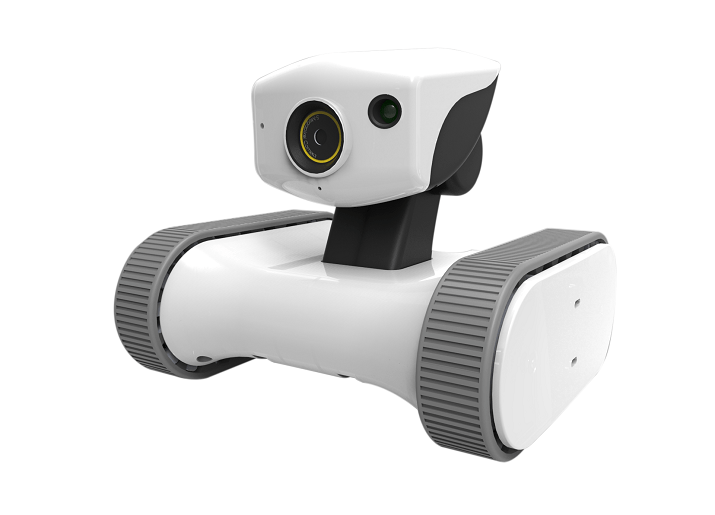
Roving, Night Vision-Enabled Robot Helps Protect Against Burglars
A nEquipped with night vision and a 5 megapixel camera for real-time video, Riley moves about the house detecting motion and alerting homeowners. Source: iPatrolew type of Smart Home device does more than just sit stationary monitoring the home, instead it is a roving robot with a 5 megapixel high-definition camera and night vision to alert homeowners to possible threats in their house.
iPatrol, Inc. has launched its Riley robot to the U.S. market that senses motion– notifying users and recording video that can be reviewed anywhere in the world, in case the homeowner is traveling. Riley directly investigates motion and captures the information. It’s also integrated with a microphone and speaker, so that homeowners can alert intruders that the police have been called.
Riley is operated via WiFi through an app for both iOS and Android devices. iPatrol says the robot can interact with more than just intruders, it can command pets or talk to family members on the other side of the house.
“Riley is a smart and mobile companion that monitors your home with real-time video,” says Rodney Lo, founder of iPatrol. “Unlike most home-security devices, Riley is mobile and can travel on most any surface without getting stuck, thanks to its rugged tank treads.”
The robot self-docks when its battery runs low and if the robot is knocked over it can stand up on its own through a click on the app. Riley is available on Amazon.com, the company’s Website and will be available in select retail stores soon.


 An eye scan can help identify early indicators of Alzheimer’s disease, according to new Canadian research. (Shutterstock.com / maxriesgo)


 Bruce's Blog