https://chromeunboxed.com/google-home-and-chromecast-deal-just-got-sweeter/

GOOGLE HOME AND CHROMECAST DEAL JUST GOT SWEETER

Google isn’t pulling any punches in their trek to make the #madebygoogle brand a household name.

On the heels of the New York and L.A. block parties, Google has cut the cost of their Smart Home assistant and Chromecast combo even deeper.

We’ve seen a number of deals on the Google Home as of late but this latest promotion will get you a Chromecast 2 or Chromecast essentially free of charge.

From now until March 18th, combine the Google Home with either a Chromecast 2 or Chromecast Audio and get $35 off your total order.

Along with it you will get 6 months of Google Play Music at no charge. ($60 value) The Play Music subscription brings with it YouTube Red as well. That’ll get you commercial-free streaming of your favorite cat videos on YouTube.

If you’ve been on the fence about grabbing a Smart Home product, this could be your chance to grab two great products for the price of one. Pick yours up from the Google Store today.

Google Home & Chromecast

http://www.csmonitor.com/Science/2017/0226/Researchers-teach-bees-to-play-their-own-version-of-golf

Researchers teach bees to play their own version of golf

The ‘game,’ which involves pushing a ball into a designated area for a reward, is unlike most behaviors a bee would be instinctively prepared for in the wild. During the game, the bees demonstrated more complex individual cognitive abilities than the insects are usually given credit for.About these ads

FEBRUARY 26, 2017 Bees aren’t known for being brainy. While complex hive architecture and their movement-based “language” are impressive feats, these are generally attributed to biological aspects of a large community of bees driven by instinct and little else. Individual bees, after all, are insects, and tend to demonstrate little, if any, autonomous thought outside the group hierarchy.

A new study, however, may challenge this conventional notion.

Researchers trained various bees to play a golf-like game in which an individual bee would push a ball into a specific area in order to get a tasty sugar-water reward. But while training bees to do something is nothing new, this study was far removed from any instinctive behaviors or situations that would occur in the wild. And despite this limitation, the bees took to their new task in unexpected ways, indicating that individual bees could be much smarter than previously thought.

According to the study, published in the journal Science, the researchers taught the bees to push a small ball into a defined area using multiple methods. The first method demonstrated the “game” with a previously-trained bee, or with a plastic model of a bee controlled by the researchers. Another method was a “ghost demonstration,” in which researchers moved the ball to the proper location using a magnet. The final method gave the bees no demonstration at all.

Every single bee that was able to view another bee move the ball was able to successfully figure out the solution, whereas about 80 percent of the bees who viewed the “ghost demonstration” were able to beat the game. Only two bees were able to figure out the puzzle with no prior demonstration.

The fact that the bees were able to figure out the game in these circumstances is impressive enough, but researchers were more interested to see how the bees adapted new ways to beat the game more quickly.

“It wasn’t monkey see, monkey do. They improved on the strategy that they saw,” study co-author Clint Perry told NPR. “This all shows an unprecedented level of cognitive flexibility, especially for a miniature brain.”

During one test, for instance, three balls were put into play, but only the one farthest away from the goal was actually movable during the demonstration phase. As a result, the trained bee only used the farthest ball to get the reward. But when the untrained bees were put into the ring with three untethered balls, the new bees immediately used the balls closest to the goal to get the reward even faster than the trained bees.

Other bees took initiative as well. Some took shorter routes than the ones that were demonstrated to them. Others sped up the process by dragging the balls backwards instead of pushing them forward.

“The old-fashioned view is if an animal has a small brain, it’s not intelligent or smart,” Olli Loukola, lead author of the study, told New Scientist. “Our study shows it’s not true that small brains are not capable of this kind of cognitive flexibility.”

Dr. Loukola thinks the study could be an indicator that bees are capable of tool use, a trait thought once to be the purview of an extremely exclusive class of vertebrates.

“If you apply the same level of scrutiny to vertebrate experiments as to those done with insects, you quickly find that although something might at first appear complex, the same simple mechanisms we find in insects also are at play in vertebrates,” he added.

But this study alone will not be able to convince many scientists that bees are capable of complex tool usage in the same way that primates and some birds are. Still, Thomas Seeley, a biologist at Cornell University, admits that pushing a ball is pretty far removed from most known instinctive behaviors for bees.

“It’s hard to see how it’s an analog to anything they do in nature,”  Dr. Seeley, who has written books about bee behavior, told NPR. “So, it’s an open question. Where did this come from? Is this an extension of the abilities they have to open up flowers?”

“We often put ourselves atop a hierarchy, where we’re smart and we have large brains, and anything far removed from us physically or morphologically, especially animals with small brains, must be not smart,” Perry told the Smithsonian. “Understanding that bees and different insects have more complex cognitive abilitiescan allow us to appreciate them more. And it might help our efforts to manage living with them a little better.”

http://topexaminer.com/2017/02/26/extraction-of-uranium-from-seawater-could-be-possible-soon/

Extraction of uranium from seawater could be possible soon

Ocean, UraniumDeveloping nations could soon be able to harness nuclear power from oceans as scientists have revealed advances that could make it possible.

Scientists have long known that uranium when dissolved in seawater combines with oxygen to form uranyl ions. These ions can be extracted from seawater using plastic fibers containing a compound called amidoxime into seawater. The uranyl ions essentially stick to the amidoxime. Once these plastic fibers become saturated, they are then chemically treated to free the uranyl, which then has to be refined for use in reactors just like ore from a mine

However, that’s where the hurdle is. The practicality of this particular process depends on three major factors – how much uranyl sticks to the fibres, how quickly ions can be captured and how many times the fibers can be reused. Researchers at Stanford University have revealed that they have been working to improve all three variables associated with the process of extracting uranium from seawater – capacity, rate and reuse.

According to the team, they came up with a conductive hybrid fiber by incorporating carbon and amidoxime. By sending pulses of electricity down the fiber, they managed to alter the properties of the hybrid fibre such that it is able to collect more uranyl ions.

Scientists performed tests on amidoxime-carbon hybrid fibers and amidoxime fibres to test how much uranyl ions each type of fiber could hold before reaching saturation. They found that by the time the standard amidoxime fibre had become saturated, the amidoxime-carbon hybrid fibres had already adsorbed nine times as much uranyl and were still not saturated.

The hybrid fibers were able to hold three times as much uranyl during an 11-hour test using seawater from Half Moon Bay, about an hour from Stanford and had three times the useful lifespan of the standard amidoxime. Trace amounts of uranium exists in seawater, but efforts to extract that critical ingredient for nuclear power have produced insufficient quantities to make it a viable source for those countries that lack uranium mines.

A practical method for extracting that uranium, which produces higher quantities in less time, could help make nuclear power a viable part of the quest for a carbon-free energy future.

While the concentration of uranium are very tiny, considering the size of the oceans, there could be enough uranium to the point that its supply could be endless. Researchers belive that a practical way to extract uranium from seawater is needed to reduce the energy insecurity of nations that depend on nuclear power but lack uranium within their own borders. The research was published in the journal Nature Energy.

http://ca.reuters.com/article/technologyNews/idCAKBN1650EQ

Google’s digital assistant comes to new Android phones

By Julia Love

(Reuters) – Alphabet Inc’s Google announced on Sunday that it will bring its digital assistant to smartphones running the latest versions of its Android operating system, vastly expanding its reach.

The Google Assistant was limited to the technology company’s own products when it was released last fall, but it has steadily been expanding to a broader range of devices.

Smartphones running Android accounted for 85 percent of the global market last year, according to tech research firm IDC, compared to 15 percent for Apple Inc’s iOS.

The Google Assistant will roll out this week to English speakers in the United States with phones running Android 7.0 Nougat and Android 6.0 Marshmallow, the company said.

English speakers in Australia, Canada and the United Kingdom will gain access to the assistant next, followed by German speakers in Germany, and the company is working on support for additional languages.

Voice-powered digital assistants have been largely a novelty for consumers since Apple’s Siri introduced the technology to the masses in 2011. But many in the industry believe the technology will soon become one of the main ways users interact with devices, and Apple, Google and Amazon.com Inc are racing to present their assistants to as many people as possible.

“Our goal is to make the Assistant available anywhere you need it,” Gummi Hafsteinsson, product lead for the Google Assistant, wrote in a blog post published on Sunday. “With this update, hundreds of millions of Android users will now be able to try out the Google Assistant.”

Companies ranging from appliance maker Whirlpool Corp to Ford Motor Co announced products featuring Amazon’s Alexa assistant at the Consumer Electronics Show in Las Vegas earlier this year, leading some analysts to conclude the online retailer had gained an early lead over Google.

The Google Pixel phone is displayed during the presentation of new Google hardware in San Francisco, California, U.S. October 4, 2016.   REUTERS/Beck Diefenbach/File Photo - RTX2QX2N
1 of 1Full Size

What is more, Android manufacturer Huawei Technologies Co [HWT.UL] announced it would support Alexa, highlighting the cost of Google’s decision to feature the assistant on its own hardware before opening it up to partners, said analyst Jan Dawson of Jackdaw Research.

“Clearly Google needs to move forward because their battle in the future is not going to be over the operating system, it’s going to be about assistant platforms,” said analyst Bob O’Donnell of TECHnalysis Research.

Google cannot trust that its assistant will be the default on all devices in the Android ecosystem. Leading manufacturer Samsung Electronics has announced plans for an assistant, and other companies are reportedly working on the technology.

“Some big manufacturers have decided to go their own way,” Dawson said. “But a lot of manufacturers simply can’t afford to develop their own.”


https://www.lifehacker.com.au/2017/02/top-10-raspberry-pi-zero-projects-that-make-use-of-its-small-stature/

Top 10 Raspberry Pi Zero Projects That Make Use Of Its Small Stature

Feb 26, 2017, 10:00am

The Raspberry Pi has long been the hobbyist choice for DIY electronics projects. The Raspberry Pi Zero, which is about the size of a stick of gum, and just five bucks has it’s own special use cases though. Here are ten of our favourite projects that make use of its size.

Illustration by Sam Woolley.

10. Display Any Information You Want on a Tiny Display

Tiny displays are awesome, so it makes perfect sense that a Raspberry Pi Zero would get stuffed inside of one. These little things make perfect desk accessories.

We’ve seen a few different iterations on this idea, like this one that displays information about your network or this one that displays pixel art. Heck, even this mini Animated GIF display could be modified to work with the Zero pretty easily.

9. Play NPR Anywhere with the Push of a Button

If you’re a big NPR fan, then you probably love the NPR One app, which plays a stream of curated NPR podcasts at random. You might be surprised that that streams available from the command line, which means you can access in a Raspberry Pi Zero.

The natural idea for a project here makes a tiny little NPR One radio using a Raspberry Pi Zero. You get buttons to skip a story and pause the stream, while the whole thing gets crammed into a fancy little DIY case.

8. Power an Electric Skateboard

If you use a skateboard to get around, you might have long dreamt of powering that skateboard for better mobility. Naturally, someone decided to use a Raspberry Pi to power one.

The idea here is to hide the Pi Zero underneath the skateboard. The Pi then powers the motor, which you’ll use a Wiimote to control. It’s pretty absurd, but that doesn’t make it any less fun to use.

7. Build a Tiny Power Supply-Sized Computer

The Pi Zero’s biggest strength is its size. One project takes advantage of that by jamming the Raspberry Pi Zero directly onto a power supply.

The idea here is simple. You set up the Raspberry Pi Zero with SSH or VNC, then mount it directly to a power supply with Sugru. Now, you can just plug it into the wall and control it remotely. This makes it practically invisible.

6. Build a Mobile Library

Have you seen those cute mini libraries packed with free books in neighbourhoods? You can do that digitally with a Raspberry Pi Zero, sharing a whole library of your own books from a Wi-Fi hotspot.

Essentially, you just turn your Raspberry Pi Zero into a Wi-Fi access point then share your own library of DRM-free books, magazines, PDFs, or whatever else you have. Obviously, you should keep this legal, but it’s a fun way to share your own stuff.

5. Play Any Simpsons Episode (or Any TV Show) At Random

If you’ve ditched cable and gone full streaming with your media, you might still miss the days of catching a random episode of your favourite show on TV. The Raspberry Pi Zero can bring that back.

In this project, they use episodes of The Simpsons stored on an SD card. With a custom script, you can click a button and it plays an episode at random. You can add any media you want here, including multiple shows if you really wanted, but The Simpsons are a fantastic choice.

4. Make a Motion Sensing Camera

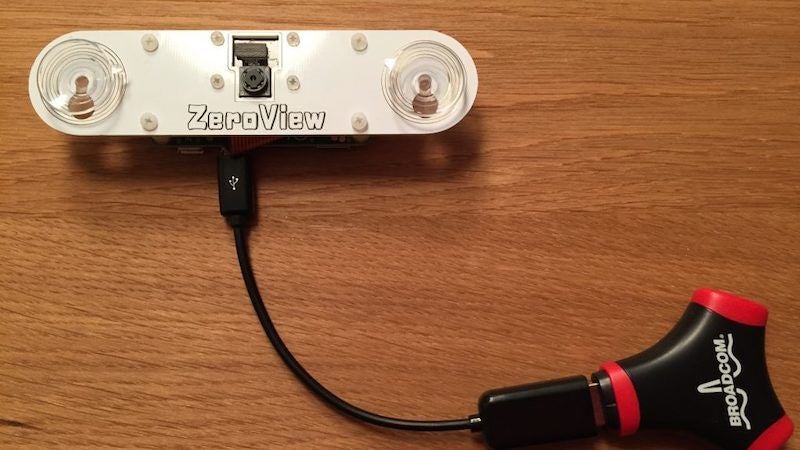
The Raspberry Pi has long been an excellent motion sensing camera, but the low profile of the Pi Zero makes it even better.

With the Raspberry Pi Zero, you motion sensing camera has a much smaller footprint, which means it can go in even tighter spaces. For example, this one mounts to your window with a pair of suction cups, which is about as lightweight as it gets.

3. Make the World’s Smallest (Probably) MAME Cabinet

MAME cabinets are awesome, but they’re massive. For the complete opposite approach, you can use a Raspberry Pi Zero to make one that’s about as small as the Pi itself.

You’ll need a few materials to make this sucker work, including a 3D printed case, but in the end cabinet is completely functional, which means you’ll have the best desk accessory in the office.

2. Build a Miniature Dongle Computer

While the Pi Zero makes a nifty little computer as it is, it makes an even better dongle computer. This way, you can attach it to any other computer you have, then it will tether itself directly so you don’t have to add in a USB or any networking.

The best part of this project is the fact you don’t need yet another mouse, screen, or keyboard sitting around. Just jam in into your normal desktop computer and you’re good to go.

1. Cram a Raspberry Pi Zero Inside an Old School Controller

We all know the Raspberry Pi makes an excellent DIY video game console. The setup process only takes a few minutes, and the Raspberry Pi Zero is totally capable of handling older games from the SNES era and earlier. The whole project is even better when the whole system is inside a controller.

Case in point (ahem), this project uses a SNES controller, this one tackles the NES controller, and this one uses that good old original Xbox controller. However you decide to do it, you’ll end up with a pretty slick little DIY retro game console you can take with you anywhere.

http://www.alternet.org/education/watch-live-chomsky-combats-alternative-facts-his-new-post-election-politics-classwatch

WATCH LIVE: Chomsky Combats ‘Alternative Facts’ In New Post-Election Politics Class

The storied professor talks neoliberalism in the age of Trump

Renowned author and linguist Noam Chomsky has been teaching a general politics course at the University of Arizona for the past six weeks. The undergraduate class “What is Politics?” co-taught with UA emeritus Marv Waterstone, marks Chomsky’s longest stay at the university. In celebration of its final week, UA will livestream a talk with Chomsky on Wednesday, March 1.

“Chomsky’s talks at the UA have been tremendously popular,” said John Paul Jones, dean of the College of Social and Behavioral Sciences in a press release last November. “We thought that students might want a deeper engagement with him, so we asked him if he wanted to teach a class at the UA and he enthusiastically said yes.”

The course description says it “examines the consequences of organizing American society and politics in a capitalist framework and explores current threats to the human species, including nuclear annihilation and climate change.”

“The purpose of this course is to engage participants in contemplating, exploring these critical issues,” Chomsky said in a promotional video. “The goal is not only to enrich understanding but also to sharpen the skills to inquire more deeply and productively into such questions. That includes critical issues about the nature of education, about formation of opinion and attitudes, and not least they will have to seek answers that are desperately needed and to think through ways of implementing them.”

In course’s final week, Chomsky will discuss contemporary resistance movements on the left and right, from Black Lives Matter to Brexit to anti-Trump, as well as new methods for effective political organizing.

Chomsky will also talk “neoliberalism, racism, and education amidst religious bans, walls, and alternative facts” reported UA.

Watch: An evening with Noam Chomsky:

Alexandra Rosenmann is an AlterNet associate editor. Follow her @alexpreditor.

https://www.forbes.com/sites/brookecrothers/2017/02/26/apple-readies-new-2017-ipad-pro-low-cost-ipad-but-release-date-not-certain/#13c5ac2d939f

Apple Readies New 2017 iPad Pro, Low-Cost iPad — But Release Date?

12.9-inch iPad Pro with Apple Smart Keyboard. (Credit: Apple)

12.9-inch iPad Pro with Apple Smart Keyboard. (Credit: Apple)

A new iPad Pro is expected to find a happy medium between the standard-sized iPad Pro and the largest model.

10.5 inches will be the new sweet spot: expect to see a new iPad Pro design with a 10.5-inch display, Rhoda Alexander, Director Tablets and PCs, at IHS Markit, told me in a phone interview. Alexander said it should show up in the coming weeks or months (more on timing at bottom).

That display size would fall between the current 9.7-inch iPad Pro and its larger 12.9-inch sibling. The beauty of the new 10.5-inch iPad* is that the device size will stay the same as the 9.7-inch iPad Pro because of a smaller bezel, according to Alexander.

“You end up with a unit that’s the same physical size as the 9.7 inch,” Alexander said. That works well for Apple because it means accessories like the Smart Keyboard can be used with 10.5-inch iPad Pro, she explained.

“I think this is a good move because the 9.7 [inch] display is too small and the chassis size on the 12.9 [inch] is too big,” said Raymond Soneira, a display expert and president of DisplayMate Technologies, in an email.

The display resolution will also increase, according to Alexander, to 2,024-by-1,668 from the current 2,048-by-1,536. “That maintains the same PPI,” she said, referring to pixels per inch.

The aspect ratio (the ratio of the width to the height of the screen) will also likely change, according to Soneira.

“If the new iPad shrinks the bezel and keeps the outside dimensions the same, then the display aspect ratio will increase from the current 1.33 to as high as 1.50,” Soneira said. “The screen area would then increase by up to 31 percent. However, with no bezel at all the screen diagonal would then be 11.2 inches for the same outside dimensions as the current iPad 9.7 (with rounded corners),” he said.

New low-cost iPad also due

A new “value” 9.7-inch iPad may go as low as $299, according to Alexander. That would come in under the current iPad Air 2 that starts at $399. Alexander said it was not clear what generation of processors the low-cost model would use.

Pricing on the new 10.5-inch iPad Pro is less clear. The current 9.7-inch iPad Pro starts at $599. Apple could lower the price of the current model by pushing the 9.7-inch down to $499 and then “sliding” the 10.5-inch iPad into the $599 slot, she said.

The iPad Mini 4 (starting at $399) may not get an update, according to Alexander.

New iPad Pro as a laptop replacement

“I’d say that there is a clear gap in Apple’s portfolio if it wishes to further position the iPad Pro as a notebook replacement,” Tim Coulling, an analyst at market researcher Canalys, told me in an email.

Market growth of tablets overall has slowed, however. Shipments have been declining for nine consecutive quarters and unit shipments  in 2016 were down 15.6% compared to 2015, market researcher IDC said in February.

But it’s important to remember that there’s a “still a huge installed base of iPads out there. A lot of them being older iPads going back as far as the iPad 2. So, we’re talking about people having iPads that are three, four, five years old,” Alexander said, adding that a new screen size would be incentive for many to upgrade.

Alexander believes the new iPad Pro could arrive in the March-April time frame. A report on Thursday from Digitimes, however, claimed that the the 10.5- and 12.9-inch iPad Pros may not come until May or June.

Apple did not respond to a request for comment.

*Note that reports of a 10.5-inch iPad Pro began way back in the summer of last year when an analyst at KGI Securities, Ming Chi Kuo, mentioned a new 10.5-inch iPad Pro in a research note.

iPad Pro: 9.7- and 12.9-inch models. (Credit: Apple)

iPad Pro: 9.7- and 12.9-inch models. (Credit: Apple)