Slightly terrifying robotic octopus arm could work safely alongside humans
German industrial automation company Festo has created a number of animal-inspired robots in the past, such as kangaroos, herring gulls, ants, and a gripper that mimics the tongue of a chameleon. The latest addition to its robot zoo comes in the form of an arm designed in the shape of an octopus tentacle: the OctopusGripper.
While it looks a little like something from a specialist Manga animation, the device is a pretty amazing piece of kit. It’s built from soft silicon and a special 3D textile knitted fabric that covers the interior bellow structures, which are filled with compressed air to control the arm’s movements. There’s also some passive and vacuum-powered suction cups to grip objects securely.
“If compressed air is applied to it, the tentacle bends inwards and can wrap around the respective item being gripped in a form-fitting and gentle manner,” Festo explains.
Before you get any ideas about creating a Doctor Octopus-style supervillain machine, the arms have been specially designed to work safely alongside people. Unlike traditional pneumatic robot arms found in factories, which usually have to be secured behind cages, the OctopusGripper is flexible enough so that any collisions with humans should be absorbed by the machine. Recently, a factory robot was blamed for the death of a Michigan woman; it’s hoped that Festo’s invention could help prevent similar tragedies.
“Its safe structure already meets the strict criteria of a soft robotics component and guarantees a safe working relationship with people,” the company writes. “Even in the event of a collision, they are harmless and do not have to be shielded from the worker like conventional factory robots.”
What Software Update 8.1 Brings For Tesla Autopilot 2.0
On Wednesday, Tesla released a new version of its software for Autopilot 2.0, bringing new semi-autonomous driving capabilities to the Model X and Model S. The update aims to bring late-model cars to parity with the original, first-generation software.
The new update for Hardware 2 electric cars (produced after October 18, 2016) brings new convenience and safety features to HW2-equipped cars. The update enables Autosteer at much higher speeds — 80mph in comparison to 55mph before– the Summon feature, Auto Lane Change and the Lane Departure Warning system. The software’s Autosteer feature depends on traffic-aware cruise control.
As many might expect, the Auto Lane Change feature causes the car to change lanes after the driver activates the turn signal while the car is in Autopilot. The car’s sensors are used to make sure that the lane is safe and free of traffic. When a vehicle crosses over a lane marking, the Lane Departure Warning alerts the drivers through a vibration in the steering wheel.
We already know about the functions of the Summon feature, which activates the self-parking-and-retrieval system that can be controlled by the owner through their car’s key fob or the Tesla mobile app. The automaker introduced the Summon feature in January 2015 in the first software update for its HW1-equipped vehicles. The latest software patch brings this capability to Hardware 2-equipped electric cars.
What’s special for the Tesla Model X?
Model X owners get one-tap automatic seat adjustment in the update, giving them more control over the positioning of the middle row seats. The new adjustment capability also helps lower the default height of the falcon doors. Such a feature can come in very handy in parking areas with low ceilings, notes Fortune.
Version 8.1 appears to navigate freeway conditions with more confidence, but it is still not on par with Tesla’s first-generation Autopilot, notes Teslarati. The new update started rolling out to vehicles in North America on Wednesday, and over the next couple of days, the patch will be rolled out to all countries worldwide.
Last year, CEO Elon Musk said he hoped to do the first cross-country test drive of a fully self-driving Tesla vehicle by the end of 2017. That means a big launch could follow in a few months.
At 9:49 a.m. Eastern, Tesla shares were up 1.43% at $281.35. Year to date, the stock is up almost 32%.
Global night-time lights provide unfiltered data on human activities and socio-economic factors
March 29, 2017
Researchers from the Harvard John A. Paulson School of Engineering and Applied Sciences (SEAS) and the Environmental Defense Fund (EDF) have developed an online tool that incorporates 21 years of night-time lights data to understand and compare changes in human activities in countries around the world.
The tool compares the brightness of a country’s night-time lights with the corresponding electricity consumption, GDP, population, poverty, and emissions of CO2, CH4, N2O, and F-gases since 1992, without relying on national statistics with often differing methodologies and motivations by those collecting them.
Consistent with previous research, the team found the highest correlations between night-time lights and GDP, electricity consumption, and CO2 emissions. Correlations with population, N2O, and CH4 emissions were still slightly less pronounced and, as expected, there was an inverse correlation between the brightness of lights and of poverty.
“This is the most comprehensive tool to date to look at the relationship between night-time lights and a series of socio-economic indicators,” said Gernot Wagner, a research associate at SEAS and coauthor of the paper.
The data source is the Defense Meteorological Satellite Program (DMSP) dataset, providing 21 years worth of night-time data. The researchers also use Google Earth Engine (GEE), a platform recently made available to researchers that allows them to explore more comprehensive global aggregate relationships at national scales between DMSP and a series of economic and environmental variables.
Abstract of Night-time lights: A global, long term look at links to socio-economic trends
We use a parallelized spatial analytics platform to process the twenty-one year totality of the longest-running time series of night-time lights data—the Defense Meteorological Satellite Program (DMSP) dataset—surpassing the narrower scope of prior studies to assess changes in area lit of countries globally. Doing so allows a retrospective look at the global, long-term relationships between night-time lights and a series of socio-economic indicators. We find the strongest correlations with electricity consumption, CO2 emissions, and GDP, followed by population, CH4 emissions, N2O emissions, poverty (inverse) and F-gas emissions. Relating area lit to electricity consumption shows that while a basic linear model provides a good statistical fit, regional and temporal trends are found to have a significant impact.
Innovative software converts Wi-Fi data into energy savings
Media Release | March 30, 2017
The Irving K. Barber Learning Centre library. Credit: Lara Swimmer Photography
For the first time in Canada, a University of British Columbia engineer has found a way to use Wi-Fi to determine the number of building occupants and adjust ventilation accordingly – saving energy without sacrificing air quality.
“Every day, thousands of smartphones, laptops and tablets connect to the Wi-Fi network at UBC,” said Stefan Storey, who holds a master’s in mechanical engineering and a PhD in resource management and environmental studies from UBC. “Our Bridge software anonymously counts the number of wireless devices in each room and passes the counts on to UBC’s building control system, which then adjusts airflow through the relevant building, practically in real time.”
Based on an occupant count, the control system can vary the airflow to a room, ramping it up for a busy lecture, or down during the times in between.
UBC worked with Storey to test the technology at the Irving K. Barber Learning Centre library, which serves thousands of students and staff. They found that it reduced energy consumption by five per cent over a period of 12 months, while maintaining air quality and occupant comfort.
David Woodson, UBC’s managing director, energy and water services, says the new system could help the university reduce greenhouse gas emissions by hundreds of tonnes and save as much as $100,000 in energy costs per year for core campus buildings. UBC is installing the technology in 10 more buildings over the next several months.
“This software uses the existing Wi-Fi network to provide good air quality and thermal comfort, so costs are lower and disruption is less compared to other occupancy detection technologies,” said Woodson, adding that UBC’s Wi-Fi users are completely protected as all private information is removed in strict compliance with Canadian privacy legislation.
For Storey, the project highlights the potential benefits of using Wi-Fi systems to create “smart buildings.” He co-founded the company Sensible Building Science around his innovation, with support from entrepreneurship@UBC, which helps UBC student, alumni, faculty and staff entrepreneurs as they take their ventures from idea to market. His patent-pending innovation is now being installed at campuses across B.C.
“As far as I know, this is the first technology in North America to use Wi-Fi access points as a sensor network and as a way to communicate with building control systems. As we continue to develop it, we can help many more buildings become much more responsive to occupant needs,” said Storey.
But now British researchers say they have overcome a major barrier that has plagued many scientists: creating enough red cells to fill a blood bag. Their findings are published in the journal Nature Communications.”When we kept (the cells) continually dividing for a year, we were quite excited,” said Jan Frayne, a biochemist at the University of Bristol and one of the study’s lead authors.
The latest study “is a dramatic step forward because it gives us the view that we can actually scale up to whole units of blood,” said Dr. Harvey Klein, chief of the NIH Clinical Center’s Department of Transfusion Medicine. Klein was not involved in the study.
Two to three drops of blood may contain a billion red cells, according to the American Red Cross.
“This technology gives us that particular dream, or at least it brings us a lot closer,” said Klein.
There will be blood
To ramp up production, the UK researchers infected stem cells with cervical cancer genes. By inserting cancer genes from human papilloma virus (HPV) into bone marrow cells, Frayne and her colleagues were able to create the first adult red blood cells that could multiply an infinite number of times. These cells are referred to as “immortal.”The concept may be a familiar one to those who have read the book “The Immortal Life of Henrietta Lacks,” in which a related strain of HPV led to the production of HeLa cells, which are widely used in scientific research. These cells were taken from a cervical cancer biopsy from Lacks, who passed away in 1951 but whose cells still multiply in laboratories today.
As the red blood cells mature, they spit out the nucleus — the core that houses their DNA — giving the cells a signature round, dimpled shape. Frayne and her colleagues filtered those cells from the rest, so the final batch did not contain the active cancer genes.
Frayne said that a small number of these stem cells can be found in a simple blood draw, too; there’s no need to do an invasive biopsy of the bone. Since her team completed the study last year, she said, they have already created two new immortal cell lines this way.
“It’s a brilliant approach, and they seemed to have solved several of the really important bottlenecks,” said Dr. Robert Lanza, Chief Scientific Officer at the Astellas Institute for Regenerative Medicine.
Lanza is no stranger to the research; he tried to solve the same problem years ago using embryonic stem cells.
But his cells didn’t eject the nucleus well enough, and fetal blood cells have too tight a grip on oxygen; they are less likely to drop off the oxygen where it needs to go. Eventually, though, he abandoned the research because “it’s not really commercially viable.”
First blood
Many others have attempted to create blood in the lab, using stem cells from umbilical cords and other sources. But these stem cells fizzle out and stop dividing at a certain point.”It’s almost like they desperately want to carry on differentiating” into mature cells, Frayne said.
In 2011, a group of French researchers transfused lab-grown red blood cells — which grew from stem cells, though not Frayne’s endless supply — into one human. The cells functioned and survived normally.
Frayne said that the first human trials will begin in England later this year, though they will not be using the immortal cells from her new study. Making the new cells under industry standards, Frayne said, could take at least several more years.
A number of other prior studies have sought to create oxygen-carrying liquids without the need for blood cells, but none of them have proved to be widely usable. In fact, a 2008 analysis found that they carried an increased risk of heart attack and death. A blood substitute called PolyHeme was famously rejected by the US Food and Drug Administration after 10 patients suffered heart attacks out of 81 who received it.
Whole blood contains a lot of other bits and pieces that may not necessarily be grown in a lab, said Lanza: blood-clotting platelets, proteins, immune cells and ions like iron.
But Lanza also said that the advantage of lab-grown blood is that it avoids common problems for patients who require multiple transfusions over their lifetime, such as those with sickle cell disease. For example, iron, which can be toxic at high concentrations, can accumulate with successive blood bags, which are given during a transfusion. Human blood, though rigorously tested, also carries a very small risk of transmitting disease.
And stem cells could be used to create Type O cells, fit for nearly any patient’s IV, Lanza said. Known as the “universal donor,” Type O is the blood type most often requested by hospitals, but it is frequently in short supply, he said.But where Lanza really expects to see this technology is on the battlefield.
Red blood sells
The Department of Defense technology research agency, known as DARPA, has funded similar studies in the past, such as a “blood pharming” study with a medical device company formerly known as Arteriocyte.
Lanza, who met with DARPA officials about his own blood cell research in the past, said that the military wants to use lab-grown blood “for patients who have massive blood loss, particularly in the battlefield, where a soldier is blown up by a bomb and there isn’t time for blood typing.”
“I think the goal ultimately is to put this on the back of a Humvee,” he said.
That research, however, met the same obstacles other scientists faced in the past, Klein said.
“They were not able to make sufficient amounts blood at any kind of reasonable cost,” said Klein, who also serves on the FDA Blood Products Advisory Committee. Though familiar with the DARPA research, he was not involved in evaluating its products.
To mass produce blood in the lab, Frayne and her colleagues would need lots of expensive liquids to grow the cells and a battery of new equipment that complies with manufacturing standards — all of which will cost money.
“To make big huge vats of it would be outside of our ability in a research lab,” she said. “We’d have to have company interest.”
A hospital in the US might pay hundreds to thousands of dollars to purchase and test a unit of donated blood, and it may charge far more to transfuse it to patients. Producing a pint of blood using her method, Frayne said, would likely be several times more expensive than buying bags from blood donors in the UK.
But Frayne is optimistic that costs will come down. She hopes that lab-grown cells will be shown to last longer, and therefore doctors might need to use less blood less frequently. That’s because stem cells can be collected while they’re young, Frayne said, while human blood has cells of all different ages. Many donated blood cells die not long after transfusion.
Collected blood expires, too. Currently, the Red Cross, which claims to provide 40% of the country’s blood supply, stores red blood cells for up to 42 days.
That aside, Klein said that lowering the cost to $1,000 to $2,000 per unit of blood would make these cells worth the price for a small subset of patients who have rare blood types or need regular transfusions. For the typical hospital patient, however, it would probably not be very practical or cost-effective, he said.
But it is their willingness to invest money in the research, Klein said, that may have led to the British team’s success where the US and other countries have faltered.
“They have put a great deal of financial muscle behind doing this on a national basis, which we simply haven’t seen in the United States,” he said, adding that perhaps there was an element of “healthy skepticism (in the US) that maybe it will never in our lifetime be practical.”
“I don’t share that skepticism,” he said.
Bad blood?
But what about the rogue red cell that slips through the filter with its cancer genes still intact? Lanza calls these cells “escapees.”
“When you’re dealing with such huge numbers of cells,” said Lanza, “there may be a few of these cells that would slip in.”
Frayne said that these cells are highly unlikely to cause any form of blood cancer. The cancer genes are only switched on by a certain antibiotic, and by the time the cells are collected, any remaining nuclei are no longer working. Before a blood transfusion, radiation can also be used to destroy any leftover DNA without affecting normal cells, she said.
Still, Frayne said, “These are all really good points to be raising, and they need to be looked at.”
But none of these concerns have slowed a deluge of requests to use her cells, Frayne said, though perhaps not from whom you’d expect. It’s not blood banks hoping to capitalize on a new, if untested, method. In fact, it’s other researchers who, until now, have not had an unlimited way to study diseases like malaria, which infect red blood cells. “That’s where all my requests are coming from,” she said.
Klein, Lanza and Frayne all said lab-grown blood cells are not meant to replace blood donors. To fill a national blood service, or even a single hospital, will require another major leap in the research.
“They’re not going to put the Red Cross out of business,” said Lanza. “Volunteer blood donations are always going to be the first line of defense — but with this technology, you have a safety net.”
A project at MIT has succeeded in replacing the common plastics frequently used for 3D printing with cellulose, the same abundantly available fiber that gives plants their structure. The purpose of the research effort was to come up with a possible renewable and biodegradable alternative to the more commonly used ABS and PLA printing materials.
Cellulose is already used for that most common of printing medium — paper. But until now, efforts to use it as an ingredient in 3D printing have run into snags. One problem is that 3D printing requires heating up the printing material to make it flowable; but cellulose tends to decompose when it’s heated, owing in part to the destruction of its hydrogen bonds. Also, the bonding among cellulose molecules in high-concentration cellulose solutions creates a polymer that is too sticky for 3D extrusion.
This electron microscope image shows a cross-section of an object printed using cellulose. The inset displays the surface of the object. Courtesy of the MIT researchers.
To overcome those hurdles the MIT team, led by post-doctoral fellow Sebastian Pattinson, worked with cellulose acetate, a composition that’s easily made and widely available and that can be used at room temperatures. According to an article on the MIT website, cellulose acetate dissolves in acetone and pours through a nozzle. As the acetone evaporates, the cellulose acetate solidifies into place. A subsequent optional process increases the strength of the printed parts.
“After we 3D print, we restore the hydrogen bonding network through a sodium hydroxide treatment,” Pattinson explained in the article. The result is a printed part with greater “strength and toughness” than would be found in a part printed in the traditional plastics.
Various methods could also quicken the printing process, such as blowing hot air over the object to speed up evaporation of the acetone.
To demonstrate the “chemical versatility” of the printing process using cellulose, Pattinson and his team added a touch of antimicrobial dye to the cellulose acetate ink and 3D printed a set of antimicrobial surgical tweezers.
This MIT research project demonstrated the chemical versatility of 3D printing with cellulose by producing a pair of surgical tweezers with antimicrobial functionality to make them sterile. Courtesy of the MIT researchers.
“We demonstrated that the parts kill bacteria when you shine fluorescent light on them,” Pattinson noted. He suggested that this type of custom tool “could be useful for remote medical settings” where surgical tools are difficult to obtain and where the sterility of the operating room isn’t “ideal.”
Cellulose is “the most important component in giving wood its mechanical properties. And because it’s so inexpensive, it’s biorenewable, biodegradable and also very chemically versatile,” said Pattinson. It’s also highly common. Cellulose and its derivatives are already used in pharmaceuticals, medical devices, as food additives, building materials and clothing, he pointed out. “A lot of these kinds of products would benefit from the kind of customization that additive manufacturing [3-D printing] enables.”
Implications for the future of mobile learning. Or not.
On 3/23 Apple filed patent application (number 20170083048) for an “electronic accessory device wherein the operational component is solely controlled by the electronic host device.”
Looking at the picture from the patent application, we see that what Apple is proposing is to give the iPhone a keyboard (and probably more battery life).
It is easy to imagine iOS evolving to a place where it can run any application as well as MacOS. At that point, the only thing that stands before a world of a merged OS is the keyboard.
Why should digital learning people care about an iPhone accessory that Apple may never bring to market?
One answer is mobile learning. And the other answer is cost.
We should acknowledge that this Apple patent application does not seem all that original. Remember the Motorola Atrix 4G Lapdock from 2011? I got all excited about this accessory in 2011, writing that:
“The Atrix is a step closer to the dream of a full computer in a mobile device. An external keyboard and screen accomplishes what Moore’s Law cannot.”
I was wrong in 2011 about the smart phone dock. Maybe I’ll be wrong as well in 2017.
Still – go with me for a second.
What if Apple could make the iPhone keyboard/screen dock really really cheap? So cheap that we wouldn’t think twice about buying a few, leaving them at work and at home.
And what if the full computer experience was really really good on an evolved iOS?
The development of this enabling hardware and evolved software may finally be what we need to push learning to mobile.
The dream of having a full mobile digital learning experience has been inhibited by the fact that the mobile form factor is great for consumption, and not so great for production. Writing requires typing, as writing is all about re-writing.
A keyboard is the best technology to translate thinking into communication.
We can dictate our thoughts, but we can’t do so publicly – and dictation remains a poor method for revising.
A converged mobile / laptop OS is surely coming. It seems strange to me that we still live in a world of OSX/iOS and Chrome OS / Android.
The fact that Microsoft has failed so far to converge the desktop / mobile OS around Windows should not dissuade from believing in a merged OS future. (Or should it?) Does anybody that you know use a Windows phone?
Part of the reason why I like this Apple patent application is that I want to see the cost of digital learning tools to come down. If tomorrow’s students need only buy a phone for all their digital learning needs – assuming that the dumb keyboard/screen accessory is as cheap as a case – then we have addressed at least one educational cost obstacle.
Maybe a switch towards an all phone world – albeit one in which phones also get keyboards and bigger screens – will spark new thinking in the world of mobile learning.
Whatever we think of this Apple patent application, we should admit to ourselves and each other that the mobile learning revolution is not quite going as planned. Laptops, keyboards, browsers, and full computer OS’s still dominate. Mobile learning apps are interesting, but beyond personalized learning applications such as Duolingo, these apps have failed to supplant the incumbent browser based digital learning platforms.
Do you think that we will witness the demise of the phone / laptop divide?
Do you believe that the future of mobile and desktop/laptop operating systems is one of separation or convergence?
How in the world are we going to catalyze the next generation of mobile learning hardware and software?
Bill Kochevar, 56, of Cleveland became paralyzed from his shoulders down, after a bicycling accident in 2006.
“It was raining really badly and I was following a mail truck and I was keeping my distance, everything was fine. But it stopped to deliver a package and I didn’t see that it had stopped and I hit right into it head first,” said Kochevar.
The quadriplegic hadn’t moved his limbs for 8 years…that is, until now.
Kochevar becoming the first person in the world to have arm and hand movements restored, with the help of a new clinical trial called “BrainGate,” the brain child of scientists and engineers at Case Western Reserve University and conducted at the Louis Stokes Cleveland VA Medical Center.
Lead study author and biomedical engineer and professor Bolu Ajiboye, Ph.D. said, “For people who have high level spinal cord injury, it represents an opportunity to really consider being able to control things in their environment.”
This is how this groundbreaking procedure works: Through electrodes currently implanted just underneath Mr. Kochevar’s skull, his brain activity is then sent to this computer, which then deciphers that brain activity into the movement he’d like to make.
But he is grateful to be part of history, giving many people just like him hope in restoring a sense of independence.
Kochevar adds, “It helps me, you know, lead a productive life and be happy all the time. And at the end of the day, that’s all that matters in life. Yup.”
While the clinical trial has already proven effective, advances are still needed to make the technology usable outside of a lab, which would ultimately make the brain implant wireless and permanent.
To prepare him to use his arm again, Kochevar first learned how to use his brain signals to move a virtual reality arm on a computer screen.
“After we were sure that he was able to control his movements, then we implanted the stimulating electrodes for his muscles and we’ve been working with him over the last year, year and a half to improve the ability to control those movements,” said Robert Kirsch, Ph.D., another study author and biomedical engineer and professor.
And now, the former IT professional is able to grab a mug of water to drink from a straw and eat forkfuls of mashed potatoes; simple tasks many of us take for granted.
While the study is only temporary, Kochevar is hoping to make it permanent.


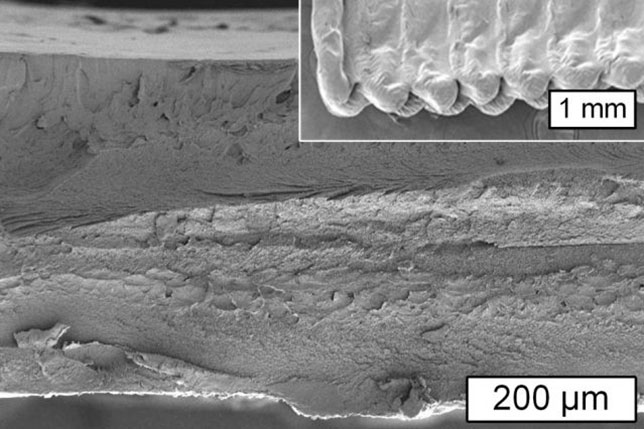 This electron microscope image shows a cross-section of an object printed using cellulose. The inset displays the surface of the object. Courtesy of the MIT researchers.
 This MIT research project demonstrated the chemical versatility of 3D printing with cellulose by producing a pair of surgical tweezers with antimicrobial functionality to make them sterile. Courtesy of the MIT researchers.

 Bruce's Blog