http://www.ctvnews.ca/health/why-a-group-of-scientists-grew-human-heart-tissue-on-spinach-1.3342787

Why a group of scientists grew human heart tissue on spinach

Everyone knows that eating vegetables is great for maintaining heart health, but what about using leafy greens to create part of a human heart?

Although the research is still in its infancy, a group of scientists from Massachusetts’s Worcester Polytechnic Institute (WPI) has been able to successfully grow heart tissue on the leaves of spinach with the aim of one day being able to use the plant to replace diseased tissue in human hearts, such as those affected by a heart attack.

In a study published online ahead of its release in next month’s journal Biomaterials, senior author and bioengineering professor Glenn Gaudette and his team at WPI report being able to grow human heart cells that could contract or beat after five days for a total of 21 days straight.

With a chronic shortage of donor organs, researchers have resorted to engineering large-scale human tissue using techniques such as 3-D printing. One complex problem that has impeded this research, however, is how to recreate a small, intricate vascular system in order to deliver oxygen and nutrients required for proper tissue growth.

“One of the big problems in tissue engineering today is getting blood supply to the newly-created tissue,” Gaudette explained to CTVNews.ca in a phone interview from Worcester, Mass.

To overcome this problem, scientists have started looking at plants for a potential solution. Bioengineering researchers have begun experimenting with growing organs on different plants using their branching network of veins, which delivers water and nutrients to the leaves.

The University of Ottawa’s Pelling Lab has been testing plant-based biomaterials for growing tissue for the past four years. The lab’s work of cultivating a human ear on an apple slice made headlines last year and attracted international attention to the emerging field.

“It’s just funny. A few years ago I was literally presenting our work and being laughed at in conferences and now other groups are actually saying, ‘Hey it wasn’t so crazy,’” Andrew Pelling, the lab’s founder remarked during a phone interview from Ottawa.

Why spinach?

The scientists at WPI have been working in the field of cardiac research for a number of years and realized the potential in plants, and spinach in particular, just by looking at them. Joshua Gershlak, a graduate student and the study’s lead author, said they were inspired to use spinach when they noticed it looks pretty similar to a human heart’s aorta, the main artery extending from the heart.

“When you look at spinach, when you hold it up to the light, you can see the nice veins passing through the leaf. It turns out that the system of pipes, the vasculature in the leaf, is very similar to human muscle tissue,” Gaudette added.

In order to create the right conditions on the spinach for human heart cells to grow, the researchers used a process called “decellurization” to strip the plant of its cells. To do this, Gershlak said the team used detergents and soaps found in body wash, but in a much higher concentration, and pumped them through the leaf’s veins. The spinach’s plant vasculature made up of primarily cellulose is all that’s left once the stripping process is complete.

Gaudette said the nice thing about the decellurization process is that it rids the biomaterial of its natural cells, which the human body ordinarily rejects during a transplant. He cited the example of a heart transplant and how it’s the new organ’s cells that are rejected by the recipient. In the case of spinach, its cells would be stripped away, making it potentially easier for the body to accept; however, biocompatibility tests still need to be conducted.

“The material that’s left behind, the cellulose, is actually pretty compatible. It’s been used in a bunch of different applications,” Gaudette said.

More research needed

Andrew Pelling, from the University of Ottawa, cautioned against reading too much into studies in their early stages, such as the one from WPI. He said the research shows promise but that it’s still a relatively small experiment.

“I don’t want people to get their hopes up when it’s still way too early,” Pelling said.

The researcher said media coverage on plant-based biomaterials can be overblown or over-interpreted and there’s still a lot of work to be done in the field.

“If as a scientific community, we want our opinion and knowledge to be respected by decision makers then we have to make sure that what’s being put out there is the truth and not hype because that’s not much better than putting out nonsense,” he warned.

Pelling did say, however, that he’s encouraged that other groups, such as the WPI researchers, are delving into this field.

“This is how science works. Other groups reproduce your work, they extend it and they move in new directions,” he said. “That’s the cool part about science and discovery.”

Gaudette acknowledged his team has a lot of work to do before spinach is used to grow tissue for a human heart. He said the next steps for the researchers will be to conduct biocompatibility tests to understand how the body would react to this type of plant material inside it. He said they also still need to solve some issues surrounding blood flow in a plant’s vascular network.

Despite its early stages, Gaudette said he’s optimistic about the future possibilities of plant-based bioengineering.

“One of the exciting things for me about this area of research is really the dreaming,” he said. ““I think we’re just on the tip of the iceberg here and I hope we’ll see a lot more applications.”

http://gizmodo.com/the-worlds-first-menstrual-period-in-a-dish-could-revol-1793684158

The World’s First ‘Period’ in a Dish Could Revolutionize Reproductive Medicine

Image: Shutterstock/vchal, Gizmodo

The female menstrual cycle is a rite of passage into womanhood that for centuries has been shrouded in mystery and taboo. Pliny The Elder, for one, believed that menstrual blood could turn crop fields barren. Just last century, one scientist floated a theory that menstrual blood contained a poison that caused women to turn wine into vinegar. Let’s not even start on the rumors that a burnt toad can ease a heavy flow.

Now, as though peeling away the mystique of womanhood once and for all, scientists at Northwestern University have used tissue cultures to create a miniature 3D model of the female reproductive tract: Ovaries, fallopian tubes, and other reproductive organs, connected together to mimic the functions of a 28-day menstrual cycle. This particular rendering of female sexuality, described in a paper published Tuesday in Nature Communications, is encased in plastic and not much bigger than an iPhone Plus.

It is, in essence, a period in a petri dish. And scientists hope that it might unlock a more detailed understanding of the female reproduction system and the diseases that plague it, as well as eventually paving the way for personalized treatments designed to reflect a woman’s individual biology.

“This is very exciting,” said Christos Coutifaris, president-elect of the American Society of Reproductive Medicine, who was not associated with the research. “In the short term, it could allow us to understand a lot more about person-to-person variability in the body. In the long term, this is a step towards individualized medicine.”

The period-in-a-petri-dish is not the first attempt to model the organs of the human body in miniature form using cellular cultures. It was part of a larger effort spearheaded by the National Institutes of Health to recreate the entire human body on a “chip.”

For every secret that science has revealed about our biology, there are hundreds more unknowns. Testing drugs on animals or human cells in a petri dish can only tell us so much about how those drugs might actually perform in the human body, and real organs are far too valuable as transplants to be used in experiments. This is where so-called “organs-on-chips” come in. By replicating many of the functions of human organs in miniature, on microchips, scientists can, in theory, more accurately observe what happens to those organs when exposed to different drugs or environmental conditions.

A time lapse of the period-on-a-chip system in action. Image: Northwestern

Back in 2010, a scientist at Harvard’s Wyss Institute developed the first organ-on-a-chip, a lung. Since then, scientists have successfully made thumb drive-sized models of the lung, liver, kidney, heart, artery, bone marrow and cornea. In each case, tiny microfluidic tubes are lined with cells taken from the organ of interest and arranged within the chip to mimic some of the key functions of those organs. When nutrients, drugs, bacteria or other test materials are run through the tubes of the chip, scientists are able to closely observe how specific cellular processes respond. In 2015, for example, Michigan State University scientists used a chip to model how endocrine cells secrete hormones into the blood stream in order to test a diabetes drug.

Organs-on-chips have recently seen a major boom in interest. In 2014, the NIH doled out $17 million in grants for its Tissue Chip for Drug Screening program to 11 institutions, a second wave of grants after funding 19 other research organizations to do tissue chip research in 2012. DARPA has its own separate tissue chip program. Increasingly, drug companies are turning to tissue chips to test new drugs, too.

The problem with the organ-on-a-chip, though, is that it only allows researchers to observe one organ at a time, rather than an entire physiological system. The period-in-a-dish is the next step up. It allows researchers to observe how different stimuli impact not only the ovaries or the uterus, but the entire reproductive system at once.

“Our biggest challenge was in some ways just building the technology,” said Teresa Woodruff, the study’s lead investigator and director of the Women’s Health Research Institute at Northwestern. “You can’t model everything that happens in the reproductive system on a single chip. This is a new way of looking at cell function.”

The period-in-a-petri-dish, called Evatar, looks more like a set of sad Lego bricks than anything distinctly biological. Each “organ” occupies its own muddy brown cube, linked together by tubes that pump fluid between them. Cultured ovarian follicles produced the hormones in this synthesized system to regulate tissue function over a 28-day cycle, causing fluids to move through the organs. One of the biggest hurdles was designing a medium that could flow through all of the system’s components, acting as blood does in the body.

“Our body is composed of a lot of different cells and all those cells are in communication,” Woodruff told Gizmodo. “We’re basically modeling that. It’s not an exact organ, but it is a good organ mimic.”

The hope is that this work will allow researchers to do a whole lot more than simply test new drugs more efficiently, though that’s definitely an important part of the work. In the paper, researchers detail the creation of a model using mouse cell cultures, but in the not-too-distant future the same approach could be used to create models of various human reproductive diseases in order to better study them. It could also allow researchers to study the differences between individuals at a functional level, one day leading to personalized therapies.

“The importance of this is that not everybody is the same,” Coutifaris, of the ASRM, said. “We’re not an inbred strain of mice where every mouse reacts the same to a drug, or a hormone or whatever. The next step is to understand the differences from woman to woman [and] how they might respond to things like drugs.”

Why, for example, does one combination of drugs result in successful in-vitro fertilization in one woman, but not another? Why are certain women more susceptible to ovarian cancer? Which birth control is right for you? Science doesn’t really offer much more than guesstimates to these questions. Organs-on-chips might at least be able to offer a little more data to base those decisions on. Using a woman’s stem cells, for example, a doctor might one day create a personalized model of her reproductive system, test a bunch of different fertility drugs on the model, and from those tests select the drug most likely to result in healthy eggs, hopefully saving her time, money, and the emotional stress of many rounds of IVF.

Woodruff said the next step is to enhance the model of the female reproductive system, and to design a male counterpart. Eventually, many of these chips might be used in tandem to understand how a drug, for example, can impact all the systems of a person’s body.

Coutifaris cautioned that for now, these advancements are most useful for research. Creating personalized drug treatments using custom-built miniature organs on a chip, he said, is a long way off.

“It’s important to be careful about expectations. There is still a lot of work to be done here,” he said. “But even though those things are far-fetched at present, we need dream.”

https://phys.org/news/2017-03-artificial-materials-atom-by-atom.html

Researchers create artificial materials atom-by-atom

March 27, 2017
Researchers create artificial materials atom-by-atom
The tip of a scanning tunnelling microscope (STM) above chlorine atoms that have been deliberately moved. By moving individual atoms under their microscope, scientists were able to arrange vacancies in a single layer of chlorine atoms and …more

Researchers at Aalto University have manufactured artificial materials with engineered electronic properties. By moving individual atoms under their microscope, the scientists were able to create atomic lattices with a predetermined electrical response. The possibility to precisely arrange the atoms on a sample bring ‘designer quantum materials’ one step closer to reality. By arranging atoms in a lattice, it becomes possible to engineer the electronic properties of the material through the atomic structure.Working at a temperature of four degrees Kelvin, the researchers used a scanning tunnelling microscope (STM) to arrange vacancies in a single layer of chlorine atoms supported on a copper crystal.

“The correspondence between and is of course what happens in real materials as well, but here we have complete control over the . In principle, we could target any electronic property and implement it experimentally”, says Dr. Robert Drost who carried out the experiments at Aalto University.

Using their atomic assembly method, the research team demonstrated complete control by creating two real-life structures inspired by fundamental model systems with exotic electronic properties.

The approach is not limited to the chlorine system chosen by the research team either. The same method can be applied in many well-understood systems in surface and nanoscience and could even be adapted to mesoscopic systems, such as quantum dots, which are controlled through lithographic processes.

“There are many fascinating theoretical proposals that don’t exist in real materials. This is our chance to test these ideas experimentally”, explains Academy Research Fellow Teemu Ojanen at Aalto University.

Researchers create artificial materials atom-by-atom
The tip of a scanning tunnelling microscope (STM) above chlorine atoms that have been deliberately moved. By moving individual atoms under their microscope, scientists were able to arrange vacancies in a single layer of chlorine atoms and …more

Explore further: Spot-welding graphene nanoribbons atom by atom

More information: Robert Drost et al, Topological states in engineered atomic lattices, Nature Physics (2017).DOI: 10.1038/NPHYS4080

Read more at: https://phys.org/news/2017-03-artificial-materials-atom-by-atom.html#jCp

https://www.cnet.com/au/news/google-home-gets-new-partners-in-its-first-big-smart-home-update/

Google Home welcomes 12 new partners in big smart home update

Starting today, Google’s smart speaker can control a variety of new devices, including locks and sprinklers.

The Google Home is at last starting to fulfill its potential in the smart home. With a dozen new companies announcing integrations with its platform, the search giant has dramatically increased what its smart speaker can do.

Starting today, for most of these new additions, you’ll be able to give a voice command to the Google Assistant built into the Google Home smart speaker and control devices from these 12 companies:

It’s the first major update to Google’s smart speaker since it launched last November. Back then, the Home worked with four platforms: Nest, Philips Hue, SmartThings and IFTTT. As a result, the Home was well behind its chief competitor — the Amazon Echo — when it came to controlling the smart home. Since then, Google’s new partner announcements have included a few at CES in January, as well as Belkin WeMo lighting products and Honeywell connected thermostats a few weeks after that.

Say the wake words “Hey Google” or “OK, Google” and you can issue a command to the Home without needing to hit any buttons.

Tyler Lizenby/CNET

This announcement doesn’t quite even the playing field with Amazon, since Amazon’s assistant Alexa now has more than 10,000 “skills” — essentially third-party apps for voice control. Still, it’s a big push in the right direction that includes many popular smart home products.

It also expands Google Home’s abilities into new territory. Previously, the Google Assistant only worked with lights, plugs, switches, thermostats and recently robot vacuums. Today’s announcement includes locks, sprinklers, an air conditioner, a sous vide cooker and even a professionally installed smart home system. It comes hot on the heels of the news that the Home is coming to the UK and Europe in April.

Google promised a push of this sort back in December of last year, when the company announced it’d be expanding Weave — the language Google’s devices use to speak to each other. Now, that promise is coming to fruition.

What we know about these new integrations

Ask Google to lock your door.

Chris Monroe/CNET

August

This is the first lock to work with Google Home. You’ll be able to ask the Google assistant to lock your door or check on the status of the lock. Unlike with Alexa, you won’t be able to ask Google to unlock your door. August has promised that feature for Google later this year. With Alexa, unlocking the door requires you to say a PIN code. We’ll see what extra security measures August puts into place for the Google Home when the time comes.

For now, you can control both the first- and second-generation August locks with the Google Assistant as long as you also have the August Connect Wi-Fi Bridge. August now works with Alexa, Apple’s HomeKit and Google Home.

Lifx

Just like with Philips Hue bulbs, you’ll now be able to turn your Lifx bulbs on or off, adjust their brightness and change their color with a voice command to the Home. Unlike Philips Hue, Lifx bulbs don’t require a hub to connect to the internet. Install your bulbs, link your account in the Google Home app and give your command. Lifx bulbs also work with Alexa, and will soon work with HomeKit.

Control any lighting devices or thermostats you have connected to your Wink Hub.

Tyler Lizenby/CNET

Wink

All Wink compatible lighting products and thermostats will now work with Google Home. Wink’s lighting products include bulbs, switches, dimmers and outlets. Wink joins SmartThings as the second major smart home platform to work with Google. Wink currently works with Alexa as well, but not HomeKit.

Rachio

Another new trick for Google Home, you’ll now be able to turn on your garden sprinklers with your voice. The Rachio Smart Sprinkler Controller connects to your home’s Wi-Fi and monitors the weather to help you water more efficiently. Rachio can control up to 16 zones of in-ground sprinklers, and now you’ll be able to command Google to turn those sprinklers on or off or set a weather delay. Rachio works with Alexa as well.

Change the color of your TP-Link bulbs with the Google Home.

Chris Monroe/CNET

TP-Link

Expanding Google’s repertoire of bulbs and switches, you’ll be able to control any of TP-Link’s lighting products with your voice as well. With TP-Link’s bulbs, you can change the color, dim the bulbs and turn the lights on and off with your voice. TP-Link even specified the colors you can pick with a voice command: yellow, red, blue, purple, orange, green and pink. Like the rest of these partners so far, TP-Link works with Alexa.

Vivint

Unlike the rest of the items on the list, you won’t be able to take advantage of Vivint’s new integration with Google Home today — it’s due to launch in April. Vivint’s also the only item on the list that is a professionally installed, whole-home smart system as opposed to individual do-it-yourself options.

Thanks to Vivint’s customized setups, Google Home will be able to control types of gadgets not yet available on the DIY front — including cameras, security systems and garage doors. Pick your package of choice for professional installation, and you’ll be able to do the basics with Google’s smart speaker as well — such as controlling lights, locks and thermostats. Vivint offers similar capabilities through packages that include an Amazon Echo.

Best Buy Insignia

Plug your fan or lamp into the Best Buy Insignia Wi-Fi Smart Plug, and you’ll be able to turn it on or off with your voice. As with the rest of Google Home’s compatible smart plugs, Insignia also has an Alexa skill.

Frigidaire

Perhaps making use of Google’s existing ability to control the temp via a thermostat, the Frigidaire Cool Connect will let Google Home keep your place cool. Using your voice, you’ll be able to control the temperature settings on Frigidaire’s smart air conditioner. You’ll also be able to set the fan speed and ask Google about the Cool Connect’s current settings. Frigidaire does have a skill enabling similar controls with Amazon’s assistant Alexa.

Anova

Use your voice to cook a steak.

Tyler Lizenby/CNET

With the Anova Precision Cooker Bluetooth + Wi-Fi, you can make your sous vide cooking even more high tech with Google Home. Just like with Anova’s Alexa skill, you can use your voice to set the temperature, check the status of your cooker and even search for recipes. Anova expects its Google Home integration to be ready by early next week.

Geeni

Bringing even more smart lighting products to the table, you’ll be able to control Geeni’s smart switches and bulbs with Google Home, just like you can with Geeni’s Alexa skill.

First Alert

With the First Alert Wi-Fi Thermostat, Google now offers another option for controlling your temperature with your voice. Similar to First Alert’s Alexa skill, you’ll be able to set and check on the temperature with the Google Assistant.

Logitech Harmony

You could already control your TV to an extent with Google Home and Google’s Chromecast. Logitech Harmony brings lots of extra talents to Google’s digital entertainment repertoire. By creating activities in the Logitech app, you’ll be able to tell Google to turn on Netflix, or switch to a specific channel. You’ll need to start each command with “OK Google, ask Harmony to…,” though I’d expect Google and Logitech to offer more flexible and intuitive commands soon.

Logitech’s compatible hubs — the Harmony Hub, Harmony Companion, and Harmony Elite — also control a variety of third party smart home devices, so you’ll be able to dim the lights, turn on your speakers, and launch the HBO app all with a customized command like “Hey Google, ask Harmony to turn on movie time.” Logitech has a similar set of skills you can enable with Amazon’s Alexa.

Finally gaining ground

Since all of Google’s new partnerships are already tied to Alexa, Google’s obviously still playing catch up. Today, though, Google took a sizeable chunk out of Alexa’s lead.

The Google Assistant built into the Home also responds to more flexible language than Amazon’s Alexa. Because of that, and thanks to all of these new integrations, Google is already nipping at Amazon’s heels in the smart home, despite the Echo’s two-year head start.

http://www.pcmag.com/news/352685/elon-musks-neuralink-will-connect-our-brains-to-computers

Elon Musk’s Neuralink Will Connect Our Brains to Computers

Not content with electric cars, launching rockets, and trying to travel to Mars, Elon Musk also wants to add AI to our brains.

Elon Musk

Elon Musk is at it again this week with news of yet another business venture in yet another futuristic field of research. He’s given us electric cars, a company dedicated to space exploration, is working on clean energy tech, and is building a tunnel, but now he wants to connect our brains directly with computers.

Musk’s latest venture is called Neuralink. It’s a medical research company whose technology is called “neural lace.” Very few details are known, but according to The Wall Street Journal, neural lace will allow individuals to directly communicate with a computer without the need for a physical interface.

http://www.ctvnews.ca/sci-tech/apple-ios-update-creates-instant-storage-space-1.3343919

Apple iOS update creates instant storage space

iPhoneTime to load up on HD movies and games.

Apple device owners may find they suddenly have a lot more storage space for music, videos, photos and apps, thanks to an iOS update that improves the way data is processed and stored on all Apple devices.

The new update, dubbed iOS 10.3, comes with a variety of storage and security improvements, as well as new functionalities for Siri, Apple’s voice-activated digital assistant. Siri can now access a variety of apps, including Uber, photo streams, payment services and internet phone apps.

But the feature most tech junkies are excited about is the new Apple File System, or APFS. APFS stores information differently from Apple’s old Hierarchical File System, which the company has been using for its products since the 1980s. The differences are highly technical, but for the lay user, AFPS will mean more efficient file storage, better file encryption and an overall faster experience when using Apple devices.

Computer program-savvy users hailed the new file system (and extra storage space) on Twitter.

http://www.pcworld.com/article/3185347/components-processors/mit-researchers-set-out-to-create-self-assembling-chips.html

MIT researchers set out to create self-assembling chips

Researchers at MIT and University of Chicago are trying to create a technology to let chips self-assemble into predefined designs and structures.

One of the hottest topics in robotics is self-assembly, and any technique that requires no human intervention is of special interest.

The technology is also highly desirable for chips. Computing devices are shrinking thanks to smaller chips, which are reaching their physical limits.

Researchers from the Massachusetts Institute of Technology and the University of Chicago have come up with a unique technique for self-assembling that could be used to cram more features onto small chip geometries.

The technology is one way to continue Moore’s Law, which for more than 50 years has helped shrink and make computing devices cheaper.

The research revolves around the self-assembly of wires on chips. The wires would  handle the biggest challenge in chip making. Instead of etching fine features onto silicon using existing methods, materials called block copolymers would expand and self assemble into predefined designs and structures.

The implementation of such self-assembly technology will involve adding one step into existing chip manufacturing technologies, said Karen Gleason, a professor at the department of chemical engineering at MIT. Today’s manufacturing technology involves burning circuit patterns on to silicon wafers via masks using long wavelengths of light.

Chips are currently being manufactured at the 10-nm process, and it’s becoming difficult to cram smaller transistors using the same wavelength. Extreme ultra-violet (EUV) lithography is expected to reduce wavelengths, helping etch finer features on to chips. EUV is expected to come online with the manufacturing of 7-nm chips. But even though billions of dollars have been invested to implement EUV, it still remains a challenge to deploy.

MIT meanwhile claims its technology can easily slip into existing manufacturing technologies without additional complications. Using standard lithography technologies, block copolymer material can be deposited on a predetermined surface pattern to create wires. The block copolymers have two different polymers that are connected like a chain.

After that, a protective polymer layer is placed on the block copolymer through a process called chemical vapor deposition. That causes the block copolymers to self-assemble into vertical layers. This is similar to how 3D transistors are constructed today. The technology can be used to create complex self-assembling patters and layers.

The technology can be applied to the 7-nm manufacturing process. A paper on the technology was published this week in the Nature Nanotechnology journal.

mit self assembled patterns 0

http://gadgets.ndtv.com/mobiles/news/ios-10-3-macos-10-12-4-watchos-3-2-tvos-10-2-updates-now-available-heres-whats-new-1674283

iOS 10.3, macOS 10.12.4, watchOS 3.2, tvOS 10.2 Updates Now Available: Here’s What’s New

HIGHLIGHTS
iOS 10. 3 brings live iPL scores through Siri
It also brings the Find My AirPods feature
watchOS 3.2 brings Theatre Mode and SiriKit
Apple has released iOS 10.3, macOS 10.12.4 Sierra, tvOS 10.2, and watchOS 3.2 updates to the general public, after running them in beta for a while. These updates bring bug fixes and improvements across entire Apple’s product lineup, the big highlight being the ability for Siri to show live scores from Indian Premier League (IPL) and International Cricket Council (ICC) cricket matches, apart from answering other queries.

iOS 10.3
First up, iOS 10.3 brings along the ‘Find My AirPods’ feature – a much needed addition given the nature of the tiny accessory. This feature is found in the Find My iPhone app, and it means that you can search for the AirPods from the app, as long as they are within Bluetooth range of any of your iOS devices signed into iCloud. Because of the limited range, it isn’t as efficient as Find My iPhone, but it’s still handy if you lose your AirPods somewhere in your house. Within the app, you can look for the pair, or just one earbud, as you prefer. The AirPods will start emitting a loud sound revealing its hiding place, or the map onscreen can also take you to the lost earbud easily.

Furthermore, Siri gets the ability to show live cricket scores from matches of the IPL and the ICC. The digital assistant will give you real-time ball-by-ball update of the most popular game format in India, a handy feature for all cricket fans in the country (especially with IPL season 10 just around the corner). You can even ask Siri other IPL-related questions like ‘What are the 2016 IPL rankings?’, ‘Who leads the IPL in runs scored?’, ‘Show me Virat Kohli stats’, ‘When is the next Cricket match?’, and Siri will reply immediately. Match schedules and player rosters can also be checked.

Furthermore, Apple has also added a system-wide API that allows app developers to ask for a review, and even reply to it – building developer-customer dialogue, and iOS 10.3 also brings iCloud Analytics for the first time. The entire changelog is below:

iOS 10.3 introduces new features including the ability to locate AirPods using Find my iPhone and more ways to use Siri with payment, ride booking and automaker apps.

Find My iPhone

View the current or last known location of your AirPods
Play a sound on one or both AirPods to help you find them
Siri

Support for paying and checking status of bills with payment apps
Support for scheduling with ride booking apps
Support for checking car fuel level, lock status, turning on lights and activating horn with automaker apps
Cricket sports scores and statistics for Indian Premier League and International Cricket Council
CarPlay

Shortcuts in the status bar for easy access to last used apps
Apple Music Now Playing screen gives access to Up Next and the currently playing song’s album
Daily curated playlists and new music categories in Apple Music
Other improvements and fixes
Rent once and watch your iTunes movies across your devices
New Settings unified view for your Apple ID account information, settings and devices
Hourly weather in Maps using 3D Touch on the displayed current temperature
Support for searching “parked car” in Maps
Calendar adds the ability to delete an unwanted invite and report it as junk
Home app support to trigger scenes using accessories with switches and buttons
Home app support for accessory battery level status
Podcasts support for 3D Touch and Today widget to access recently updated shows
Podcast shows or episodes are shareable to Messages with full playback support
Fixes an issue that could prevent Maps from displaying your current location after resetting Location & Privacy
VoiceOver stability improvements for Phone, Safari and Mail
To download the update, ensure that you have good Wi-Fi strength, and your device is charged up to 50 percent at least. Don’t forget to backup your iOS device before you download and install the update. To download and install it directly on your iOS device, go to Settings > General > Software Update, and tap Download and Install. When the download is complete, tap Install and tap Agree when Apple shows you its Terms and Conditions. Your device will the restart and install the update. To download iOS 10 via iTunes, first install iTunes, open it, and then connect your iOS device to your PC or Mac. In iTunes select your device’s icon on the top bar, click the Summary tab and then click Check for update. Now, click Download and update. At this point, you should follow the simple on-screen instructions to install iOS 10.

macOS 10.12.4
macOS 10.12.4 update is also rolling out and it brings along the iOS Night Shift feature that automatically shifts the colours in your display to the warmer end of the spectrum after dark. With this update, Mac users also get added Siri support for cricket sports scores and statistics for Indian Premier League and International Cricket Council. Apart from this, there are several new features that macOS 10.12.4 brings, and the update is available through the Mac App Store. The entire changelog is given below:

The macOS Sierra 10.12.4 Update improves the stability, compatibility, and security of your Mac, and is recommended for all users.This update:

Adds Night Shift for automatically shifting the colors in your display to the warmer end of the spectrum after dark.
Adds Siri support for cricket scores, schedules, and player rosters from the Indian Premier League and International Cricket Council.
Adds Dictation support for Shanghainese.
Improves right-to-left language support for the Touch Bar, toolbar, and visual tab picker in Safari.
Resolves several PDF rendering and annotation issues in Preview.
Improves the visibility of the subject line when using Conversation View in Mail.
Fixes an issue that may prevent content from appearing in Mail messages.
Adds support for more digital camera RAW formats.
Enterprise content:

Adds the tethered-caching command, which optimizes certain downloads for iOS devices tethered via USB. For details, enter man tethered-caching in Terminal.
Updates the security command to include the delete-identity option, which deletes both a certificate and its private key from a keychain. For details, enter man security in Terminal.
Updates the profiles command to include the -N flag, which displays a device-enrollment notification that prompts the user to complete Mobile Device Management (MDM) enrollment. For details, enter man profiles in Terminal.
Fixes an issue that causes notebook computers connected to certain docking stations to display a blank screen instead of the macOS login window on the built-in display.
Fixes an issue that causes a newly changed user-account password to be rejected at the macOS login window, if FileVault is turned on.
Adds the ability to automatically renew certain certificates delivered via a configuration profile.
Includes numerous Xsan fixes.
watchOS 3.2
Apple has also upgraded watchOS 3.1.3 to watchOS 3.2 for all Apple Watch users, and as the beta build suggested, it brings along Theatre Mode and SiriKit as the most notable features. The new Theater Mode lets users quickly mute the sound on their Apple Watch and avoid waking the screen on wrist raise. You will still continue to receive notifications (with haptic feedback) while in Theater Mode, and can even view them by pressing the digital crown or tapping on the screen.

But the biggest change with watchOS 3.2 is the introduction of SiriKit which allows developers to tap into Siri for integration. With this, users will be able to ask Siri on their Apple Watch to book a ride, send a message, make a payment, search photos, or make other requests that the app can handle. You can download the latest update through the Apple Watch app by heading to General -> Software Update.

Ensure that you have 50 percent battery, and are running on iOS 10 or later on your iPhone to be able to download the update. Refer Apple’s website for detailed instructions on how to update your Apple Watch to the latest OS version.

tvOS 10.2
Apple also rolled out tvOS 10.2 update, and while it doesn’t bring any big changes, the company has been steadily improving the platform with bug fixes and improvements of various kinds. The update is only compatible for the fourth-gen Apple TV, and to launch the update manually, head to Settings app > Navigate to System > Software Updates > Update Software. Specifically, tvOS 10.2 changelog includes:

Accelerated Scrolling support for UIKit and TVMLKit apps
Device Enrollment Program support
Expanded Mobile Device Management support
Support for the VideoToolbox framework
OS X Yosemite, El Capitan security updates
Interestingly, Apple has also released a security update for Mac machines running OS X Yosemite and El Capitan. The Security Update 2017-001 is being pushed and ‘is recommended for all users and improves the security of OS X.’ Your Mac will mostly prompt you to install it automatically, but if you can’t wait, here are the links for El Capitan and Yosemite users. Because it’s a security update, we recommend all users to download it on their Mac devices.

Tags: iOS 10.3, macOS Sierra 10.12.4, tvOS 10.2, watchOS 3.2, Mobiles, Apple, iPad, iPhone, Apple Watch, Apple TV, Macbook

https://www.macrumors.com/2017/03/27/apple-watch-3-cellular-connectivity/

Analyst Suggests Third-Generation Apple Watch Will Include Cellular Connectivity

Based on supply chain analysis following a trip to Asia, Susquehanna Financial Group analyst Christopher Rolland (via Barron’s) believes Apple’s third-generation Apple Watch may introduce cellular connectivity, a feature that’s been long rumored for the device.

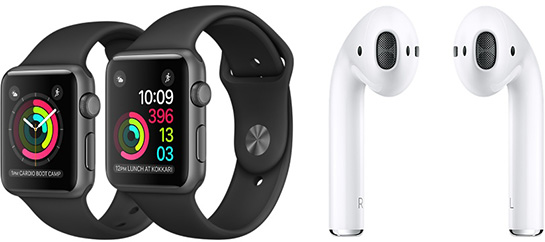
Specifically, Rolland suggests the 2017 Apple Watch will include a SIM card for LTE connectivity and that the next-generation device will be promoted alongside the AirPods.

We understand a model of the next Apple watch will include a SIM card, and therefore is likely to support LTE. We understand some issues remain, including battery life and form factor size, but significant progress has been made. Apple may be employing VOIP and data across a CAT-M1 connection for superior battery life.

Apple will tout interoperability with the company’s AirPods (now on back order till May) to make and receive phone calls (perhaps a small win for Maxim with amps in each ear bud). Positive QCOM, MXIM.

Apple has likely been working to add a cellular modem to the Apple Watch for several years, but has been unable to do so due to excessive battery drain. In early 2016, rumors suggested the second-generation Apple Watch would include cellular connectivity, but that didn’t pan out.

Mid-2016 rumors indicated Apple was researching low-power cellular chips for future versions of the Apple Watch, but was unable to make it work for the second-generation device, so the technology could potentially be ready for inclusion in a 2017 Apple Watch.

The addition of standalone cellular connectivity would further untether the Apple Watch from the iPhone, a process that started with the introduction of GPS in the Apple Watch Series 2. With a cellular connection, Apple Watch owners would not need an iPhone nearby to do things like make phone calls and stream Apple Music content, but a separate data plan would likely be needed.

Other Apple Watch 3 rumors have pointed towards a modest update that focuses mainly on under-the-hood hardware improvements to boost performance and battery life, and while we haven’t heard much information on a third-generation device, a refresh could come alongside the iPhone 8 in September.

Today’s report from Rolland also touches on some previously mentioned 2017 rumors, suggesting all three rumored iPhone models will feature wireless charging capabilities and will be charged through pads manufactured by Pegatron and Foxconn. “There is some skepticism regarding charging efficiency,” writes Rolland, “as it may take 3 hours to receive a full charge.”

While long-range contactless wireless charging was originally rumored to be included in the 2017 iPhone, later information has centered on inductive charging methods, which would require a separate charging mat or other similar charging device.

The analyst also believes Apple will eliminate the Home button in the iPhone 8, but the Lightning port will stay. He suggests there has been “serious consideration” for removing the Lightning port in 2018, however.

Rolland does not have an established track record for predicting Apple’s product plans, but the information he’s shared today is not outlandish and echoes past rumors. Still, cellular connectivity for the Apple Watch has been rumored multiple times in the past, so it’s worth viewing today’s note with some skepticism until additional information is available.