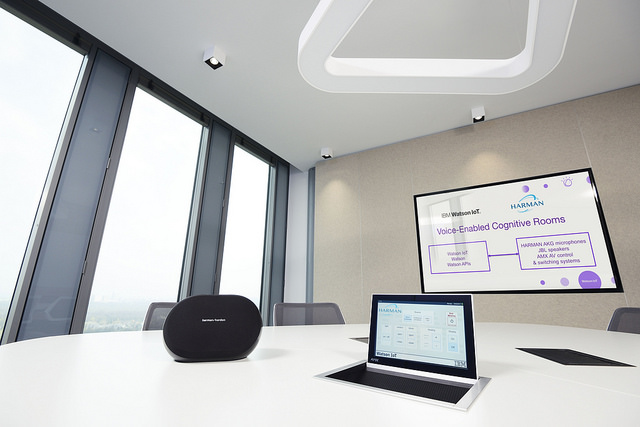
IBM’s Watson Internet of Things (IoT) unit has teamed with audio giant Harman’s Professional Solutions group to create an adaptive artificial intelligence service that can act as an “in-room cognitive concierge.” In less tech-jargon, that’s an AI able to respond to voice commands and questions based specifically on the context of the room its sensor is located in. The technology is currently being demonstrated as a cognitive conference room assistant, and it’s already in use as a patient concierge in hospital rooms. Soon, this cognitive room capability could find its way into hotel rooms, cruise ship cabins, and other corporate spaces.
Called Voice-Enabled Cognitive Rooms, the technology uses IBM’s Watson IoT application programming interfaces and cognitive computing service paired with Harman AKG microphones, JBL speakers, and control and switching systems from Harman subsidiary AMX. Similar technologies are already being embedded in Harman’s consumer devices, including sound bars and alarm clocks, but these latest developments are opening up the system to integration with corporate information systems and building controls.
Using natural language voice commands, the system can be used to control conference room equipment, set up videoconferences, launch presentations, and adjust lighting. The commands are sent to the Watson IoT cloud service and then relayed back to systems in the room as software commands. As the system learns the preferences of each person that uses it, it can automatically adjust the room’s system to their preferences.
Last October, IBM announced that the Cognitive Rooms technology had been adopted by three facilities of Thomas Jefferson University Hospital in Philadelphia to provide patients with greater control over their surroundings and to offer access to basic information about their care. Patients can ask about visiting hours, their doctor, and ask the room for reminders; the cognitive system can also conduct patient surveys and relay the results to a nurse.
The system can even be trained to answer other location-sensitive questions. For example, in a hotel room, it could respond to questions about check-out time and the location of hotel services, or it could be integrated with hotel systems to handle requests for room service, restaurant reservations, late checkout, booking an airport shuttle, and other common interactions.
Just as with consumer voice interaction systems like Amazon’s Echo and Google Home, the Cognitive Room is activated by a “wake word.” But the wake word can be customized here, allowing companies to brand the service themselves.
Hopefully, no company will decide to brand the cognitive room service as “Hal.”
Apple is promoting Earth Day this Saturday with the latest Apple Watch Activity Challenge. The new Earth Day Challenge encourages Apple Watch users to go outside and complete a 30 minute outdoor exercise to unlock new iMessage stickers and a special achievement award. Check out the stickers below:
Earth Day Challenge
Get outside and celebrate Earth Day on April 22 and earn this award. Go for a walk, run, cycle, wheelchair or swim workout of 30 minutes or more in the Workout app or any third-party app that writes these workouts to Health. You will also earn special stickers for Messages.
The new Activity Challenge for Apple Watch users is already popping up for customers in the eastern hemisphere and should arrive overnight for users in the United States.
Facebook’s new Surround 360 video cameras let you move around inside live-action scenes
The freedom of VR with the fidelity of real life
Photo: Facebook
Facebook today announced the second generation of its Surround 360 video cameradesign, and this time the company is serious about helping potential customers purchase it as an actual product. The Surround 360, which Facebook unveiled last year as an open-source spec guide for others to build off of, has been upgraded as both a larger, more capable unit and a smaller, more portable version.
Facebook is calling the big model the x24, because it now has a 24-camera array arranged in an orb instead of the 17 cameras the original flying saucer-shaped Surround 360 called for. The small model is the x6, with just six cameras but in a far more manageable package. Instead of just releasing the design schematics for these cameras online, as it did last year, Facebook is now teaming up with a select group of hardware partners to manufacture and sell finished products later this year. It’s unclear if these products will be Facebook-branded in any way, but the company is still stressing that it has no plans to sell the cameras directly.
Photo: Facebook
As for the upgrades, the x24 and x6 aren’t simply just refined versions of last year’s hardware. They also now capture 8K-quality scenes with what’s known as six degrees of freedom (6DOF), which means your body can move forward, backward, up, down, left, and right so long as your wearing a VR headset with positional tracking like the Oculus Rift. In other words, this is the same kind of freedom of motion high-quality VR allows, but this time with live-action shots. It’s done using a mix of hardware and software that captures a better understanding of the depth of objects in a scene, and replicates perspectives that the camera never captured originally.
“We capture and then we can estimate depth,” says Brian Cabral, an engineering director at Facebook who leads Surround 360 development. “We actually compute for every pixel where it is in the scene.” Once the pixel has a location, he says, viewers can view it from any perspective as it if were part of a real-life scene. After the depth estimation process, which Facebook handles with its own custom software in the cloud, the video then can be edited with any number of standard post-processing toolsets from Adobe, Foundry, and others.
This 6DOF tech has existed in the past, usually reserved for extremely high-end Hollywood special effects and editing tools, yet other companies in the camera and VR space are working on bringing costs down and making content more accessible. Camera maker Lytro is perhaps the best known, with a rig of its own that uses light field technology to capture the geometry of the light in a live-action 360-degree scene. It’s a different approach than Facebook’s, which relies more on computer vision, but it achieves a similar effect.
Facebook, however, thinks its hardware and software is cohesive and easier to use than existing tech. In a demo shot with its own Surround 360 x24 prototype, I was able to observe the differences between a static, 360-degree video and one with the new freedom of motion. The difference is immediate. In the static video shot at the California Academy of Sciences, I could only look around as if my surroundings were a static painting stretched into a sphere around me.
In the updated version, however, I could move my shoulders, lean in close to objects, and even walk around in a small sphere-shaped zone. The effect this has on the viewer is a substantial jump in the level of immersion, making one feel as if they’re viewing a real-life moment play out live instead of simply existing inside of a looped recording. It’s effectively the freedom of VR with the fidelity of real life.
Facebook’s x24 camera creates a depth mask for every object in a scene. That’s what allows these CGI butterflies to interact with the light and objects in this scene as if they were real. Photo: Facebook
Facebook says this will have big implications for the 360-degree format, giving developers the ability to create more engaging videos. You’ll even be able to edit live-action captures with CGI imagery like adding butterflies to an outdoor scene or even changing the background from cloudy to sun or from daytime to nighttime, all thanks to the light and depth data.
Plus, the content can be captured once and reformatted for different platforms, Cabral says. So you can shoot a video designed for the Rift headset and have it work on the Gear VR or even on a smartphone screen accessing it through the Facebook mobile app. With each step down, you lose features like head and body tracking and the six degrees of freedom. But the fidelity of the compressed image remains high-quality because it was natively captured in 8K.
Like the original camera, both of the new Surround 360 models were developed at Facebook’s on-site hardware lab, Area 404, under the supervision of Cabral, who has extensive computer graphics and imaging expertise. Facebook hired Cabral from Nvidia for his engineering and computer vision chops, and he’s been leading the hardware charge at the company’s camera division as a way to solve the difficult “chicken and the egg” problem with 360-degree video. Facebook has the platform to serve this kind of video to billions of users — and the VR headset company to sell those users pricey hardware. Yet not a lot of this content exists yet. Creators also don’t want to put the time, money, and effort toward creating it if they think users won’t ever experience it.
That’s precisely why Facebook has invested resources into building its series of 360-degree video cameras, both to show creators what the tech is capable of and to help kickstart the immersive video boom Facebook thinks might be the future. “What we’re trying to do with VR in general is bring people up the immersion curve,” says Mike Schroepfer, Facebook’s chief technology officer. “The end vision is as close as you can to feeling like your’e actually there. The gold standard is real life.”
Photo: Facebook
Part of that effort is meeting VR halfway with live-action captures of real-life moments that, over time, incorporate the benefits of virtual worlds. “We didn’t want to be in the camera business. We wanted creative people to be able to make this content,” Schroepfer says. FAcebook hopes to get the cameras to market some time this year, but it wouldn’t disclose pricing. (The original Surround 360 was estimated to cost about $30,000 at using the company’s exact schematics.)
Still, for the 360-degree video market, Cabral says a camera of this quality — plus a cheaper, portable version you could use more easily in tighter indoor spaces — will help push the medium forward. Ultimately, Facebook wants “to establish a creative norm,” Cabral says. “There’s a whole new language you have to shoot. We can take for granted we can shoot in 2D. The reason we want high-end creators to use this is for them to teach the rest of us.”
A new report is calling for the suspension of B.C.’s Site C dam project, saying it’s no longer going to benefit the provincial economy as once expected and that power from the hydroelectric station will likely be exported at losses of up to $1 billion.
The report on water governance released Tuesday looks at which option would be best for B.C. from a business standpoint: cancelling, suspending or finishing the $8.5-billion project.
Ultimately, it recommended the project be put on hold and reviewed by the BC Utilities Commission.
A statement from the UBC researchers said several key changes that have happened since the project’s initial approval mean it isn’t the most cost-efficient option for producing power anymore.
First, experts found that alternative options for generating electricity — such as wind power and energy conservation — have become cheaper.
The UBC report says that under BC Hydro’s forecasted demand for electricity, cumulative losses would be nearing $2.7 billion by 2036. (Christer Waara/CBC)
Secondly, BC Hydro’s predicted demand for electricity has “dropped significantly,” according to the report.
Experts said that could mean electricity from Site C won’t be fully needed for nearly 10 years after the project’s expected completion date in 2024.
The surplus energy would need to be “exported at prices currently far below cost,” leading to losses of at least $1 billion.
Under BC Hydro’s forecast demand, the analysis found, cumulative losses would be nearing $2.7 billion by 2036.
B.C. Liberal Leader Christy Clark made a campaign stop in Fort St. John on Tuesday. (Christer Waara/CBC)
“The business case for Site C is far weaker now than when the project was launched, to the point that the project is now uneconomic,” said UBC’s Karen Bakker, who co-authored the report. “The good news is that we are not past the point of no return, according to our analysis.”
The report said suspending the project would save ratepayers up to $870 million. It also said cancelling the project outright by the end of June would save just over $1.6 billion, but the report still recommended a suspension and review.
During a campaign stop in Fort St. John on Tuesday, B.C. Liberal Leader Christy Clark said Site C is still the right option for B.C., given the growing provincial population.
“Growth means our electricity needs to keep up and so we need reliable power. We need it to be affordable power and we need it to be clean power — and the only way to achieve that is through the Site C Clean Energy project,” she told media.
Clark said she hadn’t seen the UBC study, but said the hydroelectric project is about meeting the province’s energy needs in the future and work has to start now to meet that demand as the economy grows.
“So if the electricity isn’t going to be needed for 10 years, when do they expect us to start it? Nine years from now? Eleven years from now?” she asked.
“I think professional electricity planners in that field are better qualified to make the estimates about how much energy we’re going to need in 10 years than academics at UBC who are probably not in the field of electricity use at all.”
Many tech companies are coming out with their own virtual assistants. Amazon has Alexa, Microsoft has Cortana, and of course, Apple has Siri.
You are probably familiar with Siri’s joke-telling prowess. Who could forget the one when you ask her if she has a boyfriend? Siri replies, “No, but drones are always trying to pick me up.” Hilarious.But Siri is much more than just a comedic companion. The virtual assistant has many helpful tricks up her sleeve that you probably don’t know.
That’s why we’re going to tell you about five Siri tricks that you never knew existed. Stick around until the end and we’ll throw in a bonus trick.
1. Choose your favorite search engine
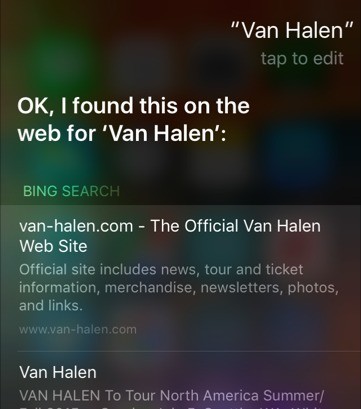
Google is the most popular search engine in the world. However, if Google isn’t showing you enough information on your favorite band Van Halen, ask Siri to search a different source.
First, you’ll need to activate Siri by holding down the home button or, if you enabled it, say “Hey Siri” out loud while your iPhone is plugged into its charger.
You can select other search engines like Bing or Yahoo.
Just say, “Search Bing” and Siri will ask, “What would you like to search for?” Say “Van Halen” and Siri will produce a number of results found on the web.
Tesla Inc (NASDAQ:TSLA) CEO Musk Targeted by Doug Derwin
Derwin believes that Musk should not be working with Trump due to his climate change policies
There have been multiple occasions where Tesla Inc. (NASDAQ:TSLA) has been under attack from either individuals or organizations related to its technology like autopilot or due to its mission of a greener environment. And it looks as if similar things are now back to haunt the company altogether as Doug Derwin is now leading a campaign against Tesla and its CEO Elon Musk.
According to a report by Electrek, Derwin plans to spend $2 million as part of the counterintuitive charity donation, the biggest of its kind. The reason for investing the massive amount is due to the environment protection measures that President Donald Trump has taken to prevent global warming, and with Musk being close to Trump, he and his company are in the line of fire as well.
Last month there was a banner visible outside Tesla’s factory in Fremont which read “Elon: Please Dump Trump.” At that time no one claimed responsibility for the banner, but now Derwin says that he was the one behind it. The advertisement clearly had a message written down that this is a paid advertisement and does not reflect the views of Clear Channel Outdoor or its lessors.
This was also the particular reason that even after his Model S was ready, he did not buy the car and instead gave away $150,000 to American Civil Liberties Union. He said that Trump was using Musk to legitimize himself and that is why he canceled his order. He also now launched a website called http://www.elondumptrump.com/that features videos of upset Tesla owners along with stickers and hats that read “Resist.”
Derwin has made it clear that he will only end the campaign once Musk parts way with Trump. Derwin said, “If Elon will resign from the boards and speak out against what Trump is doing, I’ll call off the campaign.” He also stated that he would donate $1 million to the charity of Musk’s choice if the CEO wears a “Resist” hat and tweets that he does not agree with Trump policies regarding climate change.
‘Negative mass’ created at Washington State University
April 18, 2017
Experimental images of an expanding spin-orbit superfluid Bose-Einstein condensate at different expansion times (credit: M. A. Khamehchi et al./Physical Review Letters)
Washington State University (WSU) physicists have created a fluid with “negative mass,” which means that if you push it, it accelerates toward you instead of away, in apparent violation of Newton’s laws.
The phenomenon can be used to explore some of the more challenging concepts of the cosmos, said Michael Forbes, PhD, a WSU assistant professor of physics and astronomy and an affiliate assistant professor at the University of Washington. The research appeared Monday (April 17, 2017) in the journal Physical Review Letters.
How to create negative mass
The researchers created the conditions for negative mass by cooling about 10,000 rubidium atoms to just above absolute zero, creating a Bose-Einstein condensate (in which individual atoms move as one object). In this state, particles move extremely slowly and, following the principles of quantum mechanics, behave like waves. They also synchronize and move in unison as a “superfluid” that flows without losing energy.
The lasers trapped the atoms as if they were in a bowl measuring less than a hundred micrometers across. At this point, the rubidium superfluid has regular mass. Breaking the bowl will allow the rubidium to rush out, expanding as the rubidium in the center pushes outward.
To create negative mass, the researchers applied a second set of lasers that kicked the atoms back and forth and changed the way they spin. Now when the rubidium rushes out fast enough, if behaves as if it has negative mass.
The technique used by the WSU researchers avoids some of the underlying defects encountered in previous attempts to create negative mass. It could hold clues to the behavior occurring in the heart of ultracold neutron stars, which also act as superfluids, and cosmological phenomena like black holes and dark energy, said Forbes.
The work was supported in part by a WSU New Faculty Seed Grant and the National Science Foundation.
Abstract of Negative-Mass Hydrodynamics in a Spin-Orbit–Coupled Bose-Einstein Condensate
A negative effective mass can be realized in quantum systems by engineering the dispersion relation. A powerful method is provided by spin-orbit coupling, which is currently at the center of intense research efforts. Here we measure an expanding spin-orbit coupled Bose-Einstein condensate whose dispersion features a region of negative effective mass. We observe a range of dynamical phenomena, including the breaking of parity and of Galilean covariance, dynamical instabilities, and self-trapping. The experimental findings are reproduced by a single-band Gross-Pitaevskii simulation, demonstrating that the emerging features—shock waves, soliton trains, self-trapping, etc.—originate from a modified dispersion. Our work also sheds new light on related phenomena in optical lattices, where the underlying periodic structure often complicates their interpretation.
Janet Werker, a UBC professor of psychology, commented on a study that found language learning can be retained subconsciously.
Werker, who was not involved in the study, told Scientific American that it’s exciting that the effects were seen among adults who were only exposed to the Korean language up to six months of age.
How one app wants to make you smarter while you wait
Make the most of those small moments you’re waiting for tech to do its thing
Modern technology requires an awful lot of waiting. Waiting for slow web pages to load. Waiting for people to reply to your texts. Waiting for email to send. This week, researchers at MIT unveiled a new system designed to make wait times more productive. It’s called WaitSuite.
What is WaitSuite?
WaitSuite is a set of tools designed to help people make the most of the time they spend waiting for their phone or computer. For instance, it might take a few seconds for your laptop to connect to Wi-Fi. Or you might write an email, hit send, and it takes a few seconds before your message is actually sent. Or you might be texting back and forth with someone, waiting for them to reply; you can see the little bubble that indicates they’re typing, but you can’t see their message.
A lot of technology use includes “micro moments.” These tiny bits of time, maybe just a few seconds each, that you spend waiting. A team of researchers at the Massachusetts Institute of Technology (MIT) wanted to make these micro moments more productive. So they developed a set of tools to enable what they call “wait-learning.”
In this case, they’re trying to help people learn a new language by showing vocabulary flash cards during these in-between moments when you’re waiting for your phone or computer to do something.
How would I use it?
Carrie Cai, one of the researchers at MIT who worked on WaitSuite, walked me through an example. Imagine you wake up in the morning, open up your laptop, and you have to wait a few seconds for the Wi-Fi to connect. She explained: “The app next to your Wi-Fi icon might alert you to the fact there is a word you could be learning while you are waiting. Then, later in the day, you are waiting at the elevator to go to lunch, you can actually continue on that same vocabulary progress that you had already established before so that same vocabulary progress gets carried over from one waiting moment to the next.”
This is an idea called “micro-learning” — breaking the learning process up into small tasks and spreading them out across the day.
Waiting for your laptop to connect to WiFi can be frustrating. (Derek Spalding/CBC)
Could this type of “wait-learning” be distracting or an interruption?
On one hand, I would personally love to improve my French vocabulary. But on the other hand, the idea of vocabulary flash cards popping up on my phone all the time seems like it could be distracting. And indeed, the researchers at MIT have identified this as a core challenge: “designing interactions in a way that minimizes interruption to the ongoing tasks.”
When they field tested these apps, they learned that many people already engage with technology during waiting times. For instance, people waiting for an elevator might play Candy Crush, check their email repeatedly or browse social media. The idea behind WaitSuite is that if you’re going to engage with technology in these micro moments, you might want to spend that time doing something productive.
WaitSuite could also prompt you to disengage from technology. Instead of showing you a vocabulary flash card, they could prompt you to stretch, breathe, meditate or go for a walk.
You could learn to order a croissant properly while waiting for your ‘ami’ to respond to your text. (Getty Images)
Other than foreign language vocabulary, what other kinds of things could I learn using WaitSuite?
This particular study focused on teaching vocabulary, but Cai says this same wait-learning approach could be used for lots of different kinds of learning. She says it’s best suited for learning that you can break up into small chunks.
“Any kind of content that you might learn on a flash card — for example, historical dates or medical terms, or legal jargon — those sorts of bite-sized learning content would be appropriate for wait learning, just because they’re small, they’re short, and they’re context-free,” she said.
Basically, any task you can break down into small tasks and learn through practise and repetition.
When will this be available?
The whole WaitSuite isn’t available to the public yet. But, if you want to try this out for yourself, you can get a sneak peek. Cai and her colleagues have released a tool called WaitChatter.
Wait Chatter is a Google Chrome plug-in that makes chat wait times more productive (Adam Conner-Simons, MIT)
It’s a Google Chrome plugin that works with Google Chat in Gmail. As you’re chatting back-and-forth with a friend or colleague, it’ll pop up foreign language vocabulary words for you to learn while you’re waiting for the other person to respond. Right now, it supports French and Spanish vocabulary, and assumes that your native language is English.
Personally, while I like the idea of making my wait times more productive, I’m most looking forward to the version of WaitSuite that will remind me to disengage from my devices: to stop, take a walk around the block, or just to step away from my computer for a while.
Apple has added a second Apple Watch manufacturer, according to China’s EDN (via Digitimes). The report claims that this is in part to boost total production capacity in the light of ‘an optimistic sales outlook for the device’
Compal Electronics will produce Apple Watch and Apple Watch Series 2 to account for 20-30% of total shipments initially and is setting up assembly capacity at its factory in Kunshan, eastern China. Compal will begin shipments as early as the fourth quarter of 2017.
Quanta Computer currently has an exclusive contract to make the Watches.
It should be noted that supply chain reports tend to be more reliable on the ‘what’ rather than the ‘why.’ Suppliers would not be privy to Apple’s reasons for the move.
The report acknowledges that increasing Apple’s bargaining power with Quanta is likely to be part of the motivation. A bigger factor is likely reducing risks: Apple likes to have multiple suppliers for its products so that it is not dependent on single sources of either components or assembly.
Apple was recently reported to have a secret team working on measuring blood sugar levels through the Watch as the ‘holy grail’ for those with diabetes.


/cdn0.vox-cdn.com/uploads/chorus_image/image/54326687/facebook_surround_360_x24_x6.0.jpg)
/cdn0.vox-cdn.com/uploads/chorus_asset/file/8366347/facebook_surround_360_x24_2.jpg)
/cdn0.vox-cdn.com/uploads/chorus_asset/file/8366181/facebook_surround_360_x6.png)




 Bruce's Blog