http://www.apextribune.com/artificial-photosynthesis-clean/218265/

ARTIFICIAL PHOTOSYNTHESIS COULD CLEAN THE AIR

Leaves

Specialists developed artificial photosynthesis which could decrease the level of pollution.

Researchers claim that they have found a way to annihilate pollution by implementing the use of artificial photosynthesis. By converting carbon dioxide into energy using only the sunlight, like plants do when undergoing photosynthesis, it will help us diminish the level of pollution. The latest work in the field of green energy was conducted by researchers at the University of Central Florida (UCF).

Scientists developed a way to transform carbon dioxide into energy.

  • They developed a synthetic material which is able to absorb sunlight which can break off CO2 molecules and then turn it into energy.
  • The process of artificial photosynthesis could help us annihilate pollution.

They developed a synthetic material able to transform sunlight into solar fuels, engulfing all the carbon dioxide from the air during this process. Artificial photosynthesis could be an extraordinary breakthrough if they could prove that it works at a great scale. This prospect inspired many scientists who wanted to develop an environmental panacea.

Previous studies have proved that it is possible to build artificial leaves which undergo the same process, recreating the energy-exploiting abilities of real leaves. In other studies, experts also designed photoelectrochemical cells inspired by the eyes of a moth and hybrid energy systems. Nevertheless, their goal still appears to be untouchable. Concerning the new study developed by the team of scientists at the UCF, one of the most significant challenges is centered on the wide range of sunlight types which can be utilized to start the chemical process.

The plan is to alter carbon dioxide, breaking it down into organic materials later used as fuel. Researchers point out that the UV rays of the sun are powerful enough to trigger this chemical reaction in common materials like titanium oxide. However, the problem is that UV rays stand for just 4% of the sunlight which reaches our planet.

On the other hand, the rays in the visible range represent the majority of sunlight which touches the Earth. However, there appears an issue regarding the fact that very few types of materials can track these light colors and kick off the reaction. Among those materials, specialists listed iridium, rhenium, and platinum. Unfortunately, all these are very expensive.

Thus, scientists needed to think of a solution to build this artificial photosynthesis process with affordable materials and visible light. The study was conducted by Fernando Uribe-Romo, an assistant professor, who led the team of chemists at UCF. They analyzed common titanium and then added organic molecules, and they hoped that this would be used as a light-sucking antenna. Those molecules together with the titanium were arranged as a metal-organic framework (MOF).

This mixture proved to break up the carbon dioxide from the air and transformed it into two types of solar fuel, formamides, and formate.

Image source: flickr

http://www.knowyourmobile.com/mobile-phones/iphone-8/24058/iphone-8-price-specs-iphone-7s

Apple’s iPhone 7s and iPhone 8 Detailed: Specs, Features & Pricing News

Why would Apple do this? Simple: OLED panels – or rather, a lack of them, to be precise. The other reason is that Apple will be able to retail this handset as an ULTRA-PREMIUM handset – and that means $1000+ per unit, probably.

Apple simply cannot source enough OLED panels from its suppliers to satisfy demands. This is why OLED will only appear on one handset in 2017. In 2018 and beyond, all models should feature OLED panels, as Apple’s supplier ramp up production.

The upshot to this approach is that Apple can use OLED panels as a big USP on its bigger and more expensive iPhone.

“Apple ordered 100 million OLED panels from Samsung Display for use in the iPhone 8. However, it is now thought that order has been increased to 160 million, which is worth an additional $4.3 billion to Samsung,” notes PC Mag.

OLED displays serve up richer colours, deeper blacks and have faster refresh rates. They’re also flexible, opening up a myriad of options and potential for design – things like curved aspects and truly flexible handsets.

The iPhone 8 – AKA The Mac Daddy – will have all the new, flagship features: so, improved imaging, improved display technology, the all-screen frontage, masses of storage. Basically, all the cool stuff you’ve been reading about for the last 12 months.

This will be Apple’s NEW flagship, just as the iPad Pro is its new (and more costly) iPad flagship.

iPhone 7s vs iPhone 8: Expect BIG Differences – And Not Just In Price

The iPhone 7s and iPhone 7s Plus will likely retail for the same price as the current models. Though there will be some parity with the larger, more impressive iPhone 8 – wireless charging, for one.

“Only the 5.8-inch 2017 iPhone will feature a glass and stainless steel design,” reports BGR, “while the 4.7-inch iPhone will have an aluminium housing just like this year’s iPhones.”

The report added: “The 5.8-inch iPhone is believed to be the iPhone 8, which is expected to feature a steel frame that will hold the internal components, covered by glass front and rear panels. Apple used similar designs in the past for the iPhone 4 and iPhone 4S.”

The iPhone 8 model will be dramatically more expensive; I’ve heard talk of the handset costing more than $1000/£1000 which is insanely expensive for a phone – even if it is one that packs in a lot of new stuff.

“Kuo says Apple will remove the home button completely and replace it on the iPhone 8 with a ‘function area’ akin to the Touch Bar on the new MacBook Pro line. The function area will be contextual, adapting to whatever users need depending on what they are doing,” notes Forbes.

It added: “Interestingly Kuo says the end result is the iPhone 8 will be almost bezel-less with a mammoth 5.8-inch display squeezed into a chassis no larger than the 4.7-inch iPhone 7. Exclude the function area, however, and the actual usable size of the display will be 5.15-inches – which is roughly in line with upcoming rivals like the Galaxy S8 (also tipped for a 5.8-inch display and onscreen controls).”

iPhone 7s Design?

All rumours currently point to the iPhone 7s and iPhone 7s Plus sharing the same design as last year’s models. The upshot to this is that Apple will be able to, maybe, reduce the price to entice user adoption.

The logic here is simple:

  • If you’re bored and want something new, get the iPhone 8.
  • If you’re happy enough with the iPhone 7s and its price, go with that.
  • Apple is basically giving you a choice – but in the end it will win either way.

Personally speaking, I can see A LOT of people going for the iPhone 8. I think Apple knows this which is why it has limited all the big changes to one handset.

Supply chain reports indicate that Apple is struggling to source enough OLED panels for the iPhone 8. Adding OLED to ALL iPhone releases in 2017 would further exasperate this problem. Hence the two model split.

Apple has tasked BOE, a Chinese OLED producer with filling the gap between now and 2018:

“BOE is currently in the process of building two OLED plants in the southwestern province of Sichuan, according to today’s report. The company is investing close to $14.5 billion in the process, building plants in Chengdu and Mianyang,” reports 9to5Mac.

For everything else you need to know about the iPhone 8 (and iPhone 7s) see our iPhone 8 Rumours Hub.


http://appleinsider.com/articles/17/04/28/how-to-tell-if-apple-watch-notifications-are-from-a-native-app-or-an-iphone-app

How to tell if Apple Watch notifications are from a native app or an iPhone app

Sometimes when you get a notification on your Apple Watch, you can tap on it for further options, or to open a corresponding app. Other times, that notification is from your iPhone, and there’s not much you can do with it other than dismiss it. Here’s how to quickly tell the difference.

It’s all in the shape. App icons on watchOS are circles, and when you get a notification from an app that is native to the Apple Watch, tapping on it will open the corresponding app.

When an alert arrives, or you are browsing through past ones in Notification Center, the corresponding app icon is located in the upper left. If it’s a circle, tapping once will provide quick options like “reply” or “dismiss,” and tapping a second time will open the corresponding app.

If the icon is a square, however, that means it’s simply an iPhone notification. That’s because app icons on the iPhone are squares (with rounded corners).

There aren’t as many options when dealing with a notification that isn’t from a native watchOS app. Tap it and you’ll have an option to dismiss. But there is no second tap to open the app, because the app is only on your iPhone.

This subtle distinction of round or square is an easy way to tell what you can do directly from your wrist, without the need to pull your phone out of your pocket.

For more, see AppleInsider’s Apple Watch tips series, including how to maximize music stored locally, how to maximize battery life, and how to remotely take pictures.

http://www.cbc.ca/news/health/phage-therapy-1.4090666

‘The enemy of my enemy is my friend:’ Couple turns to viruses to beat back superbug

Man with desperate infection rescued 100 years after Canadian co-discovery of phages

Steffanie Strathdee and Tom Patterson are shown vacationing in Egypt in late 2015, before he contracted a multidrug resistant superbug and had to be medically evacuated.

Steffanie Strathdee and Tom Patterson are shown vacationing in Egypt in late 2015, before he contracted a multidrug resistant superbug and had to be medically evacuated. (Courtesy Steffanie Strathdee)

It may seem like an unlikely option, but it was viruses that helped to save Tom Patterson when a superbug threatened his life.

Patterson fell ill during a vacation to Egypt in December 2015, experiencing a racing heart, abdominal pain, fever, nausea and vomiting. He was initially diagnosed with pancreatitis, or inflammation of the pancreas, at a local clinic. But when he didn’t improve with standard treatment, he was medevaced to Germany.

That’s where doctors discovered he was infected with a multidrug-resistant strain of Acinetobacter baumannii — one of the World Health Organization’s so-called “priority pathogens” because of the serious threat they pose to human health.

Once stable, Patterson was airlifted to a hospital at the University of California San Diego’s School of Medicine, where he and his wife are both professors.

Dr. Robert Schooley and Dr. Randy Taplitz

Dr. Robert Schooley and Dr. Randy Taplitz successfully administered phage therapy to Tom Patterson. (University of California San Diego )

Patterson had been treated with a combination of antibiotics, including colistin, a drug of last resort that can cause kidney damage. But his bacterial isolate had become resistant, and septic shock was ravaging his bloodstream, damaging organs.

He fell into a coma.

With the virulent superbug pushing Patterson closer to death, his wife, infectious-disease specialist Steffanie Strathdee, decided to take a different tack.

Strathdee asked her partner to squeeze her hand if he was ready to fight; she vowed to leave no stone unturned in her search for alternative therapies. Patterson squeezed back his yes.

What she turned to was phage therapy — a treatment that uses bacteriophages, or viruses that infect bacteria.

Steffanie Strathdee

‘We turned viruses into the biggest weapon against a superbug,’ says HIV researcher Steffanie Strathdee, Patterson’s wife. (University of California San Diego)

Strathdee heard of a less critically ill patient who travelled to Tbilisi, Georgia to undergo the experimental treatment. She herself had learned about bacteriophages as an undergraduate student at the University of Toronto.

Bacteriophages were once used as a treatment in the U.S. and Europe, but when penicillin came to the market in the 1950s, their use was largely abandoned outside of Russia and Poland.

Patterson’s medical team agreed to give it a try, sourcing the bacteriophages from the U.S. Navy Medical Center, Texas A&M University and a U.S. biotech firm.

‘What did I miss?’

After multiple injections, his infection started to clear.

“[Both] our careers have been [spent] looking at viruses as the enemy because we study HIV,” Strathdee said. “But in this case, the enemy of my enemy is my friend. We turned viruses into the biggest weapon against a superbug.”

Three days after the phage therapy began, Patterson’s coma ended.

“When I first came out of a coma, I said, ‘What did I miss?’ And she said, ‘Well, Donald Trump is the Republican candidate and we cured you with … purified sewage from Texas,'” Patterson recalls.

“And I said, ‘I must be hallucinating still.'”Despite the ick factor, everyone’s GI tracts are teeming with both bacteria and bacteriophages. So it makes sense that sewage is a go-to source for researchers seeking raw phages.

Dr. Robert Schooley, chief of infectious diseases at UC San Diego and Patterson’s primary physician, said he was largely willing to try phage therapy due to Strathdee’s strong advocacy.

“What’s different in some ways about this patient was that he was really extremely ill,” he said. “At the time, we did this as a last-ditch effort, and decided the risk of giving him the phage intravenously was worth the potential benefit of saving his life that we thought we would otherwise lose.”

Memories lit like a Christmas tree

When Patterson first awoke, Strathdee said he lifted his head off the pillow, recognized his daughter and kissed the girl’s hand.

Recovering from the coma, however, was a much more gradual process.

At one point, Strathdee showed him a photo of his childhood sweetheart in a beauty contest.

“When she showed me that photograph, it was as if the lights on a Christmas tree, [with just] one string lit up. I was able to recall all kinds of experiences that occurred in that period of my life. It was not like recalling a memory from yesterday. It is like many, small electric shocks in my brain — where bits and pieces were waking up.”

Over his nine months in hospital, Patterson lost about 100 pounds of mostly muscle and had to slowly relearn how to swallow and walk. He’s now back at work.

‘Phages really did something’

Both Schooley and Strathdee say the U.S. Food and Drug Administration facilitated their search for phages, which needed to be matched exactly to the bacteria ravaging Patterson.

“As it turned out, there was really very little evidence of any untoward effects of giving him the phage,” Schooley said.

This week marks the 100th anniversary of the discovery of phage therapy. The Paris-based Institut Pasteur celebrated the anniversary with a presentation of Patterson’s case.

It also used the occasion to pay tribute to the role of French-Canadian Fé​lix d’Hé​relle in showing how bacteriophages can treat infection.

Tom Patterson at March for Science

The now-healthy Patterson was able to join last week’s March for Science in San Diego, where he carried an entirely appropriate sign. (Steffanie Strathdee)

Alan Davidson, a microbiologist at the University of Toronto who studies phages, called Patterson’s case extremely exciting and impressive.

“There haven’t been enough careful trials of this kind of approach,” Davidson said. “This [case] seems to be very well-documented and it seems convincing that the phages really did something.”

Schooley says he believes phage therapy could be greatly expanded if it were prioritized by government and the pharmaceutical industry.

As for Strathdee, her outlook is even broader.

“Our hope is that we’re going to put phage therapy in the spotlight and move the field forward so that can get it to the developing world,” she said. “Because the problems of multidrug-resistant bacteria are so just much more rampant in places where there’s no real health-care system.”

inuxgizmos.com/google-assistant-sdk-dev-preview-brings-voice-agent-to-the-raspberry-pi/

Google Assistant SDK preview brings voice agent to the Raspberry Pi

Apr 28, 2017 — by Eric Brown — 919 views

Google has released a Python-based Google Assistant SDK that’s designed for prototyping voice agent technology on the Raspberry Pi 3.

Google’s developer preview aims to bring Google Assistant voice agent applications to Linux developers. The Google Assistant SDK is initially designed for prototyping voice agent technology on the Raspberry Pi 3 using Python and Raspbian Linux, but it works with most Linux distributions. The SDK lets developers add voice control, natural language understanding, and Google AI services to a variety of devices.


Google Home

The AI-infused Google Assistant voice agent emerged first on the Linux-based Google Home speaker, and spread to various Android platforms to offer AI voice interactions. Competitors include Amazon’s Alexa, Microsoft’s Cortana, and Apple’s Siri.

The SDK incorporates the Python version of the gRPC API, an open source remote procedure call (RPC) client. Since gPRC allows you to generate bindings to other platforms, developers could also extend the SDK to port to Windows and Mac platforms, as well as other programming languages including C/C++, Node.js, Java, and Ruby.


Raspberry Pi 3

The Google Assistant SDK is free for prototyping use, but requires that you make a deal with Google for commercial deployment. Later this year, “commercial device makers will also be able to use the SDK across a wide range of hardware,” said Google.

The SDK release appears to be linked in part to a survey that Google posted for Raspberry Pi developers in January asking them what kind of Google tools they would find most useful. In the survey announcement, Google said that it planned to bring its AI and machine learning technology to the Raspberry Pi in 2017.


Deeplocal’s RPi-based, Google Assistant infused Mocktail Mixer
(click images to enlarge)
The SDK includes samples and documentation, including instructions on how to make a voice-enhanced Mocktail Mixer developed by Pittsburgh-based Deeplocal. Built around a Raspberry Pi and an Arduino board, the open source bartender device lets you order cocktails by voice command, and dispenses jokes with the drinks.

The Google Assistant SDK lets you add similar Q&A chichat to other devices ranging from a robot to a smart mirror, says Google. Developers can call upon “Actions on Google” to extend the SDK with new commands. For example, an action could turn on an LED light or set a robot into motion. The voice agent can be summoned with the OK Google hotword or a physical red button made available by Google.

Other SDK features include the ability to read transcribed text from user voice input, which can be used to provide additional device functionality. For example, you could scan for happy or sad keywords and change the mood lighting accordingly. Google is currently working on enhancing the SDK with hotword support and companion app integration, among other features, and has established a community development site.

There has already been at least one open source project designed to run Google Assistant on a Raspberry Pi using IFTTT. There are many more RPi projects using Alexa. Amazon has a head start over Google, Microsoft, and Apple when it opened its Alexa SDK to device developers. Over the last year, there has been a growing number of smart home and other mostly Linux-based devices that have integrated Alexa voice agents.

Google Assistant SDK overview
Further information

The Google Assistant SDK developer preview is available for download, initially optimized for the Raspberry Pi. More information may be found in Google’s announcement announcement and on the Google Assistant SDK web page.

https://www.cnet.com/news/apple-google-alphabet-waymo-tesla-uber-ford-toyota-californias-self-driving-cars-dmv/

Apple, others want to tweak California’s self-driving car rules

The input, posted online by the DMV, includes suggestions by Lyft, Tesla, Uber, Waymo and dozens of others.

The companies — along with dozens of other organizations like Lyft, Uber, Ford and Toyota — submitted comments to the Department of Motor Vehicles, which were then posted online. The suggestions range the gamut from deciding when a driver should have to take control of the autonomous vehicle to recommending paying customers be allowed to ride in self-driving cars.

The DMV told CNET that it’s currently reviewing the public comments received on the proposed autonomous vehicle regulations. If it decides to make changes to its regulations, it will hold a 15-day public comment period for organizations and individuals to weigh in.

Autonomous car technology has become a big focus for companies such as Google and Uber, and speculation about Apple’s self-driving car plans have been swirling for months. It’s unclear whether the company wants to build an autonomous vehicle of its own or if it wants to power the infotainment and other systems of a car. Apple obtained a permit earlier this month to test self-driving cars in California.

Apple — in its letter signed by Steve Kenner, its director of product integrity — said it’s “investing heavily in the study of machine learning and automation, and is excited about the potential of automated systems in many areas, including transportation.” It wants to see changes to three California policies related to “disengagement reporting,” definitions, and testing without safety drivers.

Apple’s letter

One of Apple’s criticisms focused on current and proposed disengagement reporting requirements, which explain when a driver has to take control of the self-driving car. Apple said the metric isn’t transparent enough to make consumers comfortable with the technology. The company believes the correct metric for evaluating automated vehicles should include data on successfully prevented crashes and traffic rule violations.

Google’s Waymo wants you to test its self-driving cars

 California’s current regulations would make companies detail how many times humans had to take over control of the system because of a system failure or traffic, weather or road situation, according to Reuters.

Apple wants disengagement to be defined as “an unexpected event or failure that requires the safety driver to take control of the vehicle in order to prevent a crash or traffic violation.” It also said disengagements shouldn’t be reported for system errors or failures, the end of a test or experiment, or several other scenarios.

The other two changes Apple requested relate the definition of development vehicles and testing without a safety driver.

Apple didn’t immediately respond to a request for comment.

Other comments

Waymo, the self-driving car company owned by Alphabet, had some issues with regulations related to driver v. no driver as the key distinction, the definition of “remote operator,” liability, and information privacy.

“We’re encouraged by the DMV efforts to develop regulations for autonomous vehicles that would help California remain a leader in the development of self-driving cars,” Waymo said in a statement. “Waymo looks forward to deploying this life-saving technology in the state.”

Tesla, whose founder — Elon Musk — wants to make self-driving semis and buses, argued that vehicles weighing more than 10,000 pounds shouldn’t immediately be banned from testing or deployment on public roads. It also said it shouldn’t be prevented from selling a non self-driving car that previously was tested as an autonomous vehicle.

“This prohibition appears to have been written without consideration for vehicles that were used as autonomous test vehicles but contain only production hardware and, once loaded with production software, are indistinguishable from production vehicles,” the company said. “This is the case with many Tesla autonomous test vehicles.”

Tesla didn’t immediately respond to a request for comment.

Uber, meanwhile, said paying members of the public should be able to ride in autonomous test vehicles with drivers. The ride-sharing service got in trouble with California late last year for putting self-driving cars on the road and for picking up paying customers without permission of the DMV.

Within hours of the self-driving car launch in San Francisco in December, California’s DMV told the company it was breaking the law and needed to halt the program until it got a permit. Uber refused to back down and said it would keep the cars on the road. After a week of back-and-forth between Uber and the DMV, along with an intervention from California’s Office of the Attorney General, the DMV announced it was revoking the registration of 16 of the company’s autonomous vehicles.

Uber didn’t immediately respond to a request for comment.

Uber’s main rival, Lyft, said language requiring autonomous car companies to notify local authorities about tests is “ambiguous” and could create confusion and delays in the testing process. It proposed that the DMV could operate a webpage where manufacturers could post notices regarding their proposed testing areas. “Such a website would not only streamline the notice requirements, but also increase public access to this information,” it said in its letter.

Lyft didn’t immediately respond to a request for comment.

Car laws

The state of California has been working on autonomous vehicle regulations for nearly two years. In mid-December 2015, it released its first draft for review. In September 2016, it released its revised draft. After taking into account feedback, California published its latest proposed regulations on March 10, which set off a 45-day public comment hearing.

Along with big tech companies, other commenters during that time included insurers, car dealers’ associations, “a concerned citizen” and Fathers Against Drunk Driving.

The DMV plans to summarize and respond to all comments when it submits its regulations to the Office of Administrative Law for approval. If the OAL approves the regulations, they become law that go into effect 120 days after their approval. The DMV estimates the regulations could be in effect by the end of November, a spokesperson said.

Reuters earlier reported the news.

Does the Mac still matter? Apple execs tell why the MacBook Pro was over four years in the making, and why we should care.

https://www.fool.com/investing/2017/04/28/apples-siri-speaker-could-come-as-soon-as-june.aspx

Apple’s Siri Speaker Could Come as Soon as June

That’s just over a month away.

Rumors continue to swirl about Apple‘s (NASDAQ:AAPL) presumed interest in creating a Siri-powered speaker to take on Amazon.com‘s (NASDAQ:AMZN) popular Echo device, which is powered by the e-commerce giant’s own virtual assistant, Alexa. Given Echo’s success (Echo Look announcement notwithstanding), there doesn’t really seem to be a way for Apple to avoid creating such a device, particularly if it wants to become a meaningful smart home player — which it does.

Investors have been hearing about Apple’s “Echo killer” for months, and some new details may be emerging from the rumor mill.

Amazon Echo on a bookshelf

ECHO HAS BECOME A RUNAWAY SUCCESS. IMAGE SOURCE: AMAZON.

Rumor has it

Known tech leaker Sonny Dickson shared some purported details about the device on social media yesterday. The Mac maker is reportedly finalizing its designs. Like tvOS, which is essentially a heavily modified version of iOS, the new device may also run a “variant” of Apple’s mobile operating system.

Apple is currently finalising designs for their Alexa competitor, expected to be marketed as a Siri/AirPlay device.

It is believed to carry some form of Beats technology, and is expected to run an variant iOS

Mashable reached out to Dickson and got more details.

More from @SonnyDickson on Apple’s Alexa competitor.
– Concave top with the controls, fat with the speaker mesh portion covering it all. 1/2

More claims from @SonnyDickson on Apple’s Alexa competitor:
– Think Mac Pro style.
– Same style UE boom mesh.
– Possible release WWDC.
2/2

The product should look similar to Apple’s current Mac Pro, which is to say you could potentially mistake it for a trash can (or is it a jet engine?). It could have mesh portions covering the speakers with a concave top where the controls are located. Perhaps most importantly, we could get a glimpse of the device as early as WWDC, Apple’s worldwide developer conference, which takes place June 5-9 this year in San Jose, California.


Questions remain

That pretty much sums up the recent leaks. But as usual, what’s harder to ascertain may be more important to investors. It’s not unusual for hardware details to leak out of the supply chain, but things like pricing strategy or product branding don’t produce physical evidence, and those have greater impact on Apple’s competitiveness. The flagship Echo costs $180, while Alphabet‘s Google Home costs $129. There should be little doubt that Apple will price its response at a premium, so we’re probably talking about a price point of $200 or $250, if not more.

The challenge here is that while Apple almost always comes in at the top of a market, Siri has been pretty underwhelming compared to Alexa or Google Assistant. Since the virtual assistant is utterly critical to the user experience given the voice-activated nature of this category, it’s much harder to justify premium pricing. Apple is also behind its rivals in terms of third-party integrations and search capabilities, only really opening up Siri to third-party developers less than a year ago with a Siri SDK.

Maybe Apple hopes to integrate its Siri Speaker (or will it be called “Apple Home”?) with other Apple products, like having it be able to read calendar events off your phone or announce incoming texts and phone calls, for example. But those minor conveniences may not compete well against the thousands of Skills that Alexa has learned, or Google Home’s ability to Google things for you.

We don’t know what we don’t know, but maybe we won’t have to wait long before Apple officially unveils its newest device. WWDC is just over a month away.

http://mobilesyrup.com/2017/04/28/google-pixel-executive-david-foster-departure/

Head of Google’s Pixel division leaves company

https://www.macrumors.com/2017/04/28/original-apple-watch-repairs-extended/

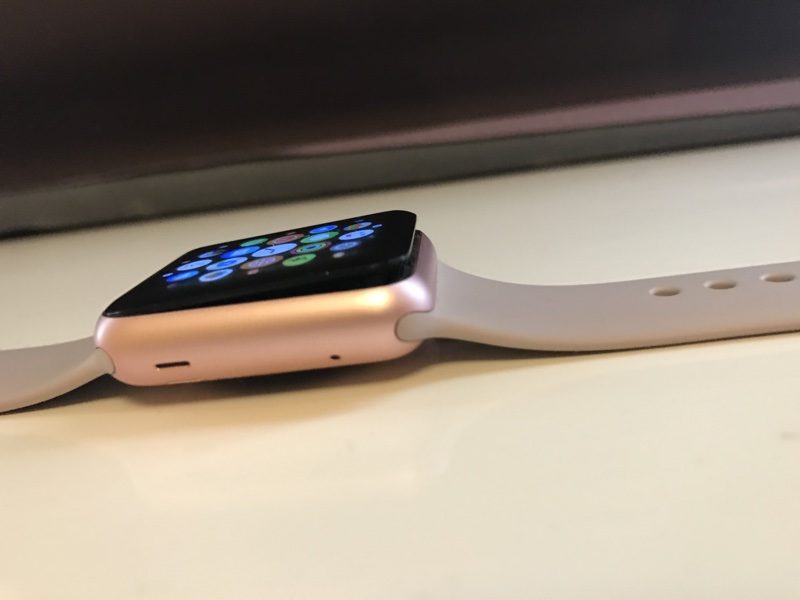
Repair Period for First-Gen Apple Watches With Battery Issues Extended to 3 Years

Apple today informed retail store employees and Apple Authorized Service Providers that it is extending the service coverage for first-generation Apple Watch models experiencing battery problems to three years.

In an entry in Apple’s repair database (via 9to5Mac), the company explains that coverage is extended for original Apple Watch models that are seeing swollen or expanded batteries. A public announcement about the service extension has not been made, and it’s not clear if Apple will offer reimbursements for customers who have already paid for battery replacements or have done battery replacements themselves.

Image via MacRumors forum user Rosepod5
Customers who have an original Apple Watch afflicted with a swollen or expanded battery will now be able to have the device repaired for up to three years after its purchase date, even when AppleCare was not purchased for the watch. From the repair database:

Apple has extended Service coverage for eligible Apple Watch (1st gen) models with an expanded/swollen battery to three years after the original date of purchase. Eligible devices will be covrered for two years beyond the original 1-year Limited Warranty.

Complaints about swollen batteries on the original Apple Watch have been circulating for a few months on reddit, the Apple Support Communities, and the MacRumors forum.

Reports are rare, but it does appear to be an issue affecting a small number of original Apple Watch users. The battery problem causes the Apple Watch screen to pop away from the casing, rendering it unusable.

The first-generation Apple Watch, first introduced in April of 2015, recently reached its second birthday on April 24.

Related Roundups: Apple Watch Series 2, watchOS 3