http://www.livemint.com/Industry/M4mOPWRf0L9cSH0OBWpniL/Apple-selfdriving-car-testing-plan-gives-clues-to-tech-prog.html

Apple self-driving car testing plan gives clues to tech programme

Apple included a 10-page training plan that appeared to be related to operators taking back manual control of the self-driving car during automated exercises of the system

San Francisco: Apple Inc. outlined a plan to train operators of self-driving cars in documents submitted to California regulators earlier this month, the latest clues to the company’s autonomous vehicle technology aspirations.

Apple was granted a permit to test self-driving cars on 14 April by the California department of motor vehicles but the company has never said anything about its plan.

The state released 41 pages of Apple application documents to Reuters that give some clues about the company’s highly secret self-driving effort, which it has never openly acknowledged.

The iPhone maker joins a long list of carmakers, start-ups and technology rivals, including Alphabet’s Waymo, that are testing cars on state roads. Apple is looking for new hit products and autonomous car technology is expected to revolutionize the traditional auto industry.

As part of the application, Apple included a 10-page training plan that appeared to be related to operators taking back manual control of the car during automated driving exercises of the system, which it calls a development platform.

Apple declined comment beyond the filing.

The plan includes a document called “Automated System: Development Platform Specific Training Overview” whose objective is “to train safety drivers in various automated driving conditions”. “Development platform will be controlled electronically (e.g. joystick) and safety drivers must be ready to intervene and take control,” the document reads.

The document highlights different scenarios to be tested, from high speed driving and tight U-turns to lane changes. One letter sent from Apple to the state department of motor vehicles noted that Apple’s development platform “will have the ability to capture and store relevant data before a collision occurs”.

The document does not include detail on how Apple’s self-driving platform actually works or other technical details. It also does not say what kind of sensors are found on Apple’s three permitted vehicles, all 2015 Lexus model RX450h. The permit does not necessarily mean that Apple itself is building a full car. Apple could instead be designing a self-driving platform that can be integrated into other manufacturer’s cars. Reuters

http://indianexpress.com/article/technology/science/new-approach-may-lead-to-high-power-batteries-4625075/

New approach may lead to high-powered batteries

Scientists develop a new approach that may increase the performance of electric storage devices and also reduce their size.

car batteries, Stanford University, superior storage capacity,  super capacitors, transition from fossil fuels to renweables, science, Science newsAdvancing new materials for energy storage is an important step towards reducing carbon emissions in the transportation and electricity sectors. (Image for representation Source: Reuters)

Scientists have developed a new approach that may lead to increase in the performance of high-power electrical storage devices such as car batteries and also decrease their size.Researchers from Stanford University in the US developed a mathematical model for designing new materials for storing electricity.

“The potential here is that you could build batteries that last much longer and make them much smaller,” said Daniel Tartakovsky, professor at Stanford University. “If you could engineer a material with a far superior storage capacity than what we have today, then you could dramatically improve the performance of batteries,” Tartakovsky said.

Also Read:  Gen-next smartphone batteries in the offing
Advancing new materials for energy storage is an important step towards reducing carbon emissions in the transportation and electricity sectors.One of the primary obstacles to transitioning from fossil fuels to renewables is the ability to store energy for later use, such as during hours when the sun is not shining in the case of solar power, researchers said.

Researchers hope the new materials developed through this model will improve supercapacitors, a type of next-generation energy storage that could replace rechargeable batteries in high-tech devices like cellphones and electric vehicles.Supercapacitors combine the best of what is currently available for energy storage – batteries, which hold a lot of energy but charge slowly, and capacitors, which charge quickly but hold little energy, researchers said.

The materials must be able to withstand both high power and high energy to avoid breaking, exploding or catching fire.”We developed a model that would allow materials chemists to know what to expect in terms of performance if the grains are arranged in a certain way, without going through these experiments,” Tartakovsky said.

“This framework also shows that if you arrange your grains like the model suggests, then you will get the maximum performance,” he said.The model could be a huge benefit to chemists and materials scientists, who traditionally rely on trial and error to create new materials for batteries and capacitors, researchers said.The study was published in the journal Applied Physics Letters.

http://gadgets.ndtv.com/apps/news/whatsapp-iphone-update-gives-siri-the-ability-to-read-out-your-latest-messages-1684580

WhatsApp iPhone Update Gives Siri the Ability to Read Out Your Latest Messages


HIGHLIGHTS

  • Siri can now read out your latest unread messages
  • Calls tab, Contact info, and Group info screens get new UI
  • WhatsApp iPhone update also brings Persian support & other features
 WhatsApp on Friday released a new update for the iPhone, which brings some nifty little visual improvements along with the ability to have Siri read out your latest messages. The new WhatsApp update (v2.17.2) is now available via the App Store.

The latest version of WhatsApp, which is about 89MB in size, highlights four key updates – you can ask Siri to read out your latest messages; visual improvements to the Calls tab, Contact info, and Group info screens; ability to select multiple statuses at once in the My Updates screen which you can forward and delete; and support for Persian language.

whatsapp update iphone whatsapp

Talking about the Siri-related update, WhatsApp already let you to compose and send WhatsApp messages through Siri. The new update know enables Siri to read out your latest messages to you hands free, which will come in handy when you’re driving, for instance.

The functionality only works if you have some unread messages. Say something like “Hey Siri, read my last WhatsApp message” and Siri will read out the new messages to you and will then prompt you to compose a reply. You can then choose to reply to the message by dictating it to Siri. We tried the new feature and it seems to work as promised. You should also note that once Siri has read your latest messages, it won’t be able to read it again the second time. Furthermore, this feature will only work for users who are on the iOS 10.3+.

Iwhatsapp siri update whatsapp

The WhatsApp update also brings some visual changes to the Calls tab, Contact info, and Group info screens. On opening any one of the screens, you’ll notice that the display images enlarge as you scroll down, and the various options below have colourful icons next to them for some added flavour to what was otherwise a fairly dull interface.

whatsapp update group whatsapp

The update also lets you select multiple statuses in the My Update section which you can forward or delete, a redesigned two-step verification interface makes it easier to set up and the camera function now remembers the lens you used last – front or back. As mentioned earlier, WhatsApp has also added support for Persian language with the latest update to its iPhone app.

https://www.rt.com/viral/385780-neuralink-brain-interface-urban/

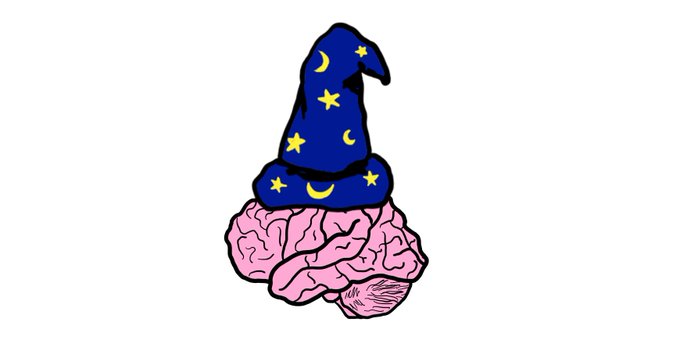
Elon Musk’s Neuralink could represent next stage of human evolution

More details on Elon Musk’s futuristic Neuralink venture have been revealed in an illustrated blog post, including how the advanced technology could see us communicate wirelessly just by thinking within 10 years.

It’s finally here: the full story on Neuralink. I knew the future would be nuts but this is a whole other level. http://waitbutwhy.com/2017/04/neuralink.html 

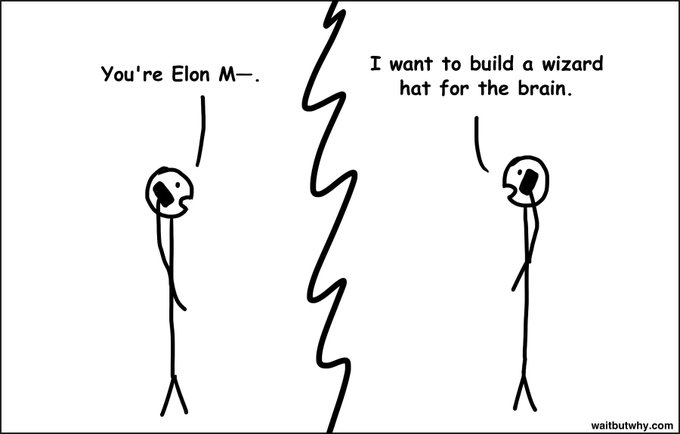
Wait But Why published the 36,400-word deep dive into Neuralink using stick figure illustrations to explain in simple terms what Musk has in mind for, well, our minds.

The blog post comes one month after Musk announced Neuralink, his latest plan to merge the human brain with AI using brain implants.

Long Neuralink piece coming out on @waitbutwhy in about a week. Difficult to dedicate the time, but existential risk is too high not to.

The post, however, was written by blogger and cartoonist Tim Urban after studying Neuralink for six weeks, a process which involved meeting with Musk. Urban was secretly working on his Neuralink breakdown weeks before the billionaire inventor made the official announcement.

Eager fans have been waiting to hear more about the venture ever since Musk promised a long piece on the subject the day of the announcement.

@waitbutwhy @hstaudmyer I have probably checked your website about 100 times to see if the neuralink post has been complete!

Urban said he’s “convinced that Neuralink somehow manages to eclipse Tesla and SpaceX in both the boldness of its engineering undertaking and the grandeur of its mission.”

Urban has written other detailed breakdowns on Musk’s projects for Wait But Why, including Tesla and SpaceX.

READ MORE: New Elon Musk venture aims to connect human brain with AI

Neuralink’s “whole brain interface” will use tiny brain electrodes that will eventually allow us to communicate wirelessly with the world, and to share our exact thoughts and visions without having to use spoken or written language. The brain could also learn faster and have access to all the world’s knowledge.

“I think we are about eight to ten years away from this being usable by people with no disability,” Musk said in an interview with Urban.

According to Musk, who has taken on the role as Neuralink’s CEO, today’s existing technology already makes us “digitally superhuman.”

“The thing that would change is the interface,” Musk explained. “Having a high-bandwidth interface to your digital enhancements.”

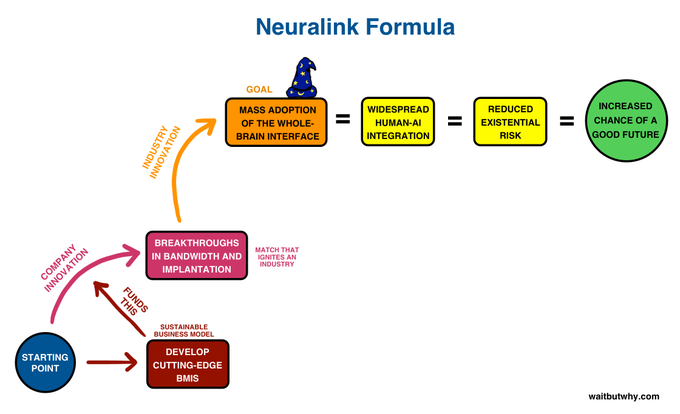
Musk’s plan is to first create cutting-edge brain machine interfaces (BMIs) to be used to help people with brain injuries, building on existing technology used in medicine.

“We are aiming to bring something to market that helps with certain severe brain injuries (stroke, cancer lesion, congenital) in about four years,” Musk told Urban.

This will help fund the company to make additional breakthroughs in implantation and increasing the bandwidth needed for the technology, which will in turn create industry-wide innovation.

It will eventually lead to mass adoption of the “whole brain interface,” which will allow us to communicate wirelessly with the world in a way that feels as natural as thinking does, Urban explains.

The future seems smart nuts, if you go with Elon Musk’s by @waitbutwhy – amplifying the human brain with an gateway;

Musk met with over 1,000 people to find the right cross-disciplinary team of experts who each bring their own unique knowledge and expertise to create a group that can think as a single “mega-expert.”

The SpaceX CEO describes the whole-brain interface as a “digital tertiary layer,” for our brains, and says his vision isn’t so far from where we are now.

“We already have a digital tertiary layer in a sense,” Musk said, “In that you have your computer or your phone or your applications.”

“You can ask a question via Google and get an answer instantly. You can access any book or any music. With a spreadsheet, you can do incredible calculations.”

“You’re already a different creature than you would have been twenty years ago, or even ten years ago,” he said, adding people are already “kind of merged with their phone and their laptop and their applications and everything,” he added.

Musk’s plan faces a number of challenges before it can become widespread, including having enough ‘bandwidth’ to process the advanced technology and finding non-invasive and biocompatible methods to implant BMIs so they do not feel like a foreign object in our bodies.

The ten-year timeline also depends on a number of factors. “It is important to note that this depends heavily on regulatory approval timing and how well our devices work on people with disabilities.” Musk said.

Urban highlighted a number of risks associated with mass adoption of the whole brain interface, including computer-like bugs and brain hacking.

As for fears that having such technology will allow people to see your thoughts, Musk explained, “People won’t be able to read your thoughts—you would have to will it. If you don’t will it, it doesn’t happen.”

http://www.tomsguide.com/us/apple-watch-3-rumors,news-24938.html

Apple Watch Series 3 Rumors: What Apple’s Planning for its Next Smartwatch

Although the smartwatch is still very much a niche category, it’s hard to deny that the Apple Watch has established itself at the top of the heap for wearables. Two years after the first Apple smartwatch appeared, we’ve already seen one significant update to the device, along with a bump to the original model. Still, we can’t help but wonder what Apple has planned next.

Unlike the upcoming iPhone 8, which has seen a blitz of rumors and reports, the next Apple Watch has mostly flown under the radar. But there are some rumors floating around out there, and given Apple CEO Tim Cook’s fondness for the device, it seems a certainty that the company is far from done with updates to its smartwatch line. Here’s what you can expect from the Apple Watch Series 3.

Apple Watch 3 Rumors at Glance

  • Release could be in fall 2017 to coincide with iPhone 8 but may be pushed back to spring.
  • 4G for staying connected away from your phone.
  • Camera to enable FaceTime calls on the go.
  • Improved battery life, which would be achieved through microLED screen technology.
  • Modular wristband for adding features, such as glucose readings for diabetics.
  • watchOS 4 will provide more complete fitness and health assessment.
  • Price to remain in $300 to $500 range.

When will the Apple Watch 3 come out?

Compared with the iPhone, which has received regular yearly updates since its release in 2007, Apple Watch updates come out with less regularity. The Series 2 models arrived in fall 2016, a year and a half after the original model’s spring 2015 debut. If that pattern were to continue, it would peg spring 2018 as the most likely release date for a Series 3 model.

However, if there’s one thing Apple is known for when it comes to product announcements, it’s surprise. Depending on the company’s strategy and production, there’s a reasonable chance of a six-month swing — in either direction — in that release date.

Most recently, a report in China’s Economic Daily News, spotted by MacRumors, suggests that a third-generation Watch will ship in 2017, appearing at a fall event that would likely place it alongside the next iPhone. That’s a definite possibility, so expect reports to  pick up if that date proves accurate

What features will Apple add to the next Apple Watch?

With its initial Apple Watch release, Apple seemingly tried to include everything and the kitchen sink in the wearable device. That certainly left less room for low-hanging fruit in future models, though the Series 2 Watch added a few major missing features in the form of GPS and better water resistance.

That leaves one other significant capability lacking from current versions of the Apple Watch: cellular connectivity. While the current Apple Watch models can work without an iPhone present as long as there’s a known Wi-Fi network, you can’t take just your Apple Watch with you and expect to have full connectivity.

However, adding 4G to the Apple Watch comes with its own challenges, such as increased size and weight and the need for better battery life, not to mention added cost from a cellular provider. Apple may not have figured out those issues yet for the Watch Series 3, so it’s hardly a sure bet for the next iteration of the device.

Rumors have also abounded since the release of the first Apple Watch that the company would add a camera to the device, largely fueled by an Apple patent from 2016. Such a camera would likely serve several purposes, from holding FaceTime video chats to taking selfies to being used as an input method — scanning bar codes, for example.

While a camera did not materialize for the Apple Watch Series 2, it remains a possibility for Series 3. However, the enthusiasm is somewhat dampened based on the ergonomics of the solution — holding up your arm for long periods  is tiring and uncomfortable — and the security/privacy concerns of adding a camera to a device on your wrist.

Current speculation has focused on somewhat more mundane updates from the next Apple Watch, including a report that Apple is working to improve the device’s battery life — perhaps in advance of adding cellular connectivity — and another that it might update the watch’s OLED display technology. While some have suggested that microLED technology could provide thinner, lighter and brighter screens, that technology has yet to be put into mass production and may not be ready for a 2017 release. That said, a recent report in DigiTimes, spotted by 9to5Mac, does suggest that the company will turn to a new glass-film touch-screen technology that would presumably reduce thickness and weight as well.

Is a modular wristband on the way?

Apple might not only change t just the style of its watchbands in the next version of the wearable, but make them smarter, too. That would likely be accomplished by adding more tech inside the bands themselves, whether that means something like extra battery cells, additional sensors, a camera, a second display or more. Much of this theory is also based on an Apple patent for modular technology in a wristband from earlier this year.

One thing a modular wristband could include is an additional health sensor for glucose monitoring. A report from CNBC says that Apple has an engineering team working on a noninvasive method of measuring blood sugar, which could be a huge boon to diabetics. The technology is said to be far enough along to have reached the clinical trial-stage, though it would still need regulatory approval.

What can we expect from the next watchOS update?

While the Apple Watch’s hardware gets a lot of attention, Apple’s watchOS software is doing most of the heavy lifting in terms of the watch’s usefulness and capabilities. The watchOS 2 and 3 have greatly refined the experience of the Watch, which, hopefully, means that watchOS 4 will continue to bring new life to existing Apple Watches as well.

If Apple follows its traditional release schedule, watchOS 4 will likely be announced at this summer’s Worldwide Developers Conference, which starts June 5. A final release would come in the fall, likely around when Apple rolls out new versions of iOS and macOS.

As to what features will find its way into watchOS 4, rumors have been pretty sparse about software, since there’s no supply chain to provide leaks. There have been suggestions that Apple has been looking into adding sleep tracking to its array of health features. Additionally, the same report from Bloomberg says the company may also add a fitness-assessment capability, which would interpret the heart-rate data the Watch already logs. For instance, the Apple Watch could measure how long it takes you to go back to resting heart rate after exertion to determine your level of health.

How much will the Apple Watch 3 cost?

Apple products traditionally target the higher end of a price range, and both the original and Series 2 versions of the Apple Watch definitely fall into that category. We’ve seen the base versions of the watch hover in the $300-$500 range, and a Series 3 Apple Watch would be likely no different.

The big question is how many editions of the Series 3 Apple will create. The original Apple Watch had three models — the aluminum Sport, the standard stainless-steel Apple Watch and the pricey gold Edition — while the Series 2 changed it up by offering the Apple Watch in either aluminum or steel, special co-branded Nike and Hermès versions and the top-end ceramic Edition. Expect the Series 3 to follow the Series 2 pattern; the multi-thousand-dollar Edition models made a splash, but Apple has seemed to move away from aiming for the truly luxury market.

What we want to see from the Apple Watch 3

Like most Apple products, the Apple Watch is a marriage of hardware and software. So, regarding improvements to the overall device, there are several things we’d like to see in both arenas that could lead to a better Apple Watch.

Regarding hardware, improvements to battery life and connectivity are certainly at the top of the chart. Being able to use the Apple Watch in more situations and for longer periods  would go a long way to integrating the device more into our daily lives. Improved battery efficiency could also enable long-awaited features, like an always-on display.

A thinner and lighter Watch wouldn’t go amiss, either, and it could even be interesting to see Apple toy with the idea of a round display, a feature  rivals have tried, with mixed results. And, as ever, faster performance would be at the top of the list for many users who still find the Apple Watch sluggish at times.

But there’s far more opportunity for improvement with the watchOS software. Some elements of the original Apple Watch design have not aged well — the honeycomb home screen, for example — and could use revisiting in a future watchOS update. Likewise, opening up watch faces to third-party developers could give users even more personalization and customization options than what Apple provides. Native apps for Notes and the recently rebranded Apple Podcasts would be welcome additions, too; though, let’s not go crazy: no need for iBooks on the Watch — not yet, anyway.

Credit: Jeremy Lips/Tom’s Guide

http://bgr.com/2017/04/22/apple-car-self-driving-software/

Apple is getting serious about self-driving cars

Though Apple’s plans to develop and manufacture a branded car may currently be on hold, the company’s plans to research and develop self-driving car technologies appears to be moving forward. Just about a week after Apple obtained a permit to test autonomous vehicles in the state of California, Business Insider filed a public-records request and managed to gain access to materials accompanying Apple’s permit application. The filed documents provide us with some interesting new information regarding Apple’s training program for its nascent self-driving car initiative.

According to training materials which correspond to software Apple calls the “Apple Automated System”, it appears that Apple engineers have been busy developing a suite of software and hardware sensors designed to assist a car drive with the flow of traffic while avoiding other vehicles and pedestrians.

According to the training packet, the car that Apple’s staffers are using to test the self-driving technology is outfitted with consumer video game gear such as a Logitech steering wheel and pedals to actuate drive by wire.

Whereas Apple’s earlier car efforts seemed to entail hiring hundreds of employees with vast automotive experience across all aspects of the car development and manufacturing process, it stands to reason that Apple, for the time being, has decided to primarily focus its attention on self-driving technologies.

With cars boasting Apple’s mysterious autonomous software having been approved for use on the road, California law holds that the drivers/passengers overseeing the testing must be sufficiently trained and ready to assume control of the wheel at any moment.

Apple applied for a permit for six drivers to drive three Lexus RX450h SUVs. Apple’s drivers, named in the application, are mostly Ph.D.s specializing in machine learning, some of whom previously worked for companies like Bosch and Tesla, according to their LinkedIn profiles.

Apple said its vehicles would be able to capture and store “relevant data before a collision occurs” in its application.

That Apple is exploring self-driving technologies may not be all that surprising, but the more interesting question is if it really matters. As it stands now, we can only presume that Apple’s progress with its own technology isn’t anywhere close to matching what established automakers and a myriad of start-up companies have already developed. Going forward, it will be interesting to see if Apple’s foray into the self-driving world will ever yield a marketable product or if it will simply become an Apple research initiative that never sees the light of day.

Apple’s full permit application can be viewed over here via AppleInsider.

http://gadgets.ndtv.com/mobiles/news/moto-g4-play-to-receive-android-nougat-in-june-report-1684686

Moto G4 Play To Receive Android Nougat in June: Report


Moto G4 Play To Receive Android Nougat in June: Report

HIGHLIGHTS

  • Moto G4 Play to get Android Nougat update in June
  • The smartphone was launched in India in September
  • It is currently available via Amazon India at Rs. 7,999

Moto G4 Play, which was launched in India in September last year, will finally receive Android Nougat update in June, according to a new report. The Moto G4 Play is priced at Rs. 8,999, but is currently being offered at Rs. 7,999 via Amazon India. It will also be the last member of the Moto G4 family to get the Nougat update. To recall, the Moto G4 and Moto G4 Plus received the Nougat update in December.

The Moto G4 Play comes with 16GB of inbuilt storage, which is expandable storage via microSD card (up to 128GB). Connectivity options include 4G LTE, VoLTE, Wi-Fi 802.11 b/g/n, Bluetooth 4.1, A-GPS, and Micro-USB. It is fitted with a 2800mAh battery, measures 144.40×72.00×9.9mm and weighs 137 grams. The smartphone is available via Amazon India and is offered in Black and White colour variants.
The Moto G4 Play was launched running on running on Android 6.0.1 Marshmallow. It sports a 5-inch HD (720×1280 pixels) display and powered by a 1.2GHz quad-core Qualcomm Snapdragon 410 SoC paired with 2GB of RAM. Optics include an 8-megapixel rear camera with an f/2.2 aperture and LED flash and a a 5-megapixel sensor front-facing camera with display flash feature.
The Nougat update for the Moto G4 Play was confirmed by Android Authority, who were informed by a Lenovo spokesperson that “Consumers will start to see Android Nougat on Moto G4 Play in June.” The spokesperson added that it would be a global rollout, so Moto G4 Play users in India can expect to get the update around the same time.

http://fortune.com/2017/04/22/apple-iphone-update-delay/

Apple’s Reported iPhone Update Might Have Hit a Rough Patch

Apple reportedly has some big plans for the iPhone, but whether its production process is going well is the subject of rumors.

Over the past week, Apple’s reported plans to build a major iPhone update have been the subject of several rumors. One of those rumors discussed what the handset might actually offer, including a big screen and new design. But it was flanked by reports of Apple needing to delay its release due to some supply problems. There’s also talk that Apple might be considering a different design than it had hoped, due to fingerprint technology not advancing to where it might have liked.

This is Fortune’s weekly roundup of the biggest Apple news this week. To see last week’s roundup, click here.

But that’s not all the Apple news this week. The company was also a target for Chinese regulators hoping to enforce controls on live-streaming apps, and the company made clear that it’s committed to creating products entirely from green materials—somehow.

Get Data Sheet, Fortune’s technology newsletter

Read on for more about Apple’s past week and what you need to know about the company’s upcoming iPhone in this week’s Fortune Apple news roundup.

  1. Apple is preparing three iPhones this year, including one that would come with an overhauled design, Bloomberg reported this week, citing sources. That third handset could come with an all-glass design and use organic light-emitting diode (OLED) technology for its screen, rather than the liquid-crystal display Apple has long relied upon. Apple might also be considering a slightly curved display and eliminating bezels to boost the screen size to around 6 inches. The biggest iPhone Apple sells now, the iPhone 7 Plus, has a 5.5-inch screen.
  2. An image of what is purported to be an iPhone schematic surfaced on the Web this week. The schematic shows the back panel of a possible iPhone. While it doesn’t reveal much, it shows a vertically aligned hole for a dual-lens camera and another hole for Apple’s fingerprint sensor. Apple currently has a fingerprint sensor on the front of its iPhone, and on the iPhone 7 Plus the company’s dual-lens camera is horizontally aligned. Whether the schematic is the real thing, however, is unknown.
  3. That hole on the back of the schematic for a fingerprint sensor could have been developed in response to some reported troubles Apple is facing with its third iPhone design. According to a Pacific Crest Securities note this week, Apple is having some trouble getting a fingerprint sensor that would be baked inside its iPhone display working. That might ultimately force the company to delay the big iPhone update a couple of months to get it right or move the sensor to the back. Apple has been rumored to be planning to bake the fingerprint sensor into the iPhone’s screen, a feature the company has never offered before.
  4. A report out of China this week said that regulators in the country are planning to talk to Apple about strengthening its controls on live-streaming applications as part of a broader effort by the government to analyze, and in some cases, clamp down, on certain kinds of Internet content.
  5. Apple this week said that it plans to stop mining materials for its products and make its devices only from green materials. However, the company cautioned that it’s not yet sure how it can be achieved and didn’t say when it might happen.
 One more thing…Interested in what Apple co-founder Steve Wozniak thinks the world will look like in 2075? The answers might surprise you.

https://www.nytimes.com/2017/04/20/health/brain-memory-dementia-epilepsy-treatments.html?emc=edit_th_20170421&nl=todaysheadlines&nlid=71705833

‘Pacemaker’ for the Brain Can Help Memory, Study Finds

Dr. Doris Greenblatt in New York. Dr. Greenblatt participated in the trial because her epilepsy had caused memory problems. CreditEdu Bayer for The New York Times

Well-timed pulses from electrodes implanted in the brain can enhance memory in some people, scientists reported on Thursday, in the most rigorous demonstration to date of how a pacemaker-like approach might help reduce symptoms of dementia, head injuries and other conditions.

The report is the result of decades of work decoding brain signals, helped along in recent years by large Department of Defense grants intended to develop novel treatments for people with traumatic brain injuries, a signature wound of the Iraq and Afghanistan wars. The research, led by a team at the University of Pennsylvania, is published in the journal Current Biology.

Previous attempts to stimulate human memory with implanted electrodes had produced mixed results: Some experiments seemed to sharpen memory, but others muddled it. The new paper resolves this confusion by demonstrating that the timing of the stimulation is crucial.

Zapping memory areas when they are functioning poorly improves the brain’s encoding of new information. But doing so when those areas are operating well — as they do for stretches of the day in most everyone, including those with deficits — impairs the process.

“We all have good days and bad days, times when we’re foggy, or when we’re sharp,” said Michael Kahana, who with Youssef Ezzyat led the research team. “We found that jostling the system when it’s in a low-functioning state can jump it to a high-functioning one.”

Researchers cautioned that implantation is a delicate procedure and that the reported improvements may not apply broadly. The study was of epilepsy patients; scientists still have much work to do to determine whether this approach has the same potential in people with other conditions, and if so how best to apply it. But in establishing the importance of timing, the field seems to have turned a corner, experts said.

Experts said the new report gives scientists a needed blueprint for so-called closed-loop cognitive stimulation: implanted electrodes that both monitor the functional state of memory areas, moment to moment, and deliver pulses only in the very microseconds when they’re helpful. The hope is that such sensitive, timed implants could bolster thinking and memory in a range of conditions, including Alzheimer’s and other dementias, as well as deficits from brain injury.

“The cool thing about this paper is that they showed why stimulation works in some conditions, and why it doesn’t in others,” said Bradley Voytek, an assistant professor of cognitive science and neuroscience at the University of California, San Diego, who was not involved in the work. “It gives us a blueprint for moving forward.”

Justin Sanchez, director of the biotechnologies office at the Pentagon’s Defense Advanced Research Projects Agency, which has doled out some $77 million to advance cognitive stimulation, said: “To me, this paper is one of the breakthrough moments on this problem, to find locations in the brain to stimulate in this particular way to boost performance.”

Photo

The right hemisphere of a study participant’s brain. The electrodes are overlaid in blue and the one researchers targeted for stimulation is toward the right, highlighted in yellow. CreditJoel Stein and Youssef Ezzyat

The new study is the latest chapter in an extraordinary, decades-long collaboration among cognitive scientists, brain surgeons and people with severe epilepsy being evaluated for an operation. The preoperative “evaluation” is a fishing expedition of sorts, in which doctors sink an array of electrodes through the top of the skull and wait for a seizure to occur, to see whether it’s operable. Many of the electrodes sit in or near memory areas, and the wait can take weeks in the hospital. Cognitive scientists use this opportunity, with patients’ consent, to present memory tests and take recordings.

This approach — called direct neural recording, and piggybacking entirely on the clinical placement of the electrodes — has become the leading edge of research into the biology of human memory. This study used data from 150 patients, and had 20 collaborators from institutions around the country, including Emory University, the University of Washington, the Mayo Clinic and the University of California, San Francisco.

In a series of experiments, the researchers had patients memorize lists of words and later, after a distraction, asked them to freely recall as many of the words as they could. All the while, the scientists monitored a handful of “hot spots” in the brain which, previous work had shown, were strongly related to memory encoding. Before the stimulation tests, the team determined the precise settings for each patient’s high- and low-functioning states.

Each participant carried out the word-memorization tests repeatedly, with different words every time; some lists were memorized with brain stimulation, and other lists with no stimulation, which served as a control. The authors then examined memory performance based on whether stimulation arrived during low- compared with high-functioning brain states.

The team then statistically analyzed the results and found that people scored slightly higher than usual on words when stimulation arrived during a low or foggy state — and worse, when the pulse arrived in a high state. “The average enhancement effect was about 12 to 13 percent,” Dr. Kahana said. “And when stimulation arrived in a good state, the average was about 15 to 20 percent worse than usual.”

Dr. Doris Greenblatt, a psychiatrist who participated in the trial at Emory, said she sought the surgery because her epilepsy had long caused memory problems. “Each seizure I had tore at the fabric of memory, and it was as if my memories weren’t attached to anything,” Dr. Greenblatt said.

She agreed to the memory testing for the study. “It was a little humiliating, to be honest,” she said of the testing. “I would remember one or two items from a list of objects in a kitchen, for instance, then think, ‘Oh no, what else was there?’ ”

She said she had no idea whether the electrodes in her brain were stimulating or not. “All I can say is that it was exhausting, and I worried about how I was doing.” She had the surgery for her epilepsy a year ago, with Dr. Robert Gross, and has not had a seizure since; her memory is also improved, she said.

The timed component in this study represented a clear break from previous approaches. In 2014 the Defense Department had funded another group testing stimulation in epilepsy patients — directly to a brain area near the hippocampus, which is crucial to memory formation. That approach did not take into account brain states, the high and low function, and it was not successful.

“To me,” said Dr. Voytek, the new approach “is a clear demarcation that the era of dumb stimulators is over.”