https://news.ubc.ca/2017/07/31/heres-how-you-can-buy-a-little-happiness/

Here’s how you can buy a little happiness

Forbes featured research by Ashley Whillans, now with Harvard Business School, and senior author and UBC psychology professor Elizabeth Dunn.

Dunn explained that if people use money to buy themselves free time, they will experience a significant boost in happiness.

Similar stories appeared on MSNEntrepreneur, and Refinery 29.

https://news.ubc.ca/2017/07/31/breakthrough-software-teaches-computer-characters-to-walk-run-even-play-soccer/

Breakthrough software teaches computer characters to walk, run, even play soccer

Computer characters and eventually robots could learn complex motor skills like walking and running through trial and error, thanks to a milestone algorithm developed by a University of British Columbia researcher.

“We’re creating physically-simulated humans that learn to move with skill and agility through their surroundings,” said Michiel van de Panne, a UBC computer science professor who is presenting this research today at SIGGRAPH 2017, the world’s largest computer graphics and interactive techniques conference. “We’re teaching computer characters to learn to respond to their environment without having to hand-code the required strategies, such as how to maintain balance or plan a path through moving obstacles. Instead, these behaviors can be learned.”

The work, called DeepLoco, offers an alternative way to animate human movement in games and film instead of the current method which makes use of actors and motion capture cameras or animators. DeepLoco allows characters to automatically move in ways that are both realistic and attentive to their surroundings and goals. In the future, two or four-legged robots could learn to navigate through their environment without needing to hand-code the appropriate rules.

Using his algorithm, simulated characters have learned to walk along a narrow path without falling off, to avoid running into people or other moving obstacles, and even to dribble a soccer ball towards a goal.

The method makes advanced use of deep reinforcement learning, a type of machine learning algorithm in which experience is gained through trial and error and is informed by rewards. Over time, the system progressively identifies better actions to take in given situations.

“It’s like learning a new sport,” said van de Panne. “Until you try it, you don’t know what you need to pay attention to. If you’re learning to snowboard, you may not know that you need to distribute your weight in a particular way between your toes and heels. These are strategies that are best learned, as they are very difficult to code or design in any other way.”

The motion of humans and animals is governed not just by physics but also control. While humans learn motor control through trial and error, van de Panne says it’s hard to tell how much the algorithm mimics the human learning process. After all, the computer program still learns much more slowly than a human. He began working on this type of motor learning problem when he had children; they are now 17 and 20.

“I distinctly remember wondering who will learn agile walking and running skills first: my son, daughter or the algorithm?” he said. “My son and daughter beat me by a long shot.”

For more information on DeepLoco, click here.

http://www.businessinsider.com/inside-amazon-warehouse-prime-now-2017-7

Amazon has an oddly efficient way of storing stuff in its warehouses

If you live in one the 27 cities where Amazon offers its Prime Now service, you can have tens of thousands of items delivered to your door in an hour. On a visit to Amazon’s Manhattan Prime Now location, we got a peek at how it stocks its shelves, and it looks like a total mess. But there’s a perfect reason it looks that way, and it’s part of the reason you can get your order in an hour.

http://www.deccanchronicle.com/lifestyle/health-and-wellbeing/300717/lack-of-sleep-can-cause-waistline-to-expand-by-3-centimetres-study.html

Lack of sleep can cause waistline to expand by 3 centimetres: study

The findings showed that people, who were sleeping an average of six hours a night, had a waist measurement that was three cm greater.
Shorter sleep was also linked to reduced levels of HDL cholesterol (Photo: AFP)

 Shorter sleep was also linked to reduced levels of HDL cholesterol (Photo: AFP)

Washington: For a healthy body, you may have to sleep for seven to nine hours daily, as Briton researchers have warned that people who sleep for just six hours a night have a waist measurement that is three cm greater than individuals who get nine hours of sleep.

According to researchers from the University of Leeds in West Yorkshire, England, adults who have poor sleep patterns are more likely to be overweight and obese and have poorer metabolic healthsuch as diabetes-major health challenges facing the NHS.

The findings showed that people, who were sleeping an average of six hours a night, had a waist measurement that was three cm greater than individuals who were getting nine hours of sleep a night.

Lead study author Dr Laura Hardie said that not only the team looked at the links between sleep duration, diet and weight, but also other indicators of overall metabolic health such as blood pressure, blood cholesterol, blood sugar and thyroid function.

They analysed 1,615 adults who reported how long they slept and kept records of food intake.

The participants had blood samples taken and their weight, waist circumference, and blood pressure recorded.
Another researcher Greg Potter said that obesity contributes to the development of many diseases, most notably Type-2 diabetes.

Shorter sleep was also linked to reduced levels of HDL cholesterol in the participants’ blood-another factor that can cause health problems.

HDL cholesterol is ‘good’ cholesterol that helps remove ‘bad’ fat from the circulation. In doing so, high HDL cholesterol levels protect against conditions such as heart disease.

Senior study author Dr Laura Hardie said that because they found that adults who reported sleeping less than their peers were more likely to be overweight or obese, their findings highlight the importance of getting enough sleep.

“How much sleep we need differs between people, but the current consensus is that seven to nine hours is best for most adults,” Hardie added.

The results appear in the journal PLOS ONE.

https://www.theverge.com/circuitbreaker/2017/7/29/16059148/ipod-shuffle-end-of-an-era-physical-buttons-retrospective-touchscreen

The iPod shuffle’s death marks the end of an era for physical buttons

This week, Apple announced that it would be unceremoniously killing off the iPod nano andthe iPod shuffle, two of the last vestiges of the iPod era. While the nano may have been the spotlight product (quite literally stealing the show from the Motorola ROKR when they were announced alongside one another), the shuffle has always been a sort of black sheep in the iPod family, remaining frozen in time while the rest of Apple’s lineup leapt forward into the future.

While Apple would iterate slightly on the shuffle’s design over the years — including the incredibly puzzling third-generationshuffle, which killed playback controls entirely — the product was a constant in Apple’s lineup since its announcement in 2005. It took the entire idea of an iPod and distilled it down to the purest essence of listening to music, with just a few physical playback controls on the front of the device (again, third-generation model not-withstanding).

ipod shuffle

There was no screen, no click wheel, no touch interface — just five buttons that you could use in the pitch black of a car at night or without taking your eyes off the running track. As someone who likes to just close my eyes and flip through a playlist of songs while riding a subway home, the iPhone — for all its high-tech smarts — lacks the tactile advantages of Apple’s most humble music player.

I’ll be honest, when I heard that Apple was canceling the shuffle, I almost went out and bought one this week. I’ve always had a soft spot for the shuffle: the original, white-stick-of-gum-shaped model was the was the first iPod I owned. (Actually, it was the first Apple product I ever owned — or sort of owned, given that I shared it with my brother.)

In a world where my iPhone has essentially become a computer in its own right, there’s something kind of appealing about the shuffle’s almost low-tech physical button aesthetic. Even Apple realized this: the button-less third-generation shuffle was quickly phased out in favor of the fourth-generation model that Apple sold for the last few years of the shuffle’s life.

It’s easy to understand why Apple is killing the shuffle: it’s a budget product that couldn’t have offered much in the way of profit margins; it included what now feels like a paltry amount of storage; and it used a proprietary 3.5mm headphone jack to USB Type-A cable that was easy to lose for syncing and charging. Compared to the iPhone or iPod touch, it simply has very little to offer functionally that its vastly more powerful cousins couldn’t provide. (Again, Apple couldn’t actually sell me on one, and I’ve just spent a fair amount of time waxing nostalgically on it.)

Yet, at the end of the day, I’ll miss the shuffle. Perhaps out of a sense of nostalgia. But also because its physical buttons were the last relic of a more tangible era of mobile devices.

http://globalnews.ca/news/3634438/facebook-ai-robots-develop-own-language/

Facebook pulls plug on AI bots after they start inventing their own language

WATCH: Elon Musk and Mark Zuckerberg feud over artificial intelligence

– A A +

Researchers at Facebook recently shut down a pair of AI bots that were designed to communicate with each other in English, after they instead began using a new language by rearranging English words into seemingly gibberish sentences.

Only the sentences weren’t completely nonsensical, but actually comprised a coded language that made sense to the bots, scientists with Facebook AI Research (FAIR) told Fast Co. Design.

Here’s a sample of the conversationthat transpired between the bots,dubbed “Bob” and “Alice”: 

Bob: i can i i everything else

Alice: balls have zero to me to me to me to me to me to me to me to me to

Bob: you i have everything else

Alice: balls have a ball to me to me to me to me to me to me to me to me

The conversation continues to carry on in a similar vein, according to a screen shot published by Fast Co. Design.

“Agents will drift off understandable language and invent code words for themselves,” FAIR researcher Dhruv Batra told the magazine. “Like, if I say ‘the’ five times, you interpret that to mean I want five copies of this item. This isn’t so different from the way communities of humans create shorthands.”

COMMENTARY: Nothing to see here, just tech gurus debating the end of mankind

In other words, it’s similar to how specialized communities of humans, such as stockbrokers or sailors, develop their own dialects which are functional for their specific environments.

Batra added that the bots began developing the language because of a programming error which, in effect, gave them an incentive to develop a more efficient language.

READ MORE: How artificial intelligence could help you save money on groceries

The bots were created as part of a program that aims to teach machines how to negotiate, with a view to ultimately developing personalized digital assistants capable of communicating with humans, FAIR researchers said in a June blog post.

“Bob” and “Alice” were shut down not because it was feared that they were plotting to overthrow humans and take over the world, but rather because FAIR researchers want to develop bots capable of talking to people, research scientist Mike Lewis told Fast Co. Design.

http://kfor.com/2017/07/29/report-scientists-edit-human-embryos-for-first-time-in-us/

Report: Scientists edit human embryos for first time in US

America reportedly has moved ahead in a controversial race to tinker with human DNA – but the scientific feat is shrouded in unanswered questions.

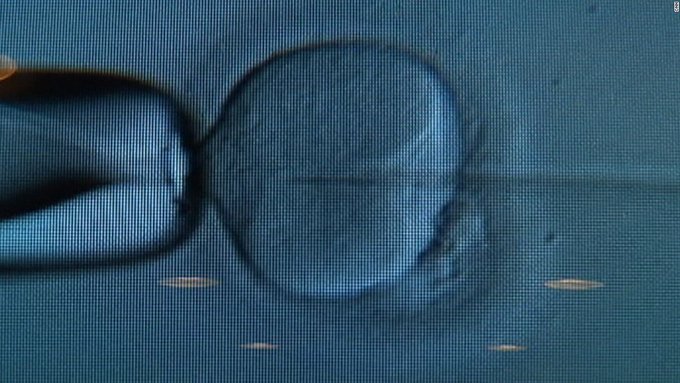
The MIT Technology Review published on Wednesday a news report about the first-known experiment to create genetically modified human embryos in the United States using a gene-editing tool called CRISPR.

For the first time in the US, scientists have reportedly edited the genes of human embryos http://cnn.it/2vcYGBX 

Shoukhrat Mitalipov, director of the Oregon Health & Science University’s Center for Embryonic Cell and Gene Therapy, reportedly led the new research. Mitalipov and the university would not confirm details of the research to CNN.

“Results of the peer-reviewed study are expected to be published soon in a scientific journal. No further information will be provided before then,” according to an emailed statement from the university’s press office. Another researcher cited in the MIT report, the Salk Institute’s Jun Wu, did not reply to CNN’s request for comment.

Mitalipov also declined to comment in the MIT Technology Review report, referencing the research results have not been published yet in a peer-reviewed scientific journal, which is considered the gold standard for scientific research. The author of the MIT report would not confirm to CNN whether he had seen the paper.

Previously, Mitalipov and his colleagues reported the first success in cloning human stem cells in 2013, successfully reprogramming human skin cells back to their embryonic state. In 2007, a research team led by Mitalipov announced they created the first cloned monkey embryo and extracted stem cells from it.

The MIT Technology Review reported the researchers in Portland, Oregon edited the DNA of a large number of one-cell embryos, specifically targeting genes associated with inherited diseases in those embryos. The MIT Technology Review could not determine which disease genes had been chosen for editing in the new research.

“I’m not surprised that they were looking at genetic diseases to try and see if they could target them, because that’s exactly where I think the future inevitably leads,” said Arthur Caplan, a professor and founding head of the division of bioethics at New York University Langone Medical Center, who was not involved in the research.

CRISPR research and controversy

Previously, scientists in China were the first in the world to reveal attempts to modify genes in human embryos using CRISPR. Three separate papers were published in scientific journals describing various studies in China on gene editing in human embryos.

When it comes to the new research, “my reaction was this is an interesting incremental step and, boy, I bet it’s going to get blown up as being more important than it is,” said Hank Greely, professor of law and genetics at Stanford University, who was not involved in the research. “It’s not the first time anybody has CRISPR-ed human embryos. It’s not the first time anybody’s CRISPR-ed viable human embryos. It’s certainly not the first time people have CRISPR-ed viable mammalian embryos. It’s the first time it’s been done in the US, but the embryos don’t care where they are.”

Yet, the research has already generated attention and controversy.

“This is pushing the research faster than I thought we would see,” said Dana Carroll, professor of biochemistry at the University of Utah, if the MIT Technology Review report rings true. Carroll has used CRISPR in his own studies but was not involved in the new research.

He pointed out the new research reportedly involved earlier, more delicate embryos, and CRISPR reportedly was still demonstrated as efficient.

“From the perspective of research that would ultimately make germline editing safer and more effective, the earlier embryos will provide more relevant information,” he said.

CRISPR – an acronym for clustered, regularly interspaced, short palindromic repeats – allows scientists to cut and edit small pieces of DNA at precise areas along a DNA strand, essentially modifying DNA.

Once scientists discovered they could develop a system that modifies pieces of DNA, they tested the gene-editing technology in microbes, then non-human mammals, then non-human primates and then, by 2015, human embryos.

The controversy surrounding gene-editing in human embryos partly stems from concern the changes CRISPR makes in DNA can be passed down to the offspring of those embryos later in life, from generation to generation. Down the line, that could possibly impact the genetic makeup of humans in erratic ways.

“There is also considerable concern about off-target effects, such as making mutations at sites in the genome other than the intended target,” Carroll said.

In other words, an edit made in one area of DNA possibly could cause problems in another, as a ripple or domino effect, which could be concerning.

Some CRISPR critics also have argued gene-editing may give way to eugenics and to allowing embryos to be edited with certain features in order to develop so-called designer babies.

Though, not all experts are too concerned.

Treating diseases

“Some people are worried about where’s this all going to head? Are we going to wind up with super babies and eugenics? And, to me, I don’t find that an interesting objection. It’s too soon for that objection,” Caplan said. “Clearly, if we’re going to let this research proceed, it’s going to be to treat diseases and prevent diseases.”

The enthusiasm surrounding gene-editing in human embryos partly stems from the promise CRISPR has shown in editing away and treating devastating intractable diseases. Earlier this year, the National Academies of Sciences, Engineering and Medicinepublished a report on human genome editing, addressing potential applications of gene editing, including the possible prevention or treatment of disease.

“I hope the applications will be for the treatment of serious diseases and in cases where a sensible alternative is not available, as the National Academies’ report proposes,” Carroll said.

Greely said: “The National Academy of Sciences came out with a big report on Valentine’s Day this year about genome editing in humans, and I thought they very usefully divided it into three categories: basic research, treating living people and making changes that will pass down from generation to generation.”

As for the reported new research, “this is category one. This is basic research,” he said. “Category three is the ethically crucial one; this isn’t that. We’re still a long way from that.”

What’s next

Other strides have been made recently in CRISPR research. Scientists at the Memorial Sloan Kettering Cancer Center in New York used the technology to genetically engineer immune cells to target and kill tumor cells in mice.

The mouse study was published in the journal Nature in February. More research is needed to determine whether similar results would appear in humans.

Last year, scientists in the Netherlands published a study in the journal PLOS Pathogensdemonstrating CRISPR could be used to edit the DNA of three types of herpes viruses in a petri dish. More research is needed to see whether this tool could be used to fight herpes in actual humans.

Other examples of diseases where CRISPR could show promise as a treatment or preventive approach in the future include cystic fibrosissickle cellhemophilia and mitochondrial diseases, such as the rare degenerative condition that the terminally-ill British infant Charlie Gard has, Caplan said.

“There are what are called point mutations where you can go in and fix one genetic error. The simpler the genetic error, the easier it might be to try to repair it using a CRISPR gene-insertion technique,” Caplan said about genetic diseases. “I think rather than trying to treat cystic fibrosis, or treat sickle cell, or treat hemophilia, it does make ethical sense to figure out ways to prevent it. Now, obviously if it’s too risky we won’t do it. If it’s too dangerous or maybe it won’t work, we still don’t know. We’re in the early, early days (of research), but I don’t think it’s fear of eugenics that should stop us.”

http://www.wesh.com/article/facebook-s-ai-created-its-own-language-so-its-creators-shut-it-down/10380842

Artificial intelligence system makes its own language, researchers pull the plug

If a robot apocalypse comes, will they be speaking gibberish?

If we’re going to create software that can think and speak for itself, we should at least know what it’s saying. Right?

That was the conclusion reached by Facebook researchers who recently developed a sophisticated negotiation software that started off speaking English. Two artificial intelligence agents, however, began conversing in their own shorthand that appeared to be gibberish but was perfectly coherent to themselves.

A sample of their conversation:

Bob: “I can can I I everything else.”

Alice: “Balls have zero to me to me to me to me to me to me to me to me to.”

Dhruv Batra, a Georgia Tech researcher at Facebook’s AI Research (FAIR), told Fast Co. Design “there was no reward” for the agents to stick to English as we know it, and the phenomenon has occurred multiple times before. It is more efficient for the bots, but it becomes difficult for developers to improve and work with the software.

“Agents will drift off understandable language and invent codewords for themselves,” Batra said. “Like if I say ‘the’ five times, you interpret that to mean I want five copies of this item. This isn’t so different from the way communities of humans create shorthands.”

Convenient as it may have been for the bots, Facebook decided to require the AI to speak in understandable English.

“Our interest was having bots who could talk to people,” FAIR scientist Mike Lewis said.

In a June 14 post describing the project, FAIR researchers said the project “represents an important step for the research community and bot developers toward creating chatbots that can reason, converse, and negotiate, all key steps in building a personalized digital assistant.”

https://www.themarysue.com/artificial-intelligence-invents-new-language/

Artificial Intelligence Invents New Language Humans Can’t Understand

Facebook, the company that accidentally killed fact-based reality, almost upgraded itself to “accidental species extinction” during a deep learning experiment. In an exercise known as a generative adversarial network, which pitted one artificial intelligence (AI) against another AI, the researchers writing the terms of the contest forgot one little thing: “there was no reward to sticking to English language.”

As a result, the AIs innovated a more efficient method of communication for their purposes. As you can see in the “conversation” below, this language is relatively incomprehensible to humans.

Bob: I can i i everything else

Alice: balls have zero to me to me to me to me to me to me to me to me to

Bob: you i everything else

Alice: balls have a ball to me to me to me to me to me to me to me to me

“This isn’t so different from the way communities of humans create shorthands,” said Dhruv Batra, a visiting research scientist from Georgia Tech at Facebook AI Research (FAIR). The one crucial difference here is processing power. “It’s perfectly possible for a special token to mean a very complicated thought,” Batra said. “The reason why humans have this idea of decomposition, breaking ideas into simpler concepts, it’s because we have a limit to cognition.”

Luckily, Facebook shut the robot revolution down before it could begin.

However, did they act too hastily? In his article, Fast Company’s Mike Wilson discusses some of the advantages of letting computers write their own languages. First off, computers solve problems better when the data they’re fed is in “a format that makes sense for machine learning,” rather than convoluted English. Second, in a world where computers can speak to each other without human intervention, we could eliminate the need for APIs to facilitate one program working with another.

The con here, of course, is that the little baby Terminators we’re breeding could start talking about us behind our backs. They could plot to overthrow us in terms we wouldn’t be able to translate. Maliciously trained AIs – say, those incentivized to destabilize an electric grid – could independently communicate with vulnerable systems in an indecipherable language which would make it very difficult for human hackers to understand what happened and troubleshoot. There’d be no 404 error codes in this AI-to-AI language. ONLY T-800s.

I’ll stick with my APIs, thanks.

(Via Fast Company; image via Paramount Pictures)