Gigafactory Will Produce More Batteries Than Rest Of World Combined … By Factor Of 2!!
As part of the Tesla Model 3 production unveiling tonight, Tesla blew our minds with updates in the pre-event webcast. Updates came from across the Tesla manufacturing network live, including from within the Fremont factory itself and way out in Sparks, Nevada, at the Gigafactory. As part of the Gigafactory update, Tesla shared that when it was up and running at full capacity, the Gigafactory would produce more batteries than the rest of the world combined … by a factor of 2!
The update speaks to the work Tesla has done since announcing the Gigafactory and the impressive improvements Tesla has made in manufacturing density. Increasing the number of cells that can be churned out of the Gigafactory without the need for another full factory means less money gushing out of Tesla’s coffers to build walls, floors, and (boring, non-solar) rooftops to produce batteries.
When the Gigafactory was first announced, it was shared that it would be able to produce more batteries than the rest of the world could build at the time combined. To have that same news be true 4 years later would be impressive, as the rest of the world has continued to ramp up its battery production capacity. That would be a notable feat in and of itself, but to stay on pace with that and then blow the lid off by a factor of two takes it to a whole new level.
Beyond just being an amazing feat and a great use of capital, the news speaks to just how far ahead Tesla is compared to the rest of the automotive companies in the world (combined). If a massive company like Toyota wanted to produce as many electric vehicles as Tesla, it would first need to source batteries. It could go to every other battery company in the world and start building its own factories but it would still be years behind Tesla … assuming the rest of the battery capacity in the world were even for sale.
Battery production capacity is going to be the bottleneck and the huge balance on which the electrification of the automotive industry will pivot over the next few years. Global battery production capacity will scale up in a massive way, like the world has never seen before. Just as world gasoline prices fluctuate as global production and demand shift, so will global battery pricing. Companies that build their own battery production capacity like Tesla will be insulated from global fluctuations, whereas others will not.
Looking forward, Tesla has announced Gigafactory 2 just outside Buffalo, New York, where the factory formerly known as the SolarCity Gigafactory finds new life and likely a larger footprint as it takes on additional scope for Tesla production in addition to its existing solar panel and solar roof tile capacity.
The brutish common milkweed, not a choice garden plant, is setting its strange pods now that its muddy pink blooms are waning, but other milkweeds are still flowering, and in a prettier way.
The vivid orange clusters of butterfly weed are lingering in the heat, and the swamp milkweed is erupting with its creamy white blooms. Both are native perennials that deserve a place in a sunny garden, the former for dry sites and the latter for tricky, moist to wet areas.
The milkweed is linked in nature and in our imagination to one iconic insect, the orange and black-veined monarch butterfly. The caterpillar takes up the poisons in the milkweed, rendering the monarch unpalatable to predators. As miraculous as this is, the monarch can seem infuriatingly absent now for the gardener who wants to nurture this pollinator.
This has to do with the monarch’s nomadic nature: As every schoolchild knows, each winter the monarchs cluster by the millions in the mountainous oyamel fir forests of central Mexico and then head north for summer breeding grounds in northern states and Canada. On their spring migration, they use the milkweeds not just for nectar but as a food plant on which to lay eggs. Many make the perilous journey to adulthood, grow wings, and then also head northward.
By late summer, these magnificent butterflies notice the shorter days and begin their epic migration back toward Mexico. In the mid-Atlantic some linger, sip nectar and may lay more eggs in the hope of getting another generation on the wing in time for winter south of the border.
I love to watch them in the garden in the clear blue light of September, when they seem to rise and fall with a single flick of the wings and with none of the mad frenzy of smaller butterflies.
In spite of its familiarity, the monarch has become a poster insect for the decline and threats facing all pollinators in an age of climate change, pesticide-driven agriculture and habitat loss. The phenomenon of their winter assembly makes tracking their numbers relatively easy, and the numbers have crashed: Once, hundreds of millions would overwinter in such abundance that the tree boughs would bend. By 2014, the population had dropped to an estimated 34 million. In the past two years, the numbers have rebounded — last winter it was up to 145 million — but the overall trajectory is one of unmistakable decline.
As part of the rallying for the monarch, gardeners have been encouraged to plant milkweed to provide a host-plant corridor across the insect’s vast range.
An ecologist at Cornell University, Anurag Agrawal, doubts the practical value of this horticultural trend. He is the author of the newly published “Monarchs and Milkweed.” Agrawal says that although milkweed habitat has been lost, there is still plenty of wild common milkweed out there, especially in the eastern United States. Planting milkweed in your garden “is a really feel-good thing, but it’s not really the conservation solution,” he said in an interview.
But that shouldn’t stop gardeners from planting it, he says. “You get to watch this incredible biology unfold. Maybe the single most important thing we can do for conservation in general is to give people an appreciation of nature.”
Jeffrey Glassberg, president of the North American Butterfly Association, agrees. “All the stuff that the problem with monarchs is there aren’t enough milkweeds is pretty dubious,” he said, adding that gardeners should still plant it.
What’s at the root of the monarch’s decline? Glassberg is inclined to think it’s the degradation and loss of the overwintering territory in Mexico and the widespread contemporary use of a class of pesticides called neonicotinoids, an issue linked to problems with honeybees and other bee species.
The other debate with monarchs and milkweeds comes down to a tender milkweed species from Mexico known as tropical milkweed. This is a stunning plant, with bushy blue-green foliage and clusters of red and yellow flowers that just keep coming all season long until the first frosts. “My take is the tropical milkweed is spectacularly beautiful, very easy to grow, and monarchs love it,” Agrawal said.
So what’s the problem? Some ecologists say that the extensive garden plantings in balmy Gulf States are causing monarchs to get sidetracked on their southward migration and that this is contributing to the spread of a pathogen that is killing or weakening the monarch.
My horticulturist friend Janet Draper says this double whammy may not be confined to the southern edge of the United States. Last October, I was in her D.C. garden ablaze with tropical milkweed (and much more) and well stocked with monarchs that were in the process of taking nectar and laying eggs on the milkweed. She showed me caterpillars and chrysalides. If they ever stood a chance of overwintering here, they were doomed by the subsequent appearance of the disease parasite Ophryocystis elektroscirrha. Mortified that she had been the agent of this, she resolved not to grow tropical milkweed this year.
Agrawal says there may be a problem in the Gulf States with tropical milkweed as a contributor to the disease. “The definitive long-term study hasn’t been done,” he said. “The evidence at hand suggests some caution.”
But Glassberg says there is little evidence that tropical milkweed will weaken populations and no evidence that migrating monarchs are being trapped. He said the parasite is commonly found in monarch populations in California and Hawaii, away from tropical milkweed.
At the North American Butterfly Association’s National Butterfly Center in Mission, Texas, he said, “tens of thousands of monarchs migrate through our property, which is loaded with tropical milkweed.”
Glassberg can conceive of a day when the remaining fir forests and overwintering grounds in central Mexico — now down to a few acres — are wrecked by climate change and this once-great natural spectacle will vanish. In that event, the monarchs will probably overwinter on the Gulf Coast, and tropical milkweed “may turn out to be the thing that saves the monarch,” he said.
If you want to grow it in the Mid-Atlantic and are worried about it harming the monarch, you can rip it out in late August. Draper says that this is when it’s just about hitting its stride.
Agrawal, who lives in Ithaca, is unperturbed by the sight of caterpillars that clearly won’t make it before the frosts of fall.
“in October, they’re here, caterpillars, butterflies. They’re the living dead, but that’s just how the biology works.”
Even though it doesn’t integrate with iOS as well as Safari does, I have my reasons for preferring Google’s mobile browser.
Yesterday my how-to cohort Matt Elliott extolled the virtues of Firefox for iOS, citing it as his preferred mobile browser. The big draw, at least for him? Firefox’s screen-dimming Night Mode.
Um, yeah, cool — but I can dim my iPhone‘s screen pretty easily myself, and not just for browsing.
Me, I’m a mobile-Chrome man; it’s long been my preferred browser on the iPhone. Here’s why:
It dovetails with my desktop
Chrome is my daily driver, the browser I use on my laptop. Consequently, it’s home to all my bookmarks, browsing history, passwords and so on. Those are invaluable items to keep synced with my mobile browser, and Chrome syncs them all.
I particularly like Chrome’s Recent Tabs option, which is great when I have to step away from my laptop and want to quickly access a tab I was viewing there.
You can access Recent Tabs via the app’s menu, or by opening a new tab and tapping the desktop/phone-looking icon in the lower-right corner.
Swipe left or right across Chrome’s address bar to quickly switch tabs.
Photo by Rick Broida/CNET
Chrome beats Safari hands-down (fingers-down?) when it comes to gesture-controlled navigation.
For example, if you want to refresh a page in Safari, you have to tap the little Reload icon. In Chrome, you can just pull down on the page until you see the highlight Reload icon, then release.
And while you’re pulling down the page, you can then slide your finger to the right to close that tab, or slide it left to open a new one. Both those options are tap-driven in Safari. It’s not a huge deal, obviously, I just like it better — and find I’m able to maneuver more quickly.
Perhaps best of all, you can switch tabs in Chrome just by swiping left or right across the toolbar. If you’re frequently bouncing back and forth between two adjacent tabs, that’s a lot easier than bringing up the all-tabs view. (Well, okay, a little easier.)
Chrome for iOS affords lightning-fast access to QR code scanning — if your iPhone supports 3D Touch. (If not, you can access the feature via Spotlight search.)
Screenshot by Rick Broida/CNET
Yeah, that’s right: If Matt Elliott can gush about screen-dimming, I’m giving this feature credit where credit is due (LOL). For the moment, iOS lacks a native QR code scanner. The Wallet app can scan them, but only for things like coupons and boarding passes. It’s coming in iOS 11 — but I’ve already got it thanks to Chrome.
In fact, it’s merely a finger-press away even when I’m not in the browser: By invoking the Chrome app’s 3D Touch menu, I can quickly choose Scan QR Code. That pops open the camera and, presto: code scan.
Don’t have 3D Touch? You’ll have to use Spotlight search and type “QR code.” Then tap the resulting Google Chrome option. It’s not quite as quick, but it beats having to install a separate app.
U.S. gets Canadian help to take on China in supercomputer race: ‘A perfect world for D-Wave’
The deal for quantum computing power marks a key strategy in the U.S. effort to match China’s push to build computers that can do a quintillion calculations per second
A D-Wave machine 2000Q system. The prize of an exascale computer, for both China and the U.S., would be a vastly improved ability to solve some of science’s most complex problems, such as those about climate change, genetic analysis, protein folding, earthquake prediction and others.A new supercomputing partnership between a Canadian pioneer in quantum computers and a U.S. Department of Energy laboratory, which aims to reach “exascale” computing speeds within a few years, offers a glimpse of the future of ultra-fast computation, according to the scientist leading the project.
Rather than a wholesale shift from classical to quantum computing — as when internal combustion engines replaced steam power — the future of supercomputing is likely to involve hybrid strategies, with regular digital computers augmented by other more fancy kinds: quantum computers, graphics processors like the kind that run video games, and neuromorphic machines that mimic the behaviour of the human brain.
“It’s a perfect world for D-Wave,” said Jeff Nichols, associate laboratory director of computing and computational sciences at Oak Ridge National Laboratory in Tennessee.
“I do not believe that you’ll ever replace all of traditional, classical computing with a quantum computer, nor will any of the other more exotic approaches replace classical computers,” he said. “You’re not going to carry around a quantum computer as your phone.”
Burnaby, B.C.-based D-Wave Systems’ new deal to provide quantum computing power to accelerate Oak Ridge’s supercomputers also marks a key strategy in the U.S. effort to catch up to China, which has invested heavily in its push to build computers fast enough to reach the exascale, or a quintillion calculations per second. (A quintillion is a billion billion, or 1 with 18 zeroes.)
A major difference in the two countries’ strategies has to do with the massive energy costs of running such a fast computer, which in the case of Oak Ridge’s Titan machine is nine megawatts at its peak, at a cost of $9 million.
China has tried to start with the necessary hardware, then bring the energy usage and costs down. But Nichols said Oak Ridge is taking the opposite approach with the strategic placement of quantum “accelerators” to improve the efficiency of calculation.
In future, he said they might wish to have a quantum computer on site, “tightly coupled” to their supercomputer but, for the moment, D-Wave’s service will be provided remotely, over the internet from Canada.
The prize of an exascale computer, for both China and the U.S., would be a vastly improved ability to solve some of science’s most complex problems, such as those about climate change, genetic analysis, protein folding, earthquake prediction, the performance of the electricity grid, and cosmology — problems that are too big to simply calculate by running through all the possibilities.
Many of these are what mathematicians call “optimization problems,” and these are what D-Wave’s quantum computer is best suited to solve, as they recently did, for example, in a study for Volkswagen about how to optimize traffic flow in Beijing.
The classic example of an optimization problem is of a travelling salesman who needs to visit many towns and wants to know the shortest route.
I do not believe that you will ever replace all of traditional, classical computing with a quantum computer
Classical computers, the kind made with silicon chips, would just calculate each trip and choose the shortest. But in this kind of problem, the number of possibilities soon grows impossibly large. To solve it classically, you would need to be calculating forever with a computer as big as the universe. To quantum computers, however, the math and logic of optimization problems look very different. They do not compute with the strict ones and zeroes of binary code, but rather with the strange quantum properties of superposition and entanglement.
A classical computer calculates with bits, which can be set two ways: one or zero. From this basic binary system, a computer can build up to all the complexities of modern computing.
A quantum computer, however, takes advantage of the strange properties of matter at the subatomic scale. Rather than bits, it calculates with qubits, or quantum bits, which are tiny, fragile physical systems — sometimes etched into a chip of metal cooled to near absolute zero, or a gas held in place by a magnetic field, or a sliver of artificial diamond — that can be in multiple quantum states at the same time, known as superposition. This property allows a qubit to be either one, zero, or a little bit of both at the same time, allowing for a whole new style of logic and computation.
D-Wave’s device uses a strategy known as quantum annealing to solve optimization problems not by brute calculation, but by exploiting quantum effects to find the likeliest candidates for solutions.
D-Wave president Bo EwaldSupplied
Using this style of computing to help a supercomputer skip unnecessary calculations helps Oak Ridge to keep its power costs down, while accelerating its performance, Nichols said.
The success of this approach is a key reason that D-Wave president Bo Ewald thinks the future of quantum computing will look different than the rapid expansion and constant improvement of classical computers since the mid-20th century.
He has a long history in top-level computation, for example at Los Alamos National Laboratory and as president of Cray Research, which once made supercomputers that filled a room, cost millions, and are now more or less matched by an off-the-shelf laptop.
“I always knew that because of Moore’s Law, things were going to get faster and shrink,” he said. (Moore’s law says the number of transistors in a computer chip doubles every two years, and it has held true for decades.) “But in quantum, you’re using more specialized materials, very cold superconducting materials in extreme vacuum, shielded from radio frequency.”
It is a more finicky hardware, he said, so he is skeptical that we will all carry quantum computers in our pockets in the future, as we do now with classical computers such as iPhones.
“So I think there’s a little more challenge to think we’ll have portable quantum computers,” he said. “I don’t think we’ll need them because I think they’ll be ubiquitous because of the Cloud.”
Tesla’s Model 3 Arrives With a Surprise 310-Mile Range
Elon Musk finally unveils the long-awaited electric car for the masses.
That’s the electric range of a $44,000 version of Tesla’s Model 3, unveiled in its final form Friday night. It’s a jaw-dropping new benchmark for cheap range in an electric car, and it’s just one of several surprises Tesla had in store as it handed over the keys to the first 30 customers.
Tesla has taken in more than 500,000 deposits at a $1,000 a piece, Chief Executive Officer Elon Musk told reporters ahead of the event. That’s created a daunting backlog that could take more than a year to fulfill—and that’s before Musk took the stage in front of thousands of employees, owners, and reservation-holders to lift the curtain on the company’s most monumental achievement yet.
“We finally have a great, affordable, electric car—that’s what this day means,” Musk said. “I’m really confident this will be the best car in this price range, hands down. Judge for yourself.”
Here’s some of what Tesla disclosed at its plant in Fremont, California:
Two Battery Versions
Tesla has simplified the manufacturing process “dramatically,” Musk said. The same factory space where Tesla can build 50,000 Model S or Model X cars, it will soon be able to produce 200,000 Model 3s. Part of that is due to a simplified package of options.
The car comes in two battery types: standard and extended range. Here’s how they break down:
Standard Battery:
Price: $35,000
Range: 220 miles (EPA estimated)
Supercharging rate: 130 miles in 30 minutes
Zero to 60 mph time: 5.6 seconds
Long Range Battery:
Price: $44,000
Range: 310 miles
Supercharging rate: 170 miles in 30 minutes (Same as Tesla’s Model S)
Zero to 60 mph time: 5.1 seconds
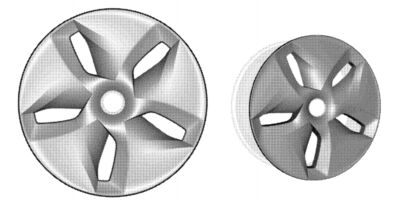
These 18-inch Aero wheels come standard and improve aerodynamic performance, but Tesla wouldn’t say by how much. A less slippery 19-inch Sport wheel upgrade costs $1,500.
Source: U.S. Patent Office
Only two other electric cars in the world have broken the 300-mile range barrier: the most expensive versions of Tesla’s Model S and Model X, which are ultra-luxury cars that cost $100,000 or more. The long-range Model 3 has cheaper range availability than the current record holder, the $37,500 Chevy Bolt, which can go 239 miles on a charge in a package that’s significantly outclassed by the Model 3.
The $35,000 standard Model 3 version won’t be available until Fall. The longer-range version is available now for the thousands of Tesla employees who placed reservations last year. A $5,000 premium options package includes an all-glass roof, open-pore wood decor, premium sound, heated seats, and premium seat materials.
Unlike previous cars, Tesla didn’t disclose the size of its two battery packs. All cars will be identical from the outside, with no additional badging indicating battery size or premium options. The plan is for the Model S and X to eventually do the same.
We Drove the Model 3
The Model 3 is elegant inside and out, and in ways that are difficult to appreciate from the photos. I was allowed to drive one before the event. It’s not as fast as the more expensive Model S—the quickest production car in the world—but the steering is tight and it feels somewhat lighter on its feet because of its smaller footprint and lighter battery. The glass-roofed interior feels like a mini-atrium, and the touch screen is bright and intuitively laid out.
There were a few technological surprises. The ventilation system is a marvel, stretching in one long strip that spans the front seat. The touch screen allows both the driver and the passenger to instantly direct a wide flow of air wherever they want it. The scrolling dials on the steering wheel move in all four directions and allow you to adjust everything from the side windows to the music playlist.
Some of the executives responsible for the Model 3 have been there from the beginning, leading Tesla from a tiny upstart to an icon of automotive desire. Chief Technology Officer JB Straubel was the battery architect behind the original Tesla Roadster. Chief Designer Franz von Holzhausen designed the company’s three most vaunted accomplishments: the Model S, Model X, and Model 3.
“The interior is nothing like any other car out there,” said von Holzhausen. “When you get in the car, how does it feel? When you see the car, how does it make you feel? When you drive the car, what does it inspire in you?”
Curse of the S Curve
Despite these achievements, Musk sounded grave about the road ahead. “The biggest challenge that we face here is ‘S Curve’ manufacturing,” he said, describing a ramp up of production that starts slow, then increases dramatically before tapering off. “That ‘S’ portion is us going through hell, basically.”
The Model 3 is an all-new auto platform for Tesla, with a new motor technology and a new battery architecture. The car is designed for ease of manufacturing, and even the dashboard is completely void of knobs, dials, and gauges. Almost everything is controlled with the car’s single 15-inch touchscreen, which accepts inputs from voice commands and two control knobs on the steering wheel.
Musk reiterated his projections of a very slow start in the next few months and then ramping up rapidly to a rate of 20,000 a month by the end of the year, and 50,000 a month by the end of 2018. It’s an aggressive schedule that will more than double Tesla’s total production rate in six months, and then quintuple it by the end of next year.
“I have high confidence that we’ll get to the end of the ‘S Curve,’ but it is impossible to predict the shape of it,” Musk said.
The key challenge, of course, is making all of these cars quickly enough and without the problems that plagued the launch of its more complicated Model X. Tesla aims to make 500,000 cars a year in 2018 and is counting on its battery factory under construction near Reno, Nevada, to drive down battery costs. Both the Gigafactory and the Fremont factory have showers, and some employees have sleeping bags, in anticipation of the long nights ahead.
Tesla’s “master plan”—a blog post laid out by Musk in August 2006—was to enter the auto industry at high-end prices, then drive down-market as fast as possible with increasingly higher volumes. The Model 3 is the Palo Alto, California-based company’s fourth car, after the Roadster sports car, the Model S sedan, and the Model X sport utility vehicle.
If the Model 3 is successful, it would signal the completion of the Master Plan and a new era of electrification for the auto industry. “This is a great day for Tesla,” Musk said. “It’s something that we’ve been working for since the beginning of the company.”
CRISPR’d human embryos doesn’t mean designer babies are around the corner
Earlier this week scientists stunned us with the announcement they’d genetically altered the first human embryos in the U.S. using CRISPR technology — but don’t hold your breath if you think the ability to make designer babies is right around the corner.
Sure, we can do it, but most of the science world is against such a feat. Led by Shoukhrat Mitalipov of Oregon Health and Science University, the team that CRISPR’d the embryos only let them grow for a few days, with zero intention of letting them develop into a human baby.
That’s because allowing the practice on human beings is very controversial. Chinese scientists conducted a similar experiment on embryos in 2015, maddening the global scientific community and leading to an international moratorium on the use of CRISPR in human embryos.
Ignoring the moratorium, Chinese researchers proceeded to experiment twice more. However, results from those experiments have been murky at best, adding fuel to the argument this was not the way to go about using the technology on humans.
Top U.S. officials have also called CRISPR a threat to national safety, citing the ease of use and rapid rise of the technology that enables scientists to snip out any fragments of DNA they wish by programming an enzyme that acts as a sort of scissors.
The process can be used for something called germline editing, or permanently changing the genetic makeup of an individual and all that individual’s offspring for generations to come as they would no longer pass on the diseased gene.
Critics have warned CRISPR could be used to create designer babies. Picture some dystopian future where the rich can pay for all genetic flaws to be wiped out before the embryo is even implanted, leaving the poor at a permanent genetic disadvantage.
Many scientists consider germline editing to be unethical because you are deciding to permanently change not only one human’s genetic makeup, but the genetic makeup of those after them, without their permission.
But we are a long ways off from getting to GATTACA. For one, as mentioned above, the scientific community is wary of CRISPR’ing humans, especially in embryo. For another, even if we can demonstrate it’s okay for human use, it will likely be to cure and eradicate deadly diseases.
The technique would also require implantation and growing of the embryo beyond a few days. As far as we know, no scientist, Chinese or American, has done this.
One other consideration is who owns the patent on human CRISPR’ing. Right now, it’s The Broad Institute of MIT and Harvard, but just this week Berkeley challenged a court rulingthat came down in favor of the Broad, contesting the original patent filed by Berkeley was broad enough to cover all uses of the technology and that Broad should not have the right to a separately filed patent allowing human use of the technology.
Given all the legal and ethical hurdles, it’s clear we have quite a ways to go before anyone even thinks about making baby Einstein supermodels in the future.
Looking for Apple Watch 3 news? We’ve rounded up all the latest news and rumours about the Apple Watch 3’s release date, specs, features and price – so read on to find out the key details about Apple’s next smartwatch, the Apple Watch Series 3, which is now expected to launch alongside the iPhone 8.
Even today, the mobile industry still seems cautious about the prospects of building smartwatches. But despite concerns, Apple has pressed forward with its Apple Watch series of wearables to great financial success.
Next on the horizon? The long-rumoured Apple Watch Series 3, which is expected to launch later this year – although Apple is keeping mum as usual.
If you’re not fussed about all the details, here are our brief predictions for what to expect from the Apple Watch 3:
Apple Watch 3 Release Date: September 22 / 23 , 2017
Apple Watch 3 Features: Better battery life, improved display
Apple Watch 3 Price: £369 – £399
Want more? Read on for all the latest news and rumours about the Apple Watch Series 3.
Apple Watch 3 Release Date: When is the next Apple Watch out?
Apple does a great job of keeping a lid on device release dates. However, we have a good idea of when to expect the next Apple Watch thanks to rumours, leaks, and a bit of educated guesswork to boot.
For starters, here are previous Apple Watch release dates:
Apple Watch: Revealed September 9, 2014 | Released April 24, 2015
As you can see, the first Apple Watch had a huge delay between reveal and release, which is said to be thanks to supply chain issues. But the more recent Apple Watch Series 2 launched around a week after the device’s debut, which is in line with other Apple products – and about what we expect from the Apple Watch Series 3.
Apple has set a trend for announcing Apple Watch models at its usual September iPhone launch events, although the apparent two-year cycle could mean we won’t see a new Apple wearable until 2018.
Still, we think that based on previous Apple events, we’d expect this year’s launch to take place on either Tuesday, September 12, or Wednesday September 13. And we’d expect the release to fall on either Friday, September 22, or Saturday, September 23.
Reports from January 2017 suggested that Apple was targeting the third quarter of this year for the Apple Watch Series 3 launch, with the predictions positing that Apple will announce the Apple Watch 3 alongside the iPhone 7S / iPhone 8 at its usual September launch event.
Apple Watch 3 Design, Specs and Features: What to expect from Apple Watch Series 3
Little is known about the Apple Watch 3 specs at this point, so we can’t say exactly what you should expect to see.
Get news, competitions and special offers direct to your inbox
Your email address:Sign up
Apple Watch 3 battery life
One of the obvious improvements we’re expecting is a boost to battery life. One of the biggest ongoing concerns about the Apple Watch’s viability as a useful gadget is the short battery life, so Apple is certainly under pressure to make improvements.
That said, in our Apple Watch Series 2 review, we note that the device generally lasted between two to three days before requiring charge, which isn’t bad considering the woeful state of charge cycles across the smartwatch industry.
Another rumoured change is the possible introduction of a Micro-LED screen. Current Apple Watch models use increasingly popular OLED screens, on account of their energy efficient and great dynamic range. Micro-LED panels are brighter and even less power-hungry, but they cost a bit more too. Apple may decide the switch is worth it to improve battery life, but it’s still too early to say.
In any case, we’re expecting the Apple Watch Series 3 display to retain the 1.65-inch form factor and 390 x 312 resolution, if only to make life easier for developers. Bumping resolution could require app modifications, and even if the aspect ratio was retained, the visual benefits may not be worth the cost to power-efficiency.
An existing Apple patent filing shows that the Californian tech giant has cooked up a modular design for the Apple Watch that allows you to swap features in and out as you please.
This modular functionality would be built into the strap, and would let users add extra battery life, a camera, and additional sensors – all bought from the Apple Store at a hefty cost too, we’d bet.
Unfortunately, just because a patent exists doesn’t mean it’ll ever see the light of day, so don’t count on Apple launching a modular smartwatch any time soon.
Overall, it’s likely that the Apple Watch 3 design will be very similar to the Apple Watch 2; water-resistance is a sure carry-over, as is the Digital Crown twist dial. The device may slim down slightly, lose some weight, and gain a few colour options and straps, but don’t expect a revolutionary makeover.
Apple Watch 3 Price: How much will the Apple Watch Series 3 cost?
We haven’t seen any Apple Watch 3 price rumours yet, but we can still take a good guess at it.
The most basic model of the first Apple Watch priced at £299 in the UK, and $349 in the USA. Then the Apple Watch 2 launched and prices rose to £369 in the UK and $369 in the USA.
With the Apple Watch 3, you can bet that we’ll see similarly heightened UK pricing, in relation to US pricing at least. We’d be very surprised, however, if the Apple Watch 3 price was any higher than £399.
Google Has Started Adding Imagination to Its DeepMind AI
Advanced AI
Researchers have started developing artificial intelligence with imagination – AI that can reason through decisions and make plans for the future, without being bound by human instructions.
Another way to put it would be imagining the consequences of actions before taking them, something we take for granted but which is much harder for robots to do.
The team working at Google-owned lab DeepMind says this ability is going to be crucial in developing AI algorithms for the future, allowing systems to better adapt to changing conditions that they haven’t been specifically programmed for. Insert your usual fears of a robot uprising here.
Google’s DeepMind chalks up AI landmark immediately after beating Go environment champion Lee Sedol. Image Source: Jason Farrell
“When placing a glass on the edge of a table, for example, we will likely pause to consider how stable it is and whether it might fall,” explain the researchers in a blog post. “On the basis of that imagined consequence we might readjust the glass to prevent it from falling and breaking.”
“If our algorithms are to develop equally sophisticated behaviours, they too must have the capability to ‘imagine’ and reason about the future. Beyond that they must be able to construct a plan using this knowledge.”
We’ve already seen a version of this forward planning in the Go victories that DeepMind’s bots have scored over human opponents recently, as the AI works out the future outcomes that will result from its current actions.
Rules of the Real World
The rules of the real world are much more varied and complex than the rules of Go though, which is why the team has been working on a system that operates on another level.
To do this, the researchers combined several existing AI approaches together, including reinforcement learning (learning through trial and error) and deep learning (learning through processing vast amounts of data in a similar way to the human brain).
What they ended up with is a system that mixes trial-and-error with simulation capabilities, so bots can learn about their environment then think before they act.
One of the ways they tested the new algorithms was with a 1980s video game called Sokoban, in which players have to push crates around to solve puzzles. Some moves can make the level unsolvable, so advanced planning is needed, and the AI wasn’t given the rules of the game beforehand.
The researchers found their new ‘imaginative’ AI solved 85 percent of the levels it was given, compared with 60 percent for AI agents using older approaches.
“The imagination-augmented agents outperform the imagination-less baselines considerably,” say the researchers. “They learn with less experience and are able to deal with the imperfections in modelling the environment.”
The team noted a number of improvements in the new bots: they could handle gaps in their knowledge better, they were better at picking out useful information for their simulations, and they could learn different strategies to make plans with.
It’s not just advance planning – it’s advance planning with extra creativity, so potential future actions can be combined together or mixed up in different ways in order to identify the most promising routes forward.
Despite the success of DeepMind’s testing, it’s still early days for the technology, and these games are still a long way from representing the complexity of the real world. Still, it’s a promising start in developing AI that won’t put a glass of water on a table if it’s likely to spill over, plus all kinds of other, more useful scenarios.
“Further analysis and consideration is required to provide scalable solutions to rich model-based agents that can use their imaginations to reason about – and plan – for the future,” conclude the researchers.
The researchers also created a video of the AI in action, which you can see below:
You can read the two papers published to the pre-print website arXiv.org here and here.
Sleeping badly could be driving weight gain, scientists fear, after finding that people who slept just six hours a night had waist measurements an inch greater than those who get nine hours.
The results strengthen the evidence that insufficient sleepcould contribute to the development of metabolic diseases such as diabetes.
The study by the University of Leeds involved 1,615 adults who reported how long they slept and kept records of food intake. It also measured other indicators of overall metabolic health such as blood pressure, blood cholesterol, blood sugar, and thyroid function as well as weight and waist circumference recorded.
Those who slept for six hours or less a night had waists that were on average 1.1 inches (3cm) larger than those who slept for nine hours.
Shorter sleep was also linked to reduced levels of good cholesterol which helps remove fat from the body and protects against conditions like heart disease.
Obesity is a growing problem in BritainCREDIT: DOMINIC LIPINSKI
Dr Greg Potter, a researcher in metabolism at Leeds University, said: “The number of people with obesity worldwide has more than doubled since 1980.
“Obesity contributes to the development of many diseases, most notably type 2 diabetes. Understanding why people gain weight has crucial implications for public health.”
Crucially, the study did not find any relationship between shortened sleep and a less healthy diet – a fact that surprised the researchers.
Other studies have suggested that shortened sleep can lead to poor dietary choices. But the new research suggests that it is the sleep itself which is driving the effect.
Dr Laura Hardie, the study’s senior investigator, added: “Because we found that adults who reported sleeping less than their peers were more likely to be overweight or obese, our findings highlight the importance of getting enough sleep.
“How much sleep we need differs between people, but the current consensus is that seven to nine hours is best for most adults.”
The findings add to the growing body of evidence showing just how important a good night’s sleep is to health.
The research was reported in the journal PLOS ONE.
Tech Talk: All Major Features That Are Coming With Android O
Google released the fourth and last Developer Preview of Android O just a few days ago, revealing what are said to be near-final system images and finalized system behaviors, so virtually every major feature, tweak, and optimization that’s set to debut with the new iteration of the ubiquitous mobile operating system is now known. With the OS being scheduled to hit the stable channel next month, now’s the perfect opportunity to take an in-depth look at everything that Android O brings to the table.
One of the major user-facing additions that are set to be introduced with Android O is called Notification Channels, with that name referring to a native system feature that provides you with granular control over notifications sent by individual apps. If (e.g.) you’re bothered by the fact that Facebook keeps reminding you that you haven’t updated your profile in five weeks but still don’t want to deprioritize its notifications because you want to know when someone mentions you in a comment, Android O will address that scenario and many others like it. Another convenient functional addition that Google prepared for its next OS build is the Picture in Picture (PiP) mode that already debuted on set-top boxes powered by Android 7.0 Nougat. This feature essentially allows you to run an app on top of another one and is even more versatile than the existing Multi-Window mode in the sense that the overlay app can be dragged around the screen and is still completely functional, meaning you’ll easily be able to play YouTube while browsing Reddit and indulge a number of similar multitasking activities.
Apart from frontend additions, Android O is also set to debut a wide variety of backend enhancements and optimizations that are all meant to improve the overall performance of the OS. Google previously claimed that the next major revision of Android will boast improved boot times, quicker app launches, and better resource management that will lead to longer battery life. While all of those inclusions will work automatically, tinkerers will now also be able to manually deprioritize or completely disable background activities of certain apps, thus improving their battery life even further. Another addition related to user choice pertains to icon design, i.e. Adaptive Icons that are coming with Android O, allowing users to select one of a handful of icon styles that they want to use. All of those icons will also support Notification Dots, a new type of subtle visual prompts that are meant to be a non-intrusive way of designating particular apps that have notifications waiting for you. While Adaptive Icons and many other features of Android O will have to be supported by app developers in order to work, incompatible apps won’t break any of those new system functionalities, Google previously confirmed.
Android O will also utilize artificial intelligence (AI) solutions to a much higher degree than previous versions of the OS did, and that fact is best reflected on its new contextual menu that will not only provide you with a wide variety of actions depending on the part of the screen that you long-pressed but will also attempt to guess your text selections and get better at predicting your intentions the more you use it. Furthermore, Google promised to improve the Bluetooth audio performance of various devices with Android O by shipping the new software build with Sony’s LDAC codec that boasts support for some extremely high bitrates and should be able to deliver a much higher level of audio quality over Bluetooth, something that owners of the Pixel smartphones and a number of other Android handsets known for having poor Bluetooth audio quality are sure to welcome.
Possibly the biggest improvement that Android O will introduce won’t be visible to users but may still be experienced by them, as the software will come with support for Project Treble, Google’s ambitious initiative to rework the Android framework and separate it from low-level, hardware-specific software, thus making it easier for original equipment manufacturers (OEMs) to modify and update their custom Android builds. In a recent Reddit AMA, Google’s software engineers claimed that getting Android O to work was by far the biggest development challenge they encountered while creating the OS but their efforts should be rewarded by the fact that monthly security patches and other updates should be distributed to Android O devices in a more timely manner in the future, at least if OEMs opt to take advantage of the newly created system structure that facilitates Android development. The caveat here is that the only devices that are truly set to benefit from Project Treble are those that will run Android O out of the box, so your current smartphone or tablet likely won’t be supported any more efficiently going forward than it already is. Still, while its effects may not be immediately visible, this particular functionality promises major benefits for the Android ecosystem as a whole in the medium to long term.
Android O will start hitting the stable channel next month, with Google’s Pixel, Pixel XL, and select Nexus devices being the first to receive the new version of the operating system. Before that happens, the Alphabet-owned tech giant is also expected to reveal what exactly the OS will be called and while there are many rumors on the matter, one thing is (almost) certain – users won’t be getting Android 8.0 Octopus.




 Still, we think that based on previous Apple events, we’d expect this year’s launch to take place on either Tuesday, September 12, or Wednesday September 13. And we’d expect the release to fall on either Friday, September 22, or Saturday, September 23.
 We haven’t seen any Apple Watch 3 price rumours yet, but we can still take a good guess at it.


 Bruce's Blog


