http://bgr.com/2017/08/26/apple-smart-glasses-next-big-thing/

Why AR powered smart glasses might be Apple’s next big money maker

Google Glass may have been a resounding flop, but some analysts believe that Apple may be able to succeed where Google did not. As a quick refresher, rumor has it that Apple is interested in developing a pair of smart glasses with a strong focus on augmented reality features. While Apple often tends futuristic products and advanced technologies that never see the light of day, a reputable report from the Financial Times not too long ago indicated that Apple wants to transition its smart glasses initiative “from a science project towards a consumer product.”

What makes Apple’s rumored interest in developing AR powered smart glasses all the more intriguing is that developers have already been churning out jaw-dropping iOS demo apps with ARKit. Originally announced at WWDC this year, ARKit provides developers with a suite tools and frameworks that allows them to create incredibly immersive augmented reality experiences. If the demos we’ve seen thus far are any indication, augmented reality may very well take over the way we interact with technology in the months and years ahead.

With so much underlying potential, analyst Tony Sacconaghi believes that Apple’s rumored AR glasses could have a discerinble impact on Apple’s bottom line.

“If a CEO’s comments are reflective of a company’s enthusiasm about a new opportunity, then Apple clearly thinks AR might be a big deal,” Sacconaghi said in a note obtained by Barron’s.

Indeed, Cook, who is notoriously tight-lipped, has been uncharacteristically effusive whenever the topic of augmented reality is broached. In fact, Cook not too long ago went so far as to say that the impact of augmented reality may rival that of the smartphone itself.

“The smartphone is for everyone,” Cook said earlier this year, “we don’t have to think the iPhone is about a certain demographic, or country or vertical market: it’s for everyone. I think AR is that big, it’s huge. I get excited because of the things that could be done that could improve a lot of lives. And be entertaining.”

As for the potential financial impact, Sacconaghi writes:

Smartglasses could potentially generate tens of billions of dollars in annual hardware sales for Apple. Comparing it to Apple’s last blockbuster product launch, the iPad, we believe that smartglasses could have just as wide (if not wider) appeal over time. Assuming a $500 ASP23 and an annual adoption rate of 2% in Year 1, ramping up to 5% by Year 3,24 we estimate that Apple smartglasses could generate over ~$25B in annual hardware sales within 3 years of release, with minimal cannibalization of other Apple products.25 26 Apple would subsequently take a majority of profits within the resulting market for smartglasses, just as the iPhone, iPad, and Apple Watch have done so in their own respective markets.

It’s hard to get too excited for an Apple product that doesn’t’ even officially exist yet, but as the months go by, it’s becoming more plausible that smart glasses might be the game-changing product many people assumed the original Apple Watch would be.
https://techcrunch.com/2017/08/26/google-chrome-mute-websites/

Google Chrome could soon let you mute annoyingly noisy websites

Websites that auto-load videos with sound may soon be a thing of the past — or, at least, your days of having to put up with them could be.

That’s because Google is testing a new option that lets users permanently mute a website within the Chrome Browser.

Noisy websites have long been a pain. Chrome introduced an indicator to flag guilty tabs a couple of years ago — it had long been needed — and now the development team is testing this mute option inside the latest experimental ‘Canary’ versionaccording to Google developer François BeaufortYou can follow this link if you want to try it out.

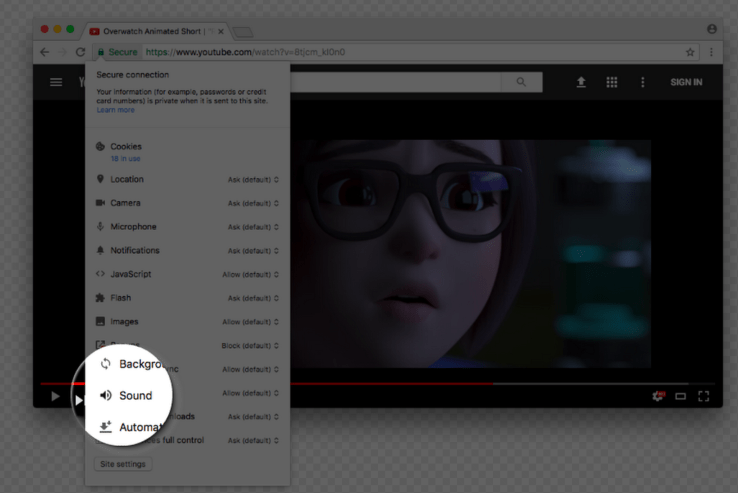
It looks very easy to use. Just click on the security status that’s located to the left of the website address, and then the option to mute the site sits within the list of its details and permissions. The mute itself lasts until the setting is changed, which effectively makes it a sound ban.

While the feature would only appear in Chrome, assuming that it graduates from this test rollout, it could spur other browser companies to follow suit.

This kind of option for users could discourage publishers from autoplaying videos with sound for fear that their website will be muted forever. That would be mean one less annoying thing on the internet and a win for us all.

https://www.thestreet.com/story/14284724/1/here-s-why-apple-s-homepod-will-crush-the-amazon-echo-and-google-home-over-time.html

Here’s Why Apple’s HomePod Will Crush the Amazon Echo and Google Home Over Time

Apple has a tendency of playing catch-up to rivals and then beating them

Apple’s $400 Siri-powred HomePod smart speaker is set to ship in December, three years after Amazon (AMZN) introduced the $179.99 Alexa-powered Echo and a year-and-a-half after the $129.99 Google Assistant-powered Google Home was released from Google, owned by Alphabet (GOOGL) .

Apple and Alphabet are holdings in Jim Cramer’s Action Alerts PLUS Charitable Trust Portfolio. Want to be alerted before Cramer buys or sells AAPL or GOOGL? Learn more now.

Alexa-enabled devices command over 70% of the smart speaker market — for now. Loup Ventures founder Gene Munster thinks Apple is set up to leap over Amazon as the market leader, according to a note he released on Friday.

Apple can make up for the three years it sat out of the smart speaker sector because the long-term winner in the space will be the speaker that “provides its user with a heightened experience and improved efficiency,” he wrote. ” We believe Apple is uniquely positioned to do so, as Apple’s device ecosystem delivers a frictionless experience, which will only get better with the adoption of voice-first computing.”

Amazon may have a head start in the smart speaker market, but it’s playing at a disadvantage without an existing base of smartphone users that can integrate the technology, he noted. On the other hand, Google, which claims a 24% chunk of the market, doesn’t have the “exposure” that Alexa Skills or SiriKit has, he noted.

Apple's HomePod.
Apple’s HomePod.

SiriKit is important for the success of the HomePod because it allows third-party developers to integrate iOS apps and watchOS apps with Siri. Soon, users will be able to ask Siri to carry out more complicated tasks than simply reporting the weather or setting a timer, Munster noted. While Siri has not managed to impress users overall, “the Siri we have come to know on our iPhones and the upcoming Siri that lives in HomePod with third-party integrations are two very different animals,” he wrote.

Siri is setting the HomePod up to take the smart speaker market by storm because its strength is being able to handle questions that are more complex, Munster said. The voice assistant can understand multi-step commands, such as “make a note called Slide 4 in my Presentation Notes folder that says: change transition,” Munster pointed out. “These functionalities are not unique to Siri, but Apple’s seamlessly integrated ecosystem of devices puts them in a position to employ voice-first computing in ways their competitors can’t match,” he explained.

With a price tag that’s significantly more than its two biggest competitors, the HomePod will need to impress customers. At Apple’s annual developer’s conference in June, the company introduced the HomePod as a smart speaker that would be particularly good for listening to music due to its high-quality speakers. However, Munster thinks that was just Apple’s way of setting its speaker apart from the Echo and Google Home devices since it needs to take market share from them to succeed. “Apple didn’t want a ‘me too’ product,” he said. “But at the end of the day, it’s the same thing.”

But even though the HomePod is $170 more than its nearest-in-price competitor, Apple fans are eager to get their hands on it. A Raymond James survey of 500 consumers in June showed that about 14% of iPhone owners intend to buy the HomePod, which is more than the 6% of respondents that indicated they wanted to buy an Apple Watch in a similar survey the firm conducted ahead of the wearable’s release in the spring of 2015. According to the same survey, 16% of respondents plan to buy an Echo, while just 2% plan to buy a Google Home.

http://www.kurzweilai.net/black-mirror-season-4-coming-to-netflix

Black Mirror Season 4 coming to Netflix

August 25, 2017

Netflix has announced the episode titles for “Black Mirror’s” fourth season, to premiere on the streaming service later this year: “Arkangel,” “Black Museum,” “Crocodile,” “Hang the DJ,” “Metalhead,” and “USS Callister” (an apparent Star Trek takeoff).


http://hackaday.com/2017/08/26/raspberry-pi-is-the-brains-behind-automated-greenhouse/

RASPBERRY PI IS THE BRAINS BEHIND AUTOMATED GREENHOUSE

[Asa Wilson] and his wife picked up a 10’x12′ greenhouse from Harbor Freight that for their location required some serious changes, understandable since they’re in Colorado on the western slope of Pike’s Peak where the winds are strong and the normal growing season is short. After assembling it on a concrete footing and adding some steel bracing, they got to work on adding an environment management system based around a Raspberry Pi. Read on for a look at the modifications they made.

Currently, the Pi monitors a single temperature and relative humidity sensor. Based on that input, the Pi controls two exhaust fans located at opposite corners at the base of the greenhouse. These are speed controlled through a custom board and are used for drawing air in from the roof vents. A third, larger, oscillating fan is mounted near the roof for circulating air. It’s speed is set manually, but it’s also turned on and off by the Pi.

There are four vents in the roof, each of which was previously manually opened with a single arm that allowed the vents to oscillate in the wind, and sometimes even fall closed. They fixed those issues by adding homemade vent controllers and geared motors in 3D printed cases. Those motors control two arms that firmly hold both sides of each vent, eliminating the oscillation.

Interestingly, the Pi used its RS-232 output to talk to all the custom controllers but they ran into issues with resistance added by electrical noise. To fix that they added a driver that converts to RS-485 before sending the signal onward.

You can see the results in the write-up on their pages and so far they look promising. However, more work is being done. They’re adding a thermal controller for monitoring up to 20 temperature sensors in the growing area and have plans for up to seven water valves. But even now, the greenhouse is a far cry from the simple plastic shell they started with.

Along the same vein of automating greenhouses, check out [David Dorhout]’s automated watering robot that wanders around with a 30 gallon tank, watering plants. There’s also [Instrument Tek]’s similar 10’x10′ greenhouse Arduino based system that, in addition to fan and watering control, also controls heat and has wireless communication to a remote laptop.

http://fortune.com/2017/08/26/apple-iphone-8-update/

A Big and Expensive iPhone Update May Be Coming Soon

Apple is said to be close to revealing a big update to its iPhone, but if the new model costs too much, it may be a problem for Apple.

That’s the key takeaway from a recent study by ad tech company Fluent. But there’s more to this week in Apple news than that. For instance, Apple doubled down on its response to the Charlottesville, Va. violence earlier this month, and moved to comply with sanctions limiting Iranians from posting apps for sale in the App Store.

And like every other week, speculation is running rampant that Apple is working on a major upgrade to the iPhone that may add the ability for people to use a stylus to digitally write on the screen.

Read on for a look at this week’s biggest Apple (AAPL, +0.37%) news and rumors, and why the company may be threatened by Samsung’s new Galaxy Note 8:

This is Fortune’s weekly roundup of the biggest Apple news this week. Here’s last week’s roundup.

  1. Apple is rumored to be close to unveiling a new iPhone, possibly known as the iPhone 8, that will include several upgrades, including a bigger screen and new all-glass design. But it’s also rumored to be costly, with some reports saying its price could top $1,000. A study this week from Fluent found that just 13% of Americans would buy an iPhone that costs so much, and that only 8% would be willing to pay for an iPhone that costs $1,400. Two-thirds of consumers said a $1,000 iPhone is simply “too expensive.”
  2. Apple has only made its Pencil stylus compatible with its high-end iPad Pro tablets. But two patent filings uncovered this week by Apple-tracking site Patently Apple suggest the company is considering the feature for the iPhone. The patents describe technologies that would let users digitally write on iPhone screens with the Apple Pencil stylus—which, since the accessory’s release in 2015, hasn’t been possible. Apple, of course, hasn’t confirmed that it’s actually planning to make the iPhone compatible with Pencil.
  3. Users who would like to donate to the Southern Poverty Law Center, an organization that monitors extremist and hate groups, and alerts police to their activities, can now do so through Apple iTunes. When users log on to the service, they’ll now have the option of donating cash to the organization in increments of $5 to $200. Apple will donate 100% of the proceeds to the Southern Poverty Law Center. The move is a response to the recent Charlottesville violence.
  4. The New York Times reported this week that Apple has been quietly removing popular Iranian apps from its App Store over the last several weeks. Apple told affected developers that U.S. sanctions prevent the company from making the apps available. Iran has responded with accusations that Apple does not “respecting customer rights.”
  5. Apple plans to build a $1.38 billion data center in Waukee near Des Moines, IA. Apple didn’t say what kind of data the facility will house, but it did receive $207.8 million in incentives from the Iowa Economic Development Authority to erect the building.

https://electrek.co/2017/08/25/tesla-powerwall-2-owner-experience/

A look at Tesla Powerwall 2 owner experience: installation, app, and backup capacity

Tesla has been slowly ramping up production of the Powerwall 2, the latest generation of its home battery pack. A lot of reservation holders are still waiting for the device, but Tesla started installations in a select few markets.

One of those lucky homeowners has been sharing his experience in a series of interesting videos.

Tesla Powerwall 2 can be used for several different purposes, but right now they are mostly being paired with rooftop solar installations in order to maximize the consumption of the solar power on location.

Scott Weston from Melbourne, Australia, where Tesla has started Powerwall installations in June, has a solar array on his rooftop and he added the Powerwall to his system a few weeks ago.

He uses the home battery pack to get more out of his solar installation and to protect his house in case of power outages, which has been an issue in Australia recently.

In this interesting series of videos, Weston shares his thoughts on his new systems and even provides a few cool demonstrations of Tesla’s new app to monitor solar energy generation and Powerwall status, as well as some tests the backup feature and failover scenario.

It’s definitely worth a watch if you are interested in the Powerwall.

http://mashable.com/2017/08/25/smartwatch-rotating-charging-dock/#TX8rJM7Fskqm

Charge your Apple Watch with this sleek, rotating dock

IMAGE: NATIVE UNION

Just to let you know, if you buy something featured here, Mashable might earn an affiliate commission.

So you shelled out some money for an Apple Watch — a sleek, super cool gadget that’s worth showing off. And while the charger that comes standard issue from Apple is fine, the watch really deserves it’s own special pedestal.

The graphite, silicone, and aluminum on this rotating smartwatch charging dock bring out the modern design of your watch, so you can pretty much think of this object as home decoration too. The dock also comes in three different colors (slate, gold, and rose gold) to match the tone of your  watch.

The charging dock fits all Apple Watch models, including all sizes and straps. The magnetic force holds your watch in place, so no need for extra protection. Just feed your watch into the charging cable and it will automatically snap onto the magnetic dock.

And since you probably charge your Apple Watch at night, the dock can be easily set up to view your device from your bed. The rotating arm allows you to choose the perfect angle to view and navigate your watch, whether that’s vertical or horizontal. Turn on that Nightstand mode and the dock will turn your watch into a handy alarm clock.

See what J. Terry Bailey had to say about this product: “Very cool charging dock for my Apple Watch. Love the quite heavy weight of it so it stays in place well. It is very compact to so it doesn’t take up as much space either horizontally or vertically as some others I investigated. The round piece the watch rests on can be swiveled to any position you want.. The watch slips easily on and off the charger and to my mind it is the most elegant looking charging stand I was able to find anywhere.”

http://inhabitat.com/scientists-just-discovered-snow-on-mars/

Scientists just discovered snow on Mars

Forget everything you think you know about Mars. In a study published in Nature Geoscience, scientists confirm that there is snow on the Red Planet. It’s not what you might think, however. Marsexperiences explosions of snow known as “ice microbursts” that only occur in the shadows and are very unlike snowfall on Earth. This finding is challenging previous notions about the planet’s history and the likelihood of future generations colonizing it.

Nature Geoscience, NASA, science, News, snow, Mars, Red Planet, weather patterns, Earth, snowfall,

On Mars, the clouds have to be very low to the surface (about 1 to 2 kilometers, or 0.61 to 1.24 miles), or else the snow will be annihilated before it even reaches the rusty soil. This is because the air pressure increases rapidly as it descends downwards. In turn, the local temperature is increased and snow reaches evaporation-ready temperatures.

As IFLScience reports, scientists previously believed snow precipitation occurred only by “the slow sedimentation of individual particles.” The authors now know this isn’t the case. Their research shows that the sudden snow explosion mechanisms must have affected “Mars’ water cycle, past and present.”

Related: NASA unveils plan to make oxygen on Mars

Nature Geoscience, NASA, science, News, snow, Mars, Red Planet, weather patterns, Earth, snowfall,

Because the red planet’s atmosphere is incredibly thin, its thermal insulation is pretty low. At night, the mercury can drop as low as -73°C (-100°F) on the equator surface, and -125°C (-195°F) at the poles. When sunlight glances Mars, water at the equator is given just enough energy to evaporate. This results in the formation of low-pressure clouds — a phenomenon NASA is already tracking.

Because the temperature of the Red Planet drops considerably at night, the rapid and localized redistribution of heat results in air currents becoming unstable. Water ice crystals then fall out in rapid succession. Some crystals may reach the surface, but others sublimate into a gas. The streaks of snowfall that fail to reach the surface are known as “virgas.”

Nature Geoscience, NASA, science, News, snow, Mars, Red Planet, weather patterns, Earth, snowfall,

For now, only robots are able to experience Mars’ unique snowfall. But if humans ever do colonize Mars — a feat Elon Musk and Stephen Hawking are ambitious to see accomplished in their lifetimes, maybe we’ll get to experience the planet’s unique weather patterns firsthand.

+ Nature Geoscience

http://www.kurzweilai.net/how-to-design-a-custom-robot-in-minutes-without-being-a-roboticist

How to design a custom robot in minutes without being a roboticist

August 25, 2017
[+]

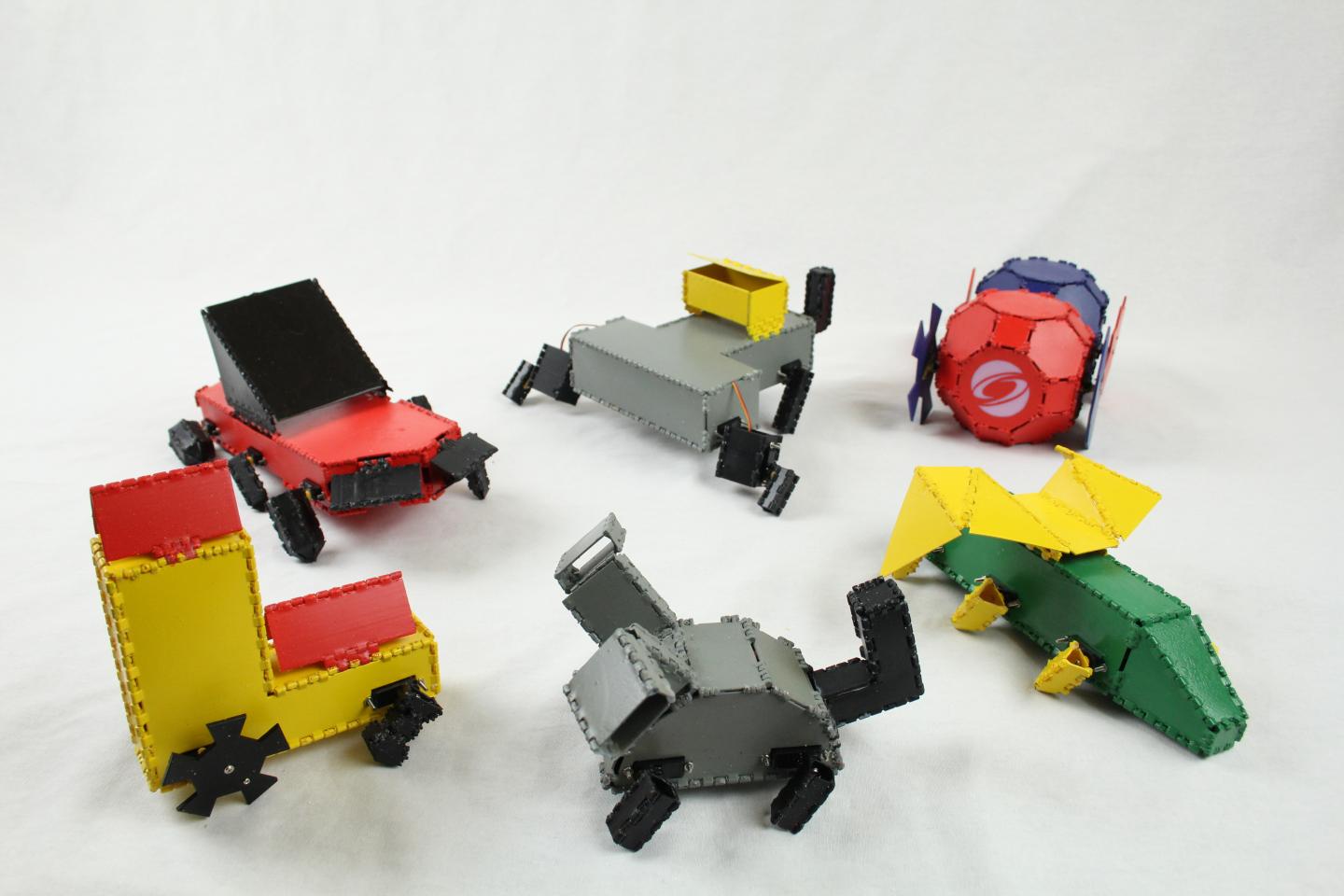
Robot designs by novices using Interactive Robogami (credit: MIT CSAIL)

MIT’s new “Interactive Robogami” system will let you design a robot in minutes and then 3D-print and assemble it in about four hours.

“Designing robots usually requires expertise that only mechanical engineers and roboticists have,” says PhD student Adriana Schulz, co-lead author of a paper in The International Journal of Robotics Research and a researcher in MIT’sComputer Science and Artificial Intelligence Laboratory (CSAIL). “What’s exciting here is that we’ve created a tool that allows a casual user to design their own robot by giving them this expert knowledge.”

Interactive Robogami uses simulations and interactive feedback with algorithms for design composition, allowing users to focus on high-level conceptual design. Users can choose from a library of more than 50 different bodies, wheels, legs and “peripherals,” as well as a selection of different steps (“gaits”).

Gallery of designs created by a novice user after a 20-minute training session. Each of the models took between 3 and 25 minutes to design and contains multiple components from the database. (credit: Adriana Schulz et al./The International Journal of Robotics Research)

The system checks to makes sure a design is actually physically possible, analyzing factors such as speed and stability. Once designed, the team’s origami-inspired “3-D print and fold” technique allows for printing the design as flat faces connected at joints, and then folding the design into the final shape, combining the most effective parts of 2D and 3D printing.*

CSAIL director Daniela Rus, a Professor of Electrical Engineering and Computer Science, hopes people will be able to use the system to incorporate robots that can help with everyday tasks, and that similar systems with rapid printing technologies will enable large-scale customization and production of robots.

“These tools enable new approaches to teaching computational thinking and creating,” says Rus. “Students can not only learn by coding and making their own robots, but by bringing to life conceptual ideas about what their robots can actually do.”

This research was supported by the National Science Foundation’s Expeditions in Computing program.

* To test the system, the team used eight subjects who were given 20 minutes of training and asked to perform two tasks: Create a mobile, stable car design in just ten minutes, and create a trajectory to navigate a robot through an obstacle course in the least amount of travel time. The team fabricated a total of six robots, each of which took 10 to 15 minutes to design, 3 to 7 hours to print and 30 to 90 minutes to assemble. The team found that their 3D print-and-fold method reduced printing time by 73 percent and the amount of material used by 70 percent. The robots also demonstrated a wide range of movement, like using single legs to walk, using different step sequences, and using legs and wheels simultaneously.


Abstract of Interactive robogami: An end-to-end system for design of robots with ground locomotion

This paper aims to democratize the design and fabrication of robots, enabling people of all skill levels to make robots without needing expert domain knowledge. Existing work in computational design and rapid fabrication has explored this question of customization for physical objects but so far has not been able to conquer the complexity of robot designs. We have developed Interactive Robogami, a tool for composition-based design of ground robots that can be fabricated as flat sheets and then folded into 3D structures. This rapid prototyping process enables users to create lightweight, affordable, and materially versatile robots with short turnaround time. Using Interactive Robogami, designers can compose new robot designs from a database of print-and-fold parts. The designs are tested for the users’ functional specifications via simulation and fabricated on user satisfaction. We present six robots designed and fabricated using a 3D printing based approach, as well as a larger robot cut from sheet metal. We have also conducted a user study that demonstrates that our tool is intuitive for novice designers and expressive enough to create a wide variety of ground robot designs.