Month: August 2017
https://www.theglobeandmail.com/report-on-business/international-business/us-business/walmart-partners-with-google-to-introduce-voice-activated-shopping/article36063928/
Walmart partners with Google to introduce voice-activated shopping
Walmart is diving into voice-activated shopping. But unlike online leader Amazon, it’s not doing it alone.
The world’s largest retailer said Wednesday it’s working with Google to offer hundreds of thousands of items from laundry detergent to Legos for voice shopping through Google Assistant. The capability will be available in late September.
It’s Google’s biggest retail partnership – and the most personalized shopping experience it offers – as it tries to broaden the reach of its voice-powered assistant Home speaker. And it underscores Walmart’s drive to compete in an area dominated by Amazon’s Alexa-powered Echo device.
“Voice shopping is becoming a more important part of everyday shopping behaviour,” said Marc Lore, CEO of Walmart’s U.S. e-commerce business.
The voice-activated devices are becoming more mainstream as they become more accessible. Even Apple has one coming out this year. Walmart has said Google’s investment in natural language processing and artificial intelligence will help make voice-activated shopping even more popular.
And Lore said the personalization of the partnership means people can shout out generic items like milk, bread and cheese, and Google Assistant will know exactly the brands and the size that the user wants.
Google introduced shopping to Home in February, letting people use voice to order essentials from more than 40 retailers like Target and Costco under its Google Express program. But that was far behind the Echo, available since late 2014.
Walmart, which has more stores than any other retailer and the largest share of the U.S. grocery market, is also working hard to close the gulf online between itself and Amazon.
It has overhauled its shipping strategy and is expanding store-curb pickup for groceries ordered online. But it’s also had to look beyond itself and form partnerships. Walmart announced Monday that it’s expanding its grocery delivery service with ride-hailing service Uber, and it’s been testing same-day delivery service with Deliv at Sam’s Club in Miami.
Amazon generally has been building its network of services on its own, using its $99-a-year Prime membership with same-day and even one-hour shipping options to develop loyalty.
It’s also been drawing in customers with its Alexa-powered devices. Amazon doesn’t give sales figures for Echo, but Consumer Intelligence Research Partners estimated that it’s sold more than 10 million Alexa-powered Echo devices in the U.S. since late 2014. That includes the core $179 Echo as well as the less expensive and smaller Echo Dot and the portable Amazon Tap.
To be more competitive with Amazon, Google Express is scrapping the $95-a-year membership starting Wednesday, allowing shoppers to get free delivery within one to three days on orders as long as the purchase is above each store’s minimum.
Walmart is integrating its Easy Reorder feature – which has data on both store and online purchases – into Google Express. Shoppers who want to reorder their favourites have to link their Walmart account to Google Express.
With other Google Express retailers, personalization takes time as the assistant learns shoppers’ preferences, says Brian Elliott, general manager of Google Express. So the quick personalization with Walmart should make voice-activated shopping more attractive, he says.
While one of Walmart’s biggest advantages over Amazon is its massive number of stores, Amazon’s nearly $14-billion offer for Whole Foods could shake up the landscape.
Walmart says it will be tapping its 4,700 U.S. stores and its fulfilment network next year to offer more kinds of customer experiences using voice shopping. For example, shoppers can tell Google Assistant they want to pick up an order in a store. Lore said the company wants to make voice shopping as easy as possible.
“That’s why it makes sense for us to team up with Google. We know this means being compared side-by-side with other retailers, and we think that’s the way it should be,” Lore wrote in a corporate blog post.
Independent internet analyst Sucharita Mulpuru-Kodal, who was unaware of the Google deal at the time of the interview, says Walmart is going in the right direction, though it has a long way to go. She noted that partnerships with companies like Uber enable the discounter to get the business “up and running” and it will be able to learn a lot.
http://www.kurzweilai.net/a-breakthrough-new-method-for-3d-printing-living-tissues
A breakthrough new method for 3D-printing living tissues
August 21, 2017
[+]
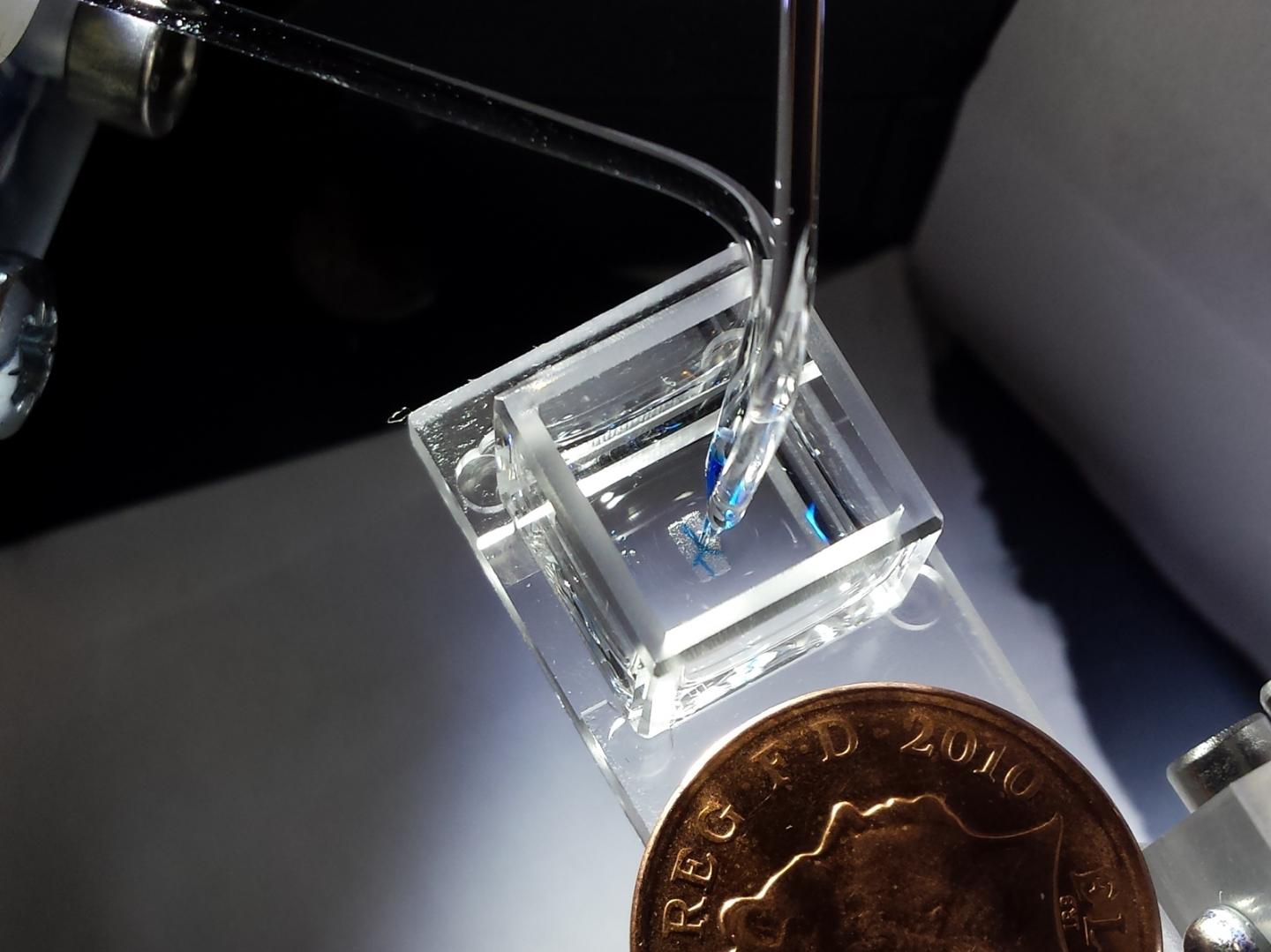
The 3D droplet bioprinter, developed by the Bayley Research Group at Oxford, producing millimeter-sized tissues (credit: Sam Olof/ Alexander Graham)
Scientists at the University of Oxford have developed a radical new method of 3D-printing laboratory-grown cells that can form complex living tissues and cartilage to potentially support, repair, or augment diseased and damaged areas of the body.
Printing high-resolution living tissues is currently difficult because the cells often move within printed structures and can collapse on themselves. So the team devised a new way to produce tissues in protective nanoliter droplets wrapped in a lipid (oil-compatible) coating that is assembled, layer-by-layer, into living cellular structures.

3D-printing cellular constructs. (left) Schematic of cell printing. The dispensing nozzle ejects cell-containing bioink droplets into a lipid-containing oil. The droplets are positioned by the programmed movement of the oil container. The droplets cohere through the formation of droplet interface lipid bilayers. (center) A related micrograph of a patterned cell junction, containing two cell types, printed as successive layers of 130-micrometer droplets ejected from two glass nozzles. (right) A confocal fluorescence micrograph of about 700 printed human embryonic kidney cells under oil at a density of 40 million cells per milliliter (scale bar = 150 micrometers). (credit: Alexander D. Graham et al./Scientific Reports)
This new method improves the survival rate of the individual cells and allows for building each tissue one drop at a time to mimic the behaviors and functions of the human body. The patterned cellular constructs, once fully grown, can mimic or potentially enhance natural tissues.
“We were aiming to fabricate three-dimensional living tissues that could display the basic behaviors and physiology found in natural organisms,” explained Alexander Graham, PhD, lead author and 3D Bioprinting Scientist at OxSyBio (Oxford Synthetic Biology).*
“To date, there are limited examples of printed tissues [that] have the complex cellular architecture of native tissues. Hence, we focused on designing a high-resolution cell printing platform, from relatively inexpensive components, that could be used to reproducibly produce artificial tissues with appropriate complexity from a range of cells, including stem cells.”
[+]

A confocal micrograph of an artificial tissue containing two populations of human embryonic kidney cells (HEK-293T) printed in the form of an arborized structure within a cube (credit: Sam Olof/Alexander Graham)
The researchers hope that with further development, the materials could have a wide impact on healthcare worldwide and bypass clinical animal testing. The scientists plan to develop new complementary printing techniques that allow for a wider range of living and hybrid materials, producing tissues at industrial scale.
“We believe it will be possible to create personalized treatments by using cells sourced from patients to mimic or enhance natural tissue function,” said Sam Olof, PhD, Chief Technology Officer at OxSyBio. “In the future, 3D bio-printed tissues may also be used for diagnostic applications — for example, for drug or toxin screening.”
The study results were published August 1 in the open-access journal Scientific Reports.
Abstract of High-Resolution Patterned Cellular Constructs by Droplet-Based 3D Printing
Bioprinting is an emerging technique for the fabrication of living tissues that allows cells to be arranged in predetermined three-dimensional (3D) architectures. However, to date, there are limited examples of bioprinted constructs containing multiple cell types patterned at high-resolution. Here we present a low-cost process that employs 3D printing of aqueous droplets containing mammalian cells to produce robust, patterned constructs in oil, which were reproducibly transferred to culture medium. Human embryonic kidney (HEK) cells and ovine mesenchymal stem cells (oMSCs) were printed at tissue-relevant densities (107 cells mL−1) and a high droplet resolution of 1 nL. High-resolution 3D geometries were printed with features of ≤200 μm; these included an arborised cell junction, a diagonal-plane junction and an osteochondral interface. The printed cells showed high viability (90% on average) and HEK cells within the printed structures were shown to proliferate under culture conditions. Significantly, a five-week tissue engineering study demonstrated that printed oMSCs could be differentiated down the chondrogenic lineage to generate cartilage-like structures containing type II collagen.
7 new features and changes in watchOS 4 beta 6
https://edtechmagazine.com/higher/article/2017/08/colleges-embrace-data-analytics-improve-student-retention?utm_source=Sailthru&utm_medium=email&utm_campaign=Issue:%202017-08-22%20Higher%20Ed%20Education%20Dive%20Newsletter%20%5Bissue:11683%5D&utm_term=Education%20Dive:%20Higher%20Ed
Colleges Embrace Data Analytics to Improve Student Retention
Universities tap data-driven insights to develop personalized interventions that boost student retention.
As more states adopt funding formulas based on student performance — such as graduation rates and degrees awarded — higher education institutions are laser-focused on improving retention. Regardless of state policy, however, such strategies make fiscal sense: Enrolling a new student is more expensive than retaining a current one. To both control those costs and serve students more effectively, many institutions leverage data analytics.
Temple University’s Fox School of Business developed its analytics initiative in concert with a major curriculum review, which included surveying businesses and focus groups about the competencies they look for in graduates. The school then looked for a way to help students measure their competencies in an integrated, cross-course fashion.
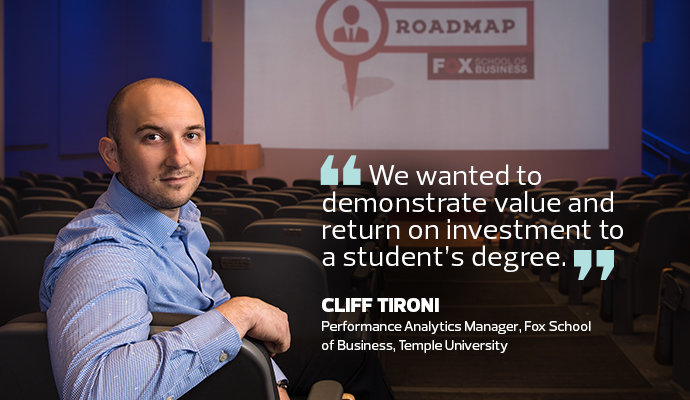
“We wanted to demonstrate value and return on investment to a student’s degree,” says Cliff Tironi, Fox’s performance analytics manager.
Data Creates a New Kind of Report Card
At Temple, it helped that Fox already had extensive data in its learning management system (LMS). Using that as a starting point, Fox built an interface, powered by Microsoft Power BI, that helps students identify their strengths and weaknesses. This real-time dashboard, dubbed RoadMap, is also a powerful demonstration of applied analytics for future MBA candidates who will enter a data-driven business world.
“It’s a deconstructed and repackaged report card,” says Tironi, who created RoadMap with Fox Associate Vice Dean Christine Kiely. “Students can view their progress in a way they never could with the traditional LMS.” For example, a student can look at the feedback he or she received on a particular skill — say, all courses with a presentation element — rather than rely on a string of letter grades, which reflect classwork in a wide variety of skill sets.
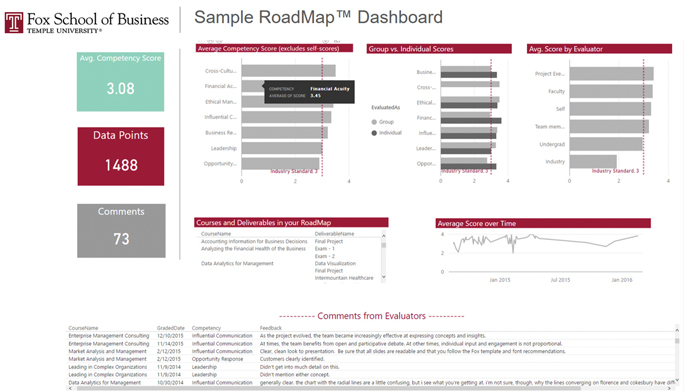
Those insights support more holistic conversations between students and their advisers, Tironi says. Now, instead of simply meeting credit requirements, advisers help students pick classes that develop well-rounded competencies.
Tironi points out that RoadMap doesn’t require professors to change their teaching methods. They already mapped exams to competencies and rubrics, so RoadMap is essentially an invisible layer of analysis, taking data that was latent in the LMS and using it in a new way. By automating the data-gathering process, researchers can spend more time on high-level analyses.
Analytics Detect Early Warning Signs
While Temple University takes a holistic approach to students’ development, the University of Nevada, Las Vegas uses course-level corrections to keep students on track. Consider UNLV’s Anatomy and Physiology, an introductory course that enrolls 1,200 students each year — half of whom fail.
In that stark statistic, Matthew Bernacki saw an opportunity. Bernacki, an assistant professor of educational psychology, had conducted extensive research into student achievement at UNLV. He recognized that data analytics could help flag students who are at risk of failing a course so that instructors can provide timely interventions.
“Students really are generating the same data that can inform their own learning practices, if we can provide them with some sort of intervention based upon it,” Bernacki says.
UNLV started using Splunk in 2010 to increase the visibility of LMS logs on servers, says Cam Johnson, an IT operations center manager. Today, the team uses Splunk Enterprise 6.5.1 and is starting to incorporate Splunk’s Machine Learning Toolkit. Tools like this have the power to put data to dynamic use.
Insights Lead to Well-Timed Intervention
Bernacki started his experiment with the Anatomy and Physiology course that was a stumbling block for so many students. He first worked with professors to digitize learning materials.
“It’s those materials that give us the signal,” he says. “What students click on — and when — helps us do the prediction.”
Bernacki built a prediction model that establishes connections between students’ academic activities and their likely outcomes in the course. That, in turn, informs an intervention strategy designed to help students when they need it most. Timing is everything, Bernacki says:
“Typically, the goal is to intervene and get in front of students digitally before they start to perform poorly on tests.”
In this case, students who appear to be in jeopardy receive an email a week before the first test to remind them of the upcoming exam and direct them to study materials (including tips for success based on the study practices of students who got A and B grades in the class).
“It’s not adaptive in the sense of letting them know what content areas they’re weak on,” says Bernacki. The data for that kind of intervention is not yet available. But what he does have, thanks to Johnson’s work with Splunk and his own research, is access to real-time, course-specific, theory-aligned predictors of success.
About half of the students respond to the messages they receive. In the pilot, about a third of students who received interventions did better than expected in the course.
Proactive Planning via Data
At Southern Connecticut State University, analytics picks up where recruitment ends and retention begins: with a survey at new student orientation. Among other questions, the survey asks students if there is any reason they might not come to campus in the fall, says Michael Ben-Avie, director of the Office of Assessment and Planning.
Depending on students’ responses, Ben-Avie and his team may circulate red flags to the appropriate campus offices, marshalling the resources a student might need to follow through with attendance plans.
“The red flags and the full report are distributed within one day after an orientation session,” says Ben-Avie. “We demonstrate to the students that we care about them by responding immediately.”
SCSU continues to gather data over time and reach out to students proactively. Ben-Avie’s office, for example, employs a handful of students who analyze student success models using IBM Watson Analytics. According to Ben-Avie, they pride themselves on discovering patterns in the data that can overturn conventional college administrator wisdom. Data-driven insights can help administrators and students focus on areas within their control (rather than, for example, a student’s lack of preparation before college).
“We focus on what happens in the college classroom, the on-campus experiences,” Ben-Avie says. “We change the conversation about the students and focus on our efficacy.”
https://electrek.co/2017/08/21/solar-eclipse-tesla-supercharger-test/
Solar eclipse is putting Tesla’s Supercharger network to the test
Today’s solar eclipse is expected to have an important impact on productivity and a noticeable one on solar energy generation, but all the travel to optimize the viewing experience also has another less obvious impact.
It is putting Tesla’s Superchargers to the test and it is showing some weaknesses in the network.
It’s nothing new. During every holiday or long weekend, Tesla’s Superchargers, like any other part of travel infrastructures, are seeing more traffic.
But with all the reports we are getting from Tesla owners on the road over the last few days, it certainly looks like this event is being particularly rough on Tesla’s Supercharger network.
We are talking about car lines beating Christmas and Thanksgiving weekend records as Tesla is trying to match its Supercharger expansion to its growing fleet.
For example, kosmkram on /r/teslamotors had to wait 30 minutes at the Grand Pass supercharger station in Oregon, which is directly in the path of the full eclipse:
There are only 4 Supercharger stalls at this station, which normally is more than OK, but today it creates wait lines.
Critters on /r/teslamotors had the same problem at Mount Shasta in California where there were 6 Tesla vehicles waiting for an empty Supercharger stall:

The wait was over an hour to get to an available stall. Some even reported longer wait times at the same station over the past few days leading up to the eclipse.
Someone sent us this video of 15 Tesla vehicles in line to get a charge at the Corning Supercharger station in California:
It certainly can be frustrating for owners waiting to get a charge in order to complete their road trip, but to be fair, long wait lines have also been reported at gas stations in regions where the full eclipse is visible.
Therefore, it is certainly not an electric vehicle-only problem, but it is useful to show some weaknesses in Tesla’s Supercharger network, which again to be fair, is the most extensive fast-charging network in the world.
Like we recently reported, Tesla just now reached 900 Supercharger stations with 6,000 Supercharger stalls and its goal is to have 10,000 Superchargers worldwide by the end of the year.
This expansion should solve some of the traffic problems highlighted above, but the automaker still has a long way to go in order to get to 10,000 Superchargers in just the next few months.
A new type of station with a higher number of stalls is expected to help. We recently had an exclusive look at the first of Tesla’s new type of Supercharger station with 40 stalls between Los Angeles and San Francisco. There are also similar stations coming just outside Oslo, Norway, and another one between LA and Las Vegas.
https://www.xda-developers.com/chrome-os-product-type-chromecast/
Chrome OS Gets its Own Product Type for Chromecast
Chromecast started out as a side project for Google that quickly turned into the best selling hardware device the company sells. Over 3.8 million were sold in the first 12 months it was launched and last year at Google I/O we learned that the company had sold over 25 million units since its inception (and is now up to 30 million). With its success, you would think that Google would be paying more attention to the small details surrounding this product.
However, Google even seems to be struggling with the branding over the years. March of last year we saw the company try to rebrand the casting technology behind the Chromecast device to Google Cast. Then less than a year later we saw reports of this being changed for 3rd-party products from Google Cast to “Chromecast Built-in.” Google had even removed the Google Cast name from the landing page on their website, which to this day shows the new branding and redirects you to a different landing page.
At that time though, the Google Cast branding name was still on places such as their Android TV landing page. This has since been updated with the Chromecast Built-in moniker, but it’s interesting to see the company go through these transitions over the years. Another small detail that seems to have been overlooked for quite some time is how a Chrome OS device is labeled when it is streaming to a Chromecast supported product.
In the Google Home application, any streams to a Chromecast device that is registered to your account shows up there. It confused many people that Chrome OS wasn’t labeled properly here since the operating system is a 1st-party product from Google. However, a new commit on the Chromium Gerrit shows that Chrome OS is getting its own product type. This commit says it will allow the Cast Receiver on Chrome OS to be properly recognized as a standalone product by other components of the Cast ecosystem (like the Google Home application).
https://electrek.co/2017/08/22/tesla-model-3-aero-wheels-can-increase-efficiency-vp-engineering/
Tesla Model 3 aero wheels can increase efficiency by ~10%, says VP of Engineering
The Tesla Model 3’s standard 18″ aero wheels are starting to get more and more interesting.
After seeing them without the aero caps last week and seeing how great they look, we now learn about the potential efficiency gain with the caps on.
It’s no mystery that airflow through a wheel or wheel well can have an important impact on the overall aerodynamic performance of a car and therefore, an important impact on its efficiency and range.
And since range is always such a concern in the mainstream when it comes to electric vehicles, completely or partly covered aero wheels have made some sort of a resurgence over the last few years with the advent of electric cars.
Their only issue is that they are generally regarded as being uglier than regular wheels.
Tesla first launched an aero wheel for the Model S a few years ago with the first generation of the all-electric vehicle


Tesla claimed that the wheels could increase the highway range by as much as 5%:
“Aerodynamic 19” wheels are designed to reduce wind resistance. Disc-like in shape, they channel air along the sides of the vehicle and can add up to 5% range during highway driving.”
But they proved to be unpopular and the automaker quickly discontinued them.
Though Tesla is now bringing back aero wheels big time by making their new 18″ design standard on the Model 3, its mass-market all-electric vehicle.
The big difference is that they are regular-looking wheels with aero caps on top that can be removed.
Here’s a side-by-side of the caps on and off (picture by Logan Jastremski):


Therefore, someone could keep the caps off for daily commuting and only add them on for long-distance travel, when a few percentage points in efficiency gain can result in several more miles of range.
And that efficiency gain could be quite significant with the Model 3’s aero wheels.
TMC member 355rockit ran into an unnamed early Model 3 owner, who claimed to be a VP of Engineering at Tesla, at a Supercharger in Monterey.
The Tesla executive gave him a quick walkthrough of his brand new Model 3 and explained why he decided to go with the 18″ wheels:
“He said that he went with Aero since he wants more mileage and said the gain is ~10%.”
That’s significantly higher than expected, but not impossible.
The engineer appears to be in the minority when it comes to wheel choice. Most of the production Model 3 vehicles that we have seen so far were equipped with the 19″ Sport wheels, which are available for a $1,500 premium.
Bigger wheels are generally regarded as more aesthetically pleasing, but with the option to have them with and without aero cap, and the potential for the former to significantly improve efficiency, the 18″ could prove popular.
http://www.huffingtonpost.ca/2017/08/22/johnson_a_23156885/
Johnson & Johnson To Pay $417 Million In Baby Powder Cancer Case
The lawsuit claimed baby powder causes cancer when used for feminine hygiene.
LOS ANGELES — A Los Angeles jury on Monday ordered Johnson & Johnson to pay a record US$417 million (C$523 million) to a hospitalized woman who claimed in a lawsuit that the talc in the company’s iconic baby powder causes ovarian cancer when applied regularly for feminine hygiene.
The verdict in the lawsuit brought by the California woman, Eva Echeverria, marks the largest sum awarded in a series of talcum powder lawsuit verdicts against Johnson & Johnson in courts around the U.S.
Echeverria alleged Johnson & Johnson failed to adequately warn consumers about talcum powder’s potential cancer risks. She used the company’s baby powder on a daily basis beginning in the 1950s until 2016 and was diagnosed with ovarian cancer in 2007, according to court papers.
Echeverria developed ovarian cancer as a “proximate result of the unreasonably dangerous and defective nature of talcum powder,” she said in her lawsuit.
Echeverria’s attorney, Mark Robinson, said his client is undergoing cancer treatment while hospitalized and told him she hoped the verdict would lead Johnson & Johnson to put additional warnings on its products.
“Mrs. Echeverria is dying from this ovarian cancer and she said to me all she wanted to do was to help the other women throughout the whole country who have ovarian cancer for using Johnson & Johnson for 20 and 30 years,” Robinson said.
“She really didn’t want sympathy,” he added. “She just wanted to get a message out to help these other women.”
The jury’s award included $68 million in compensatory damages and $340 million in punitive damages, Robinson said. The evidence in the case included internal documents from several decades that “showed the jury that Johnson & Johnson knew about the risks of talc and ovarian cancer,” Robinson said.
“Johnson & Johnson had many warning bells over a 30 year period but failed to warn the women who were buying its product,” he said.
 MIKE SEGAR / REUTERS
Johnson & Johnson spokeswoman Carol Goodrich said in a statement that the company will appeal the jury’s decision. She says while the company sympathizes with women suffering from ovarian cancer that scientific evidence supports the safety of Johnson’s baby powder.
The verdict came after a St. Louis, Missouri jury in May awarded $110.5 million to a Virginia woman who was diagnosed with ovarian cancer in 2012.
She had blamed her illness on her use of the company’s talcum powder-containing products for more than 40 years.
Besides that case, three other trials in St. Louis had similar outcomes last year — with juries awarding damages of $72 million, $70.1 million and $55 million, for a combined total of $307.6 million.
Another St. Louis jury in March rejected the claims of a Tennessee woman with ovarian and uterine cancer who blamed talcum powder for her cancers.
Two similar cases in New Jersey were thrown out by a judge who said the plaintiffs’ lawyers did not presented reliable evidence linking talc to ovarian cancer.
More than 1,000 other people have filed similar lawsuits. Some who won their lawsuits won much lower amounts, illustrating how juries have wide latitude in awarding monetary damages.
Johnson & Johnson is preparing to defend itself and its baby powder at upcoming trials in the U.S., Goodrich said.
http://www.vancouversun.com/intel+says+core+chip+will+once+decade+performance+boost/14303082/story.html
Intel says its new Core chip will be ‘once-in-a-decade’ performance boost for PCs
Intel Corp., the biggest maker of semiconductors, said its new processors are going to deliver the biggest bump in performance that personal computer users have experienced in years.
The eighth generation of its Core line will provide as much as a 40 per cent jump over its predecessor, according to the Santa Clara, California-based company. That’s a leap in performance that arguably only happens once in a decade, Intel said. New laptops built on the chips will come to market in September.
Intel, whose chips are the heart of more than 80 per cent of the world’s PCs, has been remarkably successful in a market that’s been declining since it peaked in 2011 and is now more than 100 million units smaller than it was. In the second quarter, Intel’s PC chip unit posted a 12 per cent increase in sales even as overall shipments of PCs continued their slide.
Intel’s winning strategy — one that the new lineup will try to keep going — has been to persuade consumers that they need to buy up, spending extra on computers with more expensive chips even though they’re not replacing their old PCs as often as they did. The challenge the new Core systems will face is that Advanced Micro Devices Inc., Intel’s only remaining rival in PC processors, is bringing its own new design to market this year. Chips built on its Zen are able to challenge Intel parts on performance for the first time in years, AMD has said, and they’re cheaper.
The new range of chips from Intel will provide a massive leap forward in performance compared with the 450 million PCs that are currently in use and that are more than five years old, Intel said. In that period, processors have become twice as fast at crunching data and the machines themselves have shrunk to be half as thick as they were. Editing 4K video shot on a GoPro camera might not even be possible on older machines, while with the new chips the time needed to do such tasks will be reduced to single-digit minutes versus tens of minutes on previous generation machines.
Intel said it has achieved the step up in capabilities by adding more computing cores to the chips, typically doubling up to four or eight, a significant step forward for processors used in the smallest laptops. Adding cores helps a computer’s ability to perform multiple tasks in parallel, Intel said.
Research shows that in the U.S. at least, people still spend more time on their laptops than they do on their smartphones, Intel said. It’s hoping to persuade them that with the new processors, that time will be more productive.
 Bruce's Blog