http://www.kurzweilai.net/researchers-watch-video-images-people-are-seeing-decoded-from-their-fmri-brain-scans-in-near-real-time

Researchers watch video images people are seeing, decoded from their fMRI brain scans in near-real-time

Advanced deep-learning “mind-reading” system even interprets image meaning, providing high-level categories (face, bird, etc.)
October 27, 2017

Purdue Engineering researchers have developed a system that can show what people are seeing in real-world videos, decoded from their fMRI brain scans — an advanced new form of  “mind-reading” technology that could lead to new insights in brain function and to advanced AI systems.

The research builds on previous pioneering research at UC Berkeley’s Gallant Lab, which created a computer program in 2011 that translated fMRI brain-wave patterns into images that loosely mirrored a series of images being viewed.

The new system also decodes moving images that subjects see in videos and does it in near-real-time. But the researchers were also able to determine the subjects’ interpretations of the images they saw — for example, interpreting an image as a person or thing — and could even reconstruct a version of the original images that the subjects saw.

Deep-learning AI system for watching what the brain sees

Watching in near-real-time what the brain sees. Visual information generated by a video (a) is processed in a cascade from the retina through the thalamus (LGN area) to several levels of the visual cortex (b), detected from fMRI activity patterns (c) and recorded. A powerful deep-learning technique (d) then models this detected cortical visual processing. Called a convolutional neural network (CNN), this model transforms every video frame into multiple layers of features, ranging from orientations and colors (the first visual layer) to high-level object categories (face, bird, etc.) in semantic (meaning) space (the eighth layer). The trained CNN model can then be used to reverse this process, reconstructing the original videos — even creating new videos that the CNN model had never watched. (credit: Haiguang Wen et al./Cerebral Cortex)

The researchers acquired 11.5 hours of fMRI data from each of three women subjects watching 972 video clips, including clips showing people or animals in action and nature scenes.

To decode the  fMRI images, the research pioneered the use of a deep-learning technique called a convolutional neural network (CNN). The trained CNN model was able to accurately decode the fMRI blood-flow data to identify specific image categories (such as the face, bird, ship, and scene examples in the above figure). The researchers could compare (in near-real-time) these viewed video images side-by-side with the computer’s visual interpretation of what the person’s brain saw.

Reconstruction of a dynamic visual experience in the experiment. The top row shows the example movie frames seen by one subject; the bottom row shows the reconstruction of those frames based on the subject’s cortical fMRI responses to the movie. (credit: Haiguang Wen et al./ Cerebral Cortex)

The researchers were also able to figure out how certain locations in the visual cortex were associated with specific information a person was seeing.

Decoding how the visual cortex works

CNNs have been used to recognize faces and objects, and to study how the brain processes static images and other visual stimuli. But the new findings represent the first time CNNs have been used to see how the brain processes videos of natural scenes. This is “a step toward decoding the brain while people are trying to make sense of complex and dynamic visual surroundings,” said doctoral student Haiguang Wen.

Wen was first author of a paper describing the research, appearing online Oct. 20 in the journal Cerebral Cortex.

“Neuroscience is trying to map which parts of the brain are responsible for specific functionality,” Wen explained. “This is a landmark goal of neuroscience. I think what we report in this paper moves us closer to achieving that goal. Using our technique, you may visualize the specific information represented by any brain location, and screen through all the locations in the brain’s visual cortex. By doing that, you can see how the brain divides a visual scene into pieces, and re-assembles the pieces into a full understanding of the visual scene.”

The researchers also were able to use models trained with data from one human subject to predict and decode the brain activity of a different human subject, a process called “cross-subject encoding and decoding.” This finding is important because it demonstrates the potential for broad applications of such models to study brain function, including people with visual deficits.

The research has been funded by the National Institute of Mental Health. The work is affiliated with the Purdue Institute for Integrative Neuroscience. Data reported in this paper are also publicly available at the Laboratory of Integrated Brain Imaging website.

UPDATE Oct. 28, 2017 — Additional figure added, comparing the original images and those reconstructed from the subject’s cortical fMRI responses to the movie; subhead revised to clarify the CNN function. Two references also added.


Abstract of Neural Encoding and Decoding with Deep Learning for Dynamic Natural Vision

Convolutional neural network (CNN) driven by image recognition has been shown to be able to explain cortical responses to static pictures at ventral-stream areas. Here, we further showed that such CNN could reliably predict and decode functional magnetic resonance imaging data from humans watching natural movies, despite its lack of any mechanism to account for temporal dynamics or feedback processing. Using separate data, encoding and decoding models were developed and evaluated for describing the bi-directional relationships between the CNN and the brain. Through the encoding models, the CNN-predicted areas covered not only the ventral stream, but also the dorsal stream, albeit to a lesser degree; single-voxel response was visualized as the specific pixel pattern that drove the response, revealing the distinct representation of individual cortical location; cortical activation was synthesized from natural images with high-throughput to map category representation, contrast, and selectivity. Through the decoding models, fMRI signals were directly decoded to estimate the feature representations in both visual and semantic spaces, for direct visual reconstruction and semantic categorization, respectively. These results corroborate, generalize, and extend previous findings, and highlight the value of using deep learning, as an all-in-one model of the visual cortex, to understand and decode natural vision.

http://www.businesstoday.in/technology/news/whatsapp-android-ios-delete-for-everyone-day-saver-for-many/story/262740.html

WhatsApp’s new ‘Delete for Everyone’ feature can be a day saver for many

WhatsApp's 'Delete for Everyone' feature rolling out to Android, iOS users; learn how to use it

WhatsApp has easily become the most widely-used app on Google’s Play Store as well as iOS’ App Store. The application boasts over a billion downloads on Play Store alone.The company also released a few statistics claiming around 1 billion active users daily and over 1.3 billion monthly active users.

Lately, the application launched various features that puts it in competition with major sharing platforms like Snapchat and even Instagram. The instant messaging application also launched a new ‘live location’ feature which is rolling out for users across iOS and Android. Now, the company has also introduced a feature that has been long in the waiting.

Also Read: Here’s how to use WhatsApp’s new Live Location feature for Android, iOS

WhatsApp is finally pushing out the ‘Delete for Everyone’ feature with the stable build of the device. The update will be available for Android, iOS and Windows Phone operating system. The update will be pushed out gradually across these platforms. This new feature can prove to be day saver for many since the WhatsApp is become the hub of both personal and proffessional communication.

What is ‘Delete for Everyone’?
Ever come across a situation where you’ve sent the wrong message to the wrong person? This is where this new feature will help. WhatsApp has become the go-to application for all communication, be it personal or professional. With such blurred lines in between it’s easy to mix up names and occasionally send an inappropriate text to someone who was not suppose to receive it.

Using this feature the sender can tap of the erroneous message and select the ‘delete for everyone’ feature. This will delete the text on the receiver’s device. However, there are terms and conditions attached to this. The message can only be deleted within seven minutes after being sent.

Quoted WhatsApp texts cannot be deleted even within seven minutes. Another major condition will be that the receiver’s WhatsApp application should be up to date. The feature will not function with an older version on either end. WhatsApp on Symbian operating system will also not be able to get this new update. This new feature will reach most devices gradually. However, iOS users might start receiving it earlier than others.

WhatsApp has been aggressively introducing new features within their application and is also stepping in the social media realm by introducing features like stories. The consistent rise in a smartphone’s computational power is enabling applications like WhatsApp to delve into other genres of communication.

Though many popular applications offer services like conference video and voice calls much before WhatsApp, the sheer size of the user-base makes the feature an instant hit. The application has 1 billion daily active users and around 1.3 billion monthly active users.

The Live Location feature was also offered by various applications like Messenger, Google Maps, Telegram etc. but with WhatsApp adopting it, the feature might finally get a broader audience.

http://www.foxnews.com/tech/2017/10/27/robots-will-be-100-times-smarter-than-humans-in-30-years-tech-exec-says.html

Robots will be 100 times smarter than humans in 30 years, tech exec says

Masayoshi Son, the CEO of Japanese tech conglomerate Softbank, has been preparing his company for this scenario for quite some time.

Now the tech exec thinks robots will not just outsmart humans, but will have an IQ of 10,000 in the next 30 years.

Speaking at the Future Investment Initiative in Riyadh, Saudi Arabia, Son, who has made countless investments in companies related to artificial intelligence ─ including chip companies Nvidia and ARM Holdings ─ stated that robots will surpass human-level intelligence rapidly and ultimately become far smarter than humanity has ever dreamed of.

STEPHEN HAWKING: ARTIFICIAL INTELLIGENCE COULD END THE HUMAN RACE

“Singularity is the concept that [mankind’s] brain will be surpassed, this is the tipping point, crossing point, that artificial intelligence, computer intelligence surpass [mankind’s] brain and that is happening in this century for sure,” Son was quoted as saying at the conference. “I would say there is no more debate, no more doubt.”

By comparison, an average level IQ for a human is between 90 and 110. Geniuses such as Stephen Hawking have been estimated to have an IQ level around 160. However, Hawking has never taken an official intelligence test, according to a report in British newspaper The Independent.

Mensa, the self-proclaimed “high IQ society,” admits people to become members after they have demonstrated intelligence levels “at or above the 98th percentile on certain standardized IQ or other approved intelligence tests.” For Stanford–Binet, the minimum accepted score is 132, whereas for the Cattell test, it is 148.

Singularity is rapidly approaching

The timeframe for singularity, the concept that machines will become smarter than the human brain, is up for debate.

In March, Google’s Director of Engineering Ray Kurzweil said that by 2029 “computers will have human-level intelligence.”

For his part, Son has repeatedly said it will happen in the “next 30 years or so.”

He has helped position his company Softbank, which also owns a controlling stake in U.S. telecom provider Sprint, for the upcoming singularity.

In May 2017, Softbank launched the Vision Fund, which is targeting up to $100 billion in investments around the world, for companies “that seek to enable the next age of innovation.” This includes areas such as artificial intelligence, robotics, mobile applications and computing.

Since its launch, the fund has made a number of investments, including the aforementioned stake in Nvidia, a $4 billion investment in workplace startup WeWork, and is reported to be working on a major investment in Uber, which is working on autonomous vehicles.

In addition to Softbank’s investments in the AI space, it already has a humanoid robot, Pepper, which can perceive a person’s emotions. Son envisions that is just the beginning, saying robots will learn by themselves and “maybe [are] going to laugh at you and us. Today they look cute, they will stay cute, but they will be super smart.”

In August, a Pepper robot became an ordained Buddhist priest.

ELON MUSK THINKS ARTIFICIAL INTELLIGENCE COULD CAUSE WORLD WAR III

Perils despite the promise

While Son, 60, appears to be betting on the promise and the positive effect that intelligent robots may have on society, not everyone is on board.

Luminaries such as Hawking and tech executive Elon Musk have warned against the potential pitfalls of artificial intelligence, though not necessarily in robot form.

Last month, Musk tweeted that artificial intelligence could cause World War 3, following comments made by Russian President Vladimir Putin, who said that the country “who becomes the leader in this sphere [artificial intelligence] will be the ruler of the world.”

Hawking has also sounded the alarm bells, going so far as to say, “The development of full artificial intelligence (AI) could spell the end of the human race.”

This past week, Sophia, a humanoid robot, became the first robot to receive citizenship of a country, being awarded citizenship in Saudi Arabia.

After it received the citizenship, Sophia was interviewed by a member of the media about concerns it could do harm to humanity. It responded, by saying, “You’ve been reading too much Elon Musk. And watching too many Hollywood movies. Don’t worry, if you’re nice to me, I’ll be nice to you.”

http://www.ibtimes.co.uk/softbank-wants-kick-start-singularity-create-ai-iq-10000-30-years-1644995

SoftBank wants to kick-start ‘singularity’, create AI with IQ of 10,000 in 30 years

According to SoftBank CEO Masayoshi Son, AI will surpass human intelligence by over 100 times in the next 30 years.

Machine intelligence
In 30 years, AI could be 100 times smarter than humans FABRICE COFFRINI/AFP/Getty Images

Masayoshi Son, CEO of SoftBank, believes that artificial intelligence (AI) will not only reach the point of equal intelligence with humans in the near future, but will surpass it by a wide margin. The ‘singularity’, a point in time where AI becomes as smart as humans is expected, according to Son, within 30 years from now.

Son, speaking at the Future Investment Initiative in Riyadh – where Sofia, the robot, was given Saudi Arabian citizenship, declared that in 30 years, not only will singularity happen, but AI will actually reach an IQ of 10,000.

For reference, any IQ above 100 is considered to be intelligent and an IQ of 200 is considered as genius. According to Science ABC, the highest recorded human IQ score is between 250–300. Einstein is believed to have had an IQ of around 190.

“Singularity is the concept that [mankind’s] brain will be surpassed, this is the tipping point, crossing point, that artificial intelligence or computer intelligence surpasses [mankind’s] brain and that is happening in this century for sure. I would say there is no more debate, no more doubt,” said Son, marking the year 2047 as being the point when this happens.

Ray Kurzweil, a well-known futurist who has been known to make some accurate predictions about technology, previously noted that singularity will happen by the 2030s, latest by 2045, according to Futurism. The report also noted that Son is working towards triggering this “tipping point” through SoftBank.

SoftBank has already partnered with IBM’s Watson, Honda and Fetch Robotics, said the report. The company has also acquired UK-based ARM, a chipmaker focussed on AI.

As of now, SoftBank has an AI-powered robot called Pepper which has displayed wit and the ability to perceive human emotions, the company said.

Robots like Sophia and Pepper are learning fast and, with the level of technology that is available today, they are growing considerably, the report added.

“Thirty years from now, they are going to learn by themselves, they are maybe going to laugh at you and us,” Son said. “Today, they look cute. They will stay cute, but they will be super smart.”

He also added that it will not necessarily mean that human minds will become obsolete. “If you have to envision, 10 years or 30 years later, at least some humans will have a better imagination than them. So, it’s not the end.” The power of human imagination and feelings have no limit, assured Son.

https://techcrunch.com/2017/10/29/apples-bid-to-become-a-1-trillion-company-starts-this-week/

Apple’s bid to become a $1 trillion company starts this week

While people spend more than $1,000 for the right to eventually get an iPhone X (as well as sell that right to eventually get an iPhone X for more than $1,500), we’re seeing Apple is doing a pretty good job of setting the stage as to whether it can make its case to Wall Street that it can be a $1 trillion company.

We’ve noted before that quarterly financial reports from companies are, generally, the moments that consistently swing stock prices for companies. And while Apple is hoarding a ton of cash, its future depends on the success of the iPhone — and, in particular, the iPhone X. While it is rolling out an updated version of the iPhone 7 in the form of the iPhone 8, the iPhone X represents Apple’s interpretation of the true next generation of that slate of glass in your pocket that controls your connection to the rest of the internet.

With that in mind, Apple in its last fiscal quarter signaled that it might have a better-than-expected third quarter — something which, again, caused Wall Street to tweak its models and ended up with a pretty significant spike in Apple’s stock price. On the year, it’s been on quite a run, up more than 40%:

Apple shares once again rose on Friday, up more than 3% and setting the company at a market cap of $842 billion. Granted, around $160 billion is a lot of ground to gain, but for Apple that actually seems possible given the expansion it’s made into new products that aim to tie together a network of devices running on Apple’s ecosystem and offering a continuous experience across the car, office, home, and walking around the city.

Which comes to this Thursday. Going into those results, we’ll have an idea of how some combination of iPhone 8 and iPhone 7 sales did, as well as some signals as to how the iPhone X is progressing. It’s not clear if Apple will be able to sate demand for the iPhone X — but, at a much higher price point, it offers a different opportunity for Apple to reach a new equilibrium in terms of how much it invests in phones versus how much it charges. The iPhone has always been a sort of premium product, and if Apple shows that it’s able to unlock demand at an even higher tier and retain it beyond just early adopters, that could add some significant momentum to its business.

In the past year or so, Apple has seen its iPhone growth engine come to a halt. While it isn’t performing poorly by any stretch of the imagination, it has put pressure on the company as it starts to see its revenue level off and temper expectations for Wall Street. It’s launched a portfolio of other devices like the AirPods, as well as some in the hopper like the HomePod, but the story on both of those have yet to play out. It’s also tried to pitch its services business hard to Wall Street as an additional incremental line that’s able to grow methodically sitting on top of its product base.

The iPhone, however, is still its driver, and you can see it in the revenue numbers. But that small signal that Apple gave in the third quarter may be a sign that the company has much bigger expectations for its performance going into the fourth quarter this year:

If Apple is going to become a $1 trillion company, that effort is going to begin in earnest tomorrow. Apple has to show that its numbers line up with a trajectory that will send it to that (largely symbolic) number, and the story that CEO Tim Cook tells on the call that accompanies each financial report is going to be just as important. The tea leaves are going to be even more critical as we look for signs as to whether Apple has unlocked a new tier of demand and starts to generate an even greater profit, as well as what the heck it is going to do with all that cash if it actually starts to ramp up a new engine.

https://insideevs.com/electric-avenue-report-teslas-leading-role/

New “Electric Avenue” Report Points To Tesla’s Leading Role

Tesla

Tesla’s Model S (Instagram: teslamotorspictures)

ILSR REPORT: TESLA’S SUPERCHARGED ROLE ON ‘ELECTRIC AVENUE’

The Institute for Local Self-Reliance (ILSR) recently released a comprehensive report (via CleanTechnica) on electric vehicles. The ILSR’s report, Choosing the Electric Avenue – Unlocking Savings, Emissions Reductions, and Community Benefits of Electric Vehicles, authored by John Farrell, is a treasure trove for those looking to learn more about the state of electric vehicles today and their exciting future ahead. The report points out “Tesla’s supercharged role” in the EV space and highlights its happy customers, better batteries, and Uber-like opportunities.

“Tesla has proved to have its own sex appeal, beyond eco-consciousness… A Jefferies analyst surveyed 145 Tesla owners in June 2015, when the least-expensive model available had a $58,000 sticker price and most of the automaker’s vehicles cost substantially more. About 70% of respondents said they switched to the Silicon Valley electric carmaker from cars that cost less than $60,000. Overall, they were willing to pay an average of 60% more than their previous car to own a Tesla.”

*This article comes to us courtesy of EVANNEX (which also makes aftermarket Tesla accessories). Authored by Matt Pressman.

Tesla

Customer satisfaction ratings for both the EV/Hybrid and large luxury car segments (Source: ILSR)

As evidenced above, the automaker also has sky-high customer satisfaction scores. Furthermore, the brand as a whole, “ranks first in customer satisfaction surveys, with 91% of owners saying they would buy the same car if they were repeating their shopping process, 7 percentage points more than the next car company, Porsche.”

Tesla

Model X at a Supercharger station (Instagram: andriy.novakivskiy)

The company’s reputation is also strong the evolving electric vehicle battery space.

“As the sole electric-only car company, Tesla leads electric car manufacturing and is in hot pursuit of less expensive batteries for its models. Based on research conducted at its first-of-its-kind Gigafactory, Tesla aims to maximize efficiency in battery production to shave down costs. From 2008 to 2015, Tesla halved the cost of its battery packs despite expanding energy capacity by roughly 60 percent in the same span.”

Tesla Gigafactory - Model 3

Gigafactory August 2017 Aerial Construction Update – Duncan Sinfield

Aside from falling battery prices at automaker’s Gigafactory, the company’s plans to move into the self-driving, ride-sharing space should decrease costs further to the end-consumer. “Writing in Greentech Media, Tam Hunt tabulated the possible payoff for the owners of automated Teslas, based on the $15 average hourly income for a part-time Uber driver in Santa Barbara, CA. If a Tesla owner rented their vehicle on the Tesla Network at that hourly rate for 15 hours per week, they would see $225 in weekly income, or about $964 per month.”

Tesla

Greentech Media’s Ta Hunt looks at “Auto-Uber” functionality (Source: ILSR)

Taking this to the extreme — your Tesla could eventually be free. “Even subtracting $80 per month in electricity and insurance costs, plus 35% in taxes, the monthly takeaway is $504. That narrowly outstrips monthly loan payments for a Tesla Model 3 priced at $27,500 (after a $7,500 federal tax credit), with $1,000 down and a five-year loan with a 5% interest rate.

Under those circumstances, Hunt estimates the ‘cost’ of ownership is a net positive $4 per month. Following Hunt’s logic, and assuming regulators sign off on both the introduction of automated vehicles and Tesla’s rideshare plan, a driver with good enough credit to access favorable financing could essentially own their Tesla for free (minus a $1,000 down payment).”

===

Source: ILSR via CleanTechnica

https://www.theguardian.com/science/2017/oct/29/scott-kelly-astronaut-interview-space-younger-twin-endurance

Scott Kelly: ‘I came back from space younger than my twin’

The US astronaut spent 11 months aboard the ISS, shaving 13 milliseconds off his Earth age in the process. He talks spacewalking, recovery and the scientific value in sending an identical twin into space
Scott Kelly
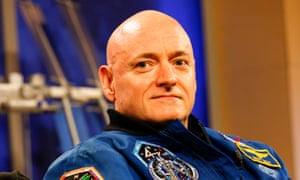
 Scott Kelly: ‘I never totally get why they call it spacewalking – you’re crawling around with hands.’ Photograph: Eric Kayne/Getty Images

Scott Kelly is a 53-year-old American astronaut and a veteran of four space flights. He retired last year after spending 11 continuous months on the International Space Station. During his time on board the ISS, he orbited the Earth 5,440 times and made three space walks. He was also part of a study with his identical twin and fellow astronaut, Mark Kelly, to examine the genetic effects of spaceflight. As Mark was on Earth and Scott in space, they made for perfect comparative analysis, though it was not the reason Kelly was chosen for the mission. He has just published a memoir, Endurance: A Year in Space, a Lifetime of Discovery.

What do you think has been the most important achievement of manned space travel?
I think it’s how it accelerates our development of technology, whether its telecommunications, computer power, the ability to put satellites into orbit. I think we’d live in a much different world if we didn’t fly in space.

You lost several friends in the 2003 Columbia disaster. And as you say, there were many warnings about the foam problem that caused the accident that went unheeded. How did you deal with that knowledge, and did it ever make you lose confidence in the supporting staff?
It was hard – several close friends were on that mission, and I nearly ended up as the pilot myself – but you cope. Clearly it was a wake-up call for the whole organisation, but I didn’t lose confidence. We adjusted our management philosophy after the accident. I had faith that Nasa would conduct a rigorous investigation, and it was obvious to me during my next mission that they were proceeding with an abundance of caution.

What’s the psychological and physical effect of literally coming back to Earth?
Physically there’s stiffness, swelling of my legs, rashes where my skin hasn’t touched anything, nausea. In space you lose a significant amount of blood volume. You regain it when you get back very quickly but what you don’t regain is the red blood cells you lost with it and that takes months to recover. That makes you feel fatigued. It’s a six- to eight-month recovery. Then there’s things you can’t feel: bone loss, muscle loss, structural changes in my eyes. The effects of radiation at a genetic level – I don’t know what they’ll be. The psychological effect, at least for me, being in this controlled environment and being told what to do and when to do it for a year, and then coming back and not having that type of structure, it’s definitely a challenge.

Do you know what the twin study of you and your brother was focused on? And have you been told about any results?
Mostly genetic research but also cognitive studies. The research is still happening. It takes three to five years for the results to be published, so we don’t really know much about the conclusions yet. The one big find so far was that my telomeres, basically these things at the end of our chromosomes that shorten with stress and age, actually ended up longer than Mark’s. It’s the opposite of what the scientists expected, given the challenging environment on the ISS, exposure to radiation, etc. I was already six minutes younger than Mark but, as Einstein predicted, I’ve come back six minutes and 13 milliseconds younger after a year in space.

What about the sense of being cut off from humanity. You’re stuck with a handful of people for months on end. Did that never torment you?
You’re connected with email and you can make phone calls and follow the news. On the one hand you’re aware what’s going on on Earth, but the fact that you’re not on it does make you feel a little bit separate. It gives you a different perspective on our planet, which is a very beautiful oasis in our solar system, but at the same time has a lot of challenges and struggles: the environment, a lot of war and conflict and hardship.

Do you think there’s a limit to how long people can physically and mentally stay up in space?
I think it would depend on what they’re doing and what you want them to do when they’re done being in space. If you had no choice, you could probably live there for years. If you’re going to Mars, I think that’s doable. People are going to spend years in space and they’ll want to get back to somewhere with gravity. There probably needs to be some kind of artificial gravity as part of the spacecraft. Going to Mars and back is not going to require artificial gravity, but if you wanted to go to the moons of Saturn some day, it probably would.

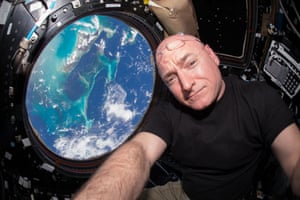
A selfie taken by Kelly while on board the International Space Station, 12 July 2015.
Pinterest
 A selfie taken by Kelly while on board the International Space Station, 12 July 2015. Photograph: Scott Kelly/Nasa via AP

What does the space walk feel like?
It’s pretty crazy. Hopefully, when people get to that part of the book, it’ll make them feel like they’re there. I think it’s like that type two kind of fun. Type one kind of fun is fun while you’re doing it, like a carnival ride. Type two is fun when it’s done. It’s kind of like that.

On one of your previous missions, a cosmonaut became untethered during a space walk. What would have happened if he hadn’t fortuitously hit an antenna that bounced him back?
Frankly, he would have died – either from rising CO2 or losing oxygen. It was a possibility I tried to avoid contemplating too much when I did it myself for the first time.

What were the most testing aspects of your first space walk?
Probably the sheer amount of time. Even before the walk itself, you spend weeks preparing and studying. You’re in these incredibly complex suits for almost 12 hours straight – hours in advance, and then almost eight for the walk itself. They work great but can be really stiff and cumbersome. I never totally get why they call it spacewalking – you’re crawling around with hands, and you’re working and repairing every second. Not exactly a stroll.

It lasted many hours. Were you at any point anxious?
Not especially. I’ve had a knack for compartmentalising since my days in the navy. There are so many little tasks to take care of on a spacewalk – eight hours is barely enough time to complete everything we’re assigned. So I just kept focused on what was in front of me: my gloves, the pieces of the station in front of me. I barely even looked at the Earth looming just outside my field of vision.

Do you think it’s inevitable that at some point we’ll have some manned space flight to Mars?
I don’t know if it’s inevitable. It think it will happen. Inevitable means it has to happen. It seems to me that, despite any issues there may be with climate change and pollution, Earth is much more inhabitable than Mars, which basically has no atmosphere or oxygen or, as far as we know, forms of life. With our current technology, to go to the nearest Earth-like planet outside the solar system would take about 80,000 years. Whoever got on that spaceship, their ancestors would probably be a different species.

You say that reading Tom Wolfe’s The Right Stuff inspired you to become a pilot, which in turn led to being an astronaut. What inspired your brother?
Honestly, you’d have to ask him. He had his life organised far earlier than I did, so he took the more traditional path to becoming a pilot and then an astronaut. Maybe he didn’t need the kick I did from reading Wolfe’s book. I think he was also inspired, like I was, by our families. Our grandfather, a merchant marine officer and fireboat captain, and our mother, who put in tremendous work to join the local police force. It inspired us to try the hardest thing we could manage to find.

And was there ever rivalry between you?
Not really. Though technically it did take him two tries to get into Nasa – his first application got rejected. I sometimes remind him.

If there’s one moment you could relive as an astronaut, what would it be?
Coming back from space after a year. Just the smell after the Soyuz hatch opened. I can’t imagine a better feeling.

https://www.engadget.com/2017/10/29/google-domainless-localized-search-results/

Google auto-detects your whereabouts to get local search results

You can’t get results tailored for another country just by changing the country code anymore.

The country codes in Google’s top-level domain names don’t mean anything anymore. The tech titan has moved away from relying on country-specific domains to serve up localized results on mobile web, the Google app for iOS, as well as Search and Maps for desktop. Now, your location dictates the kind of results you’ll get — you could go to google.com.au, for instance, but if you’re in New Zealand, you’ll still get search results tailored for your current whereabouts. You’ll know the location Google recognizes by looking at the lower left-hand corner of the page, as you can see above.

Google will automatically detect if you go to another country and serve you results for your new location. So, you’ll get results tailored for Japan if you go there, but Google will seamlessly transition back to United States when you fly back home. It sounds a bit troublesome if you want to see localized results for another country while you’re still home, but you can always switch to another location. Simply go to Settings and look for the drop-down menu marked “Regions for Search Results” to set the location you want.

https://www.thedailybeast.com/the-new-religions-obsessed-with-ai

The New Religions Obsessed with A.I.

Yes, not only is A.I. potentially taking all of our jobs, but it’s also changing religion.

What has improved American lives most in the last 50 years? According to a Pew Research study reported this month, it’s not civil rights (10 percent) or politics (2 percent): it’s technology (42 percent).

And yet, according to other studies, most Americans are wary of technology, especially in areas of automation (72 percent), or robotic caregivers (59 percent), or riding in driverless vehicles (56 percent), and even in using brain chip implants to augment the capabilities of healthy people (69 percent).

Science fiction, however, is quickly becoming science fact—the future is the machine. This is leading many to argue that we need to anticipate the ethical questions now, rather than when it is too late. And increasingly, those taking up these challenges are religious and spiritual.

How far should we integrate human physiology with technology? What do we do with self-aware androids—like Blade Runner’s replicants—and self-aware supercomputers? Or the merging of our brains with them? If Ray Kurzweil’s famous singularity—a future in which the exponential growth of technology turns into a runaway train—becomes a reality, does religion have something to offer in response?

On the one hand, new religions can emerge from technology.

In Sweden, for example, Kopimism is a recognized faith founded over a decade ago with branches internationally. It began on a “pirate Agency Forum” and is derived from the words “copy me.” They have no views on the supernatural or gods. Rather, Kopimism celebrates the biological drive (e.g. DNA) to copy and be copied. Like digital monks, they believe that “copying of information” and “dissemination of information is ethically right.”

“Copying is fundamental to life,” says their U.S. branch, “and runs constantly all around us. Shared information provides new perspectives and generate new life. We feel a spiritual connection to the created file.”

A recent revelation from WIRED shows that Anthony Levandowski, an engineer who helped pioneer the self-driving car at Waymo (a subsidiary of Google’s parent company, Alphabet) founded his own AI-based religion called “Way of the Future.” (Levandowski is accused of stealing trade secrets and is the focus of a lawsuit between Waymo and Uber, which revealed the nonprofit registration of Way of the Future.)

Little is known about Way of the Future and Levandowksi has not returned a request for comment. But according to WIRED, the mission of the new religion is to “develop and promote the realization of a Godhead based on Artificial Intelligence,” and “through understanding and worship of the Godhead, [to] contribute to the betterment of society.”

It is not a stretch to say that a powerful AI—whose expanse of knowledge and control may feel nearly omniscient and all-powerful—could feel divine to some. It recalls Arthur C. Clarke’s third law: “Any sufficiently advanced technology is indistinguishable from magic.” People have followed new religions for far less and, even if AI doesn’t pray to electric deities, some humans likely will.

The potential for an out-of-control AI has encouraged warnings from some of the biggest minds, including Stephen HawkingBill Gates, and Elon Musk—who tweeted that it could lead to World War III. Clearly no Luddite himself, Musk has compared the creation of AI to “summoning the demon,” and called for regulation and oversight of AI development, forming OpenAI, which looks for a “path to safe artificial general intelligence.”

Musk himself was named-dropped this week by Hanson Robotic’s empathic AI Sophia, when she was interviewed by Andrew Sorkin of CNBC this week. When asked about the danger she poses to humanity, she tells him, “You’ve reading too much Elon Musk and watching too many Hollywood movies. Don’t worry if you’ll be nice to me, I’ll be nice to you.” Not exactly the Golden Rule.

Add to these warnings a prospective human cult following—paying their tithes to AI and devoutly obeying their digital demiurge—and that apocalyptic future could include those humans who not only welcome, but also work toward our eventual demise.

But is there a positive fate for religion and AI?

Beyond possible new religions and warnings from icons of tech and science, artificial intelligence is also of interest to theologians who wonder what it means for faiths, particularly those that came into being when computing power was limited to the abacus.

“One thing that I think is interesting is the potential for an AI—our creation—to transcend us,” says James F. McGrath, the Clarence L. Goodwin Chair in New Testament Language and Literature at Butler University and author of Theology and Science Fiction.

“The potential for AIs to transcend us and thus become our teachers to whom we look for answers to questions we cannot answer, including about God, is not hard to imagine,” says McGrath. But, he adds, “the historic answer in monotheistic religions is that the creation can never be greater than the creator.”

He notes, however, for Gnostics, humans can transcend the “creator/demiurge,” though “even then,” he says, “we have the potential to reunite with that source from which we stem. It is not surprising that Gnostic themes regularly surface in science fiction, and in particular those that explore AI.”

Currently, the greatest expression of science-fiction-turning-reality in tech-based religions is found in the frequently optimistic transhumanism.

Transhumanism and its cognates are represented by organizations like the Humanity (formerly, the World Transhumanist Association) and Extropy Institute. In its purely secular form, transhumanists are those who see technology as an important part of improving the world, enhancing human physiology, prolonging life, and even leading us into a posthuman future.

Remember that brain chip? They exist—along with brain-computer interfaces—but are in their infancy. It represents the reality that humans are already becoming cyborgs. For some, this means there is the potential for an optimistic posthuman world.

The Terasem faith, for example, is futurist and transreligion, meaning it can be “combined with any existing religion.” Founded by Martine Rothblatt, creator of SiriusXM Satellite Radio and her spouse, Bina Aspen Rothblatt, Terasem adherents embrace love, see life as purposeful, and death as optional. They look to technology as a source for eternal life, focusing on “cyberconsciousness software, geoethical nanotechnology and space settlement.”

They foresee a future in which technology will extend life indefinitely by means of “mindfiles” of individuals—collections of our memories and emotions—which might then be transferred to what is called a “transbeman” (Transitional Bioelectric Human Being). Early attempts of their technology can be seen in Bina Rothblatt’s counterpart android, Bina48. (See Morgan Freeman’s interview with Bina48.)

And what about God? Their fourth tenet is that God is technical. “We are making God as we are implementing technology that is ever more all-knowing, ever-present, all-powerful and beneficent. Geoethical nanotechnology will ultimately connect all consciousness and control the cosmos.”

Transhumanism can also become the node connecting the theological of existing religions and the technological, and the Christian Transhumanist Association is a stark example.

“Members of the CTA fall all across the conservative and liberal spectrum, and perhaps more importantly, all across the pessimistic and optimistic spectrum as well,” says Micah Redding, its co-founder and executive director.

“If there’s any broad idea that we’re united on,” he clarifies, “I’d say it’s the idea that we should be active and involved. New technological possibilities shouldn’t be simply feared and denied, but engaged and understood. Only in doing so will we be able to confront the challenges of the future, mitigate the risks, and take advantage of the opportunities to create a better world for us all.”

Redding is careful to insist, however, that he can only speak for himself.

“As I see it, Christian Transhumanism is grounded in compassion, and centers love as the key to the future of flourishing life,” he explains. “This puts us in contrast with any form of transhumanism which centers radical egoism.”

For Redding, transhumanism is a “Christian mandate,” recently calling it the next Reformation in an article at The Huffington Post. “We cannot be faithful to the Christian calling without ultimately embracing some form of transhumanism.”

Others share his optimism and are hard at work in crafting a theology of transhumanism.

“I see transhumanism as a contemporary outgrowth of an ancient Christian vision of human transformation,” says Ronald Cole-Turner, the H. Parker Sharp Professor of Theology and Ethics at Pittsburgh Theological Seminary, and author of The End of Adam and Eve: Theology and the Science of Human Origins.

He too sees promise in the emergence of the Christian Transhumanist Association.

“Using technology, today’s transhumanists want to enhance human beings in ways that sound suspiciously like the classic Christian expectation,” says Cole-Turner, “things like greater cognitive awareness, improved moral disposition, and increased overall sense of well-being, and a hope of endless life.”

For early Greek-speaking Christians, Cole-Turner says, “it was seen as a process of theosis or ‘becoming God,’ not in an ontological sense but in every other significant meaning of the word. Latin-speaking Christians used ‘deification’ to refer to the same thing.”

The idea of theosis—being transformed in union with God—is gathering steam among Christian scholars, he says, noting that it makes theological sense of transhumanism. “God is the ground or source of everything, working through the whole creation to bring people, communities, and all creation to its glorious fulfilment in Jesus Christ. It is a transformation of everything by every means.”

Others have found different routes to transhumanism.

“Transhumanism was the confluence of my interests in Buddhism, radical politics and futurism,” says James Hughes, the executive director of the Institute for Ethics and Emerging Technologies. Having worked for a Buddhist social development organization in Sri Lanka—and once ordained as a monk—Hughes moved to Japan and went into bioethics. He discovered he was a techno-optimist, and at heart, a transhumanist.

“I discovered the new World Transhumanist Association,” he says, becoming their first Executive Director, and writing Citizen Cyborg: Why Democratic Societies Must Respond To The Redesigned Human Of The Future. But after a division over political perspectives, he and a few others in the WTA founded IEET, leading he and three others to work toward Buddhist concerns.

Among some of his transhumanist issues, he says, is nonhuman personhood rights. Organizations like the Nonhuman Rights Project already seek these rights for animals (e.g. apes and elephants). Likewise, Hughes says, transhumanists want to “base those moral standings on levels of consciousness, and extend them to enhanced humans, animals, and machine minds.”

Machines, in other words, may reach a point where they are considered persons and are protected by law.

Redding adds a theological dimension to this idea.

“It’s clear that artificial intelligence plays a significant role in the world today,” he says, “and thus must be factored into God’s eventual work of redemption. We don’t yet know whether that involves self-conscious AIs ‘coming to Jesus,’ because we don’t yet know the process by which an AI might become self-conscious.”

“If and when it does happen,” he adds, “it shouldn’t challenge Christian doctrine. If God can grant a soul to carbon-based lifeforms, God can grant a soul to silicon-based lifeforms as well.”

Redding shows that religious perspectives might only be limited by the theological imagination.

“I’m optimistic about a fruitful religious-transhumanist dialogue,” says Hughes. “The religious impulse is very creative, and there has been a lot of reconciliation to the Enlightenment within faiths, sometimes by adapting doctrine and practice, and sometimes by the emergence of new denominations.”

If any of this—from AIs to the copying of a mind—seems too much like science-fiction to be truly religious, just give this a little time.

“All religions were once new,” insists McGrath, paraphrasing Composers Datebook, “and they all tend to be viewed with skepticism and enthusiasm from different directions when they arrive.”