http://www.washingtonpost.com/sf/business/2017/11/22/no-place-like-a-smart-home/?utm_term=.525e159dd9d9

No place like a (smart) home

If you’re looking for intelligence devices, here’s what to consider before any purchases

http://business.financialpost.com/telecom/shaw-diverts-from-big-three-in-iphone-pricing-freedom-mobile-to-sell-iphone-x-for-0-upfront

Shaw undercuts Big Three on iPhone pricing, Freedom Mobile to sell iPhone X for $0 upfront

Freedom’s steep discount comes with the caveat that its network only covers major centres in B.C., Alberta and Ontario, meaning consumers may face additional roaming charges outside those zones

Freedom Mobile will sell the latest slate of iPhones, including the 8, 8 Plus and X, for $0 upfront on two-year contracts, Shaw announced in a news release Wednesday.

This pricing strategy is a sharp departure from the standard followed by the Big Three carriers Rogers Communications Inc., BCE Inc. and Telus Corp., none of which offer the newest, most expensive iPhones for zero down just months after a release.

As of Tuesday, the Big Three were selling the flagship iPhone X starting at $599 upfront plus $95 per month on two-year plans. That price only includes 1 GB of data, according to the carriers’ websites. The iPhone 8 and 8+ start at $229 and $359 on the same rate plans.

Freedom’s iPhone plans, on the other hand, include 10 GB of data starting at $65 per month for the iPhone 8 up to $110 per month for the iPhone X. To get that much data and a new iPhone from the Big Three, customers must pay at least $155 per month plus the upfront cost.

A reseller counts cash over a pile of iPhone X’s near an Apple store in Hong Kong on Friday.Anthony Wallace/AFP/Getty Images

The steep discount comes with the caveat that Freedom’s network only covers major centres in B.C., Alberta and Ontario, meaning consumers may face additional roaming charges outside those zones.

Still, it’s a major deal for data-hungry customers in Canada’s largest cities, especially considering wireless players earned more than $1 billion last year from data overage charges alone, according to the CRTC. The move falls in line with Shaw’s ambitions to lure customers away from its incumbent competitors.

Industry watchers expect the ability to sell iPhones — regardless of the big data plans — will help Freedom. It has been at a competitive disadvantage for years since previous generations of the extremely popular iPhone could not work on its network, which was slower and less reliable than those of its Big Three competitors.

But Shaw has spent millions upgrading to an LTE-advanced network, and in October announced it had reached a deal with Apple to sell iPhones. Shaw expects to finish network upgrades in Western Canada by early December and in the rest of its footprint by early 2018.

“Canadians have told us they want access to Apple’s range of products on a vastly improving network at a reasonable price,” Shaw president Jay Mehr said in a statement.

“By offering iPhone in combination with our Big Gig data plans and significant network improvements, we’re giving Canadians a new and improved option in a wireless service provider.”

Shaw is deploying additional 2500 MHz spectrum and refarming part of its AWS-1 spectrum to ensure older iPhone models work on its network.

It will sell the full range of iPhones (6, 6S, 6S Plus, SE, 7, 7 Plus, 8, 8 Plus and X) in Western Canadian retail locations as of Dec. 8, according to Chethan Lakshman, vice president of external affairs. It will only sell the newer models in Eastern Canada until network upgrades are completed early next year.

https://www.raspberrypi.org/blog/button/

WHAT DO YOU WANT YOUR BUTTON TO DO?

Here at Raspberry Pi, we know that getting physical with computing is often a catalyst for creativity. Building a simple circuit can open up a world of making possibilities! This ethos of tinkering and invention is also being used in the classroom to inspire a whole new generation of makers too, and here is why.

The all-important question

Physical computing provides a great opportunity for creative expression: the button press! By explaining how a button works, how to build one with a breadboard attached to computer, and how to program the button to work when it’s pressed, you can give learners young and old all the conceptual skills they need to build a thing that does something. But what do they want their button to do? Have you ever asked your students or children at home? I promise it will be one of the most mindblowing experiences you’ll have if you do.

A button. A harmless, little arcade button.

Looks harmless now, but put it into the hands of a child and see what happens!

Amy will want her button to take a photo, Charlie will want his button to play a sound, Tumi will want her button to explode TNT in Minecraft, Jack will want their button to fire confetti out of a cannon, and James Robinson will want his to trigger silly noises (doesn’t he always?)! Idea generation is the inherent gift that every child has in abundance. As educators and parents, we’re always looking to deeply engage our young people in the subject matter we’re teaching, and they are never more engaged than when they have an idea and want to implement it. Way back in 2012, I wanted my button to print geeky sayings:

What are the challenges for this approach in education?

Allowing this kind of free-form creativity and tinkering in the classroom obviously has its challenges for teachers, especially those confined to rigid lesson structures, timings, and small classrooms. The most common worry I hear from teachers is “what if they ask a question I can’t answer?” Encouraging this sort of creative thinking makes that almost an inevitability. How can you facilitate roughly 30 different projects simultaneously? The answer is by using those other computational and transferable thinking skills:

  • Problem-solving
  • Iteration
  • Collaboration
  • Evaluation

Clearly specifying a problem, surveying the tools available to solve it (including online references and external advice), and then applying them to solve the problem is a hugely important skill, and this is a great opportunity to teach it.

A girl plays a button reaction game at a Raspberry Pi event

Press ALL the buttons!

Hands-off guidance

When we train teachers at Picademy, we group attendees around themes that have come out of the idea generation session. Together they collaborate on an achievable shared goal. One will often sketch something on a whiteboard, decomposing the problem into smaller parts; then the group will divide up the tasks. Each will look online or in books for tutorials to help them with their step. I’ve seen this behaviour in student groups too, and it’s very easy to facilitate. You don’t need to be the resident expert on every project that students want to work on.

The key is knowing where to guide students to find the answers they need. Curating online videos, blogs, tutorials, and articles in advance gives you the freedom and confidence to concentrate on what matters: the learning. We have a number of physical computing projects that use buttons, linked to our curriculum for learners to combine inputs and outputs to solve a problem. The WhooPi cushion and GPIO music box are two of my favourites.

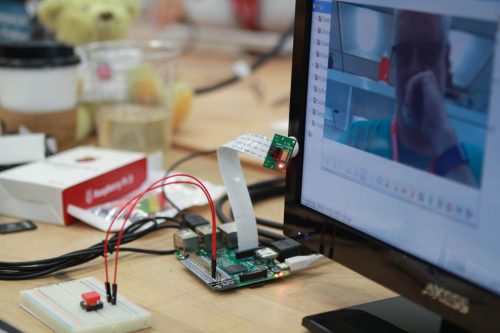
A Raspberry Pi and button attached to a computer display

Outside of formal education, events such as Raspberry JamsCoderDojosCAS Hubs, and hackathons are ideal venues for seeking and receiving support and advice.

Cross-curricular participation

The rise of the global maker movement, I think, is in response to abstract concepts and disciplines. Children are taught lots of concepts in isolation that aren’t always relevant to their lives or immediate environment. Digital making provides a unique and exciting way of bridging different subject areas, allowing for cross-curricular participation. I’m not suggesting that educators should throw away all their schemes of work and leave the full direction of the computing curriculum to students. However, there’s huge value in exposing learners to the possibilities for creativity in computing. Creative freedom and expression guide learning, better preparing young people for the workplace of tomorrow.

So…what do you want your button to do?

Hello World

Learn more about today’s subject, and read further articles regarding computer science in education, in Hello World magazine issue 1.

Read Hello World issue 1 for more…

UK-based educators can subscribe to Hello World to receive a hard copy delivered for free to their doorstep, while the PDF is available for free to everyone via the Hello World website.

https://www.reuters.com/article/us-skype-china/microsofts-skype-pulled-from-apple-android-china-app-stores-idUSKBN1DL1IG

Microsoft’s Skype pulled from Apple, Android China app stores

 BEIJING (Reuters) – Skype, Microsoft Corp’s (MSFT.O) internet phone call and messaging service, has disappeared from app stores in China including that of Apple Inc (AAPL.O), indicating the latest setback for a foreign tech service in the country.

FILE PHOTO: A web camera is seen in front of a Skype logo in this photo illustration May 26, 2015. REUTERS/Dado Ruvic/File Photo

Apple, responding to questions about Skype’s absence, late on Tuesday said it had removed several internet phone call apps from its App Store in China after the country’s government said they violated local laws.

“We have been notified by the Ministry of Public Security that a number of voice over internet protocol apps do not comply with local law, therefore these apps have been removed from the App Store in China,” an Apple spokeswoman told Reuters.

“These apps remain available in all other markets where they do business.”

The Cyberspace Administration of China, which oversees censored technology, did not immediately respond to a Reuters request for comment.

According to Reuters checks on Wednesday morning, Skype was not available in app stores in China overseen by Apple, Tencent Holdings Ltd 00700.HK and Qihoo 360 Technology Co Ltd QIHUy.SG. Alphabet Inc’s (GOOGL.O) Google Play app store is not available in China.

Microsoft, Tencent and Qihoo 360 did not immediately respond to requests for comment.

China has increased scrutiny of internet applications this year, ordering firms to remove hundreds of apps that allow users to communicate confidentially or get around China’s so-called Great Firewall system of censorship and use overseas social media.

Cyber authorities have also periodically interrupted services, such as Facebook Inc’s (FB.O) encrypted messenger app Whatsapp over the last two months.

The authorities said such actions are designed to protect personal privacy and prevent online terrorist activity. Foreign tech lobbies and businesses operating in China have said internet rules are too strict and could hit their local operations.

The actions are linked to real name authentication laws brought in earlier this year, requiring all network providers to verify the real names of users with state-issued IDs or passports.

Separate data regulations also require companies to store user information within China, and make it accessible to authorities for surveillance purposes.

Some foreign firms, including Amazon Inc (AMZN.O) and Apple have this year handed of parts of their business to local affiliates, often citing compliance with the new cybersecurity laws.

Unlike similar services that are blocked, including Facebook, Google and Twitter Inc (TWTR.N), Skype’s services are still available for those who already have the app installed.

Chinese netizens on Tuesday evening took to Weibo to discuss Skype’s disappearance, which many criticized for being overly restrictive, despite the existence of local alternatives.

Reporting by Laharee Chatterjee in BENGALURU and Cate Cadell in BEIJING; Editing by Adam Jourdan and Christopher Cushing

Our Standards:The Thomson Reuters Trust Principles.

http://www.ibtimes.co.uk/magnetic-brain-stimulation-technique-can-control-your-taste-music-1648301

Magnetic brain stimulation technique can control your taste in music

The findings could have important implications for understanding certain neurological disorders.

brain neurons neuroscience
Artistic representation of brain neurons. Istock

It is possible to increase or decrease our enjoyment of music, and our craving for more of it, through brain stimulation techniques that disrupt or enhance certain neurological circuits, according to a new study.

Previous research has shown that when you listen to your favourite songs, neurological networks involved in anticipating rewards and surprise become engaged. These are known as the fronto-striatal circuits.

However, until now nobody had ever tested whether these circuits are essential to musical reward, or if they can be manipulated, causing changes in how we experience musical pleasure.

For the study, published in the journal Nature Human Behaviour, researchers from the Montreal Neurological Institute and Hospital of McGill University used a non-invasive brain stimulation technique on participants known as transcranial magnetic stimulation (TMS).

The technique employs magnetic pulses to either stimulate or inhibit selected parts of the brain. The team applied TMS to a region that modulates the fronto-striatal circuits, leading to the release of dopamine – an important chemical that plays a key role in the brain’s reward system. Most types of reward increase levels of dopamine in the brain, resulting in a pleasurable feeling.

Participants received different kinds of brain simulation and subsequently had to listen to some of their own favourite music, as well as songs chosen by the researchers, while their psychophysiological responses were measure. They were also asked to rate their enjoyment of the music in real time and were offered the opportunity to buy the music selected by the researchers using real money, in order to measure their motivation to listen to it again.

https://techcrunch.com/2017/11/21/apple-acquires-mixed-reality-headset-startup-vrvana-for-30m/

Apple acquired augmented reality headset startup Vrvana for $30M

As Apple reportedly ramps up work to ship an augmented reality headset in 2020, it has acquired a startup from Montreal, Canada that could help it get there. TechCrunch has learned that Apple has acquired Vrvana, maker of the Totem headset — which had rave reviews but never shipped. The deal was for around $30 million, two sources tell TechCrunch.

We contacted Apple, and the company declined to comment, but also did not deny the story. Vrvana did not reply to our request for comment. Sources close to the deal have confirmed the acquisition to us.

The deal is significant because while we have seen reports and rumors about Apple’s interest in AR hardware, the company has been very tight-lipped and generally is very secretive about completely new, future products. This acquisition is perhaps the clearest indicator yet of what the company is hoping to develop.

A number of the startup’s employees have joined Apple in California. The Vrvana site is currently still up, but it stopped updating social accounts and news in August of this year.

It’s not clear what of Vrvana’s existing products, product roadmap or current business — it worked with Valve, Tesla, Audi and others under NDA — will be making its way to Apple.

The only product that Vrvana shows off on its site is the unreleased Totem headset, an “extended reality” device utilizing key technologies from both AR and virtual reality to allow for both experiences on a single headset.

A screen grab from one of Vrvana’s promotional videos for the Totem.

The tethered device had a form factor similar to many of today’s VR headsets, but uniquely relied on several forward-facing pass-through cameras to replicate the outside world on its OLED displays inside the headset. The system of cameras enabled 6DoF tracking, a technology which allows the device to track its position in 3D space, while also using infrared cameras to track a user’s hands.

Vrvana’s camera-based AR approach differs from competitors like Microsoft, which is utilizing transparent, projection-based displays for its HoloLens headset. The Totem holds a number of advantages over these systems, most notably in that it is able to overlay fully opaque, true-color animations on top of the real world rather than the ghost-like projections of other headsets which critically cannot display the color black. This allows the headset to do what it calls “seamless blend” transitions between VR and AR environments.

A key disadvantage in these types of systems, aside from bulky aesthetics, is that there is often noticeable lag between the cameras capturing the outside world and how quickly it is displayed in-headset. Vrvana CEO Bertrand Nepveu detailed this problem in a talk this summer where he shared that the startup had working prototypes that brought this latency down to 3 milliseconds.

An animation showcasing how the Totem smoothly transitions between AR and VR modes.

There are consumer applications for this kind of “extended reality” technology — for example, in games and other entertainment — but one key focus for Vrvana was enterprise usage.

“Totem’s hand tracking and inside-out positional tracking empowers your workforce to manipulate virtual objects with their hands wherever they please,” the company said in promotional materials on the headset.

This is notable considering Apple’s focus — both on its own and in partnership with other IT providers like IBM, Cisco and SAP — to court different enterprise verticals. In August, CEO Tim Cook singled out enterprise as one key focus for its AR ambitions, and in its last earnings the company reported double-digit growth in the area. The company last broke out its enterprise sales back in 2015, when Cook described it as a $25 billion business.

But scaling remains one of the hardest things for startups — especially hardware startups — to do, and this is even more the case for startups working in emerging technologies that have yet to break into the mainstream.

Founded back in 2005, Vrvana had not disclosed much of its funding. A source tells TechCrunch the company raised less than $2 million, a modest figure in the world of hardware. Investors according to PitchBook included Real Ventures (whose partner Jean-Sebastian Cournoyer is also involved with Element.ai, an ambitious AI startup and incubator in Montreal), the Canadian Technology Accelerator, and angel Richard Adler, who is also active in other VR startups.

Up to now, Apple has been fairly critical of the state of VR and AR hardware in the market today, and it has downplayed its own hand in the game.

“Today I can tell you the technology itself doesn’t exist to do that in a quality way. The display technology required, as well as putting enough stuff around your face – there’s huge challenges with that,” Cook told The Independent in answer to a question about whether it was building a headset. “The field of view, the quality of the display itself, it’s not there yet…We don’t give a rat’s about being first, we want to be the best, and give people a great experience. But now anything you would see on the market any time soon would not be something any of us would be satisfied with. Nor do I think the vast majority of people would be satisfied.”

That’s not to say that Apple has not been enthusiastic about the augmented reality space. But to date, this interest has largely manifested itself through software — specifically the company’s iOS-based ARKit SDK — and the increasingly sophisticated camera arrays on the iPhone rather than through a dedicated device, although there have been plenty of Apple patents that also potentially point to one.

Apple also has made other acquisitions that underscore its interest in developing the technology that powers the hardware. In June, Apple acquired SMI, an eye-tracking firm that was working on solutions for VR and AR headsets. Other AR and VR-related acquisitions have included Flyby MediametaioEmotient, and Faceshift.

https://www.insidehighered.com/news/2017/11/02/ed-tech-companies-gather-more-data-they-struggle-find-its-best-uses?utm_source=Inside+Higher+Ed&utm_campaign=56f9af41cb-DNU20171102&utm_medium=email&utm_term=0_1fcbc04421-56f9af41cb-199681393&mc_cid=56f9af41cb&mc_eid=e572da52ee

A Data Paradox

PHILADELPHIA — Tech companies are collecting an enormous amount of data from universities and colleges, but even big players like Microsoft seem unsure how best to harness the potential of this data, said speakers at a session here of the annual meeting of Educause.

During the “Artificial Intelligence and Machine Learning: The “Art of the Possible””session, a Microsoft representative demonstrated new developments in the Delve application that could help boost student and faculty productivity. By showing users information about their individual work performance, such as how quickly they respond to emails or spend writing papers, the app can track work habits and prompt users to work more effectively.

But the real potential of this application doesn’t lie with in this individual data, but in data about groups. Potentially, institutions could use algorithms to analyze the data and identify students who might be struggling and help them – a good thing. But institutions could also use the data to pinpoint faculty members who never respond to their emails, or don’t seem to be doing any writing – an altogether more sinister prospect to professors(particularly for the untenured). Given this quandary, the question of what to do next is one that Microsoft hasn’t yet answered, the session heard.

Concerns about data privacy were a running theme in the Educause session, which highlighted current and forthcoming AI and machine learning initiatives at companies such as McGraw-Hill Education, Box and Canvas. While AI and machine learning were touted as the bridge that will enable higher education to do meaningful things with all the teaching and learning data that is being collected, the importance of developing these technologies in a mindful and deliberate way was stressed by all the speakers, particularly as institutions have a legal responsibility to protect student data under the Family Educational Rights and Privacy Act.

Andrew Keating, the managing director of higher education at information management and storage company Box, described how his company worked with hundreds of universities to store and share their digital files. The company is working with partners to introduce AI-enabled features such as automatic transcription of video files, but also encourages colleges universities to develop their own custom tools. While the technology that academics develop is certainly useful to the company in terms of realizing the potential to of the data available, Keating said that the company was not profiting from these ideas financially, and did not mine colleges and universities’ data.

Masha Chase, senior product manager at Instructure, which created learning management system Canvas, said that in addition to safeguarding data privacy, institutions and technology companies need to think carefully about the potential of AI and machine learning to enable students to avoid being self-sufficient. “There is a danger we could lose that,” warned Chase. Among recent innovations at Canvas is a partnership with Amazon Alexa, which enables students and faculty to ask an Alexa device questions such as, “When is my next paper due?” or “How many papers do I have to grade?”

https://www.straight.com/life/997701/ubc-survey-seeks-lgbt-respondents-mental-health-research-help-address-depression-and

UBC survey seeks LGBT respondents for mental-health research to help address depression and suicide

While LGBT people are at heightened risk for mental-health issues compared to heterosexual counterparts, there has been a historical lack of data and LGBT–specific services in this area of concern.

The Still Here Project, which is part of the Men’s Health Research program at the UBC School of Nursing, is a visual art and research initiative designed to shatter taboos around and address neglected or overlooked areas of queer mental health, including depression and suicide.

According to a study led by UBC researcher and Still Here Project director Olivier Ferlatte published in the Journal of Homosexuality in September, suicide attempts reported by gay and bisexual respondents were four times more than the rate for Canadian men.

The study cited previous analyses that estimated that gay and bisexual men are two to five times more likely to attempt suicide than straight men. In fact, a previous study identified suicide among MSM as a public health crisis on par with the HIV/AIDS death toll and yet it has received disproportionately less attention from researchers.

Furthermore, the study found that lower incomes and the lack of a university degree increased the odds of suicide attempts. For instance, men without a university degree were five times more likely to have attempted suicide.

Interestingly, the study also discovered that bisexual men who had a female partner experienced protective effects against suicide than those in a same-sex relationship. The study hypothesizes that the increased risk for suicide among men with male partners may be due to them experiencing more stressors and discrimination related to being recognized as part of a visible minority.

Indigenous men were found to have twice the rate of suicide attempts as Caucasian men, which the researchers attributed to the ongoing impact of colonization, including homophobia introduced or influenced by European colonists.

MRKORNFLAKES/GETTY IMAGES

To help address the lack of research in this area, the Still Here Project launched the national Still Here Survey—Sondage Toujours là to gather information from queer Canadians about their experiences.

Any Canadians who are 17 years of age or older and who identify as lesbian, gay, bisexual, transgender, two-spirit, or queer are able to participate. Every participant will be entered into a draw to win a $300 giftcard to Amazon.

The results of the survey will be used to advocate for more mental-health services for LGBT people in Canada.

To participate in the survey, which takes approximately 25 minutes to complete, visit the Still Here Survey—Sondage Toujours là  website. The survey will close on January 31. Preliminary results will available at the Still Here website next summer.

If you or someone you know is experiencing depressive or suicidal thoughts, some options for resources include talking to a healthcare professional, such as a doctor, psychologist, or counsellor. If in crisis, contact 911 or go to a hospital immediately. 

The Crisis Intervention and Suicide Prevention Centre of B.C. offers 24-hour phone and online distress services (as well as community education). The Crisis Line Association of B.C. (1-800-784-2433) provides 24-hour service for individuals across the province.

For LGBT–specific services, options include contacting Health Initiative for Men or Qmunity, particularly for issues related to sexual or gender identity.

Kids Help Phone (1-800-668-6868) is a national service for children and teenagers. 

http://www.sleepreviewmag.com/2017/11/movement-guidelines-quantify-recommendations-sleeping-moving-sitting-kids-ages-4/

Movement Guidelines Quantify Recommendations for Sleeping, Moving, and Sitting for Kids Ages 4 and Under

movementguidelines

Canadian kids aged 4 and under are spending too much time in front of screens. For example, although it’s recommended that preschoolers have no more than 1 hour of sedentary screen time per day, 76% of them do.Today’s release of the new evidence-based Canadian 24-Hour Movement Guidelines for the Early Years helps inform how much moving, sleeping and sitting children aged 4 and under need for healthy growth and development.

The Canadian 24-Hour Movement Guidelines for the Early Years combine physical activity and sedentary behavior guidelines into one, and include sleep, showing the interrelationship between all three behaviors. These Guidelines were developed by the Canadian Society for Exercise Physiology (CSEP), the Healthy Active Living and Obesity Research Group (HALO) at the CHEO Research Institute, the Faculty of Physical Education and Recreation at the University of Alberta, the Public Health Agency of Canada, ParticipACTION, and a group of researchers from Canada and around the world, with input from over 600 national and international stakeholders.

“All types of movement matter, and a balance of moving, sleeping, and sitting is required for optimal health,” says Mark Tremblay, PhD, MSc, director of HALO, in a release. “Even if a child is getting sufficient physical activity in a day, the health benefits can be reduced by too little sleep, or too much sedentary behavior, especially if that time is spent in front of screens. Following these guidelines through the early years is associated with healthy growth, better learning and thinking, improved motor development, higher fitness level, increased quality of life, and reduced injuries.”

Only 13% of preschoolers meet the new Canadian 24-Hour Movement Guidelines, and the time being spent in front of screens is keeping this percentage unacceptably low. Although not all sedentary time is harmful—like reading or storytelling with a caregiver—excessive screen time before age 5 is, as it is linked with language delays, reduced attention, and lower school readiness.

“Parents and caregivers must help young children move, sleep and sit the right amounts,” says Elio Antunes, president and CEO of ParticipACTION. “If kids are too tired to get enough physical activity during the day, and not active enough to be tired at night, it can become a vicious cycle. We need to limit screen time and encourage children to participate in a range of enjoyable and safe play-based and organized physical activities in a variety of spaces, places and seasons, in all types of weather.”

According to the new guidelines, a healthy 24 hours includes:

For infants (under 1 year old):

MOVE: Being physically active several times in a variety of ways, particularly through interactive floor-based play, but more is better. For those not yet mobile, this includes at least 30 minutes of tummy time spread throughout the day while awake.

SLEEP: 14-17 hours (for those aged 0-3 months) or 12-16 hours (for those aged 4-11 months) of good-quality sleep, including naps.

SIT: Not being restrained for more than one hour at a time (eg, in a high chair). When sedentary, engaging in pursuits such as reading and storytelling with a caregiver is encouraged. Screen time is not recommended.

For toddlers (1-2 years old) and preschoolers (3-4 years old):

MOVE: At least 180 minutes spent in a variety of physical activities at any intensity spread throughout the day, but more is better. Include energetic play for both age groups, with preschoolers getting at least 60 minutes of it.

SLEEP: 11-14 hours of good-quality sleep for toddlers, and 10-13 for preschoolers, which may include naps, with consistent bedtimes and wake-up times.

SIT: Not being restrained for more than one hour at a time (eg, in a stroller) or sitting for extended periods. When sedentary, engaging in pursuits such as reading and storytelling with a caregiver is encouraged. Sedentary screen time for those younger than two years old is not recommended, and no more than one hour for those aged 2-4, but less is better.

“For young children to be their healthiest, they need the right amount of sleep and physical activity during their day,” says the Honourable Ginette Petitpas Taylor, minister of health. “Healthy habits in childhood lead to good health throughout life. These new Canadian 24-Hour Movement Guidelines for the Early Years are an important tool to help parents and healthcare professionals support healthy growth and development for Canadian children.”

Here are some tips to help parents and caregivers get the most out of the 24-Hour Movement Guidelines:

  • For infants, supervised activities could include tummy time, reaching and grasping, pushing and pulling, and crawling
  • For toddlers, energetic play could include running or dancing, playing outside, and exploring the environment
  • The older children get, the more energetic play they need, such as hopping, jumping, skipping, swimming, and bike riding
  • For quiet activities, try storytelling, crafts, puzzles or reading, not screens. Even if shows are educational, kids don’t take in information from screens the same way as they do when interacting with a caring adult
  • Develop healthy “sleep hygiene” by having a calming bedtime routine, consistent bedtimes and wake-up times, even on weekends and avoid screen time before sleep

“Restoring physical activity as the norm rather than the exception supports an integrated approach to healthy living and chronic disease prevention,” says chief public health officer, Theresa Tam, BMBS (UK), FRCPC. “Our work with CSEP, ParticipACTION and other partners, including the development of these Guidelines, continues to make Canada a leader in healthy living.”

https://www.digitaltrends.com/web/firefox-reverts-google-ends-yahoo-deal/

Firefox reverts to Google search engine, ending deal with Yahoo

Last week, Mozilla unleashed Firefox Quantum, a new version of its popular web browser that makes all manner of improvements to the experience. One particularly interesting tweak is the fact that its stock search engine is now Google, rather than Yahoo.

In November 2014, Mozilla inked a deal with Yahoo that would see the company’s search services integrated into the Firefox browser. The deal was set to be in place for five years, but the developer decided to cut it short in order to deliver a better product to its users.

“We exercised our contractual right to terminate our agreement with Yahoo! based on a number of factors including doing what’s best for our brand, our effort to provide quality web search, and the broader content experience for our users,” said Mozilla’s chief business and legal officer, Denelle Dixon, according to a report from 9to5Google. “We believe there are opportunities to work with Oath and Verizon outside of search.”

There’s big money to be made in offering a search engine the chance to serve as the default option for a particular piece of software or hardware. For instance, Google has recently expanded its relationship with Apple to include Siri and Spotlight search results – and the search giant was already paying as much as $3 billion per year to ensure that it was the default for iOS, according to a report from CNBC.

It would seem that Mozilla would stand to lose out on a significant amount of money by backing out of its arrangement with Yahoo. However, there’s a clause in the contract that provides that Mozilla is entitled to annual payments of up to $375 million through 2019 if it didn’t want to work with any company that purchased Yahoo – even if another search deal was put in place – as per reporting from Recode.

Search engines are the primary discovery tool for many internet users, and that makes them hugely important when it comes to online advertising. Having a large audience makes it easier to sell ad space at a premium, which should explain why companies are ready to shell out millions upon millions to work with the likes of Mozilla and Apple.