http://www.cityam.com/278579/rollable-tvs-mind-reading-hats-some-best-and-weirdest-new

From rollable TVs to mind-reading hats, here are some of the best (and weirdest) new gadgets from CES 2018

TOPSHOT-US-LIFESTYLE-IT-CES

Source: Getty

Televisions

If there’s one constant in this world, it’s that everybody wants a bigger television. All human endeavour, the cumulative effort of generations, is geared towards inventing ever larger screens capable of displaying more pixels at higher resolutions and in new, never before seen colours, so that Fiona Bruce looks as good as can be.

This year’s CES is dominated by extremely massive and microscopically thin televisions. The biggest is a prototype belonging to Samsung simply called The Wall. Intended for commercial spaces, it’s a 146-inch display that foregoes traditional OLED technology in favour of new panel tech called MicroLED. Being modular, you can snap a few of them together to replace an entire wall of your living room with raw, unfettered television. Samsung also announced its first commercial 8K television, though at just 84-inches the Q9S QLED TV is positively dinky by comparison.


The LG rollable television, mid-roll. It lives in a long box like tinfoil.

Taking a different approach, LG revealed a 65-inch OLED TV that rolls up like a giant newspaper, storing itself inside a narrow sideboard and freeing up your wall for playing squash, or whatever else you might be tempted to do with a intermittently empty piece of wall. Like 90 per cent of new tech announced this year, the unfurlable display is compatible with Google and Alexa voice assistants.

Speaking of empty walls, stick Sony’s new short-throw projector underneath one (it’s discreetly shaped like a coffee table) and you can enjoy a 120-inch 4K display, projected from a lens that sits just 9.6-inches out from the wall. So no more shadow puppets during dramatic scenes. The snappily named LSPX-A1 will cost just $30,000.


Project Linda. It sounds like a classified mission to assassinate your mum’s friend, but it’s actually a laptop

Phones

With Mobile World Congress taking place at the end of February, it’s rare to see many new, big ticket phones announced at CES. That said, some mid-range tiddlers have sneaked out, like Sony’s Xperia XA2 and Samsung’s Galaxy A8. The absence of any word of Samsung’s flagshipGalaxy S9 all but confirms we’ll see it revealed at MWC.

Chinese manufacturer Vivo showed off the first in-screen fingerprint scanner however, a development likely to find its way to premium smartphones this year or next. And Razer’s delightfully named Project Linda is a concept that plans to turn your Razer phone into a fully featured laptop, by letting you dock the handset into a slot where the touchpad would normally be. That it sounds like it’s been named after your mum’s friend next door is simply a nice bonus.


A Big Format Gaming Display, or BFGD. The acronym is a gaming reference, in which the F stands for something else entirely

Gaming

Razer’s known for high-end gaming hardware, including changing coloured desk lights that dynamically react to in-game scenes displayed on-screen. At CES the company showcased a new integration with Philips Hue, the smart light bulb folks, to extend this ambient lighting setup to encompass entire rooms. So now, if you get your arm blown off by a grenade in Call of Duty, your IKEA standing lamps might start flashing a helpful shade of red. Truly, the onward march of progress is unstoppable.

Graphics chip manufacturer Nvidia revealed a new line of supersized gaming monitors, which it’s calling Big Format Gaming Displays. Unlike televisions, these specialised displays are fine-tuned to play nice with gaming PCs, with processor-synced 120hz refresh rates ensuring no lag or screen tearing artifacts. Nvidia’s partnering with manufacturers to bring the BFGDs to market, at least one of which will be a stonking 65-inch behemoth.


A Foldimate, but why?

Smart home

There are now no fewer than two laundry folding robots on the horizon. Laundroid and Foldimate are both about the size of a big fridge. The former appears to be the more competent of the two, and uses advanced machine learning algorithms to detect which way up a blouse goes. Its robotic arms can pluck your mucky grundies from a hamper and then carefully fold your particulars, taking just 5-10 minutes per item of clothing.

Foldimate is cheaper and requires some initial assistance, as you must peg your clothes up individually inside the laundry folding compartment by hand, like a caveman.

This year’s version of Samsung’s smart fridge, still called the Family Hub, adds new features. As well as being able to view a live camera feed of your sliced ham from almost anywhere on the planet, the world’s most pointlessly advanced fridge now boasts premium speakers alongside its touchscreen display, meaning you can watch entire movies while standing next to your freezer.


The superb HD 820s cost more than some cars

Audio

Renowned for its exceptionally decent headphones, Sennheiser is for the first time turning its attention to home speakers with a prototype, tricked-out 13-driver soundbar. The audio experts at the Sennheiser labs reckon they can even simulate a few additional phantom speakers behind the listener by bouncing soundwaves around the room in just the right way.

And to ensure nobody forgets what Sennheiser is really good at, the company’s also launched an audiophile-pleasing pair of quality, closed-back headphones. The HD 820 are a pricey set of a flagship cans, costing not a penny less than €2,400.


Nissan’s Brain-to-Vehicle interface in action. There’s no accounting for taste

And the weird stuff…

Of course, it wouldn’t be CES without a relentless cavalcade of strange and obscure new technology destined for tomorrow’s landfill.

There’s the clinically dubious Modius headset, which boldly claims to trigger weight loss by blasting your brain with electrical signals. Sony has resurrected Aibo, the loveable electric dog who’s been living in a cardboard box in your attic for 20 years, and will be again soon.

The usually sensible Philips has designed a kind of electronic nappy you wrap around your head to help you sleep better. And Nissan is trialling a new magic driving hat that they say will improve your reaction times in a an emergency. Tomorrow’s world is here again, and it looks as silly as ever.

https://gizmodo.com/the-vuzix-blade-is-what-google-glass-always-wanted-to-b-1821964545

The Vuzix Blade Is What Google Glass Always Wanted to Be

When Google Glass was announced back in 2013, it was easy to forgive one of the the first AR headsets for looking awkward and being hard to use. There’s no doubt Google’s first crack at making an optical head-mounted display was ahead of its time.

The thing that always rubbed me the wrong way about Google Glass though, was how after an underwhelming debut, the company seemingly forgot about its moonshot tech. The only thing that remains of the project are enterprise-only models focused more on assisting business complete specialized tasks than expanding the tech as a whole.

They are a bit thick, but at least they don’t look like alien tech.

It’s a shame because if Google had continued to develop the Glass, we might not have had to wait as long for something like the Vuzix Blade. Sporting a tiny DLP projector that spits images onto its full color see-through display, the Blade’s uses waveguide optics to project a tiny display onto the right lens of some surprisingly normal-looking glasses.

In addition to the Blade’s innovative display, it also has everything it needs to function as a standalone wearable, complete with a built-in CPU running a customized version of Android, 8-MP camera, 4GB of storage and a microSD card slot, wi-fi, and a mic and touchpad for controlling the device.

Of course, the Blade isn’t just the second coming of the Google Glass, as Vuzix has learned important things about what you have to do to make the concept of smart glasses easier to accept. When I visited Vuzix’s booth at CEs 2018, a representative told me that unlike Google Glass, Vuzix went out of its way to make the Blades comfortable, easy to use and most importantly, something that didn’t look ridiculously clunky or awkward—so as to not scare off the general public.

This is the best shot of what it looks like to wear the Vuzix Blade.

On that front, I think Vuzix has succeeded. From 10-feet away, the Blades don’t look too much different from a standard pair of glasses, though the tint on the lenses hints that these are more than a pair of knock-off Oakleys. It’s only when you get up close that you notice the light being sent out from one corner of the glass, and all that extra thickness on the sides and bridge of its frame

The built-in camera lets you capture POV images and video.

Controlling it is a cinch too. A two-finger swipe on the touchpad built into the right side of the glasses takes you to the home screen, while a one finger swipe advances you through UI, with a single-tap used for making selections.

From there, you can pair the Blade with your phone, which makes it easy to check your messages, view directions or even take first-person photos or videos, using either the touchpad or voice commands. But that’s not all, because in addition to Vuzix’s homemade smartphone companion app, the Blade also sports built-in Alexa integration. So if you want to ask about the weather without pulling out your phone? No problem. How about controlling smart home devices like lights or your thermostat? That’s easy too.

As a trial demo for smart glasses that people might actually want to own someday, Vuzix has finally delivered on what Google Glass showed off almost five years ago. And to be clear, this is all coming from a device that’s still very much in development. Vuzix is selling some dev kits now, for around $1,800, but the company is hoping to bring the price down to around $1,000 before they become more widely available in late 2018 and early next year.

Yes, $1,000 is still bonkers for this kind of tech. But making smart glasses more approachable is incredibly important if gadgets like this ever hope to catch on.

https://unews.utah.edu/surprise-a-virus-like-protein-is-important-for-cognition-and-memory/


A protein involved in cognition and storing long-term memories looks and acts like a protein from viruses. The protein, called Arc, has properties similar to those that viruses use for infecting host cells, and originated from a chance evolutionary event that occurred hundreds of millions of years ago.

The prospect that virus-like proteins could be the basis for a novel form of cell-to-cell communication in the brain could change our understanding of how memories are made, according to Jason Shepherd, a neuroscientist at University of Utah Health and senior author of the study publishing in the journal Cell on Jan. 11.

PHOTO CREDIT: Charlie Ehlert

Jason Shepherd, Rachel Kearns, and Elissa Pastuzyn, from the Department of Neurobiology and Anatomy, University of Utah Health

Download Full-Res Image

Shepherd first suspected that something was different about Arc when his colleagues captured an image of the protein showing that Arc was assembling into large structures. With a shape that resembles a capsule from a lunar lander, these structures looked a lot like the retrovirus, HIV.

“At the time, we didn’t know much about the molecular function or evolutionary history of Arc,” says Shepherd who has researched the protein for 15 years. “I had almost lost interest in the protein, to be honest. After seeing the capsids, we knew we were onto something interesting.”

The gap in research was not for want of an interesting subject. Prior work had shown that mice lacking Arc forgot things they had learned a mere 24 hours earlier. Further, their brains lacked plasticity. There is a window of time early in life when the brain is like a sponge, easily soaking up new knowledge and skills. Without Arc, the window never opens.

Scientists had never considered that mechanisms responsible for acquiring knowledge could stem from foreign origins. Now, the work by Shepherd and his team has raised this intriguing possibility.

Everything Old is New Again

Seeing Arc’s unusual propensity to form virus-like structures prompted Shepherd to scrutinize the protein sequence with a new set of eyes. He found that regions of the code were similar to that from viral capsids. An essential tool for viral infection, capsids carry virus’ genetic information and deliver it from cell to cell in its victim.

Given that Arc looks like a viral protein, Shepherd and his colleagues designed a set of experiments to test whether it also acts like one. They first determined that several copies of Arc self-assemble into hollow virus-like capsids and stash its own genetic material, in this case mRNA, inside them. When the scientists added the capsids to mouse brain cells, or neurons, growing in a dish, Arc transferred its genetic cargo into the cells.

After viruses invade host cells, they emerge ready to infect once again. It appears that Arc works in a similar way. The scientists gathered Arc that had been released from mouse neurons and determined that the proteins and their cargo could be taken up by another set of neurons. Unlike for viruses, activating neurons mobilizes Arc, triggering the release of capsids.

PHOTO CREDIT: Chris Manfre

A protein important for cognition and memory named Arc can encapsulate genetic material (polyhedron enveloping the ribbon-like strands) and deliver it to brain cells in a manner similar to the way in which viruses infect host cells.

Download Full-Res Image

“We went into this line of research knowing that Arc was special in many ways, but when we discovered that Arc was able to mediate cell-to-cell transport of RNA, we were floored,” says the study’s lead author, postdoctoral fellow Elissa Pastuzyn. “No other non-viral protein that we know of acts in this way.”

When Lightning Strikes Twice

The story of Arc’s origin is relayed through the genomes of animals throughout evolutionary time. 350-400 million years ago, a chance occurrence struck four-limbed creatures that roamed the earth. An ancestor to retroviruses, called retrotransposons, inserted its genetic material into the animals’ DNA. The event led to the mammalian Arc that we know today.

The significance of such an event is hinted at by the fact that it happened more than once. An accompanying paper in the same issue of Cell shows that a version of Arc found in flies also looks and acts like a viral capsid. Vivian Budnik’s lab at the University of Massachusetts shows that fly Arc transports RNA from neurons to muscles to control movement. Even though mammalian and fly Arc evolved from the same class of retrotransposons, the event in flies occurred about 150 million years later.

“As an evolutionary biologist this is what is the most exciting to me,” says co-author Cédric Feschotte, a professor at Cornell University. “The fact that it happened at least twice makes us think that it happened even more.”

Shepherd believes this could mean that it is advantageous to have this viral-inspired system in place, and it may represent a novel form of intercellular communication. This hypothesis remains to be tested in mammals. “Knowing what cargo Arc vesicles transport in living animals will be critical to understanding the function of this pathway,” he says.

Remember the unusual viral-like protein that you just learned about? It could be controlling your memory. Watch this video to learn more:


###

The research was supported by the National Institutes of Health and will be published as “The Neuronal Gene Arc Encodes a Repurposed Retrotransposon Gag Protein that Mediates Intercellular mRNA Transfer” online in Cell.

In addition to Shepherd, Pastuzyn, and Feschotte, co-authors are Cameron Day, Rachel Kearns, Madeleine Kyrke-Smith, Andrew Taibi, John McCormick, Nathan Yoder, and David Belnap from the University of Utah, and Simon Erlendsson, Dustin Morado, and John Briggs from the MRC Lab of Molecular Biology at the University of Cambridge.

http://www.kurzweilai.net/how-to-grow-functioning-human-muscles-from-stem-cells

How to grow functioning human muscles from stem cells

… and microscale robot exoskeleton muscles from graphene and glass
January 10, 2018

A cross section of a muscle fiber grown from induced pluripotent stem cells, showing muscle cells (green), cell nuclei (blue), and the surrounding support matrix for the cells (credit: Duke University)

Biomedical engineers at Duke University have grown the first functioning human skeletal muscle from human induced pluripotent stem cells (iPSCs). (Pluripotent stem cells are important in regenerative medicine because they can generate any type of cell in the body and can propagate indefinitely; the induced version can be generated from adult cells instead of embryos.)

The engineers say the new technique is promising for cellular therapies, drug discovery, and studying rare diseases. “When a child’s muscles are already withering away from something like Duchenne muscular dystrophy, it would not be ethical to take muscle samples from them and do further damage,” explained Nenad Bursac, professor of biomedical engineering at Duke University and senior author of an open-access paper on the research published Tuesday, January 9, in Nature Communications.


How to grow a muscle

In the study, the researchers started with human induced pluripotent stem cells. These are cells taken from adult non-muscle tissues, such as skin or blood, and reprogrammed to revert to a primordial state. The pluripotent stem cells are then grown while being flooded with a molecule called Pax7 — which signals the cells to start becoming muscle.

After two to four weeks of 3-D culture, the resulting muscle cells form muscle fibers that contract and react to external stimuli such as electrical pulses and biochemical signals — mimicking neuronal inputs just like native muscle tissue. The researchers also implanted the newly grown muscle fibers into adult mice. The muscles survived and functions for at least three weeks, while progressively integrating into the native tissue through vascularization (growing blood vessels).

[+]

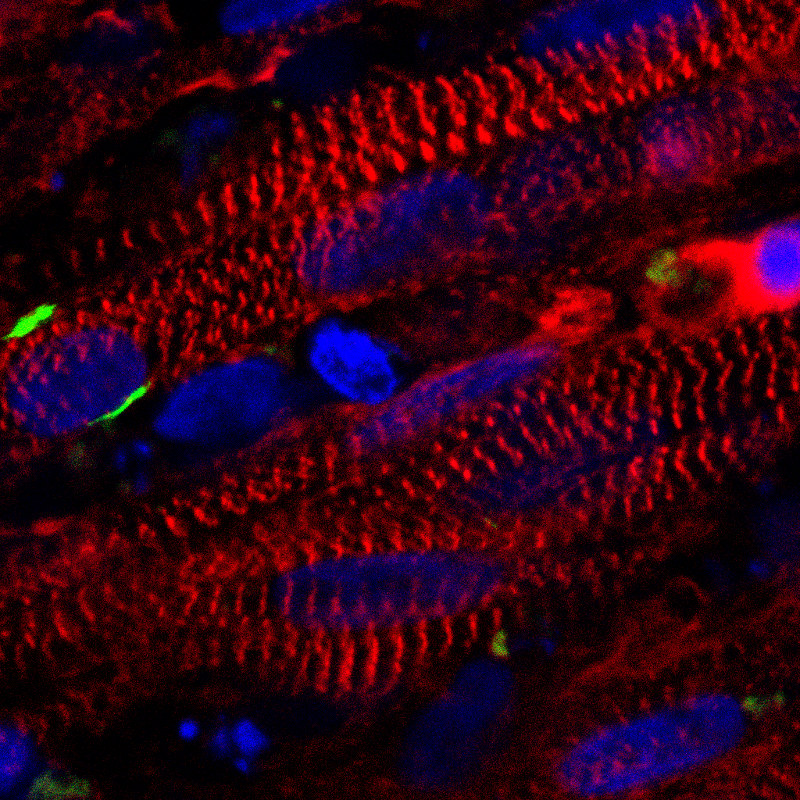
A stained cross section of the new muscle fibers, showing muscle cells (red), receptors for neuronal input (green), and cell nuclei (blue) (credit: Duke University)

Once the cells were well on their way to becoming muscle, the researchers stopped providing the Pax7 signaling molecule and started giving the cells the support and nourishment they needed to fully mature. (At this point in the research, the resulting muscle is not as strong as native muscle tissue, and also falls short of the muscle grown in a previous study*, which started from muscle biopsies.)

However, the pluripotent stem cell-derived muscle fibers develop reservoirs of “satellite-like cells” that are necessary for normal adult muscles to repair damage, while the muscle from the previous study had much fewer of these cells. The stem cell method is also capable of growing many more cells from a smaller starting batch than the previous biopsy method.

“With this technique, we can just take a small sample of non-muscle tissue, like skin or blood, revert the obtained cells to a pluripotent state, and eventually grow an endless amount of functioning muscle fibers to test,” said Bursac.

The researchers could also, in theory, fix genetic malfunctions in the induced pluripotent stem cells derived from a patient, he added. Then they could grow small patches of completely healthy muscle. This could not heal or replace an entire body’s worth of diseased muscle, but it could be used in tandem with more widely targeted genetic therapies or to heal more localized problems.


The researchers are now refining their technique to grow more robust muscles and beginning work to develop new models of rare muscle diseases. This work was supported by the National Institutes of Health.


Duke Engineering | Human Muscle Grown from Skin Cells

Muscles for future microscale robot exoskeletons

Meanwhile, physicists at Cornell University are exploring ways to create muscles for future microscale robot exoskeletons — rapidly changing their shape upon sensing chemical or thermal changes in their environment. The new designs are compatible with semiconductor manufacturing, making them useful for future microscale robotics.

The microscale robot exoskeleton muscles move using a motor called a bimorph. (A bimorph is an assembly of two materials — in this case, graphene and glass — that bends when driven by a stimulus like heat, a chemical reaction or an applied voltage.) The shape change happens because, in the case of heat, two materials with different thermal responses expand by different amounts over the same temperature change. The bimorph bends to relieve some of this strain, allowing one layer to stretch out longer than the other. By adding rigid flat panels that cannot be bent by bimorphs, the researchers localize bending to take place only in specific places, creating folds. With this concept, they are able to make a variety of folding structures ranging from tetrahedra (triangular pyramids) to cubes. The bimorphs also fold in response to chemical stimuli by driving large ions into the glass, causing it to expand. (credit: Marc Z. Miskin et al./PNAS)

Their work is outlined in a paper published Jan. 2 in Proceedings of the National Academy of Sciences.

* The advance builds on work published in 2015, when the Duke engineers grew the first functioning human muscle tissue from cells obtained from muscle biopsies. In that research, Bursac and his team started with small samples of human cells obtained from muscle biopsies, called “myoblasts,” that had already progressed beyond the stem cell stage but hadn’t yet become mature muscle fibers. The engineers grew these myoblasts by many folds and then put them into a supportive 3-D scaffolding filled with a nourishing gel that allowed them to form aligned and functioning human muscle fibers.


Abstract of Engineering human pluripotent stem cells into a functional skeletal muscle tissue

The generation of functional skeletal muscle tissues from human pluripotent stem cells (hPSCs) has not been reported. Here, we derive induced myogenic progenitor cells (iMPCs) via transient overexpression of Pax7 in paraxial mesoderm cells differentiated from hPSCs. In 2D culture, iMPCs readily differentiate into spontaneously contracting multinucleated myotubes and a pool of satellite-like cells endogenously expressing Pax7. Under optimized 3D culture conditions, iMPCs derived from multiple hPSC lines reproducibly form functional skeletal muscle tissues (iSKM bundles) containing aligned multi-nucleated myotubes that exhibit positive force–frequency relationship and robust calcium transients in response to electrical or acetylcholine stimulation. During 1-month culture, the iSKM bundles undergo increased structural and molecular maturation, hypertrophy, and force generation. When implanted into dorsal window chamber or hindlimb muscle in immunocompromised mice, the iSKM bundles survive, progressively vascularize, and maintain functionality. iSKM bundles hold promise as a microphysiological platform for human muscle disease modeling and drug development.


Abstract of Graphene-based bimorphs for micron-sized, autonomous origami machines

Origami-inspired fabrication presents an attractive platform for miniaturizing machines: thinner layers of folding material lead to smaller devices, provided that key functional aspects, such as conductivity, stiffness, and flexibility, are persevered. Here, we show origami fabrication at its ultimate limit by using 2D atomic membranes as a folding material. As a prototype, we bond graphene sheets to nanometer-thick layers of glass to make ultrathin bimorph actuators that bend to micrometer radii of curvature in response to small strain differentials. These strains are two orders of magnitude lower than the fracture threshold for the device, thus maintaining conductivity across the structure. By patterning 2-<mml:math><mml:mi>

https://news.ubc.ca/2018/01/10/sex-education-doesnt-reflect-real-life-realities-of-lesbian-and-bisexual-girls/

Lesbian couple

The study highlights the need for more inclusive sex ed, says UBC nursing professor Elizabeth Saewyc.

Sex education doesn’t reflect real-life realities of lesbian and bisexual girls

SCIENCE, HEALTH & TECHNOLOGY

Most lesbian and bisexual girls don’t know they can get sexually transmitted infections (STIs) from other girls, because sex education is mostly designed for their straight peers. This knowledge gap could be placing them at increased risk for getting STIs.

That’s one of the conclusions of a new study led by researchers at the Centre for Innovative Public Health Research, a non-profit research group based in California, conducted in collaboration with researchers at the University of British Columbia and the City University of New York.

Jennifer Wolowic

Previous UBC studies show that lesbian and bisexual girls face higher risks for teenage pregnancy than straight girls, says study co-author and UBC youth health researcher Jennifer Wolowic. In this new study, the researchers wanted to examine what lesbian and bisexual girls know about safe sex and their STI risks, especially when having sex with other girls.

“What surprised us was their overall lack of knowledge when it came to safe sex practices with female partners,” said Wolowic. “When we asked why, many told us they didn’t find their sex ed programs–if they even had one–to be very informative. And even when they asked questions, the focus on heterosexual sex made them feel uncomfortable.”

The researchers conducted online focus groups with 160 lesbian and bisexual teenage girls located across the U.S. They found that a lack of knowledge and concerns about loss of pleasure were two of the main reasons for their limited use of dental dams and other barriers.

“Participants told us, they ‘literally had never heard of dental dams,’ or thought STIs weren’t a concern when having sex with girls. Of those who knew about protective barriers, many said using protection made sex awkward or less pleasurable, and so they left them out during sex,” said Wolowic.

Many teens thought that getting tested for sexually transmitted infections was something important to do in relationships. At the same time, they thought they could trust a female partner to be “clean” to a greater extent than a male partner.

“Add to that a lack of information about where to get dental dams or how to make them, and it’s easy to understand why barrier use is so low among lesbian and bisexual girls,” says Michele Ybarra, the study’s principal investigator. “They need to know that there are sexy ways to use barriers, that they can make dental dams out of condoms if needed, and that they can get STIs having sex with other girls.”

This study also highlights the need for more inclusive sex ed, adds UBC nursing professor Elizabeth Saewyc, the paper’s senior author who leads the Stigma and Resilience Among Vulnerable Youth Centre at UBC.

“Young people need accurate sexual health information, but sex education has traditionally focused on heterosexual sex,” said Saewyc. “Our findings suggest we need to create more inclusive curriculum to help lesbian and bisexual girls have the knowledge they need to make healthy sexual decisions.”

The study, published recently in the Journal of Adolescent Health, was funded by the Office of Adolescent Health in the U.S. Department of Health and Human Services. Contact lou.bosshart@ubc.ca to obtain a copy or to schedule interviews with the authors.

http://www.techradar.com/news/you-and-ai-will-we-ever-become-friends-with-robots

You and AI: will we ever become friends with robots?

From Fry and Bender in Futurama, to Data and the crew of the USS Enterprise on Star Trek: The Next Generation, to deceptive Ava in Ex Machina, robot friends are a regular trope in science fiction. After all, is the idea of being pals with a mechanoid any weirder than Captain Kirk’s intergalactic romantic life?

But… could this ever happen? Could we one day be going for a drink with our robotic pals? Or are the machines destined to remain our slaves?

Talking the talk

The first challenge when it comes to forming friendships is talking and exhibiting intelligent behaviour. This question goes back to one of the earliest challenges in computer science. In 1950, computing pioneer Alan Turing famously laid down the benchmark for this with what became known as the Turing Test. The test is essentially quite simple: Can a machine successfully trick someone into thinking that they are talking to a human?

Since then, there is still yet to be a definitive example of an AI passing the test – though there have been numerous claims. For example, in 2014 it was claimedthat a piece of AI software called Eugene Goostman had achieved the milestone. But this has also been disputed because, for example, the creators of Eugene said that their AI was simulating a 13 year old Ukrainian boy, which critics argue is an attempt to explain poor English and comprehension. In their view it was essentially a bit of a cheat.

So when can we expect an AI to pass the test? Futurist Ray Kurzweil, who is currently working for Google on a number of technologies linked to AI, such as natural language programming, reckons computers might finally match up to humans in 2029.

Walking the walk

Perhaps though, simply talking to a machine isn’t really friendship, is it? When we think of friendship we think of people hanging out together, going for drinks and long walks on the beach. So can robots ever manage that?

The company that has probably come closest is Hanson Robotics, which is on a quest not just to build intelligent robots – but lifelike ones too. Founder David Hanson started career as one of Disney’s “imagineers”, but founded the company because he wanted to “create genius machines that are smarter than humans and can learn creativity, empathy and compassion”.

Sophia from Hanson Robotics.

His most advanced robot so far is called Sophia, and is designed to look like Audrey Hepburn. “She” has a fully expressive face, can process language and “see” stuff too. It’s easy to imagine that as technology continues to improve, her ability to mimic real human expressions will only get more realistic.

There’s just one big problem: the uncanny valley. This is the idea that was first spotted by Japanese roboticist Masahiro Mori in 1970. This is the idea that as robots become more life-like in appearance, the creepier they appear. So while a stylised, animated character may seem appealing – but a more realistic character might freak us out.

This is inevitably a problem that any robots that aim to mimic humans are going to encounter. According to The Big Think, the number of academic papers citing the phenomenon has jumped from 35 in 2004, to 510 in 2015 – suggesting that it could be something that roboticists are already encountering.

Forming emotional bonds

But let’s assume that one day scientists can successfully bridge the uncanny valley, and are able to trick us with Turing Test smashing robots: can this ever really be called friendship? This is perhaps more of a question for philosophy than technology.

Dr John Danaher has written on this subject for the Institute of Ethics and Emerging Technology, and he is more sympathetic to the idea of robot friendships than many of his peers.

In his piece, he defines three different types of friendship that people can have: Utility friendships – such as having rich friends who get you access to stuff you otherwise couldn’t. Pleasure friendships – where the value to you comes from your interactions with that person (the example he gives is a tennis partner, from whom you derive pleasure by playing together). And perhaps most deeply, there’s what he calls “Aristotelian” friendships, where you share values, concerns and interests with the other person – and where interactions are mutually enriching. According to the literature that Danaher cites, these latter relationships are founded on certain preconditions, like honesty between the two parties, and that you both think of each other as equals.

The famous C-3PO and R2-D2 of Star Wars.

Essentially, he argues that in the first two cases it would be relatively easy for robots to replicate: it’s easy to imagine how you might want to use your utility friendship with C-3PO to climb the social ladder and get invited to parties with Princess Leia. Or perhaps you might enjoy playing tennis with the Robot Federer 3000 because it provides a good challenge at your level ability.

The third category – Aristotelian friendships – are more difficult because, well, how can robots be authentic or share your values and concerns when it is just a machine simulating these things? Essentially, this means that however good technology gets, it is intrinsically not possible to have a genuine, deep friendship with a robot.

However – this is where Danaher disagrees. He argues that this isn’t so different from our interactions with other humans. We might believe that our pals share our values and are acting honestly, but just as with robots, we have no great insight into their inner mental life – all we have to go on is the stuff on the outside, just like with robots. And if you think the brain is just a machine following rules, why would a brain that has been simulated in silicon be any different?

In any case, Danaher argues that while we might struggle to form “Aristotelian” friendships with robots, there is already examples of people forming the first two kinds of attachments – such as soldiers who held a military funeral for a bomb disposal robot, or…. Well…. Some weird men and their sex bots. (Yes, we made it almost to the end of the article without mentioning sex bots.)

So will we ever be friends with robots? The technology is clearly heading in that direction, but there is still a philosophical argument to be had. But hey, if we ever do, let’s hope our robot pals are more like Bender and Data than Ava.

  • TechRadar’s AI Week is brought to you in association with Honor.

https://singularityhub.com/2018/01/10/darker-still-black-mirrors-new-season-envisions-neurotech-gone-wrong/

Darker Still: Black Mirror’s New Season Envisions Neurotech Gone Wrong

The key difference between science fiction and fantasy is that science fiction is entirely possible because of its grounding in scientific facts, while fantasy is not. This is where Black Mirror is both an entertaining and terrifying work of science fiction. Created by Charlie Brooker, the anthological series tells cautionary tales of emerging technology that could one day be an integral part of our everyday lives.

While watching the often alarming episodes, one can’t help but recognize the eerie similarities to some of the tech tools that are already abundant in our lives today. In fact, many previous Black Mirror predictions are already becoming reality.

The latest season of Black Mirror was arguably darker than ever. This time, Brooker seemed to focus on the ethical implications of one particular area: neurotechnology.

Emerging Neurotechnology

Warning: The remainder of this article may contain spoilers from Season 4 of Black Mirror.

Most of the storylines from season four revolve around neurotechnology and brain-machine interfaces. They are based in a world where people have the power to upload their consciousness onto machines, have fully immersive experiences in virtual reality, merge their minds with other minds, record others’ memories, and even track what others are thinking, feeling, and doing. 

How can all this ever be possible? Well, these capabilities are already being developed by pioneers and researchers globally. Early last year, Elon Musk unveiled Neuralink, a company whose goal is to merge the human mind with AI through a neural lace. We’ve already connected two brains via the internet, allowing one brain to communicate with another. Various research teams have been able to develop mechanisms for “reading minds” or reconstructing memories of individuals via devices. The list goes on.

With many of the technologies we see in Black Mirror it’s not a question of if, but when. Futurist Ray Kurzweil has predicted that by the 2030s we will be able to upload our consciousness onto the cloud via nanobots that will “provide full-immersion virtual reality from within the nervous system, provide direct brain-to-brain communication over the internet, and otherwise greatly expand human intelligence.” While other experts continue to challenge Kurzweil on the exact year we’ll accomplish this feat, with the current exponential growth of our technological capabilities, we’re on track to get there eventually.

Ethical Questions

As always, technology is only half the conversation. Equally fascinating are the many ethical and moral questions this topic raises.

For instance, with the increasing convergence of artificial intelligence and virtual reality, we have to ask ourselves if our morality from the physical world transfers equally into the virtual world. The first episode of season four, USS Calister, tells the story of a VR pioneer, Robert Daley, who creates breakthrough AI and VR to satisfy his personal frustrations and sexual urges. He uses the DNA of his coworkers (and their children) to re-create them digitally in his virtual world, to which he escapes to torture them, while they continue to be indifferent in the “real” world.

Audiences are left asking themselves: should what happens in the digital world be considered any less “real” than the physical world? How do we know if the individuals in the virtual world (who are ultimately based on algorithms) have true feelings or sentiments? Have they been developed to exhibit characteristics associated with suffering, or can they really feel suffering? Fascinatingly, these questions point to the hard problem of consciousness—the question of if, why, and how a given physical process generates the specific experience it does—which remains a major mystery in neuroscience.

Towards the end of USS Calister, the hostages of Daley’s virtual world attempt to escape through suicide, by committing an act that will delete the code that allows them to exist. This raises yet another mind-boggling ethical question: if we “delete” code that signifies a digital being, should that be considered murder (or suicide, in this case)? Why shouldn’t it? When we murder someone we are, in essence, taking away their capacity to live and to be, without their consent. By unplugging a self-aware AI, wouldn’t we be violating its basic right to live in the same why? Does AI, as code, even have rights?

Brain implants can also have a radical impact on our self-identity and how we define the word “I”. In the episode Black Museum, instead of witnessing just one horror, we get a series of scares in little segments. One of those segments tells the story of a father who attempts to reincarnate the mother of his child by uploading her consciousness into his mind and allowing her to live in his head (essentially giving him multiple personality disorder). In this way, she can experience special moments with their son.

With “no privacy for him, and no agency for her” the good intention slowly goes very wrong. This story raises a critical question: should we be allowed to upload consciousness into limited bodies? Even more, if we are to upload our minds into “the cloud,” at what point do we lose our individuality to become one collective being?

These questions can form the basis of hours of debate, but we’re just getting started. There are no right or wrong answers with many of these moral dilemmas, but we need to start having such discussions.

The Downside of Dystopian Sci-Fi 

Like last season’s San Junipero, one episode of the series, Hang the DJ, had an uplifting ending. Yet the overwhelming majority of the stories in Black Mirrorcontinue to focus on the darkest side of human nature, feeding into the pre-existing paranoia of the general public. There is certainly some value in this; it’s important to be aware of the dangers of technology. After all, what better way to explore these dangers before they occur than through speculative fiction?

A big takeaway from every tale told in the series is that the greatest threat to humanity does not come from technology, but from ourselves. Technology itself is not inherently good or evil; it all comes down to how we choose to use it as a society. So for those of you who are techno-paranoid, beware, for it’s not the technology you should fear, but the humans who get their hands on it.

While we can paint negative visions for the future, though, it is also important to paint positive ones. The kind of visions we set for ourselves have the power to inspire and motivate generations. Many people are inherently pessimistic when thinking about the future, and that pessimism in turn can shape their contributions to humanity.

While utopia may not exist, the future of our species could and should be one of solving global challenges, abundance, prosperity, liberation, and cosmic transcendence. Now that would be a thrilling episode to watch.