What trends will dominate influencer marketing in 2018?
The end of 2017 brings a raft of predictions for 2018, but now that the new year has started, what trends are brands going to use to increase market share?
Video: Social marketing secrets: Going from nobody to noticed
Throughout 2017, influencer marketing grew significantly. Although a comparatively new form of marketing, influencer marketing enables brands to increase awareness, and reach new audiences through influencers communicating with their followers across social media platforms.
SaaS had a major impact on the way companies consume cloud services. This ebook looks at how the as a service trend is spreading and transforming IT jobs.
For 2018 a Linquia survey predicts that 39 percent of marketers will increase influencer marketing budgets, with the majority planning to spend between $25,000 and $50,000 throughout the year.
It will be rare for a brand to launch a campaign in 2018 that does not include at least one influencer.
OLD TOOLS RULE THE NEW YEAR
Video will continue to dominate influencer marketing. Whether that is beauty vloggers sharing tips on YouTube, or brand-based video campaigns, we need to see more visual content throughout 2018.
Moving from legacy to cloud infrastructure is a huge win for business, but the process requires a fundamental shift in organizational culture and business processes both inside and outside IT. In fact, managing this change may be the biggest challenge…
Influencer videos are extremely effective at driving sales. Increasingly brands use influencer-created content in their campaigns.
According to a recent gen.video study, the Influence of Influencers, 90 percent of social media users are influenced to make a purchase after seeing content on social media and 33 percent of survey respondents reported that social media influencers are their most trusted sources when shopping.
So for 2018 two tools will rule for influencer marketing. The Linquia survey shows that 92 percent of respondents say Instagram is the most important network for influencer marketing followed by Facebook at 77 percent.
Social users recognize when an influencer has been hired for only one campaign to promote a brand or service and are quick to condemn if the influencer does not show authenticity and a steady relationship with the brand.
This means that the pool of influencers will be more in demand as more and more brands seek their services. Influencers will no longer be happy with produce giveaways. Brands will need to think of other value-add services and incentives to keep influencers engaged with the brand.
Brands should watch out for fake influencers that could harm their brands and campaigns. Due diligence should be carried out as each new influencer is brought on board.
Longer-term relationships with influencers who have worked with the brand for a while, will continue to strengthen influencer relationships.
RETURN ON E-COMMERCE INVESTMENT
Successful campaigns are measured on increased sales, or service subscription take-ups. Shopping on Instagram, which allowed customers to browse Instagram, click and purchase, proved to be successful in 2017.
Amazon Spark enables customers to follow influencers, and with one tap, purchase the item that they saw on the app.
Brands should focus on detailed metrics which enables them to accurately track ROI and other key performance indicators through good analytics tools.
Whatever the focus this year, brands need influencers to help them extend and amplify their reach. Savvy brands already have their 2018 influencers primed to go. The rest will need to act fast before the best influencers are all snapped up.
Intelligent disruption will change the way the ad industry functions.
Getty Images
As we begin another year, is there a phrase or thought that the advertising industry can focus its attention on as we enter 2018? I submit to you two words: intelligent and disruption.
According to Merriam-Webster, disrupt is, “to break apart, to throw into disorder, to interrupt the normal course of unity.” Clayton Christensen, author of Innovator’s Dilemma, wrote that “disruption is a process, not an event, and innovations can only be disruption relative to something else.” The evidence of intelligent disruption is all around us: The rise of Bitcoin (intelligent currency), five billion people connected via mobile phones (with intelligent sensor packed phones that is), computational intelligence in smart products, IOT and services produced.
Photo: Dave Rossi
I believe that the process of intelligent disruption for the advertising industry will accelerate into the next decade. Those unprepared will be left behind as they will not see the clear and present threat and by the time they understand what has happened it will be too late.
Disruption is a part of natural evolution as Charles Darwin wrote in the Origin of the Species. Darwin’s words apply to business today. He said, “It is not the strongest of the species that survives, nor the most intelligent that survives. It is the one that is most adaptable to change.”
The telegraph, telephone, transcontinental railroad, wars, economic booms and busts, the automobile, electrification, satellite, air travel, communications, internet, smartphone, space travel and computers all had their roles in disrupting the ways of people and business.
Ray Kurzweil, the head of engineering for Google recently explained that rate of change today is exponential. He said this “translates to us experiencing 20,000 years of change in the 21st century.”
Thomas Edison, one of the greatest commercial inventors of the 20th century, saw rapid change and intelligent disruption in ways applicable to today’s transforming brand marketing ecosystem. Edison would take a needs first approach vs. an ideas first approach. He would ask what was the practical application for his intelligent disruption efforts. History shows us that industries that adapted grew, creating new industries and companies while others that didn’t innovate faded away.
The last 10 years was the smart decade. It was a period of unprecedented rapid growth. Mobile phone users grew from two billion in 2007 to five billion according to a 2017 report from the GSMA. Smartphone connections increased rapidly over the last decade to 5 billion in 2017 from 179 million in 2007, according to the GSMA. Each year for the past decade, smartphones have gotten smarter with the increasing addition of smart sensors.
Ray Kurzweil, the head of engineering for Google recently explained that rate of change today is exponential. He said this “translates to us experiencing 20,000 years of change in the 21st century.”
With all this in mind, how you can harness the power of intelligent disruption for growth today? Advertising agencies and brands need to understand technology and its resultant impact on these organizations, products, customers, user interface design, service and their employees. There are five actions advertising agencies and brands can take to stay on the cutting edge of intelligent disruption.
Think differently abouthow you participate in industry events outside of the advertising industry such as CES, which kicks off next week, SXSW, Mobile World Congress, Cannes Lions and more. They are excellent opportunities to keep up with the pace of change. Careful pre-event curation yields highly productive insights, business and connections. It can move organizational mountains and provide the insights needed to take action.
The industry must also help companies facing similar business challenges where knowledge and know-how can be shared and innovate with pilotsin the marketplace to trial products and services to gather feedback. In this regard, non-industry players, such as academic organization and think tanks can aid research and speed transformative data-informed thought-leadership. Finally, keep close with customers, partners and competitors and be fully opened, flexible and collaborative in understanding their challenges.
While the pace of change is accelerating, so is the ability to capitalize on these trends and to rapidly reroute your business and profitability from a disrupted track to a transformed course.
Dan Hodges is CEO and founder of Consumers in Motion Group, which specializes in executive curation of technology and trends for Fortune 100 companies and is a strategic partner for Adweek event curation.
Microcredentials, MicroMasters, and Nanodegrees: What’s the Big Idea?
The microcredentialing movement is forcing the traditional postsecondary establishment to look more closely at their existing offerings and, perhaps, rethink their structure to fit the needs and expectations of today’s students.
HGTV has tiny houses. Higher ed now has microcredentials, including nanodegrees (offered by Udacity), MicroMasters (offered by edX), and Educator Microcredentials (offered by Digital Promise).
What’s driving the huge obsession with small?
Actually, I’m not sure I can explain the fascination with tiny houses—they look really uncomfortable—except to note that downsizing seems like a logical response to the proliferation of McMansions and real estate excess that preceded the economic meltdown.
Perhaps something similar is at work in the credentialing space, given the fact that financial aid debt has grown so large that it now exceeds credit card debt. Maybe consumers want “just enough” and fear that traditional higher ed, at least in the form of expensive degrees, is both too much and not enough, since it is at best tenuously linked to employment opportunities.
It’s worth noting that this first crop of microcredentials is being offered, not by colleges and universities, but rather non-traditional providers, some of which—like edX and Udacity—represent the newest incarnation of MOOCs. And while they work closely with traditional providers—in fact, the most elite of higher education institutions—their appeal is squarely vocational. Udacity promises its nanodegrees constitute a “valued credential” that will make their graduates “in demand.” EdX’s MicroMasters are “a Pathway to Today’s Top Jobs”—even though the programs are simply “graduate-level courses from top universities designed to advance your career.”
In other words, at one level “MicroMasters” are precisely what their name suggests: the repackaging of selected content for a targeted purpose (and for individuals in possession of bachelor’s degrees that have not provided “pathways to top jobs”).
It does raise the question, though: Why pursue a full master’s degree if five courses alone are enough to confer career success?
The downsizing of the degree thus constitutes a rebuke to the higher education establishment, even if the establishment itself is creating them. There is a serious mismatch between degrees and what people actually need to launch or advance careers. So, while it is possible to get credit from Georgia Tech for certain Udacity offerings, the industry logos splashed through the Udacity website make clear that these offerings (unlike traditional “megadegrees”) are created in collaboration with industry and designed to serve industry needs. Smaller is not only better (i.e., less expensive and more relevant to employment), it is also quicker—both for students to complete and for providers to develop. In IT especially, the amount of time it takes a college or university to develop a new degree pretty much guarantees that the content will be out of date by the time it launches.
In other words, the proliferation of little heralds something big: the widespread recognition that conventional postsecondary education is limited both in its ability to prepare students for the workplace and to communicate the value that graduates can provide. The work of Connecting Credentials, funded by Lumina, is striving to clarify what postsecondary credentials actually mean. Bravely, they have included college degrees, along with industry certifications and certificates. The current situation is simply too confusing for students—especially those who are first generation and underrepresented—to navigate. And it’s clear that employers aren’t faring much better.
Microcredentials—which, let’s face it, sound more grownup than “badges”—also address another problem: our all-or-nothing approach to conferring postsecondary credentials. Students who are just one credit short of a bachelor’s degree, for example, have nothing to show for their postsecondary experience but debt. Done well, stackable microdegrees provide small victories for students and motivation to keep going. They also represent a different way to capture and communicate the value of postsecondary learning, one that is based on skills and competencies in demand by employers rather than courses and credits. That’s why microcredentials are such a good fit for professional development, especially for educators, as with Digital Promise.
But I believe the potential of microcredentials is much greater. As an experiment, I recently challenged participants in a workshop I was leading to talk about learning without using the word “course.” They couldn’t do it. Maybe the most important thing microcredentials can do is serve as a reminder that learning does not necessarily come in degree- or even course-sized pieces.
It remains to be seen whether the creation of microcredentials will be left primarily to alternative providers. While some institutions are exploring micro opportunities to recognize learning, they are keen to stress that these are intended to supplement, not supplant, grades and credits. But what if higher education took on the challenge of re-conceptualizing its own offerings? What if a degree were designed from the outset, not as an assortment of courses, but as a sequence of valuable microcredentials that could both stand alone and stack into larger credentials?
Imagine how big that could be.
This article is the first in a monthly series by Kazin exploring different facets of the evolving postsecondary landscape.
If you’re worried about the future and where technology might lead us, 2017 didn’t help. The warnings kept rolling in about potential job lossesfrom automation and machine learning. More than 375 million of us will need to completely change occupations to avoid being replaced by robots, a recent report estimated. Meanwhile, artificial intelligence keeps getting smarter: The world got its first robot citizen, another robot learned to do backflips, and DeepMind’s AI has mastered chess.
It doesn’t need to be so frightening, says Tim O’Reilly, the founder and chief executive of O’Reilly Media. O’Reilly is known for spotting and promoting trends and innovations such as open-source software and web 2.0. In his new book WTF: What’s the Future and Why It’s Up to Us, published by Penguin Random House in October, the tech thinker and writer envisions a future in which people, particularly tech and financial executives, make smart, conscientious decisions to harness technology for good.
“WTF,” most commonly called upon as an expletive, but also an expression of astonishment, addresses the “profound sense of unease and even dismay” that many people experience when confronted with advanced technology, O’Reilly writes.
With the right choices, machines doesn’t have to put humans out of jobs. Rather, they could create work—and joy— for us. O’Reilly is keen to stress this ideal future, where AI brings us unimaginable delights and higher standards of livings, can only be achieved if we radically change how we view our economy and capitalist system.
“We are at a very dangerous moment in history,” O’Reilly warns. While some of his Silicon Valley neighbors believe we are on a steady march towards singularity, where machine and human brains melt into one force, O’Reilly has a reminder that nations can fail, civilizations can collapse, and technology can go backwards. Climate change, wealth inequality, intergenerational inequality, astronomical CEO pay, and the constant pursuit of corporate profits are all pitfalls that technology could exacerbate. It’s getting harder and harder to solve the problems we have created, he says.
For all its warnings, WTF is defiantly optimistic, and in some places surprisingly almost Marxist. It’s light on practical steps to achieve these idealistic goals, though they include more progressive taxes on financial investments and a “radical” shake up of the education system. However, there is a genuine plea for action, or at least thought, on building a better future. O’Reilly is inquisitive, sourcing ideas and thoughts from across history and disciplines, while the book is littered with quotes from literature, and by historical figures, entrepreneurs, economists, and friends in high places.
Quartz spoke to O’Reilly in London about technology’s role in building a better society. The conversation has been edited and condensed.
Quartz: You’ve been in publishing for decades. Why did you decide this would be your first book for a general audience?
“Let’s not just celebrate disruption, let’s start to identify the world that we want to build.”Tim O’Reilly: I could see the current tech backlash coming. There’s been a narrative that robots are going to take all the jobs and we’ll have a new Precariat [a social class suffering from an existence without predictability and job security]. I wanted to address the entrepreneurs in Silicon Valley who seem so tone deaf, policymakers, and of course the general public. I wanted to shape ideas and the story I felt I needed to tell was that the digital revolution is coming to the real world and it’s going to be messy but let’s not just celebrate the disruption, let’s start to identify the world that we want to build.
What does the disruption look like in that world?
I refute the idea that robots are going to take all the jobs. There’s plenty of work to be done, just look around. We have crumbling infrastructure, the looming specter of climate change, aging populations in the developed world who are going to need care, and government and healthcare systems that are stuck in the last century. There’s so much work to be done.
Early on in the book you warn that civilizations can fail and technology can go backwards. Is that a general warning or related to something specific you see in the world today?
“Climate change will either crush us as a society or we will rise to and it will allow us to transform our society.”I studied classics, so how nations fail has always been in the backdrop of my mind. Futurist and inventor Ray Kurzweil talks about steady march towards the singularitybut on human timescales there’s big flat line periods, or downward spikes. It is possible for the world to go sideways, look at things like climate change and the anti-science, anti-progress, extractive, crony capitalism that is taking over governments around the world in the name of populism. We could end up in a very, very, dark time. There’s really two possibilities: eventually climate change is going to be little bit like the aftermath of World War II, something that will either crush us as a society or we will rise to and it will allow us to transform our society.
There’s a lot of ways things that could lead to a worse future, including climate change, politics, and inequality, but you still describe yourself as an optimist.
You have to believe that we can make things better. ‘Why It’s Up to Us’ is the most important part of the book’s title. I think it’s time for us to stop believing in the divine right of capital, that it’s only natural for companies to want to extract as much profit as possible from every unit of work to screw their customers if that will make them richer. Give me a break, that doesn’t work, it’s not sustainable.
(Christopher Michel)
At times the book is a scathing attack on companies and the quest for more market value, which you describe as a system controlled by algorithims. Who is to blame for that? The companies? The financial markets?
We have these companies that think it’s ok to be hostile to their customers. I have a way of explaining this, in two parts. The first is the idea that, in some sense, systems like Google and Facebook are already artificial intelligences, just not the way we normally think of AIs. These are digital intelligence that incorporates human intelligence. We click links that inform and teach the platforms. It’s an extended digital collective brain. If that’s true then our financial markets are also one of these AIs too.
Financial markets are algorithmic systems, and they have an objective function. Thirty or forty years ago, we told them optimize for share price, to treat people as a cost to be eliminated. Executive compensation was aligned to the idea of making the share price go up regardless of the cost, which discouraged investment in the real economy of things and people. The shareholder capitalism system that we built really needs some deep rethinking.
So what precisely should we do to build this better future?
We have to break the alignment between management compensation and shareholder value. You could legislate to cap how much executives can be paid in stock, for example, it could be no more than 10% of the amount you distribute to the entire company. I don’t know want the right number is.
“We should try and distinguish between gambling in the financial markets and true investment.”We could clearly do a lot more with tax rates. We should try and distinguish between gambling in the financial markets and true investment. Maybe you do that simply by figuring out the real time horizon of an investment. There’s some interesting ideas on this, such as loyalty shares and Eric Reis’s long-term stock exchange where you get more voting power the longer you hold a stock. Policymakers need to get a lot better at learning in real time about what works and what doesn’t.
You acknowledge that the book is very US-focused, so how does the rest of the world fit into your vision?
The demographics of the world would suggest the future is not in the US or Western Europe. The choices that are made in other parts of the world are probably more important. There’s positives and negatives to that because the US and Western Europe have been the bastions of democracy and certain way of doing things, so it may be that the 21st century will develop into a very different type of culture. I hope the young people of Africa and Asia, as they grow up into prosperity, learn from the things we got wrong and build a better society. Hopefully we can help by injecting some of those ideas into the people that will own the 21st century, because I think those people won’t be us.
The latest low-cost Pi competitor to launch is the Orange Pi One Plus, a $20 board that on paper offers smooth 4K video playback with HDMI 2.0a and Gigabit Ethernet.
While these features are not available on the latest Raspberry Pi, the Pi 3 Model B, the Orange Pi One Plus does not trump the Pi 3 in every regard.
The Orange Pi One Plus only has a single USB 2.0 host port, compared to four on the Pi 3 and, like the Pi 3, has a quad-core, Arm Cortex A53-based processor. The Orange Pi has the same amount of memory as the Pi 3, but it is a slightly faster variety than the DDR2 memory on the Pi 3.
While the Allwinner H6 System-on-a-Chip (SoC) used in the Orange Pi also supports USB 3.0 and PCI-E interfaces, these features aren’t offered by the Orange Pi One Plus. Given the SoC is capable of more, it may be worth waiting for other H6-based single-board computers to be released.
Specs
System-on-a-chip: Allwinner H6 V200 quad-core, Arm Cortex A53 processor
GPU: Arm Mali-T720MP2
Memory: 1GB LPDDR3
Storage: microSD card slot up to 32GB
Video/Audio output: HDMI 2.0a up to 4K @ 60 Hz with HDR, HDCP, CEC
Top web browsers 2018: Microsoft’s IE and Edge reclaim a little lost share
After a brutal data cleansing by Net Applications put the hurt on Internet Explorer and Edge, the browsers recovered slightly in December.
Microsoft’s browsers in December recouped some of the user share they’d sloughed off in November when an analytics vendor changed how it portrays the battle for online hearts and minds.
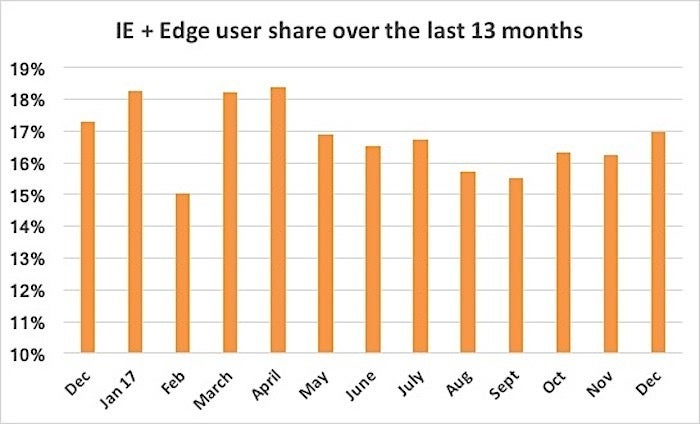
According to Net Applications of Aliso Viejo, Calif., the user share of Internet Explorer (IE) and Edge – an estimate of the fraction of the world’s personal computer owners who ran those browsers – bumped up seven-tenths of a percentage point to end 2017 at 17%.
Although the uptick recovered only a fifth of the massive loss from the month prior, when Net Applications scrubbed fraudulent bots from its data, Microsoft was likely pleased with even that small bit of good news about its browsers. IE and Edge, the former in particular, have been on an extended slide for several years.
The bot-free traffic of Net Applications pegged the total of 2017’s IE+Edge downturn at just 1.3%, a loss of only three-tenths of a point. December’s boost was a big reason for the relatively small decline during last year.
Microsoft, of course, will take anything it can get at this point, having handed its browser crown – worn since the 1990s when it unseated Netscape Navigator – to Google’s Chrome. By other measurements, notably the data acquired by Irish metrics firm StatCounter that was used to generate browser usage share, IE+Edge was already in third place, at 11.9% behind Mozilla’s Firefox and its 12.2%. (StatCounter’s usage share reflects activity, since it tallies page views, meaning that ultra-energetic users may skew results.)
In Net Applications’ numbers, Firefox remained the third-place browser, with a 11% user share, down four-tenths of a percentage point from November.
Firefox, whose maker recently overhauled the browser, also took it on the chin when Net Applications scratched out bot traffic. In the new, cleansed data, Firefox’s user share dropped 3.5 points in 2017, representing a 24% decline. That was the largest decrease among the world’s top browsers.
Chrome led the pack in December with a user share of 60.6%, virtually the same as in November, while Apple’s Safari climbed two-tenths of a percentage point to 4%.
IE+Edge’s improving number also affected another important data point: The percentage of Windows 10 users who rely on Edge ticked up slightly in December to 14%, an eight-tenths of a point increase. The gain put Edge’s share on all Windows 10 PCs at the highest mark since July 2017. Add IE, and Microsoft’s browsers ran on a combined 19.1% of all Windows PCs in December, also an increase from the month before.
But under the best circumstances, it will take months for IE+Edge to establish a clear trend of growth. Of course, the Net Applications numbers for December may have been just a fluke, a blip on the data radar. Microsoft’s browsers have seemed to stabilize after extended periods of decline in the past, for instance, only to resume their slide toward obscurity.
Net Applications calculates user share by detecting the browser agent strings of those who visit its clients’ websites. It then tallies the various browsers, accounting for the size of each country’s online population to better estimate share in regions where it lacks large numbers of analytics customers.
IDG/Data: Net ApplicationsThe user share of IE+Edge ticked up slightly in December 2017, a welcome sign to Microsoft, which has watched its lead evaporate over the last two years.
This groundbreaking metalens could make AR and VR bulk-free
A groundbreaking new lens could make future augmented reality glasses lighter and less obtrusive, replacing complex displays with a revolutionary alternative. Rather than stacking multiple traditional lenses to focus different colors of light, metalenses rely on nanostructures to do so on a single, flat surface. However, until now their potential has been more theoretical than practical.
Although advances in modern AR and VR headsets have seen them shrink down in bulk and weight, the optical requirements inevitably run into the rules of physics. To work, the lenses need to focus the whole visible spectrum and white light. However, the different properties of each light wavelength makes that tricky.
As blue wavelengths are slower to pass through glass than, say, red wavelengths, they won’t reach the eye simultaneously. The result is chromatic aberration, and until now the fix has been to use multiple lenses with different thicknesses, materials, curves, and treatments that, when stacked together, evens the optical performance for all the wavelengths involved. In the process, though, it makes for a fairly hefty package.
Researchers at the Harvard John A. Paulson School of Engineering and Applied Sciences (SEAS) believe they’ve cracked the problem of replacing such lens assemblies. Their solution depends on metalenses, a flat surface that uses nanostructures to focus light and thus avoid chromatic aberration. Although not new technology in themselves, this is the first time that metalenses have been shown with the ability to deal with the entire visible light range.
Image: Jared Sisler/Harvard SEAS
“Metalenses are thin, easy to fabricate and cost effective,” Federico Capasso, the Robert L. Wallace Professor of Applied Physics and Vinton Hayes Senior Research Fellow in Electrical Engineering at SEAS and senior author of the research, said of the development. “This breakthrough extends those advantages across the whole visible range of light. This is the next big step.”
The key is the surface treatment. Arrays of titanium dioxide nanofins – tiny ridges on the surface – are used to focus the wavelengths of light. By tweaking the height, shape, width, and distance of those nanofins, and then pairing them to control the refractive index and thus delay light passing through by different amounts according to wavelength, the single layer can make it so all of the wavelengths involved reach the same focal spot at the same time.
“By combining two nanofins into one element, we can tune the speed of light in the nanostructured material, to ensure that all wavelengths in the visible are focused in the same spot, using a single metalens,” Wei Ting Chen, a postdoctoral fellow at SEAS and first author of the paper, said of the research. “This dramatically reduces thickness and design complexity compared to composite standard achromatic lenses.”
The next big challenge will be matching the full wavelengths that the human eye is capable of seeing, and increasing the size of the metalens so that it’s practical for headsets and cameras. For the latter to work, it’ll need to be around 10 mm (0.39 inches) in diameter, the researchers point out. Clearly, though, there are expectations that it’ll be practical: Harvard has licensed the IP of the project to an unnamed startup, which will be working on a commercial implementation of the metalens technology.
You’ll be able to use Android Auto without any wires this year
Wireless Android Auto is almost here.
In November of 2016, Android Auto became a lot more accessible with the ability to run the car-centric version of the OS directly on your phone without the need for a compatible receiver. Android Auto receives do have the advantage of offering a larger display and being a more seamless integration into your vehicle, but the disadvantage is that they require your phone to be plugged into your car.
Thanks to JVC Kenwood, this won’t be an issue for too much longer. The company will be showcasing two new Android Auto receivers at CES 2018, and they’ll be the first ones that allow you to run Android Auto wirelessly without having to plug your phone into them.
Exact specs are mostly unknown, but CNET reports that both units will come equipped with 1280 x 720 HD displays and support for Apple CarPlay as well.
The current wired method of using Android Auto works fine, but the advantage of going wireless means that you can run Android Auto on your receiver and have a free port on your phone for fast-charging while on the way to work.
Apple Files Patent for Wireless Charging System With Unique Power Scheduling
HIGHLIGHTS
It is for Radio Frequency based long-range wireless charging
First iPhone, then Apple Watch and then iPad will get charged
Unclear if it’s equivalent to “over-the-air” wireless transfer
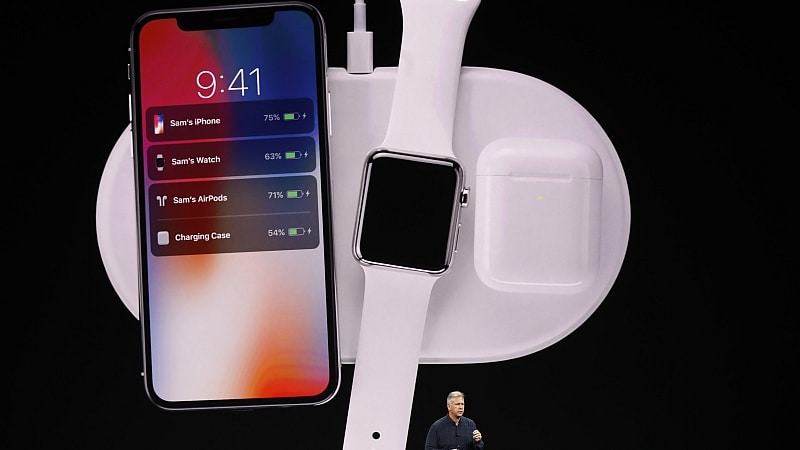
Apple has filed a patent application with the US Patent and Trademark Office that will reportedly let the user set up wireless charging transfers in a particular order so that their iPhone gets power first, followed by Apple Watch and then the iPad.
The Radio Frequency (RF) based long-range wireless charging is on the lines of wireless power developer Energous that has been recently granted consumer safety certification for its wireless charging technology by the US Federal Communications Commission (FCC).
“The US Patent and Trademark Office published a pair of patent applications from Apple that relates to wireless power transfers and a unique scheduling system,” Patently Apple reported on Friday.
“Apple’s patent notes that the system is ‘configured to wirelessly transmit power over the wireless power transfer link’,” the report added.
However, it is unclear whether this is the equivalent to “over-the-air” wireless transfer.
Wireless power developer Energous and the Cupertino-based giant have been working together on wireless charging technology since 2014, according to tech website VentureBeat.
Meanwhile, earlier in November, Apple filed a patent application for a yet-unnamed foldable device that can be “opened and closed like a book”.
“An electronic device may have a flexible portion that allows the device to be folded. The device may have a flexible display. The flexible display may have a bending region that allows the display to bend along a bend axis when the device is folded,” said a patent application published by The US Patent and Trademark Office.


 IDG/Data: Net Applications

 Bruce's Blog