This technology can shape future of electronics design
Researchers have found a way of enhancing the capabilities of an emerging nanotechnology that could open the door to a new generation of electronics.
In a study published in the journal Scientific Reports, researchers show how they have pushed the memristor — a simpler and smaller alternative to the transistor, with the capability of altering its resistance and storing multiple memory states — to a new level of performance after experimenting with its component materials.
“This is a really exciting discovery, with potentially enormous implications for modern electronics. By 2020, there are expected to be more than 200 billion interconnected devices within the Internet of Things framework – these will generate an incredible amount of data that will need processing,” said Themis Prodromakis, Professor at the University of Southampton.
According to the researchers, memristors could hold the key to a new era in electronics, being both smaller and simpler in form than transistors, low-energy, and with the ability to retain data by ‘remembering’ the amount of charge that has passed through them — potentially resulting in computers that switch on and off instantly and never forget.
Researchers demonstrated a new memristor technology that can store up to 128 discernible memory states per switch, almost four times more than previously reported. In the study, they described how they reached this level of performance by evaluating several configurations of functional oxide materials — the core component that gives the memristor its ability to alter its resistance.
“Memristors are a key enabling technology for next-generation chips, which need to be highly reconfigurable yet affordable, scalable and energy-efficient,” the researcher said.
“We are thrilled to be working with world-leading industry, bringing innovations into new electronic systems that require bespoke customisation. Such examples include systems that are employed in inaccessible environments; for example, inside the human body, space or other remote or harsh locations,” Prodromakis said.
One hour of social media enough to ruin your sleeping pattern
One hour a day on social media can derail your sleeping pattern, a new study warns.
The report by Canadian researchers was commissioned to assess why so many young people struggle to sleep eight hours.
They found the root problem to be social media: those who spent at least 60 minutes on WhatsApp, Facebook or Snapchat suffered more sleep issues than those who did not.
The more time they used the apps and sites, the less sleep they got.
The study found that teenage girls were the most addicted to social media and, therefore, more likely to be sleep deprived, but it affects boys just the same.
Canadian researchers said the findings were important as social media has grown rapidly, children and teenagers are more likely to use the new technology and develop and consolidate bad habits which they carry on as adults.
Previous studies found poor sleep has been linked to poor academic performance, and those most likely to be sleep deprived were older teens, boys, those who did less exercise or had poor mental health.
Experts suggest those aged six to 13 should get between nine and 11 hours a night, those aged 14 to 17 eight to 10 hours and those at over 18 at least seven to nine hours to maximize overall health and well-being.
Senior author Dr Jean-Philippe Chaput of the Children’s Hospital of Eastern Ontario Research Institute elaborated, “Sleep is an essential component of healthy development and an important contributor to physical health and mental health.”
“However, insufficient sleep has become widespread among adolescents over the last few decades. Insufficient sleep among adolescents has often been attributed to factors such as artificial light, caffeine use, no bedtime rules in the household and the increased availability of information and communication technology.”
Dr Chaput added: ‘We observed that social media use was associated with greater odds of short sleep duration in a dose-response manner.
“Importantly, significant associations were found when social media use exceeded one hour per day, suggesting that even this level of social media may be negatively associated with sleep duration.”
“Although females spent significantly more time using social media than males, the relationship between the use of social media and sleep duration did not differ by sex.”
“The impact social media can have on sleep patterns is a topic of great interest given the well-known adverse effects of sleep deprivation on health.”
“Electronic screen devices are pervasive in today’s society and we are just starting to understand their risks and benefits.’”
Researchers have found a way of enhancing the capabilities of an emerging nanotechnology that could open the door to a new generation of electronics.
Representational image. Pixabay
In a study published in the journal Scientific Reports, researchers show how they have pushed the memristor — a simpler and smaller alternative to the transistor, with the capability of altering its resistance and storing multiple memory states — to a new level of performance after experimenting with its component materials.
“This is a really exciting discovery, with potentially enormous implications for modern electronics. By 2020, there are expected to be more than 200 billion interconnected devices within the Internet of Things framework — these will generate an incredible amount of data that will need processing,” said Themis Prodromakis, Professor at the University of Southampton.
According to the researchers, memristors could hold the key to a new era in electronics, being both smaller and simpler in form than transistors, low-energy, and with the ability to retain data by ‘remembering’ the amount of charge that has passed through them — potentially resulting in computers that switch on and off instantly and never forget.
Researchers demonstrated a new memristor technology that can store up to 128 discernible memory states per switch, almost four times more than previously reported.
In the study, they described how they reached this level of performance by evaluating several configurations of functional oxide materials — the core component that gives the memristor its ability to alter its resistance.
“Memristors are a key enabling technology for next-generation chips, which need to be highly reconfigurable yet affordable, scalable and energy-efficient,” the researcher said.
“We are thrilled to be working with world-leading industry, bringing innovations into new electronic systems that require bespoke customisation. Such examples include systems that are employed in inaccessible environments; for example, inside the human body, space or other remote or harsh locations,” Prodromakis said.
Published Date: Jan 28, 2018 13:54 PM | Updated Date: Jan 28, 2018 13:54 PM
CleanTechnica Test Drives The Brand New 2018 Mitsubishi Outlander PHEV For You
We’re excited to start the new year with a hotly anticipated car to test drive for you, the Mitsubishi Outlander PHEV.
Finally, The Mitsubishi Outlander PHEV Arrives In The US!
How long has the wait been? About 5 years. Mitsubishi has been selling a plug-in hybrid (PHEV) version of its Outlander for many years overseas, but it has just been talking about doing so in the US — with many target launch dates coming and going. In the meantime, the company went through an almost complete breakdown (part of the reason for the delays) only to be saved by the Renault-Nissan Alliance.
I remember having had fantastic talks with senior officers about what a US version of the Outlander PHEV could look like as far as back as 2013. And the end result is pretty close to the original idea of a plug-in hybrid SUV that lets you choose what drive mode you want when you want.
Our particular Outlander PHEV is very new, with only 250 miles on it. In fact, it is so brand new that we had to crack open the charging plug’s plastic bag container. And the Outlander still smells like a brand new car, or reeks of it, depending on how you feel about that.
So far, we like the car a lot. For an SUV, it doesn’t feel bloated. The electric motor is surprisingly zesty and moves it along nicely. Although our first-day drive was spent in electric ECO mode, we feel the estimated 27 miles on electricity might be wishful thinking. We’ll see as the week progresses and we put on more miles before using its very quiet gasoline engine. We do like the CHAdeMo charging option, as those chargers are plentiful around the Los Angeles area.
The inside feels very comfortable and spacious. It’s not an outrageous SUV. It’s not over the top. It feels good without screaming luxury, and this is something we like about how Mitsubishi executes its cars. The back seats are comfortable, just as in the regular version. The trunk does sacrifice some cargo space, but nothing out of the ordinary, and there’s a ton of space back there — being an SUV and all.
Next, we’re pairing phones, digging into the manuals, and seeing just exactly what else the Outlander PHEV has to offer.
Stay tuned next week as we give you the results of our extended test drive of the Mitsubishi Outlander PHEV.
1 Week Behind The Wheel Of 2018 Mitsubishi Outlander PHEV — CleanTechnica Review, Part I
We just finished our first test drive of the year of the Mitsubishi Outlander PHEV for CleanTechnica and the results were a car that was worth the wait, even if it is a little late to the game.
Quick Specs & Info
2018 Mitsubishi Outlander PHEV (US version)
Class: Mid-size SUV
Base Model: $35,535 SEL
Competition: BMW X5 xDrive40e, Volvo XC90, Porsche Cayenne e-Hybrid
As Tested: $41,000 GT
Powertrain: 60kW Twin AC synchronous, 137 Nm front, 195 Nm rear, 2.0L DOHC MIVEC engine 117 HP
EV Range: 19 to 29 miles (CleanTechnica test drives)
Battery: 12 kWh
Gasoline Range: ~ 300 miles
Quick Pros:
The only PHEV with DC Quick Charging
1,500 lb towing capacity
EV only, Series Hybrid, Parallel Hybrid modes
5 regenerative braking modes through steering paddle shifts
Adaptive Cruise Control
Multi-view camera, 380° and overall view
Rear-cross traffic sensors
AC power outlets in trunk and rear seats
Four-wheel drive (Mitsubishi S-AWC or Super All-Wheel Control)
Cons:
The app asks access to your pictures
Trunk door automation is slow and the SUV can’t be locked during it
Entertainment system is not best in class but good enough overall
The app didn’t work on our test drive
The Mitsubishi Outlander PHEV Is Here At Last, In The US
We’ve waited a long time for the Mitsubishi Outlander PHEV, maybe as much as 5 years, but who’s been counting? Overall, the wait was worthwhile. Mitsubishi delivers a unique plug-in hybrid (PHEV) SUV, a first in its class that can manage to go offroad. It is, to date, the only PHEV SUV that features two electric motors.
The Outlander PHEV impressed us in many ways and we walked away feeling that despite falling short on a few things, it is a stellar product and will set the mark high for others to follow.
First Impressions of the Mitsubishi Outlander PHEV
The Mitsubishi Outlander PHEV strikes the right feel of quality without screaming a heavy luxury hand, as most other SUVs seem to try. The first obvious difference from the regular Outlander is the big EV button in the central console, which we were eager to press.
The fit and finish are very good. But the feel is what sets it apart from other PHEV SUVs. It looks good in a quiet, stated way and doesn’t try to look like it’s keeping up with the Joneses. It really doesn’t have much direct competition, especially when it comes to its overall performance and cost. The closest competition would be the BMW X5 xDrive40e, the Volvo XC90, and the Porsche Cayenne S e-Hybrid. All of those vehicles heavily accentuate the “luxury” feeling and come with the respective price bump, while Mitsubishi seems to be content with more technical engineering and a simple, refined interior at a more affordable price.
Although it doesn’t scream luxury, it won’t make you feel bad next to the competition either. And that is the one thing we liked the most about how the company executed this PHEV SUV. It’s good without trying hard. It makes us wonder how Mitsubishi will refine it over the years.
The interior is well appointed with two USB ports, Android Auto, and Apple CarPlay — and a neat two standard 110-volt outlets in the rear seat console and in the trunk. This makes the Outlander PHEV perfect for tailgate parties or camping if you need to plug in … well, if you need to plug in something that needs 110V, we guess.
The Technical Side Of The Mitsubishi Outlander PHEV
The Outlander PHEV is technically a series hybrid that can act as an electric vehicle (EV) and allows you to switch to parallel mode when needed. What this translates to is that the Outlander PHEV will start in EV mode and then use the engine at higher speeds to continue charging the battery when the electric motors become less efficient or the pack depleted. The gasoline engine kicks the Outlander PHEV in parallel mode by driving the front wheels, recharging the battery part for normal hybrid driving (not the complete capacity of the pack), and finally powering the motors. This is impressive engineering and very close to the Chevy Volt. This is also what Mitsubishi told it wanted to do back in 2013.
The Outlander PHEV has an interesting feature called the Battery Charging mode. What this does is use the engine to recharge the battery pack up to 80% in 40 minutes while driving at highway speeds. This is essentially meant to be used as you near your final destination and then switch to EV-only mode. This makes sense in countries like the US where gasoline prices are relatively cheap, or in places where you need a low- or zero-emission vehicle in the city. We managed to recharge up to 70% in our test drives, although we didn’t push the system to its limit.
The following videos explain the various modes in more details.
EV Mode
PHEV Series Mode
PHEV Parallel Mode
Multi-Mode Electric Driving
Pressing the “EV” button forces the Outlander PHEV into an EV Priority Mode that prevents the engine from starting. We particularly appreciated this when nearing our final destination, where we could charge the PHEV with an actual plug. The Twin Motor 4WD mode allows you to manually select all-electric driving for zero fuel consumption and a quiet ride without engine noise as you approach home (or wherever you’re going). This feature might seem like a given and it should be an option in every PHEV, but it’s not.
In part II of our CleanTechnica Mitsubishi Outlander PHEV review, we’ll look into the performance of the SUV as well as the feel of its drive. Stay tuned for part II tomorrow.
Nicolas Zart Nicolas was born and raised in the world of classic cars of the 1920s. It wasn’t until he drove an AC Propulsion eBox and finally a Tesla Roadster that the light went on. Eager to spread the news of that full torque, he started writing in 2007 for various CleanTech outlets. Since then, his passion led to cover renewable energy, test drives, podcasts, shoot pictures, and film for various international outlets both in print and online. Nicolas offers an in-depth look at the e-mobility world through interviews and the many contacts he has forged in those industries. Today he focuses most of his writing effort on CleanTechnica, a global online outlet that covers the world of electric vehicles and renewable energy. His favorite tagline is: “There are more solutions than obstacles.”
Honeybees Help Farmers, But They Don’t Help The Environment
Nigel Raine keeps a collection of wild bees in his laboratory at the University of Guelph, in Canada. Farmed honeybees can compete with wild bees for food, making it harder for wild species to survive.
Dan Charles/NPR
Honeybees are amazing and adorable, and they suffer when people spray pesticides or mow down wildflowers. We’ve heard plenty in recent years about collapsing bee colonies.
So Jonas Geldmann, at the University of Cambridge, says he understands how the honeybee became a symbol of environmental conservation.
But he still doesn’t like it.
“Lots of conservation organizations are promoting local honey, and even promoting sponsorships of honeybees and that kind of stuff, and that increasingly annoyed me,” he says.
It annoyed him because the honeybee is perhaps the one type of bee that we should worry about the least. Honeybee hives aren’t natural, and they don’t help the environment. In fact, they may harm it.
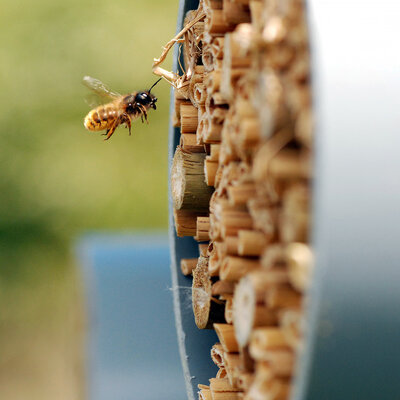
There are thousands of bee species. Almost all of them live in the wild, hiding away in the ground or in odd cavities, like hollow plant stems. They play a vital role in the ecosystem, pollinating flowering plants. Many are in peril; some species have disappeared.
Researcher Nigel Raine has a whole array of wild bees impaled on pins in his laboratory at the University of Guelph, in Canada. Many are tiny. Raine says that gardeners often assume they’re flies. “If you sit down and say, ‘No, that’s a small, solitary bee; that’s a metallic green one’ — when you show them a metallic green bee in their yard, they say, ‘Wow! That’s amazing!’ ”
And then there’s the honeybee: originally imported from Europe, raised and managed by beekeepers in order to make honey or to pollinate crops like almonds. It’s an agricultural animal, in the same way that sheep and cattle are.
When flowers are abundant, there is plenty of pollen for both honeybees and their wild cousins. But in many landscapes, or when an orchard stops blooming, farmed honeybees can compete with wild bees for food, making it harder for wild species to survive.
Basically, a healthy environment needs bees — but not honeybees, Geldmann says. This week, he published a commentary in the journal Science trying to spread the word to a wider audience. “The way we’re managing honeybees, in these hives, has nothing to do with nature conservation,” he says.
Scientists who study bees already understand this. But they struggle with how to talk to the public about it.
“We’re on a learning curve, all of us,” says Marla Spivak, at the University of Minnesota, one of the country’s most prominent bee researchers. “It’s like honeybees were the portal — the door to much larger issues, conservation issues in general.”
Concern for honeybees helped more people understand why it’s important to have more land covered with wildflowers and trees — and free from pesticides, Spivak says. Such a landscape is good for both honeybees and wild bees.
“My preference is not to pit one bee against another,” Spivak says. “I would prefer to live on a planet where there are bountiful flowers to support all of our bees.”
But the bee that needs our help the most may be that tiny green bee in your garden and not the honeybee.


 Bruce's Blog