https://www.scientificamerican.com/article/are-we-really-prepared-for-the-genetic-revolution/

Are We Really Prepared for the Genetic Revolution?
Genetic data could lead to more personalized, meaningful education, but only if parents, teachers and policymakers understand genetics well enough to correctly use the information

Are We Really Prepared for the Genetic Revolution?
Credit: Sebastian Kaulitzki Getty Images
The following essay is reprinted with permission from The Conversation, an online publication covering the latest research.

When humans’ genetic information (known as the genome) was mapped 15 years ago, it promised to change the world. Optimists anticipated an era in which all genetic diseases would be eradicated. Pessimists feared widespread genetic discrimination. Neither of these hopes and fears have been realised.

The reason for this is simple: our genome is complex. Being able to locate specific differences in the genome is only a very small part of understanding how these genetic variants actually work to produce the traits we see. Unfortunately, few people understand just how complex genetics really is. And as more and more products and services start to use genetic data, there’s a danger that this lack of understanding could lead people to make some very bad decisions.

At school we are taught that there is a dominant gene for brown eyes and a recessive one for blue. In reality, there are almost no human traits that are passed from generation to generation in such a straightforward way. Most traits, eye colour included, develop under the influence of several genes, each with its own small effect.

What’s more, each gene contributes to many different traits, a concept called pleiotropy. For example, genetic variants associated with autism have also been linked with schizophrenia. When a gene relates to one trait in a positive way (producing a healthy heart, say) but another in a negative way (perhaps increasing the risk of macular degeneration in the eye), it is known as antagonistic pleiotropy.

As computing power has increased, scientists have been able to link many individual molecular differences in DNA with specific human characteristics, including behavioural traits such as educational attainment and psychopathy. Each of these genetic variants only explains a tiny amount of variation in a population. But when all these variants are summed together (giving what’s known as a characteristic’s polygenic score) they begin to explain more and more of the differences we see in the people around us. And with a lack of genetic knowledge, that’s where things start to be misunderstood.

For example, we could sequence the DNA of a newborn child, calculate their polygenic score for academic achievement and use it to predict, with some degree of accuracy, how well they will do in school. Genetic information may be the strongest and most precise predictor of a child’s strengths and weaknesses. Using genetic data could allow us to more effectively personalise education and target resources to those children most in need.

But this would only work if parents, teachers and policymakers have enough understanding of genetics to correctly use the information. Genetic effects can be prevented or enhanced by changing a person’s environment, including by providing educational opportunity and choice. The misplaced view that genetic influences are fixed could lead to a system in which children are permanently separated into grades based on their DNA and not given the right support for their actual abilities.

In a medical context, people are likely to be given advice and guidance about genetics by a doctor or other professional. But even with such help, people who have better genetic knowledge will benefit more and will be able to make more informed decisions about their own health, family planning, and health of their relatives. People are already confronted with offers to undergo costly genetic testing and gene-based treatments for cancer. Understanding genetics could help them avoid pursuing treatments that aren’t actually suitable in their case.

It is now possible to edit the human genome directly using a technique called CRISPR. Even though such genetic modification techniques are regulated, the relative simplicity of CRISPR means that biohackers are already using it to edit their own genomes, for example, to enhance muscle tissue or treat HIV.

Such biohacking services are very likely to be made available to buy (even if illegally). But as we know from our explanation of pleiotropy, changing one gene in a positive way could also have catastrophic unintended consequences. Even a broad understanding of this could save would-be biohackers from making a very costly and even potentially fatal mistake.

When we don’t have medical professionals to guide us, we become even more vulnerable to potential genetic misinformation. For example, Marmite recently ran an ad campaign offering a genetic test to see if you either love or hate Marmite, at a cost of £89.99. While witty and whimsical, this campaign also has several problems.

First, Marmite preference, just like any complex trait, is influenced by complex interactions between genes and environments and is far from determined at birth. At best, a test like this can only say that you are more likely to like Marmite, and it will have a great deal of error in that prediction.

Second, the ad campaign shows a young man seemingly “coming out” to his father as a Marmite lover. This apparent analogy to sexual orientation could arguably perpetuate the outdated and dangerous notion of “the gay gene”, or indeed the idea that there is any single gene for complex traits. Having a good level of genetic knowledge will enable people to better question advertising and media campaigns, and potentially save them from wasting their money.

My own research has shown that even the well-educated amongst us have poor genetic knowledge. People are not empowered to make informed decisions or to engage in fair and productive public discussions and to make their voices heard. Accurate information about genetics needs to be widely available and more routinely taught. In particular, it needs to be incorporated into the training of teachers, lawyers and health care professionals who will very soon be faced with genetic information in their day-to-day work.

This article was originally published on The Conversation. Read the original article.

ABOUT THE AUTHOR(S)
Robert Chapman
PhD Candidate, Goldsmiths, University of London.
https://9to5mac.com/2018/05/27/apple-continues-work-on-ultra-flexible-living-hinge-design-for-macbooks/

Apple continues work on ultra-flexible ‘living hinge’ design for MacBooks

Apple is continuing work on a new kind of hinge design for its devices. The company has been perfecting its work here since 2013 and this week, the European Patent Office published Apple’s latest patent claim additions, which emphasize the usefulness of this flexible hinge design for MacBooks…

As outlined by Patently Apple, this patent outlines a flexible hinge design, sometimes referred to by Apple as a “Living Hinge.” This would mean that entire MacBook enclosure could be created “from a single rigid material.”

The Apple patent sounds similar to the hinge Microsoft unveiled with its Surface Book in 2015, which it refers to as a “dynamic fulcrum hinge.” Here, the hinge flexes as the laptop opens, while the display is removable from the hinge and can be replaced in the opposite direction, allowing for the laptop to be used in a tablet-like mode. Watch the video below for a quick demo of that hinge.

Here’s how Apple describes the hinge design in its own words:

“An enclosure for a laptop may be created from a rigid material having a flexible portion defined around approximately a midpoint of the material. The flexible portion may allow the rigid material to be folded in half and thus acts as a laptop clamshell.

A top portion may support a display screen and a bottom portion may support a keyboard, track pad, and the like, while an interior defined by sidewalls of the rigid material may house a variety of electronic components in accordance with conventional laptop computing devices.

In this manner, the enclosure (or a portion thereof) may be created from a single rigid material, while still providing flexibility and bending for the enclosure.”‘

In addition to the added flexibility, this sort of hinge design would seemingly make the manufacturing process easier as the entire chassis would be able to be created from a single material.

As with all Apple patents, it’s important to take this one with a grain of salt. The fact that Apple has been revising the patent since 2013 suggests this is an important area for the company, but it’s hard to know when, or if, such a hinge design will make its way to consumers.

https://electrek.co/2018/05/27/tesla-model-3-range-new-hypermiling-record/

Tesla Model 3 travels 606 miles on a single charge in new hypermiling record

Hypermiling is the practice of driving vehicles as efficiently as possible in order to achieve the longest distance possible on one charge/fuel tank.

It’s not a useful way to determine the range of a vehicle for normal driving, but it’s an interesting way to see how the way someone drives can impact fuel efficiency.

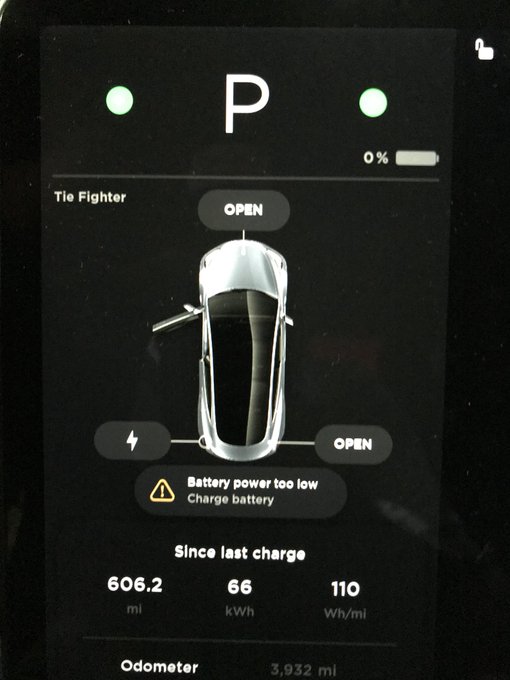
Tesla owners have now established a new hypermiling record in a Model 3 by traveling 606 miles on a single charge.

This weekend, Tesla owners Erik Strait and Sean Mitchel set out to achieve the record on a public road circuit.

Their goal was 600 miles (965 km) and they narrowly beat it for what could very well be the Guinness World Record for the longest distance driven in a production electric car on a single charge.

The attempt basically consists of driving at extremely low-speed in order to get the most efficient driving speed for the vehicle while also not using power consuming onboard features like climate control.

In the case of the Model 3, Strait and Mitchel found that maintaining the speed under 25 mph (40 km/h) was ideal.

32 hours later, they had the record.

They streamed the entire hypermiling run on Youtube, which you can watch below, but a fair warning: hypermiling might very well be the most boring motorsport to watch by a long shot:

But the results were quite interesting. Mitchell reported a very efficient 110 Wh per mile for a total 66 kWh used during the run:

Sean M Mitchell@seanmmitchell

Final hypermile numbers from @teslainventory and I: 606.2 miles (975 km), 66 kWh, and 110 wh/mi, and 32 hours of driving. At its peak it was 108F in the cabin with no a/c running. Thank you @Tesla and @elonmusk for making such an incredible piece of machinery!

As we previously reported in our feature on the Model 3 battery pack architecture, the Long Range Model 3 battery pack has a capacity of about 74 kWh, but they surprisingly got much less usable energy in their run and it’s not clear why.

There’s always some capacity left as a buffer, but it seems higher than usual in this case.

Electrek’s Take

It’s a very impressive performance – though I wouldn’t be surprised if it eventually gets surpassed with a route that results in fewer stops.

But it’s still a nice achievement and the newest hypermiling record for a Tesla vehicle – beating the previous Tesla Model S hypermiling record of just over 900 km (560 miles) on a single charge in a Model S P100D.

Interestingly, when talking about hypermiling, Tesla CEO Elon Musk said in 2015 that he would expect people to reach 600 miles (965 km) on a single charge in a Tesla vehicle in 2017.

The comment resulted in a lot of misinformation as media reported it as if Tesla plans to release a vehicle with a real-world range of 600 miles.

Of course, it’s not the case at all since hypermiling is in no way representative of the actual normal range of a vehicle, electric or not.

It’s a fun way to see how much efficiency you can get out of a car.

https://www.techrepublic.com/article/nanopc-t4-a-powerful-raspberry-pi-alternative-without-the-bottleneck-issues/

NanoPC-T4: A powerful Raspberry Pi alternative without the bottleneck issues

FriendlyELEC’s NanoPC-T4 includes support for NVMe-linked M.2 SSDs, solving I/O bottleneck issues and offering a more stable platform for professionals.

For users and developers looking for a more powerful alternative to the Raspberry Pi, the NanoPC-T4—FriendlyELEC’s newest single-board computer (SBC)—uses the same system-on-a-chip (SoC) as Samsung’s Chromebook Plus, but at a fraction of the price.

The NanoPC-T4 is a 100x64mm SBC powered by a Rockchip RK3399, which pairs a dual-core 2.0 GHz Cortex-A72 with a quad-core 1.5 GHz Cortex-A53 in a Big.LITTLE configuration, with a Mali-T864 GPU, and 4K VP9 and 10-Bit H.265/H.264 hardware video decoder, with 4 GB RAM and 16 GB storage onboard. It is bundled with a heatsink, radio antennas, a power adapter, and an acrylic case for $119. While this is a sizable increase from the Raspberry Pi’s famed $35 price point, the Pi series is sold as a board only, with third party integrators providing case options and power supplies for an additional fee.

The NanoPC-T4—aside from having a more powerful processor—concentrates on addressing the performance bottlenecks of the Raspberry Pi, making it a compelling choice for professionals. While the Raspberry Pi is limited to only relatively slow microSD storage, the NanoPC-T4 has a 16 GB eMMC onboard, as well as an M.2 2280 connector, allowing for high speed PCIe SSDs to be used. The M.2 connector supports PCI Express 2.1, and is wired for x4, making it possible to get I/O speeds faster than comparable SATA-linked SSDs.

SEE: Internet of Things policy (Tech Pro Research)

Officially, the NanoPC-T4 supports Android 7.1 and Lubuntu 16.04 with GPU and VPU acceleration. Unofficially, because of how widespread devices with the Rockchip RK3399 are, the SoC has received a great deal of attention in support in the Linux kernel. Mainline support was added in 4.12, with additional fixes provided in subsequent versions, some of which are from open source consultancy Collabora.

While the explosive popularity of the Raspberry Pi has led to a the proliferation of inexpensive single-board computers with more processing power or unique features, the education-minded Raspberry Pi has remained more popular than competitors due to the mainline Linux kernel support, and the ecosystem that developed around the boards. With mainline support for the RK3399 SoC, the NanoPC-T4 may be a more compelling alternative than other boards powered by different SoCs.

Here are the full specs for the NanoPC-T4:

Specifications

  • SoC: Rockchip RK3399
    • CPU: big.LITTLE, Dual-Core Cortex-A72 (up to 2.0GHz) + Quad-Core Cortex-A53 (up to 1.5GHz)
    • GPU: Mali-T864 GPU, supports OpenGL ES 1.1/2.0/3.0/3.1, OpenVG 1.1, OpenCL, DX11, and AFBC
    • VPU: 4K VP9 and 4K 10-Bit H265/H264 60 FPS decoding, Dual VOP, etc
  • PMU: RK808-D PMIC, cooperated with independent DC/DC, enabling DVFS, software power-down, RTC wake-up, system sleep mode
  • RAM: Dual-Channel 4GB LPDDR3-1866
  • Flash: 16GB eMMC 5.1 Flash
  • Ethernet: Native Gigabit Ethernet
  • Wi-Fi/BT: 802.11a/b/g/n/ac, Bluetooth 4.1, dual antenna interface
  • Video Input: two 4-Lane MIPI-CSI, dual ISP, up to 13MP/s, supports simultaneous input of dual camera data
  • Video output
    • HDMI: HDMI 2.0a, supports 4K @ 60Hz, HDCP 1.4/2.2
    • DP (on USB-C): DisplayPort 1.2 Alt Mode
    • LCD Interface: one eDP 1.3 (4-Lane, 10.8Gbps), one 4-Lane MIPI-DSI
  • Audio Out: 3.5mm stereo headphone jack, HDMI
  • Audio In: onboard microphone
  • USB 2.0: 2 independent native USB 2.0 Host A interfaces
  • USB 3.0: 1 native USB 3.0 Host A type interface
  • USB Type-C: Supports USB 3.0 Type-C and DisplayPort 1.2 Alt Mode on USB Type-C
  • PCIe: One M.2 M-Key PCIe x4 socket, compatible with PCIe 2.1, Dual operation mode; Onboard M3 PCB nut for mounting M.2 2280 module
  • microSD Slot x 1
  • 40Pin GPIO Extension ports:
    • 1 X 3V/1.8V I2C, up to 2 x 3V UART, 1 X 3V SPI, 1 x SPDIF_TX, up to 8 x 3V GPIOs
    • 1 x 1.8V I2S, 3 x 1.8V GPIOs
  • ADC: 3 x 1.8V ADC inputs, 5 Pin 2.54mm header
  • Debug: one Debug UART, 4 Pin 2.54mm header, 3V level, 1500000bps
  • Keys: PowerKey, Reset, MASKROM(BOOT), Recovery
  • LED: 1 x Power LED and 1 x GPIO-controlled LED
  • IR reciver: Onboard IR reciver, Acceptes 38KHz carrier frequency
  • RTC Battery: 2 Pin 1.27/1.25mm RTC battery input connector
  • Cooling: two 2.5mm PCB nuts for mounting heat sink; 3 Pin 12V cooling fan interface with PWM
  • Power supply: DC 12V/2A

The big takeaways for tech leaders:

  • The NanoPC-T4 is a more powerful alternative to the Raspberry Pi and could make a better option for developers and business professionals, as it addresses many bottleneck issues found in SBCs.
  • The Rockchip RK3399 SoC, which powers the NanoPC-T4, has mainline Linux support, which makes it more versatile than other Raspberry Pi competitors.

Save 40% Today Ad Smartocity.com Up next AUTOPLAY 44:21 Wal Thornhill: Future Science | EU2017 ThunderboltsProject 14K views New 1:28:47 The SAFIRE Project 2017 – 2018 Update ThunderboltsProject 55K views 42:03 Edwin Kaal: The Proton-Electron Atom — A Proposal for a Structured Atomic Model | EU2017 ThunderboltsProject 19K views 1:23:58 Episode 2 Symbols of an Alien Sky: The Lightning Scarred Planet, Mars (Full Documentary) ThunderboltsProject Recommended for you The Craters are Electric | Space News ThunderboltsProject 15K views New Gravitational Waves – Documentary 2018 HD The All-Seeing Eye 90K views Energy from Space | The Shift Has Begun Suspicious0bservers Recommended for you Who Still Denies Electric Currents in Space? | Space News ThunderboltsProject 18K views How the Universe Works – From The Big Bang To The Present Day – Space Discovery Documentary How the Universe Works Recommended for you The Electric Universe Theory Does Electricity Rule the Solar System [FULL VIDEO] UAMN TV 138K views Electrical Scarring of the Colorado Plateau | Space News ThunderboltsProject 15K views Monster of the Milky Way Armaita777 Recommended for you Electric Winds and Earth Geology | Space News ThunderboltsProject 13K views Les Miserables – I Dreamed a Dream (Artistic Piano Interpretation by Sunny Choi) Sunny Choi Recommended for you Thunderbolts of the Gods | Official Movie ThunderboltsProject Recommended for you John Legend – All of Me (Artistic Piano Interpretation by Sunny Choi) Sunny Choi Recommended for you No Dark Matter? – Documentary 2018 HD The All-Seeing Eye 59K views The Best Documentary Ever – Wallace Thornhill: The Elegant Simplicity of the Electric Universe (with Felicity Wunsch 4.3K views Electric Comets: Born From Fire | Space News ThunderboltsProject 13K views Military Tech Show Episode 8 (Full Military Engineering Program) | Spark Spark 1.3K views New Electricity and Water’s Changing Properties | Space News

https://www.sciencealert.com/parkinson-s-lrrk2-gene-role-discovered-tuberculosis-leprosy-infections

Scientists Just Found an Unexpected Link Between Tuberculosis And Parkinson’s Disease

What could they possibly have in common?

MIKE MCRAE

23 MAY 2018

At first glance, tuberculosis and Parkinson’s disease are about as different as diseases get, but a new study has found an important link between the two.

This connection is down to a protein called leucine-rich repeat kinase 2 (LRRK2), and not only could it help develop new treatments for both diseases, but it also demonstrates a key connection between the brain and our immune system.

Parkinson’s disease is a neurodegenerative disorder that develops as nerve cells in the brain die, depriving the tissue of a key chemical messenger called dopamine.

Exactly what causes these cells to die in some people is a mystery, though an increasing number of signs point to a confused immune system.

Mutations in LRRK2 have also been implicated in the development of Parkinson’s, a find that is already helping scientists who are developing a new class of treatments.

And research led by a team from the Francis Crick Institute and Newcastle University in the UK has now explained how LRRK2 interferes with one of the processes white blood cells use to kill bacteria.

This is where tuberculosis (TB) comes in, because it’s an infection caused by the bacterium Mycobacterium tuberculosis, usually within lung tissue.

In most cases, our bodies do a fairly good job of dealing with the infection by sending in white blood cells called macrophages – they swallow the microbes and pack them inside bubbles called phagosomes.

Once the germs are safely trapped inside these compartments, packets of enzymes called lysosomes click into place and empty their bacteria-dissolving contents, killing the infection.

Broad studies of the human genome have hinted at some kind of relationship between inflammation caused by Mycobacterium diseases – including TB and leprosy – and the LRRK2 gene.

What’s been missing are the details; just how does a gene connected to Parkinson’s disease mess with the way white blood cells deal with mycobacteria?

To get a better idea of what was going on at a cellular level, the team developed several experiments that exposed the chemical’s functions.

It turns out that LRRK2 regulates a process that connects those bacterial jail cells with their horror-show bubbles of death, effectively preventing them from joining. Meanwhile, macrophages that were engineered to have LRRK2 missing had no problem digesting their TB captives.

Not only does this discovery shed light on how TB and leprosy infections might get a foothold, but it could also explain why certain proteins accumulate inside nerves.

“We think that this mechanism might also be at play in Parkinson’s disease, where abnormal masses of protein called ‘Lewy bodies’ build up in neurons in the brain and cause damage,” says one of report’s first authors, Susanne Herbst from the Francis Crick Institute.

This makes the find a two-for-the-price-of-one deal, and the findings could potentially lead to new ways of dealing with Parkinson’s – since researchers don’t normally think about it in immunology terms.

“The dogma in the Parkinson’s field has been to focus almost exclusively on what is happening to neurons in the brain to make them degenerate,” says biochemist Patrick Lewis from the University of Reading.

“This study reinforces why we should think more broadly about the events that cause neurodegeneration, and that some of the answers to Parkinson’s disease might come from immunology.”

Our global society is an aging one, and with that comes an increasing number of neurodegenerative conditions such as Parkinson’s. We’re going to need all the help we can get in keeping those numbers low.

As for tuberculosis, the timing also couldn’t be better. A lengthy course of antibiotics is usually enough to clear up an infection, but the disease still manages to kill more than a million people each year.

In recent years, strains of TB Mycobacterium have emerged that show resistance to one or more of the medications commonly used to treat it. That means the writing’s on the wall for a possible resurgence of this deadly disease, one that could prove difficult to control without new classes of drugs.

Knowing more about potential weak points in our own immune system is looking critical, which makes research drawing links between such disparate diseases all the more valuable.

This research was published in The EMBO Journal.

Learn More

  1. Link between tuberculosis and Parkinson’s disease discoveredThe Francis Crick Institute, ScienceDaily
  2. New Drug Target Identified For Fighting Parkinson’s DiseaseJohns Hopkins Medical Institutions, ScienceDaily
  3. A defence mechanism that can trap and kill TB bacteriaThe Francis Crick Institute, ScienceDaily
  1. Microbe Profile: Mycobacterium tuberculosis: Humanity’s deadly microbial foeStephen V. Gordon et al., Microbiology
  2. Blood Assay Can Predict Latent TB That May Become Active in Children, Study Finds360Dx
  3. International Team Developing Reagent Test That Could Broaden Access to TB Screening360Dx

https://www.leafly.com/news/health/cannabis-effects-brain-damage-after-injury

Cannabis May Protect the Brain Against Stress and Injury, and Here’s Why

https://globalnews.ca/news/4225867/sleeping-in-longer-life/

Sleeping in on weekends can help you live longer: Study

A recent study published in the Journal of Sleep Research suggests sleeping in on weekend (or during the week) could extend your life.


A recent study published in the Journal of Sleep Research suggests sleeping in on weekend (or during the week) could extend your life.

Some good news: science shows sleeping in on the weekends could be beneficial to our health.

The Swedish study, recently published in the Journal of Sleep Research, found adults 65 and under who slept five or fewer hours every night during the week had a 65 per cent higher risk of death compared to those who snoozed more than six or seven hours per day.

Researchers note for those who didn’t get enough sleep during the weekdays, for example, sleeping in on weekends had no raised mortality risk.

Co-author Torbjörn Åkerstedt of the Stress Research Institute at Stockholm University and Karolinska Institutet tells Global News the message of this research is to encourage people to get enough sleep during the week.

“Short sleepers during both weekdays and weekends have an increased mortality,” he says via e-mail. “Same with consistent long sleepers. However, weekday short sleepers seem to be able to compensate during the weekend by sleeping more,” adding those who slept more than eight hours a day, seven days a week, had a 25 per cent higher mortality rate compared to those who slept for six to seven hours.

READ MORE: Should you nap at work? A sleep specialist says yes

The research

The study looked at data of more than 43,000 adults in Sweden starting from the year 1997. The study notes a cohort of subjects were followed for 13 years.

Speaking with The Gaurdian, Åkerstedt added researchers had looked at links between sleep duration and mortality in the past, but generally focused on sleeping patterns during the week.

WATCH: Did you know that sleeping naked is better for your health?

“I suspected there might be some modification if you included also weekend sleep, or day-off sleep,” he told the site.

The Guardian also notes after looking at factors like gender, BMI, smoking, shift work and how active participants were, researchers were able to see how sleep impacted their day-to-day.

READ MORE: These 6 tips will help you fall asleep faster

Another part of the research that stood out, Åkerstedt adds, is the importance of sleep as we age.

“It appears that you tend to get the sleep that you need with increasing age, even if it is rather short. Apparently, the need for sleep decreases with aging,” he says.

And what does sleeping in actually look like? He adds most of us will benefit from just an hour or so of more sleep.

Finding a routine

And as the lack of sleep continues to be a common concern for many, experts note, finding the time to get proper sleep means sticking to a routine.

“Try to sleep for seven hours regardless of day of the week, but older individuals need less, and younger need more sleep,” he says. “But as long as daytime functioning is OK, you probably get enough sleep. Don’t emphasis formal sleep duration too much.”

And although previous studies have shown sleeping in may not always work, setting a regular sleep schedule may be more beneficial.

Start by getting into the habit of sleeping and waking up at the same time every day — even on weekends.

READ MORE: A sleep divorce could save your marriage

Switching up your bedroom can also help, experts note.

Create a relaxing space that you want to sleep in and avoid bringing in work, food or your cellphone with you before you sleep.

“The bright screen essentially tells your brain to turn off the sleep switch and tricks it into thinking you need to be awake. This, in turn, suppresses melatonin production and increases cortisol and adrenaline,” Alanna McGinn, family sleep consultant and founder of Goodnight Sleep Site told Global News earlier this year.


https://www.ctvnews.ca/health/physical-fitness-could-protect-against-too-much-sedentary-time-1.3944873

Physical fitness could protect against too much sedentary time

Results from a UK study have added to the growing body of research that an active lifestyle can help offset the negative health effects of too much time spent sitting, suggesting that those who are fitter and stronger are less likely to be impacted by sedentary time.

Carried out by researchers at Glasgow University, the study analyzed data on 391,089 participants taken from the UK Biobank, a large, long-term study that includes data on all-cause mortality, cardiovascular disease (CVD) and cancer incidence, along with television viewing, computer screen time, grip strength, fitness and physical activity.

The team found that both types of screen time — leisure time spent watching a television or time in front of a computer screen — were significantly associated with all health outcomes, with higher levels of screen time associated with a higher risk of all-cause mortality, cancer, and CVD.

However, screen time had almost double the impact on the risk of death, cancer, and CVD in those who had low grip strength or low fitness levels compared to those who had the highest levels of fitness and grip strength.

A similar association was also observed between physical activity and all-cause mortality and cancer incidence.

The team noted that the use of self-reported screen time and physical activity data may have impacted the accuracy of the findings, and as an observational study no conclusions can be made about cause and effect.

However, they added that the results suggest that increasing strength and fitness may provide some protection against the negative health effects of too much time spent sitting down in front of a screen.

“Our study shows that the risks associated with sedentary behavior are not the same for everyone; individuals with low physical activity experience the greatest adverse effects,” commented corresponding author Dr. Carlos Celis-Morales.

“This has potential implications for public health guidance as it suggests that specifically targeting people with low fitness and strength for interventions to reduce the time they spend sitting down may be an effective approach.”

“While fitness testing can be difficult in healthcare and community settings, grip strength is a quick, simple and cheap measure, therefore it would be easy to implement as a screening tool in a variety of settings,” Dr. Celis-Morales added.

The results can be found published online in the journal BMC Medicine.

https://phys.org/news/2018-05-polymer-crystals-key-record-breaking-energy.html

Polymer crystals hold key to record-breaking energy transport

May 24, 2018, University of Bristol
Polymer crystals hold key to record-breaking energy transport
Image showing light emission from the polymeric nanostructures and schematic of a single nanostructure. Credit: University of Bristol

Scientists from the universities of Bristol and Cambridge have found a way to create polymeric semiconductor nanostructures that absorb light and transport its energy further than previously observed.

This could pave the way for more flexible and more efficient  and photodetectors.

The researchers, whose work appears in the journal Science, say their findings could be a “game changer” by allowing the  from sunlight absorbed in these materials to be captured and used more efficiently.

Lightweight semiconducting plastics are now widely used in mass market electronic displays such those found in phones, tablets and flat screen televisions. However, using these materials to convert sunlight into electricity, to make solar cells, is far more complex.

The photo-excited states—which is when photons of  are absorbed by the semiconducting material—need to move so that they can be “harvested” before they lose their energy in less useful ways. These excitations typically only travel ca. 10 nanometres in polymeric semiconductors, thus requiring the construction of structures patterned on this length-scale to maximise the “harvest”.

In the chemistry labs of the University of Bristol, Dr. Xu-Hui Jin and colleagues developed a novel way to make highly ordered crystalline semiconducting structures using polymers.

While in the Cavendish Laboratory in Cambridge, Dr. Michael Price measured the distance that the photo-exited states can travel, which reached distances of 200 nanometres—20 times further than was previously possible.

200 nanometres is especially significant because it is greater than the thickness of material needed to completely absorb ambient light thus making these polymers more suitable as “light harvesters” for solar cells and photodetectors.

Dr. George Whittell from Bristol’s School of Chemistry, explains: “The gain in efficiency would actually be for two reasons: first, because the energetic particles travel further, they are easier to “harvest”, and second, we could now incorporate layers ca. 100 nanometres thick, which is the minimum thickness needed to absorb all the energy from light—the so-called optical absorption depth. Previously, in layers this thick, the particles were unable to travel far enough to reach the surfaces.”

Co-researcher Professor Richard Friend, from Cambridge, added: “The distance that energy can be moved in these  comes as a big surprise and points to the role of unexpected quantum coherent transport processes.”

The research team now plans to prepare structures thicker than those in the current study and greater than the optical absorption depth, with a view to building prototype solar cells based on this technology.

They are also preparing other structures capable of using light to perform chemical reactions, such as the splitting of water into hydrogen and oxygen.

 Explore further: Solar material for producing clean hydrogen fuel

More information: “Long-range exciton transport in conjugated polymer nanofibers prepared by seeded growth” Science (2018). science.sciencemag.org/cgi/doi … 1126/science.aar8104