Panasonic, Tesla’s exclusive battery cell supplier for electric vehicles, is planning to increase battery cell production by 30% by the end of the year at Tesla Gigafactory 1.
The company says that ‘production at Tesla is gaining momentum’ and it needs to make sure not to become a bottleneck in the Model 3 production.
The Japanese electronics giant is the sole battery cell supplier for Tesla’s vehicles. It manufactures custom 18650 li-ion cells in Japan for Tesla’s Model S and Model X vehicles. The Model 3 cells are custom 2170 li-ion cells co-developed with Tesla and manufactured by Panasonic at Gigafactory 1.
Tesla Gigafactory 1, which started in 2013, has already grown into the biggest battery factory in the world with an annual production capacity of over 20 GWh.
But they need to more than double that over the next year alone in order to support Tesla’s ambitions.
Now Japanese media Nikkan is reporting that Panasonic is planning to increase its battery cell production capacity by 30% at the plant by the end of the year with three new production lines for a total of 13.
Panasonic Chief Financial Officer Hirokazu Umeda confirmed that production has gained momentum and they expect it to start being profitable by the end of the year:
“Production at Tesla is gaining momentum. We are ramping up a new (battery production) line now and expect the business to contribute not just to our revenue but also to our profit from the second half (starting in October).”
Interestingly, that’s also when Tesla plans for the Model 3 program to turn a profit.
Panasonic aims to bring the total battery cell production capacity to 35 GWh by the end of the year.
The current structure has a 1.9 million square-foot footprint. Including several levels, the factory currently has about 4.9 million square feet of operational space. This represents only ~30 percent of the planned completed Gigafactory, according to Tesla.
At 35 GWh, it would be producing at the originally announced production rate, but Tesla has since increased the planned total capacity to 105 GWh of battery cells and 150 GWh of total battery pack output.
The increase in capacity by the end of the year would support close to 10,000 Model 3 vehicles per week on its own – though Tesla doesn’t plan to achieve that until next year.
Yet Another Coal-Killing Solar Cell, Bookworm Edition
The Intertubes were buzzing all weekend with news that a solar cell the size of a book could convert enough solar energy to power an entire house. That’s a matter of solar cell efficiency, of course, so let’s take a look and see what’s cooking.
Solar Cell Efficiency, Funnel Cake Style
Speaking of cooking, the new PV research comes from the University of Exeter, which describes the breakthrough as a kind of “funnel” effect:
The idea is similar to pouring a liquid into a container, as we all know it is much more efficient if we use a funnel.
If you ever watched a funnel cake being made (or, for that matter, sausage being made), the funnel effect looks simple enough.
Translating the funnel effect into solar cell efficiency, the idea is to corral an amorphous collection of electrical charges into a more precise area, where they can be transferred into use. That’s where the efficiency magic happens:
While current solar cells are able to convert into electricity around 20 per cent of the energy received from the Sun, the new technique has the potential to convert around 60 per cent of it by funnelling the energy more efficiently.
60% Solar Cell Efficiency? A Strain, Not A Stretch
So much for the big picture. The problem is how to bump the charges from points B-Z over to A without using an actual funnel. The Exeter team took a cue from the IT field, both computer and human:
Manipulating the motion of charge carriers by means of an electric field has been a stepping stone in a wide range of sectors. From electronic circuits to synapses in neural cells, the electric field control over the dynamics of charges underpins a vast range of computing, storage, sensing, communication and energy harvesting tasks.
In particular, the team zeroed in on strain. Strain is a measurement of the original length of a material compared to its length when stretched or compressed.
Engineering strain into a material can enhance its electrical properties. However, conventional materials can only be strained so far before they break apart.
That’s where 2-D materials come in. As described by the Exeter team, atomically thin materials like graphene can sustain relatively high levels of strain. The team anticipates strain levels topping 25%, compared to a peak of just 0.4% for conventional materials.
The implications for solar cell efficiency are clear:
One tantalising charge transport phenomenon that could be accessible owing to large values of strain is the funnelling of photoexcited charges away from the excitation region and towards areas where they can be efficiently extracted.
As for which material they used, graphene is a good guess but that’s not it. The Exeter team used something new on the CleanTechnica radar, hafnium disulphide (hafnium is a silvery gray transition metal).
Coal Is Dying, With Or Without 60% Solar Cell Efficiency
The Exeter team sees their research as a “gateway” for further R&D, so don’t wait around for them if you’re thinking of getting rooftop PV. Go ahead and do it now (for those of us in the US, rooftop solar is still a good deal, PV tariffs or no tariffs).
Meanwhile, here in the US the current level of solar cell efficiency is combining with other forces — natural gas and wind power, to name a few — to knock coal power plants out of the picture.
In the latest development, last week our friends over at Utility Dive noticed something that few others did. The massive Colstrip coal power plant in Montana has been suffering through an unplanned shutdown, but its electricity customers are not suffering along with it.
The Billings Gazette has the details, so do follow this link and support local journalism. The plant’s two older units were already shut down for scheduled maintenance, and while that was happening the operator had to shut down two newer units because their pollution controls were not functioning as designed.
Six utilities own a stake in the Colstrip plant, and so far they have been able to fill the gap with non-coal sources and open market power purchases:
Right now without Colstrip electricity, those utilities are buying electricity on the spot market and doing so without interruption, sometimes at prices lower than the cost of Colstrip power. All six of Colstrip’s owners own other generating facilities, ranging from hydroelectric dams to wind farms and natural gas plants.
It’s not clear if that’s sustainable over the long run, but stay tuned. CleanTechnica is reaching out to Colstrip stakeholders to see if the weeks-long closure could have implications for the plant’s economic viability over the long run.
Honda will pay EV owners to charge when energy demand is low
It will only be available to select Fit EV customers in California for now, though.
Honda
While electric vehicles are better for the environment than cars running on gas, the electricity used to charge them might not always come from renewable sources. Honda has launched a program enticing customers to reduce their carbon footprint even further by paying them money for participating. People tend to plug their vehicles in after they get home from work, but that’s when demand on the grid is the highest. The automaker’s SmartCharge beta program gets instant info from the grid through cloud-to-cloud communications, so it can notify people (via the HondaLink EV app) to start charging when electricity demand is low and when renewable energy availability is high.
Since not everyone will be able to plug their vehicles in at the best time possible, SmartCharge has the ability to take people’s schedules into account. It will then compute for the most optimal time to charge for each individual based on the daily schedule they specify in the app, along with the amount of renewable energy generated and the amount of carbon dioxide emitted by power plants for the electricity grid.
The beta program will initially be available to select Fit EV customers in California, but the company will study its results with the intention of expanding its scope to cover more locations and more vehicles like the Honda Clarity. Customers given the opportunity to sign up for the beta will get their reward after completing five charging sessions specified by the app. Any additional reward will be based on how often they follow SmartCharge’s recommendations within a two-month period.
Telus Launches SmartHome Security and Secure Business Solutions
Telus has announced today it has launched new smart home security products for both residential and business customers, making use of its recent acquisition of AlarmForce in Western Canada. Telus SmartHome Security and Telus Secure Business are two new offerings available now in B.C., Alberta and Saskatchewan.
“TELUS has a long history of delivering innovative technologies to both consumers and businesses and we are proud to now offer security and automation solutions to help protect what matters most and streamline control of connected devices,” said Jason Macdonnell, Senior Vice-president, TELUS Smart Security, in an issued statement to iPhone in Canada. “Powered by our award-winning networks and entirely controlled from a smartphone app, TELUS’ security solutions provide integrated, flexible systems to make our customers feel safe, empowered and in control.”
Both home and business smart security solutions are managed with the Telus SmartHome app, which provides a dashboard for alerts and status updates, for all smart devices. The app also enables two-way voice monitoring, which connects your phone to the company’s monitoring service if an alarm is going off.
The SmartHome Security option allows for fully automated smart home products such as indoor and outdoor cameras, smart locks, lighting, doorbell cameras, door and window sensors, garage door controllers, smoke detectors and more, with support for voice assistants such as Google’s Assistant and Amazon’s Alexa.
The Secure Business solution offers smart automation to assist with 24/7 video surveillance monitoring, to alert business owners of break-ins and more. Control capabilities include allowing businesses to better track their equipment, such as being notified if a fridge door is left open, or to see when stores open on time by employees.
Telus explains, “Customers who have both TELUS Mobility and other TELUS home solutions products could pay as little as $25 per month on a three-year term for their SmartHome Security.” The entry plan includes a control panel with two-way voice control, three door sensors, two motion detectors and 24-hour guard response (where available).
Secure Business plans start at $35 per month on a fixed term when bundled with other company services.
New Shots of Wireless Charging AirPods Case Found in iOS 12 Beta 5
The folks over 9to5Mac have dug up some new shots of the upcoming wireless AirPods charging case in iOS 12 developer beta 5 which was just released to the developers. Looking at the photos, the new AirPods case shows a status LED on the exterior to let users know the charging status without opening the case.
Tesla tries delivering Model 3 direct to customer’s home, Musk joins for a photo op
According to Musk, it’s convenient and doesn’t waste plastic wrap
Tesla is testing a new delivery method for its Model 3 cars by taking them directly to customers’ homes. In a tweet sent out on Sunday, Musk explained the new delivery system. Instead of an open trailer like traditional delivery, this system uses an enclosed trailer, meaning there’s no need to “waste plastic wrap.” Furthermore, it delivers the vehicle direct from the factory to the owner’s home.
Musk also tagged along, stopping to grab a few photos with Devin Scott, the proud owner of a new blue Model 3. Tesla’s service centers are reportedly overwhelmed with customer deliveries now that Tesla pumps out 5,000 Model 3s a week. This new delivery method could be a way to reduce the strain. While not all the details about this new delivery method are available, it likely isn’t very efficient. The enclosed trailer appears to carry one car.
Furthermore, Tesla likely used a pick-up truck or similar vehicle to tow the trailer — vehicles that aren’t efficient or environmentally friendly. A typical car delivery truck isn’t efficient either, but it benefits from the ability to carry multiple cars at once. It also isn’t clear if this delivery method could be feasible for deliveries far from Tesla’s Fremont, California factory. Considering Tesla seems willing to try anything once, this could be a test. However, it’s unlikely that this kind of delivery method would be feasible. Organizing a fleet of delivery trucks on that scale for one-time deliveries just doesn’t make sense. For saving some “plastic wrap” it seems like a lot of extra complication.
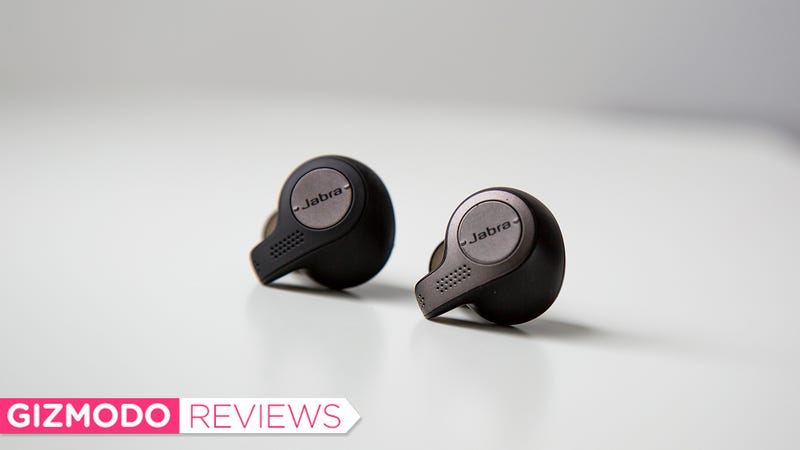
The $190 Jabra Elite Active 65t, which is water resistant, is on the left, and the $170 Jabra Elite 65t is on the right.
Photo: Adam Clark Estes (Gizmodo)
A weird thing about reviewing gadgets for a living is that my neighbors notice. Sometimes they just call me out for getting a lot packages in the mail. Other times, they ask me for advice. One neighbor recently pointed out the $190 Jabra 65t Elite Active truly wireless buds I was wearing in the elevator. “What do you think?” he asked. After taking the earbud out of my head and asking him to repeat the question, I was honest and probably a little bit surprised by my candor. I said, “I love them. You should buy them.”
This is a rare, direct recommendation for me. It’s also not the best advice for everyone. (I’ll come back to that fact in a second.) In writing reviews like this one, I’m always confronted with the should-you-buy decision, and my answer is always complicated by a myriad factors that draw from who’s buying this thing and why they might want it. The earbuds my neighbor noticed, the Jabras, are simply great for my ears. They fit great. They sound great. They work great. But the kicker—what makes these earbuds really stand out—they’re remarkably good for phone calls.
Like I said, the earbuds come from Jabra, a quirky Danish company that got its start making top-notch headsets for businesses and call centers. This bit of company history is the first clue that the microphones on the Elite Active 65t are exceptional. The second clue, I’d argue, is the design.
The Elite Active 65t earbud looks like a slimmed-down version of the Jabra Stealth Bluetooth headset. A little microphone unit extends from the front of the bud and sits just above your earlobe. There are actually four microphones placed around the earbud that also provide wind and ambient noise reduction. The Elite Active earbuds are also rated IP56, which means that they’re dust-proof and sweat-proof. They are not, however, waterproof enough to go underwater. Jabra also sells a non-active version of the earbuds called the Elite 65t. These are cheaper at $170 and look almost identical, except for a shinier plastic case. Both have a luxurious battery life of five hours with two more full charges in the included charging case.
The whole setup works on both models of earbuds. I can listen to a podcast as a subway train roars by and not worry about cranking up the volume. I can also hear the person on the other end of a phone call with fantastic clarity—even on busy city streets—thanks to the surprisingly good noise-cancelling. More impressively, they can hear me, too. Results vary. My mom says she can hear me “great,” while my dad said, “It sounds like you’re in a barrel.” Adjusting the position of the microphone fixed that problem, however.
Photo: Adam Clark Estes (Gizmodo)
This is some extraordinary shit, in my opinion. I’ve been using truly wireless earbuds exclusively for well over a year, and for the most part, it’s great. Battery life and audio quality is typically good enough that I can listen to music and podcasts quite enjoyably. Truly wireless earbuds are also small enough that I can take them out and easily put them in my pocket when I’m not using them. No more tangle cords or wearing headphones like a necklace. My biggest complaint with every set of truly wireless buds I’ve tried until now, however, is the simple fact that the microphones suck. The microphones suck on most headphones, to be honest. This means that the promise of making hands-free phone calls is usually supplanted by the reality of making one-handed phone calls.
The Jabras are different, though. I’ve been testing both the Elite Active 65t and the regular Elite 65t on and off for several months. When I use them, I use them for phone calls without worrying about sounding like I’m underwater. Aside from my dad’s jab, I haven’t had any complaints for anyone else I’ve talked to while using the earbuds.
What’s especially impressive is that the battery practically never dies. Other wireless earbuds suffer from batteries that last half as long as the Jabras, and that can be a dealbreaker. But five hours typically lasted me an entire day of using the earbuds on and off. The charging case is also small enough that I could carry it around in my pocket in case I think I might run out of juice.
Photo: Adam Clark Estes (Gizmodo)
Now, about size. The Jabra Elite 65t earbuds are not for small ears. Most truly wireless buds—like the Bose SoundSport Free or the Sony Experia Ear Duo—put the bulk of the electronics in a module that floats on the outside of your ear. This means you can swap out different-sized rubber attachments to fit more ear sizes. One exception to this trend is the Apple AirPods, which are just a hunk of plastic. If they don’t fit in your ears, they don’t fit. The other exception is the Jabra Elite 65t. The design includes a big hunk on the backside of the earbud that’s meant to fit flush into your ear, while a rubber bud nestles in to your ear canal. If you have small ears, you might be screwed.
I’m in love with the Jabra earbuds, in part, because they fit my ears perfectly. With most of the bulk hidden behind the sleek exterior, it almost looks like I’m not wearing anything to the casual observer. Meanwhile, I’m thrilled by the excellent microphone, incredible battery life, and terrific sound quality. A small-eared person might not get to enjoy any of these benefits due to simple physics. But not me.
Photo: Adam Clark Estes (Gizmodo)
So this is a subjective one if you’re worried about fit. That’s what I told my neighbor, too, after he asked me about buying earbuds. You should try on the Jabra Elite 65t before committing to them. Jump around, shake your head, and make sure they really fit. This is honestly good advice for buying any set of headphones. If you’re going to attach them to your head for several hours a day, you want the headphones or earbuds to fit. And if you can make phone calls with them too, well, you’ve got something special.
README
Exceptionally good microphone and noise-cancelling for phone calls
Sleek design fits snugly into your head
But that sleek design might be too big for your ears
CRISPR-associated protein Cas9 (white) from Staphylococcus aureus based on Protein Database ID 5AXW. Credit: Thomas Splettstoesser (Wikipedia, CC BY-SA 4.0)
Despite high hopes and high investment in CRISPR-Cas9 gene editing, scientists still have a lot to learn about how it works in humans.
In the latest example, University of California, Berkeley, scientists found that people’s assumptions about how cells repair the genome after the Cas9 enzyme snips DNA are wrong.
The discovery gives insight into why CRISPR-Cas9 gene editing works remarkably well in nearly every cell attempted, though not with equal success in all cells. And it could help researchers boost the efficiency with which cells insert new DNA into the genome—to replace a harmful mutation with the correct DNA sequence, for example—and generally tweak CRISPR-Cas9 editing to get the desired outcome.
“If you want to treat sickle cell anemia, your chances of success are inextricably tied to the efficiency with which you can replace the mutated sickle cell gene with the correct one,” said UC Berkeley postdoctoral fellow Chris Richardson, first author of a paper describing the findings. “If you harvest a million cells from a patient and you have 10 percent insertion rate, that is not as good as if you have 30 to 40 percent. Being able to manipulate those cells to increase the frequency of this process, called homology-directed repair, is exciting.”
“Gene editing is super-powerful, with a lot of promise, but, so far, a lot of trial and error. The way it works in human cells has been a black box with a lot of assumptions,” said lead author Jacob Corn, a UC Berkeley adjunct professor of molecular and cell biology. “We are finally starting to get a picture of what’s going on.”
Corn, Richardson and their colleagues will publish their findings in the August issue of the journal Nature Genetics, available online now.
Corn was until recently the scientific director of biomedicine in the Innovative Genomics Institute, a joint CRISPR research program between UC Berkeley and UC San Francisco. This fall, he will join the faculty of ETH in Zurich, Switzerland.
CRISPR relies on DNA repair
CRISPR-Cas9 is revolutionary because of the precision with which it homes in on a specific DNA sequence out of billions in the genome and cleaves the double-stranded DNA molecule. But after that, it’s up to the cell to repair the damage.
Repair can happen in two ways. Enzymes can stitch the dangling ends back together, which often results in one or more bases—the building blocks of DNA—being added or deleted, disrupting the function of the gene. Alternatively, other enzymes can patch the break with a single strand of DNA that matches the DNA sequence upstream and downstream of the cut. A complementary DNA strand is created to complete the double-strand repair.
The former, called non-homologous end-joining, appears to be the most common outcome after CRISPR cutting. The latter, homology-directed repair, happens more frequently in some types of cells than others, and requires the presence of a piece of DNA that can be used to patch the break. Researchers often supply a single-stranded piece of DNA and hope that the cell uses it to replace the faulty sequence with the new one.
Both processes are a bit mysterious, however, and no one knows why some cells readily patch in DNA while others do so infrequently.
“The enthusiasm for using CRISPR-Cas9 for medical or synthetic biology applications is great, but no one really knows what happens after you put it into cells,” Richardson said. “It goes and creates these breaks and you count on the cells to fix them. But people don’t really understand how that process works.”
To find out which DNA repair enzymes are critical to homology-directed repair after CRISPR cutting, Richardson and Corn employed a technique called CRISPR interference (CRISPRi) to knock out, one at a time, more than 2,000 genes known or suspected to be involved in DNA repair, a function critical to a healthy cell.
Surprisingly, many of the genes that proved to be important—homology-directed repair dropped dramatically when they were silenced—were involved in an important repair system not thought to be involved in CRISPR repair.
Fanconi anemia
The pathway involves 21 separate proteins and is called the Fanconi anemia pathway because, if any of the genes for these proteins is damaged, people develop Fanconi anemia, a rare but serious hereditary disease in which the bone marrow cannot make enough new blood cells. It is associated with birth defects and a high risk of cancer, including a 10 percent chance of developing leukemia in childhood. Few patients live beyond 30 years of age.
The pathway has been known and studied for decades, but it was largely understood to repair one specific kind of DNA damage: DNA interstrand crosslinks, where a nucleotide on one strand of DNA bonds tightly with a nucleotide on the adjacent strand, interfering with DNA replication and often killing the cell. Researchers in the 1980s had reported a connection between homology-directed repair and the Fanconi anemia pathway, but it had been ignored or misunderstood, Corn noted.
“Based on our work, we believe that the Fanconi anemia pathway plays a major role in fixing other types of lesions as well, but is best understood as the pathway that repairs double-strand breaks,” Richardson said. “After Cas9 editing, the Fanconi anemia pathway is required if you want to insert new DNA.”
The importance of the Fanconi anemia pathway in repairing CRISPR breaks throws into doubt some planned CRISPR treatments for the disease itself, however. Without an active Fanconi anemia pathway, cells may not be able to replace their mutated genes with normal genes after Cas9 makes a cut.
In fact, the level of activity of the Fanconi anemia pathway may affect how efficiently CRISPR can insert DNA in a specific cell. The researchers concluded that, while end-joining is the default repair mechanism after a double-strand break, the Fanconi anemia pathway competes with it, and that higher activity results in more homology-directed repair and less end-joining.
Cancer treatments
While the findings help scientists better understand the DNA repair mechanisms in human cells, they could also help researchers developing anti-cancer therapies that target DNA repair in cancer cells. Because other factors now appear to be involved in the repair of double-strand breaks, this research expands the list of proteins that could be misregulated in order to screw up DNA repair in cancer cells and make them more susceptible to death.
Richardson also found that one of the 21 proteins in the pathway, FANCD2, always homes in on the site of the double-strand break created by CRISPR-Cas9, indicating it plays an important role in regulating the insertion of new DNA into the genome at the cut site. FANCD2 could be tweaked to boost the frequency with which a cell inserts DNA via homology-directed repair.
“Also, since FANCD2 localizes to the site of Cas9 breaks, you can use FANCD2 to map where Cas9 is cutting in any cell type,” Richardson said. “If you edit a population of cells and you want to know where the on- and off-target cuts are, you can just map where FANCD2 was found in the genome and you can find the cuts.”
“The whole Fanconi anemia pathway affects the balance between end-joining and homology-directed repair; it acts like a traffic cop,” Corn said. “So a patient’s genotype will affect how you do gene editing.”
More information: Chris D. Richardson et al, CRISPR–Cas9 genome editing in human cells occurs via the Fanconi anemia pathway, Nature Genetics (2018). DOI: 10.1038/s41588-018-0174-0
This bacteria could boost solar panels on cloudy days
Jul 30, 2018
Popular Science highlighted UBC researchers who have developed a cheap, sustainable solar cell from the E. coli bacteria.
“We believe that biogenic solar cells will be a useful complement to inorganic solar cell technology,” said Vikramaditya Yadav, a professor in UBC’s department of chemical and biological engineering.
Mozilla is rebranding Firefox. The company is asking for feedback on the new look, which will try to cover the various Firefox offerings.
For most people, Firefox refers to a browser, but the company wants the brand to encompass all the various apps and services that the Firefox family of internet products cover, “from easy screenshotting and file sharing to innovative ways to access the internet using voice and virtual reality.” The fox with a flaming tail “doesn’t offer enough design tools to represent this entire product family,” Mozilla believes.
Instead of recoloring the logo and dissecting the fox, the company wants to start from scratch. That said, the name “Firefox” is staying, so Mozilla doesn’t have that much wiggle room.
A team of Mozilla product and brand designers has come up with two options:
The first icon is the Firefox masterbrand icon, an umbrella under which all the product lines will live. Mozilla hopes this is what users will one day think of when they hear the word “Firefox.”
The next lines, in order, are as follows: general purpose browser icons (including Developer Edition and Nightly colors), singularly-focused browser icons (Firefox Focus and Firefox Reality), and finally new applications and services (the five icons in the last two lines).
The two design system are supposed to “embrace all of the Firefox products in the pipeline and those still in the minds of our Emerging Technologies group.” Mozilla is asking users for feedback, just like when it revamped the Mozilla brand.
To be clear, that means Mozilla is not crowdsourcing the answer, is not asking users to vote, and is not asking for free design submissions. The company is simply asking for users to comment what they think on the announcement blog post.
Before you comment, however, you should read this warning:
Extreme caveat: Although the products and projects are real, these design systems are still a work of fiction. Icons are not final. Each individual icon will undergo several rounds of refinement, or may change entirely, between now and their respective product launches. Our focus at this point is on the system.
Mozilla is still exploring typography, graphic patterns, motion, naming, events, partnerships, and other elements of the system. A final system will be rolled out “over the next few months” based on user feedback, formal user testing, and “our product knowledge and design sensibilities.”
Mozilla says it will be using these criteria to evaluate the work:
Do these two systems still feel like Firefox?
How visually cohesive is each of them? Does each hold together?
Can the design logic of these systems stretch to embrace new products in the future?
Do these systems reinforce the speed, safety, reliability, wit, and innovation that Firefox stands for?
Do these systems suggest our position as a tech company that puts people over profit?
Personally, I’m struggling with the first question for both designs. But maybe that’s because I only saw the proposals a few days ago — I guess the second one could grow on me.






 Bruce's Blog