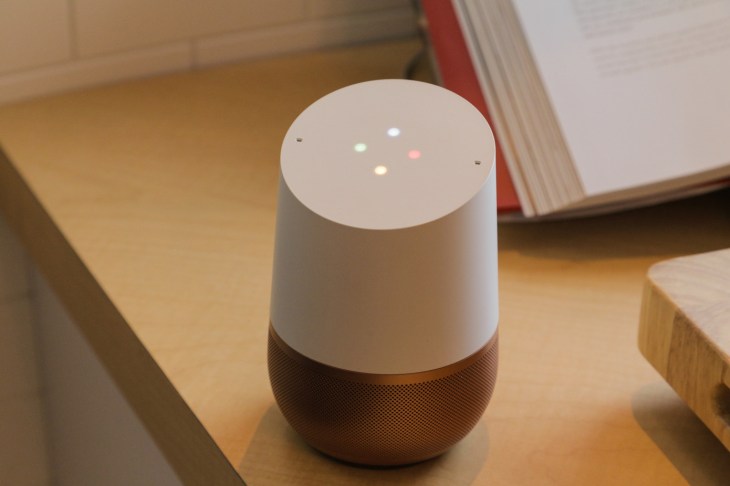
Back at Google I/O, Google announced two new features for Google Assistant: custom routines and schedules — both focusing on automating things you do regularly, but in different ways.
The first lets you trigger multiple commands with a single custom phrase — like saying “Hey Google, I’m awake” to unsilence your phone, turn on the lights and read the news. Schedules, meanwhile, could trigger a series of commands at a specific time on specific days, without you needing to say a thing.
While custom routines launched almost immediately after I/O, scheduling has been curiously absent. It’s starting to roll out today.
As first noticed by DroidLife, it looks like scheduling has started rolling out to users by way of the Google Home app.
To make a schedule:
Open the Google Home app
Go to Settings>Routines
Create a new routine with the + button
Scroll to the “Set a time and day” option to schedule things ahead of time
If you don’t see the “time and day” option yet, check back in a day or two. Google is rolling it out over the next few days (generally done in case there’s some bug it missed), so it might pop up without much fanfare.
Want your bedroom lights to turn on every morning at 7 am on workdays? You can do that. Want that song from the Six Flags commercials to play every day at noon to get you over the hump and/or drive your roommates up a wall? Sure! Want to double-check the door lock, dim the downstairs lights and make sure your entertainment center is off at 2 am? If you’ve got all the smart home hardware required, it should be able to handle it.
While a lot of things you might use Google Assistant for can already be scheduled through their respective third-party apps (most smart lights, for example, have apps with built-in scheduling options), this moves to bring everything under one roof while letting you fire off more complicated sequences all at once. And if something breaks? You’ll know where to look.
Philips Hue is releasing a connected bathroom mirror that lights up
By Patrick O’Rourke
It looks like Philips has plans to rapidly expand its Hue smart light ecosystem. Just last week the tech giant released its outdoor smart lights in Canada, and now it looks like Philips has plans to expand into the bathroom with a new connected mirror that lights up. The Adore Bathroom mirror look it will work like a standalone light-up mirror, but just like Hue’s other products, it will also be capable of connecting to a Hue Bridge Hub in order to connect it to your smart home setup. While most of Hue’s other devices are plug-and-play, it looks like the Adore Bathroom mirror needs to be connected directly to a wall socket and permanently installed.
The mirror’s product listing says that it features IP44 water resistance, which makes sense given its designed to be used in a bathroom. It also seems to only feature adjustable white light and not rainbow-colours like other Hue products. While the Adore Bathroom mirror is currently listed on Hue’s website, it’s unclear how much it will be price in Canada. Further, it’s also not currently in stock. We’ve reached out to Philips for more information and will update this story when we hear back. Rumours also surfaced this week that Hue has plans to release Colour Outdoor Lightstrips.
Telus Prepaid Pay-Per-Use to Require Minimum $10 Plan for All Subscribers [u]
Telus has announced to prepaid customers on pay-per-use plans changes are coming as of August 26, 2018, requiring all subscribers to pay a minimum $10 rate plan.
The company updated customers via text message today—the full text is below, as relayed by iPhone in Canada reader, Peter:
TELUS Update: Prepaid pay-per-use will be changing as of August 26, 2018 and all subscribers now require a minimum $10 rate plan. As a valued customer, you’ll automatically be enrolled in an exclusive $10/month rate plan on this date, which includes 500 local anytime mins along with 100 msgs. Note: extra usage will be charged at pay-per use rates of $0.60/min and $0.50/msg.
If you prefer to choose a different rate plan, please log in to telus.com/mytelus or call #123. If you switch to an in-market rate plan, you won’t be able to get this exclusive rate plan back. For more details on the upcoming change, please visit https://www.telus.com/en/bc/mobility/prepaid/pay-per-use?CMP=sms_telus_srv_mob_ser_adhoc_PPU_Update_jul_jul_2018_
So existing customers will be automatically signed up to $10 per month plans, which will include 500 local anytime minutes and 100 text messages, with overages charged at $0.60 per minute (a 400% increase) and $0.50 per message, respectively. Long distance minutes will cost $1.20 per minute.
According to Peter, he’s on the Messaging 250 plan which costs $5 per month and includes 250 outgoing and incoming text messages, along with calls at $0.15 per minute. The new plan means he no longer will receive free incoming text messages, he says, as they are now $0.50 each to receive.
On the company’s FAQ page, Telus explains why they are changing prepaid pay-per-use plans, below:
In order to maintain our current network, IVR, Self-serve and call center experience. We also want to continue to be the leader in the prepaid space.
Telus requires all prepaid pay-per-use customers to maintain their rate plan with a balance (updated). Those with existing rate plans will “continue to keep their rate plan,” but those who do not have a rate plan will automatically see this $10 rate plan added to their account.
Are you a Telus prepaid pay-per-use customer affected by this upcoming change?
Fire wheel: The Milky Way system, called galaxis, resembles a gigantic spiral with an estimated 200 billion stars. One of them is our sun. Credit: Robert Hurt/SSC/Caltech/JPL/NASA Robert Hurt
For thousands of years, people have been puzzling over the milky strip that extends across the entire firmament. In the modern era, Galileo Galilei discovered that this Milky Way consists of countless stars. However, it was not until the 20th century that astronomers succeeded in deciphering its form and its true nature.
“My third observation relates to the nature of the Milky Way (…) No matter which part of it one targets with the telescope, one finds a huge number of stars, several of which are quite large and very striking; yet, the number of small stars is absolutely unfathomable.” These words were written in 1610 by a man who with his self-constructed telescope studied unknown lands that were not of this world. It was this work that earned him a place in history: Galileo Galilei.
The land that he described is literally out of this world, and the document bears the title Sidereus Nuncius (“Starry Messenger”). In it, the Italian mathematician and astronomer presents his observations of the satellites of Jupiter, the Earth’s moon and also the Milky Way. Until then, their nature had remained a mystery, and had above all been the subject of mythology. The Greek natural philosopher Democritus had already claimed in the 5th century BC that the diffusely glowing strip in the sky – known by the African !Kung bushmen as the “backbone of the night” – consisted of countless weak stars.
Grindstone in the firmament
After the discovery made by Galilei, however, nearly 150 years would pass before this celestial structure would again became the subject of scientific study. Thomas Wright of County Durham believed that stars were arranged in a flat region similar to a grindstone, which extended over the entire sky. For him, the Milky Way was nothing other than the projection of this grindstone. The German philosopher Immanuel Kant seized on this theory – and came very close to discovering the truth.
In his General Natural History and Theory of the Heavens, published in 1755, he explained the Milky Way as an extended and very diluted layer of stars. The sun, the Earth and all the other planets were part of this layer—but not at its centre. Depending on the line of sight, along the plane of the layer or vertically out of it, we would see different numbers of stars.
Curved: from the side, the galaxy looks like a slightly bent wheel. It has a diameter of about 100,000 and a thickness of only 5,000 light years. Around the centre there is a bright, spherical bulge. Credit: Helmut Rohrer
But how were the astronomers to find out whether the apparent view of the Milky Way in the sky reflected its actual spatial structure? Stellar statistics devised at the end of the 18th century by Friedrich Wilhelm Herschel promised a solution: Herschel recorded the coordinates and brightness of all the stars that he could see through his telescope.
However, the undertaking failed: apart from the unreliability of these measurements – for example, although it was possible to determine the apparent brightness of the stars, it was impossible to determine their absolute luminosity and hence their distance – there was also a fundamental problem: the Milky Way is filled with interstellar matter, gas and dust clouds that absorb the light from the stars. This obscures the view of the central region and makes it impossible to see the overarching structure. For this reason, stellar statistics can never encompass the system as a whole, but only the region around the sun up to a radius of about 10,000 light-years. The breakthrough did not come until the middle of the 20th century, when astronomers learned to look at the sky with different eyes using radio telescopes.
A look through curtains of dust
Hydrogen is the most common element in the universe. As part of interstellar matter, neutral hydrogen (H1) fills the space between the stars, and thus also fills the Milky Way. This means that the distribution of clouds of hydrogen gas trace the shape of the whole system, similar to the way in which bones shape the human body.
But how can these cosmic “bones” be made visible? The answer is provided by the nanouniverse: in the ground state of hydrogen, the direction of spin of the atomic nucleus and the electron that orbits around it are antiparallel. If two hydrogen atoms collide, the direction of spin of the nucleus and the electron may be flipped to end up parallel to each other – and after a certain time, they return to their basic antiparallel state.
This process releases energy, which is radiated as an electromagnetic wave. This line lies in the radio range of the electromagnetic spectrum. Despite the extremely low density of interstellar matter, atoms are constantly colliding, causing the H 1 areas to glow in the light of this hydrogen line.
Close view: this image of the central part of the Milky Way shows a region of 1000 x 500 light years and was taken with the MeerKAT telescope stationed in South Africa, a system consisting of 64 radio antennas. Credit: SARAO
This radiation penetrates the dust curtains almost unobstructed and can be picked up by radio telescopes. Thanks to this new window into the universe, astronomers have been able to discover the spiral structure of the Milky Way. However, in the 1970s, researchers found that hydrogen alone was not sufficient as an indicator of the galaxy’s morphology because, for example, it is less concentrated in the spiral arms than expected. The search began anew.
Arms in motion
The most important indicator turned out to be clouds of interstellar molecules; they emit radiation in the light of carbon monoxide (CO). Now it was gradually becoming possible to refine the portrait of the Milky Way. Accordingly, the galaxy (from the Greek word gala: milk) is a bent wheel, 100,000 light years in diameter and with a thickness of just 5,000 light years. The wheel hub with its black hole is surrounded by a spherical bulge of stars with an embedded cigar-shaped structure – a kind of bar.
Around 15,000 light years from the centre, a ring extends that also consists of dust and gas clouds, as well as stars. The galaxy is characterised by several arms. Most of them bear the names of the stellar constellations in which we observe them: the Sagittarius and Perseus Arms, the Norma and Scutum-Crux Arms, the 3-Kiloparsec Arms and the Cygnus Arm.
Our solar system is located in the Orion Arm, 26,000 light-years from the centre and almost on the main plane. The system, which contains around 200 billion suns, is surrounded by a spherical halo containing thousands of globular star clusters and a spherical region consisting of very thin hydrogen plasma. The entire galaxy rotates, with objects closer to the centre rotating faster, and those further from the centre rotating more slowly. The curve of this differential rotation shows irregularities that cannot be explained by visible mass alone.
Here, it is likely that invisible dark matter plays a role. And the astronomers face yet another problem: despite the rotation, the spiral arms do not unwind, but have maintained their shape for billions of years. One explanation for this is shockwaves that propagate throughout the whole system and compact the matter in the spiral arms like a traffic jam on the motorway. Researchers are still puzzling over what causes these density waves.
Book-Sized Solar Panels Could Power a Whole Home in New Breakthrough
Scientists have developed a pioneering new technique that could generate enough electricity to power an entire home – all by using solar panels that are much smaller than current models.
A team of experts from the University of Exeter has discovered an innovative way for generating photovoltaic (PV) energy – or ways in which to convert light into power.
The new technique relies on ‘funneling’ the sun’s energy more efficiently directly into power cells, such as solar panels or batteries.
Crucially, this ground-breaking method has the potential to harvest three times the energy compared with traditional systems. The researchers believe their breakthrough could result in solar panels, no bigger than a book, producing enough energy to power a family-sized house.
Adolfo De Sanctis, who is the lead author of the paper, said: “The idea is similar to pouring a liquid into a container, as we all know it is much more efficient if we use a funnel. However, such charge funnels cannot be realized with conventional semiconductors and only the recent discovery of atomically thin materials has enabled this discovery.”
In the research, the team of physics experts developed a process to ‘funnel’ electrical charge onto a chip. Using the atomically thin semiconductor hafnium disulphide (HfS2), which is oxidized with a high-intensity UV laser, the team was able to engineer an electrical field that funnels electrical charges to a specific area of the chip, where they can be more easily extracted.
While current solar cells are able to convert around 20% of the energy received from the sun, the new technique has the potential to convert around 60% of it by funneling the energy more efficiently.
New Pixel 3 XL leak reminds us the Note 9 isn’t the only hot Android phone about to launch
One of the hottest Android smartphones of the year is about to launch, the new Galaxy Note, and Samsung’s phone is dominating the rumor mill. We know everything there is to know about the Galaxy Note 9, either because Samsung can’t keep any secrets or because it’s actively encouraging leaks as a way to drive up buzz for the handset. The Galaxy S9 wasn’t the best-selling phone Samsung thought it would be, so the company is hoping that the Note 9 will do better than its predecessor.
But the new Note 9 is not the only hot Android phone about to launch. Google’s Pixel 3 series is due in late September or October, and we have a brand new leak for you that shows Google’s next-gen design for its handset line.
While the Galaxy Note 9 will have a “boring” design since it’ll look just like the Note 8, the Pixel 3 XL will bring over a new design. Some people might not like the fact that Google is copying the iPhone X, but that’s precisely what will happen later this year.
The Pixel 3 XL will have all the characteristics of every other iPhone X clone out there, including a notch at the top and a bottom bezel since Google doesn’t want to cough up the cash needed to copy the iPhone X properly. We already saw a bunch of Pixel 3 XL renders based on leaked CAD files, as well as real-life photos of a prototype, so the following image won’t come as a surprise.
Obtained by GizmoChina, the render shows a new case for the Pixel 3 XL. All the design elements we saw in previews leaks are there. On the front we’ve got a somewhat thick notch at the top that features two cameras and a front-speaker, as well as a bottom bezel that incorporates a second speaker. On the rear, there’s a single-lens camera and a fingerprint sensor. Finally, there’s a single port on the bottom, the USB-C connector. Like Apple and many others, Google also killed the headphone jack so don’t expect one on the Pixel 3 phones.
The new Pixels should hit stores by mid or late October, assuming Google doesn’t make any changes to its Pixel launch strategy.
This artist’s impression provided by the European Southern Observatory in July 2018 shows the path of the star S2 as it passes close to the supermassive black hole at the center of the Milky Way galaxy.
M. KORNMESSER/THE CANADIAN PRESS
A team of international scientists observing a star in the Milky Way have for the first time confirmed Einstein’s predictions of what happens to the motion of a star passing close to a supermassive black hole.
Einstein’s 100-year-old general theory of relativity predicted that light from stars would be stretched to longer wavelengths by the extreme gravitational field of a black hole, and the star would appear redder, an effect known as gravitational red shift.
“This was the first time we could test directly Einstein’s theory of general relativity near a supermassive black hole,” Frank Eisenhauer, senior astronomer at the Max Planck Institute for Extraterrestrial Physics, told journalists.
“At the time of Einstein, he could not think or dream of what we are showing today,” he said.
A team of scientists at the European Southern Observatory started monitoring the central area of the Milky Way using its Very Large Telescope to observe the motion of stars near the supermassive black hole 26 years ago.
The black hole is 26,000 light years away from Earth and has a mass 4 million times that of the Sun.
The scientists selected one star, S2, to follow. With an orbit of 16 years, they knew it would return close to the black hole in 2018.
Over 20 years, the accuracy of their instruments has improved and so in May 2018, they were able to take extremely precise measurements in conjunction with scientists from around the world.
This showed the star’s orbital velocity increasing to more than 25 million kph (15.5 million mph) as it approached the black hole.
The star’s wavelength stretched as it sought to escape the gravitational pull of the supermassive black hole, shifting its appearance from blue to red, Odele Straub from the Paris Observatory said.
The scientists now hope to observe other theories of black hole physics, she said.
“This is the first step on a long road that the team has done over many years and which we hope to continue in the next years,” MPE’s Reinhard Genzel, who led the international team, said.
New design for Gmail for Android shown off at Google cloud conference
The new design features an all-white theme with multi-coloured icons
Google showed off some of what’s coming for Gmail at its Cloud Next 2018 conference in San Francisco on Wednesday. In a ‘directional slide’ the company gave attendees a look at the new Material Design of Gmail for Android. While the update appears to take some queues from the recent Gmail for Web update, it’s actually smaller in scale. An important note, the slide shows the direction the team is going in, but not necessarily the final product.
That being said, it does look good if you’re a fan of white. Like many Google apps, Gmail for Android is going all white, with colourful icons that pop on the screen. That means the classic red accents are gone. Furthermore, the top of the app features a full-width search bar.
The navigation drawer button resides on the left side of the search bar and a profile icon resides on the right. A large white circle button with a multi-coloured plus sign makes it’s home in the bottom right corner of the app. Additionally, the inbox view will feature a new list containing images, files and other attachments for easy access.
Finally, Gmail will get new density options so people can decide how much information they want on screen. Attendees also got a glimpse of upcoming Gmail for Web features. The Gmail team is testing a bottom carousel that can suggest contacts, attachment types and other filters. Attendees were also told during a Q&A that Inbox, Gmail’s experimental email app, would not change.
Tesla Model 3 Performance test-drive highlights real-world 0-60 capabilities
When Elon Musk announced the specs of the Tesla Model 3 Performance, he stated that the electric car would be able to beat a BMW M3 on the track. With instant torque from its dual electric motors, the Model 3 Performance has the potential to be the Model S P100D’s smaller, more track-capable sibling. Earlier this month, Tesla started a test drive program for the high-performance vehicle in selected showrooms. One of these test drives, which included a sprint from 0-60 mph, was recently posted on YouTube.
The video, uploaded by Kevin B, featured a test drive session in the Model 3 Performance provided by Tesla’s Costa Mesa Sales & Delivery Center in Orange County, CA, located roughly one hour south of Los Angeles. Considering that the Model 3 Performance’s main draw is its speed and handling over the vehicle’s single motor and non-performance siblings, Kevin opted to simulate a real-world highway sprint from 60 to 85 mph and a 0-60 mph dash from a freeway entry ramp.
Knowing how to deal with (or prevent) baggage mishaps can be a life-saver.
Although Kevin didn’t officially time the run – after all, it was a test drive that was chaperoned by a Tesla sales advisor – the video indicates that it took around 4 seconds for the car to hit 60 mph. The torque was notable during the launch, and the acceleration was smooth and consistent, even with four adults inside the car. A demo for Enhanced Autopilot as the electric car traveled on the 405 Freeway south near the Rt 73 Interchange was also included in the test drive.
The Model 3 Performance starts at $64,000 before options. With a Performance Package that includes 20″ Performance Wheels, Michelin Pilot Sport 4S summer tires, a carbon fiber rear spoiler, aluminum alloy pedals, and a top speed boost that enables the electric car to max out at 155 mph, the vehicle’s cost hikes up to $69,000. With all options including Enhanced Autopilot and Full Self-Driving, the Model 3 Performance is priced at $80,000, making it lower-priced than comparable vehicles like the BMW M3, the Mercedes AMG C 63 S Coupe, and the Audi RS5.
The vehicle is propelled by two electric motors that generate a combined 450 hp and 471 lb-ft of torque, giving the car the capability to sprint from 0-60 mph in 3.5 seconds. In a recent announcement on Twitter, Elon Musk noted that the Model 3 Performance’s speed and handling could be improved by fitting the vehicle with wider rear wheels and tires. With the setup, Musk stated that the electric car’s 0-60 mph time could be reduced to 3.3 seconds.
Considering Tesla’s tendency to improve its vehicles over time, as well as Musk’s previous approval of a suggestion pertaining to a Ludicrous Mode for the Model 3 Performance, there is a pretty good chance that buyers of the electric car could see their vehicles get speed improvements within the next months, or even years for that matter.
Watch the test drive of the Model 3 Performance in the video below.
Interested in solar? Get a solar cost estimate and find out how much a solar system would cost for your home or business.
Black holes aren’t surrounded by a burning ring of fire after all, suggests new research.
Some physicists have believed in a “firewall” around the perimeter of a black hole that would incinerate anything sucked into its powerful gravitational pull.
But a team from The Ohio State University has calculated an explanation of what would happen if an electron fell into a typical black hole, with a mass as big as the sun.
“The probability of the electron hitting a photon from the radiation and burning up is negligible, dropping even further if one considers larger black holes known to exist in space,” said Samir Mathur, a professor of physics at Ohio State. The study appears in the Journal of High Energy Physics.
The new study builds on previous work from 2004 led by Mathur that theorized that black holes are basically like giant, messy balls of yarn—fuzzballs” that gather more and more heft as new objects are sucked in. That theory, Mathur said, resolved the famous black hole “information paradox” outlined by Steven Hawking in 1975. Hawking’s research had concluded that particles entering a black hole can never leave. But that ran counter to the laws of quantum mechanics, creating the paradox.
The firewall argument emerged in 2012, when four physicists from the University of California, Santa Barbara argued that any object like a fuzzball would have to be surrounded by a ring of fire that will burn any object before it could reach the fuzzball’s surface.
“What we’ve shown in this new study is a flaw in the firewall argument,” Mathur said.
Black holes are places in space with such immense gravitational pull that not even light can escape once it’s captured. Their powerful pull condenses any matter black holes draw in. They are invisible, but scientists have established that black holes can range from tiny to huge, estimations that are based on the behavior of stars and gas surrounding the black hole.
After months of mathematical machinations, Mathur and his team arrived at their by-the-numbers explanation to support their theory discounting the firewall. It’s built on string theory, the scientific notion that the universe is composed of subatomic string-like tubes of energy. The belief is rooted in the marriage of quantum mechanics (which concerns itself with the mathematics of subatomic particles) and Albert Einstein’s theory of relativity.
Mathur has always counted himself among those scientists who are firewall skeptics.
“The question is ‘Where does the black hole grab you?’ We think that as a person approaches the horizon, the fuzzball surface grows to meet it before it has a chance to reach the hottest part of the radiation, and this is a crucial finding in this new physics paper that invalidates the firewall argument,” he said.
“Once a person falling into the black hole is tangled up in strings, there’s no easy way to decide what he will feel.
“The firewall argument had seemed like a quick way to prove that something falling through the horizon burns up. But we now see that there cannot be any such quick argument; what happens can only be decided by detailed calculations in string theory,” Mathur said.


/arc-anglerfish-tgam-prod-tgam.s3.amazonaws.com/public/BCM7EVHDVVI3NG5JNYTQPBDLTQ.jpg)


 Bruce's Blog