Canadians among the most susceptible to skin cancer, study finds
A doctor inspects a patient’s mole for skin cancer in this file photo. (damiangretka / istock.com)
Canadians might adore their short summers and flock to the beaches in droves, but a new report finds we also have one of the highest risks of developing skin cancer.
A new study has ranked Canada 19th on a list of 62 countries with the highest susceptibility to skin cancer.
The study graded countries on several factors, including its average UV light, its average skin tone based on demographics, and its rates of new skin cancer diagnoses.
It was produced by Derma.plus, a German organization that provides dermatological advice.
New Zealand ranked highest on the skin cancer index, with a score of 10. The country, which receives high amounts of sunshine and where much of the population is white, has some of the highest skin cancer incidence rates in the world.
Australia was a close second, with a score of 9.67. Switzerland, Sweden and Norway rounded out the top 5 with scores in the 5 range.
While Canada doesn’t get at much sun as some countries on the list, it placed 19th on the list with a score of 3.41 in large part due to our skin type score, which was determined by looking at our ethnic distribution.
Bangladesh residents were found to be least susceptible to skin cancer, followed by those in Iraq and Egypt. All three countries scored a 1 on the index. (The study did not include data from most of the countries of Africa.)
Socioeconomic factors
To get a better sense of the efforts each country is making to treat skin cancer, the study also ranked countries on a Socioeconomic Treatment Index, which cross-referenced skin cancer death rates against average income and national health spending.
Sweden, Switzerland and Italy ranked in the top 3 on the index, while Canada ranked 22nd.
Australia, which has one of the highest skin cancer incidences in the world, also appears to have one of the lowest skin cancer death rates, at just 13 per cent, the study found. Italy, Denmark and the U.S. also have low mortality rates, at 14 per cent.
Canada’s skin cancer mortality rate sits at 21 per cent.
Nigeria, on the other hand, had the highest mortality rate on the list, at 67 per cent. Pakistan and China also had poor survivability, with mortality rates at 63 per cent, based on data from the World Health Organization.
Skin cancer is the most commonly diagnosed form of cancer in the world. If detected early, it can be one of the easiest to cure.
In Canada, approximately 80,000 cases of skin cancer are diagnosed here each year. That includes more than 5,000 cases of melanoma — the mostly deadly form.
Prof. Dietrick Abeck, chief medical adviser for Derma.plus notes that more than 3 million non-melanoma skin cancers and 150,000 melanoma skin cancers are diagnosed each year around the world.
“The incidence of both non-melanoma and melanoma skin cancers has increased dramatically over the past decades,” he said in a statement.
Ball-and-stick model of carbon dioxide. Credit: Wikipedia
Professor Arne Skerra of the Technical University of Munich (TUM) has succeeded for the first time in using gaseous CO2 as a basic material for the production of a chemical mass product in a biotechnical reaction. The product is methionine, which is used as an essential amino acid, particularly in animal feed, on a large scale. This newly developed enzymatic process could replace its current petrochemical production. The results have now been published in the journal Nature Catalysis.
The industrial production of methionine from petrochemical source materials is currently done via a six-step chemical process that requires highly toxic hydrogen cyanide, among other substrates. In 2013, Evonik Industries, one of the world’s largest manufacturers of methionine, invited university researchers to propose new processes for making the substance safer to produce. Methional, which occurs in nature as a degradation product of methionine, is formed as a facile intermediate during the conventional process.
“Based on the idea that methionine in microorganisms is degraded by enzymes to methional with the release of CO2, we tried to reverse this process,” explains Professor Arne Skerra from the Department of Biological Chemistry at TUM, “because every chemical reaction is in principle reversible, while often only with the extensive use of energy and pressure.” Skerra participated in the call for proposals with this idea, and Evonik awarded the concept and supported the project.
Supported by postdoctoral researcher Lukas Eisoldt, Skerra began to determine the parameters for the manufacturing process and for producing the necessary biocatalysts (enzymes). The scientists conducted initial experiments and determined the CO2 pressure which would be needed to produce methionine from methional in a biocatalytic process. Surprisingly, an unexpectedly high yield resulted even at a relatively low pressure—approximately corresponding to the one in a car tire of approximately two bars. Based upon the achievements after just one year, Evonik extended the funding, and now the team, reinforced by the Ph.D. student Julia Martin, investigated the biochemical background of the reaction and optimized the enzymes involved using protein engineering.
More efficient than photosynthesis
After several years of work, not only was it possible to improve the reaction on a laboratory scale to a yield of 40 percent, but also to elucidate the theoretical background of the biochemical processes. “Compared to the complex photosynthesis, in which nature also biocatalytically incorporates CO2 into biomolecules as a building block, our process is highly elegant and simple,” reports Arne Skerra. “Photosynthesis uses 14 enzymes and has a yield of only 20 percent, while our method requires just two enzymes.”
In the future, the basic principle of this novel biocatalytic reaction can serve as a model for the industrial production of other valuable amino acids or precursors for pharmaceuticals. Meanwhile, Professor Skerra’s team will refine the process, which has been patented, using protein engineering so that it will become suitable for large-scale application.
This could be the first time that there is a biotechnological manufacturing process using gaseous CO2 as an immediate chemical precursor. Up to now, attempts to recycle the greenhouse gas, which is a major contributor to climate change, have failed due to the extremely high energy required to do so.
More information: Julia Martin et al, Fixation of gaseous CO2 by reversing a decarboxylase for the biocatalytic synthesis of the essential amino acid l-methionine, Nature Catalysis (2018). DOI: 10.1038/s41929-018-0107-4
Brain discovery could block aging’s terrible toll on the mind
Faulty brain plumbing to blame in Alzheimer’s, age-related memory loss — and can be fixed
UNIVERSITY OF VIRGINIA HEALTH SYSTEM
IMAGE: OBSTRUCTING LYMPHATIC VESSELS (IN GREEN) IN A MOUSE MODEL OF ALZHEIMER’S DISEASE SIGNIFICANTLY INCREASED THE ACCUMULATION OF HARMFUL PLAQUES IN THE BRAIN. “WHAT WAS REALLY INTERESTING IS THAT WITH THE… view more
CREDIT: COURTESY KIPNIS LAB
Aging vessels connecting the brain and the immune system play critical roles in both Alzheimer’s disease and the decline in cognitive ability that comes with time, new research reveals. By improving the function of the lymphatic vessels, scientists at the University of Virginia School of Medicine have dramatically enhanced aged mice’s ability to learn and improved their memories. The work may provide doctors an entirely new path to treat or prevent Alzheimer’s disease, age-related memory loss and other neurodegenerative diseases.
The research is the latest from the lab of pioneering neuroscientist Jonathan Kipnis, PhD, whose team discovered in 2015 that the brain is surrounded by lymphatic vessels – vessels science textbooks insisted did not exist. That discovery made headlines around the world and was named one of the year’s biggest by Science, yet Kipnis sees his team’s new finding as their most important yet. “When you take naturally aging mice and you make them learn and remember better, that is really exciting,” he said. “If we can make old mice learn better, that tells me there is something that can be done. I’m actually very optimistic that one day we could live to a very, very, very old age and not develop Alzheimer’s.”
How the Brain Cleans Itself
It turns out that the lymphatic vessels long thought not to exist are essential to the brain’s ability to cleanse itself. The researchers’ new work gives us the most complete picture yet of the role of these vessels – and their tremendous importance for brain function and healthy aging.
Kipnis, the chairman of UVA’s Department of Neuroscience and the director of its Center for Brain Immunology and Glia (BIG), and his colleagues were able to use a compound to improve the flow of waste from the brain to the lymph nodes in the neck of aged mice. The vessels became larger and drained better, and that had a direct effect on the mice’s ability to learn and remember. “Here is the first time that we can actually enhance cognitive ability in an old mouse by targeting this lymphatic vasculature around the brain,” Kipnis said. “By itself, it’s super, super exciting, but then we said, ‘Wait a second, if that’s the case, what’s happening in Alzheimer’s?'”
The researchers determined that obstructing the vessels in mice worsens the accumulation of harmful amyloid plaques in the brain that are associated with Alzheimer’s. This may help explain the buildup of such plaques in people, the cause of which is not well understood. “In human Alzheimer’s disease, 98 percent of cases are not familial, so it’s really a matter of what is affected by aging that gives rise to this disease,” said researcher Sandro Da Mesquita, PhD. “As we did in mice, it will be interesting to try and figure out what specific changes are happening in the old [brain] lymphatics in humans so we can develop specific approaches to treat age-related sickness.”
Kipnis noted that impairing the vessels in mice had a fascinating consequence: “What was really interesting is that with the worsening pathology, it actually looks very similar to what we see in human samples in terms of all this aggregation of amyloid protein in the brain and meninges,” he said. “By impairing lymphatic function, we made the mouse model more similar to human pathology.”
Treating – or Preventing – Alzheimer’s
The researchers now will work to develop a drug to improve the performance of the lymphatic vessels in people. (Kipnis just inked a deal with biopharmaceutical company PureTech Health to explore the potential clinical applications of his discoveries.) Da Mesquita also noted that it would be important to develop a method to determine how well the meningeal lymphatic vasculature is working in people.
The researchers believe that the best way to treat Alzheimer’s might be to combine vasculature repair with other approaches. Improving the flow through the meningeal lymphatic vessels might even overcome some of the obstacles that have doomed previously promising treatments, moving them from the trash heap to the clinic, they said.
It may be, though, that the new discovery offers a way to stave off the onset of Alzheimer’s to the point that treatments are unnecessary – to delay it beyond the length of the current human lifespan.
“It may be very difficult to reverse Alzheimer’s, but maybe we would be able to maintain a very high functionality of this lymphatic vasculature to delay its onset to a very old age,” Kipnis said. “I honestly believe, down the road, we can see real results.”
Findings Published
The researchers have published their findings in the prestigious journal Nature. Antoine Louveau, who was the first author on the original discovery of the meningeal lymphatics, and Da Mesquita are the first authors of the paper. The team also included Andrea Vaccari, Igor Smirnov, R. Chase Cornelison, Kathryn M. Kingsmore, Christian Contarino, Suna Onengut-Gumuscu, Emily Farber, Daniel Raper, Kenneth E. Viar, Romie D. Powell, Wendy Baker, Nisha Dabhi, Robin Bai, Rui Cao, Song Hu, Stephen S. Rich, Jennifer M. Munson, M. Beatriz Lopes, Christopher C. Overall and Scott T. Acton.
Kipnis emphasized the collaborative nature of the work, noting the importance of many different areas of expertise. For example, the project included big data processing by Christopher Overall from the Department of Neuroscience/BIG center and contributions from Acton and Vaccari from the Virginia Image and Video Analysis Laboratory at UVA. Other important contributions came from UVA’s Center for Public Health Genomics, the Department of Neurosurgery and UVA’s Department of Biomedical Engineering. (The Department of Biomedical Engineering itself is a joint collaboration of UVA’s School of Medicine and School of Engineering.) “It’s another exemplification of how today research cannot be done in one place and one lab,” Kipnis said.
###
The work was supported by the National Institutes of Health’s National Institute on Aging, grants AG034113 and AG057496; the Cure Alzheimer’s Fund; the Hobby Foundation; the Owens Family Foundation; the Thomas H. Lowder Family Foundation; and the American Cancer Society, grant IRG 81-001-26.
Zapping your brain while you sleep could actually improve your memory
Technologies like Elon Musk’s proposed Neuralink promise augmentation of the human memory, courtesy of a special brain chip. If you’re not quite ready to dive into the world of brain implants to improve your memory function, however, you might appreciate a piece of research carried out recently by scientists at the Society for Neuroscience.
They have demonstrated a noninvasive overnight brain stimulation technique that promises to improve people’s ability to remember things. And you won’t have to worry about an overzealous engineer taking a miniature hacksaw to your skull – this technique won’t even disturb your sleep!
“We have shown that we can improve the integration of recent experiences into a more general form of memory through the process of sleep-dependent consolidation,” Dr. Nicholas Ketz, one of the researchers on the project, told Digital Trends. “We do this by selectively enhancing the natural slow-wave oscillations that occur during sleep, which are essential in this consolidation processes. Further, we’ve shown that we can use a fully closed-loop system that automatically detects these oscillations and stimulates at the matching frequency and phase of the ongoing slow waves, greatly improving our ability to influence the underlying brain state and thus the consolidation process.”
Participants in the researchers’ study were trained and then tested on a visual discrimination task in which they had to identify objects and people in a scene. Those who had been given the brain stimulation while sleeping were noticeably better at detecting those same targets in similar, but novel, situations.
Ketz said that there is still further work to be done, though.
“While the average response across the group of participants shows increased performance and enhanced slow-wave oscillations, many participants showed varying degrees of responsiveness to the intervention,” he said. “Future work related to this approach would try to understand, within each individual, how to minimize the duration of the intervention, and maximize the response to stimulation.”
The hardware is designed for enterprise applications, like automating quality control checks in a factory
Google’s new Edge TPU chips on a standard US penny. Credit: Google
Two years ago, Google unveiled its Tensor Processing Units or TPUs — specialized chips that live in the company’s data centers and make light work of AI tasks. Now, the company is moving its AI expertise down from the cloud, and has taken the wraps off its new Edge TPU; a tiny AI accelerator that will carry out machine learning jobs in IoT devices.
The Edge TPU is designed to do what’s known as “inference.” This is the part of machine learning where an algorithm actually carries out the task it was trained to do; like, for example, recognizing an object in a picture. Google’s server-based TPUs are optimized for the training part of this process, while these new Edge TPUs will do the inference.
These new chips are destined to be used in enterprise jobs, not your next smartphone. That means tasks like automating quality control checks in factories. Doing this sort of job on-device has a number of advantages over using hardware that has to sent data over the internet for analysis. On-device machine learning is generally more secure; experiences less downtime; and delivers faster results. That’s the sales pitch anyway.
The Edge TPU is the little brother of the regular Tensor Processing Unit, which Google uses to power its own AI, and which is available for other customers to use via Google Cloud. Google
Google isn’t the only company designing chips for this sort of on-device AI task though. ARM, Qualcomm, Mediatek and others all make their own AI accelerators, while GPUs made by Nvidia famously dominate the market for training algorithms.
However, what Google has that its rivals don’t is control of the whole AI stack. A customer can store their data on Google’s Cloud; train their algorithms using TPUs; and then carry out on-device inference using the new Edge TPUs. And, more than likely, they’ll be creating their machine learning software using TensorFlow — a coding framework created and operated by Google.
This sort of vertical integration has obvious benefits. Google can ensure that all these different parts talk to one another as efficiently and smoothly as possible, making it easier for customer to play (and stay) in the company’s ecosystem.
Google Cloud’s vice president of IoT, Injong Rhee, described the new hardware as a “purpose-built ASIC chip designed to run TensorFlow Lite ML models at the edge” in a blog post. Said Rhee: “Edge TPUs are designed to complement our Cloud TPU offering, so you can accelerate ML training in the cloud, then have lightning-fast ML inference at the edge. Your sensors become more than data collectors — they make local, real-time, intelligent decisions.”
Interestingly, Google is also making the Edge TPU available as a development kit, which will make it easier for customers to test out the hardware’s capability and see how it might fit into their products. This devkit includes a system on module (SOM) containing the Edge TPU, an NXP CPU, a Microchip secure element, and Wi-Fi functionality. It can connect to a computer or server via USB or a PCI Express expansion slot. These devkits are only available in beta though, and potential customers will have to apply for access.
This may seem like a small part of the news, but it’s notable as Google usually doesn’t let the public get their hands on its AI hardware. However, if the company wants customers to adopt its technology, it needs to make sure they can try it out first, rather than just asking them to a leap of faith into the AI Googlesphere. This development board isn’t just a lure for companies — it’s a sign that Google is serious about owning the entire AI stack.
And now the latest version of that security key will be available for the world to use.
In an exclusive hands-on, CNET was able to test the Titan Security Key, Google’s own key, which uses multifactor authentication to protect people against phishing attacks. Security keys come in many forms, whether it’s a USB stick or a Bluetooth fob, used to connect to your device when you try logging in.
The point is to provide a second layer of security through multifactor authentication — that is, more than one method of proving you’re the person who’s authorized to log in. Hackers may be able to steal your password online, but they often have a much harder time stealing a physical security key that’s with you.
Google has been advocating for security keys for a while, making them a requirement for its Advanced Protection Program, and touting them as the “strongest, most phishing-resistant authentication factor.”
The Titan Security Key, which comes in both USB and Bluetooth versions, will be available for sale in Google’s online store within the next few months, said Christiaan Brand, a Google product manager for identity and security.
It’ll come in a bundle with both the USB and Bluetooth versions for $50, or you can buy one or the other for about $20 to $25 each, Brand said. The set of security keys should work on any device with a USB port or a Bluetooth connection.
The software on the security keys is developed by Google’s engineers, and the company has been testing it internally since early 2017. Though the Titan security key shares a name with Google’s security chip, it’ll be using a different set of chips.
“We’re very sure of the quality of the security,” Brand said.” We’re very sure of how we store secrets and how hard it would be for an attacker to come in and blow the security up.”
The Titan Security Key will come in both a USB and Bluetooth version.
Sarah Tew/CNET
Phishing is one of the most common ways for hackers to get your password. It was how Russian hackers infiltrated the Democratic National Committee — using sophisticated attacks to target people and trick them into giving up their passwords. But these attacks aren’t just reserved for politicians.
They can pop up during tax season and disasters, in coordinated attempts to get everyday people to type in their passwords on an imposter website. Security keys add an extra level of protection because even if hackers were successful in stealing your password through phishing, they wouldn’t be able to grab your security key. Security keys would also be able to warn you if you were visiting a phishing website.
They’re great for security, but sometimes the keys do their job a little too well — as when the Titan temporarily locked me out of my own account when I didn’t have access to the key. More on that below.
Functionally, the Google key should work exactly the same as popular keys already on the market, like YubiCo’s Yubikey, which Google recommended in the past. Sam Srinivas, a product management director for information security at Google, said the company’s not trying to compete with other security keys, but rather expand how many options are available.
“The most important thing is for everyone to use a security key,” said Srinivas. “The Titan Key is specifically for customers who want security keys and trust Google.”
In a response posted after the announcement, Yubico CEO Stina Ehrensvard saidthe company wouldn’t be following Google’s lead with a Bluetooth version.
“While Yubico previously initiated development of a [Bluetooth] security key, and contributed to the [Bluetooth Universal 2nd Factor authentication] standards work, we decided not to launch the product as it does not meet our standards for security, usability and durability,” Ehrensvard wrote. Bluetooth “does not provide the security assurance levels of NFC and USB, and requires batteries and pairing that offer a poor user experience.”
Google declined to comment on Yubico’s remarks about Bluetooth security.
Watch this:Google is releasing its own ‘Titan’ security key to prevent…
0:56
The hope is now that Google is creating and selling its own security key, it can bring the price down if the device gets popular enough, which is the company’s goal.
“We’re not quite happy where these devices are out of reach for customers who can’t afford it,” Brand said. “We’re thinking that hopefully at some point in time, these keys can be in the sub-$10 range.”
But before prices can drop, Google is going to have to convince people they actually need a security key.
Google is aware of the lack of interest in multifactor authentication, and it’s hoping the Titan key can change that.
There are plenty of reasons why people might not be interested in security keys. It’s another item to carry around. They already have two-factor authentication set up with their phones. They might believe their passwords are already strong enough.
All of these are obstacles Google will have to get around to get more people using security keys.
One of the most popular forms of two-factor authentication is to have the service send a PIN via text message to your phone, which you then type in. It helps, but it’s not foolproof, Srinivas said. Google found that a targeted attack would be able to trick people into giving up that PIN code, too.
In a Twitter thread, Shane Huntley, director of Google’s Threat Analysis Group, explained how someone could still phish a victim through text messages, even with two-factor authentication. Basically, the attacker could send the victim a bogus request for the PIN.
2FA will protect you against you against other important attacks such as password being stolen from one site and used on another, or passwords databases being compromised. But any 2FA system that involves the user entering a code is phishable.
Shane Huntley
✔@ShaneHuntley
Attack Steps:
1. User enters password into attackers site
2. Attacker attempts to log in immediately and SMS code sent to user
3. Attacker sees code is required then returns page asking for code to user
4. User enters code
5. Attacker wins
Huntley then recommended using a security key to prevent that from happening.
A security key has other advantages over codes sent to a phone. Though a phone is convenient, Srinivas said, a security key is easier to use and keep track of. You don’t need a network to use it, which is helpful when people are in different countries and can’t receive text messages. You also don’t need power for it, a good thing if your phone battery dies. The Bluetooth version of the Titan key can last for up to six months on a single charge.
“The fundamental thing is that we’ve got to make this easier for real people to use,” Srinivas said.
Google will run awareness campaigns about its new security key, but they’ll be targeted to the people it thinks need them the most: potential targets that hackers are after, like politicians, business executives and journalists.
“Even though carrying this key all the time might not be for the billions, if your account really matters, it’s valuable enough that you should be carrying it,” Srinivas said.
Setting it up
The Titan Security Key plugged in to log on to a computer.
Sarah Tew/CNET
I had a chance to try out the Titan Key myself.
Setting up my security keys was a fairly standard experience. I went to my security settings for Google, and looked for the 2-Step Verification section. From there, I clicked on Add Security Key and was prompted to stick the USB key in and tap the button on it.
I went through the same process for the Bluetooth version, and also set it up for my Facebook account. Now even if someone gained access to my Gmail password, they wouldn’t be able to log in unless they also stole the security key from my pocket.
I did run into a few hiccups without my security key over the weekend — I left it in the office and was asked to enter it to log in to my account from home. Luckily I also set up a backup verification through a Google prompt, which sends an alert to my email on a trusted device, instead of a text message.
But it’s hiccups like that that often push people away from using security keys. If I didn’t have that backup measure, I’d have been locked out of my account until I got access to the key again.
Google’s goal, though, is to get rid of these slip-ups by making security keys second nature, in the same way that people leave their homes every day with a set of house or car keys.
“We want people to understand that this is almost a necessary thing that they should use,” Srinivas said.
Phish out of water
Before Google started testing the Titan Key internally, it found that its own employees were susceptible to phishing attacks.
Google’s Red Team, a group within the company dedicated to testing employees’ security, made multiple successful phishing efforts against Google’s own staffers. It exposed a weakness within Google: If an attack was sophisticated enough, it could gain access to the company.
But once Google’s employees started using security keys, Srinivas said, that essentially stopped.
“They’ve pretty much given up on phishing as a primary vector in our own attacks,” he said.
First published July 25, 9 a.m. PT Update, 9:36 a.m.: Adds response from Yubico, 10:42 a.m.: To include remarks from Google on Bluetooth.
Security: Stay up-to-date on the latest in breaches, hacks, fixes and all those cybersecurity issues that keep you up at night.
Blockchain Decoded: CNET looks at the tech powering bitcoin — and soon, too, a myriad of services that will change your life.
In a lab somewhere in British Columbia, a scientist examined the bacteria he’d been genetically engineering under a microscope. This wasn’t just any bacteria. It could hold the answers to humanity’s most pressing problems.
“It alive,” I like to think he whispered. And then, “Oh my God! It’s profitable!”
To understand what I’m daydreaming about, you need some background. Humans are in an energy rut, but you know who seems to be collecting energy just fine? Plants. Plants turn sunlight into energy, and they’re really good at it. Unfortunately, humans just don’t have a knack for photosynthesis.
That why we make solar panels: they’re our version of what a plant does naturally. But solar panels only work well in places with a lot of, you know, sun. They’re just not that efficient under cloudy skies. There’s a reason Honolulu is switching to solar power, while Vancouver is not.
Luckily, Canadians are on it.
For a while, scientists have been thinking: “Hey, plants seem to make energy pretty well, even in Canada. Maybe we should just use them instead of making robot versions.”
Like plants, some kinds of bacteria make dye that turns sunlight into energy. So scientists did the obvious: they sucked out the bacteria’s dye.
The process was a little vampirey, but it worked okay. Except for being expensive. And requiring a bunch of toxic chemicals that roughed up the dye.
But recently, some University of British Columbia scientists went, “Hey, bacteria seem to make energy pretty well. Maybe we should just use them instead of sucking out their insides first.” So the researchers genetically engineered a bunch of E-coli bacteria to make a ton of dye. Then they smeared the bacteria over glass to see if it would collect solar energy.
It worked! In fact, this new version was twice as efficient, ten times cheaper and 87 percent less creepy than the old bacteria dye stuff.
“We recorded the highest current density for a biogenic solar cell,” said Vikramaditya Yadav, the University of British Columbia engineering professor who headed the project. “These hybrid materials that we are developing can be manufactured economically and sustainably, and, with sufficient optimization, could perform at comparable efficiencies as conventional solar cells.”
And here’s why this really matters: the bacteria worked even when it was cloudy out. That means places like Canada might soon be able to collect solar energy just as well as Hawaii, bringing Canada one step closer to becoming a tropical getaway.
Researchers Identify 1,271 Genetic Variants Linked to Educational Attainment
A multinational team led by researchers at Vrije Universiteit Amsterdam and the Univesities of Queensland and Southern California, Los Angeles, has conducted a large-scale genetic association analysis of educational attainment in a sample of approximately 1.1 million individuals and identified 1,271 genome-wide-significant genetic variants. The findings, published in the journal Nature Genetics, shed new light on the role genetics play in influencing complex human behaviors.
Although primarily influenced by environmental and social factors, years of schooling are also influenced by genes associated with cognitive function such as memory and personality traits. Image credit: Sci-News.com.
“It moves us in a clearer direction in understanding the genetic architecture of complex behavior traits like educational attainment,” said co-author Robbee Wedow, a graduate student at the University of Colorado Boulder.
For the study, Wedow and colleagues analyzed a combined 71 datasets comprising over 1.1 million participants with European ancestry from 15 different countries and who were least 30 years old.
The data were from the UK Biobank Resource, the personal genomics company 23andMe, and the combined results of smaller genetic studies.
One of the previous studies had found that 74 gene variants, including many involved in brain development, were moderately predictive of educational attainment.
By using a far larger sample size for the current study, the team was able to identify 1,271 associated gene variants, including those involved with neuron-to-neuron communication and neurotransmitter secretion.
“It would be completely misleading to characterize our results as identifying genes for education,” said co-lead author Dr. Daniel Benjamin, from the University of Southern California.
Combined, the 1,271 variants explain about 4% of the variation in educational attainment across individuals.
“Even variants with the largest effects predict, on average, only about three more weeks of schooling in those who have those variants compared to those who don’t,” Dr. Benjamin said.
“Yet, when we analyze the combined effects of many genetic variants, taken together they can predict the length of a person’s formal education as well as demographic factors.”
When the scientists included the effects of all of the variants they measured across the genome to develop a new polygenic score, they found that the score was predictive of 11-13% of variation in years of completed schooling.
That makes the score’s predictive power for educational attainment equivalent to that of demographic factors, like household income or maternal education.
“That is a large effect for a polygenic score, especially for a behavioral outcome,” Wedow said.
“While useful for research, the polygenic score is by no means deterministic,” he added.
“The very small effects of individual genetic variants confirm what we’ve seen in our earlier work, and it’s an important finding in itself,” Dr. Benjamin said.
“It would be completely misleading to characterize our results as identifying ‘genes for education’.”
“Yet, the polygenic score is useful for research because it combines the effects of a very large number of genetic variants.”
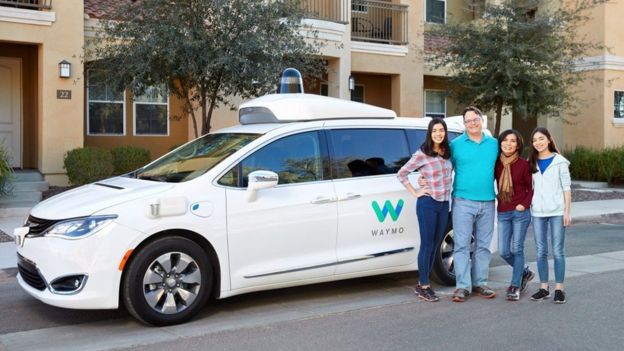
Google cars self-drive to Walmart supermarket in trial
Image copyrightWAYMOImage captionWaymo’s cars will deliver Walmart customers to their groceries
Google’s sister-company Waymo has announced a trial in which its self-driving cars will ferry shoppers to and from a nearby Walmart store to pick up their groceries.
However, it indicates how the tech giant thinks the autonomous vehicles could be deployed if and when they exit the experimental stage.
One expert said cost would be key.
The only word on pricing so far is a promise to offer participants discounts when they order goods via Walmart’s Online Grocery Pickup service as part of the deal.
“If this is rolled out properly you would expect there to be a reasonably high threshold in terms of the price and spend commitment to justify the service,” commented Julie Palmer, a retail expert at the consultancy Begbies Traynor.
“You’d expect it to be limited to shoppers buying higher value items.”
Image copyrightWALMARTImage captionEagle-eyed shoppers spotted the Waymo parking spaces in advance of the announcement
Some suggested that the tie-up could offer an alternative to Amazon’s Prime Now quick-delivery service.
“Google and Amazon are both looking at cutting-edge ways to enter the food retail market, and we’re only beginning to see them flex their muscles,” remarked Ms Palmer.
The announcements comes two days after Waymo’s chief executive tweeted that its cars had driven a total of eight million miles on public roads, which is double what its tally had been in November.
Image copyrightWAYMOImage captionWaymo launched its test programme in Phoenix in June 2017
“This real-world experience, plus over five billion miles in simulation, is how we’re building the world’s most experienced driver,” John Krafcik added.
Self-driving rivals have also had announcements of their own this week:
Ford has said it will spin off its autonomous car business into a separate company at the start of August, and plans to invest $4bn (£3bn) into the effort before the end of 2023. General Motors announced a similar move in May
Mu is a very simple-to-use Python editor and IDE (integrated development environment) and this week, version 1.0 was released!
New Mu
Mu is designed to be as user-friendly and as helpful as possible for new Python programmers, presenting just the tools that are useful, such as:
Syntax highlighting
Automatic indentation
In-built help
Code checking
Debugging
Great for new programmers
Mu is intended to be not the only Python IDE you’ll ever need, but the first one — the editor that helps you start your coding journey, but not necessarily the one you finish it with. So when you’re ready, you will have the skills and confidence to move on to using a more advanced Python IDE.
You can use Mu in a number of modes; modes make working with Mu easier by only presenting the options most relevant to what you’re using Mu for:
Mu version 1.0 is available now for Windows, macOS, Linux, and the Raspberry Pi’sofficial operating system Raspbian! And to help new Python programmers get started, we have created a guide to Getting Started with Mu for all these operating systems.
Mu is the brainchild of Nicholas Tollervey, who has worked tirelessly to create Mu. I recently met up with him and some of the Mu team at the world’s first Mu-“moot” to celebrate this release:
One of the inspirations for Mu was the keynote presentation at EuroPython 2015 given by Raspberry Pi’s Carrie Anne Philbin. She talked about the barriers to children getting started with Python, including the lack of an suitably easy-to-use IDE:
Raspberry Pi has provided support for the project, helping to take Mu from its first implementation as a micro:bit programming tool to a general-purpose and simple-to-use Python editor and IDE!
 A doctor inspects a patient’s mole for skin cancer in this file photo. (damiangretka / istock.com)


/cdn.vox-cdn.com/uploads/chorus_image/image/60503095/Edge_TPU_chip.max_1000x1000.0.png)
/cdn.vox-cdn.com/uploads/chorus_asset/file/6511859/tpu-2.png)


 © SofiaV/Shutterstock




 Bruce's Blog