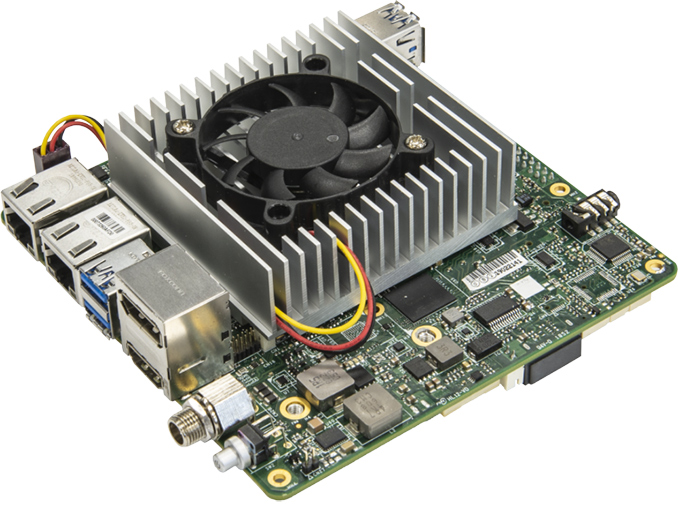
AAEON has introduced its new single board computer (SBC) that is powered by Intel’s Core i3/i5/i7 ‘Whiskey Lake’ SoCs. The AAEON UP Xtreme is designed for developers of embedded applications that need performance of Intel’s higher-end CPU cores in a very small form-factor. The SBC comes with a BGA SOC, soldered-down DDR4 memory, eMMC storage, and has a rich set of I/O connectors.
Traditionally, AAEON’s UP-series single board computers have used Intel’s low-power Atom-class SoCs (Cherry Trail, Apollo Lake, etc.). As the name suggests, the UP Xtreme SBC is aimed at embedded devices that need Intel’s high-performance mobile SoCs, such as dual-core or quad-core Whiskey Lake processors with Intel’s UHD Graphics 620, and a 15 W TDP. Just like other SBCs, the UP Xtreme measures 120×120 mm, but because of increased TDP it uses active cooling. Depending on exact SKU, the UP Xtreme comes with 4 to 16 GB of DDR4 memory as well as 16 to 128 GB of eMMC 5.1 storage.
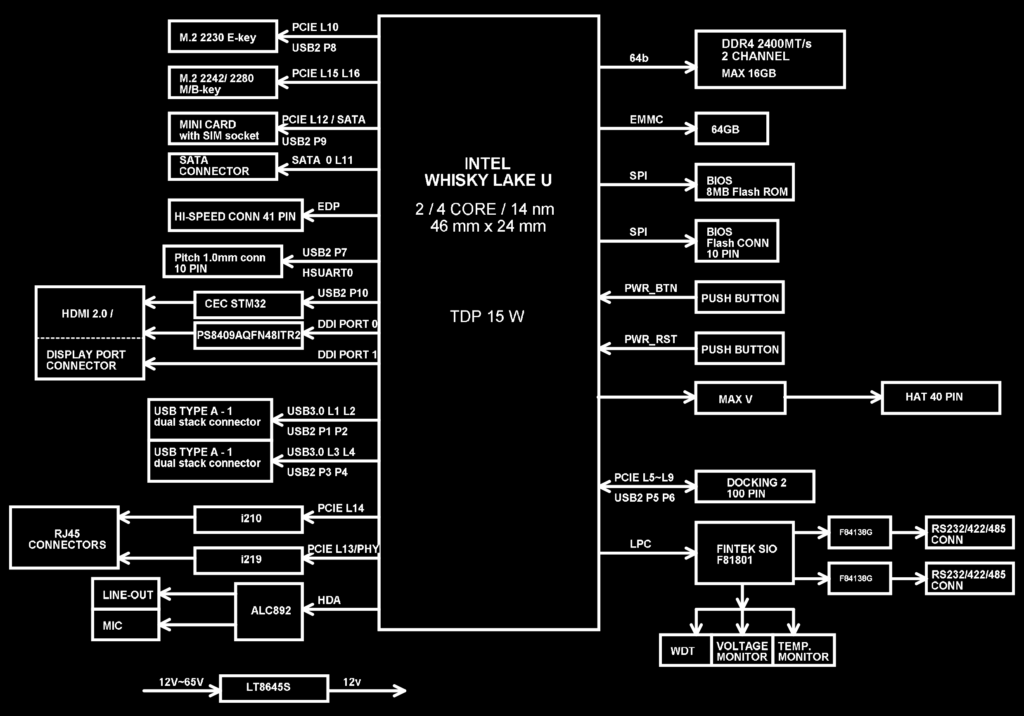
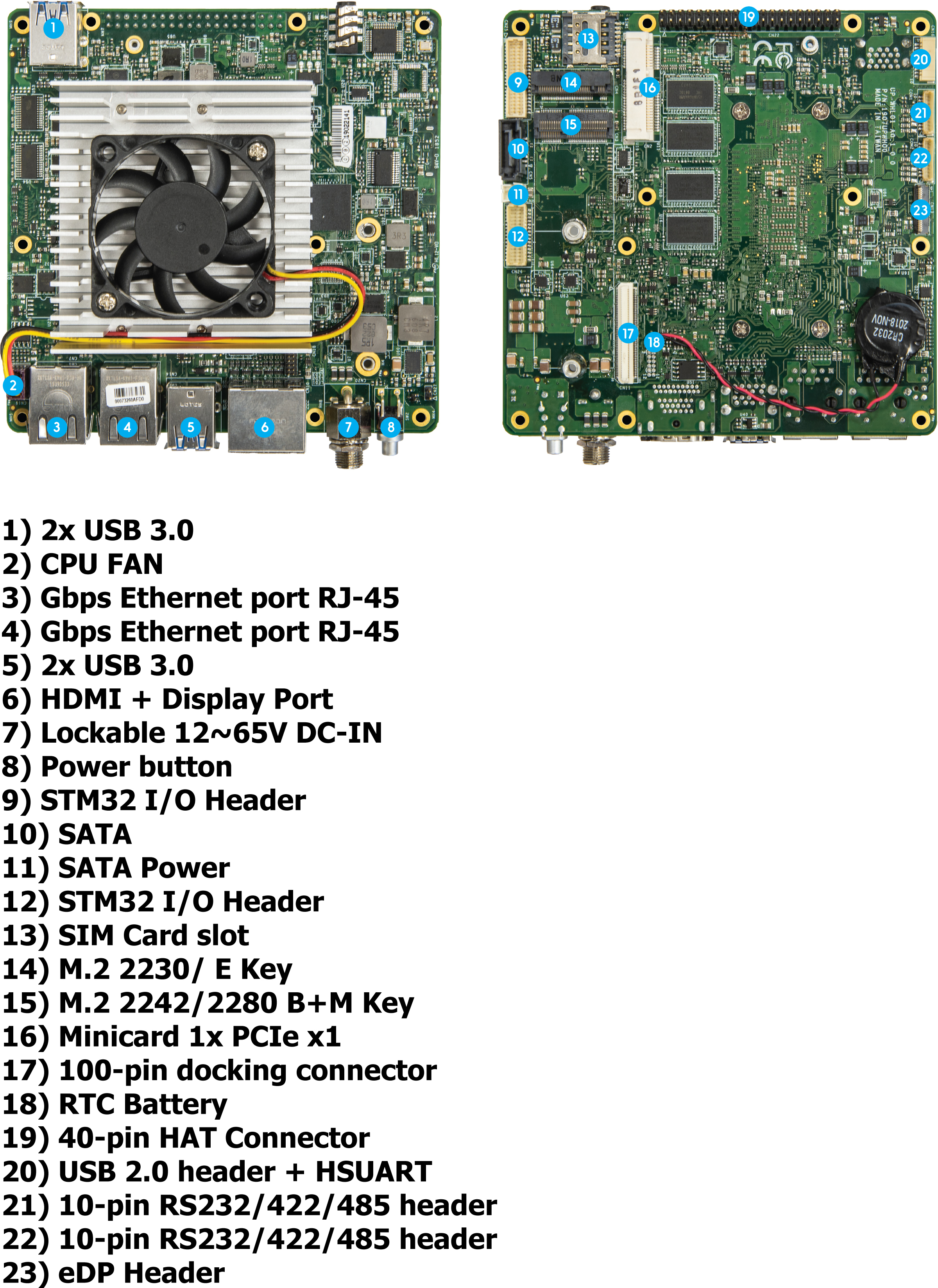
The motherboard carries two GbE controllers from Intel (i210/i211, and i219LM PHYs), four USB 3.0 ports, two USB 2.0 ports, two Serial ports controlled using the Fintech F81801 chip, display outputs (DisplayPort, HDMI, eDP), RealTek’s ALC887 audio codec, and so on. As for expandability, the UP Xtreme SBC has a SATA connector, an M.2-2280 slot (PCIe 3.0 x2, SATA), an M.2-2230 slot, a 40-pin HAT connector, a 100-pin docking connector, and so on.
Because of rich connectivity options supported by the UP Xtreme motherboard, it may not only address a vast range of embedded systems, but can also be paired with various custom-designed modules (i.e., AAEON’s AI Module, Intel’s RealSense cameras, etc.) for emerging applications that need computer vision, AI, and so on. Meanwhile, the SBC is compatible with Android, Windows 10, Ubuntu, and Yocto operating systems.
AAEON has not disclosed pricing of its UP Xtreme single board computers, but given the fact that Intel’s Whiskey Lake processors start at $281 in sets of 1000, do not expect these products to be cheap even in entry-level configurations.
BRAIN BOOST? Older people’s brain responses to a single bout of exercise mirrored their responses to three months of training, a new study finds.
SAN FRANCISCO — For some older people, the brain boosts from exercise can be almost immediate. Improvements in their thinking abilities after a single 20-minute bout of pedaling a stationary bike mirrored those produced by three months of regular exercise, according to a preliminary study presented March 24 at the annual meeting of the Cognitive Neuroscience Society.
The similarity between a single bout of exercise and months of training “suggests we don’t have to wait three months to see an improvement,” cognitive neuroscientist Michelle Voss of the University of Iowa in Iowa City said. “We can get a day-by-day boost.”
Voss and her colleagues enlisted 34 people with an average age of 67 to undergo brain scans, memory tests and exercise. In the first part of the study, she and her colleagues were looking for effects of a single 20-minute stint on a stationary bike, designed to be rigorous enough to make people sweat. Participants were huffing and puffing, but could still talk during the workout.
Before and after exercising, participants underwent functional MRI brain scans and took memory tests that involved remembering previously seen faces. The team did similar brain tests on a different day, after participants spent 20 minutes on a bike that pedaled for them.
On average, after 20 minutes of intense exercise, people were better at remembering the faces, especially when the task was hard, than after sitting on the self-pedaling bike. And certain connections between brain areas got stronger, too, the fMRI scans showed.
Participants then were divided into two groups — one that spent the next three months exercising three times a week for 50 minutes, and one that spent just four minutes exercising three times a week. When studied as a group, people’s results after this longer-term exercise were similar to their results after the 20-minute bout of exercise, with an overall improvement on the face task for people with the longer workouts compared with those who exercised for 12 minutes a week.
But within that average, people’s responses varied. To Voss’ surprise, the people who improved a lot after 20 minutes had similar memory improvements, and similar brain changes, after the three months. And those who didn’t improve after the 20 minutes were less likely to have improved after three months.
“If it’s not working for some people, that’s good to know,” Voss says. “But you can go one step further and ask, ‘Are the reasons it’s not working modifiable? And can we learn that quickly? Can we fail fast?’”
Teasing apart the individual variation among exercise effects is “really exciting,” says cognitive neuroscientist Wendy Suzuki of New York University in New York City. She cautions that the study is preliminary. Still, she says, “this is exactly the right question to ask.”
Suzuki thinks of exercise as medicine. “The key word is ‘personalized’ medicine,” she says.
“Can it be designed for you at your age and fitness level and gender and genetic background?” The answer, she says, is theoretically yes, though scientists have much more work to do to understand how exercise affects people differently.
Last week, the Raspberry Pi foundation released the first official Raspberry Pi-branded keyboard and mouse. As a keyboard, it’s probably pretty great; it’s clad in a raspberry and white color scheme, the meta key is the Pi logo, there are function keys. Sure, the Ctrl and Caps Lock keys are in their usual, modern, incorrect positions (each day we stray further from God’s light) but there’s also a built-in USB hub. Everything balances out, I guess.
The Pi keyboard started shipping this week, and it took two days for someone to put a Pi zero inside. Here’s how you do it, and here’s how you turn a Pi keyboard into a home computer, like a speccy or C64.
The parts required for this build include the official Pi keyboard, a Pi Zero W, an Adafruit Powerboost, which is basically the circuitry inside a USB power bank, and a LiPo battery. The project starts by disassembling the keyboard with a spudger, screwdriver, or other small wedge-type tool, disconnecting the keyboard’s ribbon cables, and carefully shaving down the injection molded webbing that adds strength to the keyboard’s enclosure. The project is wrapped up by drilling holes for a power LED, a button to turn the Pi on and off, and the holes for the USB and HDMI ports.
One shortcoming of this build is the use of a male-to-male USB cable to connect the keyboard half of the circuitry to the Pi. This can be worked around by simply soldering a few pieces of magnet wire from the USB port on the Pi to the USB input on the USB hub. But hey, doing it this way gives the Official Pi keyboard a convenient carrying handle, and when one of the ports breaks you’ll be able to do it the right way the second time. Great work.
The Defense Advanced Research Projects Agency (DARPA) has given further details on the capabilities of its Collaborative Operations in Denied Environment (CODE) program aims to adapt and respond to unexpected threats for existing unmanned aircraft that would extend mission capabilities and improve U.S. forces’ ability to conduct operations in denied or contested airspace.
DARPA announced that some success has been achieved and a swarm of unmanned aerial vehicles equipped with CODE successfully carried out mission objectives, even when communications were offline and GPS was unavailable.
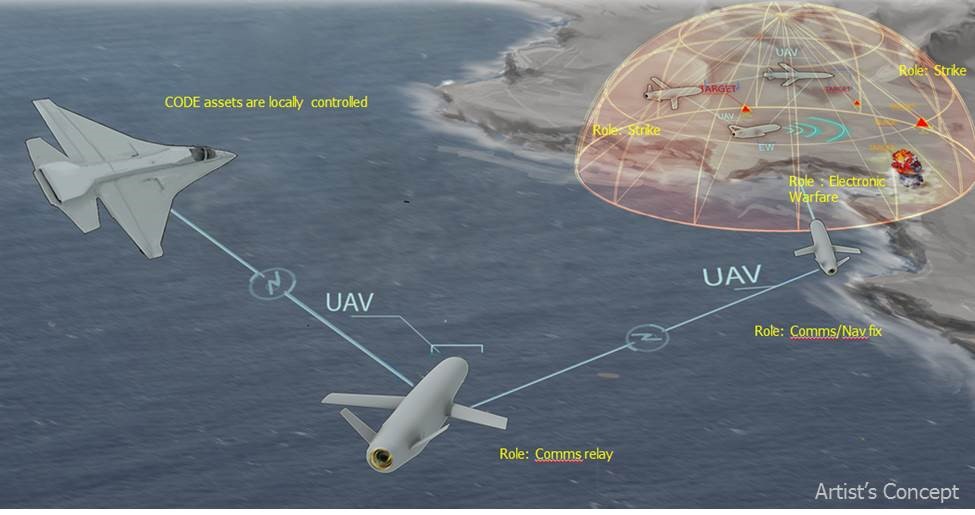
CODE intends to focus in particular on developing and demonstrating improvements in collaborative autonomy—the capability of groups of unmanned aircraft to work together under a single person’s supervisory control. The unmanned vehicles would continuously evaluate their own states and environments and present recommendations for coordinated unmanned aircraft actions to a mission supervisor, who would approve or disapprove such team actions and direct any mission changes. Using collaborative autonomy, CODE-enabled unmanned aircraft would find targets and engage them as appropriate under established rules of engagement, leverage nearby CODE-equipped systems with minimal supervision, and adapt to dynamic situations such as attrition of friendly forces or the emergence of unanticipated threats.
One-by-one, six RQ-23 Tigersharks lifted off, fitted with an array of sensors onboard. Next to the runway at the U.S. Army’s Yuma Proving Ground, the mission team inside a small operations center tracked the aircraft and as many as 14 additional virtual planes on an aerial map.
The capstone demonstration paired program performer Raytheon’s software and autonomy algorithms and Johns Hopkins University Applied Physics Laboratory’s White Force Network to create a realistic, live/virtual/constructive test environment. During four demonstration runs, the team activated a variety of virtual targets, threats, and countermeasures to see how well the Tigersharks could complete their objectives in suboptimal conditions.
“Exactly how the aircraft continue to work together in degraded conditions is the most challenging aspect of this program,” said Scott Wierzbanowski, the DARPA program manager for CODE in the Tactical Technology Office. “Current procedures require at least one operator per UAV in the field. Equipped with CODE, one operator can command multiple aircraft; and in a denied environment, the aircraft continue toward mission objectives, collaborating and adapting for deficiencies.”
Before, if operators lost communications with a UAV, the system would revert to its last programmed mission. Now, under the CODE paradigm, teams of systems can autonomously share information and collaborate to adapt and respond to different targets or threats as they pop up.
“CODE can port into existing UAV systems and conduct collaborative operations,” said Wierzbanowski. “CODE is a government-owned system, and we are working closely with our partners at the Air Force Research Laboratory and Naval Air Systems Command to keep each other informed of successes and challenges, and making sure we don’t replicate work. In the end, our service partners will leverage what we’ve done and add on what they need.”
The Tigersharks employed in the demonstration are surrogate assets for CODE. Each has about one-tenth the speed and performance of the aircraft planned for integration, but shows traceability to larger platforms. Constructive and virtual threats and effects presented by the White Force Network are appropriately scaled to the Tigersharks’ capabilities.
“It’s easy to take the CODE software and move it from platform to platform, both from a computer and vehicle perspective. It could be a manned aircraft, unmanned aircraft, or a ground vehicle,” said J.C. Ledé, technical advisor for autonomy with the Air Force Research Laboratory. “The concept for CODE is play-based tactics, so you can create new tactics relatively easily to go from mission to mission.”
The Naval Air Systems Command (NAVAIR) will take ownership of CODE after DARPA closes out the agency’s role in the program this year. It already has built a repository of algorithms tested throughout the development process.
“What we’re doing with the laboratory we set up is not just for the Navy or NAVAIR. We’re trying to make our capabilities available throughout the entire DoD community,” said Stephen Kracinovich, director of autonomy strategy for the Naval Air Warfare Center Aircraft Division (NAWCAD). “If the Army wanted to leverage the DARPA prototype, we’d provide them not just with the software, but an open development environment with all the security protocols already taken care of.”
Kracinovich says NAWCAD has a cadre of people with hands-on knowledge of the system, and is ready to help port the capability to any other DoD entity. That ease of transition puts CODE technologies on a clear path to assist deployed service members by enabling collaborative autonomous systems to operate in contested and denied environments with minimal human supervision.
Tedros Adhanom Ghebreyesus, director general of the World Health Organization (WHO), speaks during a meeting with Chinese Foreign Minister Wang Yi at the Ministry of Foreign Affairs in Beijing, Tuesday, July 17, 2018. (AP Photo/Mark Schiefelbein, Pool)
World Health Organization experts said last week it would be irresponsible for any scientist to do human gene-editing studies in people. They also called for a central registry of gene-editing studies to make sure scientists are open and honest about their work.
The WHO group was set up three months ago after a Chinese scientist announced he had edited the genes of twin babies. They met for the first time last Tuesday in Geneva, Switzerland.
The group said it had agreed on a way to set rules for gene-editing research. It also asked the WHO to start setting up a registry for such studies immediately.
“The committee will develop…guidance for all those working on this new technology” said the WHO’s chief scientist, Soumya Swamanathan.
Last year, a Chinese scientist claimed to have edited the genes of two baby girls. They were born to the same mother in the same pregnancy.
News of the births led to condemnation from around the world. Many people believed it might be the start of “designer babies,” children whose genes have been edited to give them desirable traits or qualities.
Scientists and ethicists from seven countries called recently for a suspension of gene editing that would result in genetically-altered babies. They warned the process could have permanent and possibly harmful effects on human beings.
The WHO group said in a statement that any human gene editing work should be done for research only. It also said trials of gene-editing should not be done on humans.
The WHO’s director-general, Tedros Adhanom Ghebreyesus, welcomed the group’s plans. “Gene editing holds (great) promise for health, but it also poses some risks, both ethically and medically,” he said.
The group said it aims over the next two years to produce governance rules for national, local and international officials to make sure that human genome editing science progresses within agreed ethical limits.
People’s memory of their own post-traumatic stress disorder (PTSD) symptoms is not always consistent over time, according to a new study published in Psychiatry Research. The study found evidence that the recall of past PTSD symptoms is related to current symptom severity.
“Over the last five years or so, we have read dozens of papers about how people can remember their traumatic experiences inconsistently over time,” said stud author Sasha Nahleen, a PhD candidate at Flinders University and member of Dr. Melanie Takarangi’s Forensic and Clinical Cognition Lab.
“For example, when veterans are asked soon after returning home, and again years later, about whether they experienced certain trauma events during their deployment, they often report having experienced more events at the second time-point compared to the first. However, we noticed pretty quickly that there were significantly fewer studies about whether people remember their own trauma-related symptoms and distress consistently over time.”
In the study, the researchers asked 410 sexual assault survivors to report their PTSD symptoms and then recall them 6 months later.
“In our study, female participants were first asked to report their trauma-related symptoms including: 1) persistent re-experiencing of trauma, for example through unwanted memories, flashbacks, and nightmares, 2) avoidance of thoughts or reminders of the trauma, 3) negative thoughts or feelings such as exaggerated feelings of self-blame and isolation, and 4) increased reactivity such as being extra vigilant. Six months later, participants were asked to recall those symptoms,” Nahleen explained.
The researchers observed a small but statistically significant decrease in PTSD severity over time. Participants who did not meet the criteria for a PTSD diagnosis at the six month follow-up tended to recall fewer symptoms than they initially reported. But the opposite was true among participants who were PTSD-positive — they recalled experiencing more symptoms than initially reported.
“Overall, we found that people may draw on how they feel now when they are trying to remember their past reactions to trauma. Specifically, people who are not very distressed by their trauma may remember experiencing fewer symptoms in the past than they initially reported. On the other hand, people who are distressed by their trauma, may remember experiencing more symptoms in the past than they initially reported,” Nahleen told PsyPost.
The study includes some limitations. The researchers were unable to account for some factors that could have influenced the results.
“Like other studies in this area, we could not corroborate participants’ reported trauma and trauma-related symptoms. For practical reasons, we also did not measure all the factors that could influence symptom severity and memory after trauma, such as experiencing other trauma events, traumatic brain injury, levels of cognitive functioning and so on,” Nahleen said.
“Our findings have important implications because they show that people may remember their own trauma-related symptoms inconsistently over time. In the future, we aim to investigate the clinical implications of our findings such as whether it would be useful for clinicians to gather additional corroborating reports of symptoms where possible and sensitively discuss with clients that past symptom severity may not always be as severe as they remember.”
Many of you have probably fantasized about getting your hands on some of Tony Stark’s technology. The iron man suit is probably one of the most iconic pieces of technology across popular culture and comics.
Though there have been multiple attempts to create something similar across the military and industrial sectors, Sarcos Robotics’ may be the closest and coolest thing we will get in a long time that resembles the avenger’s super suit. But wait, we are getting a little too ahead of ourselves.
Sarcos Robotics is a global leader in robot systems that augment the body. Rather than have robots replace us as our overloads in the industrial, public safety and military sectors, Sarcos believes that augmenting humans through robotics is a better solution.
The Sarcos Robotics team has recently been awarded a contract by the United States Special Operations Command to deliver a production version of its Guardian™ XO®. Like something out of a Ripley movie of the Matrix, the XO is a full-body, autonomously powered robotic exoskeleton.
ONSORED VIDEOSP
Augmented Power
The Sarcos Robotics exoskeleton suit is based off an early prototype that was recognized globally for its innovative design and functionality. In short, the Guardian™ XO is an exoskeleton suit that drastically improves human strength and endurance without restricting the operator’s freedom of movement.
People wearing the suit are able to comfortably lift 90kg without any exertion or strain. The exoskeleton uses a combination of advanced materials, sensors, and algorithms to give wearers ultimate control.
The Guardian™ XO has a host of applications across manufacturing, industrial and military industries.
The Contract
The USSOCOM XO partnership follows recent news that the company partnered with the U.S. Navy and U.S. Air Force for the use of the exoskeletons. These XO skeletons could trigger the emergence of the “super soldier” while also offering officers the ability to be safe while in the field.
With $175 million invested in R&D, Sarcos Robotics ensures that the system is safe, intuitive and power efficient. It will be interesting to see how exoskeleton technology will be used to augment humans.
Mindfulness practices can significantly upgrade your internal operating system.
Posted Mar 22, 2019
Childhoodattachment experiences have profound impacts on our mental-emotional architecture and our capacity for healthy relationships. Negative, problematic early attachment experiences commonly leave legacies of lasting life challenges, including difficulties in psychological flexibility and emotional regulation that adversely affect people’s ability to be empathic and compassionate and experience intimacy and connectedness. Many of the beneficial effects of mindfulness and meditation bear a remarkable resemblance to the characteristics of people who grow up with healthy, attuned attachments. In this way, mindfulness practice can effectively upgrade our internal operating system.
A computer’s operating system (OS) enables the hardware to operate and communicate with the software. Hardware includes the physical components of a computer system—the central processing unit (CPU), keyboard, hard drive, power supply, etc. Software refers to organized collections of computer data and instructions and consists of programs that permit a computer to perform specific tasks, such as online searches, email, word processing, and anti-virus protection. The operating system is the core set of programs that run the computer and upon which all other programs rely on in order to operate.
Human hardware includes the brain, nervous system, and the body, while the software consists of our thoughts, emotions, and physical sensations. The human OS consists of our relationship to others, ourselves, the world around us as well as our spiritual connection. It assigns meaning to our thoughts, emotions, and physical sensations; mediates between our internal and external experiences; links our neurophysiology with our thoughts and feelings; and determines the quality of our interactions. Operating system updates correct program incompatibilities, discovered errors, and security vulnerabilities. Operating system upgrades improve overall functioning.
Mindfulness can upgrade your internal operating system by helping to make the unconscious conscious and create the space for reasoned and skillful responses, even in the face of highly charged feelings. Stress, anxiety, fear, and anger lose their grip more easily and quickly, giving you greater freedom of choice to respond intentionally rather than to react reflexively.
Mindfulness promotes emotional regulation and mitigates impulsivity by increasing the gap between stimulus (what happens to us) and response (what we do with what happens to us). The crucial importance of this gap is vividly encapsulated in a paraphrase of Viktor Frankl’s description in Man’s Search for Meaning of how he survived the horrors of life in a Nazi death camp during World War II: between stimulus and response, there is a space. In that space is the opportunity to choose our response. In our response lies our growth and our freedom.
Part of how mindfulness practice upgrades your internal operating system is by increasing emotional intelligence. Unlike IQ or formal intelligence/intellect, which is generally fixed and stable throughout life, emotional intelligence (EI) refers to a range of internal and interpersonal skills that can be acquired and improved with practice. Although some people are naturally more emotionally intelligent than others, you can develop high emotional intelligence even if you weren’t born with it.
Internal EI skills include the ability to identify one’s own emotions, be consciously aware of them as they happen, and regulate them and their effects on one’s behavior. Interpersonal or interactional EI skills include the ability to accurately sense and empathize with the emotions of other people and use the awareness of your own emotions and those of others to negotiate interactions skillfully. These skills are part and parcel of mindfulness practice.
Emotional intelligence requires effective communication between the rational-logical part of the brain—the prefrontal cortex—and the emotional part of the brain-centered in the amygdala within the limbic system. Mindfulness is a bridge that connects these two areas of the brain, and consistent practice of these skills builds new neural pathways that over time become stronger and more efficient.
Mindfulness can help you better tolerate and stay with difficult emotions, so they don’t hold you hostage. You can increase your ability to bear discomfort—physically and emotionally—and be present with it, without being suffocated by it or needing to push it away. When you enlarge your capacity to bear emotional discomfort, you are less likely to react automatically to your emotions or let them control you.
More people struggle with anxiety than perhaps any other emotion. The word worry originates from an old English word for strangle. The anxiety that comes with worrying, with its anticipatory fear of what might or could possibly happen in the future, strangles your ability to be skillful in the here and now.
Mindfulness practice can prepare you to recognize and observe the experience of anxiety, fear, sadness, guilt, depression, loneliness, emptiness, frustration, anger, and other distressing emotions—along with the negative thinking that both contribute to these emotions and is reinforced by them—with acceptance and perspective. As the Buddha observed in the Sutta-Nipāta:
In an effort “to democratize AI,” researchers at MIT have found a way to use artificial intelligence to train machine-learning systems much more efficiently. Their hope is that the new time- and cost-saving algorithm will allow resource-strapped researchers and companies to automate neural network design. In other words, by bringing the time and cost down, they could make this AI technique more accessible.
Today, AI can design machine learning systems known as neural networks in a process called neural architecture search (NAS). But this technique requires a considerable amount of resources like time, processing power and money. Even for Google, producing a single convolution neural network — often used for image classification — takes 48,000 GPU hours. Now, MIT researchers have developed a NAS algorithm that automatically learns a convolution neural network in a fraction of the time — just 200 GPU hours.
Speeding up the process in which AI designs neural networks could enable more people to use and experiment with NAS, and that could advance the adoption of AI. While this is certainly not uncomplicated, it could be a step toward putting AI and machine learning in the hands of more people and companies, freeing it from the towers of tech giants.







 Bruce's Blog