FORGET ARTIFICIAL INTELLIGENCE; THINK ARTIFICIAL LIFE
If you are a science fiction fan, you are probably aware of one of the genre’s oddest dichotomies. A lot of science fiction is concerned about if a robot, alien, or whatever is a person. However — sometimes in the same story — finding life is as easy as asking the science officer with a fancy tricorder. If you go to Mars and meet Marvin, it is pretty clear he’s alive, but faced with a bunch of organic molecules, the task is a bit harder. Now it is going to get harder still because Cornell scientists have created a material that has an artificial metabolism and checks quite a few boxes of what we associate with life. You can read the entire paper if you want more detail.
Three of the things people look for to classify something as alive is that it has a metabolism, self-arranges, and reproduces. There are other characteristics, depending on who you ask, but those three are pretty crucial.
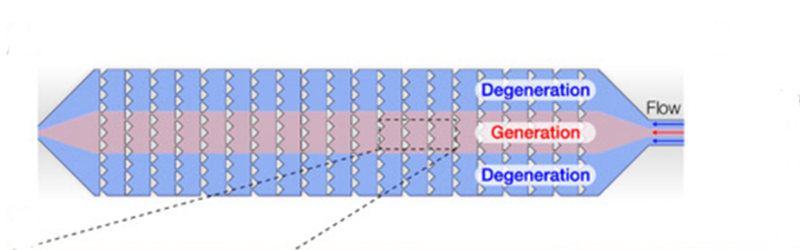
The material is a biomaterial that emerges from its building blocks and arranges itself – first into polymers and eventually tiny shapes. Starting from a 55-nucleotide base seed sequence, the DNA molecules were multiplied to create tiny chains of repeating DNA.
The material was placed in a flow of chemicals — the equivalent of food for the synthetic beast — the DNA synthesized its own new strands, with the front end of the material growing and the tail end degrading simultaneously. The effect is that the “creature” moves against the flow like a slime mold does.
If you’ve just invented fake life and it will move, what do you do? Race them against each other, of course. That’s exactly what they did — you can’t make this stuff up.
Although the material uses instructions coded with DNA, it is still pretty crude, only lasting a few generations for now. The material also doesn’t respond to stimulus — another key indicator of life. Of course, because it is DNA-based, it is possible that they’ll succeed in making it do so or that it could mutate on its own. You can only wonder if life started with simple building blocks like this untold number of years ago.
 Bruce's Blog