https://www.raspberrypi.org/blog/vc4-and-v3d-opengl-drivers-for-raspberry-pi-an-update/

VC4 and V3D OpenGL drivers for Raspberry Pi: an update

Here’s an update from Iago Toral of Igalia on development of the open source VC4 and V3D OpenGL drivers used by Raspberry Pi.

Some of you may already know that Eric Anholt, the original developer of the open source VC4 and V3D OpenGL drivers used by Raspberry Pi, is no longer actively developing these drivers and a team from Igalia has stepped in to continue his work. My name is Iago Toral (itoral), and together with my colleagues Alejandro Piñeiro (apinheiro) and José Casanova (chema), we have been hard at work learning about the V3D GPU hardware and Eric’s driver design over the past few months.
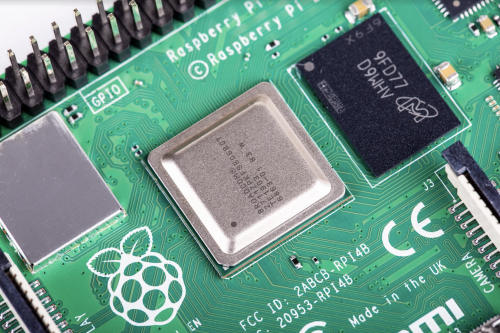
Learning a new GPU is a lot of work, but I think we have been making good progress and in this post we would like to share with the community some of our recent contributions to the driver and some of the plans we have for the future.

But before we go into the technical details of what we have been up to, I would like to give some context about the GPU hardware and current driver status for Raspberry Pi 4, which is where we have been focusing our efforts.

The GPU bundled with Raspberry Pi 4 is a VideoCore VI capable of OpenGL ES 3.2, a significant step above the VideoCore IV present in Raspberry Pi 3 which could only do OpenGL ES 2.0. Despite the fact that both GPU models belong in Broadcom’s VideoCore family, they have quite significant architectural differences, so we also have two separate OpenGL driver implementations. Unfortunately, as you may have guessed, this also means that driver work on one GPU won’t be directly useful for the other, and that any new feature development that we do for the Raspberry Pi 4 driver stack won’t naturally transport to Raspberry Pi 3.

The driver code for both GPU models is available in the Mesa upstream repository. The codename for the VideoCore IV driver is VC4, and the codename for the VideoCore VI driver is V3D. There are no downstream repositories – all development happens directly upstream, which has a number of benefits for end users:

  1. It is relatively easy for the more adventurous users to experiment with development builds of the driver.
  2. It is fairly simple to follow development activities by tracking merge requests with the V3D and VC4 labels.

At present, the V3D driver exposes OpenGL ES 3.0 and OpenGL 2.1. As I mentioned above, the VideoCore VI GPU can do OpenGL ES 3.2, but it can’t do OpenGL 3.0, so future feature work will focus on OpenGL ES.

Okay, so with that introduction out of the way, let’s now go into the nitty-gritty of what we have been working on as we ramped up over the last few months:

Disclaimer: I won’t detail here everything we have been doing because then this would become a long and boring changelog list; instead I will try to summarize the areas where we put more effort and the benefits that the work should bring. For those interested in the full list of changes, you can always go to the upstream Mesa repository and scan it for commits with Igalia authorship and the v3d tag.

First we have the shader compiler, where we implemented a bunch of optimizations that should be producing better (faster) code for many shader workloads. This involved work at the NIR level, the lower-level IR specific to V3D, and the assembly instruction scheduler. The shader-db graph below shows how the shader compiler has evolved over the last few months. It should be noted here that one of the benefits of working within the Mesa ecosystem is that we get a lot of shader optimization work done by other Mesa contributors, since some parts of the compiler stack are shared across multiple drivers.
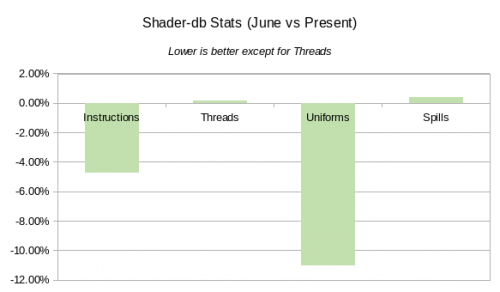
Bar chart with y-axis range from -12.00% to +2.00%. It is annotated, "Lower is better except for Threads". There are four bars: Instructions (about -4.75%); Threads (about 0.25%); Uniforms (about -11.00%); and Splits (about 0.50%).

Another area where we have done significant work is transform feedback. Here, we fixed some relevant flushing bugs that could cause transform feedback results to not be visible to applications after rendering. We also optimized the transform feedback process to better use the hardware for in-pipeline synchronization of transform feedback workloads without having to always resort to external job flushing, which should be better for performance. Finally, we also provided a better implementation for transform feedback primitive count queries that makes better use of the GPU (the previous implementation handled all this on the CPU side), which is also correct at handling overflow of the transform feedback buffers (there was no overflow handling previously).

We also implemented support for OpenGL Logic Operations, an OpenGL 2.0 feature that was somehow missing in the V3D driver. This was responsible for this bug, since, as it turns out, the default LibreOffice theme in Raspbian was triggering a path in Glamor that relied on this feature to render the cursor. Although Raspbian has since been updated to use a different theme, we made sure to implement this feature and verify that the bug is now fixed for the original theme as well.

Fixing Piglit and CTS test failures has been another focus of our work in these initial months, trying to get us closer to driver conformance. You can check the graph below showcasing Piglit test results to have a quick view at how things have evolved over the last few months. This work includes a relevant bug fix for a rather annoying bug in the way the kernel driver was handling L2 cache invalidation that could lead to GPU hangs. If you have observed any messages from the kernel warning about write violations (maybe accompanied by GPU hangs), those should now be fixed in the kernel driver. This fix goes along with a user-space fix to go that should be merged soon in the upstream V3D driver.
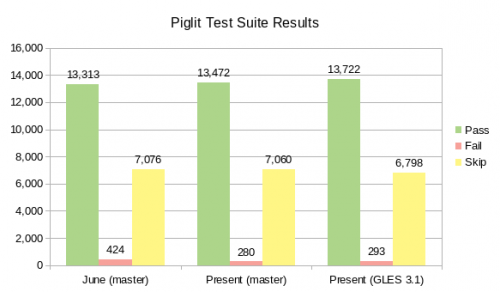
A bar chart with y-axis ranging from 0 to 16000. There are three groups of bars: "June (master)"; "Present (master)"; Present (GLES 3.1)". Each group has three bars: Pass; Fail; Skip. Passes are higher in the "Present (master)" and "Present (GLES 3.1)" groups of bars than in the "June (master)" group, and skips and fails are lower.

A a curiosity, here is a picture of our own little continuous integration system that we use to run regression tests both regularly and before submitting code for review.
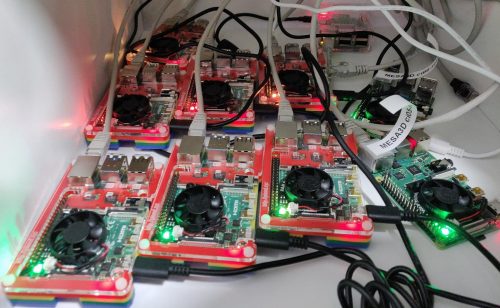
Ten Raspberry Pis with small black fans, most of them in colourful Pimoroni Pibow open cases, in a nest of cables and labels

The other big piece of work we have been tackling, and that we are very excited about, is OpenGL ES 3.1, which will bring Compute Shaders to Raspberry Pi 4! Credit for this goes to Eric Anholt, who did all the implementation work before leaving – he just never got to the point where it was ready to be merged, so we have picked up Eric’s original work, rebased it, and worked on bug fixes to have a fully conformant implementation. We are currently hard at work squashing the last few bugs exposed by the Khronos Conformance Test Suite and we hope to be ready to merge this functionality in the next major Mesa release, so look forward to it!

Compute Shaders is a really cool feature but it won’t be the last. I’d like to end this post with a small note on another important large feature that is currently in early stages of development: Geometry Shaders, which will bring the V3D driver one step closer to exposing a full programmable 3D pipeline – so look forward to that as well!

https://parkinsonsnewstoday.com/2019/10/14/20-million-grant-awarded-study-imaging-protein-misfolding-parkinsons/

$20M Grant Awarded for Research into Imaging Protein Misfolding in Parkinson’s

$20M Grant Awarded for Research into Imaging Protein Misfolding in Parkinson’s

The National Institute of Neurological Disorders and Stroke (NINDS) has awarded a five-year, $20 million grant to researchers looking for a way to image misfolded proteins in the brains of people with Parkinson’s and other neurodegenerative diseases, which could greatly advance diagnosis and disease monitoring.

Parkinson’s disease is thought to be a proteinopathy — a condition caused by proteins in the brain folding improperly, which sets off a chain reaction of misfolding in other proteins, eventually forming clumps and damaging the brain. Specifically, Parkinson’s is characterized by clumps of the protein alpha-synuclein.

Alzheimer’s disease is another proteinopathy, characterized by clumps of beta-amyloid. But there’s a crucial difference between the two in terms of how they are diagnosed and managed.

Brains can be imaged using a positron emission tomography (PET) scan, a technique in which a radioactive dye called a tracer is injected into the body. The tracer then binds to specific proteins, allowing clumps of these proteins to be visible on the scan. Although PET scans have been able to image beta-amyloid plaques for nearly a decade, the technology to visualize clumps of alpha-synuclein doesn’t yet exist.

The NINDS grant hopes to foster the development of a PET tracer that will bind to alpha-synuclein, as well as another tracer that will bind to 4R tau, a protein with important roles in frontotemporal degeneration and progressive supranuclear palsy.

This will be done using computers to find promising chemical formulations, then synthesizing and testing them. Although straightforward in theory, actually finding a molecule that can safely and specifically bind to these proteins is akin to finding a needle in a haystack, the researchers said. Hence, the importance of beginning with computer simulations.

“Finding a needle in a haystack is much easier when you have a machine made to find needles,” Andrew Siderowf, MD, a professor at the University of Pennsylvania and study leader, said in a press release.

The effort will also be led by researchers at Washington University-St. Louis, the University of Pittsburgh, the University of California-San Francisco, and Yale University.

Finding such a dye could allow screening for early detection of Parkinson’s disease before symptoms manifest. It could be used as an objective marker of an investigative treatment’s effectiveness in clinical trials.

“Currently, when testing new drugs for Parkinson’s, assessing the patient’s clinical symptoms is the only way to measure whether or not the treatment is working, but clinical features evolve very gradually,” Siderowf said. “Having an imaging biomarker that is sensitive to changes in a Parkinson’s pathology could greatly accelerate drug development.”

Robert H. Mach, PhD, a professor at the University of Pennsylvania and study co-investigator, summarized the researchers’ goal: “At the end of five years, we hope to have a radioactive tracer that will be able to detect Parkinson’s early on and provide detailed information about the disease’s progression, which is critical for discovering and testing new treatments.”

Marisa holds an MS in Cellular and Molecular Pathology from the University of Pittsburgh, where she studied novel genetic drivers of ovarian cancer. She specializes in cancer biology, immunology, and genetics. Marisa began working with BioNews in 2018, and has written about science and health for SelfHacked and the Genetics Society of America. She also writes/composes musicals and coaches the University of Pittsburgh fencing club.
Fact Checked By:

Ana holds a PhD in Immunology from the University of Lisbon and worked as a postdoctoral researcher at Instituto de Medicina Molecular (iMM) in Lisbon, Portugal. She graduated with a BSc in Genetics from the University of Newcastle and received a Masters in Biomolecular Archaeology from the University of Manchester, England. After leaving the lab to pursue a career in Science Communication, she served as the Director of Science Communication at iMM.

https://cleantechnica.com/2019/10/14/lex-fridmans-tesla-autopilot-mileage-statistics-charts/

Lex Fridman’s Tesla Autopilot Mileage Statistics & Charts

October 14th, 2019 by 

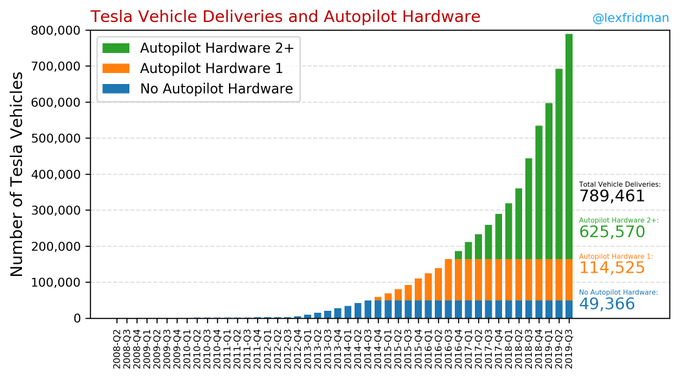
Lex Friedman just released a report titled Tesla Vehicle Deliveries and Autopilot Mileage Statistics. “Over 625,000 Tesla vehicles with the Autopilot Hardware 2+ delivered to date. The learning fleet is growing,” he states below in a Twitter post.

Lex Fridman@lexfridman

Over 625,000 Tesla vehicles with the Autopilot Hardware 2+ delivered to date. The learning fleet is growing. https://lexfridman.com/tesla-autopilot-miles-and-vehicles/ 

View image on Twitter

The report provides estimates of Tesla cars delivered and the Autopilot miles driven segmented by its hardware version based on these three milestones:

  1. September 2014: Autopilot Hardware 1.0 installed (Autopilot not enabled).
  2. October 2015: Autopilot enabled.
  3. October 2016: Autopilot Hardware 2.0 released.

Lex cites the primary source for the data on deliveries as the quarterly investor letters, from which his team generated a quarterly estimate of the vehicles delivered by model.  The graph below also shows that there have been over 740,095 Teslas with Autopilot capabilities delivered and 625,570 have Autopilot Hardware Version 2+.

Autopilot Mileage Statistics

Lex covers both total and Autopilot miles. The graph below shows total Autopilot miles on both the first and second generation of the Autopilot hardware, with estimates showing that Autopilot had 1.88 billion miles to date and that miles in all Tesla vehicles were 16.8 billion to date.

Autopilot Mileage Statistics

Lex also provided a short detail as to how he came up with these numbers. He started with the number of Teslas delivered by quarter and separated them by the versions of Autopilot. Then he did an estimate of per-day deliveries dating all the way back to 2008. After this, he calculated the number of miles driven in each vehicle under both manual and Autopilot control. Lex points out that there are two notable periods that were accounted for.

  1. Hardware 1 production started around October of 2014 but Autopilot was not enabled until a year later.
  2. Hardware 2+ production started around October of 2016 but was not enabled until January of 2017.

Lex also credits all of the sources where he got the data from and you can see those here.


What Does This Mean For Tesla?

Lex’s report on Tesla deliveries and Autopilot mileage statistics provides insight into how people who own a Tesla use Autopilot.

The fact that out of almost 16.8 billion miles only 1.88 billion were driven on Autopilot shows that, in general, people are still a bit shy when it comes to giving control of their driving to the car. I’ve even had several friends here who own a Tesla tell me that, “Sorry, I am not ready for Autopilot,” meaning they prefer driving manually to letting the car have control.

These numbers show Tesla’s team that there’s an opportunity for Tesla — both the company and owners who are advocates for Autopilot — to demonstrate just how vital Autopilot is.

Another way to look at it is that, since 2015, when Autopilot was first enabled, there have been over a billion miles driven on it. This is a great thing and it shows that people are embracing Autopilot. No other company compares for such technology, in terms of miles of data collected from the real world. When it comes to the overall trust, people are going to be cautious, especially when they are in a situation where they are being asked to relinquish their own control.

Autopilot, unlike what you might have seen in the news as demonstrated by people misusing it, is not fully self-driving yet. It’s still a technology that is in its youth. It’s still growing and learning. Unlike what many may think, it hasn’t graduated high school yet, so those who use it need to realize that they are still in control as long as they are staying focused and are constantly aware of their surroundings. Reading a book, eating a bagel, and not paying attention to the obstacles in front of you is a great example of not letting go of control … but actively throwing it out the proverbial window.

Lex’s data shows just how much Autopilot has grown and is continuing to grow, and we can all learn from the summary charts.
About the Author

 Johnna Crider is a Baton Rouge artist, gem and mineral collector, and Tesla shareholder who believes in Elon Musk and Tesla. Elon Musk advised her in 2018 to “Believe in Good.” Tesla is one of many good things to believe in. You can find Johnna on Twitter

https://www.inverse.com/article/60091-tesla-pickup-truck-elon-musk-teases-design

Tesla Pickup Truck: Elon Musk gives biggest hint yet about bold design

What will Tesla’s truck look like?

tesla pick up truck elon musk teaser wtf
Filed Under Elon Musk

The Tesla Pickup Truck is going to launch with an unexpected design, Elon Musk declared Monday. The Tesla CEO, who has suggested the upcoming electric vehicle is something of a passion project for him, stated via social media that existing concept art is far removed from the final truck’s design.

“Cybertruck doesn’t look like anything I’ve seen bouncing around the Internet,” Musk declared via Twitter. “It’s closer to an armored personnel carrier from the future.”

The statement gives both the clearest indication yet of the car’s potential shape, while also pouring cold water on fan-made attempts to produce concept art. The car is set to form the third and final phase of Tesla’s strategy to reach a broader audience, which started with the Model 3 sedan that launched in July 2017 and continued with the Model Y compact SUV unveiled in March.

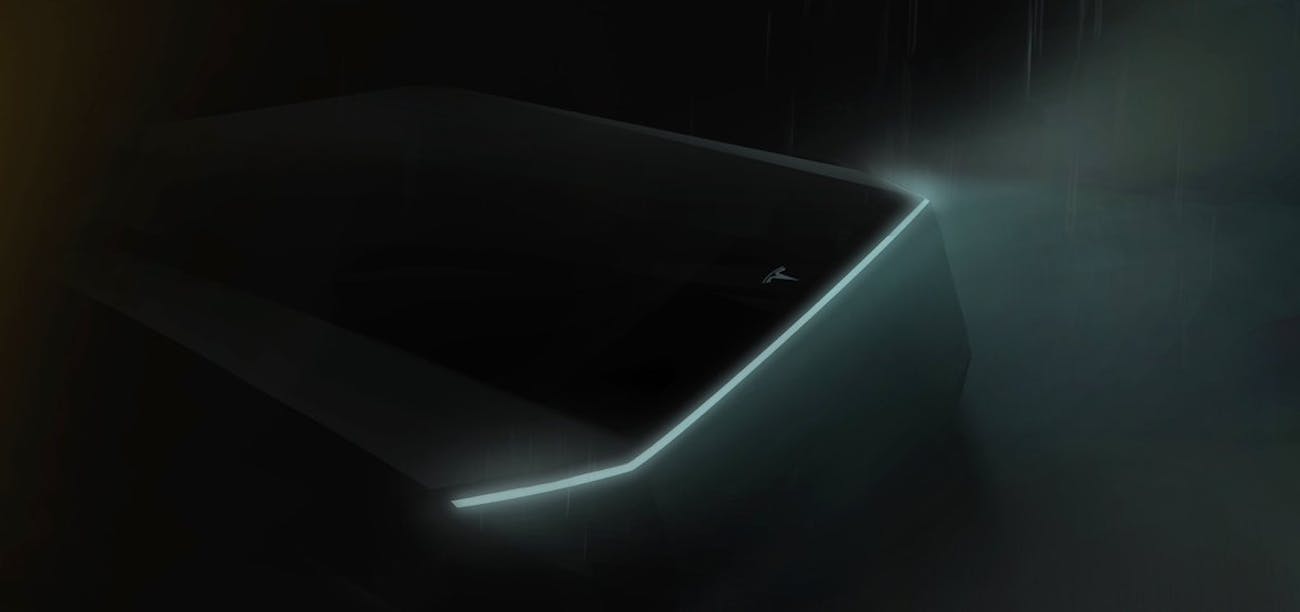
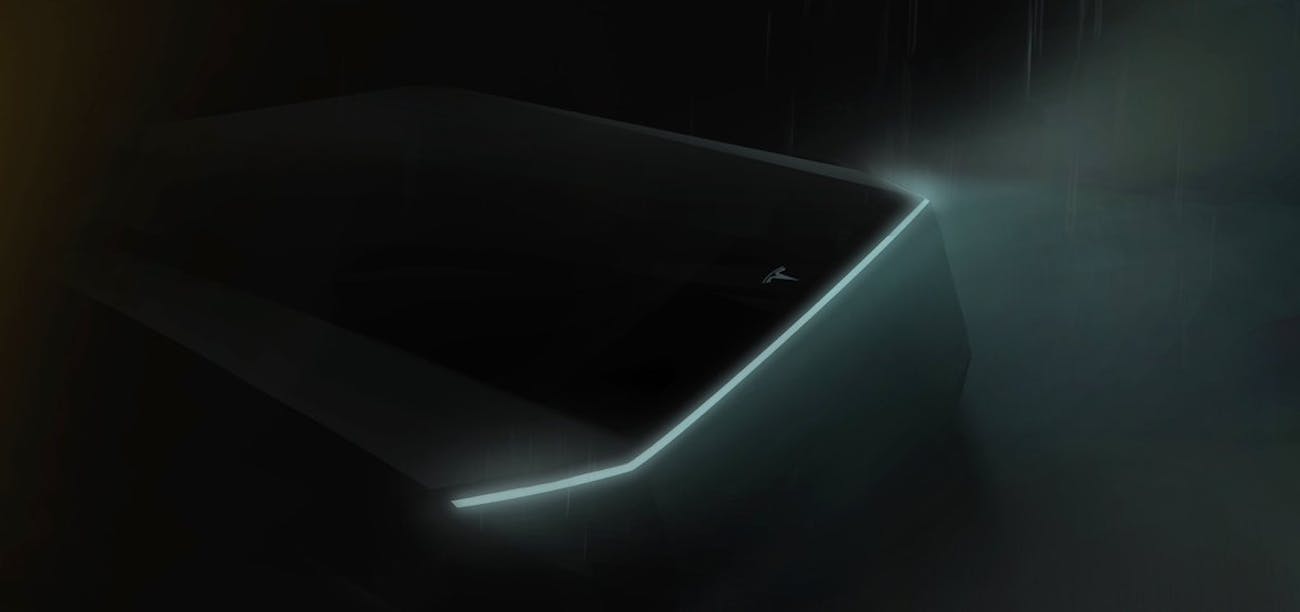
In contrast to the simple entry-level designs of the Model 3 and Model Y, Musk has described the truck’s design as “cyberpunk,” “Blade Runner” and “heart-stopping.” Tesla has released one teaser image of the truck, during the Model Y reveal, an image that was so subtle Musk had to highlight it after the event.

Tesla Pickup Teaser
The first teasers for the Tesla pickup truck have not given us a lot to go on.

Musk suggested as recently as September that the Pickup Truck could be unveiled in November. With the launch potentially coming as early as next month, Musk may have just given his clearest indication of how the car may look.

Tesla Pickup Truck: what it might look like

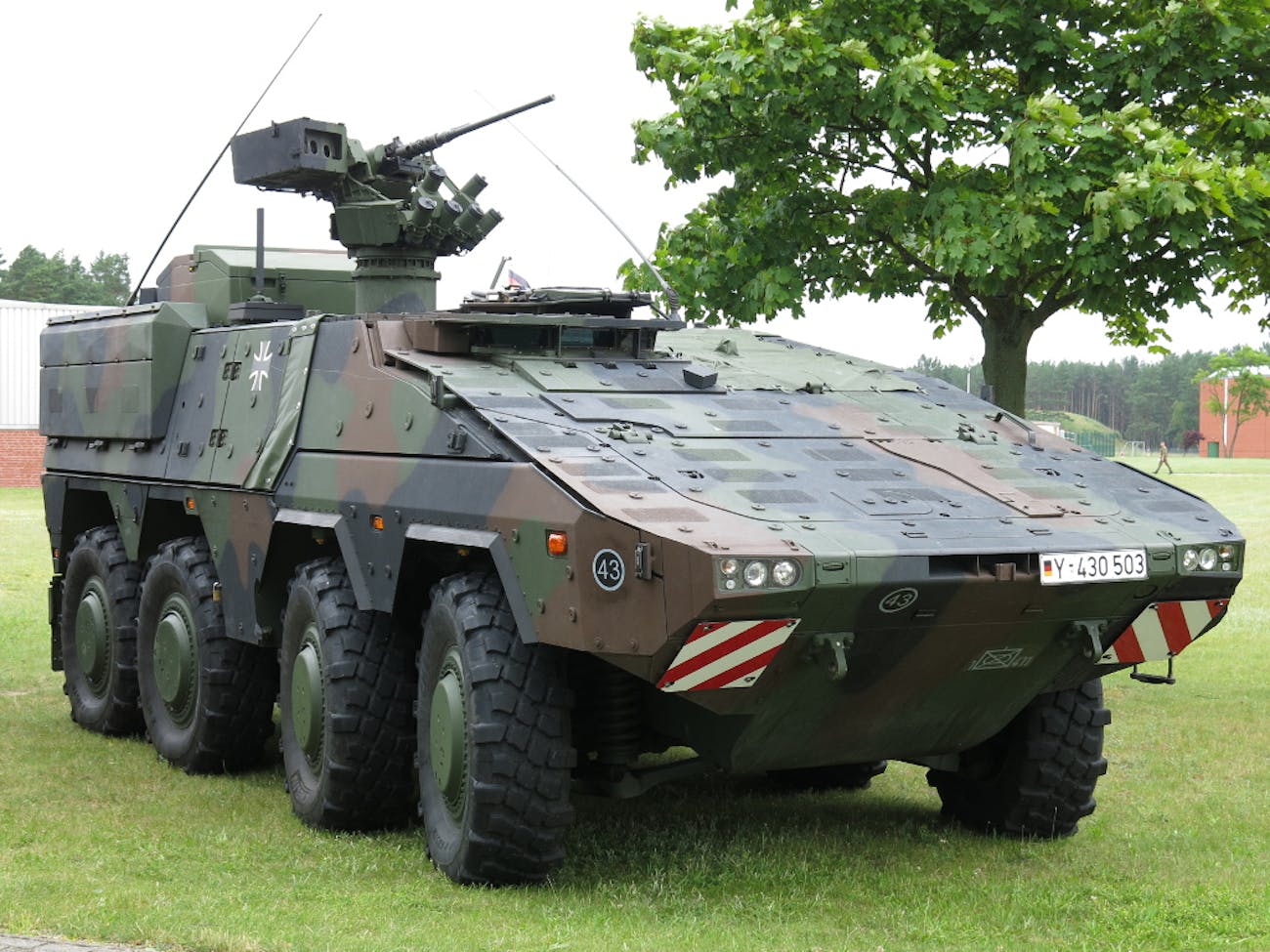
Musk suggested on Monday that the car will look like “an armored personnel carrier from the future.” These are vehicles that have played an important role in military combat since the First World War. The Organization for Security and Co-operation in Europe notes that, unlike tanks and other infantry fighting vehicles, the APC is primarily designed to carry a large number of people rather than acting as an offensive vehicle.

The Boxer, a modern APC primarily operated by the German Army, can transport 11 people. Army Technology described it as “one of the best armored personnel carriers in the world.”

Boxer APC.
Boxer APC.

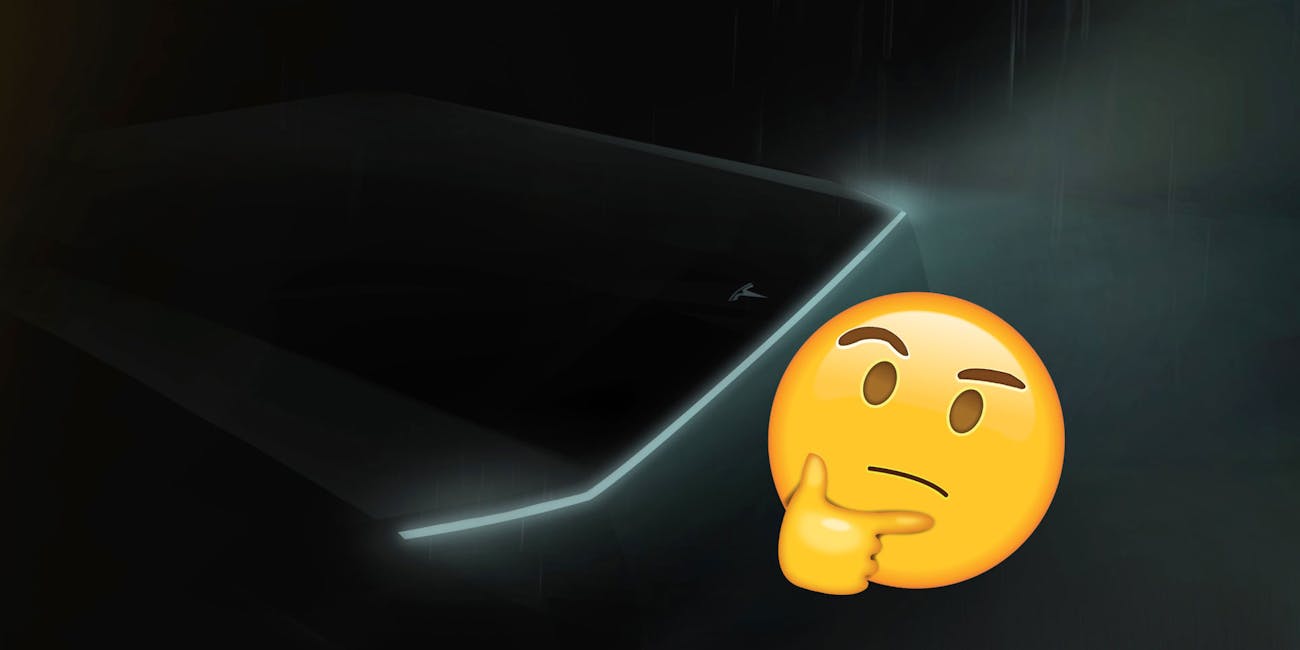
Compare the front’s design to the teaser image, and you can perhaps faintly see how Tesla’s Pickup Truck may resemble a modern APC.

Tesla Pickup Teaser
Pickup Truck: a modern APC?

Tesla Pickup Truck: how it compares to previous guesses

Concept artists have tried to guess at what the vehicle may look like. One popular design came from Emre Husmen, an Istanbul-based designer who has worked with clients like Ford and Fiat and even produced designs for a Tesla Model S. Husmen produced this concept for a truck that received a large amount of attention among Tesla fans.

Unfortunately, as Musk suggested on Monday, the vehicle probably doesn’t look anything like this Joe Rogan, who previously hosted Musk on his podcast, sent Musk a picture of Husmen’s design only to be told it was inaccurate.

“He’s like, ‘that’s not really our truck,’” Rogan said during an episode last week. “He said…what was his words? It’s ‘more Blade Runner-esque’.”

Other fans have produced their own attempts at the design, leading to numerous results popping up on Google Images:

Tesla Pickup Truck Artist Renderings
When one searches on Google for “Tesla pickup truck,” there is no shortage of imagined renderings.

Beyond design, Musk has ratcheted up the anticipation for the truck’s features. In June he teased that the truck needs to cost $49,000 or less, needs to offer better truck-like performance than the Ford F-150, and needs to outperform the Porsche 911 in terms of sports car performance.

Truck fans have expressed concern to Inverse that the company could be on a collision course with an established culture. One Reddit user went as far as to state that “every comment he’s made about the truck has made me nervous.”

Ahead of the big reveal in November, the design could turn out to be a make-or-break feature of the truck.

https://bigthink.com/surprising-science/insomnia-brain-health

Not enough sleep throws your circadian rhythm, leading to potential cognitive problems

Sleep deprivation leads to a shutdown in the production of essential proteins.

Photo by Ulrich Baumgarten via Getty Images
  • Two new studies indicate what happens when your natural circadian rhythm is disrupted by not enough sleep.
  • The production of essential proteins is disrupted by a lack of sleep, which could result in cognitive decline.
  • From dementia to an uptick in obesity, sleep deprivation wreaks havoc in your physiology.

As sleep science continues to discover the necessary benefits of a good night’s rest, roughly one-third of Americans sleep less than six hours every night. Two new studies, both published in the journal Science, and both conducted on mice, have deepened our understanding of why sleep matters so much to cognitive and physical health.

The downsides of sleep deprivation are well-known. From an increase in automobile accidents to stark cognitive decline (sometimes leading to dementia) to weight gain, a regular sleep schedule is the best recovery tool we have in our biological arsenal. Napping has been shown to help, though the eight-hour overnight prescription seems to hold up best, for most people. Sleeping too much, it turns out, has adverse affects as well, but that’s not a problem most run into.

For the studies published in Science, researchers were able to better understand the relationship between sleep cycles and our circadian rhythm, the internal timekeeper that preps us for shutting down and waking back up. While a number of factors play into that rhythm — screen time, caffeine intake, habitual behaviors, work schedule — by honoring its natural cycle you prime for your body for optimal health.

Falling off the cycle, it turns out, disrupts communication between the neurons necessary for maintaining a healthy relationship to our nightly ritual.

The Science of Sleep

In the first study, researchers at the University of Zürich discovered that our circadian rhythm regulates protein transcription. When you’re feeling tired and head off to bed, the proteins necessary for healthy cellular functioning are produced, peaking at two points in the day: right before bed and upon waking up. Sleep sets into motion the transcripts for protein-building, while waking up promotes synapse-firing, the communications device that allows neurons to speak.

When mice were deprived sleep, the transcripts malfunctioned. The messenger RNA (mRNA) were unable to deliver the messages necessary for completing the protein-building and synapse-firing phases that sleep provides. The team, led by Sara B. Noya at the Institute of Pharmacology and Toxicology, writes:

“Under conditions of high sleep pressure, one-fourth of mRNAs remained identically circadian, and most preserved some degree of circadian rhythmicity. In contrast, no substantial circadian rhythm could be detected in any protein when sleep pressure was constantly high.”

The takeaway: honoring your circadian rhythm — some of us are early risers, others late to bed, so nuance matters; what appears stable is that seven-to-nine hours of sleep works for most everyone — will result in the proper building of proteins and communication between neurons. Depriving yourself of sleep will not only make you tired; your mental health will pay the price over time.

Image source: Jacopin / BSIP / Universal Images Group via Getty Images

Illustration of the biological clock. Depending on sunlight perceived by the eye, signals are sent to the suprachiasmatic nucleus, home of the circadian clock, located in the hypothalamus, which controls various biological rhythms. The brain controls the secretion of melatonin (sleep hormone), which increases as light diminishes.

For the second study, a team led by Franziska Brüning (Ludwig Maximilian University of Munich; the Max Planck Institute of Biochemistry) measured the attachments of a phosphate molecule that turns these proteins on and off every four hours, aka “circadian clock-driven protein phosphorylation.” Previous studies have measured this process every 24 hours, making this new research more revealing in terms of how these proteins operate.

As with the companion study above, they discovered two peaks, one upon sleeping, the other before waking. The team writes that previously it was not well understood how time of day affected phosphorylation. By depriving mice of sleep, an abundance of the process was lost in forebrain synapses. They write:

“Our data uncover molecular processes in synapses whose activity is temporally gated by phosphorylation, such as synaptic inhibition at dawn and excitation at dusk.”

Maria Robles, who took part in both papers, says these companion studies reveal the our brain has developed “a beautiful way to control” the molecules necessary for healthy physical and cognitive functioning. While mice are not men, our shared DNA allow such studies to reveal the inner workings of human physiology. These two studies bring us closer to revealing what we already instinctually know: nothing replaces a good night’s sleep.

https://techcrunch.com/2019/10/14/announcing-techcrunch-robotics-ai-on-march-3-2020-at-uc-berkeley/

Announcing TechCrunch Robotics & AI on March 3, 2020 at UC Berkeley

Robotics is back! We are excited to announce that on March 3 next year TechCrunch will host its fourth annual TC Sessions: Robotics & AI at UC Berkeley’s Zellerbach Hall.

Last year, 1,500 founders, technologists, engineering students and investors turned up for a day of main stage interviews with the top figures in AI and robotics, as well as workshops, speaker Q&A and intense networking. The show aims to sit at the intersection of straight-up technology and robotics startups, a zone that’s getting richer every year thanks to rapid advances in AI, GPUs, sensors and all the other related fields.

Boston Dynamics  founder Marc Raibert,  a regular guest at the show, sums up the show this way: “TechCrunch’s AI / Robotics show blends the best of thoughtful, research-focused robotics with a unique business in technology focus. The result is an event that not only shows cutting edge technology but provides perspective of how it will be impacting business soon.”

Last year, we officially added AI to the title of the show, a recognition that AI is perhaps the single biggest driver behind rapid advancement in robotics. As serial medical robotics entrepreneur Dr. Frederic Moll said at TechCrunch Disrupt SF earlier this week, “Everybody focuses on the mechatronic part of robotics, but what’s going to change the world is the intelligence of robotics.”

Get ready for TechCrunch editorial interviews with the world’s top robotics and AI experts, newsmaking demos, super edifying workshops and fantastic networking. Whether you’re looking for technology and product insights, investment, engineering talent, new partners or all of the above, no show delivers more in a single day than TC Sessions: Robotics & AI.

If you want to get a sense of agendas from our past shows, check out past agendas: 2017 @ MIT2018 @UC Berkeley, 2019 @ UC Berkeley.

https://driving.ca/tesla/auto-news/news/elon-musk-says-tesla-truck-to-debut-november

Elon Musk says Tesla truck to debut November

Styling remains a mystery, though we know the pickup will allegedly cost under $US50,000

Tesla’s upcoming electric pickup truck offering is still on schedule to debut next month, according to CEO Elon Musk, who in the past has said the truck will cost less than US$50,000 and “be better than a Ford F-150.”

Musk said back in July the Pickup was “close” to being ready for its unveil, after having earlier promised we’d see the truck November 2019; when pressed on Twitter early October for a reveal date, he said there was “No change” to that plan.

The exec has parceled out several of the truck’s specs, but the thing that no one has a real clue about is the styling; all we have to go on is a teaser image Musk let slip at the end of the Model Y announcement in March.

Steve Jobs Ghost 👻@tesla_truth

Have you decided on a date for the pickup reveal? Still targeting November?

127 people are talking about this

The best we’ve got besides that is a warning the styling will be divisive – Musk called it “not for everyone” – and a hint it will look “really futuristic-like cyberpunk Blade Runner design.”

Musk has so far let us know there will be optional battery packs capable of 400 to 500 miles (645 to 800 km) of range or better; that it will offer seating for six; and that, allegedly, it will boast 300,000 lbs of towing capacity.

Dual Motor All-wheel-drive has been promised, as has dynamic air suspension that will double as an air compressor for tools. Expect built-in locker and, apparently, the ability to float on water.

There’ve been several prospective renderings of the forthcoming truck, including this one from a Canadian artist, but we’ll have to wait until next month to find out if the truck really “may be too futuristic for most people.”

https://cleantechnica.com/2019/10/12/polestar-pricing-tesla-model-3-6-car-in-usa-capital-one-on-tesla-effect-cleantechnica-top-20/

Polestar Pricing … Tesla Model 3 = #6 Car In USA … Capital One On “Tesla Effect” — #CleanTechnica Top 20

Polestar’s entry into the electric vehicle world took the top spot this past week on CleanTechnica, being the number one article viewed on CleanTechnica thanks to the hundreds of thousands of views it pulled in. The focus of the article was its pricing, which is surprisingly high. Yet again, it seems that a new “Tesla killer” just doesn’t compete with Tesla vehicles, even though it is a nice addition to the EV market and deserves solid sales.

Of course, with that non-Tesla story being #1, that means we had to wait all the way till the #2 spot for a Tesla story in the top 20 — oh, the patience required! Then Tesla swept the rest of the top 10, and almost the entire top 20. What’s so special about this California company? Scroll down to find out.

A Polestar store almost ready to open in Norway. Image courtesy Are Hansen.

  1. Polestar Reveals Pricing Details For Its Battery Electric Sedan. Are You Sitting Down?
  2. Tesla Model 3 = 6th Best Selling Car In USA In 3rd Quarter*
  3. Capital One: Value of Luxury Gas Cars Getting Slammed by Tesla Model 3
  4. How Much Range Does A Tesla Model 3 Have After 50,000 Miles?
  5. Where Are They Now? “HUGE” Tesla Model 3 Issues That Are No Longer Issues
  6. Tesla FUD: I Was Wrong
  7. Tesla Model 3 = 24% of Small & Midsize Luxury Car Sales in USA*
  8. The Netherlands Surpasses Wildest Predictions For Tesla Model 3 Sales
  9. European Car Leasing System Will Blow Up Tesla & Other EV Sales
  10. Tesla Reached 7,000 Cars Per Week In 3rd Quarter & Nobody Noticed
  11. California’s Clean Truck Rule: First Of Its Kind & Long Overdue
  12. Tesla Model 3 Sales = 2× Ford Mustang Sales or BMW 3 Series Sales (USA)
  13. Moroccan 7-Star Hotel Looks To Replace Bentleys With Tesla Model X Fleet
  14. Smooth
  15. What Motivates Someone To Key A Tesla?
  16. Tesla Vehicle Efficiency Leads Industry Thanks To Tesla Vehicle Design Culture
  17. Western Australia Utility Removing Poles & Wires In Renewable Energy Transition
  18. Is Tesla Model 3 The Next Toyota Camry?
  19. Generac Dives Into Residential Energy Storage With Seamless Solar Integration #SPI2019
  20. I Invest In Tesla Because I Believe In Elon Musk

If you appreciate our cleantech news coverage and analysis, I encourage you to become a monthly subscriber — even $3 a month is hugely appreciated! You can also make a one-time contribution if you don’t like monthly withdraws.
About the Author

 Zach is tryin’ to help society help itself one word at a time. He spends most of his time here on CleanTechnica as its director and chief editor. He’s also the CEO of Important Media. Zach is recognized globally as an electric vehicle, solar energy, and energy storage expert. He has presented about cleantech at conferences in India, the UAE, Ukraine, Poland, Germany, the Netherlands, the USA, Canada, and Curaçao. Zach has long-term investments in Tesla [TSLA] — after years of covering solar and EVs, he simply has a lot of faith in this company and feels like it is a good cleantech company to invest in. But he offers no investment advice and does not recommend investing in Tesla or any other company.