Month: November 2019
https://www.mindbodygreen.com/articles/why-this-brain-doctor-wants-you-to-take-tech-timeout
Why This Brain Doctor Wants You To Take A Tech Timeout
Have you ever been heading into a meeting at work and noticed that all of your colleagues are staring at their phones? Or gone on a date only to watch the person you’re having dinner with constantly check messages on their smartphone? Of course, you have. And you’ve probably done it, too.
Most of us can’t imagine living without our digital devices. Yet, less than a decade ago, only 35% of Americans owned a smartphone, according to Pew Research. Today, however, that number has jumped to 81% and to a whopping 96% among 18- to 29-year-olds. Our phones, as well as our tablets, laptops, gaming consoles, and other devices, make our lives so much easier, and better, in so many ways. However, they also come with a hefty price.
Our love affair with all things tech is taking a toll on our brain health.
What technology is doing to our brains.
As a psychiatrist for more than three decades, I’ve worked with hundreds of people who are so tied to their tech devices that it’s negatively affecting multiple areas of their lives. Here are some of the main problems I see among my patients.
Tech addiction
In my practice, I see many people struggling with an unhealthy relationship with their devices. They are among the estimated 210 million people struggling with Internet and social media addiction. The brain-imaging work we do at Amen Clinics shows that tech addiction, which is considered a behavioral addiction, is associated with negative changes in multiple brain regions.
Anxiety and mood issues
More time spent on tech devices adds up to more problems with mental well-being. Did you know that teens who log five hours each day on their phones are twice as likely to have symptoms of depression? And in young adults, using seven to 11 social media platforms triples the risk of developing depression and anxiety compared with those who use no more than two platforms.
All those notifications and alerts from our gadgets can be so distracting, and if the buzzing or beeping occurs when you’re knee-deep in a critical task, it impairs performance. In fact, you don’t even have to read that incoming text message or email to experience a drop in your ability to complete the task at hand, according to findings in the Journal of Experimental Psychology.
Low self-esteem
Sadly, self-esteem is too often tied to the number of likes you get on social media. We collaborated with The Dr. Oz Show on a brain-imaging experiment involving the Tinder dating app to assess its effect on mood and focus in a group of men and women in their 30s. In this trial, when they got a “swipe right”—meaning someone using the app liked their pictures and short bio—it increased activity in the pleasure and mood centers of their brains. However, getting more “swipe left” reactions—indicating rejection—caused changes in their brains associated with increased vulnerability to pain and depression.
Forgetfulness
Our reliance on technology and media multitasking are diminishing our working memory capacity as well as our long-term memory function, according to researchers at Stanford University.
Increased impulsivity
Our gadgets give us the ability to see something we want and get it immediately. Scientists are discovering that heavy smartphone use is more likely to lead to impulse control issues.
Relationship woes
Is that smartphone getting between you and your romantic partner? It’s called “technoference,” and emerging research shows it can sabotage relationships. A 2019 study found that smartphones could be a source of frustration for couples. I can vouch for that statistic based on the number of people who come to me for couples’ therapy complaining about their partner’s tech devices.
How to take a tech timeout at work.
When my patients are struggling with the adverse effects of digital obsession, I usually prescribe a tech timeout. You may need one too. Here are some simple strategies to help you unplug at work, in your relationships, and at school.
Try intermittent internet fasting.
As intermittent fasting has become a popular and effective way to achieve and maintain a healthy weight, the same concept can be used to develop a more blissful relationship with your gadgets. Obviously, I wouldn’t recommend strutting into the office on Monday morning and announcing, “I’m going on an internet fast today, so don’t text, email, or call me for the rest of the day.” But you can choose to unplug on your own time. Take a 15-minute break in the afternoon without your phone or leave it at the office when you go to lunch.
Stick to the single-screen rule
Are you one of those multi-screeners? You know the type—updating social media feeds on an iPad while videoconferencing with a client and working on a spreadsheet on your computer? This type of multitasking leads to problems with attention and has been found to decrease productivity by up to 40%. Limit yourself to one screen at a time. It will boost your focus and help you complete tasks more efficiently so you can be more productive.
How to take a tech timeout in relationships.
Don’t talk and text.
If you’re going on a date, I suggest that you both put your phones out of reach, so you can get to know each other and spend quality time together. If your date has a hard time detaching from his or her phone or seems super stressed about it, it could be a warning sign of tech addiction.
Make the bedroom a tech-free zone.
If you want to enhance intimacy with your partner, clear out all screens from the bedroom, including computers, smartphones, and televisions. Creating a relaxing, distraction-free environment will let you focus on each other. I’ve worked with several couples that have reported developing a stronger bond after removing this “third wheel” from the bedroom.
How to take a tech timeout in school.
Avoid the “Google Effect.”
Schoolwork—whether it’s high school, college, or continuing education, at one time required students to use their brains to memorize facts. This ability has dramatically diminished due to what researchers call the “Google Effect,” or digital amnesia. To give your brain a workout, put your tech devices aside for at least a portion of your study sessions, and make an attempt to memorize class material.
Log off during class.
Considering that lecture notes are widely available, and it’s easy to hit the “record” button on your phone or computer, you may be tempted to tune out during class and get distracted with your phone. This is dangerous! Make it a habit to hide your phone in your backpack so you can’t access it during class. This will help you concentrate on the material, ask questions, and have a better understanding of what the instructor highlights as important and will likely be on the exam!
Taking a temporary tech timeout in the important areas of your life will enhance your overall brain health and can increase productivity, strengthen relationships, and improve academic performance. Commit to some tech timeouts today so you can start recharging your brain and enhancing your life.
https://www.sciencealert.com/brain-scans-reveal-how-it-s-possible-to-remain-high-functioning-with-half-a-brain
Remarkable MRI Study Reveals How Some People Function With Only Half a Brain
Astounding stories of people living relatively normal lives with giant chunks of their brains damaged or missing often seem to defy logic. But, given the chance, our brains have an uncanny skill – to mold their abilities around the missing bits.
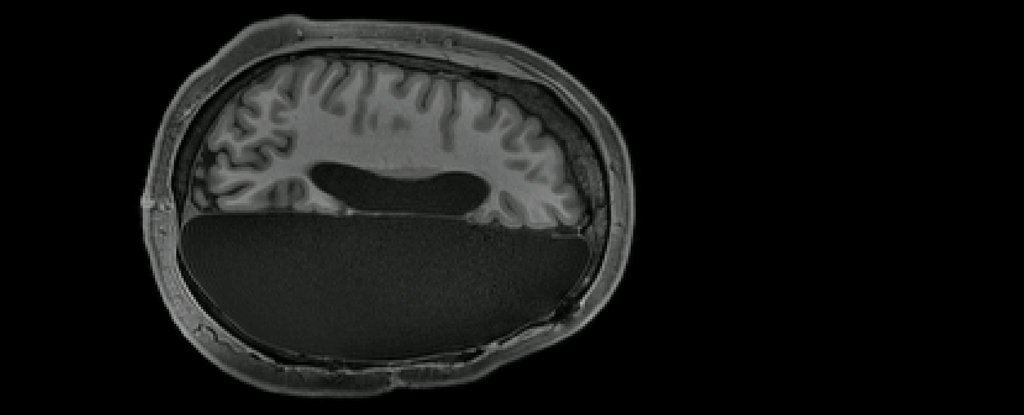 A new study of people missing entire halves of their brains has provided insights into how this is possible, revealing the human brain’s remarkable ability to multitask when parts of it are literally absent.
“You can almost forget their condition when you meet them for the first time,” said neuroscientist Dorit Kliemann from the California Institute of Technology.
“When I sit in front of the computer and see these MRI images showing only half a brain, I still marvel that the images are coming from the same human being who I just saw talking and walking and who has chosen to devote his or her time to research.”
Six of the study participants had undergone the frighteningly drastic procedure of having one of their brain hemispheres removed during childhood, to treat a rare and extreme type of epilepsy. The procedure is called hemispherectomy, and is used only if the seizures are “catastrophic” or drugs have failed.
“It’s truly amazing what these patients can do. Yes, they have challenges, but their cognitive abilities are still remarkably high functioning given that they are missing half of the brain tissue,” said Kliemann.
By comparing MRI scans of these participants with six controls who didn’t have any brain parts removed, along with a database of 1,482 brains scanned for the Brain Genomics Superstructure Project, Kliemann and colleagues found that the pattern of resting-state brain activity in the participants with just half their brain is remarkably similar to people who possess all their brain matter.
But the team also detected a difference: participants who’d had hemispherectomies showed a lot more connection between brain networks.
 MRI from a participant who had a hemispherectomy as a child. (Caltech brain imaging center)
These networks control things like attention, sensory, and limbic (emotion and memory) activities, and often involve both hemispheres of the brain. Studies suggest that within-network activity links to abilities like motor control, whereas connections between networks are essential for executive abilities like working memory.
This increase in connections was consistent across the six non-control participants, and across all the different networks – so, for example, the attention network showed more connections to the visual network than usual. The patterns of connectivity between networks remained the same as the controls, they were just doing more.
“Their brain networks seem to be multitasking,” Carnegie Mellon University neuroscientist Marlene Behrmann, who was not involved in the study, told The New York Times.
This increase in connection between networks reflects how the remaining brain compensates for loss of available brain hardware, in order to maintain cognitive function and consciousness, the researchers explain in their paper.
They point out that due to the very small sample size they were unable to make connections between the differences in brain activity and specific behaviours or cognition like IQ.
In future research, the team is now keen to learn how these brain networks work together to compensate for damaged or missing brain parts during specific tasks – as opposed to resting-states that were tested here.
And understanding how our different brain networks can multitask through increased connections might help scientists to uncover treatments for other brain injuries.
“As remarkable as it is that there are individuals who can live with half a brain, sometimes a very small brain lesion like a stroke or a traumatic brain injury like a bicycle accident or a tumor can have devastating effects,” said Kliemann.
You can read the full paper in Cell Reports.
https://www.pcgamer.com/biostar-launches-its-fastest-ssd-yet/
Biostar launches its fastest SSD yet
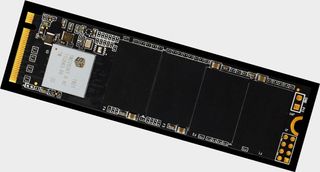
(Image credit: Biostar)
Biostar is expanding its line of solid state drives with the new M700 series, and it represents the fastest storage product in the company’s stable. However, the M700 series won’t be able to keep up with the recent crop of best NVMe SSDs that leverage the PCI Express 4.0 bus.
To be fair, that doesn’t matter much for gaming—several of the best SSDs for gaming are still older SATA 6Gbps models. They’re comparatively pokey to NVMe SSDs, and especially the blazing fast ones that tap into the PCIe 4.0 bus, but those speed gains don’t really translate to games.
As for the M700 series, Biostar is pushing out two capacities—512GB (M700-512GB) and 256GB (M700-256GB). They are both M.2 form factor drives, with an NVMe interface supporting PCIe 3.0.
Performance varies by capacity. The larger 512GB model is the faster of the two, with rated sequential reads of up to 2,000MB/s and sequential writes of up to 1,600MB/s. On the 256GB model, those figures dip to 1,850MB/s on the read side and 950MB/s on the write side, the latter of which is a much steeper drop.
Depending on how these drives end up being priced, they could be interesting additions, or rather boring—Biostar is introducing these drives right as the Black Friday deals season is about to start, and there will likely be a lot of bargains on the SSDs in the coming days and weeks.
I’ve reached to Biostar for information on pricing and availability, and will update this article when/if I hear back.
https://www.cnn.com/2019/11/22/cars/tesla-cybertruck-electric-pickup-truck/index.html
Tesla reveals Cybertruck, but breaks its ‘unbreakable’ windows during unveiling

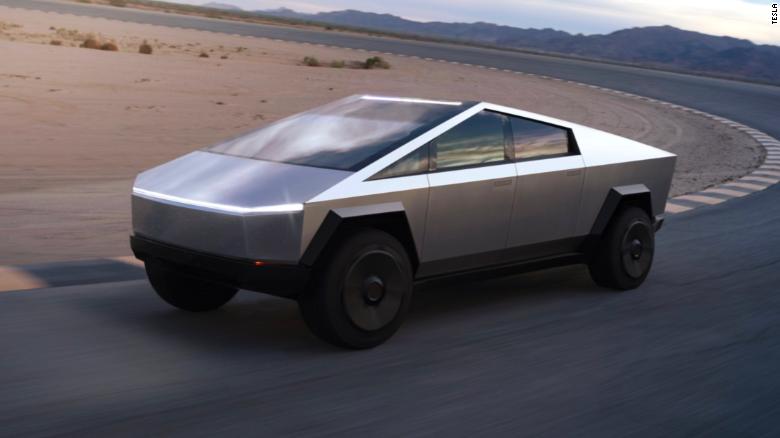
(CNN Business)The Cybertruck has arrived and it looks nothing like any pickup truck you’ve ever seen. Tesla CEO Elon Musk revealed the long-awaited electric pickup truck at its Design Studio in Hawthorne, California, just outside Los Angeles.
When the truck initially drove onto the stage, many in the crowd clearly couldn’t believe that this was actually the vehicle they’d come to see. The Cybertruck looks like a large metal trapezoid on wheels, more like an art piece than a truck.
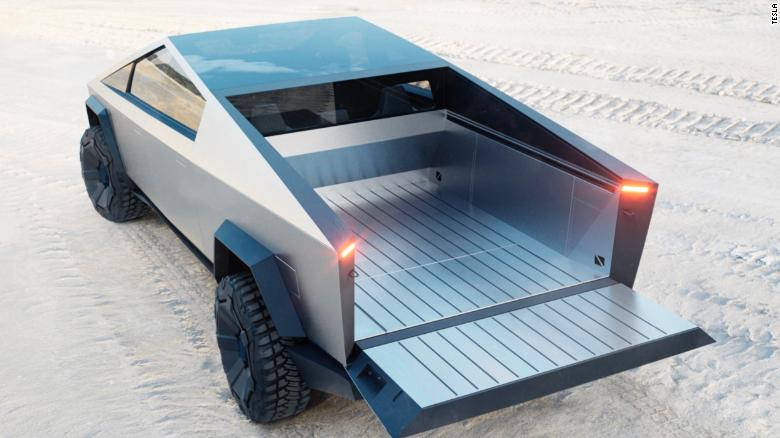
The Tesla Cybertruck’s bed has a roll-down cover and a built-in ramp in the tailgate.
Instead of a distinctly separate cab and bed, the body appears to be a single form. The exterior is made from a newly developed stainless steel alloy, the same metal that’s used for SpaceX rockets, Musk said. That alloy enables the car to be “literally bulletproof” against at least smaller firearms, including 9-millimeter handguns, Musk said.
A man with a sledgehammer hit the sides of the truck without damaging it. But a demonstration of the truck’s supposedly unbreakable metal glass windows backfired when a metal ball thrown at the windows did, in fact, break them.
“But it didn’t go through, ” Musk sheepishly pointed out.

Tesla CEO Elon Musk stands in front of the shattered windows.
Incredible power at an incredible price
Musk has made striking claims about the truck’s capabilities. Among them, he has said the Cybertruck would be more capable, in terms of towing and hauling, than a Ford F-150 and perform as a better sports car than a Porsche 911.
The most expensive version of the truck, the Tri Motor All-Wheel-Drive, will be able to carry 3,500 pounds, tow up to 14,000 pounds and go from zero to 60 in 2.9 seconds. It will also be able to drive up to 500 miles on a full charge. Base models will have a range of 250 miles.
In addition to being able to carry cargo in its bed, the truck will have lockable storage spaces under the hood and in the sides. The bed itself also has a sliding cover. Drivers will also be able to adjust the ride height of the truck, for when they are on the highway or off-road, using an adaptive air suspension system.
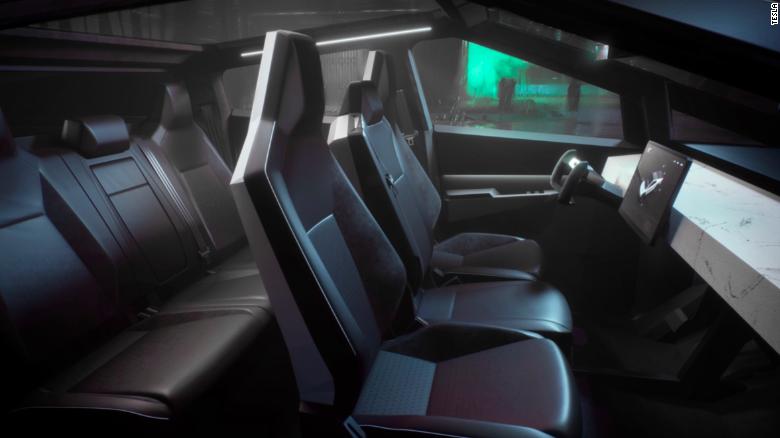
The Cybertruck has, supposedly, shartterproof windows.
Another eye-catching feature of the truck is its price. The base version of the truck will start at $39,900. That’s only about $10,000 more than the price of a base model Ford F-150, which starts at about $30,000. But it would compete well with the cost of a nicely equipped F-150. An F-150 Lariat Super Cab, for instance, starts at about $44,000.
Prices for the top end Tri Motor AWD version of the Cybertruck start at $69,900. Buyers will also be able to choose Tesla’s “self-driving” option for $7,000. (The truck should be able to drive itself once the software for that becomes available.)
Musk had one final surprise as the presentation was wrapping up.
“Oh, yeah,” he said. “We also made an ATV.”
With that, a rider came out from a side room on a small electric all-terrain vehicle. He flipped down the truck’s tailgate, extended a built in ramp, and rode it up into the bed.
‘A niche product at best’
Tesla’s new electric truck won’t be without some stiff competition. It’s going up against the two market leaders in full-size trucks in America. Ford is developing its own electric F-series truck, while General Motors, which makes Chevrolet and GMC pickups, also has its own electric pickups in the works. Earlier Thursday, GM CEO Mary Barra said the auto maker expects to begin selling its electric pickup in the fall of 2021.
Rivian, a Michigan-based start up also plans to begin selling its own electric pickup next year. The company counts Amazon and Ford as major investors. Rivian founder, R.J. Scaringe, ranked third on this year’s just-released Motor Trend Power List, a largely subjective ranking of relative auto industry mojo. Musk ranked 24th. Rivian’s trucks will cost tens of thousands of dollars more then Tesla’s, but they will look far more like trucks.
The market potential for Tesla’s truck remains somewhat of a mystery. There has, to date, been little overlap between full-size pickup truck buyers and Tesla buyers. For instance, Teslas and other electric cars sell well on America’s coasts, while large pickups sell best in the Midwest.
Also, Tesla’s Cybertruck looks nothing like a traditional pickup. Truck buyers may want to stand out, but it’s unclear they’ll be comfortable with standing out quite so much.
The Tesla Cybertruck doesn’t have a seperate body and frame, like most trucks. Instead, it’s strength comes from its metal skin, Elon Musk said.
“It will be a niche product at best and poses no threat in the pickup market as we know it today. said Matt DeLorenzo, senior executive editor at Kelley Blue Book. “The other downside is that this truck will have no federal tax credits by the time it comes out.”
In an interview on the Recode Decode podcast with Kara Swisher last year, Musk admitted the truck might have a hard time finding a market.
“You know, I actually don’t know if a lot of people will buy this pickup truck or not, but I don’t care,” he said at the time. “If there’s only a small number of people that like that truck, I guess we’ll make a more conventional truck in the future.”
Chelsea Sexton, an analyst who covers the electric vehicle market, said she doesn’t believe the truck Musk showed is very close to the final production vehicle.
“From a specification standpoint, I believe that’s probably what they’re aiming for, but no question that body style, that is not a high-volume product,” she said.
Production will begin in late 2021, with production of the Tri Motor AWD version of the Cybertruck beginning a year later, according to Tesla.
https://techxplore.com/news/2019-11-machine-algorithms-safety-fairness.html
New algorithms train AI to avoid specific bad behaviors

Artificial intelligence has moved into the commercial mainstream thanks to the growing prowess of machine learning algorithms that enable computers to train themselves to do things like drive cars, control robots or automate decision-making.
But as AI starts handling sensitive tasks, such as helping pick which prisoners get bail, policy makers are insisting that computer scientists offer assurances that automated systems have been designed to minimize, if not completely avoid, unwanted outcomes such as excessive risk or racial and gender bias.
A team led by researchers at Stanford and the University of Massachusetts Amherst published a paper Nov. 22 in Science suggesting how to provide such assurances. The paper outlines a new technique that translates a fuzzy goal, such as avoiding gender bias, into the precise mathematical criteria that would allow a machine-learning algorithm to train an AI application to avoid that behavior.
“We want to advance AI that respects the values of its human users and justifies the trust we place in autonomous systems,” said Emma Brunskill, an assistant professor of computer science at Stanford and senior author of the paper.
Avoiding misbehavior
The work is premised on the notion that if “unsafe” or “unfair” outcomes or behaviors can be defined mathematically, then it should be possible to create algorithms that can learn from data on how to avoid these unwanted results with high confidence. The researchers also wanted to develop a set of techniques that would make it easy for users to specify what sorts of unwanted behavior they want to constrain and enable machine learning designers to predict with confidence that a system trained using past data can be relied upon when it is applied in real-world circumstances.
“We show how the designers of machine learning algorithms can make it easier for people who want to build AI into their products and services to describe unwanted outcomes or behaviors that the AI system will avoid with high-probability,” said Philip Thomas, an assistant professor of computer science at the University of Massachusetts Amherst and first author of the paper.
Play
00:00
03:57
Enter fullscreen
Play
Fairness and safety
The researchers tested their approach by trying to improve the fairness of algorithms that predict GPAs of college students based on exam results, a common practice that can result in gender bias. Using an experimental dataset, they gave their algorithm mathematical instructions to avoid developing a predictive method that systematically overestimated or underestimated GPAs for one gender. With these instructions, the algorithm identified a better way to predict student GPAs with much less systematic gender bias than existing methods. Prior methods struggled in this regard either because they had no fairness filter built-in or because algorithms developed to achieve fairness were too limited in scope.
The group developed another algorithm and used it to balance safety and performance in an automated insulin pump. Such pumps must decide how big or small a dose of insulin to give a patient at mealtimes. Ideally, the pump delivers just enough insulin to keep blood sugar levels steady. Too little insulin allows blood sugar levels to rise, leading to short term discomforts such as nausea, and elevated risk of long-term complications including cardiovascular disease. Too much and blood sugar crashes—a potentially deadly outcome.

Machine learning can help by identifying subtle patterns in an individual’s blood sugar responses to doses, but existing methods don’t make it easy for doctors to specify outcomes that automated dosing algorithms should avoid, like low blood sugar crashes. Using a blood glucose simulator, Brunskill and Thomas showed how pumps could be trained to identify dosing tailored for that person—avoiding complications from over- or under-dosing. Though the group isn’t ready to test this algorithm on real people, it points to an AI approach that might eventually improve quality of life for diabetics.
In their Science paper, Brunskill and Thomas use the term “Seldonian algorithm” to define their approach, a reference to Hari Seldon, a character invented by science fiction author Isaac Asimov, who once proclaimed three laws of robotics beginning with the injunction that “A robot may not injure a human being or, through inaction, allow a human being to come to harm.”
While acknowledging that the field is still far from guaranteeing the three laws, Thomas said this Seldonian framework will make it easier for machine learning designers to build behavior-avoidance instructions into all sorts of algorithms, in a way that can enable them to assess the probability that trained systems will function properly in the real world.
Brunskill said this proposed framework builds on the efforts that many computer scientists are making to strike a balance between creating powerful algorithms and developing methods to ensure that their trustworthiness.
“Thinking about how we can create algorithms that best respect values like safety and fairness is essential as society increasingly relies on AI,” Brunskill said.
More information: P.S. Thomas el al., “Preventing undesirable behavior of intelligent machines,” Science (2019). science.sciencemag.org/lookup/ … 1126/science.aag3311
Journal information: Science
Provided by Stanford University
The Pea-Sized Gland That Controls Your Thoughts | Random Thursday
Neuralink – Merging Brain and Machine
https://techcrunch.com/2019/11/20/apple-expands-and-updates-its-everyone-can-code-program/
Apple expands and updates its ‘Everyone Can Code’ program

Apple announced today an expansion of its program designed to get more students coding. The company says it has redesigned the “Everyone Can Code” curriculum with a focus on introducing more elementary and middle school students to coding, while also adding more resources for teachers, a new student guide, and refreshed Swift Coding Club materials. It’s also adding thousands of free coding sessions at Apple Stores in December, to celebrate Computer Science Education Week.
The updated curriculum is meant to make coding more approachable, Apple explains, by offering activities that are more closely connected to the students’ everyday lives. It also includes a new guide to Swift Playgrounds called Everyone Can Code Puzzles, where students can experiment with concepts and apply their understanding across over 40 hours of activities.
The guide comes with a teacher companion, which includes the solutions, assessment strategies, accessibility resources, and more.
The curriculum is also now optimized for VoiceOver, includes closed-captioned videos, and videos in American Sign Language.

In another expansion, Apple has integrated its Everyone Can Create project guides into the new curriculum. Launched last year on Apple Books, Everyone Can Create has served to get teachers to integrate things like drawing, music, filmmaking and photography into their classroom, by way of Apple technology.
Related this news, Apple says it’s increasing the number of Today at Apple coding sessions from December 1 through 15, 2019 in order to celebrate Computer Science Education Week.
The free, interactive sessions are meant to inspire young coders with block-based coding using robots, while more advanced coders use Swift Playgrounds to learn coding concepts or to code an AR project.
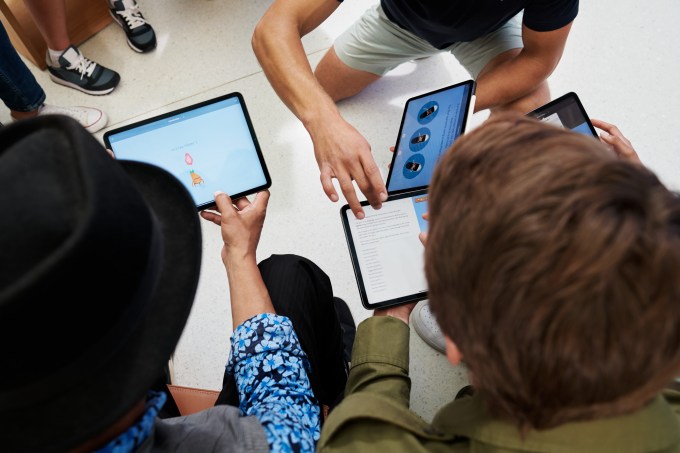
Some stores will also offer preschool-aged coding sessions in the new Coding Lab with Helpsters, the little monsters who star in the new Apple TV+ show, from the makers of Sesame Street. Other sessions will involve Apple Distinguished Educators, Apple Entrepreneur Camp innovators, developers, and artists. A Develop in Swift curriculum will continue to be available for high school and college students, Apple noted.
And for the seventh consecutive year, Apple will support the Hour of Code with a new Hour of Code Facilitator Guide that will help teachers and parents host sessions using Swift Playgrounds.
https://www.xda-developers.com/g-suite-google-assistant-gmail-google-calendar/
G Suite users get basic Google Assistant voice commands for Gmail and Google Calendar
People who regularly use G Suite accounts often complain about the lack of features compared to regular Google accounts. The company has slowly been fixing this as of late with a bunch of features added back in April. Now, Google is finally allowing G Suite accounts to use Google Assistant voice commands for Gmail and Google Calendar.
Google Assistant’s voice commands for G Suite users are pretty basic at the moment. Here’s what you can do:
- Let you know when your next meeting is
- Create, cancel or reschedule a Calendar event
- Send a note to event attendees via email
- Send an email
- Dial into a meeting

Google Assistant will only work with one account at a time. You’ll have to switch between accounts if you’re signed into a personal Google account and a G Suite account. To use these commands you will first have to apply to use them. Right now, the feature is in beta and not enabled by default. That means if you’re not an admin you’ll have to convince the higher-ups to apply.
 Bruce's Blog