https://scitechdaily.com/new-electronics-devised-that-mimic-the-human-brain-in-efficient-learning/

New Electronics Devised That Mimic the Human Brain in Efficient Learning
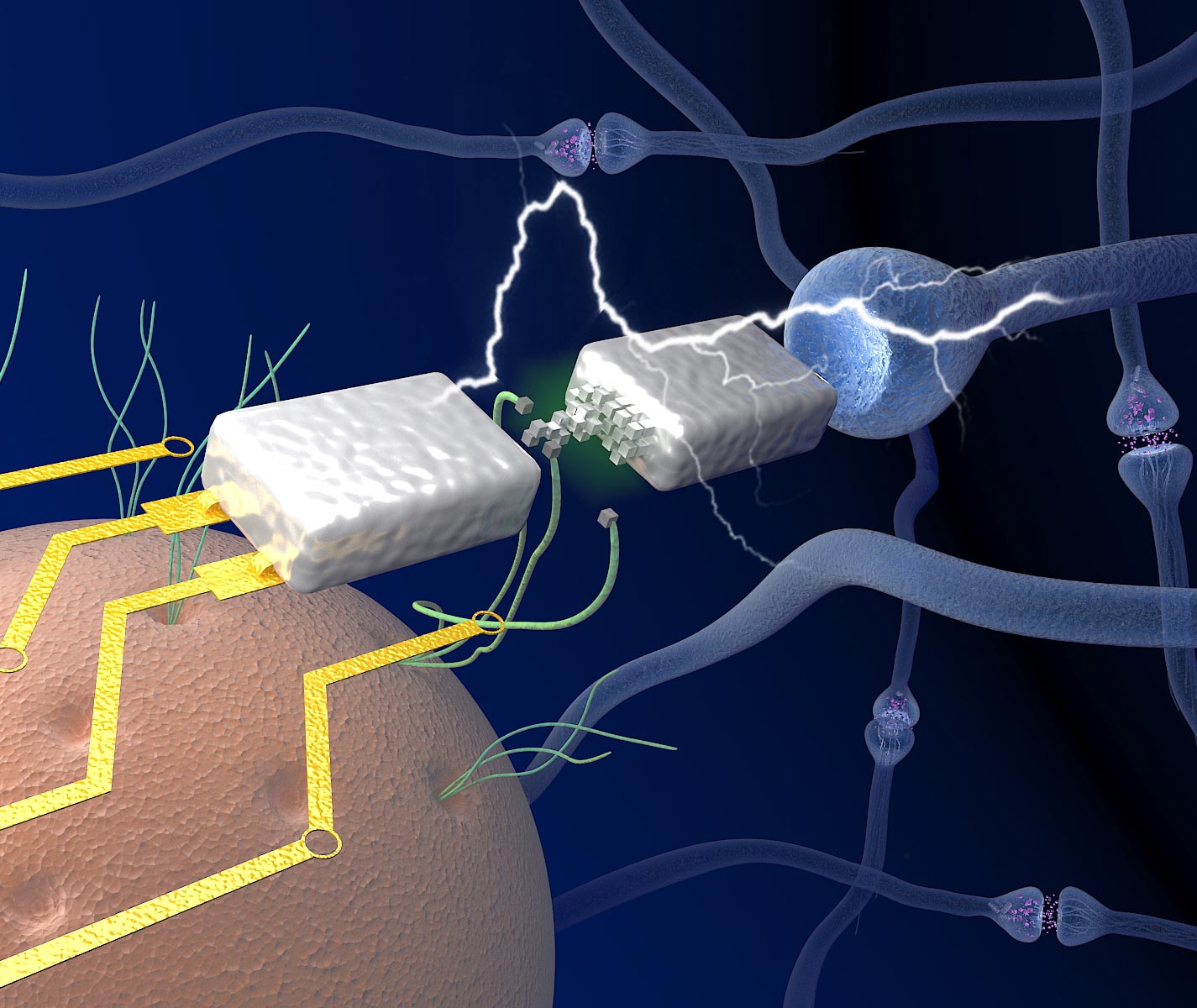
Neuromorphic Memristor

University of Massachusetts Amherst researchers advance neuromorphic computing.

Only 10 years ago, scientists working on what they hoped would open a new frontier of neuromorphic computing could only dream of a device using miniature tools called memristors that would function/operate like real brain synapses.

But now a team at the University of Massachusetts Amherst has discovered, while on their way to better understanding protein nanowires, how to use these biological, electricity conducting filaments to make a neuromorphic memristor, or “memory transistor,” device. It runs extremely efficiently on very low power, as brains do, to carry signals between neurons. Details are published in Nature Communications today (April 20, 2020).

A memristor (a portmanteau of memory resistor) is a non-linear two-terminal electrical component relating electric charge and magnetic flux linkage. It was described and named in 1971 by Leon Chua, completing a theoretical quartet of fundamental electrical components which comprises also the resistor, capacitor and inductor.

As first author Tianda Fu, a Ph.D. candidate in electrical and computer engineering, explains, one of the biggest hurdles to neuromorphic computing, and one that made it seem unreachable, is that most conventional computers operate at over 1 volt, while the brain sends signals called action potentials between neurons at around 80 millivolts — many times lower. Today, a decade after early experiments, memristor voltage has been achieved in the range similar to conventional computer, but getting below that seemed improbable, he adds.

Fu reports that using protein nanowires developed at UMass Amherst from the bacterium Geobacter by microbiologist and co-author Derek Lovely, he has now conducted experiments where memristors have reached neurological voltages. Those tests were carried out in the lab of electrical and computer engineering researcher and co-author Jun Yao.

Yao says, “This is the first time that a device can function at the same voltage level as the brain. People probably didn’t even dare to hope that we could create a device that is as power-efficient as the biological counterparts in a brain, but now we have realistic evidence of ultra-low power computing capabilities. It’s a concept breakthrough and we think it’s going to cause a lot of exploration in electronics that work in the biological voltage regime.”

Lovely points out that Geobacter’s electrically conductive protein nanowires offer many advantages over expensive silicon nanowires, which require toxic chemicals and high-energy processes to produce. Protein nanowires also are more stable in water or bodily fluids, an important feature for biomedical applications. For this work, the researchers shear nanowires off the bacteria so only the conductive protein is used, he adds.

Fu says that he and Yao had set out to put the purified nanowires through their paces, to see what they are capable of at different voltages, for example. They experimented with a pulsing on-off pattern of positive-negative charge sent through a tiny metal thread in a memristor, which creates an electrical switch.

They used a metal thread because protein nanowires facilitate metal reduction, changing metal ion reactivity and electron transfer properties. Lovely says this microbial ability is not surprising, because wild bacterial nanowires breathe and chemically reduce metals to get their energy the way we breathe oxygen.

As the on-off pulses create changes in the metal filaments, new branching and connections are created in the tiny device, which is 100 times smaller than the diameter of a human hair, Yao explains. It creates an effect similar to learning — new connections — in a real brain. He adds, “You can modulate the conductivity, or the plasticity of the nanowire-memristor synapse so it can emulate biological components for brain-inspired computing. Compared to a conventional computer, this device has a learning capability that is not software-based.”

Fu recalls, “In the first experiments we did, the nanowire performance was not satisfying, but it was enough for us to keep going.” Over two years, he saw improvement until one fateful day when his and Yao’s eyes were riveted by voltage measurements appearing on a computer screen.

“I remember the day we saw this great performance. We watched the computer as current voltage sweep was being measured. It kept doing down and down and we said to each other, ‘Wow, it’s working.’ It was very surprising and very encouraging.”

Fu, Yao, Lovely and colleagues plan to follow up this discovery with more research on mechanisms, and to “fully explore the chemistry, biology and electronics” of protein nanowires in memristors, Fu says, plus possible applications, which might include a device to monitor heart rate, for example. Yao adds, “This offers hope in the feasibility that one day this device can talk to actual neurons in biological systems.”

Reference: “Bioinspired bio-voltage memristors” by Tianda Fu, Xiaomeng Liu, Hongyan Gao, Joy E. Ward, Xiaorong Liu, Bing Yin, Zhongrui Wang, Ye Zhuo, David J. F. Walker, J. Joshua Yang, Jianhan Chen, Derek R. Lovley and Jun Yao, 20 April 2020, Nature Communications.
DOI: 10.1038/s41467-020-15759-y

https://www.eonline.com/ca/news/1142842/don-t-sleep-on-these-25-while-you-were-sleeping-secrets

Can you believe it’s been 25 years since While You Were Sleeping woke us up to our insane love for Sandra Bullock?

Directed by John Turtletaub and starring the then up-and-coming star and Bill Pullman, the guy that didn’t stand a chance against Tom Hanks in Sleepless in Seattle, While You Were Sleeping surprised everyone when it became one of the most successful movies of 1995.

Starring Bullock as Lucy, a lonely fare token collector who is helplessly in love with Peter (Peter Gallagher), a commuter she admires from afar until she saves his life and then ends up telling his family, including his handsome brother Jack (Pullman), that she’s his fiancée. Unexpected romance, family bonding and a happy ending ensues.

Sure, it is a storyline that could’ve easily been creepy and taken a turn for a Lifetime thriller, but thanks to Bullock’s undeniable charisma and her charming chemistry with Pullman, While You Were Sleeping is still one of the genre’s most beloved offerings 25 years after its release.

However, it could’ve almost starred two other major rom-com leading ladies and a former James Bond.

Here are 25 secrets you might not know about While You Were Sleeping, including some surprising reveals about the original script from screenwriter Frederic Lebow, who wrote the movie with Daniel G. Sullivan

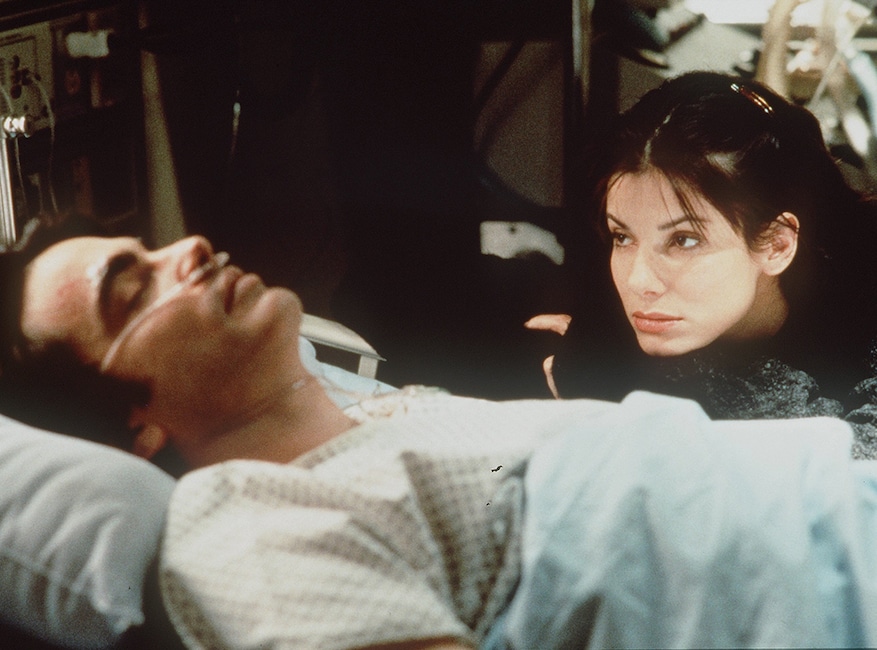
While You Were Sleeping, Sandra Bullock, Bill Pullman

Hollywood Pictures/Kobal/Shutterstock

While You Were Sleeping, Sandra Bullock, Peter Gallagher

Hollywood Pictures/Kobal/Shutterstock

While You Were Sleeping, Sandra Bullock, Bill Pullman

Hollywood Pictures/Kobal/Shutterstock

While You Were Sleeping, Sandra Bullock

Mike Weinstein/Hollywood/Kobal/Shutterstock

While You Were Sleeping, Sandra Bullock

Buena Vista/Getty Images

While You Were Sleeping, Bill Pullman, Sandra Bullock

Buena Vista/Getty Images

While You Were Sleeping, Bill Pullman

Buena Vista/Getty Images

While You Were Sleeping, Sandra Bullock

Mike Weinstein/Hollywood/Kobal/Shutterstock

https://www.sciencealert.com/releasing-herds-of-animals-in-the-arctic-could-help-fight-climate-change-says-study

We Could Release Herds of Animals in The Arctic to Fight Climate Change, Says Study

JEFF BERARDELLI, CBS NEWS
21 APRIL 2020

Herds of horses, bison and reindeer could play a significant part in saving the world from an acceleration in global heating. That is the conclusion of a recent study showing how grazing herbivores can slow down the pace of thawing permafrost in the Arctic.

main article imageThe study – a computerized simulation based on real-life, on-the ground data – finds that with enough animals, 80 percent of all permafrost soils around the globe could be preserved through 2100.

The research was inspired by an experiment in the town of Chersky, Siberia featured on CBS News’ 60 Minutes. The episode introduces viewers to an eccentric scientist named Sergey Zimov who resettled grazing animals to a piece of the Arctic tundra more than 20 years ago.

Zimov is unconventional, to say the least, even urging geneticists to work on resurrecting a version of the now-extinct woolly mammoth to aid in his quest. But through the years he and his son Nikita have observed positive impacts from adding grazing animals to the permafrost area he named Pleistocene Park, in a nod to the last ice age.

Permafrost is a thick layer of soil that remains frozen year-round. Because of the rapidly warming climate in Arctic regions, much of the permafrost is not permanently frozen anymore. Thawing permafrost releases heat-trapping greenhouse gases that have been buried in the frozen soil for tens of thousands of years, back into the atmosphere.

Scientists are concerned that this mechanism will act as a feedback loop, further warming the atmosphere, thawing more soil, releasing more greenhouse gases and warming the atmosphere even more, perpetuating a dangerous cycle.

Last year their fears were confirmed when a study led by scientists at Woods Hole Research Center revealed that the Arctic was no longer storing as much carbon as it was emitting back into the atmosphere.

nasa permafrost co2Winter emissions of carbon dioxide (CO2) in the Arctic, 2013-2017. (NASA)


In winter the permafrost in Chersky, Siberia stays at about 14 degrees Fahrenheit (-10 degrees Celsius). But the air can be much colder, dropping down to 40 below zero Fahrenheit. Typically there is a thick blanket of snowfall in winter which insulates the soil, shielding it from the frigid air above and keeping it milder.

The idea behind Zimov’s on-the-ground Pleistocene Park experiment was to bring grazing animals with their stamping hooves back to the land to disperse the snow, compress the ground and chill the soil.

Turns out, it worked. The 100 resettled animals, across a one-square-kilometer area, cut the average snow cover height in half, dramatically reducing the insulating effect, exposing the soil to the overlying colder air and intensifying the freezing of permafrost.

In an effort to see what impact this method could have on a much larger scale, beyond the confines of Pleistocene Park, Christian Beer of the University of Hamburg conducted a simulation experiment. His team used a special climate model to replicate the impact on the land surface throughout all of the Arctic permafrost soils in the Northern Hemisphere over the course of an entire year.

The results, published in the Nature journal Scientific Reports, show that if emissions continue to rise unchecked we can expect to see a 7-degree Fahrenheit increase in permafrost temperatures, which would cause half of all permafrost to thaw by 2100.

In contrast, with animal herds repopulating the tundra, the ground would only warm by 4 degrees Fahrenheit. That would be enough to preserve 80 percent of the current permafrost though the end of the century.

“This type of natural manipulation in ecosystems that are especially relevant for the climate system has barely been researched to date, but holds tremendous potential,” Beer said.

CBS News asked Beer how realistic it is to expect that the Arctic could be repopulated with enough animals to make a difference. “I am not sure,” he replied, adding that more research is needed but the results are promising. “Today we have an average of 5 reindeers per square kilometer across the Arctic. With 15 [reindeer] per square kilometer we could already save 70 percent permafrost according to our calculations.”

“It may be utopian to imaging resettling wild animal herds in all the permafrost regions of the Northern Hemisphere,” Beer concedes. “But the results indicate that using fewer animals would still produce a cooling effect.”

Rick Thoman, a climate specialist at the International Arctic Research Center in Alaska, agrees that snow disturbed and trampled by animal herds is a much less efficient insulator, but he has his doubts about implementing this idea.

“Unless the plan is to cover millions of square kilometers with horses, bison and reindeer, how could this possibly have any significant impact? I certainly would not call it ‘utopian’ to destroy permafrost lands as we know them by having these animals in the distribution and numbers required.”

Beer and his team did consider some potential side effects of this approach. For example, in summer the animals would destroy the cooling moss layer on the ground, which would contribute to warming the soil. This was taken into account in the simulations, but the cooling impact of the compressed snow effect in winter is several times greater, they found.

“If theoretically we were able to maintain a high animal density like in Zimov’s Pleistocene Park, would that be good enough to save permafrost under the strongest warming scenario? Yes, it could work for 80 percent of the region” said Beer.

As a next step, Beer plans to collaborate with biologists in order to investigate how the animals would actually spread across the landscape.

https://www.techradar.com/news/whatsapp-finally-gets-a-feature-that-lets-it-compete-with-skype-and-zoom

WhatsApp finally gets a feature that lets it compete with Skype and Zoom

WhatsApp

It’s not very long since we first heard rumours that WhatsApp was on the verge of upping its game to better compete with the likes of Zoom and Skype. Something these two big-name video conferencing tools have in their favour is the number of people they allow to take part in chats.

WhatsApp has long only offered support for up to four chat participants, but just last week we learned of hints in app code suggesting that this was about to be increased, at least in the iOS version of the app. Now the change is rolling out, and it’s not just iPhone users that will be able to chat with more people.

The change was spotted by WABetaInfo and it means that both iOS and Android users will no longer be limited with chatting with up to three other people. The latest beta version of the app sees the number of chat participants doubling from four to eight.

The increase helps to make WhatsApp far more versatile and useful, but it’is still not on a par with Skype and Zoom. Skype now allows up to 50 people to take part in a group chat, while Zoom supports up to 100.

The more the merrier

In order to take advantage of the increase in the number of participants, everyone taking part in a chat needs to be running at least version 2.20.133 of the Android app or 2.20.50.25 on iOS. Providing this is the case, up to eight people can enjoy group audio and video calls together.

The feature is gradually rolling out, so it is possible that even if you have either of these versions installed you can’t add more than 4 participants to a group chat. Starting a group chat is a simple matter of switching to Calls, tapping the call button and then tapping New group call before selecting who you would like to take part.

https://news.softpedia.com/news/firefox-becomes-the-new-chrome-as-users-complain-of-huge-memory-usage-529769.shtml

Latest Firefox version said to eat up system RAM

Apr 20, 2020 10:05 GMT  ·  By Bogdan Popa   ·  Comment  ·

Share:                  
Mozilla Firefox on Windows 10

   Mozilla Firefox on Windows 10

Mozilla Firefox has long been considered the main alternative to Google Chrome, with many praising its low resource usage, but it looks like everything has changed in the latest update for the browser.

The new Firefox has become quite a memory hog, users now complain, with a thread on reddit indicating that Mozilla’s browser eats up much more RAM than Google Chrome.

While this is something that nobody would have imagined a couple of years ago, users complain that Firefox can sometimes even crash systems with a limited amount of RAM due to this increased resource usage.

Feedback needed

“You are not the only one affected by this. I’ve even started to face sluggish behaviour with 2 or 3 tabs where Chrome keeps the sanity. I have a PC with 4GB RAM and the impact is visible. Multiple users including myself reported this issue. Currently waiting for devs to address the issue,” one user on reddit explains.

“I’ve been having the same issue I thought I was going insane, I thought my browser was infected with malware or something. As long as I’ve been using Firefox it’s never hogged this much memory before. I hope the devs fix this in the next update because this is very annoying,” someone else adds.

At this point, the only thing you can do is just let Mozilla know about this issue, and instructions to send feedback on RAM are available in the linked reddit thread.

Meanwhile, Firefox has become the third most-used browser worldwide, after the Chromium-based Microsoft Edge managed to secure the second place. Google Chrome continued to be the number one browser (both on the desktop and mobile) with a market share that gets close to 70 percent, which means that nearly 7 in 10 PCs out there run this browser.

https://www.siasat.com/heres-how-covid-19-may-affect-brain-1877544/

Here’s how COVID-19 may affect brain

Confusion, seizure, strokes are the unusual signs surfacing in new reports from the front lines.

Here’s how COVID-19 may affect brain

Washington: A pattern is emerging among COVID-19 patients arriving at hospitals in New York: Beyond fever, cough and shortness of breath, some are deeply disoriented to the point of not knowing where they are or what year it is.

At times this is linked to low oxygen levels in their blood, but in certain patients the confusion appears disproportionate to how their lungs are faring.

Jennifer Frontera, a neurologist at NYU Langone Brooklyn hospital seeing these patients, told AFP the findings were raising concerns about the impact of the coronavirus on the brain and nervous system.

By now, most people are familiar with the respiratory hallmarks of the COVID-19 disease that has infected more than 2.2 million people around the world.

But more unusual signs are surfacing in new reports from the frontlines.

A study published in the Journal of the American Medical Association last week found 36.4 percent of 214 Chinese patients had neurological symptoms ranging from loss of smell and nerve pain, to seizures and strokes.

A paper in the New England Journal of Medicine this week examining 58 patients in Strasbourg, France found that more than half were confused or agitated, with brain imaging suggesting inflammation.

“You’ve been hearing that this is a breathing problem, but it also affects what we most care about, the brain,” S Andrew Josephson, chair of the neurology department at the University of California, San Francisco told AFP.

“If you become confused, if you’re having problems thinking, those are reasons to seek medical attention,” he added.

“The old mantra of ‘Don’t come in unless you’re short of breath’ probably doesn’t apply anymore.”

Viruses and the brain

It isn’t completely surprising to scientists that SARS-CoV-2 might impact the brain and nervous system, since this has been documented in other viruses, including HIV, which can cause cognitive decline if untreated.

Viruses affect the brain in one of two main ways, explained Michel Toledano, a neurologist at Mayo Clinic in Minnesota.

One is by triggering an abnormal immune response known as a cytokine storm that causes inflammation of the brain — called autoimmune encephalitis.

The second is direct infection of the brain, called viral encephalitis.

How might this happen?

The brain is protected by something called the blood-brain-barrier, which blocks foreign substances but could be breached if compromised.

However, since loss of smell is a common symptom of the coronavirus, some have hypothesized the nose might be the pathway to the brain.

This remains unproven — and the theory is somewhat undermined by the fact that many patients experiencing anosmia don’t go on to have severe neurological symptoms.

In the case of the novel coronavirus, doctors believe based on the current evidence the neurological impacts are more likely the result of overactive immune response rather than brain invasion.

To prove the latter even happens, the virus must be detected in cerebrospinal fluid.

This has been documented once, in a 24-year-old Japanese man whose case was published in the International Journal of Infectious Disease.

The man developed confusion and seizures, and imaging showed his brain was inflamed. But since this is the only known case so far, and the virus test hasn’t yet been validated for spinal fluid, scientists remain cautious.

More research needed

All of this emphasizes the need for more research.

Frontera, who is also a professor at NYU School of Medicine, is part of an international collaborative research project to standardize data collection.

Her team is documenting striking cases including seizures in COVID-19 patients with no prior history of the episodes, and “unique” new patterns of tiny brain hemorrhages.

One startling finding concerns the case of a man in his fifties whose white matter — the parts of the brain that connect brain cells to each other — was so severely damaged it “would basically render him in a state of profound brain damage,” she said.

The doctors are stumped and want to tap his spinal fluid for a sample.

Brain imaging and spinal taps are difficult to perform on patients on ventilators, and since most die, the full extent of neurologic injury isn’t yet known.

But neurologists are being called out for the minority of patients who survive being on a ventilator.

“We’re seeing a lot of consults of patients presenting in confusional states,” Rohan Arora, a neurologist at the Long Island Jewish Forest Hills hospital told AFP, saying that describes more than 40 percent of recovered virus patients.

It’s not yet known whether the impairment is long term, and being in the ICU itself can be a disorienting experience as a result of factors including strong medications.

But returning to normal appears to be taking longer than for people who suffer heart failure or stroke, added Arora.

https://www.techspot.com/news/84905-samsung-developing-industry-first-160-layer-nand-flash.html

Samsung said to be developing industry’s first 160-layer NAND flash memory chip

Samsung is feeling the heat on the memory market

By  

Why it matters: Samsung entered 2020 owning no less than 36 percent of the NAND flash market, a position it will not easily concede to other players. The Korean giant is scrambling to be the first company that can produce 160-layer NAND, and is going to great lengths to make it happen through its Chinese factories.

Earlier this month, news broke that China’s biggest chipmaker has come up with a 128-layer QLC NAND chip that is better than Samsung’s sixth generation, 136-layer V-NAND in terms of capacity, speed, and power efficiency.

SK Hynix is also in the sampling phase with its 128-layer TLC NAND for consumer and enterprise SSDs that will range in capacity from 250 GB to 16 TB and come in both blade and 2.5 inch formats. Western Digital and Kioxia (formerly Toshiba) are expected to ship 112-layer 3D NAND in Q4 2020. With a bit of luck, Micron’s fourth generation, 128-layer NAND chips will ship in consumer SSDs even earlier than that.

Samsung appears to have accepted the challenge and is fast-tracking development of its seventh generation, 160-layer V-NAND memory with a plan to match the release date of YMTC’s 128-layer QLC NAND, which is slated to enter mass production by the end of this year.

The Korean giant’s new NAND chip will use its advanced Double Stack technology to achieve a 67 percent higher cell density per package when compared to 96-layer chips that are widely used on the market. This would result in reduced power consumption and price per gigabyte, but we can also expect a compromise in overall write endurance that will limit the new chip’s value for enterprise applications.

For the enterprise market, Intel’s 3D XPoint and Samsung’s Z-NAND are still the best choice in terms of latency and write endurance, with Intel looking to deliver 144-layer QLC flash in upcoming Optane drives that can take a beating. Kioxia and Western Digital are also coming up with an alternative called XL-FLASH, which is only going to heat up the competition and eventually bring the cost down enough to see the tech make it into consumer drives.

Samsung made $16.5 billion in NAND flash sales in 2019, and has invested more than $8 billion into upgrading its factories in China. Recently, the company asked the Chinese government to allow 200 Samsung engineers to be allowed to travel to its Xian factory to oversee the production of the new NAND chips. If everything goes to plan, the plant will have an output of 130,000 wafers per month.

https://phys.org/news/2020-04-actin-avalanches-memories.html

Actin ‘avalanches’ may make memories stick

Actin 'avalanches' may make memories stick
These snapshots of actin filaments, motors and linkers show how a branched network changes during an avalanche as tension in the system, indicated by color, is released over 10 seconds. The blue squares at top left highlight concentrated high-tension regions that become low-tension areas (top right) after the event. Researchers suspect avalanches in the actomyosin networks in neuronal cells are one possible mechanism by which the brain preserves memories. Credit: Memory/Plasticity Group at CTBP/Rice University

If you’re on skis, you want to avoid avalanches. But when the right kind happen in your brain, you shouldn’t worry. You won’t feel them. They’re probably to your benefit.

Scientists at Rice University’s Center for Theoretical Biological Physics (CTBP) have simulated the mechanics of a complex network that helps give neurons their ever-changing structures. They found the complex, Arp2/3, may be largely responsible for the “avalanches” observed in the cells’ cytoskeletal networks.

The finding, published in the Proceedings of the National Academy of Sciences, provides another clue to how the brain forms and retains memories. It follows a study last year that detailed the interactions that allow neurons to accept the electrical signals that remodel their structures. An earlier study suggested  that control the shape of neurons may be the key to the formation and storage of long-term memories.

The new study led by Rice biophysicist Peter Wolynes, University of Houston physicist Margaret Cheung and Northeastern University biophysicist Herbert Levine suggests cytoskeletal avalanches within the neurons’  may be one way they retain new information.

Much about the cytoskeleton in every cell remains a mystery, but neurons are particularly interesting to the research team that studies how they acquire information and store it for later use. Lego-like actin proteins assemble to form these spidery filaments that allow motor proteins to carry nutrients and other cargoes across cells. They also give cells the ability to move and divide.

Sometimes, these filaments form branched actomyosin networks that have been observed to collapse. The simulations revealed the presence of Arp2/3 is key to nucleating branched actin networks that occasionally convulse and release strain in the network. (Arp stands for actin-related protein.)

When Arp2/3 was present, the simulations showed branched networks tended to relax significantly more slowly than unbranched networks do.

“There’s an analogy I use,” Wolynes said. “With memory, you have to have something that changes, then it has to remain relatively permanent, but then perhaps be able to change again.

“Suppose you have a pillow made up of a random array of feathers,” he said. “They’re basically rods, similar to the branched structure of actin. If you put your head on the pillow, you crush it down, and when you get up later it still has that same crushed shape. Another time, it could have a different shape. So it has memory.”

Actin 'avalanches' may make memories stick
An animated model shows the release of tension in a branched actomyosin network. Researchers suspect such avalanches are one possible mechanism by which the brain’s neurons preserve memories. Credit: Memory/Plasticity Group at CTBP/Rice University

Actin networks retain memory in somewhat the same way, Wolynes said. “Like your pillow, the rods in the network reconfigure when you put stress on them, in this case, an electrochemical signal input. When signaled, they undergo a series of avalanches that change the shape of the dendritic spine.”

“These are also similar to earthquakes in a sense,” Levine added. “In an earthquake, the ground is static for a long time and then you have a dramatic event that reconfigures things. This new configuration lasts for a long time.

“The novelty of what’s being done here is that we’re not just focusing on individual molecules, as we’ve often done in the past,” he said. “We’re figuring out how individual molecules and their properties can modulate structures at larger length scales.”

The models showed branched actomyosin networks do not destabilize at specific concentrations, but that the avalanches depend on the initial configuration of the network as well as the history of past avalanches.

“Like your pillow, how flexible the  is depends on how often it has been compressed in the past,” Wolynes said.

Cheung, whose lab continues to run three-dimensional MEDYAN models that combine mechanics and chemistry to study actomyosin dynamics, said many additional proteins are involved and are being studied by the team in order to understand memory.

The team hopes to tie its new findings to the earlier study led by Wolynes on how actin filaments exert force to stabilize long-term memories in prionlike fibers.

“One of the ways in which memory becomes more lasting is to change the global shape of the dendritic spine,” Levine said. “That’s not currently in our modeling framework, and it will be an extensive effort to get it to work, but I’m interested in how to extend these models to calculate how the shapes change.”

Rice graduate student James Liman is lead author of the paper. Co-authors are Rice graduate student Carlos Bueno, University of Houston graduate student Yossi Eliaz, Rice academic visitor Nicholas Schafer and Neal Waxham, the William M. Wheless III Professor in Biomedical Sciences and a professor of neurobiology and anatomy at the University of Texas Health Science Center at Houston’s McGovern Medical School.


Explore further

Scientists advance search for memory’s molecular roots


More information: James Liman el al., “The role of the Arp2/3 complex in shaping the dynamics and structures of branched actomyosin networks,” PNAS (2020). https://www.pnas.org/cgi/doi/1 … 1073/pnas.1922494117

Provided by Rice University

https://theconversation.com/a-new-kind-of-physics-stephen-wolfram-has-a-radical-plan-to-build-the-universe-from-dots-and-lines-136830

A new kind of physics? Stephen Wolfram has a radical plan to build the universe from dots and lines

Stephen Wolfram is a cult figure in programming and mathematics. He is the brains behind Wolfram Alpha, a website that tries to answer questions by using algorithms to sift through a massive database of information. He is also responsible for Mathematica, a computer system used by scientists the world over.

Last week, Wolfram launched a new venture: the Wolfram Physics Project, an ambitious attempt to develop a new physics of our universe. The new physics, he declares, is computational. The guiding idea is that everything can be boiled down to the application of simple rules to fundamental building blocks.

What’s the point of the ‘new physics’?

Why do we need such a theory? After all, we already have two extraordinarily successful physical theories. These are general relativity – a theory of gravity and the large-scale structure of the universe – and quantum mechanics – a theory of the basic constituents of matter, sub-atomic particles, and their interactions. Haven’t we got physics licked?

Not quite. While we have an excellent theory of how gravity works for large objects, such as stars and planets and even people, we don’t understand gravity at extremely high energies or for extremely small things.

General relativity “breaks down” when we try to extend it into the miniature realm where quantum mechanics rules. This has led to a quest for the holy grail of physics: a theory of quantum gravity, which would combine what we know from general relativity with what we know from quantum mechanics to produce an entirely new physical theory.

The current best approach we have to quantum gravity is string theory. This theory has been a work in progress for 50 years or so, and while it has achieved some success there is a growing dissatisfaction with it as an approach.


How is Wolfram’s approach different?

Wolfram is attempting to provide an alternative to string theory. He does so via a branch of mathematics called graph theory, which studies groups of points or nodes connected by lines or edges.

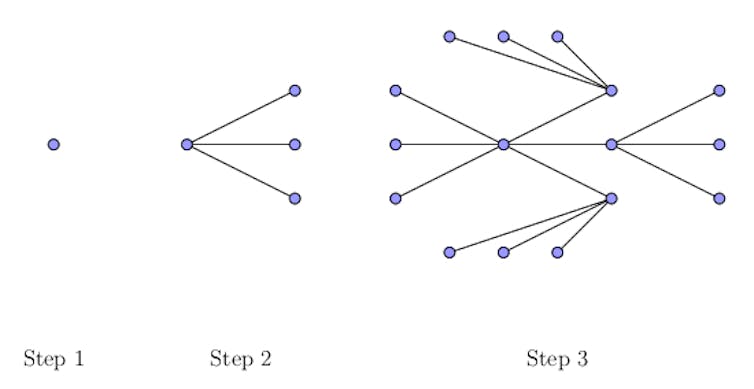
Think of a social networking platform. Start with one person: Betty. Next, add a simple rule: every person adds three friends. Apply the rule to Betty: now she has three friends. Apply the rule again to every person (including the one you started with, namely: Betty). Keep applying the rule and, pretty soon, the network of friends forms a complex graph.

In Wolfram’s theory, applying a simple rule multiple times creates a complex network of points and connections. Samuel Baron

Wolfram’s proposal is that the universe can be modelled in much the same way. The goal of physics, he suggests, is to work out the rules that the universal graph obeys.

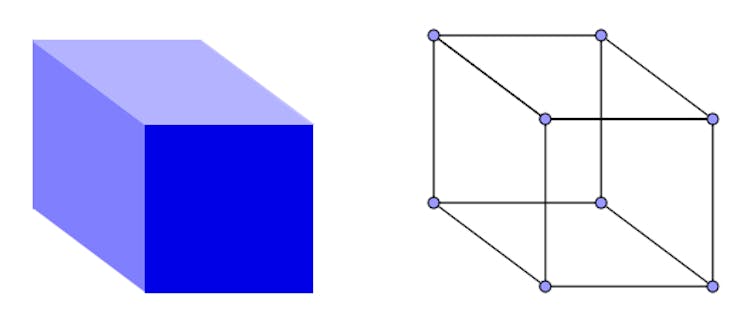
Key to his suggestion is that a suitably complicated graph looks like a geometry. For instance, imagine a cube and a graph that resembles it.

In the same way that a collection of points and lines can approximate a solid cube, Wolfram argues that space itself may be a mesh that knits together a series of nodes. Samuel BaronAuthor provided

Wolfram argues that extremely complex graphs resemble surfaces and volumes: add enough nodes and connect them with enough lines and you form a kind of mesh. He maintains that space itself can be thought of as a mesh that knits together a series of nodes in this fashion.

What does this have to do with physics?

How can complicated meshes of nodes help with the project of reconciling general relativity and quantum mechanics? Well, quantum theory deals with discrete objects with discrete properties. General relativity, on the other hand, treats the universe as a continuum and gravity as a continuous force.

If we can build a theory that can do what general relativity does but that starts from discrete structures like graphs, then the prospects for reconciling general relativity and quantum mechanics start to look more promising. If we can build a geometry that resembles the one given to us by general relativity using a discrete structure, then the prospects look even better.

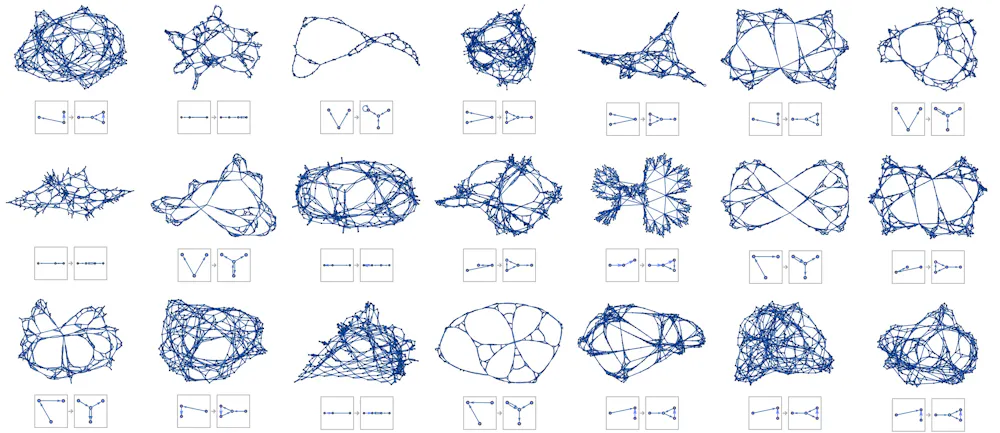
Stephen Wolfram believes that space itself may be a complex mesh of points connected together by means of a simple rule that is iterated many times. Wolfram Physics Project

So is it time to get excited?

While Wolfram’s project is promising, it does contain more than a hint of hubris. Wolfram is going up against the Einsteins and Hawkings of the world, and he’s doing it without a life spent publishing in physics journals. (He did publish several physics papers as a teenage prodigy, but that was 40 years ago, as well as a book A New Kind of Science, which is the spiritual predecessor of the Wolfram Physics Project.)

Moreover, his approach is not wholly original. It is similar to two existing approaches to quantum gravity: causal set theory and loop quantum gravity, neither of which get much of a mention in Wolfram’s grand designs.


Read more: Einstein to Weinstein: the lone genius is an exception to the rule


Nonetheless, the project is notable for three reasons. First, Wolfram has a broad audience and he will do a lot to popularise the approach that he advocates. Proponents of loop quantum gravity in particular lament the predominance of string theory within the physics community. Wolfram may help to underwrite a paradigm shift in physics.

Second, Wolfram provides a very careful overview of the project from the basic principles of graph theory up to general relativity. This will make it easier for individuals to get up to speed with the general approach and potentially make contributions of their own.

Third, the project is “open source”, inviting contributions from citizen scientists. If nothing else, this gives us all something to do at the moment – in between baking sourdough and playing Animal Crossing, that is.

https://nationalpost.com/news/canada/hackers-can-access-your-phone-and-laptop-cameras-heres-why-you-should-cover-them-now

Zoom, Skype, Microsoft Teams: Why you should cover the camera on your phone or laptop

When your laptop is off, its webcam can’t be activated. But many of us keep our laptops in hibernation or sleep mode, which means the device can be woken by a cybercriminal

Most of us have a camera built into our phone, tablet, laptop, or a desktop webcam we use for work, study or virtual socialising.The Conversation

Whether you use Zoom, Skype or Microsoft Teams, the webcam on your home PC or laptop device has probably never been as active as it is during this pandemic.

Most of us have a camera built into our phone, tablet, laptop, or a desktop webcam we use for work, study or virtual socialising.

Unfortunately, this privilege can leave us vulnerable to an online attack known as camfecting. This is when hackers take control of your webcam remotely. They do this by disabling the “on” light which usually indicates the camera is active – so victims are none the wiser.

Many of our device cameras remain unsecured. In fact, research has suggested globally there are more than 15,000 web camera devices (including in homes and businesses) readily accessible to hackers, without even needing to be hacked.

Take a tip from Zuckerberg

When your laptop is turned off its webcam can’t be activated. However, many of us keep our laptops in hibernation or sleep mode (which are different). In this case, the device can be woken by a cybercriminal, and the camera turned on. Even Mark Zuckerberg has admitted he covers his webcam and masks his microphone.

The number of recorded instances of image captured through unauthorised webcam access is relatively low. This is because most attacks happen without the user ever realising they’ve been compromised. Thus, these attacks go unaccounted for.

It’s important to consider why someone would choose to hack into your home device. It’s unlikely an attacker will capture images of you for personal blackmail, or their own creepy exploits. While these instances do eventuate, the majority of illicit webcam access is related to gathering information for financial gain.

Tricking

Cybercriminals frequently attempt tricking people into believing they’ve been caught by a webcam hack. Everyday there are thousands of spam emails sent in a bid to convince users they’ve been “caught” on camera. But why?

Shaming people for “inappropriate” webcam use in this way is a scam, one which generates considerable ransom success. Many victims pay up in fear of being publicly exposed.

Most genuine webcam hacks are targeted attacks to gather restricted information.
They often involve tech-savvy corporate groups carrying out intelligence gathering and covert image capturing. Some hacks are acts of corporate espionage, while others are the business of government intelligence agencies.

There are two common acquisition techniques used in camfecting attacks. The first is known as an RAT (Remote Administration Tool) and the second takes place through false “remote tech support” offered by malicious people.

Genuine remote tech support usually comes from your retail service provider (such as Telstra or Optus). We trust our authorised tech support people, but you shouldn’t extend that trust to a “friend” you hardly know offering to use their own remote support software to “help you” with a problem.

An example of an RAT is a Trojan virus delivered through email. This gives hackers internal control of a device.

Trojan virus

When a Trojan virus infects a device, it’s not just the webcam that is remotely accessed, it’s the whole computer. This means access to files, photos, banking and a range of data.

The ability to install a RAT has been around for several years. In 2015, a popular RAT could be purchased on the internet for just US $40. The malware (harmful software) can be deployed via an email, attachment, or flash drive.

Those wanting to learn how to use such tools need look no further than YouTube, which has many tutorials. It has never been easier for hackers.

They’re everywhere

Our homes are getting “smarter” each year. In 2018, the average Australian household reportedly had 17 connected devices.

Let’s say there’s one or two laptops, three or four mobile phones and tablets, a home security camera system and a smart TV with a built-in camera for facial recognition.

Add a remote video doorbell, a talking doll named My Friend Cayla, the drone helicopter you got for Christmas, and the robot toy that follows you around the house – and it’s possible your household has more than 20 IP accessible cameras.

To better understand your vulnerabilities you can try a product like Shodan. This search engine allows you to identify which of your devices can be seen by others through an internet connection.

Cyberhygiene

Placing a piece of black tape over a camera is one simple low-tech solution for webcam hacking. Turning your laptop or desktop computer off when not in use is also a good idea. Don’t let a device’s hibernation, sleep or low power mode lure you into a false sense of safety.

At work you may have firewalls, antivirus, and intrusion detection systems provided by your company. Such protections are void for most of us when working from home. “Cyberhygiene” practices will help secure you from potential attacks.

Always use secure passwords, and avoid recycling old ones with added numbers such as “Richmond2019”, or “Manutd2020”. Also, make sure your antivirus and operating system software is regularly updated.

Most of all, use common sense. Don’t share your password (including your home wifi password), don’t click suspicious links, and routinely clear your devices of unnecessary apps.

When it comes to using webcams, you may wonder if you’re ever completely safe. This is hard to know – but rest assured there are steps you can take to give yourself a better chance.The Conversation

By David Cook, Lecturer, Computer and Security Science,Edith Cowan University, Edith Cowan University

This article is republished from The Conversation under a Creative Commons license. Read the original article.