Raspberry Pi sales surge on the back of COVID-19 crisis
A Raspberry Pi-powered work from home computer set up. (Source: Raspberry Pi)
There have been a lot of unexpected side effects of the COVID-19 pandemic and we can add another to the list. Perhaps unsurprisingly, the Raspberry Pi Foundation has revealed that March saw its second highest number of sales since it launched in 2012.
Enthusiast mini-PC on a board, Raspberry Pi, is experiencing a surge in orders on the back of the COVID-19 pandemic. As with other parts of the tech sector experiencing a sharp rise in sales, the Raspberry Pi Foundation has experienced its second largest number of sales in a month. For the month of March, sales hit a phenomenal 640,000 units.
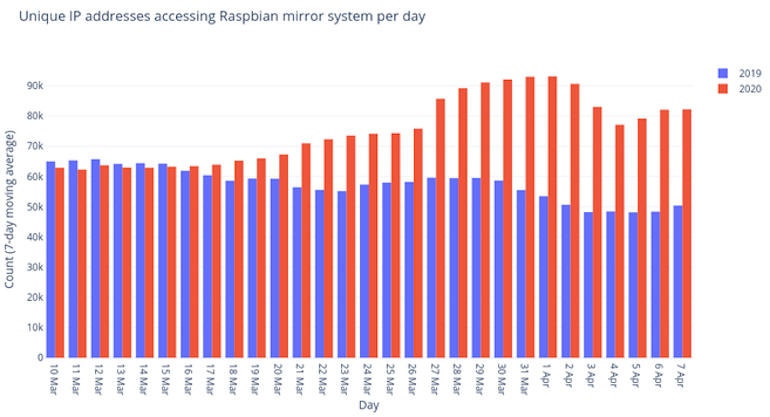
Raspberry Pi founder and current CEO Eben Upton says that he believes the sales spike is because people are looking for an inexpensive way to work from home or continue with their studies in response to lockdown orders. Upton revealed that the number of unique IP addresses connecting to the Raspbian OS mirror system crested 90,000 over a several day sequence in March, which is up from the usual peak of around 58,000.
In addition to home use, Raspberry Pi has also found its way into several new ventilator designs as companies scramble to make enough units available for people suffering from COVID-19 related respiratory issues. Upton believes that this is because it is a readily available, compact and inexpensive computer with enough horsepower to be fit for purpose. Raspberry Pi says it is ramping up production 192,000 units per month 250,000 for the coming month to help meet the increased demand.
Rise in Raspberry Pi sales compared with the same period last year. (Source: Raspberry Pi)
Apple releases instructions and manufacturing guide for its face shields The tech giant is providing its design to other companies trying to aid public health efforts
By Aisha Malik@AiishaMalik1APR 19, 2020 11:14 AM ED
Apple has released design instructions and a manufacturing guide for its face shields to encourage others to develop their own versions. Due to the ongoing COVID-19 pandemic, there has been a shortage of medical equipment across the world. Tech giants like Apple have contributed by developing their own versions of protective equipment and donating it to hospitals in need.
Apple has donated hundreds of thousands of face shields to date, and has now released instructions for other companies to do the same. The manufacturing guide includes details about the materials that are needed to produce the shields, along with tips on how to properly pack them for transport. Releasing its designs for the shields is a helpful move on Apple’s part because it could help other companies that are trying to aid public health efforts by allowing them to skip the design steps and go straight to the production steps. The tech giant notes that the manufacturing instructions should only be used by an expert in a factory environment since the production requires professional level expertise. Image credit: Apple
Raspberry Pi: Combine the power of up to seven Compute Modules with the Turing Pi Cluster Board
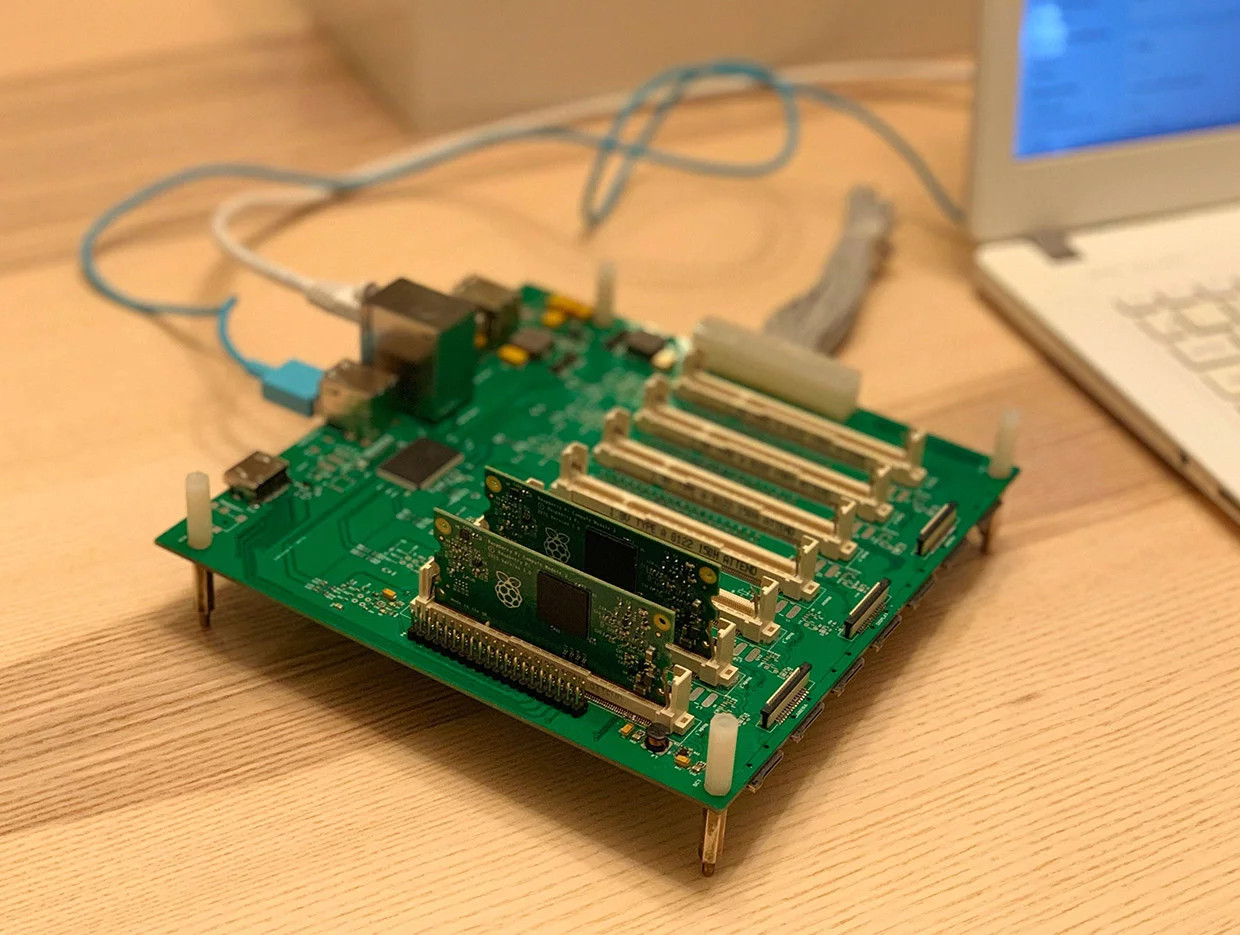
Raspberry Pi: Combine the power of up to seven Compute Modules with the Turing Pi Cluster Board. (Image source: Turing Pi)
The Turing Pi Cluster Board turns up to seven Raspberry Pi Compute Modules into a powerful cluster device. The board can not only be used for network storage, but also as a platform for video games.
Brought to our attention by BetaNews and reported by websites like CNX Software last year, the Turing Pi Cluster Board is almost ready for production. Built on a mini-ITX mainboard, the Turing Pi can hold up to seven Raspberry Pi Compute modules. The manufacturer states that all devices up to Computer Module 3+ are compatible.
The Turing Pi has a microSD card reader and 40 GPIO pins for each module, along with HDMI and a MIPI DSI connector video output. The manufacturer has included one 3.5 mm jack, two MIPI CSI connectors and Gigabit Ethernet with an on-board switch.
The 170 x 170 mm board has eight USB ports too and can be powered via a 12 V DC jack. Alternatively, you could use an ATX power supply. The Turing Pi supports the Kubernetes ecosystem, according to the manufacturer, as well as machine learning and serverless stacks. You could also use the Turing Pi to host Minecraft though, for example. Please see the board’s documentation page for more information.
The Turing Pi can be pre-ordered for US$189 plus shipping, with the manufacturer hoping to ship units in June or July 2020. Please note that the price is only for the Turing Pi. Accordingly, you must purchase Compute Modules and a power supply separately.
A Vital Hack Could Turn Medical Devices Into Ventilators
Hundreds of thousands of lower-grade breathing devices are going unused because manufacturers say they can’t perform life-saving functions. But a new patch might change that.
PHOTOGRAPH: GETTY IMAGES
AS INFECTIONS FROM the ongoing Covid-19 pandemic continue to climb, hospitals around the world are struggling with a potentially fatal shortage of ventilators, the bedside machines that help patients breathe when they’re unable to do so on their own. Meanwhile, hundreds of thousands of lower-grade breathing devices known as continuous positive airway pressure machines sit idle in closets or warehouses because their manufacturers say they can’t perform the same life-saving functions.
This story originally appeared on Ars Technica, a trusted source for technology news, tech policy analysis, reviews, and more. Ars is owned by WIRED’s parent company, Condé Nast.
Security researcher Trammell Hudson analyzed the AirSense 10—the world’s most widely used CPAP—and made a startling discovery. Although its manufacturer says the AirSense 10 would require “significant rework to function as a ventilator,” many ventilator functions were already built into the device firmware.
Its manufacturer, ResMed, says the $700 device solely functions as a continuous positive airway pressure machine used to treat sleep apnea. It does this by funneling air into a mask. ResMed says the device can’t work as a bilevel positive airway pressure device, which is a more advanced machine that pushes air into a mask and then reduces the pressure to a calibrated lower level to allow it back out. With no ability to work in both directions or increase the output when needed, the AirSense 10 can’t be used as the type of ventilator that could help patients who are struggling to breathe. After reverse-engineering the firmware, Hudson says the ResMed claim is simply untrue.
To demonstrate his findings, Hudson on Tuesday is releasing a patch that he says unlocks the hidden capabilities buried deep inside the AirSense 10. The patch is dubbed Airbreak in a nod to jailbreaks that hobbyists use to remove technical barriers Apple developers erect inside iPhones and iPads. Whereas jailbreaks unlock functions that allow the installation of unauthorized apps and the accessing of log files and forensic data, Airbreak allows the AirSense 10 to work as a bilevel positive airway pressure machine, a device that many people refer to as a BiPAP.
“Our changes bring the AirSense S10 to near feature parity with BiPAP machines from the same manufacturer, boost the maximum pressure output available, and provide a starting point to add more advanced emergency ventilator functionality,” Hudson and other researchers wrote on their website disclosing the findings.
Bilevel positive airway pressure devices aren’t normally approved to treat patients suffering from Covid-19, but in the kind of ongoing emergency that’s confronting many hospitals, the Food and Drug Administration has temporarily approved their use as ventilators, provided the converted devices are fitted with filters to prevent aerosolization of the virus. Several groups are actively working to make that conversion happen. Freeing up hundreds of thousands of lower-cost CPAP machines could give those efforts a vital boost.
The researchers are clear that Airbreak shouldn’t be used on any device treating a patient suffering from Covid-19—at least not yet. Its more immediate use is to prove that the AirSense 10 does, in fact, have the ability to provide emergency ventilator functions. The researchers’ preference is for ResMed to release its own firmware update that unlocks the ventilator functions. Given the recent FDA exemptions, ResMed could do this relatively quickly, the researchers say.
The benefit of ResMed releasing a patch is two-fold. One, a manufacturer-released update is likely to be more reliable. Additionally, a patch from ResMed could be installed much more quickly and reliably on more recent devices that have over-the-air update capabilities. Installing Airbreak, by contrast, is a lengthy process that requires manually opening a case and reflashing firmware.
ResMed representative Tracy Moehnke, however, said neither the AirSense 10 nor a more advanced AirSense 10 AutoSet were capable of providing “bilevel therapy,” meaning both inhalation and exhalation. Only a more expensive AirCurve 10 device could do that, Moehnke said. When I asked about the significant reworking the company says is required to make the less expensive AirSense 10 models work this way, Moehnke replied, “CPAP- and APAP-only devices would require significant rework to deliver bilevel therapy.”
Asked if ResMed was willing to work with the researchers to explore ways to convert the lower-cost models, the representative wrote, “We are already exploring that option, but our primary focus is to maximize production of our current ventilation devices, masks, and accessories.”
Tuesday’s release of Airbreak will allow medical technicians and researchers to test the unadvertised features of the ResMed machines to see precisely how they might be used in emergency rooms struggling with a dangerous lack of proper ventilators. It’s also designed to demonstrate that there’s little preventing first responders from using the AirSense 10—and likely CPAPs available from ResMed competitors—to treat patients suffering from Covid-19.
Confusion, seizure, strokes: How COVID-19 may affect the brain
PUBLISHED : 18 APR 2020 AT 08:45
A picture of a human brain taken by a positron emission tomography scanner
WASHINGTON – A pattern is emerging among COVID-19 patients arriving at hospitals in New York: Beyond fever, cough and shortness of breath, some are deeply disoriented to the point of not knowing where they are or what year it is.
At times this is linked to low oxygen levels in their blood, but in certain patients the confusion appears disproportionate to how their lungs are faring.
Jennifer Frontera, a neurologist at NYU Langone Brooklyn hospital seeing these patients, told AFP the findings were raising concerns about the impact of the coronavirus on the brain and nervous system.
By now, most people are familiar with the respiratory hallmarks of the COVID-19 disease that has infected more than 2.2 million people around the world.
But more unusual signs are surfacing in new reports from the frontlines.
A study published in the Journal of the American Medical Association last week found 36.4 percent of 214 Chinese patients had neurological symptoms ranging from loss of smell and nerve pain, to seizures and strokes.
A paper in the New England Journal of Medicine this week examining 58 patients in Strasbourg, France found that more than half were confused or agitated, with brain imaging suggesting inflammation.
“You’ve been hearing that this is a breathing problem, but it also affects what we most care about, the brain,” S Andrew Josephson, chair of the neurology department at the University of California, San Francisco told AFP.
“If you become confused, if you’re having problems thinking, those are reasons to seek medical attention,” he added.
“The old mantra of ‘Don’t come in unless you’re short of breath’ probably doesn’t apply anymore.”
– Viruses and the brain –
It isn’t completely surprising to scientists that SARS-CoV-2 might impact the brain and nervous system, since this has been documented in other viruses, including HIV, which can cause cognitive decline if untreated.
Viruses affect the brain in one of two main ways, explained Michel Toledano, a neurologist at Mayo Clinic in Minnesota.
One is by triggering an abnormal immune response known as a cytokine storm that causes inflammation of the brain — called autoimmune encephalitis.
The second is direct infection of the brain, called viral encephalitis.
How might this happen?
The brain is protected by something called the blood-brain-barrier, which blocks foreign substances but could be breached if compromised.
However, since loss of smell is a common symptom of the coronavirus, some have hypothesized the nose might be the pathway to the brain.
This remains unproven — and the theory is somewhat undermined by the fact that many patients experiencing anosmia don’t go on to have severe neurological symptoms.
In the case of the novel coronavirus, doctors believe based on the current evidence the neurological impacts are more likely the result of overactive immune response rather than brain invasion.
To prove the latter even happens, the virus must be detected in cerebrospinal fluid.
This has been documented once, in a 24-year-old Japanese man whose case was published in the International Journal of Infectious Disease.
The man developed confusion and seizures, and imaging showed his brain was inflamed. But since this is the only known case so far, and the virus test hasn’t yet been validated for spinal fluid, scientists remain cautious.
– More research needed –
All of this emphasizes the need for more research.
Frontera, who is also a professor at NYU School of Medicine, is part of an international collaborative research project to standardize data collection.
Her team is documenting striking cases including seizures in COVID-19 patients with no prior history of the episodes, and “unique” new patterns of tiny brain hemorrhages.
One startling finding concerns the case of a man in his fifties whose white matter — the parts of the brain that connect brain cells to each other — was so severely damaged it “would basically render him in a state of profound brain damage,” she said.
The doctors are stumped and want to tap his spinal fluid for a sample.
Brain imaging and spinal taps are difficult to perform on patients on ventilators, and since most die, the full extent of neurologic injury isn’t yet known.
But neurologists are being called out for the minority of patients who survive being on a ventilator.
“We’re seeing a lot of consults of patients presenting in confusional states,” Rohan Arora, a neurologist at the Long Island Jewish Forest Hills hospital told AFP, saying that describes more than 40 percent of recovered virus patients.
It’s not yet known whether the impairment is long term, and being in the ICU itself can be a disorienting experience as a result of factors including strong medications.
But returning to normal appears to be taking longer than for people who suffer heart failure or stroke, added Arora.
Zoom is now a household name for work-from-home employees. Here is your guide to Zoom basics, including its security vulnerabilities and video conferencing alternatives such as Microsoft Teams.
Due to the COVID-19 pandemic, more people are working from home. With workforces scattered to the wind, many businesses have had to adapt to virtual meetings as the new normal, which has been a massive boon for the video chat and conferencing software Zoom.
In February 2020, Zoom added more users than it did in the entirety of 2019. Major media platforms started using Zoom to stream broadcasts from at-home anchors, and “Zooming” quickly became eponymous with video chats and virtual meetings.
Zoom’s explosive growth came with increased focus on security and privacy issues that went largely unnoticed before. Major companies and governments around the world have been banning Zoom from work use, and half a million sets of user credentials have even been found for sale on the Dark Web.
Zoom has pledged to fix a long list of security issues, but that hasn’t stopped a third of users from getting cold feet. So, is Zoom still a video conferencing app worth using? If so, who should use it when so much personal and business security could be at risk? Learn more by reading this Zoom basics guide.
Zoom lets people who join a meeting with an Android or iOS device share the screen of their mobile device. Zoom supports screen sharing from laptop and desktop devices, as well.
Image: Zoom
What is Zoom?
Zoom is video conferencing software for Windows, macOS, iOS, Android, and Linux. It supports one-on-one calls, as well as group meetings that can hold up to 100 users for free or 500 users with an additional purchase.
Zoom, the company, was founded in 2011 by Eric Yuan, and the Zoom application was released in 2013. Zoom has been lauded for its simple interface, ease of use, and accessibility to non-tech savvy people, which has aided in its steady climb as a video conferencing app of choice for small businesses, enterprises, and individuals. By 2017, Zoom had grown into a unicorn company by reaching $1 billion in valuation.
Along with its desktop and mobile apps, Zoom offers solutions for enterprise conference rooms, browser extensions, and a web client that allows meeting participants to attend meetings without having to install the Zoom app.
Zoom has attracted many users by having a robust free tier, which allows meetings of up to 100 people without restricting any app features, instead limiting meetings for free accounts to 40 minutes.
Is Zoom safe to use?
With the outbreak of the COVID-19 pandemic, Zoom saw a massive spike in users because of stay-at-home orders. By the end of March 2020, security issues started being reported.
March 26: An investigation finds that Zoom is sending user data to Facebook without permission. Zoom removed its Facebook data collection the following day.
March 30: Another investigation finds that Zoom is not using end-to-end encryption, Zoom bombs are first reported, and multiple flaws in both the windows and macOS versions of Zoom are reported.
April 1: Zoom is treating email addresses with the same domain (e.g., ISPs, but not email-only services like Gmail) as if they belong to the same company, allowing countless users access to names, photos, and email addresses of other users. Zoom issues a public apology and freezes all feature rollouts to focus on security fixes.
April 2: A data mining feature is discovered that allows some users to gain access to LinkedIn profiles of other Zoom users.
April 3: Recordings of thousands of Zoom meetings, many containing private information, are found freely viewable and unsecured on the web. Zoom issues another apology, and reveals it’s using AES-128 encryption instead of the much more secure AES-256.
April 5: Zoom admits in a statement that some calls were being accidentally routed through a whitelisted server located in China.
April 6: The first collection of Zoom accounts is found for sale on the dark web.
April 13: A further 500,000 Zoom accounts are found for sale on the dark web, with many costing as little as a few cents.
April 16: Two new privacy bugs are discovered: One allows an attacker to view and download Zoom meeting videos stored in the cloud via an unsecured link, and a second lets deleted meeting recordings be viewed in the cloud for hours after deletion.
Zoom has issued numerous apologies and pledged to improve its security.
Some of the security issues, like Zoom bombing, can be addressed by users taking steps to protect their meetings, and Zoom has enabled by default many of the security features needed to do so. Other issues like poor encryption, lack of end-to-end encryption during meetings, and account theft can’t be stopped by good Zoom user habits.
Zoom has a lot of competition, and its recent missteps have opened some very large windows for those competitors to step in and capture some of its market share. TechRepublic recently wrote about 10 Zoom alternatives, and some of those options have even added Zoom-like features recently to draw away security-conscious users.
Free video chat options similar to Zoom include:
Microsoft Teams, the Office 365-integrated video chat platform, has been extended for free to anyone with an email address, and Microsoft has lifted meeting user limits to help those affected by the COVID-19 pandemic.
Skype video calls can be attended by up to 50 people (half that of free Zoom accounts). For small business teams, this makes it an ideal option.
Google Hangouts is free for individual users. Google’s enterprise product, Meet, is reserved for G Suite customers, though those outside an organization can still attend, but not host, meetings.
The allure of Zoom isn’t only in its myriad features, but also in its incredible usability. Zoom is designed with non-tech people in mind: Its interface is simple, signing up is quick and hassle free, and it works well with minimal user input. Anyone looking for a video conference solution for teams with people who don’t like, or are unfamiliar with, modern tech will find Zoom a great solution.
Any business using Zoom or considering using it should keep an eye on tech news about security issues, and be sure to follow best security practices to protect your calls from unauthorized entry.
Companies and individuals can sign up for, and get started with, Zoomat its website. Organizations considering a premium tier of Zoom can find out more about pricing on its plans page, from which subscriptions can also be purchased.
ByJENNIFER CHU, MASSACHUSETTS INSTITUTE OF TECHNOLOGYAPRIL 18, 2020
Technique may enable molecule-based quantum computing.
For years, scientists have looked for ways to cool molecules down to ultracold temperatures, at which point the molecules should slow to a crawl, allowing scientists to precisely control their quantum behavior. This could enable researchers to use molecules as complex bits for quantum computing, tuning individual molecules like tiny knobs to carry out multiple streams of calculations at a time.
While scientists have super-cooled atoms, doing the same for molecules, which are more complex in their behavior and structure, has proven to be a much bigger challenge.
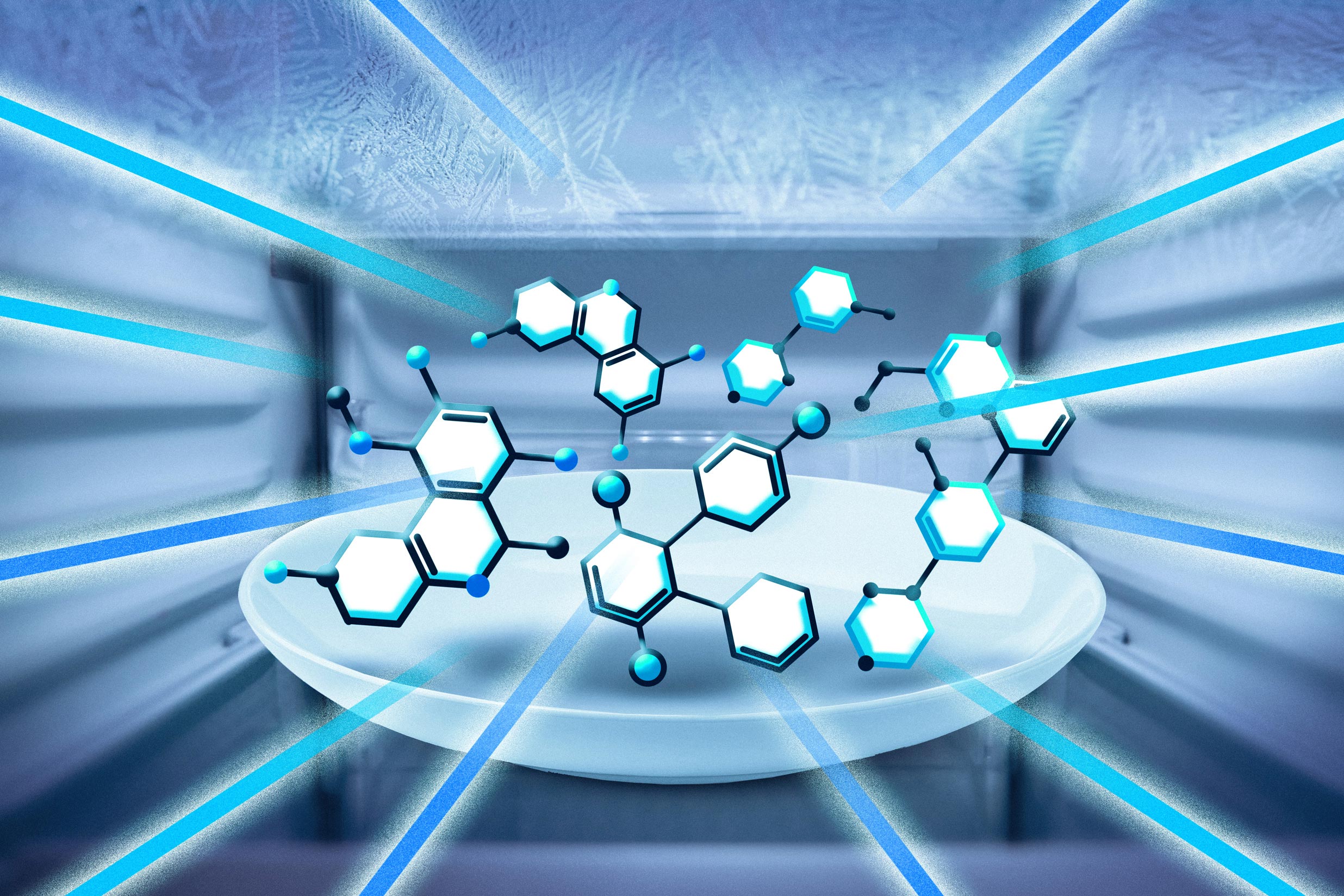
Now MIT physicists have found a way to cool molecules of sodium lithium down to 200 billionths of a Kelvin, just a hair above absolute zero. They did so by applying a technique called collisional cooling, in which they immersed molecules of cold sodium lithium in a cloud of even colder sodium atoms. The ultracold atoms acted as a refrigerant to cool the molecules even further.
Collisional cooling is a standard technique used to cool down atoms using other, colder atoms. And for more than a decade, researchers have attempted to supercool a number of different molecules using collisional cooling, only to find that when molecules collided with atoms, they exchanged energy in such a way that the molecules were heated or destroyed in the process, called “bad” collisions.
In their own experiments, the MIT researchers found that if sodium lithium molecules and sodium atoms were made to spin in the same way, they could avoid self-destructing, and instead engaged in “good” collisions, where the atoms took away the molecules’ energy, in the form of heat. The team used precise control of magnetic fields and an intricate system of lasers to choreograph the spin and the rotational motion of the molecules. As result, the atom-molecule mixture had a high ratio of good-to-bad collisions and was cooled down from 2 microkelvins to 220 nanokelvins.
“Collisional cooling has been the workhorse for cooling atoms,” adds Nobel Prize laureate Wolfgang Ketterle, the John D. Arthur professor of physics at MIT. “I wasn’t convinced that our scheme would work, but since we didn’t know for sure, we had to try it. We know now that it works for cooling sodium lithium molecules. Whether it will work for other classes of molecules remains to be seen.”
Their findings, published today in the journal Nature, mark the first time researchers have successfully used collisional cooling to cool molecules down to nanokelvin temperatures.
Ketterle’s coauthors on the paper are lead author Hyungmok Son, a graduate student in Harvard University’s Department of Physics, along with MIT physics graduate student Juliana Park, and Alan Jamison, a professor of physics and member of the Institute for Quantum Computing at the University of Waterloo and visiting scientist in MIT’s Research Laboratory of Electronics.
Reaching ultralow temperatures
In the past, scientists found that when they tried to cool molecules down to ultracold temperatures by surrounding them with even colder atoms, the particles collided such that the atoms imparted extra energy or rotation to the molecules, sending them flying out of the trap, or self-destructing all together by chemical reactions.
The MIT researchers wondered whether molecules and atoms, having the same spin, could avoid this effect, and remain ultracold and stable as a result. They looked to test their idea with sodium lithium, a “diatomic” molecule that Ketterle’s group experiments with regularly, consisting of one lithium and one sodium atom.
“Sodium lithium molecules are quite different from other molecules people have tried,” Jamison says. “Many folks expected those differences would make cooling even less likely to work. However, we had a feeling these differences could be an advantage instead of a detriment.”
The researchers fine-tuned a system of more than 20 laser beams and various magnetic fields to trap and cool atoms of sodium and lithium in a vacuum chamber, down to about 2 microkelvins — a temperature Son says is optimal for the atoms to bond together as sodium lithium molecules.
Once the researchers were able to produce enough molecules, they shone laser beams of specific frequencies and polarizations to control the quantum state of the molecules and carefully tuned microwave fields to make atoms spin in the same way as the molecules. “Then we make the refrigerator colder and colder,” says Son, referring to the sodium atoms that surround the cloud of the newly formed molecules. “We lower the power of the trapping laser, making the optical trap looser and looser, which brings the temperature of sodium atoms down, and further cools the molecules, to 200 billionths of a kelvin.”
The group observed that the molecules were able to remain at these ultracold temperatures for up to one second. “In our world, a second is very long,” Ketterle says. “What you want to do with these molecules is quantum computation and exploring new materials, which all can be done in small fractions of a second.”
If the team can get sodium lithium molecules to be about five times colder than what they have so far achieved, they will have reached a so-called quantum degenerate regime where individual molecules become indistinguishable and their collective behavior is controlled by quantum mechanics. Son and his colleagues have some ideas for how to achieve this, which will involve months of work in optimizing their setup, as well as acquiring a new laser to integrate into their setup.
“Our work will lead to discussion in our community why collisional cooling has worked for us but not for others,” Son says “Perhaps we will soon have predictions how other molecules could be cooled in this way.”
This research was funded, in part, by the National Science Foundation, NASA, and the Samsung Scholarship.
ByQUEENSLAND UNIVERSITY OF TECHNOLOGYAPRIL 17, 2020
Scientists around the world are scrambling to adapt their research to find solutions to the many problems raised by the Covid-19 pandemic sweeping the world, not the least being a face mask shortage.
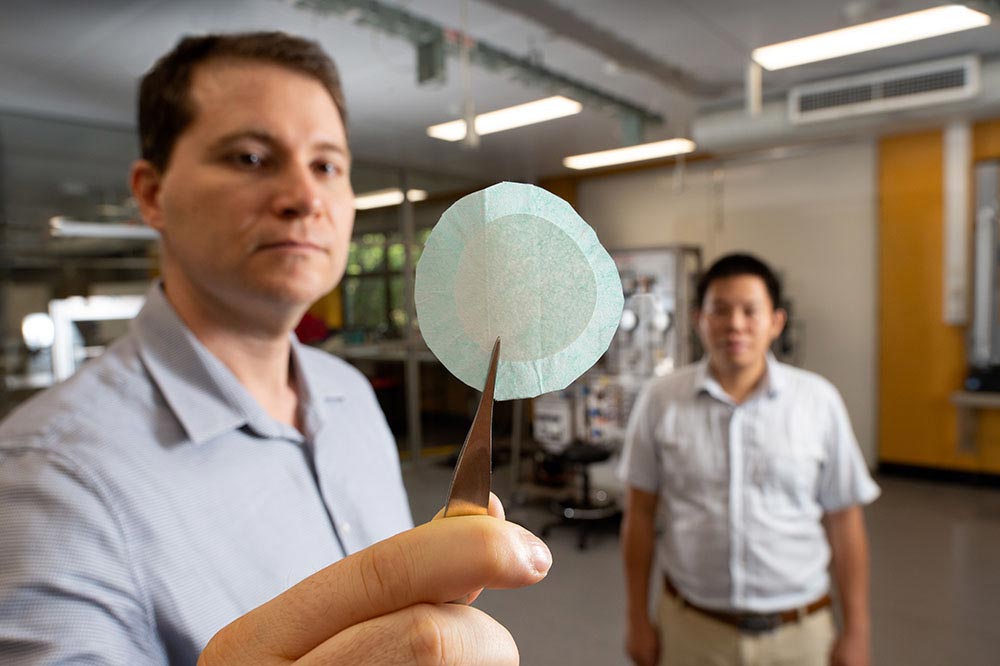
A new material created by QUT scientists is very effective at removing particles smaller than 100 nanometers, which is in the range of a virus
Material is easier to breathe through than high-quality face masks — important for people with existing respiratory issues
Can be quickly made in large quantities using simple equipment, it is biodegradable and made from waste plant material
Thoroughly tested and compared with high-quality commercially available
QUT process engineer Dr. Thomas Rainey and his research team are stepping up work on a nanoparticle-removing new material they were developing for biodegradable anti-pollution masks.
“We have developed and tested a highly breathable nanocellulose material that can remove particles smaller than 100 nanometers, the size of viruses,” Dr. Rainey said.
“I see many people wearing masks which are not tested for viruses. We have tested this material thoroughly and found it to be more efficient in its ability to remove virus-size nanoparticles than the high-quality commercially available masks we tested and compared it with.”
Dr. Rainey said the team also tested the new material for breathability.
“By breathability we mean the pressure or effort the wearer has to use to breathe through the mask. The higher the breathability the greater the comfort and reduction in fatigue,” he said.
“This is an important factor for people who have to wear masks for long periods or those with existing respiratory conditions.
“Our tests showed the new material was more breathable than commercial face masks, including surgical masks.
“This new material has excellent breathability, and greater ability to remove the smallest particles.”
Dr. Rainey said the material could be used as a disposable filter cartridge in face masks.
“This material would be relatively inexpensive to produce and would therefore be suitable for single-use.
“The cellulose nanofiber component is made from waste plant material such as sugar cane bagasse and other agricultural waste products and is, therefore, biodegradable. It can be made using relatively simple equipment, and so we can quickly produce large quantities of the material.”
“We have established proof of concept as a nanoparticulate filtration material and we are currently seeking industry partners.”
It’s a small thing, when you see it. It’s not quite 18″ across and just a few inches thick, but packed inside it is enough power to blast a vehicle from zero to 155 MPH in mere seconds. Officially, it’s the QFM-360-X, but you can call it the HyperPower Quantum Force electric motor. And you can expect to see it powering Elon Musk’s Hyperloop in the near future.
Reading the specs on HyperPower’s electric motor is a dizzying experience. Each 18″ by what looks like less than 4″ motor reportedly puts out a megawatt of power. That’s 1,340 HP, and HyperPower has developed the motor so it can be arranged in a compact “10 motor” common shaft engine that puts out an almost unbelievable 13,400 (thirteen-thousand four-hundred) HP.
That’s that’s a whole lot of horsepower.
To prove the concept and help develop the motors’ durability further, HyperPower is taking its Mighty Mouse engines racing. They’ll be campaigning a Top Fuel style dragster throughout Australia that’s been fitted with a four-motor common shaft arrangement that makes over 5,000 HP.
All that power translates to a 0-320 MPH (530 km/h) time of just 3.7 seconds, on its way to a top speed of about half the speed of sound. All of which should be more than enough performance to put the fear of an electric god into one or two internal-combustion cars out there, don’t you think?
“This motor is the culmination of my career’s effort and a notable milestone for our team to now have the X-series prototype in production,” says Michael Fragomeni, Founder and Managing Director of HyperPower. “With volume assembly running in parallel. [This is] our planet’s first brutally race-specific electric motor, and we’ve innovated many novel technical attributes to achieve such.”
With so much power available from such a small package, global development of Musk’s Hyperloop project — which seemed pretty fanciful at first, if not outright farcical — is literally accelerating. “There are companies are dealing with us on using the motor with Hyperloop projects,” Fragomeni told New Atlas, from the company’s headquarters in northern Perth. “There’s (no other motor) in the world that can do what ours does with the power, weight saving and energy charge rate centered around aerospace engineering and outcomes.”
Next-Generation Electric Motor Enters Production in Western Australia
Igniting Growth in Australia’s Future Industries Capability
Designed to propel Hyperloop, Hypercars and Aerospace, HyperPower Technologies’ Quantum Force model electric motor is the World’s First Extreme-Duty Performance eMachine (electric motor/generator).
Minted the “QFM-360-X” with its diameter at 430 millimeters and a power output of up to 1 MegaWatt (1,340 HorsePower), this motor eclipses all electric motorsport offerings to date and well-specified for propulsion of future transport systems, such as Hyperloop and Light Rail. The HyperPower Quantum Force eMotor is designed with reliability and field serviceability at the fore, and is modular to suit many applications – being scalable in a common-shaft array to 10 MW (13,400 HP).
Innovative features of the motor include:
● ReVolutionary Power-to-Mass; ● Ultra-High Power Output and Efficiency; ● Extra-Low-Voltage Drive System – for industry roll-out of non-lethal EVs; ● Quiet, responsive, with repeatable safety and intelligence.
Michael Fragomeni, Founder and Managing Director of HyperPower Pty Ltd based in Western Australia said, “This motor is the culmination of my career’s effort and a notable milestone for our team to now have the X-series prototype in production, with volume assembly running in parallel. Our planet’s first brutally race-specific electric motor, and we’ve innovated many novel technical attributes to achieve such”.
“With national and global in-bound interests establishing, we’re developing partnerships in the uptake of our ultra-high-power propulsion components into commercial integration and continuing the expansion of our in-house production and intensive R&D programs”. Through developing novel intellectual property in componentry, academia, and production infrastructure, HyperPower’s S.T.E.M. engagement with student interns and post-graduates brings exposure to emerging roles in the clean-tech industry; from exotic composites to additive manufacturing (3D printing), and rapid mechatronic prototyping to tooling and workflow.
“Aligning with our Federal Government’s focus on growing Future Automotive, Manufacturing, and Space industries, our growth of engineering through innovation and increasing production infrastructure develops greater Australian sovereign advanced manufacturing capabilities as we continue through commercialization, and brings forward jobs opportunities both locally and nationally,” Mr. Fragomeni said.
Source | Images: HyperPower, via Facebook and New Atlas. Follow CleanTechnica on Google News.
It will make you happy & help you live in peace for the rest of your life.
Jo Borrás I’ve been involved in motorsports and tuning since 1997, and have been a part of the Important Media Network since 2008. You can find me here, working on my Volvo fansite, riding a motorcycle around Chicago, or chasing my kids around Oak Park.
An Italian artificial intelligence (AI) company that specializes in natural language reading and semantics is using its AI tech to extract emotions and sentiment from 63,000 English-language social media posts on Twitter every 24 hours to create a semantic analysis of people’s feelings during COVID-19.
Expert System collects the data in the same time frame – 10 am EST (3 pm CET) on the same day of each week. The data is analyzed every 24 hours and interpreted by Sociometrica. The company applied the most frequently used hashtags related to coronavirus to analyze the data such as #coronalockdown, #covid19, #coronavirusuk, #stayathome, #stayhomesavelives, #coronaviruspandemic, #clapforourcarers, #isolationlife.
Expert Systems and Sociometrica analyze the sentiment of 63,000 social media posts each day to … [+]
EXPERT SYSTEMS AND SOCIOMETRICA
Walt Mayo, CEO of Expert System Group, said that social media sentiment analysis shows that fear and anxiety around the Corona crisis and how it is unfolding and the efforts to combat it dominate communications.
COVID-19 And Our Surprising Digital Transformation
“We also have seen growing criticism of individual behavior that is considered irresponsible and goes against advice to follow social distancing and other recommendations to “flatten the curve,” added Mayo. “But we also have seen growing expressions of gratitude toward health care workers and emerging signs of hope more broadly.”
Mayo believes it’s important to monitor people’s sentiment changes because some of the success of the anti-virus strategy depends on the behavior of individuals. From the data, the general trend shows that fear is the most widespread emotion.
Mayo says that sentiment data two weeks ago in early April indicated that people were afraid because they wanted to return to their normal life; they were insisting on answers both regarding the progression of the pandemic and actions to combat the virus. “Strong criticism was leveled at those who didn’t respect safety distancing rules and other behavior [..] that would prevent the spread of the virus,” said Mayo.
“The days preceding Easter were a turning point, with more positive emotions correlated to a growing expression of “action” around the commitment to the fight against the virus and the courage of doctors and nurses working at the forefront of the fight and the confidence in science,” said Mayo.
April 17, 2020, data showed positive emotions, including hope and love expressed towards health care personnel, showed a slight increase from 21.6% to 23.9% in 24 hours.
I’m a writer who looks at innovation and how technology and science intersect with industry, environment, arts, agriculture, mobility, health. I’ve been called the tech









 Bruce's Blog