https://www.zdnet.com/article/no-code-software-microsofts-power-apps-gets-better-teams-links-and-mixed-reality/

No-code software: Microsoft’s Power Apps gets better Teams links and mixed reality

Users of Microsoft’s ‘low-code’ Power Apps development tool will soon be able to use augmented-reality capabilities on smartphones to generate 3D models and integrate them into real-world workflows in warehouses, manufacturing business, construction, and retail.

Microsoft is touting the new mixed-reality capabilities in Power Apps as a cheaper way for organizations to build custom mixed-reality apps than hiring a bunch of expensive developers.

Power Apps offers two types of apps. Canvas apps allow a designer to drag and drop elements of a UI on to an interface while the UI on model-driven apps is created for the user. Using connectors, business users can integrate data from a range of data sources like Azure, Office 365, Twitter, Oracle, SharePoint and so on.

The coming addition of mixed-reality capabilities in Power Apps will allow business users to tap augmented-reality features on smartphones and tablets to add mixed-reality elements into an app.

It will allow users to create a 3D model of an object and, for example, visualize whether it fits a given workspace or impacts visibility in the space. The app will enable linear and volumetric measurements, opening the possibility to automate a process or feed it back into a data source.

Users can then view and interact with 3D models, superimpose them in the real world, and take a photo of the scene to share with others.

Microsoft points to several customers that are using the mixed-reality capabilities already, including an HVAC company that uses CAD software to create 3D models of its products.

The company can now include the 3D models in its Power Apps product catalog app and visualize whether a particular HVAC model will fit a customer’s site.

Microsoft will release a public preview of the mixed-reality capabilities in May. Until then, interested organizations can apply to Microsoft to participate in the private preview.

The company is also doing more to improve the user experience of Power Apps. Last week, Microsoft released a beta of a single app for both canvas and model-driven apps. Previously, users needed to install two different versions of Power Apps, making it a pain for users.

Microsoft launched Power Apps in 2015 to give business users and developers a way to create custom apps without writing code. Google’s answer to no-code Power Apps is AppSheet, a company it acquired earlier this year.

SEE: No programming language skills needed: New Microsoft ‘no code’ Power Apps beta is out

Microsoft Teams, Microsoft’s work collaboration tool, has also gained better integration with Power Apps. Microsoft says it’s seen “unprecedented growth” of Power Apps within Teams due to remote working amid the coronavirus pandemic.

The new integration enables Teams ‘context variables’ within Power Apps, which provides access to information about the channel, team, or group a Power Apps app has been embedded in. This feature allows Power Apps makers to filter relevant content and pre-populate fields based on which channel the app is embedded in.

Using the Teams sub entity ID, a maker can deep-link to a page of an app embedded inside Teams. Microsoft believes this could be useful for the Power Apps crisis communications template it created in response to the pandemic.

3d-to-ar-900x600.png
Mixed-reality capabilities in Power Apps will allow users to create a 3D model of an object and, for example, visualize whether it fits a given workspace

Image: Microsoft

https://www.infoq.com/news/2020/04/uber-fiber-distributed-ml/

Uber and OpenAI Introduce Fiber, a New Library for Distributed Machine Learning

Uber and OpenAI have open-sourced Fiber, a new library which aims to empower users in implementing large-scale machine learning computation on computer clusters. The main objectives of the library are to leverage heterogeneous computing hardware, dynamically scale algorithms, and reduce the burden on engineers implementing complex algorithms on clusters.

It’s a challenge for machine learning frameworks to remain flexible enough to support  reinforcement learning- (RL) and population-based algorithms together with other heuristics like deep learning because the requirements can vary greatly. While established frameworks like TensorFlow and PyTorch cover the setup of distributed training for most common machine learning methods, these frameworks are less fit for RL-based and population-based methods, which often require frequent interaction with simulators and a complex and dynamic scaling strategy. Fiber provides a unified Python user interface to its distributed computing framework to support these new requirements.

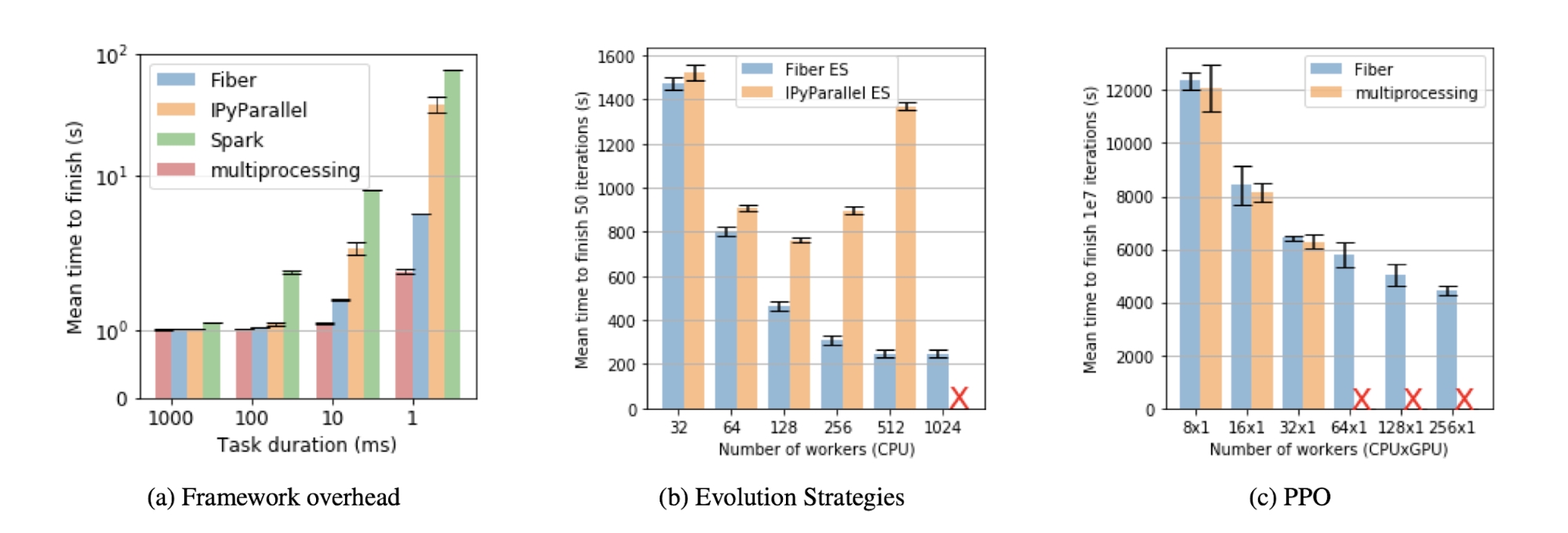
The research paper published alongside Fiber details the experiments used to evaluate the library on framework overhead, evolution strategies, and proximal policy optimization (PPO). Researchers compared Fiber with IPyParallel (iPython for parallel computing), spark, and the standard python multiprocessing library on framework overhead and found that Fiber outperforms iPyParallel and Spark when task duration is short, which is an important metric to understand when dealing with simulators. The performance of the distributed version of PPO enabled by Fiber compared with a multiprocessing implementation on Breakout in the Atari benchmark shows that Fiber can scale RL algorithms beyond local machines.

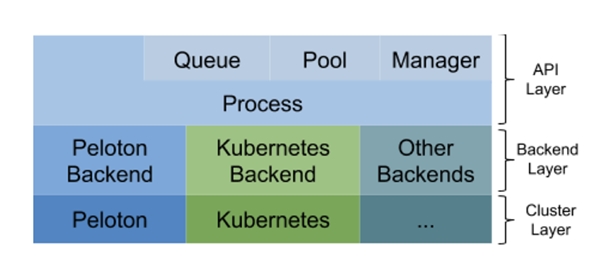
Fiber is split into the API layer, the backend layer, and the cluster layer. The API layer has similar requirements and semantics to the standard Python multiprocessing module, but it is extended to work in distributed environments. The backend layer can handle communication of tasks for a multitude of different cluster managers. Finally, the cluster layer contains the cluster managers like Kubernetes and Peloton.

Fiber introduces a new concept called job-backed processes. When starting one of these processes, a new job with a Fiber backend on the current cluster is created. A parent container encapsulates the required files, input data, and any other dependencies of that job before child processes are started with the same container image to guarantee a consistent running environment. The diagram below illustrates this architecture in more detail:

The recent releases of both Fiber and Google’s new distributed reinforcement learning library Seed RL show that big tech firms are aiming to both reduce costs and simplify the process for training cutting-edge machine learning algorithms.

https://www.castanet.net/news/Kelowna/296581/Kelowna-tech-firm-offers-free-AI-ordering-system-to-restaurants

Kelowna tech firm offers free AI ordering system to restaurants

Free AI system for restaurants

Touch Tourism announced today that they are volunteering their time and new technology to help local restaurants and cafes set up an online take-out ordering system to help during the COVID-19 pandemic.

“The hospitality industry, an industry our business strongly relies on, is on its knees. It seriously needs our help now more than ever,” says Robert Field, CEO of Touch Tourism.

“I’m going all in to donate my time, knowledge and technology to help as many local restaurant and cafe owners survive this as I can.”

The Kelowna tech start-up developed a new online-based ordering system called, Chatbot. It’s an artificially intelligent and around the clock Take-Out Order Assistant, that will handle all incoming customer order on the restaurant’s or cafe’s Facebook Messenger account.

“Current solutions for restaurant and cafe business owners, such as Skip the Dishes and Doordash, we feel are overcharging for their services,” says Field.

“When minimizing expenses has never been more paramount for businesses, we wanted to offer a much more cost-effective alternative, that has the restaurant or cafe owners’ best interest at heart.”

Customers converse with the Chatbot inside the familiarity of their Facebook Messenger, which allows short-staffed businesses a chance to concentrate on creating food and beverages for their customers rather than taking orders over the phone.

They can ask for specific items while browsing through images of food and beverage items they can add to their order.

Once ready to complete the order, the Take-Out Chatbot has the customer confirm their selected items before arranging them to pay securely online finishing the transaction.

“Taking orders really is only the tip of the iceberg as to what Chatbots can achieve. The more they communicate with customers the smarter they become and eventually get to know what your customers want and when to offer it to them. It’s [a] really exciting technology,” explains Field.

https://www.psychologytoday.com/us/blog/the-athletes-way/202004/baby-talk-is-universal-language

Baby Talk Is a Universal Language

Babies around the globe prefer infant-directed speech, a new study reports.

Posted Apr 05, 2020


sirtravelalot/Shutterstock

New research from The ManyBabies Consortium led by Michael Frank of Stanford University reports that babies from different cultures around the globe prefer infant-directed speech (IDS) over adult-directed speech (ADS), regardless of the language being spoken.

IDS is synonymous with baby talk, which is also referred to as motheresefatherese, or parentese.

The latest international, multi-lab study (Frank et al., 2020) of baby talk tested 2,329 babies in 16 countries on their degree of preference for infant-directed speech. The findings were published on March 16 in the journal Advances in Methods and Practices in Psychological Science.

The ManyBabies Consortium’s mission is the replication of influential experiments in developmental psychology using multiple laboratories. As their homepage explains, “Our goal is to bring labs together to address difficult outstanding theoretical and methodological questions about the nature of early development and how it is studied.”

According to the consortium, their recent study of infant-directed speech preference is the most extensive multi-site study to examine how infants around the globe respond to baby talk.

Michael Frank is a developmental psychologist and director or the Stanford Language and Cognition Lab. In a Stanford news release, he said, “Often parents are discouraged from using baby talk by well-meaning friends or even health professionals. But the evidence suggests that it’s actually a great way to engage with your baby because babies just like it—it tells them, ‘This speech is meant for you!'”

For this study on infants’ relative preference for IDS over ADS, Michael Frank and other members of the ManyBabies Consortium used three methods (e.g., head-turn preference, eye tracking, and central fixation) to assess babies’ speech preference.

The average age of the babies who participated in this research was around nine months (with a range of 3-15 months old). This research was conducted in 67 different laboratories across Australia, Asia, Europe, and North America. Infancy research on IDS vs. ADS speech preference is underway by members of the ManyBabies Consortium in Africa and South America.

“We wanted to get labs together from around the world to test how similar or different babies’ preferences are across different environments,” Frank said. Overall, babies from every international site that has submitted results thus far have shown a preference for infant-directed speech over adult-directed speech.

The latest research by Frank et al. on the universal preference for IDS among infants dovetails with previous research (Piazza et al., 2017), which found that mothers around the globe intuitively shift their vocal timbre from ADS to IDS when speaking to infants. This study, “Mothers Consistently Alter Their Unique Vocal Fingerprints When Communicating with Infants,” was published in Current Biology.

Elise Piazza and colleagues at Princeton University found that most mothers systematically shifted to infant-directed speech when communicating with babies. This is a multicultural phenomenon that occurs across a wide variety of languages. “Importantly, this shift [to motherese] was similar across languages, suggesting that such alterations of timbre may be universal,” the authors conclude.

Why Is Baby Talk During Adult-to-Adult Communication So Prevalent?

It’s not surprising that babies around the globe prefer infant-directed speech. What is surprising (to me) is how many “grown-up” couples also seem to enjoy baby talk. Why is this?

A post from 2019 by fellow Psychology Today blogger Karen Wu, “4 Reasons Why Baby Talk Is Good for Couples,” offers four evidence-based reasons that help to explain why romantic partners often communicate with each other using IDS-like speech.

Wu cites a landmark study (Bombar & Littig, 1996), which found that couples who use baby talk tend to be more securely attached and happier. As Meredith Bombar and Lawrence Littig explain, “Communication intentions accompanying baby talk paralleled the hallmarks of attachment, especially affection and play. These and other results suggest that baby talk functions in the process of intimate personal connection.”

Among the other potential reasons for adult baby talk that Wu discusses are the possibility that the pet names interwoven into baby talk (e.g., “mon bébé, “snugglepuffs,” “my little schnookums“) may fortify bonds between intimate couples and that the speech register of baby talk conveys affection. According to Wu: “Adults cite the motivations to be playful, affectionate, and vulnerable as the reasons for their baby talk.”

In closing, the makers of this lighthearted YouTube video asked 100 people to talk like a baby.

References

The ManyBabies Consortium authors: Michael Frank, Christina Bergmann, Elika Bergelson, Krista Byers-Heinlein, Alejandrina Cristia, Rhodri Cusack, Kelsey Dyck, Caroline floccia, Judit Gervain, Nayeli Gonzalez, Kiley Hamlin, Erin Hannon, Danielle Kellier, Melissa Kline, Casey Lew-Williams, Thierry Nazzi, Robin Panneton, Hugh Rabagliati, Jennifer Rennels, Amanda Seidl, Daniel Yurovsky, Melanie Soderstrom. “Quantifying Sources of Variability in Infancy Research Using the Infant-Directed-Speech Preference.” Advances in Methods and Practices in Psychological Science (First published: March 16, 2020) DOI: 10.1177/2515245919900809

https://www.psypost.org/2020/04/out-of-body-virtual-reality-experiences-can-increase-self-compassion-56346

Out of body virtual reality experiences can increase self-compassion

Increased interest in meditation and its many positive benefits has been accompanied by a plethora of self-help books, YouTube guided meditations, and smartphone apps. Despite these various aids, users of meditation still have difficulty with certain practices, especially those that require using mental imagery. Thus, while compassion-based interventions are known to increase empathy, and reduce stress, anxiety, and depression, the benefits of these interventions aren’t being fully realized by many practitioners.

In this regard, Virtual Reality (VR) can be a potent ally as it “facilitate[s] the construction and sustainment of mental images.” To determine to what extent Virtual Reality can positively influence the outcome of compassion-based interventions, a group of Spanish researchers divided 16 university students into two groups that received compassion training. Half received traditional training, while the remainder’s training was augmented with VR. Participants in the VR group were able to observe themselves as a third person via a participant-facing eye-level camera, and to reach out and “touch” themselves, by touching the outstretched hands of an interviewer (an experimental method known as The Machine to Be Another).

Following the training, both groups showed “increased positive qualities towards self/others, decreased negative qualities toward self, and increased awareness and attention to mental events and bodily sensations.” However, the use of VR-bolstered mental imagery was associated with a greater frequency of self-care behaviors, like nutrition and hydration, exercise, regular sleep, and active self-compassion, after a period of two weeks.

The study, by its methodology and limitations, opens the door for several avenues of future research. For example, the participants were primarily female (75%), all university students, and limited in number. Furthermore, while a corollary relationship was found between the use of VR and increased frequency of self-care behaviors, its directionality and precise nature is still unclear.

In light of an increased interest in meditation, and given the greater availability both in terms of production and price of VR headsets, the study’s findings provide a practical solution for improving the effects of compassion-based interventions, including reduced stress, anxiety and depression, and increased self-compassion and self-love.

The study, “Putting Oneself in the Body of Others: A Pilot Study on the Efficacy of an Embodied Virtual Reality System to Generate Self-Compassion“, was authored by Ausiàs Cebolla, Rocío Herrero, Sara Ventura, Marta Miragall, Miguel Bellosta-Batalla, Roberto Llorens, and Rosa Ma Baños.

https://linuxgizmos.com/i-mx8m-mini-pico-itx-board-has-a-dsp-for-voice-control-plus-optional-ai/

i.MX8M Mini Pico-ITX board has a DSP for voice control plus optional AI

Apr 6, 2020 — by Eric Brown — 441 views

Estone’s “EMB-2237-AI” Pico-ITX SBC integrates a “SOM-2237” module that runs Linux on an i.MX8M Mini and adds a DSP for audio. The carrier adds LAN with PoE, MIPI-DSI and -CSI, mics and speakers, and an M.2 slot with Edge TPU AI support.

Estone Technology’s EMB-2237-AI is the first SBC we’ve seen to combine the 100 x 72mm Pico-ITX form-factor with an NXP i.MX8M Mini SoC. Other Mini-based SBCs include Seco’s SBC-C61, Boardcon’s sandwich-style EM-IMX8M-MINI, and Garz & Fricke’s recent Tanaro, among others.

 
EMB-2237-AI, front and back
(click images to enlarge)
Unlike Estone’s i.MX8M-based EMB-2238 Pico-ITX SBC, the EMB-2237-AI is a sandwich-style model built around a compute module. Estone’s SOM-2237 module, which currently lacks its own product page, is equipped with NXP’s dual- or quad-core i.MX8M Mini. This up to 1.8GHz Cortex-A53 SoC has a Cortex-M4 MCU plus Vivante 3D and 2D GPUs with HD video support. There are instructions for building a Yocto-based Linux image plus support for Android 9. 

The SOM-2237 module adds a separate, low-power Cirrus Logic CS47L24 digital signal processor. This dual-core 300MHz DSP integrates an audio hub codec embedded with SoundClear voice control technology.

The SOM-2237 is further equipped with 2GB to 4GB LPDDR4 and 8GB iNAND, which is listed as “default.” The block diagram suggests a possible option to expand with eMMC.


EMB-2237-AI block diagram
(click image to enlarge)
The EMB-2237-AI carrier board adds a microSD slot, 802.11 b/g/n WiFi with Bluetooth 4.0, and a 10/100Mbps Ethernet port with a Power-over-Ethernet module. There’s also a 12V DC jack, which the block diagram identifies as a 9-36V input.Other coastline ports include 2x USB 2.0 host and a single USB Type-C OTG port. Internally, there are more USB headers plus serial and GPIO.


EMB-2237-AI detail view
(click image to enlarge)
Imaging features include 4-lane MIPI-DSI and a similarly HD-ready dual-channel LVDS with 24-bit RGB interface that supports optional Estone LCD touch-panels. There’s also a 4-lane MIPI-CSI camera connector.

Audio features that feed off the Cirrus Logic DSP and the i.MX8 family’s extensive digital audio support include a dual digital MEMS mic header. There are also various line-out and speaker interfaces.

Google M.2 Accelerator A+E key module with Edge TPU
(click image to enlarge)
The AI part of the EMB-2237-AI name stems from the M.2 E-key socket, which supports an optional, 4-TOPS Google Edge TPU AI accelerator. This appears to be Google’s $35 M.2 Accelerator A+E key module, which was introduced with a B+M key model. These M.2 modules followed an earlier Mini PCIe Accelerator that was announced along with Google’s original, Edge TPU-enabled Coral Dev Board.Specifications listed for the EMB-2237-AI include:

  • Processor (via SOM-2237 module) — NXP i.MX8M Mini Dual or Quad (2x or 4x Cortex-A53 @ up to 1.8GHz) with GCNanoUltra GPU for 3D, GC320 for 2D, and Cortex-M4F @ 400MHz; Cirrus Logic CS47L24 (2x 300MHz DSP cores)
  • Memory/storage:
    • 2GB or 4GB LPDDR4 RAM (via SOM-2237)
    • 8GB iNAND flash with possible iNAND or eMMC expansion (via SOM-2237)
    • MicroSD slot
  • Networking/wireless:
    • 10/100 Ethernet port with IEEE 802.3af compliant PoE
    • Ampak AP6212 with 802.11 b/g/n and Bluetooth 4.0
  • Media I/O:
    • Dual-channel, 24-bit LVDS/RGB
    • I2C touch interface for optional 5- to 10.1-inch touch panels
    • 4-lane MIPI-DSI at up to 1920 x 1200
    • 4-lane MIPI-CSI
    • 2x I2C for touch and CSI
    • 2x digital MEMS mic inputs
    • 2x line-out
    • 2x amplified line-out (1.5W)
    • Mono Class D speaker out (2W)
    • SAI input
  • Other I/O:
    • USB 2.0 host ports
    • Micro-USB 2.0 Type-C OTG port
    • 2x USB 2.0 headers
    • 4x GPIO
    • RS-232/RS-485 header
    • Serial debug console header
  • Expansion — M.2 E-key socket that supports optional Google M.2 Accelerator A+E key module with 4-TOPS Edge TPU
  • Other features — RTC with battery; watchdog; boot button with multiple boot options
  • Power — 12V DC input (possible 9-36V support) or 5V via PoE
  • Operating temperature — 0 to 60°C; 5 to 95% @ 40°C non-condensing humidity tolerance
  • Dimensions – 100 x 72mm (Pico-ITX form factor)
  • Operating system — Yocto based Linux with kernel 4.14, Qt, Wayland; Android 9; supports Amazon AVS (Alexa Voice Service) Device SDK and Sensory TrulyHandsfree Wake Word Engine

Further information

No pricing or availability information was provided for the EMB-2237-AI. More information may be found on Estone Technology’s product page and wiki.


https://www.forbes.com/sites/johnkoetsier/2020/04/06/googles-tigers-and-ponies-are-democratizing-augmented-reality-and-its-just-what-we-need-right-now/#7f68a9e21aa9

Google’s Tigers And Ponies Are Democratizing Augmented Reality, And It’s Just What We Need Right Now

Lions, tigers, and ponies are sprouting like wildfire in people’s homes, and it’s all Google’s fault. Plus, perhaps a certain show on Netflix about a zoo and its owner.

But maybe this is just what we need right now.

The magic, courtesy of Google, is augmented reality. In this case, it’s the imposition of virtual images within physical settings. Google announced the new feature way back in May, and the advertising-supported giant no doubt hopes brands will use it to show us shoes and sofas and other things to buy.

Right now, people are mostly just having fun putting tigers into their living rooms.

But this is the beginning of something significant, according to experts in augmented and mixed reality.

Today In: Consumer Tech

“’With everyone stuck at home watching Tiger King, how incredible is it that we all have the ability to have virtual tigers, lions and bears from Google,” says Alan Smithson, CEO of MetaVRse, an mixed reality company. “This is the beginning of our daily interactions with digital objects and where the line between real and AR blurs.”

While it seems simple, almost childish, it’s an important step to what Robert Scoble, the chief strategy officer at Infinite Retina, calls “spatial computing.”

“All of these augmented reality efforts are further readying us all for a major move to working in 3D,” Scoble says. “I expect that move to what I call ‘Spatial Computing’ to accelerate greatly between now and 2025 and be mainstream by 2030.”

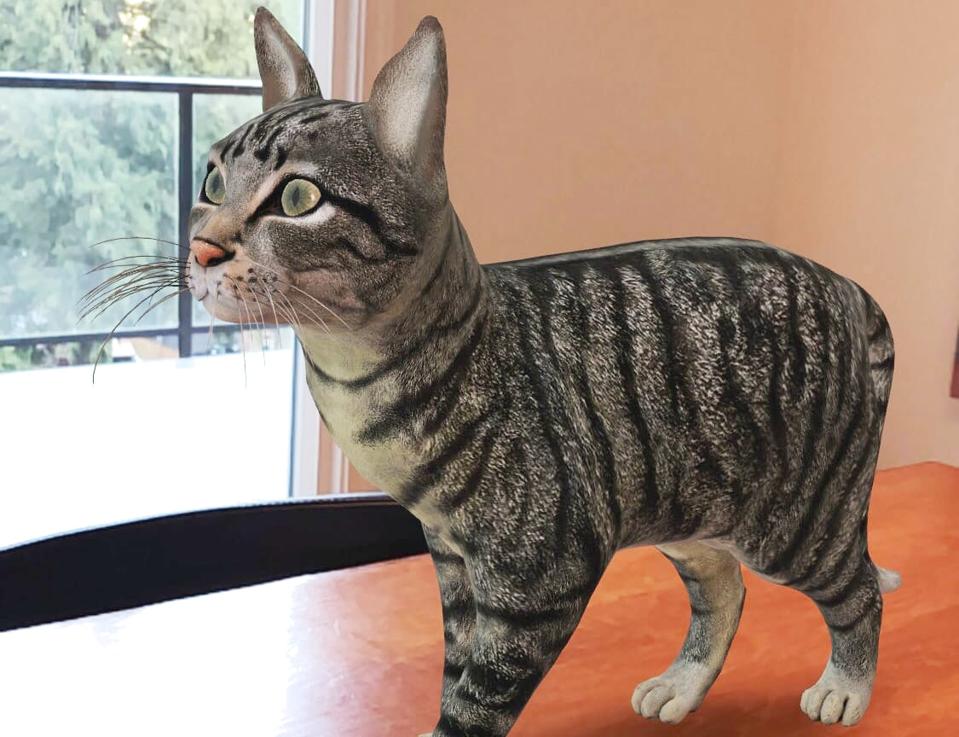
To experience the effect, all you have to do is open Google on a compatible device — think: recent smartphone with a decent camera and reasonably-fast processor — and search for an animal like a wolf, tiger, or a Shetland pony. In the search results, you’ll be able to find an option to “View in 3D” which will place the animal right in your setting.

It has depth as well, so you can see around it somewhat as you move your phone, and the animal moves as well, as you can see in the video above.

Fun? Yes. And a nice distraction from the distressing realities of global news in the war on COVID-19.

But also a reminder that augmented reality is coming soon. And that, even if it’s currently all about the smartphones we already have in our hands instead of expensive and finicky new head-mounted displays, it’s still cool and potentially useful.

Now I can actually check if that new sofa fits with our existing decor while staying at home and socially distancing. If, of course, brands start using the new technology.

For Google, this is strategically important.

While Google still owns search in general, Amazon has increasingly taken over product search in the last few years — a particularly lucrative space for an advertising giant like Google. If Google can convince retailers to adopt new formats of showing and sharing products, people can see products “in real life” without having to go to Amazon.

And that might just decrease Amazon’s clout in product search, while restoring Google’s.

Plus, tigers in the living room are cute.

Follow me on Twitter or LinkedIn. Check out my website or some of my other work here.

I forecast and analyze trends affecting the mobile ecosystem. I’ve been a journalist, analyst, and corporate executive, and have chronicled the rise of the mobile

https://medicalxpress.com/news/2020-04-scientists-reveal-brain-tumors-impact.html

Scientists reveal brain tumors impact normally helpful cells

Virginia Tech scientists reveal brain tumors impact normally helpful cells
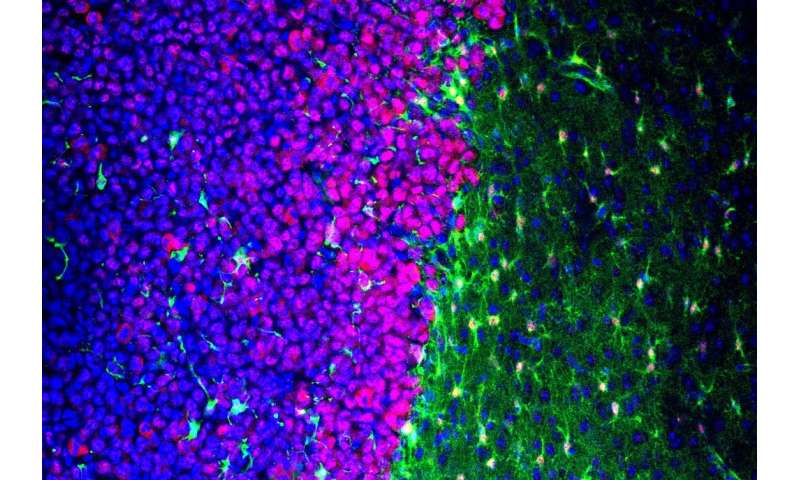
The same brain cells designed to stop brain damage fail to support healthy neurons when a cancer grows. New research, led by Stefanie Robel and Harald Sontheimer at the Fralin Biomedical Research Institute at VTC, reveals how gliomas alter astrocytes, a cell type that helps protect neurons and is crucial to preventing seizures. Credit: Virginia Tech

When the brain gets injured, star-shaped brain cells called astrocytes come to the rescue. In the case of glioma—the most common type of primary brain tumor—this protective action comes at a price.

A new study published in Neurochemistry International reveals that gliomas alter  function, which normally prevents the brain from being flooded with excess excitatory chemicals. This could contribute to the seizures experienced by many brain cancer patients.

“Seizures are a serious and debilitating comorbidity that affect most patients with primary brain tumors. Unfortunately, epilepsy dramatically reduces quality of life, and our current anti-epileptic drugs are not effective for all patients,” said Stefanie Robel, an assistant professor at the Fralin Biomedical Research Institute at VTC and the study’s co-senior author.

“My lab is looking for other cellular and molecular targets that contribute to seizures resulting from gliomas, and so far, what we’re finding is that the scar-forming astrocytes that surround the  play an important role.”

Gliomas are competitive, fast-growing tumors that—just like all other —need an energy source to survive. Composed primarily of glia cells, gliomas take over the brain’s microvasculature, syphoning off a fresh supply of nutrients from other . The tumors also release toxic levels of glutamate, an excitatory neurotransmitter, which can kill off the brain’s densely packed healthy neurons, making space for the cancer to grow. An abundance of glutamate can also cause more neurons to become electrically active, which can result in seizures.

Astrocytes swiftly scar the tumor to protect the brain from further damage—but this comes at a price.

“Under ordinary circumstances, you’d expect astrocytes to buffer any additional glutamate. Part of their job is to maintain balanced, homeostatic conditions for neurons by removing excess glutamate and potassium,” said Robel, who is also an assistant professor in Virginia Tech’s School of Neuroscience and the Virginia Tech Carilion School of Medicine. “Like micro vacuum cleaners, they tidy up neurotransmitters and ions floating amid .”

But the astrocytes encasing gliomas exhibited different molecular signatures based on their proximity to the cancer. The cells directly touching the tumor were elongated and swollen, mimicking the response to other brain injuries associated with epilepsy, such as stroke or .

Electrophysiology and staining experiments revealed the stretched cells also lacked proper localization or function of proteins needed to carry potassium and glutamate inside an astrocyte. The cells had also lost a vital enzymatic process that converts glutamate into glutamine, a molecule that neurons use to suppress activity.

Under these conditions, the brain’s delicate balance of excitation and inhibition tips, and problems arise.

Toxic levels of  emitted from the tumor, exacerbated by the astrocytes dysfunctional state, destroy healthy neurons. Previous studies led by Sontheimer showed that the fluid suspended between brain cells reaches harmful levels of excitability—enough to spark a seizure. After the first seizure, the circuits involved are preferentially strengthened, making future episodes even more likely.

“A tumor is a dynamic, living tissue that sends and receives chemical signals to surrounding glial  and neurons, influencing their behavior,” Robel said. “What we’re seeing is that these very fine changes in astrocyte function and morphology in glioma response could have a very big impact for the patient.”

As more research about astrocytic response to injury, disease, and cancer is published, Robel hopes that larger patterns will emerge.

“If we can understand what astrocytes do in the context of  trauma, or even autism, maybe these overarching biological patterns will help us identify new diagnostics, therapies, and treatments to help patients suffering from a wide range of diseases,” Robel said.


Explore further

Scientists unveil molecular pathway behind stress-induced structural changes


More information: Susan C. Campbell et al, Potassium and glutamate transport is impaired in scar-forming tumor-associated astrocytes, Neurochemistry International (2019). DOI: 10.1016/j.neuint.2019.104628
Provided by Virginia Tech

https://phys.org/news/2020-04-nonreciprocal-gate-induced-strontium-titanate-polar.html

Nonreciprocal transport in the gate-induced strontium titanate polar superconductor

Nonreciprocal transport in the gate-induced strontium titanate polar superconductor
Device image and gate-induced superconductivity in SrTiO3. (A) Schematic image of SrTiO3-EDLT. (B) Longitudinal first harmonic resistance Rωxx as a function of temperature T under zero magnetic field. The applied current was 0.05 μA, which can be regarded as low-current limit. Transition temperature defined by the midpoint of the resistive transition is estimated as Tc0 = 0.31 K (black arrow). Black dashed line shows fitting curve by the Halperin-Nelson formula, where RN = 128 ohms is the normal-state resistance (T = 1.0 K), b = 1.17 is a dimensionless constant, and TBKT = 0.18 K is BKT transition temperature (white triangle). The applied gate voltage VG is 5.0 V at T = 260 K. Credit: Science Advances, doi: 10.1126/sciadv.aay9120

In materials science, two-dimensional electron systems (2DES) realized at the oxide surface or interface are a promising candidate to achieve novel physical properties and functionalities in a rapidly emerging quantum field. While 2-DES provides an important platform for exotic quantum events including the quantum Hall effect and superconductivity, the effect of symmetry breaking ; transition from a disorderly state in to a more definite state, on such quantum phases remain elusive. Nonreciprocal electrical transport or current-direction-dependent resistance is a probe for broken inversion symmetry (presence of a dipole), as observed on several noncentrosymmetric crystals and interfaces. In a new report, Yuki M. Itahashi and a team of scientists in applied physics, nanosystems and materials science in Japan and the U.S. reported nonreciprocal transport at the surface of a 2-D superconductor made of the superconducting material strontium titanate (SrTiO3). The team observed gigantic enhancement of the nonreciprocal region in the superconducting fluctuation region—at six orders of magnitude larger compared to its normal state. The results are now published on Science Advances and demonstrate unprecedented characteristics of the 2-D polar superconductor.

Polar conductors or superconductors are potential material platforms for quantum  and spintronic functionalities, with inherent nonreciprocal transport that reflects the elusive property of time-reversal symmetry breaking (i.e. breaking conservation of entropy). Recent experiments have extended to the superconducting state to observe a large nonreciprocal response and physicists are keen to examine the nonreciprocity around superconducting transition in a simple electron system. For this, Itahashi et al. engineered chromium/gold (Cr/Au) electrodes on the atomically flat surface of SrTiO3 and placed ionic liquid on the top to form an electric double layer transistor (EDLT) to realize a Rashba superconductor; based on the Rashba effect, with an ion-gating technique on the SrTiO3 material surface. The scientists then measured the first and second harmonic electronic transport using a standard lock-in technique to measure nonreciprocal charge transport and quantify time-reversal symmetry breaking in the system. Nonreciprocal transport is also an effective tool to identify Cooper pairs, where a pair of electrons overcome their usual repulsion to share a quantum state for nonreciprocal paraconductivity in superconductors, which Itahashi et al. also intended to quantify in the Rashba superconductor.

Nonreciprocal transport in the gate-induced strontium titanate polar superconductor
Magnetotransport of gate-induced 2D SrTiO3 for both the normal and superconducting states and enhancement of the nonreciprocal transport in the superconducting fluctuation region. (A) First and (B) second harmonic magnetoresistance (Rωxx and R2ωxx, respectively) above Tc0 (normal state, T = 0.47 K and I = 20 μA) as a function of in-plane magnetic field B perpendicular (red) or parallel (blue) to I. Insets in (A) and (B) show the magnified view of Rωxx(B) and schematics of the measurement configuration (directions of B and I), respectively. (C) Rωxx and (D) R2ωxx below Tc0 (superconducting fluctuation region, T = 0.22 K and I = 1 μA) as a function of in-plane B perpendicular (red) or parallel (blue) to I. In (A) to (D), Rωxx is normalized by the normal-state resistance RN = 128 ohms, and Rωxx/R2ωxx is symmetrized/anti-symmetrized as a function of B. (E) Temperature dependence of γ=2R2ωxxRωxxBI in the normal state (I = 20 μA) and superconducting fluctuation region (I = 0.9 μA). Purple (normal state) and orange (superconducting fluctuation region) circles were extracted from the measurement of magnetic field scan of R2ωxx at low B below 0.1 T, while purple (normal state) and orange (superconducting fluctuation region) dots were plotted from the temperature scan of R2ωxx under B = 3 and 0.05 T, respectively. Credit: Science Advances, doi: 10.1126/sciadv.aay9120

The scientists initially detailed the first harmonic resistance (FHR) corresponding to linear resistance near superconducting transition for a  of 5.0 V. The results showed a temperature dependence at the low current limit (I = 0.05 μA). Then they focused on second harmonic resistance (SHR) and credited nonreciprocal charge transport observed at the surface of SrTiOto the polar symmetry within the superconducting fluctuation region and in the normal state. The team observed magneto-transport in gate induced 2-D SrTiO3 within a  (B) perpendicular to the current (I) for normal and superconducting states—with enhanced nonreciprocal transport in the superconducting fluctuation region. To compare the magnitude of nonreciprocity between the normal state and region of superconductivity fluctuation, they calculated the coefficient of nonreciprocal magnetoresistance (γ), which depended on the temperature within the regions.

The team subsequently measured the dependence of the second harmonic signals on current (I), in the normal state and in the superconducting fluctuation region. In the normal state, the SHR showed an almost linear dependence on the current. In the superconductivity fluctuation region at a magnetic field of 0.1 Tesla, the SHR increased linearly, reached a maximum at around 1 µA and suppressed—to indicate suppression of superconductivity by the high current.

Nonreciprocal transport in the gate-induced strontium titanate polar superconductor
Current dependence of the second harmonic magnetoresistance in the normal and the superconducting fluctuation region. (A) Second harmonic magnetoresistance R2ωxx at T = 0.85 K under I = 3 μA (red), 5 μA (orange), 10 μA (green), 15 μA (blue), and 20 μA (purple). R2ωxx is antisymmetrized as a function of B. (B) ∣∣R2ωxx∣∣ at B = 3 T as a function of I, which is extracted from (A). Black solid line shows linear fitting as a function of I. (C) Magnetic field dependence of ∣∣R2ωxx∣∣ at T = 0.22 K under I = 0.05 μA (red), 0.6 μA (orange), 1.2 μA (green), and 1.8 μA (blue). Each curve is shifted vertically by 0.5 ohms and antisymmetrized as a function of B. (D) Current dependence of ∣∣R2ωxx∣∣ at B = 0.1 T, where R2ωxx is regarded as a linear function of B. In low-current region (I ≤ 1 μA), ∣∣R2ωxx∣∣ linearly increases (black solid line) with I. Credit: Science Advances, doi: 10.1126/sciadv.aay9120

To further investigate the possible origin of nonreciprocal superconducting transport in the system, the scientists measured the  of FHR and SHR during the transition. To accomplish this, they noted magnetic field dependence of FHR and SHR at various temperatures and specifically observed SHR to be largely enhanced during superconducting transport. Although Itahashi et al. applied a relatively large current and in-plane magnetic field, they recorded zero-resistance state at the lowest temperature. The results implied the existence of the Berenzinskii-Kosterlitz-Thouless transition (BKT transition), named after a team of Nobel prize-winning condensed matter physicists. It describes phase transitions in 2-D systems in condensed matter physics approximated by a XY model in order to understand unusual phases or states of matter in superconductors.

Nonreciprocal transport in the gate-induced strontium titanate polar superconductor
Temperature dependence of the magnetoresistance and the nonreciprocal transport. Magnetic field dependence of (A) the first (Rωxx) and (B) the second (R2ωxx) harmonic magnetoresistance at T = 0.16 K (red), 0.19 K (orange), 0.22 K (green), 0.26 K (blue), 0.29 K (purple), 0.33 K (black), and 0.37 K (pink), respectively. In (B), each curve is shifted vertically by 0.5 ohms. Rωxx/R2ωxx is symmetrized/antisymmetrized as a function of B. Temperature variation of (C) Rωxx and (D) γ under B = 0.05 T and I = 0.9 μA. In this region, R2ωxx is linear as a function of B and I. Rωxx/γ is symmetrized/antisymmetrized as a function of B. Characteristic structure (kink structure around T = 0.24 K and peak structure around T = 0.17 K) appears in (D), according to which we can identify two regions of the nonreciprocal transport of different origins, i.e., paraconductivity region and vortex region. At the lowest temperature, zero-resistance state is observed, where Rωxx and γ becomes negligibly small. Magnification of γ in (E) paraconductivity region and (F) vortex region. Black dashed line in (E) shows fitting curve by γ(T)=γs(1−R(T)RN)2, and black dashed line in (F) indicates fitting curve by γ(T)=C(T−TeffBKT)−3/2. Normal-state resistance RN = 128 ohms is defined as Rωxx at T = 1.0 K. Credit: Science Advances, doi: 10.1126/sciadv.aay9120

In this way, Yuki M. Itahashi and colleagues proposed nonreciprocal transport in noncentrosymmetric (without inversion symmetry) 2-D superconductors within a magnetic field. The nonreciprocal transport originated from amplitude fluctuation from the normal to the superconducting state. Temperature dependence of the coefficient of nonreciprocal magnetoresistance (γ) observed in the experiments agreed well with the microscopic theoretical picture of free motion for thermally excited vortices and antivortices in polar 2-D superconductors. The nonreciprocal response is therefore a powerful tool to understand the nature of noncentrosymmetric superconductors.

Itahashi et al. believe that nonreciprocal transport could appear universally for different materials at interfacial superconducting systems with polar symmetry. The results provide information on previously unknown functions of superconductivity and important information on the electronic state and pairing mechanisms in noncentrosymmetric superconductors—as an important topic for further investigation. The work highlighted nonreciprocal transport in interfacial superconducting systems such as gate-induced 2-D superconductor SrTiO3. The team probed the marked jump of nonreciprocal transport from the normal to superconducting states as direct evidence for giant enhancement of nonreciprocal transport in the system. The results offer important insight into polar superconductors and pave a new way to search for hitherto unknown emergent properties and functionalities at 2-D oxide interfaces and .


Explore further

Observation of non-trivial superconductivity on surface of type II Weyl semimetal


More information: Yuki M. Itahashi et al. Nonreciprocal transport in gate-induced polar superconductor SrTiO3, Science Advances (2020). DOI: 10.1126/sciadv.aay9120H. Y. Hwang et al. Emergent phenomena at oxide interfaces, Nature Materials (2012). DOI: 10.1038/nmat3223

Pan He et al. Bilinear magnetoelectric resistance as a probe of three-dimensional spin texture in topological surface states, Nature Physics (2018). DOI: 10.1038/s41567-017-0039-y

https://www.theladders.com/career-advice/psychopaths-tend-to-have-this-very-annoying-social-media-habit

Psychopaths tend to have this very annoying social media habit

article-image
No content is innocuous enough to escape internet hate completely. Baking tutorials, compilations of people passing the bar exam, and even two herpetologists soberly discussing the evolution of rain frogs are all susceptible to the very best of indecent words.  

A new study from the Journal Frontiers in Psychology attempts to locate the driving force behind the online rage. According to the data, psychosis plays a major role (perhaps unsurprisingly).

“The main aim of the present study is to identify the psychological predictors of posting hate comments online. Based on the initial literature review, we decided to focus on the following traits: Dark Triad (i.e., Narcissism, Psychopathy, and Machiavellianism), level of experienced frustration, level of experienced envy, and satisfaction with life.”

The participating subjects were reviewed and approved by the Ethical Review Board of the Institute of Psychology at the University of Wrocław.

Biting Nails

The authors of the new paper derived their findings from online comments posted by Facebook users aimed at athletes who participated in the 2018 Winter Olympic Games.

Forty-six of the 94 users involved in the study submitted comments that could be reasonably defined as hateful; gems like “she discredits our country” and “representing our country while being so ugly should be banned.”.

Although nearly 50% of disparaging comments were posted by female respondents, elements of the dark triad of personality traits, narcissism, Machiavellianism and psychopathy, were suspected to link the commonalities and differences of online haters compared to trolls and more generic forms of cyberbullying more substantively.

In this context, haters were distinguished as individuals who occasioned some sort of perceived constructive inducement when they allowed themselves to chastise players online.

The internet appeared to foster the frustration-aggression hypothesis first introduced by American psychologist Neal Miller back in 1941.

When people become frustrated, for any reason, they’re often tempted to exercise their frustration at the expense of others in the form of verbal or physical aggression.

Online, where ambiguity is so easily achieved, users may exact antagonistic behaviors through various mediums, including chat rooms, comment sections, direct messaging, etc.

“More recently, Breuer and Elson (2017) overviewed numerous empirical research and found evidence for the frustration-aggression link. Thus, it is reasonable to assume that if the frustration fosters aggressive behaviors, such occurrence may be even more pronounced in the online setup, as the internet offers various ways to express verbal aggression,” the authors continued.

After follow up analysis, the results showed that high scores in the Psychopathy subscale were reliable predictors of posting hating comments online; while high scores on the Envy Scale were found to be only marginally significant. No meaningful correlation was established between online hate and narcissism or Machiavellianism. The correlates were certainly compelling, however, If we set anecdotal evidence aside, some relevant limitations become apparent.

While giving in to an impulse to target aggressive language at strangers might be indicative of some underlying psychological abnormality, this study was conducted on active members of the sports community, which is a demographic that has been independently linked to impassioned demonstrations. Moreover, the study window occurred during a uniquely charged time, as many Olympic game viewers burden the featured events with heavy themes like patriotism and cultural significance.

Still, the new study teases the potential for further research. With an election, health crisis and looming economic catastrophe in the balance, now might be a good time to reboot global etiquette.

“Considering a reported increase in online hating, predictions are that online hating behavior will become even more and more severe. Results of the present study are one of the first steps in broadening our understanding who the online haters are, which, in turn, may help identifying the best strategies for psychological interventions for haters, and creating counter-hating strategies,” the report concludes.