https://www.popularmechanics.com/science/animals/a32210601/humboldt-squid-communication/

How the Deep Sea Squid Communicates in Fascinating and Flashy Ways

“This turns some of our ideas about bioluminescence almost around upside-down.”

NOAA
  • Deep-sea Humboldt squid have been seen exhibiting an interesting behavior in their natural habitat which they “talk” to each other.
  • A new paper describes a method of communication between Humboldt’s in which they backlight their bodies and overlay a display of colors and patterns against that backlighting in order to send messages to other squid.
  • This behavior seems to indicate that squid are capable of putting sentences together in order to communicate with their shoal.

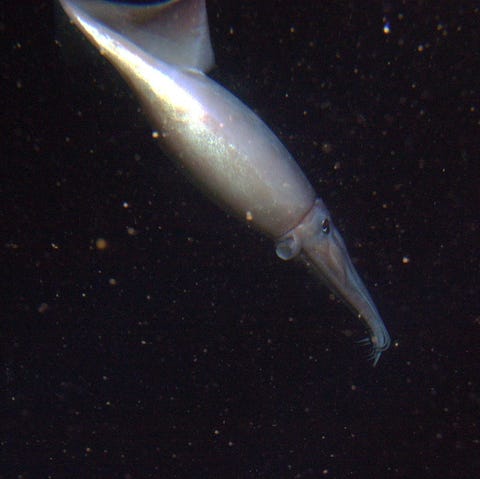
According to new research published in the Proceedings of the National Academy of Sciences (PNAS), Humboldt squid (Dosidicus gigas) communicate using a kind of complex—and impressive—process that gives them a voice in the dark abyss of the deep sea.

Animals across several species communicate in various ways and the Humboldt is no different. It doesn’t use echolocation, clicks, or whistles to send a message; instead, the Humboldt uses bioluminescence in a really clever way: for backlighting.

Ben Burford, a Stanford University graduate student and lead paper author, told NPR that arrangement of a Humboldt’s coloring and bioluminescent is something akin to the formation of sentences—they can say different things depending on what patterns, colors, and backlighting they choose to display.


“So, they could for instance say: ‘hey, that fish over there is mine, and I’m the dominant squid,’” Burford said.

This discovery also means that the purpose is bioluminescence is—at the very least—twofold: squid use them to attract prey and communicate with each other although it seems this flashy ‘talking’ is mostly used during feeding frenzies.

In their paper, Burford and his team share that communication between deep-sea creatures has been hard to study since it’s difficult to reach the depths at which they live—Humboldt’s live more than 1,000 feet below the ocean’s surface.


Using footage obtained via remotely operated vehicles (ROVs) from the Monterey Bay Aquarium Research Institute (MBARI), Burford and colleagues analyzed Humboldt movements and behaviors in their natural habitat.

They found that the squid can “visually convey and receive large quantities of information by combining complex pigmentation patterning with whole-body luminescence” especially when foraging “and in social scenarios.” This method of backlighting only certain portions of their bodies is similar to the backlighting on devices such as e-readers or phones.

The researchers note that their data suggests that Humboldt communication “could share design features with advanced forms of animal communication.” It also provides insight about how animals interact and speak with each other “in one of the planet’s most challenging environments for visual communication.”

https://phys.org/news/2020-04-highly-sensitive-nanosensor-subtle-potassium.html

Highly sensitive nanosensor detects subtle potassium changes in the brain

Highly sensitive nanosensor detects subtle potassium changes in the brain
Design and sensing mechanism of the K+ nanosensor. (A) Schematic illustration for the synthesis of the nanosensor. The NaYF4:Yb/Tm@NaYF4:Yb/Nd (UCNP) core was synthesized and coated with a dense silica layer and a successive mesoporous silica shell. Etching away of the dense silica layer forms a hollow cavity that allows the loading of PBFI. The nanosensor was lastly coated with the K+-selective filter membrane. (B) Schematics showing a magnified view of the nanosensor [from the red dotted box in (A)] and its K+ sensing mechanism. The filter membrane layer allows only K+ to diffuse into and out of the nanosensor, thus excluding the interference from other cations. Once diffused into the nanosensor, K+ will bind to PBFI immediately. Upon NIR irradiation, the upconverted UV light from the UCNPs excites PBFI, leading to the emission of K+-bonded PBFI. Credit: Science Advances, doi: 10.1126/sciadv.aax9757

Researchers have developed a number of potassium ion (K+) probes to detect fluctuating Kconcentrations during a variety of biological processes. However, such probes are not sensitive enough to detect physiological fluctuations in living animals and it is not easy to monitor deep tissues with short-wavelength excitations that are in use so far. In a new report, Jianan Liu and a team of researchers in neuroscience, chemistry, and molecular engineering in China, describe a highly sensitive and selective nanosensor for near infrared (NIR) Kion imaging in living cells and animals. The team constructed the nanosensor by encapsulating upconversion nanoparticles (UCNPs) and a commercial potassium ion indicator in the hollow cavity of mesoporous silica nanoparticles and coated them with a K+ selective filter membrane. The membrane adsorbed K+ from the medium and filtered away any interfering cations. In its mechanism of action, UCNPs converted NIR to ultraviolet (UV) light to excite the potassium ion indicator and detect fluctuating potassium ion concentrations in cultured cells and in animal models of disease including mice and zebrafish larvae. The results are now published on Science Advances.

The most abundant intracellular cation potassium (K+) is extremely crucial in a variety of biological processes including neural transmission, heartbeat, muscle contraction and kidney function. Variations in the intracellular or extracellular K+ concentration (referred herein as [K+]) suggest abnormal physiological functions including heart dysfunction, cancer, and diabetes. As a result, researchers are keen to develop effective strategies to monitor the dynamics of [K+] fluctuations, specifically with direct optical imaging.

Most existing probes are not sensitive to K+ detection under physiological conditions and cannot differentiate fluctuations between [K+] and the accompanying sodium ion ([Na+]) during transmembrane transport in the Na+/Kpumps. While fluorescence lifetime imaging can distinguish Kand Nain water solution, the method requires specialized instruments. Most Ksensors are also activated with short wavelength light including ultraviolet (UV) or visible light—leading to significant scattering and limited penetration depth when examining living tissues. In contrast, the proposed near-infrared (NIR) imaging technique will offer unique advantages during deep tissue imaging as a plausible alternative.

Highly sensitive nanosensor detects subtle potassium changes in the brain
Structural characterization of the K+ nanosensor. (A to C) High-angle annular dark-field images of UCNP@dSiO2 (A), UCNP@dSiO2@mSiO2 (B), and UCNP@hmSiO2 (C). (D) Scanning electron microscopy (SEM) image of the shielded nanosensor. (E) SEM image of the shielded nanosensor immersed in an aqueous solution containing 150 mM Na+, 150 mM K+, 2 mM Ca2+, 2 mM Mg2+, 50 μM Fe2+, 2 mM Zn2+, 50 μM Mn2+, and 50 μM Cu2+. (F) EDS elemental line scanning profiles along the white line in (E) reveal that only K+ signals are present in the mesopores and hollow cavities of the shielded nanosensors. Credit: Science Advances, doi: 10.1126/sciadv.aax9757

Designing the K+ nanosensor and characterizing its structureTo engineer the , Liu et al. encapsulated upconversion  (UCNPs) and a commercial K+ indicator—potassium-binding benzofuran isophthalate (PBFI) into the core of mesoporous silica nanoparticles (MSNs). The UCNPs were able to convert NIR light into UV light and excite the acceptor of the Kindicator through luminescence resonance energy transfer. They shielded the outer surface of silica nanoparticles with a thin layer of K+ selective filter membrane with micropores created from carbonyl oxygen for specificity. The setup favored the free transfer of K+ through the membrane pore, while preventing other biologically relevant cations from diffusing through. The technique allowed them to detect slight fluctuations in [K+] in the solution. The team used transmission electron microscopy (TEM) to observe the well-controlled structure and appearance of the nanoparticles during each step of nanosensor construction. Dynamic light scattering confirmed the presence of a filter membrane on the surface of the shielded nanosensor.

Highly sensitive nanosensor detects subtle potassium changes in the brain
Imaging of K+ efflux in HEK 293 cells. (A) Schematics showing the detection of K+ efflux by a streptavidin-conjugated nanosensor, which is tethered to a biotin-modified cell. (B) Confocal microscopy images showing the fluorescence (at 400 to 500 nm and 500 to 600 nm) of nanosensor-labeled HEK 293 cells at different time points after treatment with the K+ efflux stimulator (a mixture of 5 μM nigericin, 5 μM bumetanide, and 10 μM ouabain). (C) Time courses of nanosensor fluorescence variations and calculated time dependence of K+ efflux rate after treatment with K+ efflux stimulator. (D) Time-dependent fluorescence fluctuations of shielded nanosensor-labeled HEK 293 cells after treatments with different concentrations (20, 40, 60, 80, and 100%) of K+ efflux stimulator. Results from five independent experiments were summarized as mean ± SEM in (C) and (D). Credit: Science Advances, doi: 10.1126/sciadv.aax9757

Performance of the nanosensor in water and during [K+] fluctuations in cells.The team tested the enhanced sensitivity of the shielded nanosensor in a physiological range (0 to 150 mM) and showed a 12-fold increase in fluorescence intensity compared to unshielded nanosensors. The K+ probes had to display high selectivity against Na+, which Liu et al. verified using the shielded nanosensor by rapidly detecting consistent fluorescence sensitivity to fluctuating [K+], while remaining unaffected by increasing [Na+].

Since living cells rely on the sodium-potassium adenosine triphosphatase (Na+/K+ pump) to maintain a steep [K+] gradient across their plasma membrane, the process is partially responsible for the cell’s energy expenditure. Defects in cellular energy metabolism can lead to a loss of the [K+] gradient, while giving rise to extracellular [K+] known as [K+]0, which the scientists monitored to obtain a valuable indicator of cell viability and growth. Thereafter, they increased the specificity of the nanosensor to detect cell death or proliferation rates by grafting polyethylene glycol (PEG) on the surface of nanosensors in a culture medium containing the human embryonic kidney 293 cell line. They then optimized the protocol by anchoring large numbers of nanosensors onto cell membranes using streptavidin-conjugated nanosensors to biotin-modified cells. The results highlighted improved sensitivity of shielded nanosensors to continuously monitor the Kefflux.

Highly sensitive nanosensor detects subtle potassium changes in the brain
K+ imaging results of the shielded nanosensors-treated mouse brain upon initiating spreading depression by KCl triggering. The full-length video is eight times faster than the real speed. Credit: Science Advances, doi: 10.1126/sciadv.aax9757

Spreading waves in the mouse intact brainThe team then applied the shielded nanosensor to investigate cortical spreading depression (CSD) in the mouse brain as a wave-like propagation of neural activity. The process typically involves a slow propagation release of K+ in the cortical surface and could be triggered in the mouse brain via potassium chloride (KCl) incubation. The scientists simultaneously monitored the local field potential and optical signal through the surgical cranial window and observed a wave of increasing [K+]propagate gradually across the cortex after stimulation. Liu et al. did not observe a wave in mice injected with unshielded nanosensors, indicating the importance of the outer filter for improved sensitivity of the nanosensor. The recorded wave velocity did not vary significantly from the values obtained using blood oxygen-level dependent magnetic resonance imaging (MRI) in patients with migraine aura.

Highly sensitive nanosensor detects subtle potassium changes in the brain
Extracellular potassium burst in larval zebrafish brain upon PTZ treatment. (A) PTZ treatment induced increases in both neuronal calcium activity (middle) and extracellular potassium concentration (right). Left: Imaged brain areas include the left and right telencephala (Tel-l and Tel-r, respectively), the left and right habenulae (Hb-l and Hb-r, respectively), the pineal body (P), and the left and right optic tecta (OT-l and OT-r, respectively). Middle: Neuronal calcium activity was monitored by using a genetically expressed calcium indicator, jRGECO1a. The measured response amplitude is coded in red and mapped back to the imaged brain region. Scattered activity spots are marked as white, and their neighboring zones are marked as gray. Four ROIs (yellow) are selected. Right: Extracellular potassium concentration was monitored by using the potassium nanosensor. The measured response amplitude is coded in green and mapped back to the imaged brain region. (B) Neuronal calcium activity (red) and extracellular potassium concentrations observed for the four representative ROIs are marked in (A). After PTZ application, both neuronal calcium activity and extracellular potassium concentration have increased at several activity spots, including the pineal body and the anterior optic tecta, as represented by ROI1. At neighboring zones of the activity spots, neuronal calcium activity change is absent or minimal, while the extracellular potassium concentration continues to increase (ROI2 and ROI3). However, in the area far from the activity spots (ROI4), neither neuronal calcium activity nor extracellular potassium concentration has increased. Credit: Science Advances, doi: 10.1126/sciadv.aax9757

To extend applications of the nanosensor, Liu et al. monitored neuronal calcium levels and extracellular potassium concentrations using zebrafish larvae. While a large increase in the extracellular potassium concentration can cause intense neuronal activation to cause CSD and epilepsy, no direct evidence exists to show changes in extracellular potassium during the disease. The team therefore engineered a disease model using zebrafish larvae to increase extracellular potassium concentrations and observed disease characteristic neuronal activation in specific brain regions.

In this way, Jianan Liu and colleagues engineered a potassium ion nanosensor with extremely high sensitivity and selectivity. The external coating of a selective filter membrane enhanced the selectivity, sensitivity, and kinetics of the device for rapid and quantitative [K+] detection in living cells and intact brains. The shielded nanosensor will have broad applications in brain research to improve the understanding of abnormal [K+]-related diseases. The method alongside optical fiber-based endoscope and photometry will allow real-time potassium imaging in freely moving animals.


Explore further

Sensitive and specific potassium nanosensors to detect epileptic seizures


More information: Jianan Liu et al. A highly sensitive and selective nanosensor for near-infrared potassium imaging, Science Advances (2020). DOI: 10.1126/sciadv.aax9757Prashant Padmawar et al. K+ waves in brain cortex visualized using a long-wavelength K+-sensing fluorescent indicator, Nature Methods (2005). DOI: 10.1038/nmeth801

Michelle L. Gumz et al. An Integrated View of Potassium Homeostasis, New England Journal of Medicine (2015). DOI: 10.1056/NEJMra1313341

https://www.psychologytoday.com/us/blog/progress-notes/202004/get-know-your-shadow

Get to Know Your Shadow

What kind of relationship do you have with your dark side?

Posted Apr 25, 2020


BRUNO CERVERA/Unsplash

Perception is more powerful than reality. I am influenced by that which I perceive to be true, whether it is actually true or merely imagined. As a therapist, I have a responsibility to notice and, at times, confront perception. I would do well to proceed respectfully, empathically, and without unnecessary provocation. Those real or imagined perceptions infuse every relationship and often stand between people. Unacknowledged, they have ways of impeding growth in relationships.

Sigmund Freud believed that we are forcefully determined by underlying inclinations. He believed that such inclinations maintain their power by our oblivion to them. There is a force to my perception of you. As my emotions about you interact with your emotions about me, the reality of us takes on a third identity that is quite a thing to behold. And as we scan further out into the layers of human development from family to culture to society, it is as if I am not only a system of emotions and perception but that I am embedded within increasingly complex systems of emotion and perception.

Experiences feed our perceptions and, in turn, our perceptions influence experiencing. Along the way, we collect bits and pieces of emotion and reaction, image and symbol, and store them away within the unconscious. We experience others, and so much of life, through their innuendo.

The mind holds a vast collection of imagery and symbolism. Most of those images and symbols lie dormant in the dark confines of shadow, a term Carl Jung coined to appreciate that aspect of memory and personality that we disown. The shadow is a dangerous place of storage, to the extent it requires a vigilante guarding, the task of protection ever more becomes the threat of projection. We inflate our shadow by repressing experiential images and symbols, and we become defensive to the same degree. The pretentious pomp and circumstance of some colorful personality may betray the insecurities and fear of vulnerability that lie within.

In the tradition of great literature across time and culture, shadows have symbolized the past, dark and ill-understood reflections of unexpected reminders or else lingering memories. The writer, J.M. Barrie developed with such complexity the figure of Peter Pan’s shadow that it was a distinct character in the story. Peter had no natural attachment to his shadow and–not coincidentally–no memory of his childhood, without which he could not learn from early experiences and, therefore, could not grow up.

Photo courtesy Orange County Archives/Wikimedia Commons
Mr. and Mrs. Darling (Cyril Chadwick and Esther Ralston) discover Peter Pan’s Shadow in the film, “Peter Pan” (1924
Source: Photo courtesy Orange County Archives/Wikimedia Commons

While the burden of such memory created for Peter a degree of weightlessness permitting him the freedom to fly about, he wanted to be in relationship with his shadow and tried again and again to re-attach it, even to dance with it. Interestingly, Peter’s shadow from time to time exhibited, or else evoked, emotions aligned with Peter’s own courage of conviction, even joy and sadness.

I love a particular vignette from the story occurring at a point in conversation between Wendy and Peter when he begins to cry.

“O Peter, no wonder you were crying,” she said, and got out of bed and ran to him.

“I wasn’t crying about mothers,” he said rather indignantly. “I was crying because I can’t get my shadow to stick on. Besides, I wasn’t crying.”

“It has come off?”

“Yes.”

(Barrie, 1911)

In a sense, Peter’s shadow had functioned as a mother figure, and Peter lost his shadow the same way he lost his mother: by leaving through the window of a nursery. When he returned to his mother, the window was locked, but when he returned to his shadow, the window was open. The shadow functioned as a constant for Peter, a role similar to that of a mother. The prospect of losing his shadow overcame him with sadness and reminded of the threat of loss and other suffering experienced in childhood.

We live in constant risk of projecting the threats of childhood: the way a coach cursed and slung us into the mud by the sidebar of a face mask; the way two friends mocked or betrayed, leaving us in silence and agony; the way a role model listened to our vulnerable disclosures with quick darting glances to the business and files of his office, uncharmed by the grace of the moment; the way the lunch lady screeched at our clumsiness with such fire and terror that our hearts pulsed with anxiety.

Let’s be clear: we’re also at risk of projecting the threats of traumatic experiences from adulthood.

Certain stimuli naturally affect certain responses: the smell of appetizing food induces salivation, touching a hot frying pan causes a reflexive jerk of pain. Pavlov taught us that these natural physiological responses can be corrupted. Every time we encounter an intense situation that produces anxiety, unconscious memory bytes associated with the original stimuli (e.g. food, frying pan) surface. These are the emotionally-loaded experience-laden images and symbols that we so often project onto our world.

During critical years of development, we unknowingly work to consolidate our view of the world and the general predispositions of our personality. Upon individuating from our families, such experiential fragments continue to unknowingly influence our thoughts, emotions, and behavior. Could our lives be more unconsciously determined than we imagined?

In the best of cases, we have opportunity to be attached to and in relatively healthy relationship with our shadow, resulting in a more thoroughly valid self-concept and, consequently, a groundedness which limits flying about but leads to better living wherever we happen to be.

Tom Barrett/Unsplash
Source: Tom Barrett/Unsplash

Jung (1959) wrote that “no one can become conscious of the shadow without considerable moral effort. To become conscious of it involves recognizing the dark aspect of the personality as present and real” (p. 8). And by “dark,” Jung referenced the metaphor of darkness and light, with light being what is visible and dark being what is not clearly visible. In other words, the shadow is integrally threaded into the moral arc of your, as well as–I’m sure Jung would have me say–our collective, universe.
References

Barrie, J. M. (1911). Chapter 3: Come Away, Come Away!. Peter Pan (Lit2Go Edition). Retrieved February 13, 2020, from https://etc.usf.edu/lit2go/86/peter-pan/1537/chapter-3-come-away-come-away/

Jung, C. G. (1959). Aion: Researches into the phenomenology of the self. In Read, H., Fordham, M., & Adler, G. (Eds.), Collected works (R. F. C. Hull, Trans.). Princeton: Princeton University Press, Bollingen Series XX.

http://linuxgizmos.com/new-banana-pi-sbcs-slim-down-for-low-power-iot/

New Banana Pi SBCs slim down for low-power IoT

Apr 24, 2020 — by Eric Brown — 4889 views

Banana Pi’s “BPI-F2P” SBC runs Linux on a quad -A7 SunPlus SP7021 and offers dual LAN with PoE plus 40-pin GPIO. Also new is a “BPI-EAI80 AIoT” SBC with a dual Cortex-M4 Edgeless EAI80 MCU with 300-GOPS NPU.

SinoVoip’s Banana Pi project has posted specs for its second development board based on SunPlus Technology’s SP7021 SoC after the Banana Pi BPI-F2S, which we covered back in November. The new Banana Pi BPI-F2P has a similar layout and feature list as the BPI-F2S. The biggest difference is the addition of two serial ports, as well as a new Power-over-Ethernet function on one of the two 10/100 Ethernet ports. Meanwhile, the FPGA connector for an optional Artix-7 FPGA module has been removed.


BPI-F2S

The Banana Pi project also revealed a Banana Pi BPI-EAI80 AIoT SBC that does not run Linux, but sort of looks like a board that would (see farther below). We found out about the SBCs from Geeky Gadgets, which has separate reports on the BPI-F2P and BPI-EAI80 AIoT. These link to announcements on Hackter.io here and here. Although the BPI-F2P and BPI-F2S appear to be backed by the Banana Pi community, there is no indication these are open source hardware boards like most Banana Pi SBCs. Schematics have yet to be posted for the BPI-F2, which is now selling for $58 at AliExpress.
Banana Pi BPI-F2P

The SP7021 (Plus1) SoC was developed by SunPlus and Tibbo Technology for IoTR and industrial control applications. The SoC has 4x 1GHz Cortex-A7 cores pus an 8051 microcontroller and an Arm9 CPU used as a real-time core. The SunPlus SP7021 further integrates a secure boot chip, an RTC, a 3.3V PMIC128MB or 512MB DDR3-1066. (For more details on the SP7021, please see our BPI-F2S report.)

 
Banana Pi BPI-F2P and detail view
(click images to enlarge)
Like the BPI-F2S, the BPI-F2P gets by on the SP7021 SoC’s half gig of RAM and adds 8GB eMMC, a microSD slot, and the dual Fast Ethernet ports. The project does not list the type of PoE support used by one of the two ports. 

Other similar features include 2x USB 2.0, single micro-USB and HDMI 1.4 ports, and MIPI-CSI and 40-pin GPIO connectors. The board is similarly equipped with a TPM 2.0 security chip, a boot select switch, and ICE and serial console debug connectors. The 12V DC input is accompanied by a reset switch, but the JTAG interface has been removed.

The BPI-F2P adds an RS-232 DB9 port and an RS-485 terminal plug interface. There’s also a new RTC and Lithium battery and 2x USB 2.0 headers. The 130 x 85mm SBC has a -40 to 85°C operating range.

Images are available for Ubuntu Mate 18.04, Kali Linux, CentOS, Fedora-Mate, and Mozilla’s IoT Gateway, all with Linux kernel 4.19.37. Debian 10 is available with kernel 4.19. SunPlus and Tibbo also maintain a Yocto stack on GitHub.
Banana Pi BPI-EAI80 AIoT

We usually don’t cover non-Linux boards, but we are intrigued by the growing number of high-end MCU SBCs that can perform many of the functions of low-end Cortex-A based boards. The Banana Pi BPI-EAI80 AIoT is built around China-based Edgeless Semiconductor’s crossover AI MCU series, in this case the Edgeless EAI80. There’s no website yet, but earlier this month CNXSoft reported on the SoC and briefly mention the upcoming Banana Pi board based on the project, which is now named the BPI-EAI80 AIoT.

 
Banana Pi BPI-EAI80 AIoT and detail view
(click images to enlarge)
The Edgeless EAI80 comprises dual Cortex-M4F cores at up to 200Mhz, along with DSP instructions, I/D cache, crypto features, and 2D graphics support. One of the cores offloads the other to perform complicated mathematical calculations. The SoC-like MCU also integrates a 300MHz CNN NPU with 300 GOPS AI performance — that’s giga operations per second instead of TOPS’ tera. The NPU can handle image detection and recognition and supports CNN models such as Resnet-18, Resnet-34, Vgg16, GoogleNet, and Lenet. 

The 86 x 54mm BPI-EAI80 AIoT board adds 8MB SDRAM and an Espressif ESP8266 WiFi chipset, the forerunner of the later ESP8285 and ESP32. The SBC has an LCD interface for up to 1024 x 768 resolution plus a camera connector with dual camera support. There is also a USB 2.0 Type-C port, a CANBus 2.0 A/B interface, 40-pin GPIO, and dual mic support, among other features shown on the detail view above.

The EAI80 is one of the lower-end of five models up to an EAI98, which appear to differ mostly in terms of the number of interfaces such as ADC and GPIO. The EAI Series supports RTOSes such as Edgeless’ Free E-RTOS, as well as FreeRTOS, Mbed, and Zephyr.
Further information

No pricing or availability information was provided for the Banana Pi BPI-F2P or BPI-EAI80 AIoT. More information may be found on Banana Pi’s BPI-F2P wiki and BPI-EAI80 AIoT wiki.

https://hackaday.com/2020/04/24/raspberry-pi-cluster-shows-you-the-ropes/

RASPBERRY PI CLUSTER SHOWS YOU THE ROPES

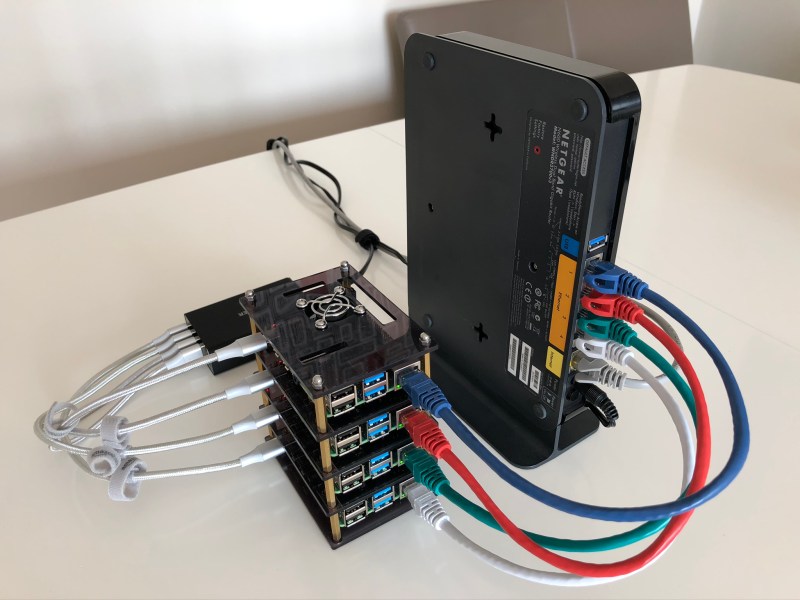
Raspberry Pi clusters are a common enough project, but a lot of the builds we see focus on the hardware side of the cluster. Once it’s up and running, though, what comes next? Raspberry Pis aren’t very powerful devices, but they can still be a great project for learning how to interact with a cluster of computers or for experimental test setups. In this project from [Dino], four Pis are networked together and then loaded with a basic set of software for cluster computing.

The first thing to set up, after the hardware and OS, is the network configuration. Each Pi needs a static IP in order to communicate properly. In this case, [Dino] makes extensive use of SSH. From there, he gets to work installing Prometheus and Grafana to use as monitoring software which can track system resources and operating temperature. After that, the final step is to install Ansible which is monitoring software specifically meant for clusters, which allows all of the computers to be administered more as a unit than as four separate devices.

This was only part 1 of [Dino]’s dive into cluster computing, and we hope there’s more to come. There’s a lot to do with a computer cluster, and once you learn the ropes with a Raspberry Pi setup like this it will be a lot easier to move on to a more powerful (and expensive) setup that can power through some serious work.

https://interestingengineering.com/novel-brain-computer-interface-can-restore-sense-of-touch

Novel Brain-Computer Interface Can Restore Sense of Touch

The new device could completely alter how those with spinal cord injuries interact with the world.

Novel Brain-Computer Interface Can Restore Sense of Touch

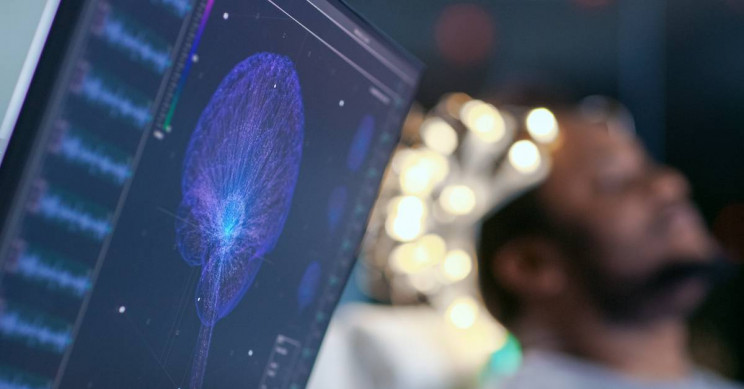
A new brain-computer interface has been developed that could completely alter how those with spinal cord injuries perceive and interact with the world around them, as reported by Inverse. The invention comes from a team of researchers from the Battelle Memorial Institute (BMI) in Columbus.

RELATED: THIS BRAIN-COMPUTER DEVICE GIVES VOICE TO THOSE WHO CANNOT SPEAK

Relaying signals to a computer

It consists of a computer chip that is implanted in the brain in order to relay neural signals to a computer. The computer chip then restores not only motion but also a sense of touch.

“There has been a lot of this work done in artificial limbs for amputees, so robotic limbs,” the study’s first author and research scientist at BMI Patrick Ganzer, told Inverse.

“[With] these robotic limbs, you want to move digits or fingers, however feeding touchback is tricky there. Other groups are using this similar brain-computer interface approach to restore movement control and touch, but they’re doing this by stimulating the brain directly. The novel part that we’re addressing is the participant is not using a robotic limb, but he’s using his own hand — which is really challenging.”

The novel system works by collecting neural signals from a brain implant that it transfers to a nearby computer. The computer then analyzes this stream of data, breaking it down into movement and sensory information.

Previous studies

This is impressive because previous studies had indicated that patients with spinal cord injuries were no longer producing these secondary sensory signals. Ganzer’s study, however, discovered that these signals were still present, but at levels so low that the patient was unable to feel them.

The solution, therefore, was to use an algorithm to boost their signal and have the computer relay the new data back to the patient through stimulation to forearm electrodes and vibrations on a haptic armband. The electrodes are used for movement while the haptic armband is used for touch sensations.

Woman Tested Positive for COVID-19 despite Not Leaving Her House for Three Weeks

Now, Ganzer says the researchers want to take this approach from the lab to the streets.

“One of our main goals right now is to get the system portable, so it may be even wheelchair mountable, and do these experiments in the home where it’s noisy and much more complicated,” Ganzer told Inverse.

“We want this technology to be used not in the laboratory eventually but at home, helping participants.”

https://www.notebookcheck.net/Raspberry-Pi-Turn-the-popular-single-board-computer-into-a-compact-weather-station.462894.0.html

Raspberry Pi: Turn the popular single-board computer into a compact weather station

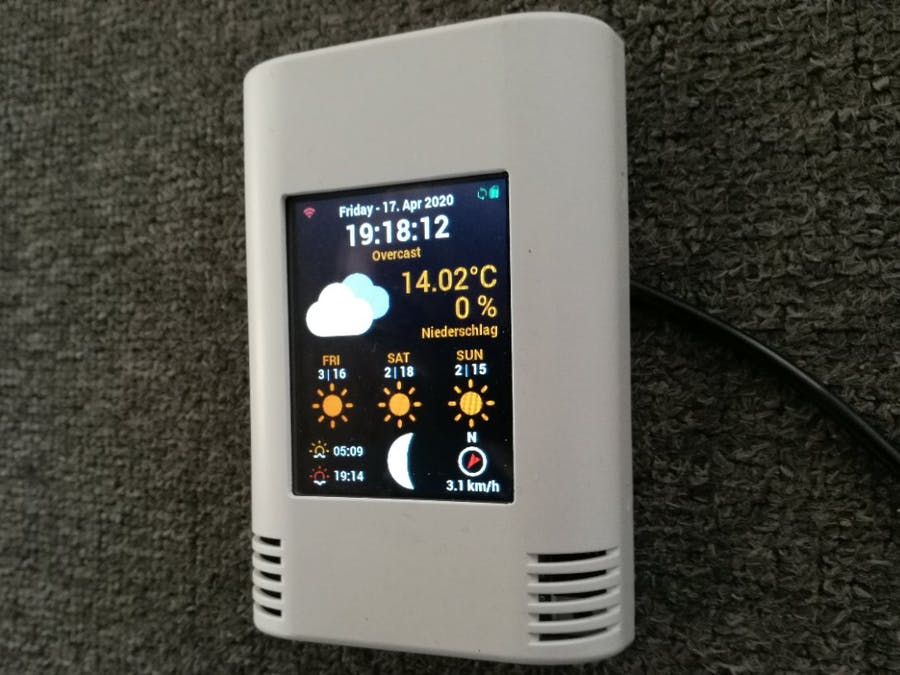
Raspberry Pi: Turn the popular single-board computer into a compact weather station. (Image source: Hartmut Wendt)
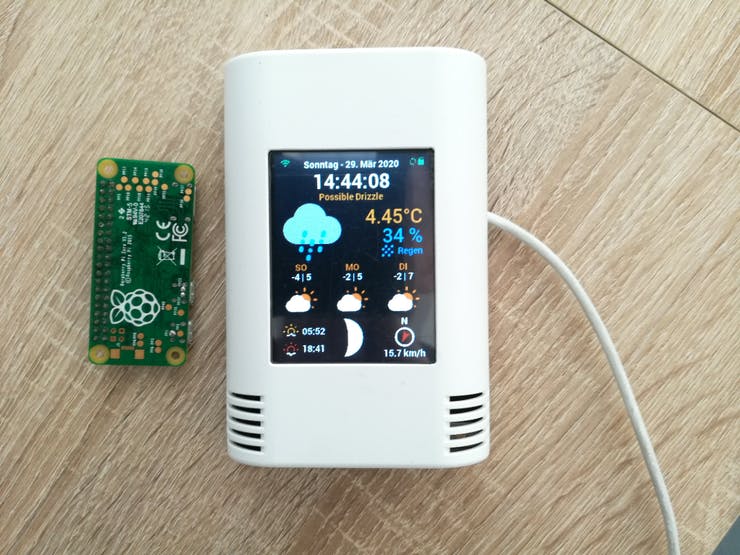
Based around a Raspberry Pi Zero W, a community project has transformed the popular single-board computer into a compact weather station. Comparatively easy and inexpensive to create, the system can be wall-mounted and features a 2.8-inch touchscreen display.

Based around a Raspberry Pi Zero W, the “Raspberry Pi Based Weather Station” is a compact unit that can display forecasts for the next few days. Additionally, the project can show the time, current date, wind speed, along with the time of sunrise and sunset on a given day.

Posted on Hackster.io, the project also calls for an AZ-Touch Pi0 kit, which features a 2.8-inch TFT panel, an ILI9341 display controller and an XPT2046 touch controller. You will also need a soldering iron, but Hartmut Wendt has published a full build guide and parts list on Hackster.io to follow.

Wendt also supplies a prepared Raspbian image and instructions for configuring your unit with Dark Sky. Please note that while the Dark Sky API will work until the end of 2021, but you can no longer sign up for a developer account. Wendt has pointed out that one could potentially use an equivalent API from other weather providers, though.

(Image source: Hackster.io)

Source(s)

https://cleantechnica.com/2020/04/24/tesla-achieved-the-accuracy-of-lidar-with-its-advanced-computer-vision-tech/

Tesla Achieved The Accuracy Of Lidar With Its Advanced Computer Vision Tech

April 24th, 2020 by 


Tesla Replicated The Visibility Of Lidar With Its Realtime Vision Processing System

Tesla’s progress with artificial intelligence and neural nets has propelled its Autopilot and Full Self Driving solutions to the front of the pack. This is largely a result of the brilliant work being led by Tesla’s Senior Director of AI, Andrej Karpathy. Karpathy presented Tesla’s methods for training its AI at the Scaled ML Conference in February. Along the way, he shared specific insights into Tesla’s methods for achieving the accuracy of traditional laser-based lidar with just a handful of cameras.

The secret sauce in Tesla’s ever-evolving solution is not the cameras themselves, but rather the advanced processing and neural nets they have built to make sense of the wide range and quality of inputs. One new technique Tesla’s AI team has built is called pseudo-lidar. It blends the lines between traditional computer vision and the powerful point map world of lidar.

Traditional Lidar

Traditional lidar-based systems rely on an array of lidar hardware to provide an unparalleled view of the world around the vehicle. These systems leverage invisible lasers or similar tech to send a massive number of pings out into the world to detect surrounding objects.

The result is a realtime visualization of what the world around a vehicle looks like based on the distance of each laser point. The computer translates the points into a 3D representation and is able to identify other vehicles, humans, roads, buildings, and the like as a means of enabling the vehicle to navigate in that world more safely.

In recent years, the push towards autonomous driving has resulted in a massive surge in the development of lidar units themselves, and the supporting software solutions that use them. Even so, the cost of lidar systems continues to be prohibitive, with single sensors costing thousands of dollars each. Cameras, on the other hand, only cost a few dollars each, thanks to their prevalence in smartphones, laptops, and the like.

Pseudo Lidar

Tesla’s camera-based approach is much cheaper and easier to implement on the hardware side, but requires an insanely complex computer system to translate raw camera inputs and vehicle telematics into intelligence. At a foundational level, the computer can identify lane markings, signs, and other vehicles from a series of sequential static images, also known as a video.

Tesla is taking computer vision to unprecedented levels, analyzing not just images, but individual pixels within the image. “We take a pseudo-lidar approach where you basically predict the depth for every single pixel and you can cast out your pixels,” Karpathy said. Doing this over time replicates much of the functionality of a traditional lidar system, but requires a massive amount of realtime processing power for the image deconstructions to be of any use.

Vehicles are driven in realtime, so it doesn’t do any good to have a system that can make determinations or predictions based on an image if it the results are not available instantaneously. Thankfully, Tesla built its own hardware for the third major version of its autonomous driving computer and it was purpose-built to run Tesla’s code.

Achieving the functionality of lidar is important, as it unlocks all of the software solutions that were built to utilize inputs from traditional lidar systems. “You basically simulate lidar input that way, but it’s purely from vision. Then you can use a lot of techniques that have been developed for lidar processing to achieve 3D object detection.” It’s like giving a GPS to someone navigating a forest with just a compass and a map. It doesn’t solve the problem, but it is another extremely valuable tool in developing the best solution.

“The Gap is Quickly Closing”

Tesla’s so-called pseudo-lidar solution is getting better. Karpathy showed off a range of lidar-esque 3D maps of the world that look a heck of a lot like the results coming from cutting-edge lidar solutions. Of course, visualizations are more for the benefit of humans, not computers, so don’t truly communicate just how impactful Tesla’s progress with computer vision is. “If you give yourself lidar and how well you can do versus if you do not have lidar, but you just use vision techniques and psuedo-lidar approaches, the gap is quickly closing,” Karpathy said.

https://insideevs.com/news/414583/ford-mustang-mach-e-production-deliveries-postponed/

We saw that coming due to COVID-19, but it seems Ford is already confirming the delay to clients.

John Lennon said: “Life is what happens to you while you’re busy making other plans.” Ironically, the COVID-19 pandemic shows “Beautiful boy” is very accurate for reasons we’d prefer never proven right. Plans have to change, and Ford’s for the Mustang Mach-E are no exception. According to messages Norwegian clients are receiving, production will move to June or July instead of May.

With that, deliveries will also have to wait a little longer. Manufacturers that work with dealership networks usually start production two to three months before cars are handled to customers. OEMs have to make sure all dealers have the vehicles when it announces clients can go there to check the novelty for themselves.

The message Norwegian clients are getting confirms that: deliveries are expected to begin in November. You have already seen the message above, taken from the MachE Forum, and the Google translation is right below:

“Update on Mustang Mach-E  

As you know, the Mustang Mach – E offers a very good range for its various configurations, and soon your own Mach-E will be within reach too! Despite the challenging situation around the coronavirus (COVID-19), we are now in full production planning and deliveries are scheduled to start in November 2020. To ensure the earliest possible delivery of your car, we recommend that you do not make changes to your pre-order, as this may result in some later production. If you still want to make changes, contact Ford’s Customer Service.  

Final type-approval data and thus also final prices have been somewhat postponed as a consequence of COVID-19. As it looks now, we expect this in place at the end of June/July, at which point you will also be asked to finally confirm your order, as well as to have the opportunity to order accessories and apply for financing. We emphasize that you can safely keep your pre-order – you can cancel this free of charge at any time until you confirm your order.” 

We have tried to contact Ford to confirm the message these Norwegian clients are getting. The company sent us the following statement:

“We’ll have more details to share on the timing of our upcoming all-new vehicles once we have safely brought our factories and facilities back online.”

If deliveries start simultaneously in Europe and the U.S., as Ford previously stated, you already know when you will be able to drive your Ford EV: by the end of the year if the monster’s gone and we can have no fear. We hope that is the case. Otherwise, plans will have to change again.

Source: Mach-E Forum

https://phys.org/news/2020-04-catalyst-door-efficient-environmentally-friendly.html

Catalyst opens door to more efficient, environmentally friendly ethylene production

Catalyst opens door to more efficient, environmentally friendly ethylene production
Reaction pathways for oxidative dehydrogenation of ethane facilitated by the molten carbonate shell modified perovskite redox catalyst. Credit: Fanxing Li, NC State University

A research team led by North Carolina State University has engineered a new catalyst that can more efficiently convert ethane into ethylene, which is used in a variety of manufacturing processes. The discovery could be used in a conversion process to drastically reduce ethylene production costs and cut related carbon dioxide emissions by up to 87%.

“Our lab previously proposed a technique for converting  into ethylene, and this new redox catalyst makes that technique more energy efficient and less expensive while reducing ,” says Yunfei Gao, a postdoctoral scholar at NC State and lead author of a paper on the work. “Ethylene is an important feedstock for the plastics industry, among other uses, so this work could have a significant economic and environmental impact.”

“Ethane is a byproduct of shale gas production, and the improved efficiency of our new catalyst makes it feasible for energy extraction operations in  to make better use of that ethane,” says Fanxing Li, corresponding author of the paper and an associate professor and University Faculty Scholar in NC State’s Department of Chemical Engineering.

“It is estimated that more than 200 million barrels of ethane are rejected each year in the lower 48 states due to the difficulty of transporting it from remote locations,” Li says. “With our catalyst and conversion technique, we think it would be cost effective to convert that ethane into ethylene. The  could then be converted into , which is much easier to transport.

“The problem with current conversion techniques is that you can’t scale them down to a size that makes sense for remote energy extraction sites—but our system would work well in those locations.”

The new redox catalyst is a molten carbonate promoted mixed metal oxide, and the  takes place at between 650 and 700 degrees Celsius with integrated ethane conversion and air separation. Current conversion techniques require temperatures higher than 800 degrees C.

“We estimate that the new redox  and technique cut energy requirements by 60-87%,” Li says.

“Our technique would require an initial investment in the installation of new, modular chemical reactors, but the jump in efficiency and ability to convert stranded ethane would be significant,” Li says.

The paper, “A Molten Carbonate Shell Modified Perovskite Redox Catalyst for Anaerobic Oxidative Dehydrogenation of Ethane,” will be published April 24 in the journal Science Advances.


Explore further

Proton solid oxide electrolytic cell facilitates non-oxidized dehydrogenation of ethane


More information: “A molten carbonate shell modified perovskite redox catalyst for anaerobic oxidative dehydrogenation of ethane” Science Advances (2020). https://advances.sciencemag.or … ontent/6/17/eaaz9339

Journal information: Science Advances