https://boingboing.net/2020/06/22/we-are-all-part-of-the-biggest.html

We are all part of the biggest psychological experiment in history

FOLLOW US

Twitter / Facebook / RSS

During the COVID-19 pandemic, 2.6 billion people were under a mandate to stay at home. According to psychologist Elke Van Hoof of Free University of Brussels-VUB, [the lockdown] “is arguably the largest psychological experiment ever conducted.” What impact will COVID-19 have on the planet’s mental health? The scientific study of psychological resilience is not a new field. But COVID-19 is fairly unique in the range of stressors it triggers, from the death of loved ones to isolation, devastating financial loss, and uncertainty about what comes next. Meanwhile, we actually aren’t all “in the same boat.” In Scientific American, Lydia Denworth surveys the real-time research on what we can learn from all this about resilience and how to increase it for the next time. From Scientific American:

Individual resilience is further complicated by the fact that this pandemic has not affected each person in the same way. For all that is shared–the coronavirus has struck every level of society and left few lives unchanged–there has been tremendous variation in the disruption and devastation experienced. Consider Brooklyn, just one borough in hard-hit New York City. Residents who started the year living or working within a few miles of one another have very different stories of illness, loss and navigating the challenges of social distancing. How quickly and how well individuals, businesses and organizations recover will depend on the jobs, insurance and health they had when this started, on whether they have endured hassle or heartbreak, and on whether they can tap financial resources and social support.

The pandemic has laid bare the inequities in the American health care system and economic safety net. Black and Latino Americans are dying at much higher rates than white Americans. “When we talk about preexisting conditions, it isn’t just if I’m obese, it’s our society’s preexisting condition,” says medical anthropologist Carol Worthman of Emory University, an expert in global mental health. The scientific study of psychological resilience is not a new field. But COVID-19 is fairly unique in that it’s triggering a wide range of stressors, from the death of loved ones, isolation, and massive financial loss to uncertainty about what happens next.

Fortunately, the unprecedented pandemic is leading to unprecedented science not just in virology but on mental health and resilience. Behavioral scientists are measuring the psychological toll in real time and striving to identify what helps people cope. Unlike, say, the September 11 terrorist attacks or Hurricane Katrina, which occurred over a finite period even though their effects were drawn out, the open-ended time frame for ­COVID-19 allows for new kinds of longitudinal studies and research directions. The sudden mass switch to virtual forms of working and socializing is expected to jump-start more nuanced investigations into what makes social interaction satisfying–or stultifying. If researchers meet the challenge of ­COVID-19, says psychiatrist Dennis Charney of the Icahn School of Medicine at Mount Sinai, “there will be a whole new science of resilience. We could learn how to help people become more resilient before these things happen.”
https://www.techexplorist.com/mystery-earths-vanishing-crust-solved/33391/

The mystery of Earth’s vanishing crust solved

A picture that contradicts prevailing theories.BYAMIT MALEWARJUNE 28, 2020SCIENCE

Scientists examined hundreds of samples taken along the global ridges that contain recycled ancient oceanic crust in variable amounts. “Depleted
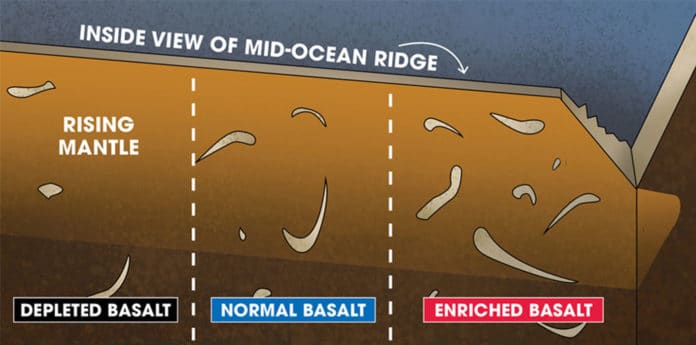
Scientists examined hundreds of samples taken along the global ridges that contain recycled ancient oceanic crust in variable amounts. “Depleted” segments of the ridge received lower than “normal” amounts of recycled crust, while “enriched” segments contain a larger proportion of recycled crust. Credit: Caroline McNiel/National MagLab

The Earth’s crust is what we live on and is by far the thinnest layers of Earth. The thickness varies depending on where you are on Earth, with the oceanic crust being 5-10 km and continental mountain ranges being up to 30-45 km thick. 

But what happens below this crust remains obscure, including the fate of sections of crust that vanish back into the Earth.

Now, a team of geochemists based at the Florida State University-headquartered National High Magnetic Field Laboratory has found some significant clues about where those rocks have been hiding.

A new study has come out with fresh evidence that while most of the Earth’s crust is relatively new, a small percentage is made up of ancient chunks that had sunk long ago back into the mantle then later resurfaced. They also found that based on the amount of that “recycled” crust, that the planet had been churning out crust consistently since its formation 4.5 billion years ago—a picture that contradicts prevailing theories.

Co-author Munir Humayun, a MagLab geochemist and professor at Florida State’s Department of Earth, Ocean, and Atmospheric Science (EOAS) said, “Like salmon returning to their spawning grounds, some oceanic crust returns to its breeding ground, the volcanic ridges where the fresh crust is born. We used a new technique to show that this process is essentially a closed-loop and that recycled crust is distributed unevenly along ridges.”

Recycled ancient crust returns to the oceanic ridges
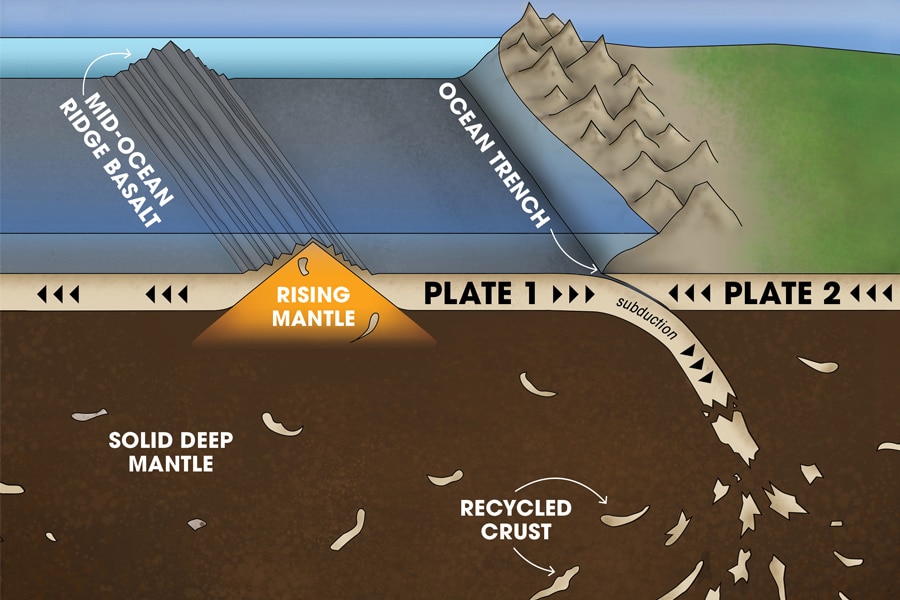
Recycled ancient crust returns to the oceanic ridges. Credit: Caroline McNiel/National MagLab

Scientists have long estimated about what happens to subducted crust after being reabsorbed into the hot, high-pressure environment of the planet’s mantle. It may sink further into the mantle and settle there, or ascend back to the surface in tufts, or to the surface in plumes, or swirl through the mantle.

Scientists had already seen clues supporting the theory. Some basalts collected from mid-ocean ridges, called enriched basalts, have a higher percentage of certain elements that tend to seep from the mantle into the melt from which basalt is formed; others, called depleted basalts, had much lower levels.

To highlight the mystery of the disappearing crust, scientists observed 500 samples of basalt collected from 30 regions of ocean ridges. Some were enriched, some were depleted, and some were in between.

Scientists discovered that the overall extents of germanium and silicon were lower in melts of the recycled crust than in the “virgin” basalt rising out of melted mantle rock. So they built up another strategy that pre-owned that proportion to distinguish a particular chemical fingerprint for the subducted crust.

They thus devised an accurate technique to measure the ratio using a mass spectrometer at the MagLab. Then they crunched the numbers to see how these ratios differed among the 30 regions sampled, expecting to see variations that would shed light on their origins.

Scientists first discovered nothing. This concerned scientists, and they started looking at the problem from a wider view. Instead of comparing the basalts of different regions, they compared enriched and depleted basalts.

After quickly re-crunching the data, scientists were thrilled to see apparent differences among those groups of basalts.

The team had detected lower germanium-to-silicon ratios in enriched basalts—the chemical fingerprint for the recycled crust—across all the regions they sampled, pointing to its marble cake-like spread throughout the mantle. Essentially, they solved the mystery of the vanishing crust.

Humayun said, “Sometimes you’re looking too closely, with your nose in the data, and you can’t see the patterns. Then you step back, and you go, ‘Whoa!’”

Digging deeper into the patterns they found, the scientists unearthed more secrets. Based on the amounts of enriched basalts detected on global mid-ocean ridges, the team was able to calculate that about 5 to 6 percent of the Earth’s mantle is made of recycled crust. This figure sheds new light on the planet’s history as a crust factory. Scientists had known the Earth cranks out crust at the rate of a few inches a year. But has it done so consistently throughout its entire history?

Their analysis, Humayun said, indicates that “The rates of crust formation can’t have been radically different from what they are today, which is not what anybody expected.”

Journal Reference:
  1. Elemental constraints on the amount of recycled crust in the generation of mid-oceanic ridge basalts (MORBs)” Science Advances (2020). DOI: /10.1126/sciadv.aba2923

https://9to5mac.com/2020/06/28/best-apple-watch-sleep-tracking-apps/

Don’t want to wait for watchOS 7? Here’s how to start sleep tracking with Apple Watch today

Chance Miller

– Jun. 28th 2020 6:10 am PT

@ChanceHMiller

24 Comments

Sleep tracking with Apple Watch is a great way to gain new insight into your sleeping habits and trends over time. In fact, with the release of watchOS 7 this fall, Apple will officially offer native sleep tracking support for the first time. But if you don’t want to wait until the fall to start sleep tracking with your Apple Watch, a handful of incredibly powerful third-party apps have come to the App Store. Read on as we round up the best sleep tracking apps for Apple Watch

Native Apple Watch Sleep Tracking

With the release of watchOS 7 this fall, Apple Watch will officially support sleep tracking without needing a third-party application. watchOS 7 will be available to public beta users next month. This marks the first time that Apple has ever offered a public beta of watchOS 7. A public stable release will happen this fall, Apple says.

We went hands-on with the experience earlier this week, explaining that Apple is tying Apple Watch sleep-tracking capabilities in with new iPhone features such as Wind Down and Wake Up for a seamless cross-device experience.

There’s a new Sleep app on the Apple Watch, as well as a Sleep Mode that hides your usual watch face and instead shows the current time, as well as what time your alarm is set for. It also disables features like raise-to-wake, so your watch face isn’t lighting up in the middle of the night.

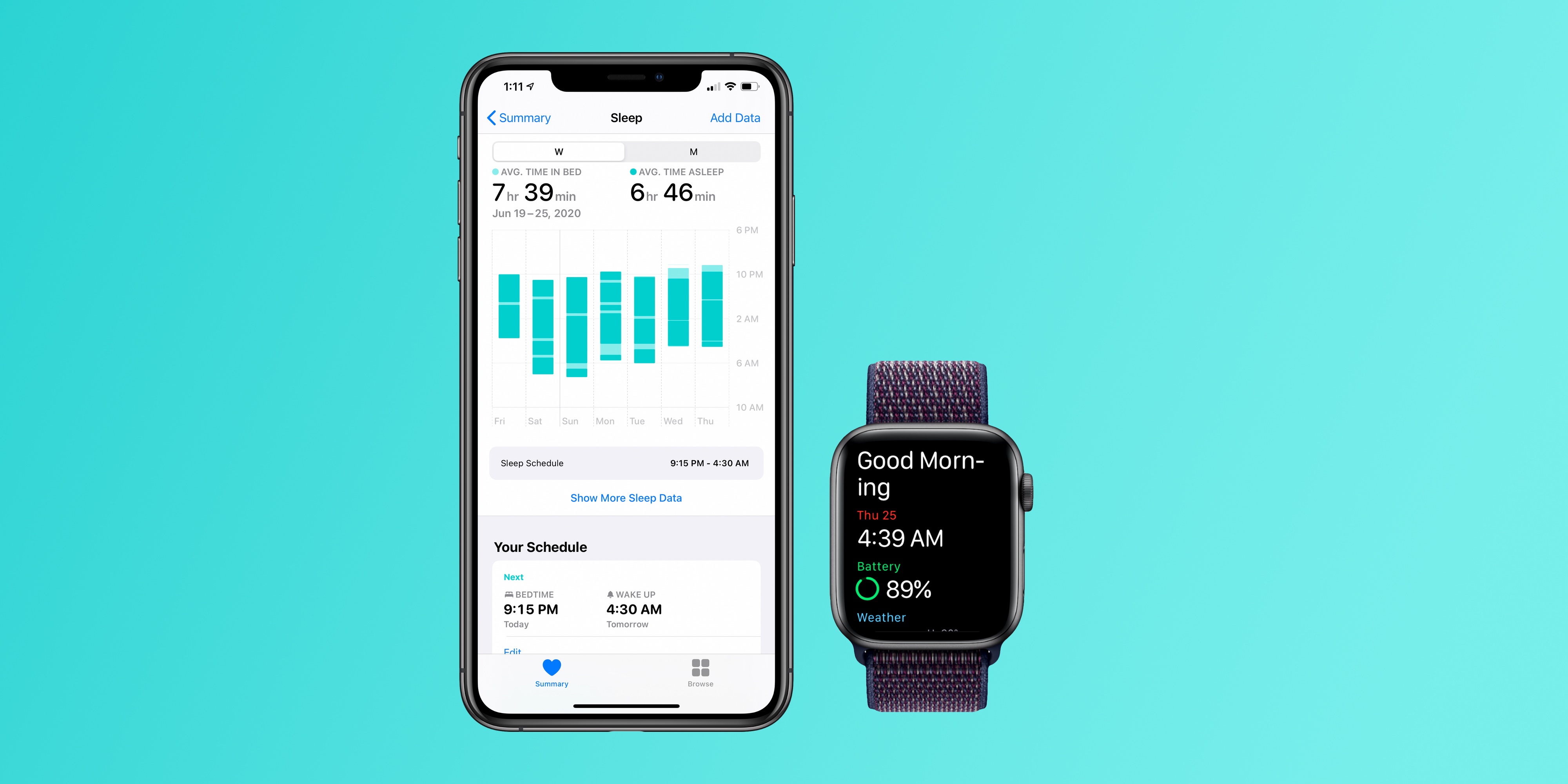
To view the sleep data tracked by your Apple Watch, you can go to the Sleep app on Apple Watch or the Health app on iPhone. The actual data here is limited. Apple simply shows you your time asleep, as well as a range for your heart rate. That’s where third-party applications still prove useful. They can offer much more data than Apple’s native implementation, and you don’t have to wait until the fall to get started.

What about battery life?

Before you start tracking your sleep with Apple Watch, you’ll need to make a plan for when you’ll charge your watch. There are two primary options here: before bed or after you wake up in the morning. One key change for me has been placing an extra Apple Watch charger at my desk rather than on my nightstand.

For me, it’s much easier to charge before bed every night. I wake up and head straight to the gym most mornings, so I have to make sure my Apple Watch has enough battery for workout tracking. If I put my Apple Watch on the charger at around 8 p.m., after I’ve already reached my stand goal for that day, it usually has a full charge by the time I head to bed at 9:30 p.m. And when I wake up in the morning, I almost always have more than 90% battery left — more than enough to make it through the day.

This works perfectly for me, but your routine is probably different than mine. The key is to come up with a plan that you can replicate every day. Whether that’s charging in the morning or at night, or a combination of both, it’s a lot easier than you might think to change your Apple Watch charging habits.

Of course, there is also always the option of repurposing an old Apple Watch as your dedicated “sleep watch.” 9to5Mac’s Zac Hall previously explained how to do that. You could also pick up a used or refurbished older Apple Watch model to do this.https://googleads.g.doubleclick.net/pagead/ads?client=ca-pub-4344806526196296&output=html&h=280&adk=3246872700&adf=3859030553&w=750&fwrn=4&fwrnh=100&lmt=1593370545&num_ads=1&rafmt=1&armr=3&sem=mc&pwprc=1586602734&psa=1&guci=2.2.0.4.2.2.0.0&ad_type=text_image&format=750×280&url=https%3A%2F%2F9to5mac.com%2F2020%2F06%2F28%2Fbest-apple-watch-sleep-tracking-apps%2F&flash=0&fwr=0&pra=3&rh=188&rw=750&rpe=1&resp_fmts=3&wgl=1&fa=27&adsid=NT&dt=1593370544928&bpp=33&bdt=6388&idt=-M&shv=r20200624&cbv=r20190131&ptt=9&saldr=aa&abxe=1&cookie=ID%3D962489e65fdb4bac%3AT%3D1590697436%3AS%3DALNI_MZrMmZbkvV6mzN_y6V7Ci2roAyfLA&prev_fmts=0x0%2C336x280&nras=2&correlator=6586797227631&frm=20&pv=1&ga_vid=1547582911.1590697436&ga_sid=1593370544&ga_hid=1482719034&ga_fc=0&iag=0&icsg=564035374944192&dssz=61&mdo=0&mso=0&u_tz=-420&u_his=1&u_java=0&u_h=1050&u_w=1680&u_ah=1027&u_aw=1680&u_cd=24&u_nplug=3&u_nmime=4&adx=393&ady=3330&biw=1535&bih=899&scr_x=0&scr_y=0&eid=21065532%2C21066428%2C42530500%2C42530502&oid=3&pvsid=2258708404511276&pem=478&ref=https%3A%2F%2Fnews.google.com%2F&rx=0&eae=0&fc=1408&brdim=1%2C24%2C1%2C24%2C1680%2C23%2C1550%2C979%2C1550%2C899&vis=1&rsz=%7C%7Cs%7C&abl=NS&cms=2&fu=8336&bc=31&ifi=5&uci=a!5&btvi=2&fsb=1&xpc=RbpNsLoTOU&p=https%3A//9to5mac.com&dtd=180

Once you’ve established a charging routine for your Apple Watch, it’s time to pick a sleep tracking app. There are a few different options.

AutoSleep

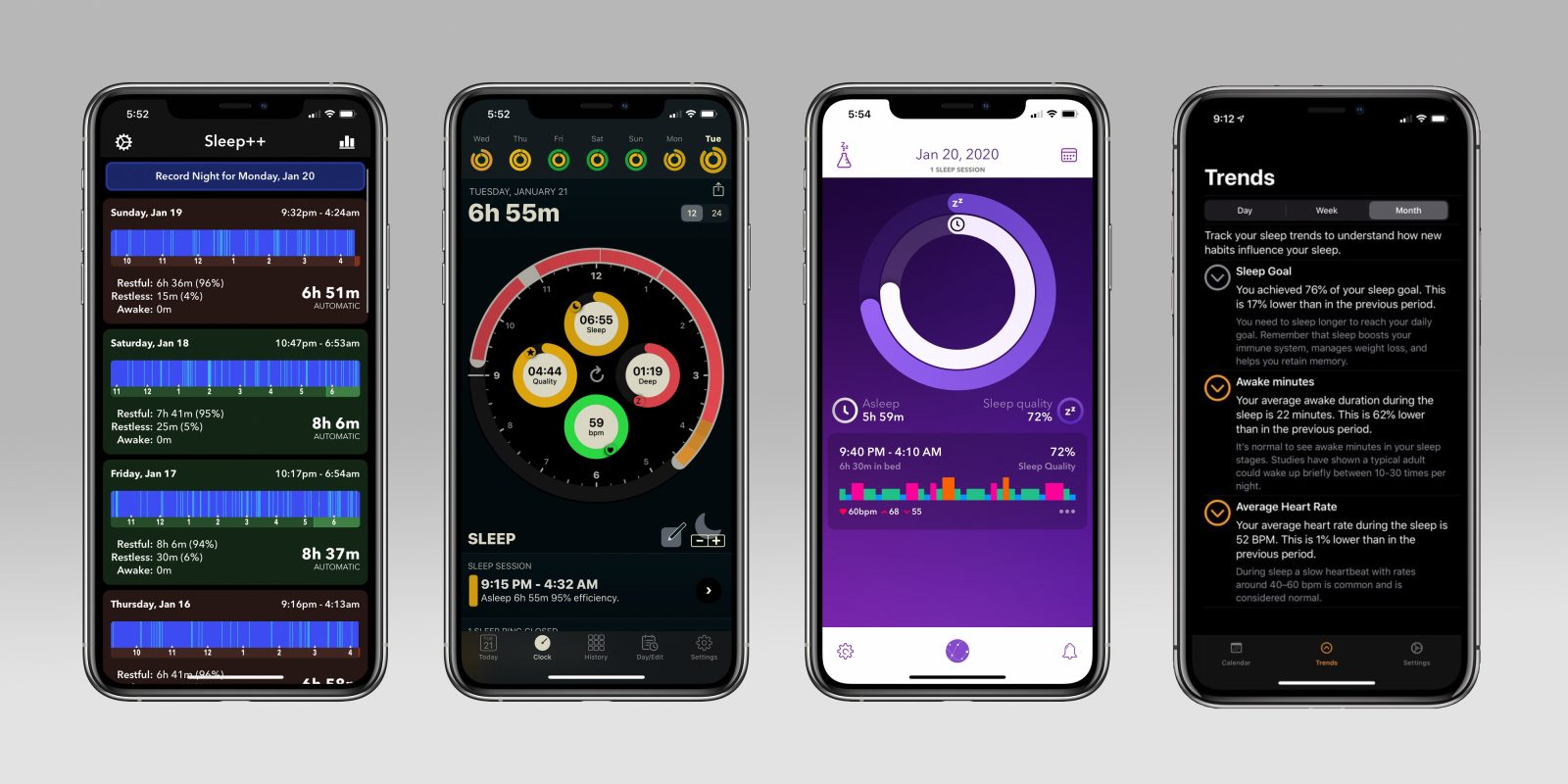
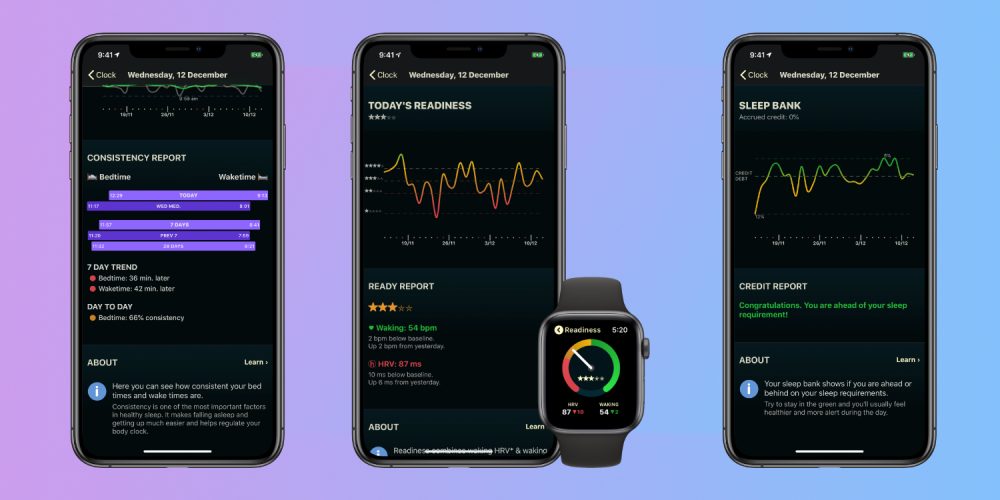
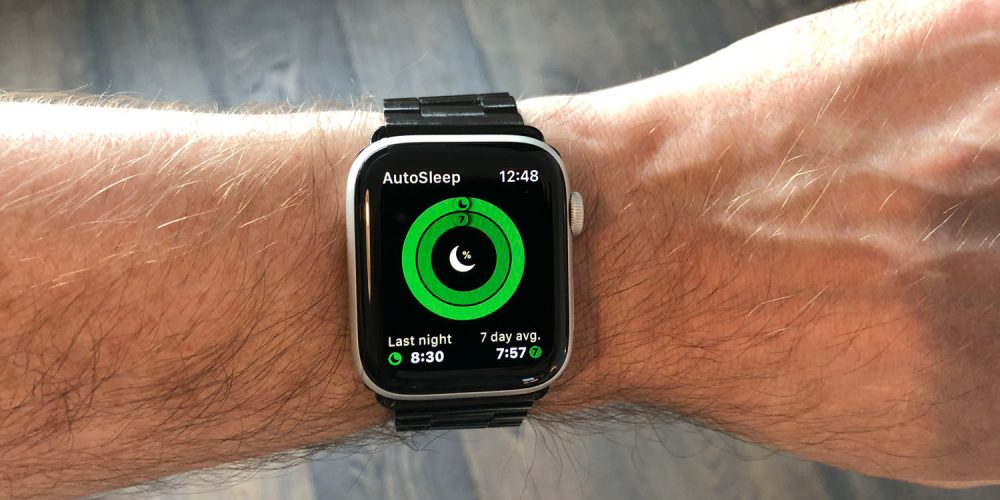
AutoSleep is probably the most popular Apple Watch sleep tracking app on the App Store, and for good reason. It provides some of the most in-depth data, including a detailed look at sleep, sleep quality, heart rate, deep sleep, and much more.

AutoSleep uses a system of rings to help you monitor those key statistics. The main interface shows you rings for sleep, sleep quality, deep sleep, and bpm. All of this data comes at a cost, however, and AutoSleep’s interface can feel a bit overwhelming once you dive into all of the available data.

To combat that, AutoSleep also offers an excellent Apple Watch application that makes it easy to get a quick look at the current day’s sleep data. There is also a “readiness” score that attempts to predict how ready you are for the day based on your sleep for that night.

More on AutoSleep:

AutoSleep is available on the App Store for $2.99 as a one-time purchase.

Sleep++

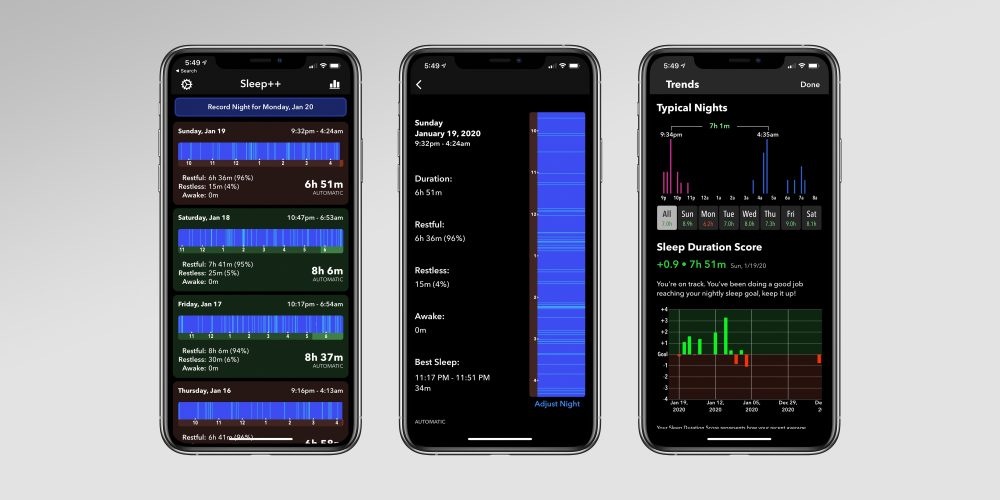
Sleep++ is another popular sleep tracking app for Apple Watch with support for automatic sleep detection, bedtime reminders, sleep goals, and more. In the Sleep++ app, the main interface provides a detailed look at your sleep habits over the past few days.

Like its competitors, Sleep++ also offers quite a bit of data on sleep trends, cycles, phases, and more. You can also see a detailed timeline of your sleep, including when you were restful, restless, and awake, with a particularly neat look at when your “best sleep” occurred.”https://googleads.g.doubleclick.net/pagead/ads?client=ca-pub-4344806526196296&output=html&h=280&adk=3246872700&adf=2465277383&w=750&fwrn=4&fwrnh=100&lmt=1593370545&num_ads=1&rafmt=1&armr=3&sem=mc&pwprc=1586602734&psa=1&guci=2.2.0.4.2.2.0.0&ad_type=text_image&format=750×280&url=https%3A%2F%2F9to5mac.com%2F2020%2F06%2F28%2Fbest-apple-watch-sleep-tracking-apps%2F&flash=0&fwr=0&pra=3&rh=188&rw=750&rpe=1&resp_fmts=3&wgl=1&fa=27&adsid=NT&dt=1593370544928&bpp=16&bdt=6387&idt=-M&shv=r20200624&cbv=r20190131&ptt=9&saldr=aa&abxe=1&cookie=ID%3D962489e65fdb4bac%3AT%3D1590697436%3AS%3DALNI_MZrMmZbkvV6mzN_y6V7Ci2roAyfLA&prev_fmts=0x0%2C336x280%2C750x280&nras=3&correlator=6586797227631&frm=20&pv=1&ga_vid=1547582911.1590697436&ga_sid=1593370544&ga_hid=1482719034&ga_fc=0&iag=0&icsg=564035374944192&dssz=62&mdo=0&mso=0&u_tz=-420&u_his=1&u_java=0&u_h=1050&u_w=1680&u_ah=1027&u_aw=1680&u_cd=24&u_nplug=3&u_nmime=4&adx=393&ady=5510&biw=1535&bih=899&scr_x=0&scr_y=0&eid=21065532%2C21066428%2C42530500%2C42530502&oid=3&pvsid=2258708404511276&pem=478&ref=https%3A%2F%2Fnews.google.com%2F&rx=0&eae=0&fc=1408&brdim=1%2C24%2C1%2C24%2C1680%2C23%2C1550%2C979%2C1550%2C899&vis=1&rsz=%7C%7Cs%7C&abl=NS&fu=8336&bc=31&ifi=6&uci=a!6&btvi=3&fsb=1&xpc=hJ4kywSeJz&p=https%3A//9to5mac.com&dtd=213

One of the best things about Sleep++ is that it’s completely free, with an optional in-app purchase to remove advertisements. If you’re looking for a data-rich automatic Apple Watch sleep tracker, you download Sleep++ on the App Store.

Pillow

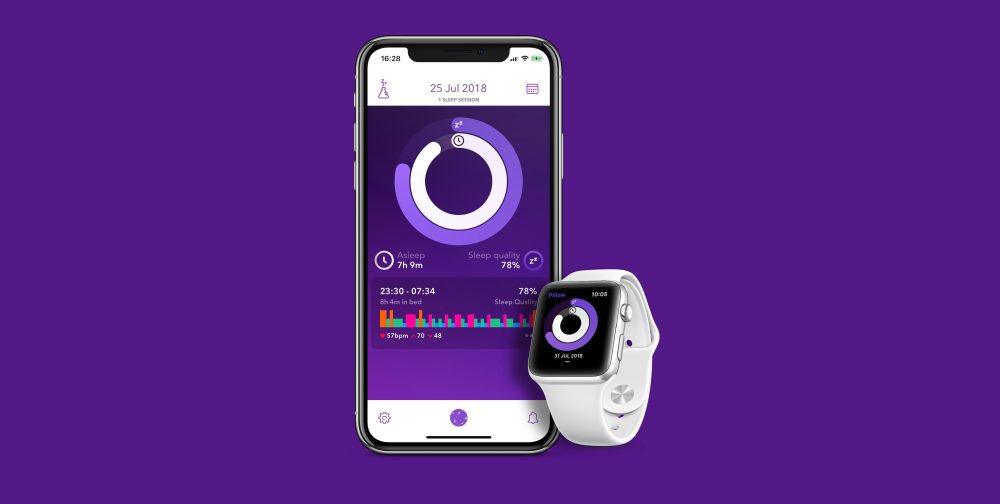
When I wrote about sleeping apps for the Apple Watch almost three years ago, Pillow was an option that I wasn’t familiar with at the time, but multiple 9to5Mac readers suggested I give it a try. With features like automatic sleep detection and heart-rate analysis, Pillow fits right in among the rest of the market.

One of the key features of Pillow is its support for recording important audio events throughout the night. This means the app can track data including snoring, sleep apnea, and sleep talking, but the biggest caveat here is that noise detection only works in manual mode.

There’s also support for viewing detailed sleep trends over time, personalized recommendations, and more. You can try Pillow on the App Store for free with in-app purchases.

NapBot

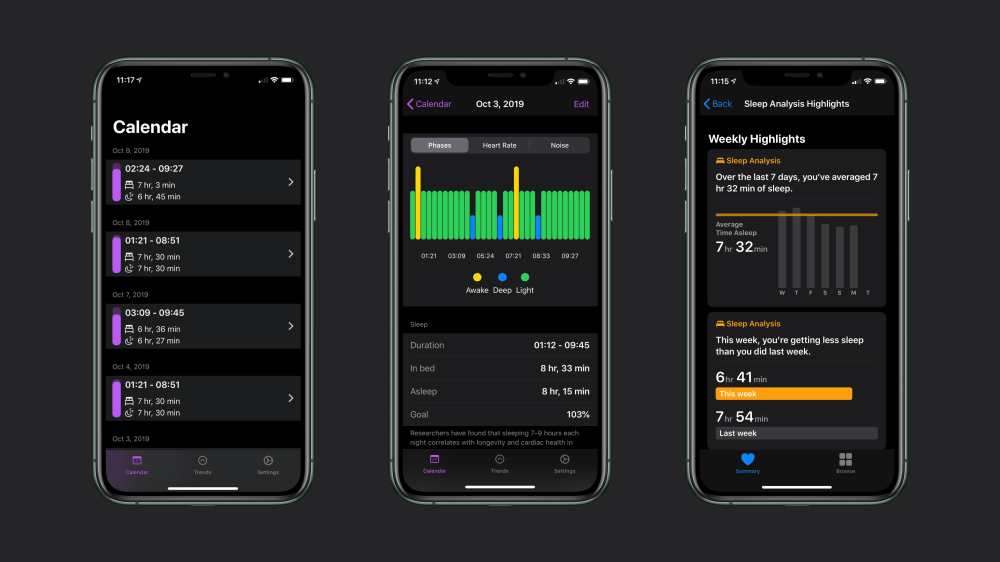
NapBot is a newcomer to the Apple Watch sleep tracking fun, and it’s quickly becoming one of the most powerful options. NapBot uses machine learning to perform automatic sleep tracking, allowing you to see details on phases, trends, and more.

NapBot offers an impressive amount of data in an impressively easy-to-navigate interface. The “Calendar” tab in the app allows you to get a detailed look at your sleep on a daily basis, and you can pick a specific day to see more detailed information on heart rate and phases.

NapBot also just launched its first Apple Watch app that’s completely independent of the iPhone. It currently only allows you to see the previous day’s sleep, but hopefully it will add more capabilities and historical data over time.

NapBot is the newest Apple Watch sleep tracking app, but it’s also quickly becoming my go-to. You can download it on the App Store for free with in-app purchases.

Others

If none of those options pique your interest, Sleep Watch is another choice that’s available on the App Store. Apple acquired Beddit in 2017, but it’s primarily a hardware sleep tracker that you put underneath your sheets. Sleep Cycle was available for the Apple Watch up until recently, but support was dropped back in October.

What do I use?

Despite all of the new entrants into the sleep tracking Apple Watch industry, I still find AutoSleep to be the most powerful option, but that’s not to say it’s perfect. AutoSleep offers you a lot of data, and sometimes it’s overwhelming trying to figure out the logic behind some that data.

NapBot is becoming a close second for me. While it’s a newcomer to the scene, it’s getting better quickly with consistent updates. For instance, it recently added a standalone Apple Watch app, new trends and Apple Watch complications, and more.

The key, regardless of which application you pick, is to make sure there is some sort of automatic sleep detection feature. This reduces friction and means you don’t have to remember to manually start a sleep tracking session every night before bed. Instead, your Apple Watch can track your sleep in the background, without any interaction from you.

These apps also integrate with Apple’s Health app, which means you can get an overview of your sleep data alongside everything else in the Health app. The Health app is useful for tracking long-term trends and averages, but if you want detailed data, you’ll have to jump to your third-party app of choice.

Now that Apple’s first-party sleep tracking solution for Apple Watch has been officially announced, there’s more interest than ever in sleep tracking applications. These third-party apps offer powerful and rich data, Health app integration, and more. Plus, you can get started today, without waiting for watchOS 7 to be released in the fall.

Do you track your sleep with Apple Watch? Which app do you prefer?

https://www.hindustantimes.com/it-s-viral/this-person-s-hand-washing-routine-produces-an-unexpected-result-watch/story-GSXZcI7pQOGm3qqqWGz3zH.html

This person’s hand washing routine produces an unexpected result. Watch

There is a reason this post was shared on the ‘unexpected’ subreddit. A reason one can only realise post watching the clip itself.

IT-S-VIRAL Updated: Jun 28, 2020 15:16 IST

Sanya Budhiraja

Sanya Budhiraja
Hindustan Times, New Delhi

The image shows the camera person washing one of their hands.
The image shows the camera person washing one of their hands.(Reddit/Rad-Panda-)

It is no lie that washing one’s hands thoroughly has multiple health benefits. Appropriate use of water and soap helps ensure that you as well as those around you experience good health. However, this particular Reddit user is using the hygienic procedure of washing hands for entertainment purposes. Their video may leave you a little surprised.

Posted on Reddit on June 27, the clip is almost 10 seconds long. The video’s caption reads, “That’s new”.

The recording shows the camera person washing one of their hands. Already soaped up, the individual’s palm is in the shape of a fist. They rub the ends of their fingers onto the inside of their hands in a rhythmic motion. This action goes on for a few seconds, after which the person opens their palm.

What happens next is genuinely unexpected. Watch the video to check it out.

Since being shared to the subreddit ‘unexpected’, the post has accumulated almost 58,000 upvotes and nearly 800 comments.

Here is how Redditors reacted to the unique bubble creation method. One person said, “He’s a bubble bender”. While another individual wrote, “If everyone on the planet were given random superpowers, this is the kind I would end up with”. Though we are unsure about the exact use of such a superpower, at least it’d be entertaining to possess.

“Is it possible to learn this power?” inquired a Reddit user. To this, another responded by saying, “Not from a Jedi”.

The jury is still out on how the original poster did this amazing trick with them commenting, “Expected that tiny bubbles would appear, but the huge bubble made me go crazy, like what happened?”.

What are your thoughts on this clip? Is it something you’ll be trying out the next time you wash your hands?

https://venturebeat.com/2020/06/26/probeat-google-meet-is-the-new-google/

ProBeat: Google Meet is the new Google+

EMIL PROTALINSKI@EPRO JUNE 26, 2020 10:30 AM

Google Meet logo

Ever since rebranding Google Hangouts Meet in early April, Google has been on a Google Meet blitz. The onslaught began less than three months ago, and yet it feels like it’s been years. Maybe that’s because Google has made so many announcements that it’s hard to keep track, or maybe it’s because time in the age of coronavirus is strange. I cannot tell. In any case, the timing is no coincidence: Google Meet is clearly a direct response to Zoom, which during the pandemic … oh, what’s the sense of repeating it, you already know.

Google has been adding features and sticking Meet everywhere it can, almost as if the company’s very existence depended on it. This isn’t a new play. The Google Meet push is remarkably similar to the Google+ strategy. More than a decade ago, Google decided that Facebook was an existential threat. Google tried various social experiments for years and eventually decided that Google+ was its darling. The timing may be different this go around — again, you know why — but the scheme is the same. Google decided that Zoom is an existential threat. Google has bet on various communication apps over the years, and Google Meet is its current darling.Recommended VideosPowered by AnyClipHate Paywalls? Google May Start Paying Some of Them for YouPauseUnmuteDuration 1:04Toggle Close Captions/Current Time 0:21Loaded: 82.98% FullscreenUp Nexthttps://imasdk.googleapis.com/js/core/bridge3.392.0_en.html#goog_195159797Google announces new privacy setting controlsFacebook pledges $200M to support black-owned businessesNOW PLAYINGHate Paywalls? Google May Start Paying Some of Them for YouGoogle to replace Google Home with new Nest smart speaker?Google Employees Demand End To Police ContractsGoogle Ad Revenue Expected to Fall Due to PandemicGoogle Bans Zerohedge for Racist Comment SectionGoogle’s Chrome target of massive spying attackGoogle’s diversity vow for 2025Google Vows to Add More Diverse Leadership by 2025Verizon joins growing Facebook ad boycottGoogle Browser Extensions Hosted Massive Spyware Campaign, Researchers FindGoogle Continues Tightening Belt ‘Difficult’ Few MonthsEU Wants Facebook, Twitter And Google To Give Monthly Fake News ReportsGoogle Removes The Federalist and Zero Hedge From Its Ad Platform

Feature overload

Google has done a lot with Meet in just three months. The company reorganized the team in chargeintegrated Meet directly into Gmail, and launched Meet free for anyone with a Google Account. Any of these on its own would be massive, but taken together, all at once, they show Google really isn’t kidding around.

As for all of Meet’s new features, I won’t list everything added and announced in the past three months (but I will call out noise cancellation). So here’s a reminder of just the past two weeks. You can now launch Google Meet from Gmail on Android and iOSmake group Google Meet calls on Google Assistant smart displays (like Next Hub Max), and use the dedicated meet.new domain to start a new call.VB Transform 2020 Online – July 15-17. Join leading AI executives: Register for the free livestream.

In terms of newly announced features just yesterday, Google Meet is getting:

  • Layout improvements: See up to 49 participants at once, like Microsoft Teams and Zoom.
  • Hand raising: Let participants “raise their hands” when they have a question or something to say.
  • Meeting attendance: Give meeting hosts a simple way to see who attended their meeting.
  • Breakout rooms: Make it easy for large meetings to split into smaller groups, have parallel discussions, and reconvene once finished.
  • Q&A: Provide a channel for the audience to ask questions without disrupting the flow of the conversation.
  • Polling: Engage participants in large meetings with real-time polling.
  • Additional moderator controls: Give meeting hosts additional controls for muting, presenting, joining, and more.

The above reads like a Zoom feature list. (Google isn’t the only one moving on Zoom — Microsoft is doing the exact same thing with Teams.)

More timely and more useful, for now

Maybe adding features like no tomorrow is fine. After all, Google Meet feels more valuable than Google+, at least during these WFH times. Google of course is betting Meet will still be useful long after we’re no longer required to be sheltering in place.

Many remember Google+ as one of Google’s biggest failures, if not its biggest. And many hated Google+. But Google+ had its fair share of hardcore fans and advocates. Just ask Mike Elgan, who wrote a Google+ eulogy. (Google+ still technically exists by the way. It’s being replaced by Google Currents, which is a Google+ just for enterprise customers, on July 6.)

Keep in mind that the Google+ hate largely grew from Google trying so desperately to push Google+ onto users who wanted nothing to do with it. Most notably, Google thrust Google+ onto YouTube’s billion-plus users. Now it’s thrusting Meet onto Gmail’s billion-plus users.

Maybe putting Google Meet inside Gmail makes more sense than Google+ inside YouTube. But if Google learned anything from Google+, it should be careful about where else it integrates Meet.

Google is clearly moving quickly and boldly to prevent Zoom becoming the Facebook of videoconferencing. As it does so, the company needs to make sure its own users don’t start loving to Zoom and hating to Meet.

https://www.discovermagazine.com/mind/are-there-purposeless-behaviours

poseless Behaviours?

Are habits goal-free behaviours, or does every habit actually serve a purpose?

Neuroskeptic iconNeuroskepticBy NeuroskepticJune 27, 2020 4:00 PM

Brain with Question Marks Header - Neuroskeptic

(Credit: Neuroskeptic)

Everyone has habits. But what exactly are they?

According to many psychologists, habits are behaviours that are purely stimulus-driven. What this means is that habitual behaviours do not serve a goal or purpose – instead, they simply activate in response to a particular situation. These behaviours may have served a purpose in the past, but after being ‘overlearned’ (repeated many times), they no longer do so.

A common example of a ‘purposeless’ habit might be the following not-uncommon situation: every morning, someone gets in their car and drives to work. One morning, they want to go shopping on the other side of town instead. However, after driving for a while, they suddenly realize that they’ve driven straight to their workplace.about:blankabout:blank

In this scenario, the person’s goal was to go to the shops, but their habitual driving-to-work behaviour activated, even though work was not their goal. This kind of lapse into a habitual behaviour suggests that many of our actions might be ‘automatic’ and purposeless.

Traffic

(Credit: Sevenke/Shutterstock)

However, a new paper in Perspectives on Psychological Science argues that Habitual Behavior Is Goal-Driven.

According to authors Arie W. Kruglanski and Ewa Szumowska, “there is no need to postulate purposeless behavior” when it comes to habits. Contrary to popular belief, habits are goal-driven behaviours just like any other.

Much of the paper is devoted to arguing that even highly overlearned behaviours are still sensitive to reward outcomes. In other words, overlearning does not, in fact, change behaviour from being goal-driven to being goal-free, even in animals. I found these arguments convincing.

Kruglanski and Szumowska admit, however, that habits can sometimes seem to go directly against our goals – such as the driving example, in which a habitual navigation behaviour actually takes us further away from where we want to go.about:blankabout:blank

The authors’ answer to these ‘intrusion errors’ is rather ingenious, but I’m not sure I fully buy it. According to Kruglanski and Szumowska, intrusion error behaviours are still goal-driven, and they arise when there are multiple conflicting goals:

It is also possible to see such instances as a goal conflict or a situation in which there are two competing goals: the situationally activated going-home goal and the intended shopping goal. Indeed, the former goal may be more automatic and thus override the other goal, unless sufficient cognitive control was used to inhibit it.

In other words, driving to work when we want to go to the shops is not a goal-free habit. Rather, drive-to-work is a goal, which is activated when we get into the car in the morning, and this goal can make us drive to work, even if we also have a conflicting goal, like going to the shops.

This is an elegant interpretation, but I wonder if it’s enough to rule out ‘purposeless behaviour’.

Kruglanski and Szumowska are saying that instead of stimulus-driven behaviours, there are stimulus-driven (situationally activated) goals. Yet in both cases, we end up with a behaviour which is not serving our ‘main’ goal at a given moment. So, we still have behaviour which could be called ‘purposeless’ in relation to the purpose that we are consciously trying to achieve.

Kruglanski and Szumowska go on to draw an interesting parallel between the driving-to-work intrusion and the Stroop effect in which we find it impossible not to read text even if reading it interferes with the task we’re trying to do:about:blankabout:blank

Stroop Effect

Example of color-word Stroop stimuli. The task is to say outloud the color in which each word appears on the screen. This is difficult because we tend to read the words, and the colors mentioned in the text don’t match the colors on the screen.

The Stroop effect is usually interpreted as evidence that reading text is an non-goal-driven, habitual process. According to Kruglanski and Szumowska, however, we could see the Stroop effect as a consequence of a “well-entrenched goal to read the word”.

My problem with this is it’s not clear to me how we could distinguish between Stroop-as-automatic and Stroop-as-goal-driven. Does the “goal” account make any different predictions from the “non-goal” one? The same could be said of the driving example, although it’s driving-to-work does seem intuitively more likely to be goal driven. It is driving to somewhere, after all. Overall, this is a most interesting piece of work, but I’m not sure that the ghost of purposeless behaviour has been fully exorcized from the house of psychology.

https://www.psypost.org/2020/06/study-offers-new-psychological-explanation-for-mens-tendency-to-overestimate-womens-romantic-interest-57167

Study offers new psychological explanation for men’s tendency to overestimate women’s romantic interest

BY BETH ELLWOOD Share on Facebook Share on Twitter

SHARE

New research suggests that men’s tendency to overestimate women’s sexual interest is more than just an evolutionary adaptation. The study found that differences in sociosexual orientation and the tendency to project one’s interest onto others completely explained sex differences in the misperception of partner’s interest. The study was published in Psychological Science.

Previous research has consistently found that when it comes to gauging a partner’s sexual interest, men and women display different biases. Men tend to overestimate women’s sexual interest, while women underestimate men’s sexual interest. Some researchers have speculated that these differences have evolved to serve the mating strategies of each sex. From an evolutionary perspective, men have more to lose by underestimating a partner’s interest and potentially missing a mating opportunity than women do. Women, on the other hand, have more to lose by overestimating a man’s interest and engaging in sex with an uncommitted man.

Study author Anthony J. Lee, a lecturer at The University of Stirling, and his team wanted to explore whether there might be other factors involved that can explain men’s and women’s differences in perceptions of sexual interest.https://googleads.g.doubleclick.net/pagead/ads?client=ca-pub-9585941727679583&output=html&h=193&slotname=1119529262&adk=623081439&adf=4079649426&w=770&fwrn=4&lmt=1593366130&rafmt=11&psa=1&guci=2.2.0.0.2.2.0.0&format=770×193&url=https%3A%2F%2Fwww.psypost.org%2F2020%2F06%2Fstudy-offers-new-psychological-explanation-for-mens-tendency-to-overestimate-womens-romantic-interest-57167&flash=0&wgl=1&adsid=NT&dt=1593368937088&bpp=5&bdt=11291&idt=1022&shv=r20200624&cbv=r20190131&ptt=9&saldr=aa&abxe=1&cookie=ID%3Dffb4b7da62a79793%3AT%3D1580495811%3AS%3DALNI_MYAqCMYgQMzvE_Z0m2kwrKSI2vLew&prev_fmts=0x0%2C1200x280&nras=1&correlator=862755405257&frm=20&pv=1&ga_vid=1074498395.1549234223&ga_sid=1593368938&ga_hid=715087935&ga_fc=0&iag=0&icsg=4290993012604924&dssz=43&mdo=0&mso=0&rplot=4&u_tz=-420&u_his=1&u_java=0&u_h=1050&u_w=1680&u_ah=1027&u_aw=1680&u_cd=24&u_nplug=3&u_nmime=4&adx=183&ady=1975&biw=1535&bih=899&scr_x=0&scr_y=0&eid=42530494%2C42530496%2C182982000%2C182982200&oid=3&pvsid=1990173519096153&pem=924&ref=https%3A%2F%2Fnews.google.com%2F&rx=0&eae=0&fc=1920&brdim=1%2C24%2C1%2C24%2C1680%2C23%2C1550%2C979%2C1550%2C899&vis=1&rsz=%7C%7CeEbr%7C&abl=CS&pfx=0&fu=8336&bc=31&ifi=2&uci=a!2&btvi=1&fsb=1&xpc=tfQVBiTkGA&p=https%3A//www.psypost.org&dtd=1029

“This study was motivated by a paper published by Carin Perilloux and Rob Kurzban in Psychological Science in 2012. The conclusion of that paper was that men have evolved the tendency to overestimate women’s sexual interest, and women under-estimate that of men’s,” Lee told PsyPost.

“My thought on this was that there are a lot of differences between men and women that could explain this bias without appealing to inherent sex differences. For instance, people (regardless of their sex) who are interest in short-term sexual encounters may be more likely to overestimate sexual interest, it just so happens that men tend to be more interested in these types of relationships.”

A speed-dating study was conducted among a sample of 1,226 heterosexual young adults with an average age of 19. Each participant met around three to four members of the opposite sex for a total of 3 minutes each, adding up to 3,850 interactions. After each meeting, subjects rated their sexual interest in their partner and the perceived sexual interest of their partner. Subjects also completed the Sociosexual Orientation Inventory which measured their willingness to partake in uncommitted sex by assessing their past experiences, their attitudes towards casual sex, and their desire for sex. Finally, subjects rated their own attractiveness.

Results were consistent with previous studies, showing that men, overall, perceived higher levels of sexual attraction from women than women did from men. Effects were also found for each of the three potential mediators. When it came to sociosexual orientation, those with an inclination towards short-term relationships perceived more sexual interest from their partners. As the authors point out, this could indicate that people who are more open to casual sex overperceive other’s interest in them in order to maximize opportunities for mating.

Next, those who rated themselves as higher in attractiveness also perceived greater sexual interest from their partners.https://googleads.g.doubleclick.net/pagead/ads?client=ca-pub-9585941727679583&output=html&h=193&slotname=1119529262&adk=582992545&adf=262397893&w=770&fwrn=4&lmt=1593366130&rafmt=11&psa=1&guci=2.2.0.0.2.2.0.0&format=770×193&url=https%3A%2F%2Fwww.psypost.org%2F2020%2F06%2Fstudy-offers-new-psychological-explanation-for-mens-tendency-to-overestimate-womens-romantic-interest-57167&flash=0&wgl=1&adsid=NT&dt=1593368937093&bpp=2&bdt=11296&idt=1209&shv=r20200624&cbv=r20190131&ptt=9&saldr=aa&abxe=1&cookie=ID%3Dffb4b7da62a79793%3AT%3D1580495811%3AS%3DALNI_MYAqCMYgQMzvE_Z0m2kwrKSI2vLew&prev_fmts=0x0%2C1200x280%2C770x193&nras=1&correlator=862755405257&frm=20&pv=1&ga_vid=1074498395.1549234223&ga_sid=1593368938&ga_hid=715087935&ga_fc=0&iag=0&icsg=4290993012604924&dssz=44&mdo=0&mso=0&rplot=4&u_tz=-420&u_his=1&u_java=0&u_h=1050&u_w=1680&u_ah=1027&u_aw=1680&u_cd=24&u_nplug=3&u_nmime=4&adx=183&ady=3208&biw=1535&bih=899&scr_x=0&scr_y=0&eid=42530494%2C42530496%2C182982000%2C182982200&oid=3&pvsid=1990173519096153&pem=924&ref=https%3A%2F%2Fnews.google.com%2F&rx=0&eae=0&fc=1920&brdim=1%2C24%2C1%2C24%2C1680%2C23%2C1550%2C979%2C1550%2C899&vis=1&rsz=%7C%7CeEbr%7C&abl=CS&pfx=0&fu=8336&bc=31&ifi=3&uci=a!3&btvi=2&fsb=1&xpc=iq5gCTKK3v&p=https%3A//www.psypost.org&dtd=1221

“If we assume that individuals have some insight into their own attractiveness (indeed, self-rated attractiveness was positively associated with received sexual interest from partners in our sample), this finding could suggest a learning effect in which individuals who have received interest in the past raise their internal representation of their own attractiveness, which in turn influences their perceptions of sexual interest from potential partners in future interactions,” Lee and associates say.

The final and largest effect on perceived interest from a partner was the rater’s own sexual interest. In fact, subjects’ perceptions of a partner’s sexual interest were more strongly associated with their own interest in that partner than the partner’s actual sexual interest. This effect is consistent with the idea that people tend to project their sexual interest onto others, and could “reflect a broader tendency for individuals to assume that others think like themselves” rather than an evolutionary adaptation.

Importantly, when researchers took the three mediators into account, the effect for sex disappeared. This suggests that sex differences in perception of sexual interest can be completely explained by the factors of sociosexual orientation, self-ratings of attractiveness, and projected sexual interest. This challenges the idea that sex differences in misperceptions of sexual interest have evolved solely to accommodate the different mating strategies of men and women.

“There doesn’t appear to be an inherent difference between men and women regarding perceptions of sexual interest, and any misperceptions in sexual interest appear to be more due to more individual differences, such as that in motivation,” Lee said.

“While our particular paper identified some individual differences that helped explain differences in misperceptions in sexual interest, we did not investigate an exhaustive list.”

The study, “Sex Differences in Misperceptions of Sexual Interest Can Be Explained by Sociosexual Orientation and Men Projecting Their Own Interest Onto Women”, was authored by Anthony J. Lee, Morgan J. Sidari, Sean C. Murphy, James M. Sherlock, and Brendan P. Zietsch.

https://www.psychologytoday.com/us/blog/hide-and-seek/202006/what-is-eudaimonia

What Is Eudaimonia?

Why it is much better than happiness.

Posted Jun 28, 2020

THE BASICS

Pixabay

Source: Pixabay

We all say we want to be happy, but the pursuit of happiness often seems like a wild goose chase.

Maybe the problem is not so much with us, or the world we live in, but with the very concept of happiness.

A much better concept, I think, is that of eudaimonia, which literally means ‘good soul’, ‘good spirit’, or ‘good god’.

Eudaimonia is often translated from Greek simply as ‘happiness’—but that is very misleading. The word ‘happy’, which is related to ‘happen’ and ‘perhaps’, derives from the Norse happ for ‘chance’, ‘fortune’, or ‘luck’. From Irish to Greek, most European words for ‘happy’ originally meant something like ‘lucky’—one exception being Welsh, in which it originally meant ‘wise’.

Another word for ‘happy’ or ‘fortunate’ in Old English is gesælig, which, over the centuries, morphed into our ‘silly’.

Eudaimonia, in contrast, is anything but silly. It has nothing to do with luck and everything to do with hard work. It is a much deeper, fuller, and richer concept than happiness, sometimes articulated in terms of flourishing or living a life that is worthwhile or fulfilling.

Many philosophical schools in antiquity thought of eudaimonia as the highest good, often even the very aim and purpose of philosophy, although various schools such as epicureanism and stoicism may have conceived of it in somewhat different terms.

What can be said is that, unlike happiness, eudaimonia is not an emotion but a state of being—or even, especially for Aristotle, a state of doing. As such, it is more stable and reliable, and cannot so easily be taken away from us. Although it leads to pleasure or satisfaction of the deepest kind, it does not come from pleasure, but is according to higher values and principles that transcend the here and now.

Socrates on Eudaimonia

Socrates, it seems, equated eudaimonia with wisdom and virtue. In the Greater Alcibiades, he says that he who is not wise cannot be happy; in the Gorgias, that nothing truly bad can ever happen to a good man; and in the Meno, that everything the soul endeavours or endures under the guidance of wisdom ends in happiness.

At his trial, in the Apology, Socrates gives a defiant defence, telling the jurors that they ought to be ashamed of their eagerness to possess as much wealth, reputation, and honour as possible, while not caring for or giving thought to wisdom or truth, or the best possible state of their soul. ‘Wealth’ he says, ‘does not bring about excellence, but excellence makes wealth and everything else good for men, both individually and collectively.’

Socrates provided the ultimate proof that nothing truly bad can ever happen to a good man: When the jurors condemned him to death, they only made him and his ideas immortal—and he made sure not to stop them.

Plato on Eudaimonia

Plato broadly agreed with Socrates. In the Republic, Plato’s brother Glaucon argues that most people are fundamentally selfish, but maintain a reputation for virtue and justice to evade the social costs of being or appearing unjust. But if a man could get hold of the mythical Ring of Gyges and make himself invisible, he would most surely behave as it suited him:article continues after advertisement

No man would keep his hands off what was not his own when he could safely take what he liked out of the market, or go into houses and lie with any one at his pleasure, or kill or release from prison whom he would, and in all respects be like a god among men.

We behave justly not because we value justice, but because we are weak and fearful; while the unjust man who is cunning enough to seem just will get the better of everyone and everything.

As part of his lengthy reply to Glaucon, Plato famously conjures up an idealized Republic to help him ‘locate’ (define) justice, first in the state and then in the individual. Plato argues that justice and injustice are to the soul as health and disease are to the body: If health in the body is intrinsically desirable, then so is justice in the soul. For Plato, an unjust man cannot be happy because he is not in rational and ordered control of himself.

Aristotle on Eudaimonia

It is with Plato’s one-time student Aristotle and his Nicomachean Ethics that the concept of eudaimonia is most closely associated.

For Aristotle, a thing is best understood by looking at its end, purpose, or goal. For example, the purpose of a knife is to cut, and it is by seeing this that one best understands what a knife is; the goal of medicine is good health, and it is by seeing this that one best understands what medicine is, or should be.

Now, if one does this for some time, it soon becomes apparent that some goals are subordinate to other goals, which are themselves subordinate to yet other goals. For example, a medical student’s goal may be to qualify as a doctor, but this goal is subordinate to her goal to heal the sick, which is itself subordinate to her goal to make a living by doing something useful. This could go on and on, but unless the medical student has a goal that is an end-in-itself, nothing that she does is actually worth doing.article continues after advertisement

What, asks Aristotle, is this goal that is an end-in-itself? This ‘supreme good’, he replies, is eudaimonia, and eudaimonia only.

Fine, but what is eudaimonia? For Aristotle, it is by understanding the distinctive function of a thing that one can understand its essence. Thus, one cannot understand what it is to be a gardener unless one can understand that the distinctive function of a gardener is ‘to tend to a garden with a certain degree of skill’.

Whereas human beings need nourishment like plants, and have sentience like animals, their distinctive function, says Aristotle, is their unique and god-like capacity to reason. Thus, our supreme good is to lead a life that enables us to use and develop our reason, and that is in accordance with reason.

By living our life to the full according to our essential nature as rational beings, we are bound to flourish, that is, to develop and express our full human potential, regardless of the ebb and flow of our good or bad fortune.

To put this in modern terms, if we develop our thinking skills, if we guard against lies and self-deception, if we train and master our emotions, we will, over the years, make better and better choices, do more and more meaningful things, and derive ever-increasing satisfaction from all that we have become and all that we have done, and are yet able to do.

https://www.infoq.com/news/2020/06/web-animations-evergreen-browser/

Web Animations API Now Supported in All Evergreen Browsers

LIKEDISCUSSPRINT

JUN 27, 2020 2 MIN READ

by

With the release of Safari 13.1, the Web Animations API now ships with all evergreen browsers.

Early animations in web browsers were typically created with JavaScript APIs. This approach was flexible but could not easily allow browsers to optimize animations with hardware acceleration or hooks into the layout and rendering pipeline.

CSS Animations and CSS Transitions were first introduced by the WebKit team in 2007 and eventually became web standards. These APIs are easy to use and overcome the challenges of early JavaScript animation implementations.

However, CSS animations and transitions have known limitations, particularly around the dynamic creation of animations, controlling the playback of animations, and monitoring the lifecycle of an animation.

The Web Animations API introduces a solution that gives the optimization power of CSS animations and transitions, but the flexibility of earlier JavaScript-based APIs. The Web Animations API provides programmatic control over web animations via a timing model and animation model. Animations get created and controlled via JavaScript with access to playbackrate, iterations, events, and more. Previously this might have been possible with extensive use of requestAnimationFrame or the less efficient setInterval.

Today’s modern browsers such as Firefox, Safari, and all Chromium-based browsers such as Chrome, Edge, and Brave now natively support Web Animations. Earlier browsers can leverage the Web Animations API with the web-animations-js shim, and frameworks like Dojo leverage this shim for non-evergreen web animations support.

The Web Animations specification provides a shared model for animations on the web. CSS Transitions and CSS Animations exist as layers above that shared foundational model.

Debugging web animations is supported in all evergreen browsers. Safari’s Web Inspector includes animations in the Media & Animations timeline in the Timelines Tab.

The Firefox Animation inspector displays animations synchronized along a timeline, including a draggable widget you can use to move to any point in the timeline and see the page at that point. The Firefox animations inspector shows animations created with Web Animations as well as CSS animations and CSS @keyframes rules.

Chromium-based browsers include the Chrome DevTools Animation Inspector, allowing developers to inspect and modify animations. The Chrome Animation Inspector supports CSS animations, CSS transitions, and web animations, but does not support requestAnimationFrame animations.

With native Web Animations support and developer tool support available in all modern browsers, JavaScript and web developers have fast, efficient, and native animations support available. While it took nearly 15 years to reach this point of maturity, this is a significant achievement for the web platform.

Web Animations is a W3C working draft recommendation. Collaboration and feedback is encouraged via the W3C CSS Working Group GitHub repo.

https://scitechdaily.com/fluorocarbon-bonds-are-no-match-for-new-light-powered-nanocatalyst/

Fluorocarbon Bonds Are No Match for New Light-Powered Nanocatalyst

TOPICS:CatalystsEnvironmentNanotechnologyPollutionPolymersRice University

By RICE UNIVERSITY JUNE 26, 2020

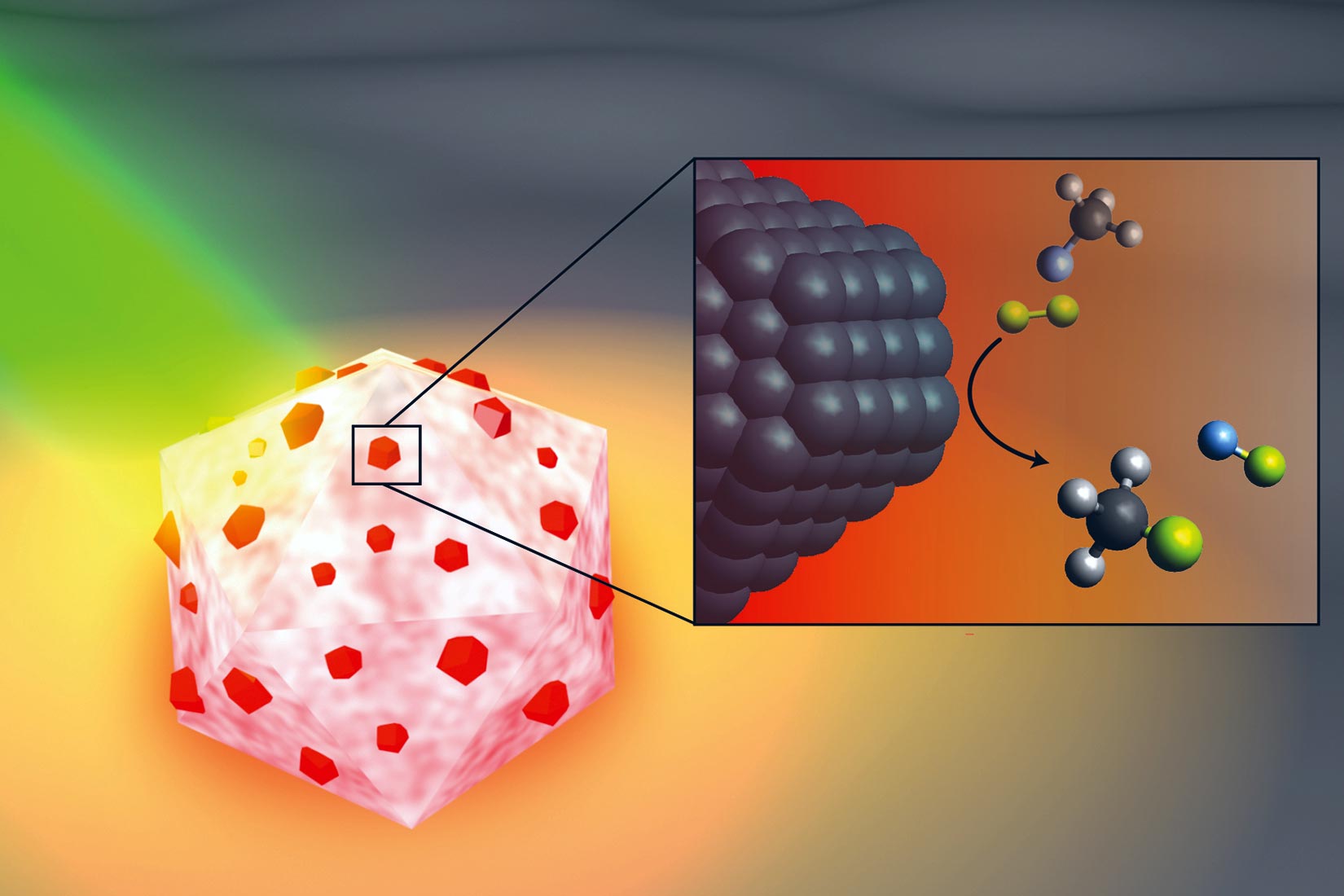
An artist’s illustration of the light-activated antenna-reactor catalyst Rice University engineers designed to break carbon-fluorine bonds in fluorocarbons. The aluminum portion of the particle (white and pink) captures energy from light (green), activating islands of palladium catalysts (red). In the inset, fluoromethane molecules (top) comprised of one carbon atom (black), three hydrogen atoms (grey) and one fluorine atom (light blue) react with deuterium (yellow) molecules near the palladium surface (black), cleaving the carbon-fluorine bond to produce deuterium fluoride (right) and monodeuterated methane (bottom). Credit: H. Robatjazi/Rice University

Lab Unveils Catalyst That Can Break Problematic C-F Bonds

Rice University engineers have created a light-powered catalyst that can break the strong chemical bonds in fluorocarbons, a group of synthetic materials that includes persistent environmental pollutants.

In a study published this month in Nature Catalysis, Rice nanophotonics pioneer Naomi Halas and collaborators at the University of California, Santa Barbara (UCSB) and Princeton University showed that tiny spheres of aluminum dotted with specks of palladium could break carbon-fluorine (C-F) bonds via a catalytic process known as hydrodefluorination in which a fluorine atom is replaced by an atom of hydrogen.

Rice University’s Naomi Halas is an engineer, chemist and pioneer in the field of light-activated nanomaterials. Credit: Jeff Fitlow/Rice University

The strength and stability of C-F bonds are behind some of the 20th century’s most recognizable chemical brands, including Teflon, Freon and Scotchgard. But the strength of those bonds can be problematic when fluorocarbons get into the air, soil and water. Chlorofluorocarbons, or CFCs, for example, were banned by international treaty in the 1980s after they were found to be destroying Earth’s protective ozone layer, and other fluorocarbons were on the list of “forever chemicals” targeted by a 2001 treaty.

“The hardest part about remediating any of the fluorine-containing compounds is breaking the C-F bond; it requires a lot of energy,” said Halas, an engineer and chemist whose Laboratory for Nanophotonics (LANP) specializes in creating and studying nanoparticles that interact with light.

Over the past five years, Halas and colleagues have pioneered methods for making “antenna-reactor” catalysts that spur or speed up chemical reactions. While catalysts are widely used in industry, they are typically used in energy-intensive processes that require high temperature, high pressure or both. For example, a mesh of catalytic material is inserted into a high-pressure vessel at a chemical plant, and natural gas or another fossil fuel is burned to heat the gas or liquid that’s flowed through the mesh. LANP’s antenna-reactors dramatically improve energy efficiency by capturing light energy and inserting it directly at the point of the catalytic reaction.

In the Nature Catalysis study, the energy-capturing antenna is an aluminum particle smaller than a living cell, and the reactors are islands of palladium scattered across the aluminum surface. The energy-saving feature of antenna-reactor catalysts is perhaps best illustrated by another of Halas’ previous successes: solar steam. In 2012, her team showed its energy-harvesting particles could instantly vaporize water molecules near their surface, meaning Halas and colleagues could make steam without boiling water. To drive home the point, they showed they could make steam from ice-cold water.

The antenna-reactor catalyst design allows Halas’ team to mix and match metals that are best suited for capturing light and catalyzing reactions in a particular context. The work is part of the green chemistry movement toward cleaner, more efficient chemical processes, and LANP has previously demonstrated catalysts for producing ethylene and syngas and for splitting ammonia to produce hydrogen fuel.

Study lead author Hossein Robatjazi, a Beckman Postdoctoral Fellow at UCSB who earned his Ph.D. from Rice in 2019, conducted the bulk of the research during his graduate studies in Halas’ lab. He said the project also shows the importance of interdisciplinary collaboration.

“I finished the experiments last year, but our experimental results had some interesting features, changes to the reaction kinetics under illumination, that raised an important but interesting question: What role does light play to promote the C-F breaking chemistry?” he said.

The answers came after Robatjazi arrived for his postdoctoral experience at UCSB. He was tasked with developing a microkinetics model, and a combination of insights from the model and from theoretical calculations performed by collaborators at Princeton helped explain the puzzling results.

“With this model, we used the perspective from surface science in traditional catalysis to uniquely link the experimental results to changes to the reaction pathway and reactivity under the light,” he said.

The demonstration experiments on fluoromethane could be just the beginning for the C-F breaking catalyst.

“This general reaction may be useful for remediating many other types of fluorinated molecules,” Halas said.

###

Reference: “Plasmon-driven carbon–fluorine (C(sp3)–F) bond activation with mechanistic insights into hot-carrier-mediated pathways” by Hossein Robatjazi, Junwei Lucas Bao, Ming Zhang, Linan Zhou, Phillip Christopher, Emily A. Carter, Peter Nordlander and Naomi J. Halas, 8 June 2020, Nature Catalysis.
DOI: 10.1038/s41929-020-0466-5

Halas is the Stanley C. Moore Professor of Electrical and Computer Engineering in Rice’s Brown School of Engineering, director of Rice’s Smalley-Curl Institute and a professor of chemistry, bioengineering, physics and astronomy, and materials science and nanoengineering.

Additional co-authors include Ming Zhang, Linan Zhou and Peter Nordlander, all of Rice; Junwei Lucas Bao, formerly of Princeton University and now at Boston College; Emily Carter, formerly of Princeton and now at UCLA; and Phillip Christopher of UCSB.

This research was supported by the Air Force Office of Scientific Research (MURI FA9550-15-1-0022), the Defense Threat Reduction Agency (HDTRA1-16-1-0042), the Welch Foundation (C-1220 and C-1222) and the Arnold and Mabel Beckman Foundation.