https://www.psypost.org/2020/07/new-study-indicates-that-thwarted-emotional-connectedness-and-mental-fantasies-could-lead-to-stalking-57473

New study indicates that thwarted emotional connectedness and mental fantasies could lead to stalking

BY ERIC W. DOLAN Share on Facebook Share on Twitter

New research published in Motivation and Emotion provides insight into some of the psychological mechanisms underlying stalking behavior. The study suggests that threatening one’s need for relatedness can increase obsessive thinking, which in turn increases proximity-seeking towards a romantic target.

“When I first started my doctoral research, I got interested in trying to understand the motivational and social-cognitive predictors of stalking behavior,” said Timothy Jacob Valshtein (@TJValshtein), a PhD student at New York University who co-authored the study with Elizabeth R. Mutter.

“Stalking is an incredibly common experience (something like 20% of all women will be stalked at some point in their lives). Yet, so much of our understanding of why people perpetrate remains unclear. After reading the literature and talking with my advisor and co-author Dr. Gabriele Oettingen, we started thinking about the role that mental imagery plays in stalking behavior.

“People have really rich inner lives — I think we can all relate to a time when we imagined something really terrible happening to a loved one. We thought that when these kinds of thoughts, coupled with a context where you feel really alone and yearning for human connection is what might lead someone to think obsessively about a romantic partner,” Valshtein said.

“But ultimately, our interest in the origins of obsessive thinking really stemmed from a broader interest in understanding why some individuals (often men) have such a difficult time respecting the boundaries of their romantic interests.”

In three experiments, which included 738 participants in total, the researchers found that the need to feel emotionally connected with others (psychological relatedness) and distressing fantasies were both associated with obsessive thinking. In addition, obsessive thinking was linked to heightened intentions to seek proximity to a romantic target.

“We found experimental evidence to suggest that when the need to feel related/connected to close others is interrupted and when we have fantasies about something awful happening to a romantic partner, we tend to start thinking more obsessively about the very person who may be able to quell those anxieties and satisfy that need to feel related. Put simply, we seek out the comfort of close others when we feel lonely — even if that loneliness and self-doubt is completely a figment of our imagination,” Valshtein told PsyPost.

The researchers used two different methods to induce a need for psychological relatedness. Two of the experiments asked the participants to list 16 times when their partner and made them feel loved. The participants were told that this is an easy task. However, previous research has found the opposite — people tend to have a hard time remembering 16 specific memories about feeling loved.

The third experiment used a task known as the cyberball game, in which participants are systematically ignored and excluded during a virtual ball tossing game.

But like all research, the study includes some limitations.

“Research on obsessive thinking and stalking-like proximity seeking behaviors can be really tricky to pin down. In our studies, we never actually measure behavior, just self-report of thoughts and feelings. On the one hand, as someone who’s interested primarily in human behavior, this is less than ideal. Yet on the other, I think there is a real ethical responsibility for us as scientists to consider. I don’t want to bring our research participants in the lab, make them feel bad, and then put them in a position where they might start stalking their romantic partner,” Valshtein said.

“So we tried to keep things safe and only inside the lab. Another important shortcoming is that these particular studies don’t grapple with gender differences in obsessive thinking or stalking-like behaviors. However, we know from prior research on stalking that gender is something really important to consider, as men are typically the perpetrators of stalking behavior.”

Surprisingly, the researcher did not uncover any significant gender differences when it came to obsessive thinking. “This suggests that obsessive thinking alone isn’t the only important consideration in trying to understand why people stalk — in fact, some of our ongoing work is thinking about the gender differences in the self-regulation that follows after obsessive thinking starts,” Valshtein explained.

“That is, maybe men and women don’t differ in how obsessively they think about their romantic partners, but rather it’s what comes after those obsessive thoughts that matters. Men, compared to women, may not be so effective at regulating their subsequent romantic behaviors. This is all still very ongoing, so it’s quite speculative.”

“This is such a new area of research, so there are a lot of challenging problems to work on. As I mentioned above, some of our in-progress work revolves around further developing these concepts. One area we’re starting to look forward to examining more carefully is how these dynamics unfold in the context COVID-related distancing and isolation,” Valshtein added.

“Social distancing and other forms of preventative health practices seem to be making it more difficult to feel connected to romantic partners (in situations where two individuals are dating but not cohabitating). We’re looking now to see if individuals who experience those same kinds of negative fantasies may be more willing to go out and pursue romantic partners — even if it might be dangerous or undesirable to do so in the context of a global pandemic.”

The study, “Relatedness needs and negative fantasies as the origins of obsessive thinking in romantic relationships“, was authored by Timothy J. Valshtein, Elizabeth R. Mutter, Gabriele Oettingen, and Peter M. Gollwitzer.
https://phys.org/news/2020-07-quantum-tunneling.html

Measuring how long quantum tunneling takes

by Bob Yirka, Science X Network, Phys.org

quantum
Credit: Pixabay/CC0 Public Domain

A team of researchers at the University of Toronto has found a way to measure how long quantum tunneling takes to happen. In their paper published in the journal Nature, the group describes experiments they conducted and the result they found when attempting to measure how long quantum tunneling takes under certain circumstances.

In one sense, quantum tunneling is simple—it is a phenomenon in which a particle passes through an energy barrier despite lacking the energy to do so. Scientists do not really know how it works, but have found uses for it anyway—like making scanning tunneling microscopes. One factor of quantum tunneling that has been debated by physicists over the past century is how much time it takes for a particle to pass through an energy barrier.

The difficulty in answering this question lies in the definition of time itself, and how it applies to quantum tunneling. In this new effort, the researchers took a simplified approach to measuring how long it takes for one type of particle (a rubidium atom) to pass through a very specific kind of energy barrier (a laser beam). The “clock” in their experiments was the spin of the rubidium atoms used—since the duration of their spin is a known quantity, they can be used as clocks by measuring how much spin occurs while they are subjected to tests—such as passing through a laser beam. Thus, all the researchers had to do was note the current state of spin for the atom before it entered the beam and then measure it again when it exited.

Execution of the plan involved trapping a cloud of rubidium atoms using a laser beam and then using the same laser beam to move the atoms into the path of another laser beam—and measuring their spin on either side of the second beam. To make it easier to measure the spin of the atoms, the researchers first ultra-cooled the cloud before sending them through the energy barrier. Measurement of the change in spin showed the tunneling took approximately 0.62 milliseconds.

In further investigations, the researchers would like to learn more about the trajectory of the atoms as they move through the barrier—and they also note that some theories have suggested particles are able to move through a barrier without ever having passed through its interior.


Explore furtherMeasuring a particle’s spin in a rapidly rotating object


More information: Ramón Ramos et al. Measurement of the time spent by a tunnelling atom within the barrier region, Nature (2020). DOI: 10.1038/s41586-020-2490-7Journal information:NatureProvided by Science X Network

https://scitechdaily.com/dive-deep-into-hidden-world-of-quantum-states-to-find-silicons-successor-in-race-against-moores-law/

Dive Deep Into Hidden World of Quantum States to Find Silicon’s Successor in Race Against Moore’s Law

TOPICS:DOELawrence Berkeley National LaboratoryQuantum MaterialsQuantum PhysicsUC Berkeley

By LAWRENCE BERKELEY NATIONAL LABORATORY JULY 26, 2020Van Hove Singularity

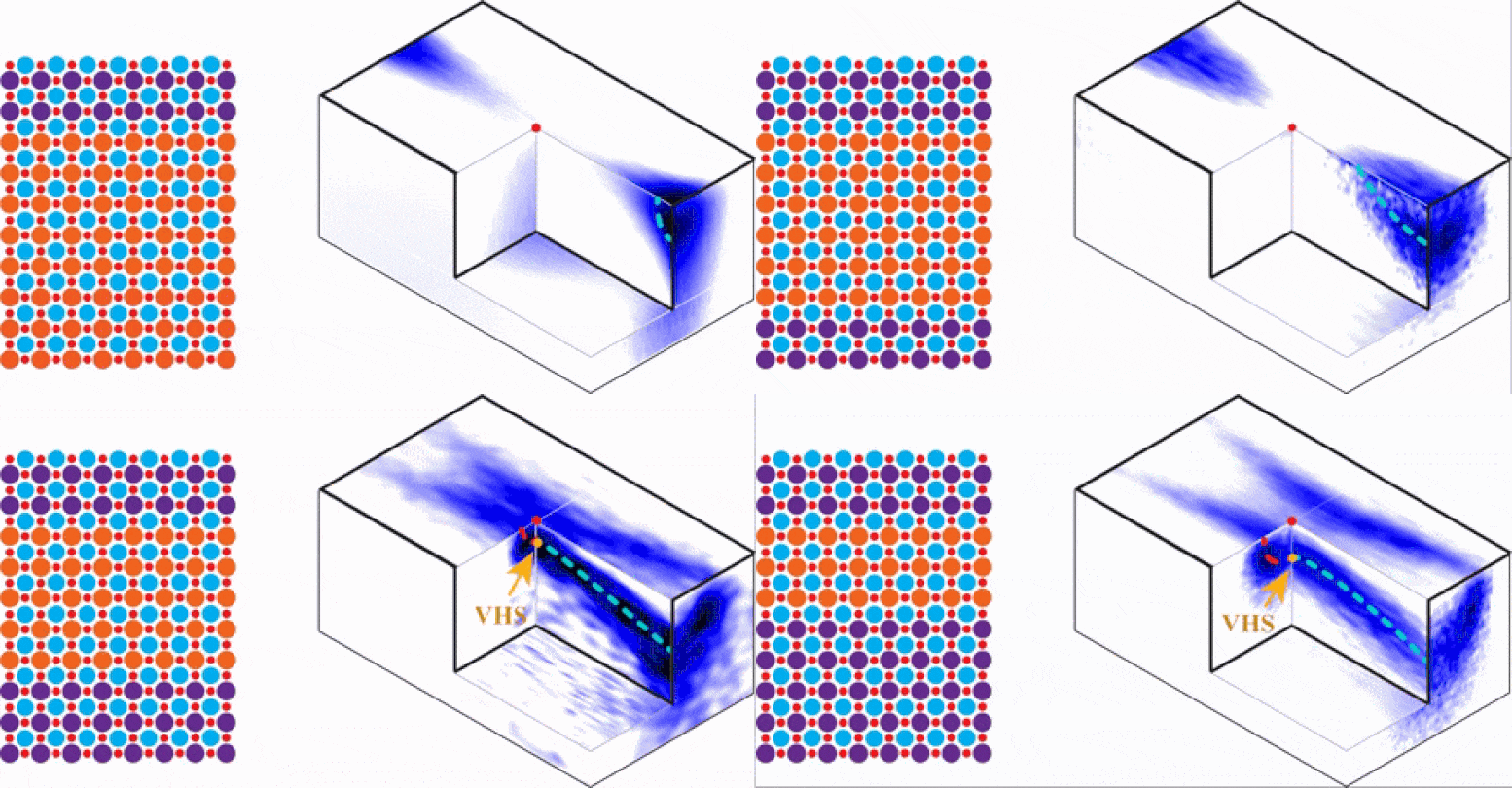
Right: Animation of a Van Hove singularity (VHS) shown approximately 1 nanometer below the surface of an oxide heterostructure made of atomically thin layers of strontium titanate and samarium titanate. Left: Atomic composition of the oxide heterostructure illustrated by colored dots: Purple represents samarium; orange represents strontium; light blue represents titanium; and small red dots represent oxygen. Credit: Ryo Mori/Berkeley Lab

Discovery by scientists at Berkeley Lab, UC Berkeley could help find silicon’s successor in race against Moore’s Law.

In the search for new materials with the potential to outperform silicon, scientists have wanted to take advantage of the unusual electronic properties of 2D devices called oxide heterostructures, which consist of atomically thin layers of materials containing oxygen.

Scientists have long known that oxide materials, on their own, are typically insulating – which means that they are not electrically conductive. When two oxide materials are layered together to form a heterostructure, new electronic properties such as superconductivity – the state in which a material can conduct electricity without resistance, typically at hundreds of degrees below freezing – and magnetism somehow form at their interface, which is the juncture where two materials meet. But very little is known about how to control these electronic states because few techniques can probe below the interface.

Now, a team of researchers led by the Department of Energy’s Lawrence Berkeley National Laboratory (Berkeley Lab) has gained new insight into the evolution of exotic electronic properties from atomically thin oxide heterostructures. Their findings – reported in the journal Nature Communications – could lead to new electronic materials that surpass the limitations imposed by Moore’s Law, which predicted in 1975 that the number of transistors packed into a tiny silicon-based computer chip would double every two years.

At Berkeley Lab’s Advanced Light Source, the research team – directed by Alessandra Lanzara, senior faculty scientist in Berkeley Lab’s Materials Sciences Division and professor of physics at UC Berkeley – used a special technique called angle-resolved photoemission spectroscopy (ARPES) to directly measure the electronic structure of electrons confined between layers of a strontium titanate/samarium titanate heterostructure.

Probing at a depth of approximately 1 nanometer (a billionth of a meter) inside the sample, the researchers discovered two unique electronic properties – called a Van Hove singularity (VHS) and Fermi surface topology – which condensed matter physicists have long considered important features for tuning superconductivity and other such exotic electronic states in electronic materials.

The researchers’ observation of VHS and Fermi surface topology at the interface between atomically thin oxide materials for the first time suggests that the system is an ideal platform for investigating how to control superconductivity at the atomic scale in 2D materials.

“Our findings add new pieces of information to this young field. While the road toward the industrial use of oxide electronics is still far, our work is a step forward in the development of next-generation alternatives to traditional electronics beyond Moore’s Law,” said lead author Ryo Mori, a doctoral researcher in Berkeley Lab’s Materials Sciences Division and Ph.D. student in the Applied Science and Technology (AS&T) program at UC Berkeley.

The scientists next plan to further investigate how electronic properties such as Van Hove singularities change at higher temperatures and different voltages.

Researchers from Berkeley Lab, UC Berkeley, and UC Santa Barbara participated in the study.

Reference: “Controlling a Van Hove singularity and Fermi surface topology at a complex oxide heterostructure interface” by Ryo Mori, Patrick B. Marshall, Kaveh Ahadi, Jonathan D. Denlinger, Susanne Stemmer and Alessandra Lanzara, 4 December 2019, Nature Communications.
DOI: 10.1038/s41467-019-13046-z

The Advanced Light Source is a DOE Office of Science user facility at Berkeley Lab.

This work was supported by the DOE Office of Science. Additional funding was provided by the Gordon and Betty Moore Foundation and the National Science Foundation.

https://www.kitchenertoday.com/coronavirus-covid-19-local-news/how-practicing-mindfulness-can-help-us-through-the-coronavirus-pandemic-2589577

How practicing mindfulness can help us through the coronavirus pandemic

The coronavirus pandemic has altered our ways of living — mindfulness can help us reconnect with our selves and each otherabout 12 hours ago By: The Conversation

yoga pose stockStock image

This article, written by Kira Jade CooperUniversity of Waterloo, originally appeared on The Conversation and has been republished here with permission:

We seem to have mastered the perfect recipe for chaos: a global ecological emergency, humanitarian crises and to top it off, a pandemic of epic proportions. Where do we begin to make sense of the current times? Or more importantly, how can we move towards a positive systemic shift that leaves no one behind?

How about taking a breath?

Mindfulness, a once-traditional Buddhist practice has become a normalized part of secular society and is lauded by many health and wellness authorities. It is now found in many public spaces such as schools, politics, military units and hospitals.

Increasingly, researchers are finding new applications and interventions for mindfulness practices to enhance individual well-being, including the reduction of stress, anxiety and depression. While these have demonstrated promise for improving numerous aspects of human health, little research has explored the potential benefits for mindfulness to contribute to collective well-being, especially during times of widespread crisis.

My research has found that mindfulness can be used to advance not only individual wellness, but depending on the practice and its application, a broader sustainability agenda as well. This relatively unexplored means of supporting sustainability progress has immense value to offer in times of crisis, particularly COVID-19.

Mindfulness and COVID-19

The COVID-19 pandemic has surfaced many deep sustainability concerns. What it has also emphasized is our too-often mindless ways of being that have resulted in deep inequities and an exploitative relationship with the biosphere.

Researchers have found that mindfulness practice can increase compassion and empathy, which are essential traits for supporting both individual and collective resilience.

And as social distancing and quarantine measures keep us physically separate and yearning for connection, the role of mindfulness in nurturing feelings of interconnectedness and reducing risk factors for loneliness and isolation has become increasingly important.

Mindfulness has also been found to deepen connection to nature, and even heighten recognition of climate change.

Together, this understanding and commitment to well-being for all are critical processes to mitigate our current unsustainable ways of being and doing. Since mindfulness has been found to reduce consumerism and promote more sustainable consumption habits, it supports a path for tackling large sustainability challenges.

First responders and frontline workers

Additionally, for first responders who are facing likely unprecedented high levels of chronic stress as a result of COVID-19, mindfulness can also help reduce compassion fatigue and workplace burnout.

Furthermore, in light of the current tension between police and civilians, mindfulness may also offer benefit in addressing inequalities as it has been found to reduce aggression in law enforcement officers.

Despite the numerous potential benefits of mindfulness, finding effective ways to leverage these practices, while also recognizing some of their drawbacks and limitations remains an ongoing challenge.

Drawbacks of mindfulness

To increase marketability, mindfulness has been largely separated from its Buddhist roots. In the process, many of the traditional moral and ethical elements of the practice have been replaced with a more individualized and often self-serving agenda.

Business ventures that target high-spending and elite consumers, including Google, Apple and Nike have capitalized on this niche in the wellness market. Mindfuness is a profitable and growing multi-billion dollar industry.

Mindfulness practices that reinforce a notion of self as separate from the rest of nature and society can risk missing many benefits of traditional mindfulness practice. Similarly, by focusing exclusively on developing a heightened awareness of self, mindfulness practitioners can fail to see the consequences of their behaviours.

Individualized mindfulness practices that are preoccupied with enhancing pleasure and enjoyment, as opposed to ending suffering, can inadvertently encourage materialism and selfishness.

A mindful future

Rather than advancing narrow neoliberal and capitalistic agendas by leveraging mindfulness as a productivity hack, product or service, mindful practice could enhance both individual and collective well-being while supporting broader sustainability progress. For this to be conceived and pursued, the ways by which we define, practice, and apply mindfulness need to be re-examined, and in some cases, transformed.

One such transformation is the integration of mindfulness practices into peace-building initiatives in conflict areas. In places such as refugee camps, mindfulness is used to support resilience building, while simultaneously fostering both individual and collective well-being.

As our new reality unfolds under the circumstances imposed by COVID-19, it continues to reveal further socio-ecological challenges. We will need to learn how to practise mindfulness wisely, in a manner that reduces suffering for all beings, in both the present moment and the post-pandemic future.

Kira Jade Cooper, PhD Candidate, School of Environment, Resources and Sustainability, University of Waterloo

This article is republished from The Conversation under a Creative Commons license. Read the original article.

https://www.eurekalert.org/pub_releases/2020-07/msu-wic072320.php

When it comes to happiness, what’s love got to do with it?

MICHIGAN STATE UNIVERSITYSHARE PRINT E-MAIL

IMAGE
IMAGE: MSU RESEARCHERS FOUND THAT STAKING HAPPINESS ON BEING MARRIED ISN’T A SURE BET. view more CREDIT: MICHIGAN STATE UNIVERSITY

EAST LANSING, Mich. – How accurate was William Shakespeare when he said, “‘Tis better to have loved and lost than never to have loved at all”? Researchers from Michigan State University conducted one of the first studies of its kind to quantify the happiness of married, formerly married and single people at the end of their lives to find out just how much love and marriage played into overall well-being.

The study — published in the Journal of Positive Psychology — examined the relationship histories of 7,532 people followed from ages 18 to 60 to determine who reported to be happiest at the end of their lives.

“People often think that they need to be married to be happy, so we asked the questions, ‘Do people need to be in a relationship to be happy? Does living single your whole life translate to unhappiness? What about if you were married at some point but it didn’t work out?,'” said William Chopik, MSU assistant professor of psychology and co-author of the paper. “Turns out, staking your happiness on being married isn’t a sure bet.”

Chopik and Mariah Purol, MSU psychology master’s student and co-author, found that participants fell into one of three groups: 79% were consistently married, spending the majority of their lives in one marriage; 8% were consistently single, or, people who spent most of their lives unmarried; and 13% had varied histories, or, a history of moving in and out of relationships, divorce, remarrying or becoming widowed. The researchers then asked participants to rate overall happiness when they were older adults and compared it with the group into which they fell.

“We were surprised to find that lifelong singles and those who had varied relationship histories didn’t differ in how happy they were,” said Purol. “This suggests that those who have ‘loved and lost’ are just as happy towards the end of life than those who ‘never loved at all.'”

While married people showed a slight uptick in happiness, Purol said the margin was not substantial — nor what many may expect. If the consistently married group answered a 4 out of 5 on how happy they were, consistently single people answered a 3.82 and those with varied history answered a 3.7.

“When it comes to happiness, whether someone is in a relationship or not is rarely the whole story,” Chopik said. “People can certainly be in unhappy relationships, and single people derive enjoyment from all sorts of other parts of their lives, like their friendships, hobbies and work. In retrospect, if the goal is to find happiness, it seems a little silly that people put so much stock in being partnered.”

If someone longs for a lifelong partner to start a family and build a happy life together, Chopik and Purol’s research suggests that if that individual isn’t completely happy to begin with, getting married won’t likely dramatically change it all.

“It seems like it may be less about the marriage and more about the mindset,” Purol said. “If you can find happiness and fulfillment as a single person, you’ll likely hold onto that happiness — whether there’s a ring on your finger or not.”

###

(Note for media: Please include the following link to the study in all online media coverage: https://www.tandfonline.com/doi/full/10.1080/17439760.2020.1791946)

Michigan State University has been working to advance the common good in uncommon ways for 160 years. One of the top research universities in the world, MSU focuses its vast resources on creating solutions to some of the world’s most pressing challenges, while providing life-changing opportunities to a diverse and inclusive academic community through more than 200 programs of study in 17 degree-granting colleges.

For MSU news on the Web, go to MSUToday. Follow MSU News on Twitter at twitter.com/MSUnews

https://scitechdaily.com/new-photonic-crystal-light-converter-powerful-tool-for-observation-in-physics-and-life-sciences/

New Photonic Crystal Light Converter: Powerful Tool for Observation in Physics and Life Sciences

TOPICS:BiochemistryNanotechnologyOpticsUniversity Of Tokyo

By UNIVERSITY OF TOKYO JULY 26, 2020

Circularly polarized laser light goes through the PCN device and comes out the other side as VUV polarized in the opposite direction. Credit: © 2020 Konishi et al.

Spectroscopy is the use of light to analyze physical objects and biological samples. Different kinds of light can provide different kinds of information. Vacuum ultraviolet light is useful as it can aid people in a broad range of research fields, but generation of that light has been difficult and expensive. Researchers created a new device to efficiently generate this special kind of light using an ultrathin film with nanoscale perforations.

The wavelengths of light you see with your eyes constitute a mere fraction of the possible wavelengths of light that exist. There’s infrared light which you can feel in the form of heat, or see if you happen to be a snake, that has a longer wavelength than visible light. At the opposite end is ultraviolet (UV) light which you can use to produce vitamin D in your skin, or see if you happen to be a bee. These and other forms of light have many uses in science.

Within the UV range is a subset of wavelengths known as vacuum ultraviolet light (VUV), so called because they are easily absorbed by air but can pass through a vacuum. Some VUV wavelengths in the region of around 120-200 nanometers (nm) are of particular use to scientists and medical researchers as they can be used for chemical and physical analyses of different materials and even biological samples.

Photonic Crystal Light Converter Hole Spacing

However, there is more to light than a wavelength. For VUV to be truly useful, it also needs to be twisted or polarized in a manner called circular polarization. Existing methods to produce VUV, such as using particle accelerators or laser-driven plasmas, have many drawbacks, including cost, scale and complexity. But also, these can only produce untwisted linear polarized VUV. If there was a simple way to make circular polarized VUV, it would be extremely beneficial. Assistant Professor Kuniaki Konishi from the Institute for Photon Science and Technology at the University of Tokyo and his team may just have the answer.

“We have created a simple device to convert circularly polarized visible laser light into circularly polarized VUV, twisted in the opposite direction,” said Konishi. “Our photonic crystal dielectric nanomembrane (PCN) consists of a sheet made from an aluminum oxide-based crystal (ℽ-Al2O3) only 48 nm thick. It sits atop a 525 micrometer-thick sheet of silicon which has 190 nm-wide holes cut into it 600 nm apart.”

https://www.youtube.com/embed/_ew7WnOgU-w?feature=oembed
Numerical simulation of vacuum ultraviolet. Credit: © 2020 Konishi et al.

To our eyes the PCN membrane just looks like a flat featureless surface, but under a powerful microscope the pattern of perforations can be seen. It looks a little like the holes in a showerhead which increase the water pressure to make jets.

“When pulses of circularly polarized blue laser light with a wavelength of 470 nm shine down these channels in the silicon, the PCN acts on these pulses and twists them in the opposing direction,” said Konishi. “It also shrinks their wavelengths to 157 nm which is well within the range of VUV that is so useful in spectroscopy.”

With short pulses of circularly polarized VUV, researchers can observe fast or short-lived physical phenomena at the submicrometer scale that are otherwise impossible to see. Such phenomena include the behaviors of electrons or biomolecules. So this new method to generate VUV can be useful to researchers in medicine, life sciences, molecular chemistry and solid state physics. Although a similar method has been demonstrated before, it produced less useful longer wavelengths, and did so using a metal-based film which is subject to rapid degradation in the presence of laser light. PCN is far more robust to this.

“I am pleased that through our study of PCN, we found a new and useful application for circularly polarized light conversion, generating VUV with the intensity required to make it ideal for spectroscopy,” said Konishi. “And it was surprising that the PCN membrane could survive the repeated bombardment of laser light, unlike previous metal-based devices. This makes it suitable for lab use where it may be used extensively over long periods. We did this for basic science and I hope to see many kinds of researchers make good use of our work.”

Reference: “Circularly polarized vacuum ultraviolet coherent light generation using a square lattice photonic crystal nanomembrane” by Kuniaki Konishi, Daisuke Akai, Yoshio Mita, Makoto Ishida, Junji Yumoto, and Makoto Kuwata-Gonokami, 21 July 2020, Optica.
DOI: 10.1364/OPTICA.393816

https://www.medicalnewstoday.com/articles/molecule-in-blood-linked-to-cognitive-decline-in-old-age#Shared-pathway

Molecule in blood linked to cognitive decline in old age

A new study has found a molecule that could serve as a biomarker to identify those at greater risk of developing dementia in later life. It could also help scientists develop preventive treatments.

seniors doing a jigsaw puzzle
A recent study suggests a molecule within the blood could be an early tell-tale sign of cognitive decline.

Dementia is a debilitating condition that involves the progressive decline of memory, communication, and thinking.

Globally, the number of people with this condition has more than doubled, rising from 20.2 million in 1990 to 43.8 million in 2016.

The most common form of dementia is Alzheimer’s disease, which accounts for 60-70% of all cases. As populations age, the prevalence of Alzheimer’s and other forms of dementia is expected to continue rising.

Currently, once symptoms occur, they cannot be reversed. With this in mind, researchers are exploring ways to diagnose the condition years or even decades before it develops, and find drugs to prevent its progress.

One promising biomarker of Alzheimer’s is a molecule that circulates in the blood, known as asymmetric dimethylarginine (ADMA).

By inhibiting an enzyme called nitric oxide synthase, ADMA reduces the amount of nitric oxide synthesized by the endothelial cells that line blood vessels.

The role of nitric oxide is to dilate blood vessels, increasing blood flow. When levels are abnormally low, it restricts blood flow to tissues, starving them of oxygen and triggering inflammation.

The importance of childhood intelligence

Low levels of nitric oxide are linked to the development of atherosclerosis, cardiovascular disease, and Alzheimer’s. A few small studies have also found a link between high concentrations of ADMA and cognitive decline in older people.

However, none of these studies have adjusted for the effect of low intelligence in childhood, which accounts for up to 50% of cognitive decline in old age.

Now, researchers at the University of Aberdeen and the University of Oxford in the United Kingdom, and Flinders University in Melbourne, Australia, have found a breakthrough.

They analyzed data from 63-year-olds, who had all taken the same mental ability test at Scottish schools in 1947 when they were 11 years of age.

Two decades ago, the 1936 Aberdeen Birth Cohort was established by medical researchers to follow this unique set of people.

Between 2000 and 2004, 93 of them took part in a research project to study cognitive aging and health. Blood samples were taken in 2000, and the participants underwent a series of cognitive tests at regular intervals over the next 4 years.

After adjusting for their childhood intelligence test scores, the authors of the new study found a link between raised ADMA concentrations in their blood and a decline in cognitive performance four years later.

The researchers now report these findings in a study published in the International Journal of Geriatric Psychiatry.

An early warning sign?

Poor cognitive performance late in middle age is an established risk factor for the development of dementia.

“Therefore the results of this study suggest that ADMA, an easily measurable marker of atherosclerosis and cardiovascular risk, could be an early indicator of cognitive decline in old age — and possibly dementia,” says study author Prof. Arduino Mangoni, head of clinical pharmacology at Flinders University.

However, the study accounts for too few participants to draw definitive conclusions.

“We should be cautious about emphasizing the results with the 93 participants’ results here,” says lead author Dr. Deborah Malden, from the Nuffield Department of Population Health at the University of Oxford.

“We would know much more after repeating this study in a large-scale cohort, potentially tens of thousands of individuals.”

Future research could include genetic information about participants and involve repeated measurements of ADMA at regular intervals, rather than the single analysis used in this study.

Ideally, there would also be follow-up with participants for longer than 4 years.

In addition, the present study could not rule out the possibility of reverse causality. In other words, individuals with early dementia may have changed their resulting behavior, which in turn could have affected their ADMA levels.

Expect in-depth, science-backed toplines of our best stories every day. Tap in and keep your curiosity satisfied.Enter your emailSIGN UP NOW

Your privacy is important to us

Shared pathway

If future research confirms the results of this preliminary study, however, existing drugs could be deployed as preventive treatments.

The investigators write:

“Importantly, ADMA concentrations can be modulated by pharmacological interventions, and therefore ADMA may prove valuable as a future prevention strategy for dementia and [Alzheimer’s disease].”

Intriguingly, previous studies suggest that high levels of ADMA in the bloodstream are a common factor in the development of a wide range of diseases, say the researchers.

High concentrations are linked to type 2 diabetes, chronic obstructive pulmonary disease (COPD), and depression, as well as cardiovascular disease and dementia.

This suggests that a single drug could help address the wide range of medical conditions that develop from this shared metabolic pathway.

https://www.livescience.com/what-is-consciousness.html

What is consciousness?

By Grant Currin – Live Science Contributor 11 hours ago

The ancient Greeks dove into this question. But what do modern scientists think?

Is consciousness uniquely human? Or do other living things have varying degrees of it?Is consciousness uniquely human? Or do other living things have varying degrees of it?(Image: © Shutterstock)

Humans once assumed our planet was the physical center of the solar system, so it’s no surprise that we also think highly of consciousness, the apparently unique quality that allows our species to contemplate such matters.

But what is consciousness? The topic has been extraordinarily controversial in the scientific and philosophical traditions. Thinkers have spent an immense amount of time and ink trying to unravel mysteries, such as how consciousness works and where it resides. 

The short answer isn’t very satisfying. Scientists and philosophers still can’t agree on a vague idea of what consciousness is, much less a strict definition. One reason for that is that the concept is used to mean slightly different things. Many experts agree, however, that conscious beings are aware of their surroundings, themselves and their own perception.

Related: Can we ever stop thinking?

But the long answer leaves room for hope because researchers seem to be getting closer to an answer. 

Something special?

Contemporary researchers have shown they can use a brain-scanning technique known as functional MRI to detect consciousness by indirectly measuring blood flow in the brain, a process that may indicate which areas of the brain are more active than others. But, for millennia, there was no way to collect evidence of this phenomenon. That made the topic challenging for thinkers who prized rationality and methodical experimentation.

In the Western world, the Italian astronomer Galileo Galilei tried to push anything to do with consciousness outside of the realm of scientific inquiry. A generation later, French mathematician and philosopher René Descartes brought consciousness into slightly sharper focus with his argument that mind (or soul) and body are two fundamentally different things. This position is called mind-body dualism. 

“The vast majority [of thinkers] used to think that consciousness is very special,” Susanna Schellenberg, distinguished professor of philosophy and cognitive science at Rutgers University in New Jersey, told Live Science. 

But that attitude has fallen out of favor, thanks in part to people like 19th-century biologist Thomas Huxley, who helped usher in the view that what happens in the mind is a result of material events happening in the brain. It’s a perspective that’s grown in popularity. 

“The idea I hold is a physicalist view, that consciousness isn’t anything special in the world,” Schellenberg said. That makes it a lot easier to imagine that humans aren’t alone in possessing consciousness. 

“We write poetry and rabbits don’t, as far as we can tell,” she said. “So, it’s a difference of degree, not of kind.”

Peering across the tree of life

“Almost everything you can say about [consciousness] is kind of BS,” said Joseph LeDoux, a professor of neural science and psychiatry at New York University. “The only way to describe it is in terms of what it is and what it’s not.”

When comparing human consciousness to that of other animals, LeDoux finds it productive to look at neuroanatomy. For instance, humans are unique in having a highly developed frontal pole cortex, a part of the brain that researchers have connected with the ability to know what’s on one’s mind. That’s an important aspect of consciousness by just about every definition. While non-human primates can’t boast this late-model region of the brain, many of them do have other evolutionarily recent additions to the brain, such as the dorsolateral prefrontal cortex. It’s been implicated in consciousness, and humans have one, too. For instance, this brain region is associated with working memory in humans, according to a 2015 review in the journal Frontiers in Systems Neuroscience

“We know other animals probably have something [like consciousness], but they don’t have what we have because we’re different,” because of these differences in neural anatomy, according to LeDoux, who wrote “The Deep History of Ourselves: The Four-Billion-Year Story of How We Got Conscious Brains” (Viking, 2019). 

“People get all upset when you say that … but no one confuses a chimpanzee with a human,” he said. The cellular and molecular makeup of a chimp causes it to look and act differently from humans, so it stands to reason that the same kind of differences would cause chimpanzee consciousness to be different, too. 

Related: Why does time fly when you’re having fun?

Some researchers take things a step further, holding that consciousness is a property of matter so fundamental that even an electron is conscious to a certain extent, a position known as panpsychism. Christof Koch, president and chief scientist of the Allen Institute for Brain Science in Seattle and a proponent of panpsychism, wrote in Scientific American that “any complex system … has the basic attributes of mind and has a minimal amount of consciousness in the sense that it feels like something to be that system.” RELATED MYSTERIES

What if humans were twice as intelligent?

Why do our brains have folds?

How accurate is the Myers-Briggs personality test?

Could Danger Be the Reason?

Schellenberg said she thinks that a lot of animals have consciousness because “anything that feels pain … is conscious,” she said, noting the opinion is controversial. 

Similarly, LeDoux thinks that avoiding danger is an important function of consciousness and possibly the reason it exists. 

“All of our mental states, emotional states, are not inherited from animals. They’re cognitively assembled, based on our knowledge of all we’ve learned about fear and danger through our life,” he said. Human brains organize reams of information into schemas that serve as “the template of your conscious experience,” he said. 

For her part, Schellenberg doesn’t think consciousness is the be-all, end-all question that it’s made out to be.

“I’m one of the people who think consciousness isn’t that interesting compared to why our mind and brain can do what it does,” Schellenberg said. “The brain can, with multiple exceptions, do its job regardless of whether it’s in a conscious state or not.”

Originally published on Live Science. 

https://singularityhub.com/2020/07/26/deepminds-newest-ai-programs-itself-to-make-all-the-right-decisions/

DeepMind’s Newest AI Programs Itself to Make All the Right Decisions

By Jason Dorrier -Jul 26, 202014

29https://spkt.io/a/665049

When Deep Blue defeated world chess champion Garry Kasparov in 1997, it may have seemed artificial intelligence had finally arrived. A computer had just taken down one of the top chess players of all time. But it wasn’t to be.

Though Deep Blue was meticulously programmed top-to-bottom to play chess, the approach was too labor-intensive, too dependent on clear rules and bounded possibilities to succeed at more complex games, let alone in the real world. The next revolution would take a decade and a half, when vastly more computing power and data revived machine learning, an old idea in artificial intelligence just waiting for the world to catch up.

Today, machine learning dominates, mostly by way of a family of algorithms called deep learning, while symbolic AI, the dominant approach in Deep Blue’s day, has faded into the background.

Key to deep learning’s success is the fact the algorithms basically write themselves. Given some high-level programming and a dataset, they learn from experience. No engineer anticipates every possibility in code. The algorithms just figure it.

Now, Alphabet’s DeepMind is taking this automation further by developing deep learning algorithms that can handle programming tasks which have been, to date, the sole domain of the world’s top computer scientists (and take them years to write).

In a paper recently published on the pre-print server arXiv, a database for research papers that haven’t been peer reviewed yet, the DeepMind team described a new deep reinforcement learning algorithm that was able to discover its own value function—a critical programming rule in deep reinforcement learning—from scratch.

Surprisingly, the algorithm was also effective beyond the simple environments it trained in, going on to play Atari games—a different, more complicated task—at a level that was, at times, competitive with human-designed algorithms and achieving superhuman levels of play in 14 games.

DeepMind says the approach could accelerate the development of reinforcement learning algorithms and even lead to a shift in focus, where instead of spending years writing the algorithms themselves, researchers work to perfect the environments in which they train.

Pavlov’s Digital Dog

First, a little background.

Three main deep learning approaches are supervised, unsupervised, and reinforcement learning.

The first two consume huge amounts of data (like images or articles), look for patterns in the data, and use those patterns to inform actions (like identifying an image of a cat). To us, this is a pretty alien way to learn about the world. Not only would it be mind-numbingly dull to review millions of cat images, it’d take us years or more to do what these programs do in hours or days. And of course, we can learn what a cat looks like from just a few examples. So why bother?

While supervised and unsupervised deep learning emphasize the machine in machine learning, reinforcement learning is a bit more biological. It actually is the way we learn. Confronted with several possible actions, we predict which will be most rewarding based on experience—weighing the pleasure of eating a chocolate chip cookie against avoiding a cavity and trip to the dentist.

In deep reinforcement learning, algorithms go through a similar process as they take action. In the Atari game Breakout, for instance, a player guides a paddle to bounce a ball at a ceiling of bricks, trying to break as many as possible. When playing Breakout, should an algorithm move the paddle left or right? To decide, it runs a projection—this is the value function—of which direction will maximize the total points, or rewards, it can earn.

Move by move, game by game, an algorithm combines experience and value function to learn which actions bring greater rewards and improves its play, until eventually, it becomes an uncanny Breakout player.

Learning to Learn (Very Meta)

So, a key to deep reinforcement learning is developing a good value function. And that’s difficult. According to the DeepMind team, it takes years of manual research to write the rules guiding algorithmic actions—which is why automating the process is so alluring. Their new Learned Policy Gradient (LPG) algorithm makes solid progress in that direction.

LPG trained in a number of toy environments. Most of these were “gridworlds”—literally two-dimensional grids with objects in some squares. The AI moves square to square and earns points or punishments as it encounters objects. The grids vary in size, and the distribution of objects is either set or random. The training environments offer opportunities to learn fundamental lessons for reinforcement learning algorithms.

Only in LPG’s case, it had no value function to guide that learning.

Instead, LPG has what DeepMind calls a “meta-learner.” You might think of this as an algorithm within an algorithm that, by interacting with its environment, discovers both “what to predict,” thereby forming its version of a value function, and “how to learn from it,” applying its newly discovered value function to each decision it makes in the future.

Prior work in the area has had some success, but according to DeepMind, LPG is the first  algorithm to discover reinforcement learning rules from scratch and to generalize beyond training. The latter was particularly surprising because Atari games are so different from the simple worlds LPG trained in—that is, it had never seen anything like an Atari game.

Time to Hand Over the Reins? Not Just Yet

LPG is still behind advanced human-designed algorithms, the researchers said. But it outperformed a human-designed benchmark in training and even some Atari games, which suggests it isn’t strictly worse, just that it specializes in some environments.

This is where there’s room for improvement and more research.

The more environments LPG saw, the more it could successfully generalize. Intriguingly, the researchers speculate that with enough well-designed training environments, the approach might yield a general-purpose reinforcement learning algorithm.

At the least, though, they say further automation of algorithm discovery—that is, algorithms learning to learn—will accelerate the field. In the near term, it can help researchers more quickly develop hand-designed algorithms. Further out, as self-discovered algorithms like LPG improve, engineers may shift from manually developing the algorithms themselves to building the environments where they learn.

Deep learning long ago left Deep Blue in the dust at games. Perhaps algorithms learning to learn will be a winning strategy in the real world too.

Image credit: Mike Szczepanski / Unsplash29

JASON DORRIERJason is managing editor of Singularity Hub. He did research and wrote about finance and economics before moving on to science, technology, and the future. He is curious about pretty much everything, and sad he’ll only ever know a tiny fraction of it all.

https://mobilesyrup.com/2020/07/25/greyhound-apple-tv-plus-blockbuster-films-report

Greyhound success leading Apple to buy more ‘Netflix-like’ blockbuster films: report The Tom Hanks WWII drama was reportedly a huge hit for Apple TV+ By Bradly Shankar@bradshankarJUL 25, 2020 12:56 PM EDT0

The success of Apple TV+’s recently released Greyhound film is driving the Cupertino, California tech giant to invest in several more blockbuster-type films, according to a new report from The Fast Company. Written by and starring Tom Hanks, Greyhound debuted on Apple TV+ on July 10th and reportedly gave the streaming service its biggest opening weekend to date. In particular, 30 percent of those watching the WWII drama were said to have been new to Apple TV+ altogether.

Given those figures, Apple is now planning to release a dozen films per year, notes The Fast Company, with two to four titles from that lineup consisting of Greyhound-esque bigger-budget fare. So far, Greyhound is the biggest film that Apple has released by far, costing the company an estimated $70 million USD (about $94 million CAD) to acquire from Sony after its theatrical plans were scrapped. Otherwise, Apple TV+’s current film catalogue is small and consists of lower-budget indie titles, such as animal documentary

The Elephant Queen, coming-of-age drama Hala and biographical drama The Banker. For those reasons, one insider told The Fast Company that Apple’s overall film ambitions have so far been murky to those in the industry. “They’re more confusing than Netflix. I know what Netflix wants and doesn’t want,” he said. “[Apple hasn’t] come out to the agencies and said, ‘We need these kinds of movies.’ I think they’re much more specific on the TV side.” Indeed, Apple’s TV efforts have largely focused on HBO-like prestige television, such as The Morning Show, Dickinson, 

For All Mankind and Defending Jacob.  However,

with Greyhound performing well, Apple is now telling Hollywood studios that it wants more of those kinds of films, reports The Fast Company. In particular, sources told the outlet that Apple is looking to capitalize on the fact that many studios are shifting away from major theatrical releases amid the COVID-19 pandemic. Beyond Sony selling Greyhound to Apple, other examples of films heading from theatres to digital platforms during the global health crisis include Universal’s Lovebirds going to Netflix, the film version of Hamilton premiering on Disney+ and Paramount’s Spongebob on the Run heading to Netflix in Canada. Focused on curation For now, it’s unclear whether Apple has its eye on specific films or is simply now being more open to such titles in general. That said, we already know of a few major films the company had acquired prior to Greyhound‘s successful release. The two most notable titles are Antoine Fuqua’s $105 million USD (about $141 million CAD) thriller Emancipation starring Will Smith and Martin Scorsese’s $200 million USD (about $268 million CAD) drama Killers of the Flower Moon with Leonardo DiCaprio and Robert DeNiro. Notably, in the case of the latter film, this is even more than the reported $175 million USD budget (about $234 million CAD) for Scorsese’s The Irishman, which hit Netflix in November. However, The Fast Company‘s sources stressed that Apple is by no means looking to match Netflix in terms of output. “They don’t want to be Costco,” said one source to The Fast Company. “They want to be very curated.” In any case, having more buzzworthy films coming to the platform will, in theory, help Apple retain subscribers. As it stands, the service is estimated to have between 30 and 40 million subscribers, Wedbush analyst Dan Ives told The Fast Company. That said, the “majority” of these people come from free trials, said Ives — namely, the one-year subscriptions that came at no additional cost with the purchase of select Apple products. With services like Netflix and Disney+, there are extensive back catalogues of older shows and movies to keep subscribers around in between the release of new original content. Apple TV+, on the other hand, only has a library of a few dozen original titles. Therefore, Apple having more of these films on top of its TV series will, in theory, help entice more people to begin paying for the service after trials run out. It’s also worth noting that Apple has reportedly been in talks in talks with companies like MGM to acquire libraries of older titles — including, most notably, the James Bond films. That said, there’s been no update on that front yet. Image credit: Apple

Read more at MobileSyrup.comGreyhound success leading Apple to buy more ‘Netflix-like’ blockbuster films: report