https://www.popularmechanics.com/space/rockets/a33917439/emdrive-wont-die/


The EmDrive Just Won’t Die

More than 20 years after its introduction, the EmDrive is still being tested in labs around the world, including DARPA. But the controversial thruster’s do-or-die moment is quickly approaching.

BY DAVID HAMBLINGSEP 11, 2020emdriveLUISMMOLINAGETTY IMAGES

When DARPA put money behind the controversial EmDrive in 2018, it looked like a big gamble. Many physicists had dismissed the revolutionary space drive as simply fake science. Now its EmDrive project is greenlit for Phase 2, DARPA told Popular Mechanics in February this year. Meanwhile, other teams are hoping to reach a final demonstration of the technology later this year.

“This is a technology which could transform space travel and see craft lifting silently off from launchpads and reaching beyond the solar system,” says Mike McCulloch, a lecturer in geomatics at the University of Plymouth, U.K., and leader behind DARPA’s EmDrive project. “We can also get an unmanned probe to Proxima Centauri in a (long) human lifetime, 90 years.”

But DARPA is tempering that idealistic vision.

“Theoretical model-based predictions of performance have led to new thruster designs, and these new designs may help inform future development and testing activities,” a DARPA spokesman told Popular Mechanics.

With two ongoing studies rigorously testing the EmDrive’s “impossibility,” the controversial drive that’s hung around astro-engineering circles for more than two decades is only months away from its do-or-die moment.

The Drive Continues
nasa eagleworks

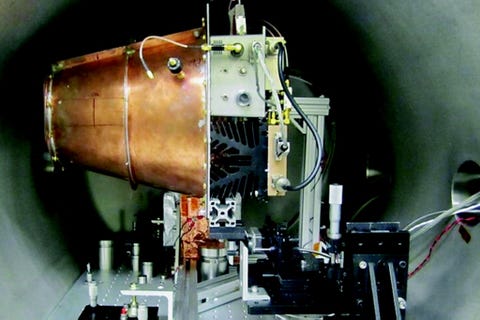
NASA Eagleworks team testing the EmDrive in 2016.NASA

The original EmDrive, built by Roger Shawyer in 1998, is a sealed copper tube (pictured above) wider at one end than the other. According to Shawyer, if you bounce microwaves around inside the tube, they exert more force in one direction than the other, creating a net thrust without the need for any propellant.

RELATED STORYDARPA Is Betting Big on the EmDrive

According to conventional physics, this shouldn’t happen. Put simply, closed systems like the proposed EmDrive should not generate thrust. But several research groups, including NASA’s Eagleworks (formally known as the Advanced Physics Propulsion Laboratory, set up to explore new technologies) and a team at Xi’an in China, tried it and got the same result, a small-but-distinct net force.

Critics believe that the experimental results must be wrong while McCulloch believes we just don’t understand the physics yet.

“MANY ENTHUSIASTIC INDIVIDUALS WANT TO BELIEVE IT IS A METHOD THAT CAN BE USED TO ESCAPE THE CONSTRAINTS OF KNOWN PHYSICAL PRINCIPLES ON SPACE PROPULSION SYSTEMS.”

McCulloch has developed a theory of Quantized Inertia (QI), which explains the effect and how it could help with human space travel. McCulloch has spent much of the past 18 months honing this theory and checking how its predictions match results in the laboratory.

Jose Luis Perez Diaz in Madrid, Spain, and Martin Tajmar in Dresden, Germany, are carrying out the experimental side of the project. Tajmar confirms that he plans to publish two papers in February 2021, one on the “normal” microwave EmDrives and the other on the laser-based EmDrives. On the experimental side, Tajmar is still working on eliminating every possible source of error.

“We are still improving our balances and testing continues, “ says Tajmar. “In particular we are working on further reduction of magnetic field interactions with the environment, which was the major side-effect that we discovered in previous testing.”

When asked whether he might have an alternative explanation for the apparent thrust seen in previous tests, Tajmar only says to “Wait for the papers…”

Tales From the Loop

One of McCulloch’s predictions is that thrust can be achieved with light as well as microwaves. Diaz has carried out experiments in Madrid testing this hypothesis by using an asymmetric loop of optical fiber wound 2,000 times, which he calls a Photon Loop.

As with the microwave version, the asymmetry is what matters. A racing car experiences different forces depending on how sharp a bend it goes around, and according to QI, a similar effect occurs with light going around bends of different curvature. Diaz found that passing laser pulses through the Photon Loop produces enough net force to move it.

After Diaz constructed and tested this apparatus, he sent it to Tajmar’s laboratory in Dresden for verification and precise measurement of the thrust, which is being carried out this summer. McCulloch says that the thrust appears to be between one and four micronewtons—exactly the amount his theory predicts.

photon loop

Example of the Photon Loop.JOSE LUIS PEREZ DIAZ

The advantage of this apparatus is that fiber optics are much cheaper and easier to set up and test than copper cavities requiring precise machining. Once the design is perfected, it should be possible for physics labs around the world to make their own Photon Loops and see the effect for themselves.

The big challenge is accurately measuring such a low level of thrust as an experimental error can skew results dramatically. McCulloch believes this can be resolved in the next phase. By feeding the thrust equations into optimization software, McCulloch has designed a drive thousands of times more efficient than Shawyer’s original. This design has a series of spikes at one end—McCulloch says they nicknamed it the Bart Drive after Bart Simpson’s spiky hair.

The current design is calculated to provide a thrust of about .012 Newtons (equal to the weight of a paperclip, or a raisin) for one kilowatt of power, similar to the drives used to maneuver satellites. But McCulloch believes they can do several times better at least, and that the experiments will prove this.

“The Bart Drive should provide 0.012 N/kW, comparable to industry ion drives already but without propellant, which makes them heavy, and with a limited lifespan,” says McCulloch. “If we can provide 0.1 N/kW [about 8 times more than existing drives] without needing propellant then the satellite companies will be very interested, and my hope is that this is the threshold that will make the technology take off.”

A Physics Violation

This content is imported from YouTube. You may be able to find the same content in another format, or you may be able to find more information, at their web site.

A working EmDrive which produces more thrust than existing space drives would be revolutionary, but McCullouch’s QI theory is not accepted physics—not even close.

The sticking point is the law of conservation of momentum, which says that inside a closed system momentum remains constant. This is why you cannot actually pull yourself up by your booststaps. This result has remained solid for the past century and is accepted by the vast majority of scientists.

This is why most critics don’t take the EmDrive seriously, and some mock it with comments about ‘magic space unicorns’ providing thrust, or ‘EmDrive, more like BS Drive.’ The weight of science is on their side, and it will take something pretty dramatic to displace it.New Study Casts Doubt on the EmDrive

Brice Cassenti, an expert in advanced propulsion systems at the University of Connecticut, goes with the general view that the EmDrive does not seem plausible because it violates the law of conservation of momentum.

“Only the electromagnetic waves emitted by the conical antenna can provide a momentum change, that can provide a force, and the force is several orders of magnitude too small,” Cassenti told Popular Mechanics. He believes the EmDrive’s enduring popularity with DARPA is because of the promise it offers.

“Many enthusiastic individuals want to believe it is a method that can be used to escape the constraints of known physical principles on space propulsion systems and open up humanity to voyages to the stars,” says Cassenti.

Cassenti believes it is important to explore new and challenging concepts, but given the infinite variety on offer, he prefers those with the backing of known physics.

“In my opinion, it will always be better to invest engineering efforts in existing avenues that satisfy known physical principles and gradually build up science in new avenues for engineers to explore,” says Cassenti.

Everyone Can Play

Whether real or not, DARPA isn’t the only one working on this technology.

McCulloch is also talking to a consortium in California who are creating their own Horizon Drive experiment. This group includes the University of Southern California and an organization, which he is only allowed to describe as a ‘major aerospace company.’ Their goal is to demonstrate the effect “viscerally” so that, unlike micro-thrust demonstration, anyone who sees it will believe. McCulloch says that results should be released this month.This content is imported from {embed-name}. You may be able to find the same content in another format, or you may be able to find more information, at their web site.

Even the U.S. Navy has been dabbling in this area. One of their researchers, Salvatore Cesar Pais, recently took out a patent for a space drive with a conical resonant cavity and microwave emitters remarkably similar to the EmDrive. The Navy declined to discuss this work.

There are other players, too. Chinese researchers from Northwestern Polytechnical University in Xi’an were the earliest to take an interest in Shawyer’s work in the early 2000s, publishing a number of scientific papers outlining their apparently rapid progress. There was a flurry of media indicating they were preparing to test their drive in space in 2016, but everything has been silent since.

The current phase of the DARPA project will continue until May 2021, and it’s possible that the project will fizzle out unless there are tangible results. After two decades, the final verdict on the EmDrive is quickly approaching.

https://bgr.com/2020/09/11/sleep-tracking-technology-mit-bodycompass-sleep-position/

MIT researchers figured out how to track sleeping positions without cameras or sensors

Sleep TrackingA woman uses a smartwatch and phone to track her sleep. Image source: Microgen/AdobeBy Chris Smith@chris_writesSeptember 11th, 2020 at 9:01 PM

  • Sleep trackers analyze a variety of data to score the quality of one’s sleep, but they can’t easily measure one’s sleeping position.
  • Sleep position may be critical in some illnesses, and monitoring may require cameras and sensors that a person would have to wear when going to bed.
  • MIT researchers have created a wall-mounted device that bounces radio waves off of a person’s body, and an algorithm can then turn that data into information about the sleeper’s position in bed.

Sleeping is one of the most important things we do all day, but we’re often doing it wrong. And sleep habits can impact one’s overall health, not just the next day. Thankfully, tech companies have figured out all sorts of ways of tracking sleep quality to improve sleep, using various technologies that are readily available. Sensors in phones, smartwatches, and fitness trackers can pick up movement and noises, and also measure things like heart rate and temperature. Metadata from other health apps and information about the time you went to sleep and the time you wake up is then paired with data from sensors, and an algorithm can then explain how well you’ve slept. In theory, this could all lead to better, healthier sleeping patterns and a healthier life.https://tpc.googlesyndication.com/safeframe/1-0-37/html/container.html

It turns out that it’s not just your sleeping habits that might affect the quality of sleep, but also the position in which you sleep. But keeping track of sleep position might be more challenging. It can involve cameras and body sensors, which can be either too intrusive or annoying. That’s where an MIT innovation comes in, as researchers have figured out how to bounce radio waves off of your body to determine your sleeping positions.DON’T MISS10 deals you don’t want to miss on Saturday: Prime Day prices on AirPods, N95 masks, Purell, crazy Ring doorbell deal, more

Sleeping positions could help patients suffering from various illnesses, including Parkinson’s, epilepsy, sleep apnea, and bedsores, and might correct sleeping positions that might not be healthy, to begin with. People with epilepsy risk death when sleeping on their stomach, the researchers explained. Those who have Parkinson’s might lose the ability to turn in bed as the illness progresses. The device could be used to monitor infants as they sleep.

The device is called BodyCompass, and it will be presented officially at UbiComp 2020 in a few days, per MIT News.

BodyCompass works by looking at the reflection of radio signals as they bounce off of objects in the room. The device is placed on a bedroom wall, and then it transmits radio signals that will move through the room and then return to the device. The system can tell the difference between radio waves that bounce off inanimate objects in the room and the human body, which is critical for determining a sleeping person’s position in bed.https://tpc.googlesyndication.com/safeframe/1-0-37/html/container.html

The person’s breathing plays a huge role in the algorithm, as it modulates the radio waves. The system will only interpret reflections that come from the body and determine how that person was sleeping.

“Identifying breathing as coding helped us to separate signals from the body from environmental reflections, allowing us to track where informative reflections are,” Ph.D. student Shichao Yue said.

A neural network analyzes all the data, and the device can then tell whether a person has been sleeping on the right side from a person who just tilted slightly towards the right side. This might not seem like a big deal, but it’s absolutely important for people who suffer from epilepsy or people who sleep in a prone position correlated with sudden unexpected death.

Because it only interprets radio-waves, the system is minimally invasive when it comes to privacy. It can’t pick up any other information. “Since we will only record essential information for detecting sleep posture, such as a person’s breathing signal during sleep, it is nearly impossible for someone to infer other activities of the user from this data,” Yue said.

To train the AI, the researchers collected over 200 hours of sleep data from 26 healthy people sleeping in their bedroom. Initially, the subjects wore two accelerometers on their chest and body. BodyCompass was accurate 94% of the time when the device was trained on a week’s worth of data. One night yielded results that were 87% accurate. And only 16 minutes of data would be good for an 84% accuracy.

It’s unclear how or if such a device would work if two people sleep in the same bed, however.

The device could be coupled with alerts that can tell people to change their sleeping positions or smart mattresses that might move an epilepsy patient to a safer position. That said, there’s no telling whether the BodyCompass tech will be available in commercial products anytime soon. But any tech company that makes sleep tracking products should definitely be aware of this technology.

https://immunology.sciencemag.org/content/5/51/eaay9368

Sympathetic nervous tone limits the development of myeloid-derived suppressor cells

  1. View ORCID ProfileJames T. Nevin1,*
  2. View ORCID ProfileMarmar Moussa2
  3. William L. Corwin1
  4. View ORCID ProfileIon I. Mandoiu2 and 
  5. View ORCID ProfilePramod K. Srivastava1,*

 See all authors and affiliationsScience Immunology  11 Sep 2020:
Vol. 5, Issue 51, eaay9368
DOI: 10.1126/sciimmunol.aay9368

A sympathetic tumor response

The sympathetic nervous system (SNS) has been shown to regulate immune responses through various mechanisms. Nevin et al. now show that ablation of SNS signaling can suppress tumor immunity, and this is caused by disruption in α-adrenergic signaling that is needed for myeloid cell maturation. In tumor-bearing mice, this disruption promotes the accumulation of immature myeloid-derived suppressor cells, which allows for tumor growth. In the absence of intact SNS signaling, MDSCs also promote expansion of regulatory T cells by secreting the alarmin heterodimer S100A8/A9. These results provide insight into the contributions of SNS signaling in innate and adaptive immunity, particularly in the context of tumor immunity.

Abstract

Sympathetic nerves that innervate lymphoid organs regulate immune development and function by releasing norepinephrine that is sensed by immune cells via their expression of adrenergic receptors. Here, we demonstrate that ablation of sympathetic nervous system (SNS) signaling suppresses tumor immunity, and we dissect the mechanism of such immune suppression. We report that disruption of the SNS in mice removes a critical α-adrenergic signal required for maturation of myeloid cells in normal and tumor-bearing mice. In tumor-bearing mice, disruption of the α-adrenergic signal leads to the accumulation of immature myeloid-derived suppressor cells (MDSCs) that suppress tumor immunity and promote tumor growth. Furthermore, we show that these SNS-responsive MDSCs drive expansion of regulatory T cells via secretion of the alarmin heterodimer S100A8/A9, thereby compounding their immunosuppressive activity. Our results describe a regulatory framework in which sympathetic tone controls the development of innate and adaptive immune cells and influences their activity in health and disease.

  • Copyright © 2020 The Authors, some rights reserved; exclusive licensee American Association for the Advancement of Science. No claim to original U.S. Government Works

https://www.sciencemag.org/about/science-licenses-journal-article-reuse

This is an article distributed under the terms of the Science Journals Default License.View Full Text

https://mobilesyrup.com/2020/09/11/google-nest-thermostat-motion-controls/

New Google Nest Thermostat might feature motion controls Is Project Soli evolving again? By Brad Bennett@thebradfadSEP 11, 2020 7:01 PM ED

T0 A new version of Google’s Nest Thermostat has passed through FCC certification in the United States that might include some sort of ‘Motion Sense’ air gesture system. Beyond having all of the standard thermostat certifications, this new version will include a 60GHz transmitter, according to Droid-Life.  This could be one of two things, according to the publication — either an ultrafast Wi-Fi 6 transmitter or a project Soli chip for air gestures. While the Wi-Fi 6 option seems the most obvious, there doesn’t seem to be a reason for Google to integrate it in a rather slow-moving thermostat. However, one way to remarket the product would be to add Motion Sense from the Pixel 4. The feature doesn’t make a ton of sense here since you would almost have to be close enough to touch the thermostat to use Motion Sense. That said, maybe Google has some cool tricks up its sleeve that will make the gestures a lot more useful. Source: Droid-Life

https://thinkdm.org/2020/09/12/sleep/

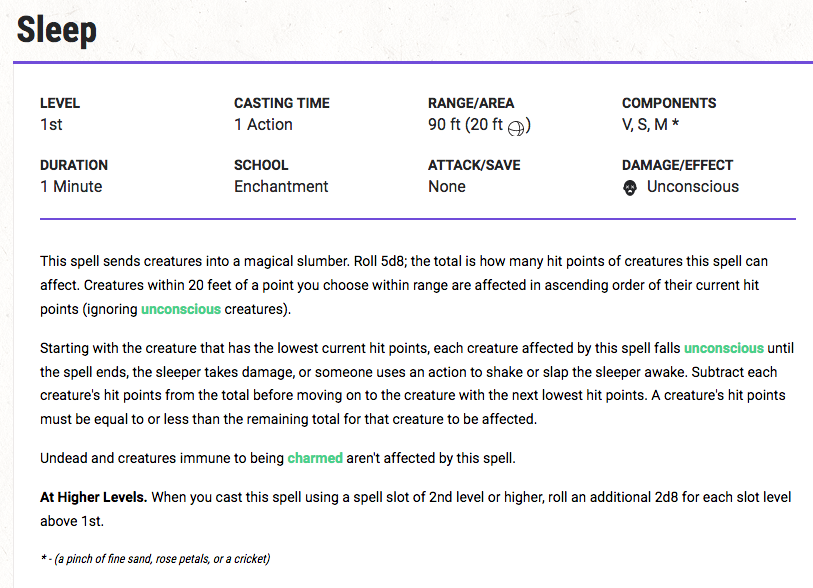
Sleep Spell Reawakening

thinkdmChanging the RulesNumber MunchersSpell Breakdowns  September 12, 2020

D&D’s sleep spell employs an interesting mechanic that isn’t built in the same fashion as most other spells in 5th Edition. Like many elements of D&D (especially spells), it pulls inspiration from the historical mechanics of prior editions. As a result, this 1st level spell can be hard to parse for new players. Many have gone as far as to say that the mechanic is simply bad. Even D&D Lead Rules Designer Jeremy E. Crawford has suggested that “the sleep spell tech…is deprecated design.”

Without debating the veracity of these opinions, we can acknowledge that perception often overrides reality with game mechanics. Let’s take a look under the hood, check out the balance, and see if we can come up with some recommendations for tweaking the sleep spell in your home game.

Mechanics

Effect. This is a strange one. The sleep spell renders foes unconscious, but not with a simple save mechanic. In fact, there’s no save at all. Instead, you roll up a certain number of dice and start knocking out the weakest characters first, subtracting their hit points from the total of your roll.

Power. The total number of hit points the spell affects is 5d8, increasing 2d8 for each additional spell level. The average number of hit points you’ll affect casting this spell is 27.5. Compare this against the presumed hit points provided by the Dungeon Master’s Guide’s Monster Statistics by Challenge Rating table.

Targets. With a 20 foot radius, there’s a variable number of targets that a spell can effect. Thankfully, the Dungeon Master’s Guide provides an assumption for the number of targets within a spell’s area.

The sleep spell’s 20 foot radius gives us an assumption of four targets. But, remember that targets will be affected in order of ascending hit points remaining. Four just gives us an idea for where to set the cap on the maximum number of presumed targets.

Issues

Base Power. An average roll for the sleep spell is not enough to knock out two orcs (CR 1/2). This seems geared towards shutting down smaller swarms of creatures like goblins (CR 1/4) and kobolds (CR 1/8). Now, you might say that the spell was meant to sleep foes who have already been weakened by combat. You’re right, and we’ll get to that in a second.

Scaling. With each additional spell level, you can roll an additional 2d8 to add to the sleep pool. But, that’s only another 9 hit points per level on average, which doesn’t go very far with how quickly monster HP scales.

The sleep spell can quickly become dead weight in a caster’s spellbook. It should not be as strong as an equivalent spell when upcast, but it should maintain usefulness.

No Save. An issue we encounter when trying to scale this spell is that it doesn’t rely on a saving throw. It just works. That’s a pretty terrifying proposition for a DM, and it’s why sleep has a uniquely restrictive implementation. When we expand or rework this mechanic, we need to be cognizant of this fact. Simply adding more dice can quickly make this a powerhouse spell.

Uncertainty. Even where a player has resigned themselves to dinging a target before casting sleep, they never really know whether it’s going to work, not only because of the usual uncertainty of the dice, but also because they have no idea what the target’s remaining hit points might be! Even if your table uses a system like “bloodied” to communicate when a monster has reached half HP, you have no hard information on the actual number of hit points remaining (until it hits zero).

Non-Confrontational Use. Beating someone up defeats the intention to avoid a confrontation by using magic that is ultimately harmless. If I want to incapacitate a pair of guards so my party can sneak by, I don’t want to have to fight. The entire point is avoiding that.

Single vs. Multi-Target. Where sleep excels at putting the kids to bed, it would be nice to have a mode that targets down the threat you want to incapacitate while you deal with the swarm.

The Fix

There are many ways to tackle this hack, all fraught with their own issues. The thing about the current spell iteration is that it does what it does very nicely. That is, it works on the weakest creatures in a bunch, leaving you to tangle with the healthiest/meatiest ones left over.

Steeper Scaling

If we just scale up the amount of dice we get to roll hit points, we’re risking making the spell a LOT stronger. However, its possible that the issue we’re facing is not with the base amount of dice you roll. The average roll on a level 1 sleep spell is the same as an average HP roll for a bugbear (CR 1). Rather, maybe the scaling is off. The average roll on a level 9 sleep spell is the same as an average HP roll for a Chuul (CR 4). So, the scaling is going out the window somewhere. Perhaps this was intentional in the design, but it makes it scarcely useful to upcast sleep.

We actually get a pretty neat scaling if we just increase the number of upcast dice from +2d8 to +3d8 per level. It matches up nicely with the average rolls for CR 2 and CR 3. The scaling slows down a little bit after that point, matching up our CR 4 example at a 5th level cast, and undershooting our CR 5 example by a bit with a 6th level cast. Upcasts progressively getting relatively weaker against higher CRs is an indication of good balance.

New Mechanic

But, are we committed to the mechanic working how it does? Would we sacrifice the current styling to have a system that aligns more closely with other narrative goals we want to accomplish?

One thing the current system does really nicely is that it keeps you from sleep-targeting the main baddie to take them out of the fight. Sleep is really powerful if there’s nobody else around to wake them. With other spells, we rely on things like saving throws to protect stronger creatures. There’s no reason this couldn’t be a saving throw spell.

But, since sleep is so powerful, we can take a page from other spells that induce powerful conditions, such as contagion or flesh to stone, and use a multiple save paradigm. Now, I really hate when you have to make an attack roll to kick a target into saving throws. It’s just too much. But, I don’t mind progressively stronger effects based on successive saves. So, here’s what I came up with:

https://scitechdaily.com/transistor-integrated-microfluidic-cooling-for-more-powerful-electronic-chips/

Transistor-Integrated Microfluidic Cooling for More Powerful Electronic Chips

TOPICS:Electrical EngineeringEPFLNanotechnologySemiconductors

By EPFL SEPTEMBER 11, 2020

Credit: EPFL 2020

Managing the heat generated in electronics is a huge problem, especially with the constant push to reduce the size and pack as many transistors as possible in the same chip. The whole problem is how to manage such high heat fluxes efficiently. Usually electronic technologies, designed by electrical engineers, and cooling systems, designed by mechanical engineers, are done independently and separately. But now EPFL researchers have quietly revolutionized the process by combining these two design steps into one: they’ve developed an integrated microfluidic cooling technology together with the electronics, that can efficiently manage the large heat fluxes generated by transistors.

Their research, which has been published in Nature, will lead to even more compact electronic devices and enable the integration of power converters, with several high-voltage devices, into a single chip.

https://www.youtube.com/embed/Gt12X2X0kUo?feature=oembed
We placed microfluidic channels very close to the transistor’s hot spots, with a straightforward and integrated fabrication process, so that we could extract the heat in exactly the right place and prevent it from spreading throughout the device. Credit: EPFL 2020

The best of both worlds

In this ERC-funded project, Professor Elison Matioli, his doctoral student Remco Van Erp, and their team from the School of Engineering’s Power and Wide-band-gap Electronics Research Laboratory (POWERLAB), began working to bring about a real change in mentality when it comes to designing electronic devices, by conceiving the electronics and cooling together, right from the beginning, aiming to extract the heat very near the regions that heat up the most in the device. “We wanted to combine skills in electrical and mechanical engineering in order to create a new kind of device,” says Van Erp.

The team was looking to solve the issue of how to cool electronic devices, and especially transistors. “Managing the heat produced by these devices is one of the biggest challenges in electronics going forward,” says Elison Matioli. “It’s becoming increasingly important to minimize the environmental impact, so we need innovative cooling technologies that can efficiently process the large amounts of heat produced in a sustainable and cost-effective way.”

Microfluidic channels and hot spots

Their technology is based on integrating microfluidic channels inside the semiconductor chip, together with the electronics, so a cooling liquid flows inside an electronic chip. “We placed microfluidic channels very close to the transistor’s hot spots, with a straightforward and integrated fabrication process, so that we could extract the heat in exactly the right place and prevent it from spreading throughout the device,” says Matioli. The cooling liquid they used was deionized water, which doesn’t conduct electricity. “We chose this liquid for our experiments, but we’re already testing other, more effective liquids so that we can extract even more heat out of the transistor,” says Van Erp.

Reducing energy consumption

“This cooling technology will enable us to make electronic devices even more compact and could considerably reduce energy consumption around the world,” says Matioli. “We’ve eliminated the need for large external heat sinks and shown that it’s possible to create ultra-compact power converters in a single chip. This will prove useful as society becomes increasingly reliant on electronics.” The researchers are now looking at how to manage heat in other devices, such as lasers and communications systems.

Reference: “Co-designing electronics with microfluidics for more sustainable cooling” by Remco van Erp, Reza Soleimanzadeh, Luca Nela, Georgios Kampitsis and Elison Matioli, 9 September 2020, Nature.
DOI: 10.1038/s41586-020-2666-1

https://news.slashdot.org/story/20/09/11/1956239/mit-sleep-monitor-can-track-peoples-sleeping-positions-using-radio-signals

A team of MIT researchers has developed a device that can monitor people’s sleep postures without having to use cameras or to stick sensors on their body. Engadget reports:It’s a wall-mounted monitor the team dubbed BodyCompass, and it works by analyzing radio signals as they bounce off objects in a room. As the researchers explained, a device that can monitor sleep postures has many potential uses. It could be used to track the progression of Parkinson’s disease, for instance, since people with the condition lose their ability to turn over in bed. To differentiate between radio signals bouncing off a body and signals bouncing off random objects in a room, the system focuses on signals that bounce off a person’s chest and belly. In other words, the body parts that move while breathing. It then sends those signals to the cloud, so the BodyCompass system can analyze the user’s posture.

The team trained their creation’s neural network and tested its accuracy by gathering 200 hours of sleep data from 26 subjects who had to wear sensors on their chest and belly in the beginning. They said that after training the device on a week’s worth of data, it predicted the subject’s correct body posture 94 percent of the time. In the future, BodyCompass could be paired with other devices to prod sleepers to change positions, such as smart mattresses. When that happens, the device could alert people with epilepsy if they’ve taken a potentially fatal sleeping position, reduce sleep apnea events and notify caregivers to move immobile patients at risk of developing bedsores. It could also help everyone else get a good night’s sleep, because we definitely all need it.

https://www.psypost.org/2020/09/women-who-agree-with-compliments-are-viewed-more-negatively-than-those-who-downplay-them-study-finds-57940

Women who agree with compliments are viewed more negatively than those who downplay them, study finds

BY BETH ELLWOOD 

A study exploring women’s responses to compliments in the context of online dating has found that women are rated less favorably when they agree with compliments than when they dismiss praise or respond with, “Thank you.” The findings were published in Sex Roles.

Evidence suggests that harassment on dating apps is alarmingly common, particularly for women. Study authors Maria DelGreco and Amanda Denes suggest that understanding the expectations surrounding online interactions serves as a starting point towards reducing online harassment.

In particular, the researchers were interested in the expectations surrounding women’s responses to compliments. Some researchers have suggested that when women agree with compliments, it upsets the male power dynamic, causing women to be more negatively evaluated and potentially harassed by men. DelGreco and Denes propose that it may also have to do with the violation of expectations.

“Although power may underlie such interactions,” the researchers say, “it is also possible that individuals respond negatively to women’s responses to compliments because their expectation of how compliments should be responded to are violated.”

A study was conducted among 413 undergraduate students — 50.6% were women, 48.9% were men, and 0.5% identified as other. The students were randomly assigned to one of three groups. In all conditions, subjects were shown a fictional message exchange that involved a male complimenting a female’s eyes, and included the female’s response.

In one condition, the exchange involved the female conforming to expectations by simply responding to the compliment with “Thank you!”. In a second condition, the woman defied expectations in a positive way, by turning down the praise with, “Thank you, but I don’t think so.” In the third condition, the woman defied expectations in a negative way, by agreeing with the compliment and displaying self-praise saying, “Thank you, I know! They’re pretty great.” After reading the message exchange, all subjects evaluated the fictional woman across several characteristics.

Results showed that women who agreed with the compliment were rated as less socially attractive, conversationally appropriate, and likable than women who conformed to expectations by accepting the compliment with, “Thank you!”. They were also rated as having more power and higher self-esteem. While researchers had expected women who dismissed the compliment to be rated more favorably, since they were positively defying expectations, women who turned down the compliment were also rated less socially attractive, conversationally appropriate, and likable than those who accepted the compliment. They were additionally rated lower in power and self-esteem.

“The finding that women who respond with agreement are evaluated more poorly is especially problematic in that it suggests that women who are confident and empowered may be the targets of negative interpersonal and online behavior. Such findings may also echo larger gendered power dynamics at play in online dating contexts,” the authors say.

DelGreco and Denes address the limitation that their study relied on a fictional message exchange and that subjects’ reactions to the messages may not coincide with how they would perceive such an exchange in the real world. Still, the researchers say, “Ultimately, the findings suggest that dating double standards continue to exist in online dating contexts and that confident women may be subject to social sanctions.”

The study, “You are not as Cute as you Think you are: Emotional Responses to Expectancy Violations in Heterosexual Online Dating Interactions”, was authored by Maria DelGreco and Amanda Denes.

https://www.theguardian.com/science/2020/sep/12/stars-astronomy-spacex-satellite-elon-musk

Are Elon Musk’s ‘megaconstellations’ a blight on the night sky?

Miniature satellites open up a world of technological possibility. But experts say they degrade the astronomical landscape

Stuart Clark @DrStuClark

Sat 12 Sep 2020 17.00 BST

A composite of long exposure images showing SpaceX’s Starlink satellite constellation passing over London earlier this year.
 A composite of long exposure images showing SpaceX’s Starlink satellite constellation passing over London earlier this year. Photograph: Stephen Chung/Alamy Live News

The natural serenity of the night sky is a touchstone for all of us. Everyone alive today looks at the same stars no matter where they are located on the planet. But the connection is more profound because, next to our brief lives, the stars are immortal. Shakespeare saw the same stars in the same patterns that we do. So did Galileo, Columbus, Joan of Arc, Cleopatra and the first human ancestor to look up in curiosity. The night sky is nothing short of our common human heritage.

Last year, however, something happened that might change that view for ever. On 23 May 2019, Elon Musk’s company SpaceX launched 60 small satellites from a single rocket. The satellites were the first in what is planned to be a “megaconstellation” of thousands of satellites that will bring internet coverage to the entire planet.

A day later, a satellite tracker from the Netherlands, Marco Langbroek, took a video of the satellites passing overhead – and what he saw blew his mind. “It started with two faint, flashing objects moving into the field of view,” he wrote on his blog. “Then, a few tens of seconds later, my jaw dropped as the ‘train’ entered the field of view. I could not help shouting ‘OAAAAAH!!!!’ (followed by a few expletives…).” He posted a video of what he saw.

Since that time, SpaceX has launched hundreds more Starlink satellites, and although watching these satellites pass overhead has become a new hobby for some, others are worried about the cultural implications, and the way it could affect our relationship with the night sky. Left unchecked, we may never again be able to experience a view of the silent, still cosmos with our own unaided eyes. Instead, it will always be criss-crossed by bright, human-made objects.

One man’s mission to conquer space

 Read more

“In a couple of generations there will be no one left alive who remembers the night sky before these satellites. They will have grown up with Starlink and the other proposed megaconstellations as part of their conception of the night sky. I think that’s a radical change,” says Alice Gorman of Flinders University, South Australia, a pioneer in the emerging field of space archaeology and heritage.

“One of the reasons people value the night sky is because it gives you a sense of transcendence and connectedness to the universe, and inspires contemplation about the meaning of life and the massive scale of stars and galaxies. That seems to be an experience that people really value and so people have argued that a right to the night sky is kind of fundamental to being human,” says Gorman.

What gives this discussion added urgency is that the more researchers and businesses think about megaconstellations, the more they realise what they can do with them. Telecommunications, navigation, weather prediction, climate monitoring and other Earth observation, space science – the limits are simply those of people’s imaginations.

Jordi Puig-Suari holding a CubeSat, which he invented with Stanford professor Bob Twiggs.
 Jordi Puig-Suari holding a CubeSat, which he invented with Stanford University professor Bob Twiggs. Photograph: California Polytechnic State University

By any measure, it is an extraordinary moment in the history of our study and use of outer space. But what might be the consequences?

The megaconstellations have been made possible by the miniaturisation of technology, and at the forefront of this drive is the CubeSat, developed by Bob Twiggs of Stanford University and Jordi Puig-Suari of California Polytechnic State University in the 1990s.Advertisement

CubeSats are tiny satellites. At their smallest they are just 10 x 10 x 10cm. “The size was driven by the size of a Beanie Baby box that they happened to have on hand,” says Scott Williams, a programme director at SRI International, who was developing smaller satellites himself in the late 1980s. He then started working with Twiggs on the early ideas for CubeSats. Back then, no one had megaconstellations in mind.

Sign up for Lab Notes – the Guardian’s weekly science update


“It was purely an educational thing, to get students involved in launching something into space within the timeframe of a PhD,” says Samson Phan, a senior research engineer at SRI International.

Traditionally, satellites are about the size of a car. They are hugely expensive to make and take many years to design, build and launch. The goal of the CubeSat programme was for a student team to be able to produce a working satellite in a few years that could transmit a radio signal like the first artificial satellite, Russia’s Sputnik 1. But from the initial idea of developing an educational resource, a grand vision was quick to form.

Williams and his then colleague Victor Aguero both saw a parallel to the way microcomputers had become a “disruptive event” that revolutionised technology. “The vision was: can you do more with less? Instead of building an exquisite trillion-dollar satellite, can you get significant capability out of a whole lot of much cheaper satellites?” he says.

Following their PhDs, Williams and Aguero moved to SRI International, where Williams has focused on the development and exploitation of small satellites in general and CubeSats in particular. And now the fruits of those labours are really starting to show. The small satellite market is exploding.

In a couple of generations there will be no one left alive who remembers the night sky before these satellites

From 1998 to 2012, more than 120 small satellites were launched. In the next two years, that number more than doubled. The tally now runs at around 500 small satellites a year, mostly made up of the Starlink units. Although they are not CubeSats, they apply the same principle of a small, simple satellite that can be mass produced to keep the cost down.

In July, the UK government bought a £400m stake in OneWeb, which plans to launch its own constellation of 650 small satellites to provide internet and a satellite navigation service, following the UK’s disbarring from the EU’s Galileo project because of Brexit.

Beyond communications and navigation, small satellites open up a whole new world of scientific investigations. The European Space Agency (ESA) now has a dedicated team of people looking into what missions around Earth and in deep space are enabled by CubeSats.

But for all the promise, there are some big problems with megaconstellations. One of the biggest is space debris. If satellites collide in orbit, they produce clouds of debris that can destroy other satellites, potentially starting a chain reaction known as the Kessler syndrome. And with megaconstellations exponentially increasing the number of satellites in orbit, the danger will increase.

“All of a sudden, there’s an increased burden on our space traffic management, which is, at best, in an early stage of existence,” says Hugh Lewis, an expert in space debris at the University of Southampton.

An early illustration of this problem came in September 2019 when one of the first batch of Starlink satellites was found to be on a collision course with the ESA’s €481m Aeolus Earth-observation satellite. Because of a miscommunication between the two organisations, it wasn’t until half an orbit before the potential smash that ESA moved their satellite out of the danger zone.Advertisement

“There’s a lot of unknowns and there’s a lot of uncertainty associated with things like space safety,” says Lewis, “We don’t have rules of the road yet.” The good news, though, he says, is that nearly all of the commercial space companies that he’s spoken to are aware of these issues and doing their best to address them.

But then there are the astronomers. They perhaps stand to lose the most from the megaconstellations as the satellites will forever be crossing their fields of view, damaging their ability to collect data from the distant universe. Take, for example, the Vera C Rubin Observatory, an American-funded facility in Chile. This gigantic telescope has been in development for more than 20 years and costs millions of dollars. It is designed to begin the deepest survey of the night sky ever in 2022, but now it’s astronomers are wondering how to deal with the plethora of Starlink satellites that will streak across its images every night.

Nanosatellites in space.
 A whole new world of scientific investigation… Nanosatellites in space. Photograph: Science History Images/Alamy Stock Photo

Advertisement

Robert Massey, the deputy executive director of the Royal Astronomical Society, has taken a particular interest in the consequences and understands that it is a knotty problem. “I recognise that there are multiple uses of space, and that astronomers are not the only community with a stake in that,” he says. “On the other hand, you can also argue that private companies are not the only organisations that have a stake in the now burgeoning commercialisation of low-Earth orbit. They should be regulated, just as they are on the surface of the Earth and in the atmosphere, the seas and so on.”.

To its credit, SpaceX has not turned a blind eye to these concerns. In response to the near-miss with ESA, the company claims to have made changes to its communications system. Additionally, as a result of conversations with the Royal Astronomical Society and others, SpaceX has darkened the latest batches of the spacecraft and installed a “visor” that blocks sunlight from falling on the bulk of the satellite. With those two modifications, the satellites should only be visible to the naked eye when they are in their final orbits – although that won’t stop them potentially damaging the view of anyone using even the smallest telescope.

While some might find this intolerable, others see things very differently. “People tend to fall into two camps,” says Gorman, “Some are like: ‘It’s come to this, we’ve now put so much stuff in space that it’s going to be in our face all the time’, and the other kind of people are incredibly excited.”

Elon Musk.
 People tend to fall into two camps: doubtful and incredibly excited… SpaceX founder Elon Musk. Photograph: Steve Nesius/Reuters

Williams is one of the latter. “The stars are nice and the planets are nice but if you’re trying to captivate an eight-year-old, it needs to move. I recall the first time I saw a manmade object going across the sky. It was amazing,” he says. “I think as these constellations get bigger, and this kind of image becomes more easily accessible to the youth, I think they’ll look up at those things and wonder: what can we do with that?”

Indeed, there were many people who have already been thrilled by the sight of the Starlink trains, flooding social media with images and exclamations. But Massey thinks that this is driven more by novelty value and that, with time, the interest might wane. “If people see a string of bright satellites moving across the sky, of course they’re very interested in that. I think the problem is when you have a sky absolutely full of them, even if they’re fainter. It’s a bit like a blue sky being full of planes and contrails. We don’t necessarily see that as something to celebrate,” says Massey.

The history of humankind has been one in which we have regularly re-evaluated our association with the night sky: from a heavenly realm of gods, to a place of mystical influence over our lives, to a universe of unreachable celestial objects, to its modern incarnation as a realm of destinations that we may one day colonise. Perhaps the constant presence of visible satellites is just another of these turning points.

Whatever camp you fall into, there is no doubt that this is a dramatic change to what has previously been an unadulterated way of contemplating nature and our place within it. And only time will tell what the consequences of that change will be.

Stuart Clark’s latest book, Beneath the Night: How the Stars Have Shaped the History of Humankind, is published on 1 October by Guardian Faber

Since you’re here …

… joining us from Canada, we have a small favour to ask. You’ve read 46 articles in the last year. And you’re not alone; millions are flocking to the Guardian for open, independent, quality news every day, and readers in 180 countries around the world now support us financially.

We believe everyone deserves access to information that’s grounded in science and truth, and analysis rooted in authority and integrity. That’s why we made a different choice: to keep our reporting open for all readers, regardless of where they live or what they can afford to pay.

The Guardian has no shareholders or billionaire owner, meaning our journalism is free from bias and vested interests – this makes us different. Our editorial independence and autonomy allows us to provide fearless investigations and analysis of those with political and commercial power. We can give a voice to the oppressed and neglected, and help bring about a brighter, fairer future. Your support protects this.

Supporting us means investing in Guardian journalism for tomorrow and the years ahead. The more readers funding our work, the more questions we can ask, the deeper we can dig, and the greater the impact we can have. We’re determined to provide reporting that helps each of us better understand the world, and take actions that challenge, unite, and inspire change.

Your support means we can keep our journalism open, so millions more have free access to the high-quality, trustworthy news they deserve. So we seek your support not simply to survive, but to grow our journalistic ambitions and sustain our model for open, independent reporting.

If there were ever a time to join us, and help accelerate our growth, it is now. You have the power to support us through these challenging economic times and enable real-world impact.

http://linuxgizmos.com/arm-linux-version-of-j-link-debugger-lets-the-raspberry-pi-play-host/

Arm Linux version of J-Link debugger lets the Raspberry Pi play host

Sep 11, 2020 — by Eric Brown — 219 viewsPlease share:

Segger has ported its J-Link debugging software to Arm Linux hardware such as the Raspberry Pi for use with its J-Link Debug Probes. The news follows the release of the compatible Eclipse Embedded CDT for Arm and RISC-V.

The Raspberry Pi and other Arm Linux gizmos have long been supported as targets by development platforms such as Eclipse and compatible debuggers such as Segger Microcontroller’s J-Link. Now they can act as the development platform itself.

Segger has released its first debugging software for use with its J-Link hardware debuggers that supports 32-bit and 64-bit Arm Linux platforms including the Raspberry Pi. Aimed primarily at industrial automation projects, the release coincides with the release of the compatible Eclipse Embedded CDT (C/C++ Development Tools) for Arm and RISC-V (see farther below).


J-Link Pro 500 (left) and J-Link Base Compact
(click images to enlarge)

J-Link for Arm Linux contains all command-line versions of the software and supports the same target devices and features found in the Windows, macOS, and Linux x86 equivalents. Features include high-speed download into flash memory and an unlimited number of breakpoints “even in flash memory,” says Segger.

The software includes the GDB Server remote server software, which makes it “compatible with all popular development environments.” The J-Link SDK supports writing custom programs for J-Link on Arm Linux.

J-Link for Arm Linux works with a variety of J-Link Debug Probes detailed in the chart below. All the J-Link probes offer USB, JTAG, cJTAG, SWD, SWO, and ETB Trace support, and some offer Ethernet, ETM Trace, WiFi, and other features. Bandwidth and target interface speeds vary, with RAM download speed ranging from 200KB per second to 3MB per second.


J-Link Debug Probe feature comparison
(click images to enlarge)

J-Link for Arm Linux is a significant milestone toward bringing Arm up to speed with x86 platforms for embedded development hosting. Yet, even the quad-core, Cortex-A72 Raspberry Pi 4 with up to 8GB RAM is less than ideal for more demanding development and debugging applications.


Raspberry Pi 4

Stated Liviu Ionescu, developer of the Open-Source Eclipse Embedded CDT project: “Although it seems very unusual, even unlikely, it is now possible to use a small Raspberry Pi 4 single board computer with the Eclipse for Embedded C/C++ Developers package and the additional xPack binary tools, plus Segger’s J-Link debug probe and J-Link software, to create projects, build them and run debug sessions! Amazing!”

Stated Rolf Segger, founder of Segger Microcontroller: “While the typical use is automated test systems and using Raspberry Pi as a J-Link bridge or Server in the LAN / WLAN, there are many other applications. With Eclipse Embedded CDT coming, it is possible to use Raspberry Pi and J-Link as hardware to develop, download and debug firmware for Embedded Devices.”

Eclipse Embedded CDT (C/C++ Development Tools) comprises a set of plug-ins that allow developers to create, build, debug, and manage ARM and RISC-V projects with the Eclipse framework “without having to manually create and maintain makefiles,” says the Eclipse Foundation. Formerly referred to as GNU MCU/ARM Eclipse, the plug-ins include executables and static/shared libraries in both 32- and 64-bit versions and run on Windows, macOS, and GNU/Linux.

The platform provides debugging support via JTAG/SWD, as well as a peripheral registers view for debug sessions. Templates are available for some Cortex-M processors. The Eclipse plug-ins can integrate a series of external tools available from the separate xPack Project.

 
Further information

The J-Link for Arm Linux software is available in free non-commercial and commercial versions. The commercial versions of the J-Link hardware probes range from $378 for the J-Link Base Compact to $998 for the J-Link Pro, both of which are shown farther above. Educational versions such as the J-Link EDU and J-Link EDU Mini sell for as low as $18.

More information may be found in Segger’s announcement, as well as its J-link product page and J-Link shopping page.

More on Eclipse Embedded CDT may be found here.

LinuxGizmos related posts: