Science Made Simple: What Is a Tokamak?
TOPICS:DOEEnergyPlasma Physics
By U.S. DEPARTMENT OF ENERGY JANUARY 30, 2021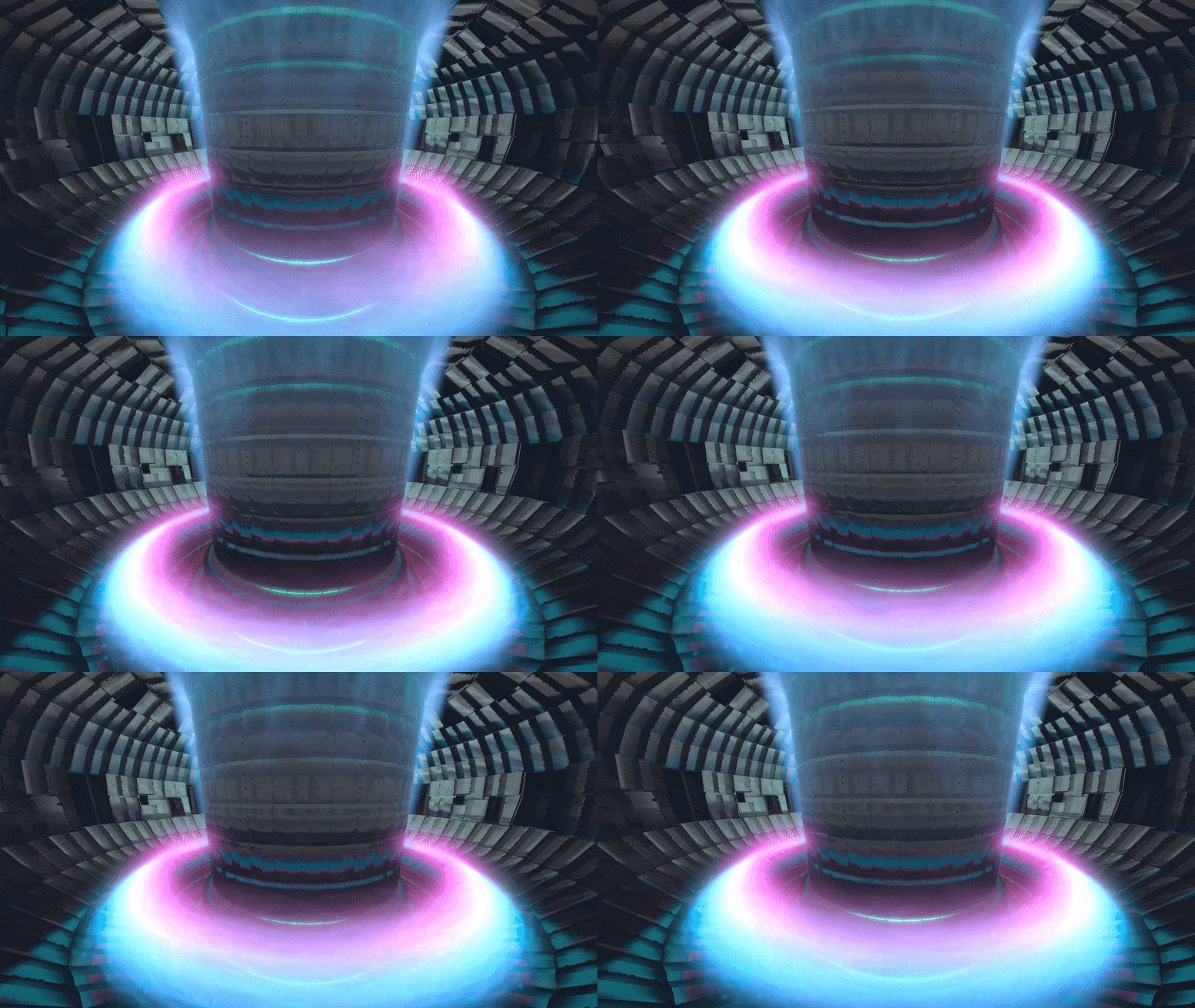
ITER fusion reactor tokamak. Credit: ITER
A tokamak is a machine that confines a plasmausing magnetic fields in a donut shape that scientists call a torus. Fusion energy scientistsbelieve that tokamaks are the leading plasma confinement concept for future fusion power plants.
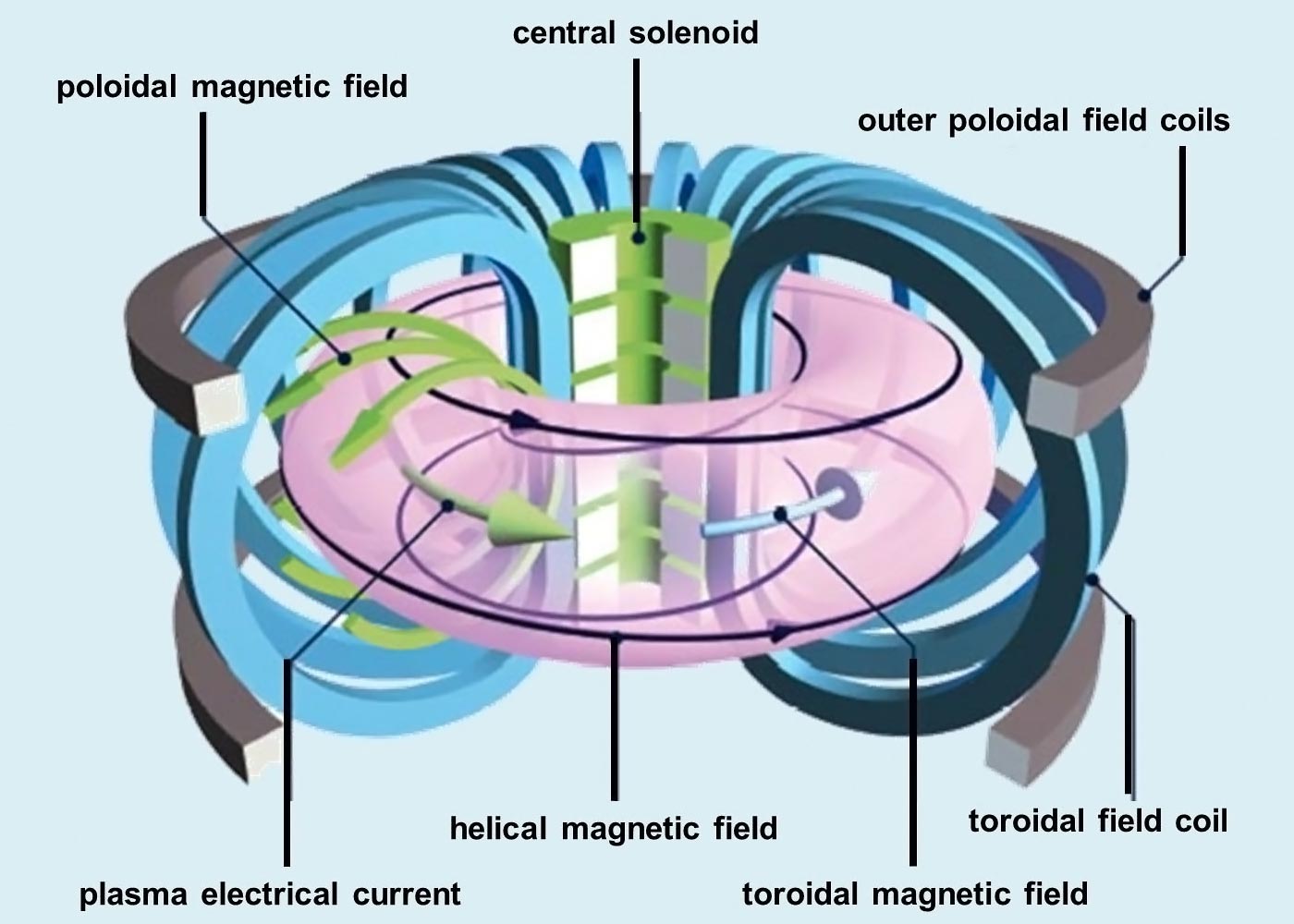
In a tokamak, magnetic field coils confine plasma particles to allow the plasma to achieve the conditions necessary for fusion. One set of magnetic coils generates an intense “toroidal” field, directed the long way around the torus. A central solenoid (a magnet that carries electric current) creates a second magnetic field directed along the “poloidal” direction, the short way around the torus.
The two field components result in a twisted magnetic field that confines the particles in the plasma. A third set of field coils generates an outer poloidal field that shapes and positions the plasma.
Basic tokamak components include the toroidal field coils (in blue), the central solenoid (in green), and poloidal field coils (in grey). The total magnetic field (in black) around the torus confines the path of travel of the charged plasma particles. Credit: Image courtesy of EUROfusion
The first tokamak, T-1, began operation in Russia in 1958. Subsequent advances led to the construction of the Tokamak Fusion Test Reactor at Princeton Plasma Physics Laboratory and Joint European Torus in England, both of which achieved record fusion power in the 1990s. These successes motivated 35 nations to collaborate on the superconducting ITER tokamak, which aims to explore the physics of burning plasmas.
Quick Tokamak Facts
- Tokamaks can sustain plasma currents at the mega-ampere level, which is equivalent to the electric current in the most powerful bolts of lightning.
- The world record fusion power output of 16 megawatts was achieved in the JET tokamak in England in 1997.
- The ITER central solenoid will be the largest superconducting magnet ever built. It will produce a field of 13 tesla, equivalent to 280,000 times the Earth’s magnetic field.
DOE Office of Science: Tokamak Contributions
The DOE Office of Science primarily supports research and development on tokamaks through its Fusion Energy Sciences (FES) program and FES partnerships with its Advanced Scientific Computer Research (ASCR) program. The FES program focuses on tokamaks because of the concept’s excellent ability to confine plasma, a feature necessary to sustain fusion reactions and realize fusion energy production. The Office of Science maintains world-leading research programs at tokamak user facilities such as the DIII-D National Fusion Facility and the National Spherical Torus Experiment Upgrade (NSTX-U). FES supports several international collaborations, too. These include projects in Asia as well as ITER in France. The FES role in ITER, which is managed by the US ITER Project Office, includes fabrication of the central solenoid.
We recommend
- A New Path to Improve High $\beta_{\rm p}$ Plasma Performance on EAST for Steady-State Tokamak Fusion ReactorBaonian Wan et al., Chinese Physics Letters, 2020
- Theoretical analysis for the mechanical behavior caused by an electromagnetic cycle in ITER $$\hbox {Nb}_{3}\hbox {Sn}$$ Nb 3 Sn cable-in-conduit conductorsDonghua Yue et al., Acta Mechanica Sinica, 2018
- Discharge simulation and volt-second consumption analysis during ramp-up on the CFETR tokamak*Cheng-Yue Liu et al., Chinese Physics B, 2020
- Theoretical analysis for the mechanical behavior caused by an electromagnetic cycle in ITER $$\hbox {Nb}_{3}\hbox {Sn}$$ Nb 3 Sn cable-in-conduit conductorsDonghua Yue et al., Acta Mechanica Sinica, 2018
- MONARCH 2: Abemaciclib in Combination With Fulvestrant in Women With HR+/HER2− Advanced Breast Cancer Who Had Progressed While Receiving Endocrine TherapySledge et al., J Clin Oncol, 2017
 Bruce's Blog