Elon Musk donates $5 million to education group Khan Academy
By Alaa Elassar, CNN
Updated 7:46 AM ET, Sun January 17, 2021
(CNN)Tesla CEO Elon Musk has donated $5 million to the online learning organization Khan Academy.In a YouTube video posted Monday, Khan Academy founder Salman Khan thanked Musk for the donation, which the Tesla CEO made through his Musk Foundation.“Elon, I hope you really feel good about this,” Khan said in the video. “This is going to allow us to accelerate all sorts of content. Our aspirations are all subjects — from kids to early stages of college. This will accelerate our science content, allow us to do more early learning, allow us to make the software and the practice that much more engaging.”
Online classes: 5 reasons students benefit from ‘cameras off’Founded in 2002, the Musk Foundation supports research in renewable energy, human space exploration, pediatrics and science and engineering.Khan Academy is a nonprofit that aims to “provide free, world-class education for anyone, anywhere.” Students worldwide can utilize Khan Academy videos, which are translated into more than 36 languages, and learn at their own pace. The resources — videos, practice exercises, and personalized learning dashboards — are also used by parents and teachers.As the coronavirus pandemic forced schools to turn to distance learning, many students and parents who struggled with the transition turned to Khan Academy for help, the organization says.While many students may not recognize Khan’s face, millions of them know Khan by his voice, because of his video tutorials on subjects ranging from photosynthesis and calculus to the American Revolution.Khan Academy has over 120 million registered users, with up to 30 million students using the platform every month.”I view this type of investment in what we’re doing as really foundational for us to be able to build a multi-generational institution, so that future Elon Musks of the world are also able to tap into their potential and help all of us up-level who we are as a civilization,” Khan said.
The average daily time spent online by adults increased by nearly an hour during the UK’s spring lockdown when compared to the previous year, according to communications regulator Ofcom. With numerous countries back under severe pandemic restrictions, many of us once again find ourselves questioning whether our heavy reliance on technology is impacting our wellbeing.
In our recent research, we explored how to empower people to have healthier and more productive relationships with digital technology. Our findings can be applied to those suffering from digital addiction as well as those who may feel their digital diet has ballooned unhealthily in the solitude and eventlessness of lockdown.
Screen time is an obvious measure of digital addiction, although researchers have noted that there is no simple way to determine how much screen time one can experience before it becomes problematic. As such, there is a continued lack of consensus on how we should think about and measure digital addiction.
Credit: Lynette Coulston / PixabayMany of us have turned to video conferencing to keep in touch with friends and family.
During a global pandemic, when there often feels like no alternative to firing up Netflix, or video conferencing with friends and family, screen time as an indicator of digital addiction is clearly ineffective. Nonetheless, research conducted on digital addiction intervention and prevention does provide insights on how we can all engage with our digital technologies in a healthier way during a lockdown.
1. Setting limits
During the course of our research, we found that effective limit setting can motivate users to better control their digital usage. When setting limits, whatever goal you’re deciding to work towards should be aligned with the five “SMART” criteria. That means the goal needs to be specific, measurable, attainable, relevant and time-bound.
For example, instead of framing your goal as “I will cut down my digital media use,” framing it as “I will spend no more than one hour watching Netflix on weekdays” will enable you to plan effectively and measure your success objectively.
2. Online Support Groups
It might seem a little paradoxical, but you can actually use technology to help promote greater control over your screen time and digital overuse. One study has found that online peer support groups — where people can discuss their experiences with harmful technology use and share information on how to overcome these problems — can help people adjust their digital diet in favor of their personal wellbeing. Even an open chat with your friends can help you understand when your tech use is harmful.
Self-awareness can also be attained by reflecting on emotional and cognitive processing. This involves recognizing feelings and psychological needs behind excessive digital usage. “If I don’t instantly reply to a group conversation, I will lose my popularity” is a problematic thought that leads to increased screen time. Reflecting on the veracity of such thoughts can help release people from addictive patterns of digital usage.
4. Know your triggers
Acquiring self-awareness on addictive usage patterns can actually help us to identify unsatisfied needs that trigger digital overuse. When we do this, we can pave the way to define alternative behaviors and interests to satisfy those needs in different ways.
Mindfulness meditation, for instance, could be an alternative way of relieving stress, fears, or anxiety that currently leads users to digital overuse. If you feel your digital overuse might simply be due to boredom, then physical activity, cooking, or adopting offline hobbies can all provide alternative forms of entertainment. Again, technology can actually help enable this, for example by letting you create online groups for simultaneous exercising, producing a hybrid solution to unhealthy digital habits.
We must also remember that our relationship with digital media reflects our inner drives. Humans are innately social creatures, and socializing with others is important to our mental wellbeing. Social media can enhance our opportunities for social contact, and support several positive aspects of mental wellbeing, such as peer support and the enhancement of self-esteem. The engagement with media to purposefully socialize during a lockdown can support our mental health, rather than being detrimental to our wellbeing.
Ultimately, technology companies also have a responsibility to both understand and be transparent about how the design of their platforms may cause harm. These companies should empower users with explanations and tools to help them make informed decisions about their digital media use.
While we may consider this as a legitimate user requirement, technology companies seem to be at the very early stages of delivering it. In the meantime, reflecting on when and why we turn to our screens is a good basis upon which to form positive digital habits during new lockdowns imposed this year.
Sleep Better at Night by Shifting Your Daytime Habits With 7 Tips From Arianna Huffington
Arianna Huffington・January 17, 2021
This isn’t your standard New Year’s plan. No restrictive diets, no weekly weigh-ins, no “whole new you” for this new year—because, hey, you’re pretty great already. These four expert-led plans—designed to help you move your body, eat more veggies, get a better night’s sleep, or show yourself some loving care—are all about developing healthy habits that better align with your goals.Get the Program
We naturally associate sleep with nighttime, but daytime mindset shifts can make a huge difference for improving our ability to sleep when the sun goes down. These mindfulness practices and movements for better sleep start the moment we wake up and continue until it’s time for bed.
Getting exercise throughout the day increases the likelihood that you’ll get better sleep later—and that certainly doesn’t have to mean going to the gym.
For example, getting exercise throughout the day increases the likelihood that you’ll get better sleep later—and that certainly doesn’t have to mean going to the gym. University of Pennsylvania researchers showed that those who walked for exercise got better sleep and that, as lead study author Michael Grandner, PhD, put it, “these effects are even stronger for more purposeful activities, such as running and yoga, and even gardening and golf.”
Small changes in the course of a busy day, such as taking the stairs instead of the elevator if you are able to do so, are sneakily effective. With that in mind, each of this week’s tips for mindfulness practices and movements for better sleep aim to help you optimize your daily routine in small but meaningful ways.
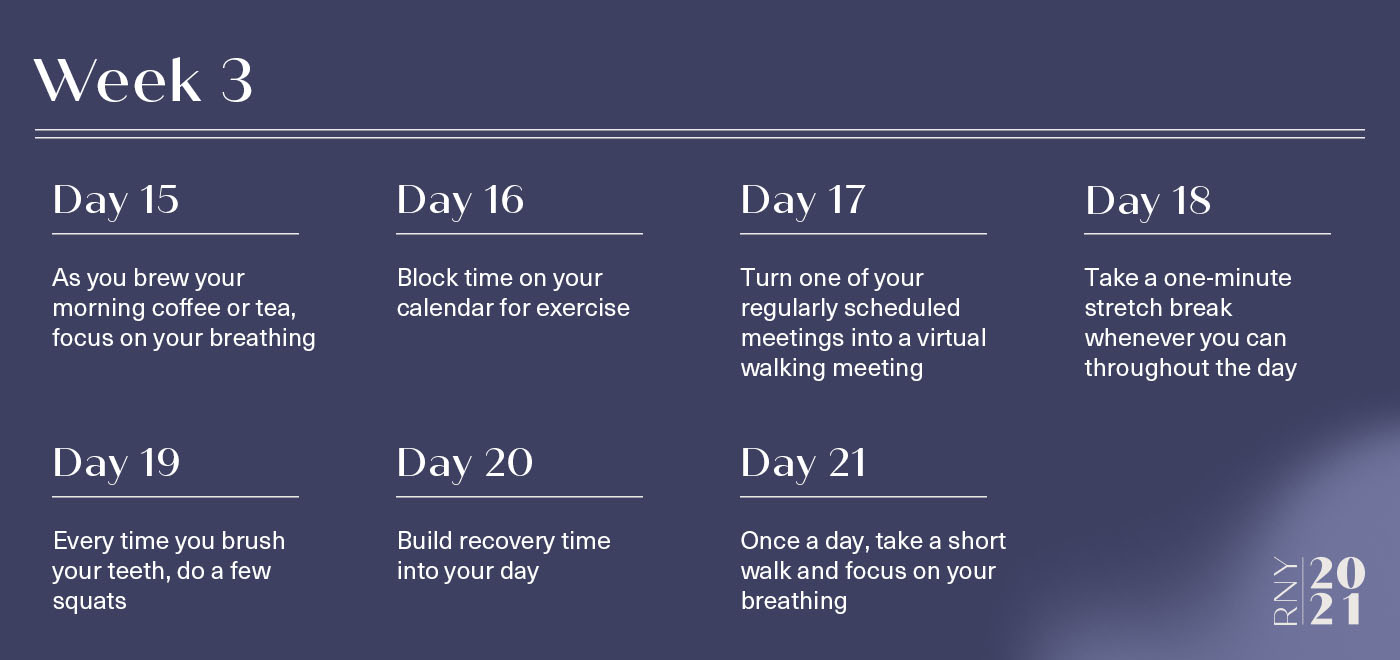
Day 15: As you brew your morning coffee or tea, focus on your breathing
Instead of watching television, looking at your phone, or going to your to-do list, focusing on your breathing will help you quickly center yourself for the day ahead.
Day 16: Block time on your calendar for exercise
Treat your exercise time like you would an important meeting or doctor’s appointment. You wouldn’t miss those! So, shift your mindset about exercise to be an investment in your sleep and health, and then prioritize that time for yourself.
Day 17: Turn one of your regularly scheduled meetings into a virtual walking meeting
You and the other meeting attendees can go on walks in your respective neighborhoods (as long as you can maintain safe social distancing), and speak on the phone as you walk.
Day 18: Take a one-minute stretch break whenever you can throughout the day
Frequent movement fuels your body and mind. Stand up, change positions, stretch—anything to get your blood flowing.
Day 19: Every time you brush your teeth, do a few squats
Stacking a new habit on top of an existing one is a great way to add movement to your day with no extra time added.
Day 20: Build recovery time into your day
Take a tip from top athletes who introduce small recovery rituals into their process: Simply stop what you’re doing, and bring your awareness to the palms of your hands or the soles of your feet—or both. Let your awareness stay there for a minute, and feel the tension leave your body.
Day 21: Once a day, take a short walk and focus on your breathing
You can still your mind even when you’re moving your body. If you’re in a place filled with noise and distractions, a quiet walk once or twice a day can help bring you into closer contact with yourself, your breath, and the world beyond your workplace or other sources of stress.
Apple MacBook Air M1 GET IT FOR:Starts at Rs 92,900 HIGHLIGHT: Fast performance
Starting afresh is never easy, especially when you have a product that enjoys a cult following. But that is exactly what Apple did in 2020 with its MacBook devices when it introduced its own M1 processor. By the looks of it, nothing has changed – the MacBook Air still looks the same. But at the heart of it, everything is differ
when it introduced its own M1 processor. By the looks of it, nothing has changed – the MacBook Air still looks the same. But at the heart of it, everything is different.
The M1 processor has an eight-core CPU – with four high-performance cores and four more for routine tasks. The M1 processor is based on ARM and not Intel’s Core CPUs and it is a risk to move away from the tried and tested model used by one and all. Apple has taken that risk and it has paid off handsomely as the new MacBook Air is an excellent laptop that does everything really well.
We put the MacBook Air through some rigorous testing – high graphics games, video editing and photo editing – and found that it hardly broke a sweat. The MacBook Air is one of the rare laptops to not have a fan and it is remarkable how cool the laptop remains even during heavy-duty processing tasks.
The battery life on the MacBook Air is really good and lasts for close to 18 hours – one of the best we have seen in any laptop. The design remains the same – thin and light with an aluminium frame that makes it look good and easy to carry. You get three colour variants – space grey, gold and silver.
Both Dell and HP have made thinner laptops than the Air so that can’t really be the selling point of the MacBook like it used to. That’s why the shift in the processor, as it is something you will not find in any other laptop in the market – except the MacBook Pro, which costs about Rs 25,000 more.
One of the sore points of the MacBook Air always has been connectivity and that, unfortunately, hasn’t changed. You get two Type-C ports and a 3.5-mm jack, which means a dongle dock is something you will have to buy.
One of the sore points of the MacBook Air always has been connectivity and that, unfortunately, hasn’t changed. You get two Type-C ports and a 3.5-mm jack, which means a dongle dock is something you will have to buy.
The 13-inch display (2560 x 1600 resolution) IPS display remains the same and is great to look at – vivid and accurate colour reproduction and sharp viewing angles. The Magic Keyboard is found in the MacBook Air which has ample travel time and the trackpad is as responsive as ever.
The MacBook Air M1 is a near-perfect laptop. At Rs 92,900, it has everything one wants in a premium laptop – fast processor, good looks and a really long battery life.
One of the obstacles for progress in the quest for a working quantum computer has been that the working devices that go into a quantum computer and perform the actual calculations, the qubits, have hitherto been made by universities and in small numbers. But in recent years, a pan-European collaboration, in partnership with French microelectronics leader CEA-Leti, has been exploring everyday transistors — that are present in billions in all our mobile phones — for their use as qubits.
The French company Leti makes giant wafers full of devices, and, after measuring, researchers at the Niels Bohr Institute, University of Copenhagen, have found these industrially produced devices to be suitable as a qubit platform capable of moving to the second dimension, a significant step for a working quantum computer. The result is now published in Nature Communications.
Quantum dots in two dimensional array is a leap ahead
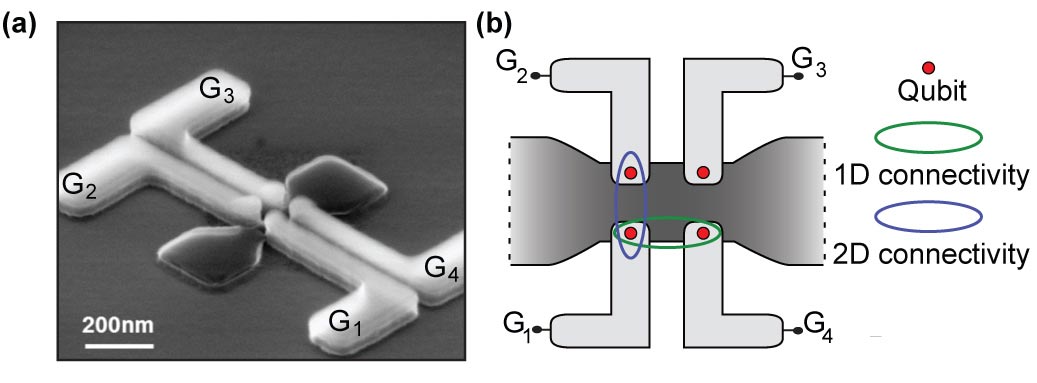
One of the key features of the devices is the two-dimensional array of quantum dot. Or more precisely, a two by two lattice of quantum dots. “What we have shown is that we can realize single electron control in every single one of these quantum dots. This is very important for the development of a qubit, because one of the possible ways of making qubits is to use the spin of a single electron. So reaching this goal of controlling the single electrons and doing it in a 2D array of quantum dots was very important for us,” says Fabio Ansaloni, former PhD student, now postdoc at center for Quantum Devices, NBI.
(a) Scanning electron image of one of the Foundry-fabricated quantum dot devices. Four quantum dots can be formed in the silicon (dark grey), using four independent control wires (light grey). These wires are the control knobs that enable the so called quantum gates. (b) Schematic of the two-dimensional array device. Each Qubit (red circle) can interact with its nearest neighbor in the two-dimensional network, and circumvent a Qubit that fails for one reason or other. This setup is what “second dimension” means. Credit: Fabio Ansaloni
Using electron spins has proven to be advantageous for the implementation of qubits. In fact, their “quiet” nature makes spins weakly interacting with the noisy environment, an important requirement to obtain highly performing qubits.
Extending quantum computers processors to the second dimension has been proven to be essential for a more efficient implementation of quantum error correction routines. Quantum error correction will enable future quantum computers to be fault tolerant against individual qubit failures during the computations.
The importance of industry scale production
Assistant Professor at Center for Quantum Devices, NBI, Anasua Chatterjee adds: “The original idea was to make an array of spin qubits, get down to single electrons and become able to control them and move them around. In that sense it is really great that Leti was able to deliver the samples we have used, which in turn made it possible for us to attain this result. A lot of credit goes to the pan-European project consortium, and generous funding from the EU, helping us to slowly move from the level of a single quantum dot with a single electron to having two electrons, and now moving on to the two dimensional arrays. Two dimensional arrays is a really big goal, because that’s beginning to look like something you absolutely need to build a quantum computer. So Leti has been involved with a series of projects over the years, which have all contributed to this result.”
The credit for getting this far belongs to many projects across Europe
The development has been gradual. In 2015, researchers in Grenoble succeeded in making the first spin qubit, but this was based on holes, not electrons. Back then, the performance of the devices made in the “hole regime” were not optimal, and the technology has advanced so that the devices now at NBI can have two dimensional arrays in the single electron regime. The progress is threefold, the researchers explain: “First, producing the devices in an industrial foundry is a necessity. The scalability of a modern, industrial process is essential as we start to make bigger arrays, for example for small quantum simulators. Second, when making a quantum computer, you need an array in two dimensions, and you need a way of connecting the external world to each qubit. If you have 4-5 connections for each qubit, you quickly end up with a unrealistic number of wires going out of the low-temperature setup. But what we have managed to show is that we can have one gate per electron, and you can read and control with the same gate. And lastly, using these tools we were able to move and swap single electrons in a controlled way around the array, a challenge in itself.”
Two dimensional arrays can control errors
Controlling errors occurring in the devices is a chapter in itself. The computers we use today produce plenty of errors, but they are corrected through what is called the repetition code. In a conventional computer, you can have information in either a 0 or a 1. In order to be sure that the outcome of a calculation is correct, the computer repeats the calculation and if one transistor makes an error, it is corrected through simple majority. If the majority of the calculations performed in other transistors point to 1 and not 0, then 1 is chosen as the result. This is not possible in a quantum computer since you cannot make an exact copy of a qubit, so quantum error correction works in another way: State-of-the-art physical qubits do not have low error rate yet, but if enough of them are combined in the 2D array, they can keep each other in check, so to speak. This is another advantage of the now realized 2D array.
The next step from this milestone
The result realized at the Niels Bohr Institute shows that it is now possible to control single electrons, and perform the experiment in the absence of a magnetic field. So the next step will be to look for spins – spin signatures – in the presence of a magnetic field. This will be essential to implement single and two qubit gates between the single qubits in the array. Theory has shown that a handful of single and two qubit gates, called a complete set of quantum gates, are enough to enable universal quantum computation.
Reference: “Single-electron operations in a foundry-fabricated array of quantum dots” by Fabio Ansaloni, Anasua Chatterjee, Heorhii Bohuslavskyi, Benoit Bertrand, Louis Hutin, Maud Vinet and Ferdinand Kuemmeth, 16 December 2020, Nature Communications. DOI: 10.1038/s41467-020-20280-3
It’s time to go against the grain with some tricky rhythmic phrasing
(Image credit: Future)
Last month, I presented a couple of interesting ways to apply accent patterns to a steady stream of 16th notes to create five- or six-note groups.
I then demonstrated how to chain those groups together to produce some rather tricky-sounding syncopations and rhythmic phrasing schemes that “go against the grain” of the expected four-note “quads.”
As you recall, I employed the very drum-like and musically effective “rhythm-within-a-rhythm” approach. I’d now like to present yet another cool and interesting way to phrase 16th notes – in groups of three, again by applying shifting accents. And with this pattern, we’ll learn about a highly useful and appealing rhythmic phrasing device known as dotted-eighth syncopations. CLOSEhttps://imasdk.googleapis.com/js/core/bridge3.433.2_en.html#goog_1559026801Volume 0% PLAY SOUND
To begin, I’m going to play steady 16th notes entirely on the A string, using strict alternate picking and the open string as a rearticulated pedal tone and hitting the octave-higher A at the 12th fret on every third note, starting on beat 1 (see Figure 1).
The result is a highly syncopated “threes-on-fours” hemiola pattern with the naturally accentuated high A note “popping” at a different spot each time it’s played, relative to the beat.
(Image credit: Future)
As you can see, in 44 meter the pattern takes three bars to complete and come full circle, to the point where the fretted high A note finally falls on beat 1 again.
A highly beneficial exercise, or drill, is to practice running through this pattern repeatedly while counting the 16th-note subdivisions out loud and tapping your foot squarely on each beat. Doing so will definitely bolster your skills for playing and feeling rhythmically intense musical styles, such as prog rock, fusion, metal and funk.
A cool thing you can do with this pattern is add a moving melody line with the fretted notes. In Figure 2, I’m additionally incorporating a sort of bluesy-Dorian-chromatic line that walks down the A string, skipping over certain notes, then back up again, using just enough notes – 16 – that the line lands on the starting high A each time you begin it again. (This line, by the way, brings to mind the double-time outro riff in the song B.Y.O.B. by System of a Down.)
(Image credit: Future)
Now, if we were to remove all the open A notes and instead hold each fretted note for the duration of three 16ths, we’re left with the rhythmically sparser but equally syncopated line shown in Figure 3.
This is an example of a dotted-eighth syncopation pattern. As you recall from a few lessons back, an augmentation dot placed to the right of a note indicates that its duration is increased by 50%. And so, in 44 meter, a dotted eighth note equals an eighth note tied to a 16th.
When crossing beats, however, you need to use a tie instead of a dotted eighth note, to show the breaks between the beats, per the rules of rhythmic notation. (This example, by the way, kind of reminds me of the super badass bass riff in Jungle Boogie by Kool & the Gang.)
(Image credit: Future)
As an additional exercise, play Figure 3 again, but now articulate each fretted note staccato, cutting it short after picking it, thus adding rests between the notes. Again, be sure to count and tap your foot as you play, to maximize the benefit of the drill.
Software provides annotated and segmented brain images captured by Hyperfine’s portable MRI system.
Hyperfine Research, Inc., secure 510(k) clearance from the U.S. Food & Drug Administration for its Advanced AI image assessment software that can automatically measure and return annotated and segmented brain images.
This software works with Hyperfine’s Swoop™ Portable MR Imaging System, the first MRI system develop to capture brain MRI images at the patient’s bedside. In particular, this tool offers ventricular volume, image extraction, alignment, and midline shift. This data gives providers of all expertise levels the quantitate markers that are necessary for decision support, as well as the immediate feedback that can be critical for diagnostic feedback.
“With this powerful tool now built into the Swoop™ system, we are making MR imaging not only accessible at the bedside, but making it easier for providers to move quickly from scan to a recommended course of treatment,” said Khan Siddiqui, M.D., Hyperfine’s chief medical officer. “The data provided by Hyperfine’s deep learning software will liberate users of our MR technology by providing simple, accessible information in just minutes.”
It’s the kind of practical analysis you’ll find in Improving Emotional Intelligence 2021, my free 115-page ebook–an empowering strategy that can help you deal more easily with difficult people.
Because let’s face the truth. We’re all encountering more of them lately: people whose nerves are shot, whose patience is at an end, whose anxieties are through the roof, and whose behavior, as a result, is sometimes fraught.
Know anyone like that? The good news is that if you can learn to differentiate quickly among five related emotions that difficult people like this might be experiencing, you can create strategies to respond, and maximize your happiness and success.
Article continues after video.FEATURED VIDEO
Forget Big-Picture: Why You Should Build Mental Toughness Through Small Stepshttps://imasdk.googleapis.com/js/core/bridge3.433.2_en.html#goog_1428070159Volume 0%
Fear, anger, frustration, resentment, rage
Let’s go to the five emotions, along with their summarized Merriam-Webster definitions.
First, fear: “an unpleasant, often strong emotion caused by anticipation or awareness of danger.”
Next, anger: “a strong feeling of displeasure and usually of antagonism.”
Third, frustration: “a deep chronic sense or state of insecurity and dissatisfaction arising from unresolved problems or unfulfilled needs.”
Fourth isresentment: “a feeling of indignant displeasure or persistent ill will at something regarded as a wrong, insult, or injury.”
Finally, rage: “violent and uncontrolled anger.”
You could probably find a few others to add to the discussion — jealousy, anyone? self-righteousness, perhaps? — but these five should be enough to navigate.
And I hope that already, just by looking at the definitions, we’re seeing the similarities and differences.
Let’s stipulate also these are not all inherently bad emotions. Some of them are normal and healthy at times, even if they’re unpleasant.
We all feel fear, for example. That can be a positive thing, even if it’s not always pleasant. Fear keeps people from danger; fear can motivate them to work hard and achieve.
Anger and frustration, too, are natural and healthy in some circumstances; there are things in the world and that happen to us that prompt these normal feelings.
Frankly, with our common external factors in 2021 – the pandemic, economic instability, even insurrection and political unrest – they’re to be expected.
However, when we start moving toward resentment and even rage, these are much less healthy — and they can indicate that people have already begun to lose control of their emotions.
Fear, anger, frustration, resentment and rage were all on display in ample supply.
But for our purposes, let’s use more normal examples from business and life.
I should point out also that even if we say that people who don’t take the time to go through this analysis are technically exhibiting lower emotional intelligence, that’s not a judgment of moral value.
It’s more of a self-help technique that you can use or not; your choice.
So, think of an angry customer, or a previously stellar employee whose attitude seems to have deteriorated. Perhaps there have been sharp words, or sullenness. Maybe it’s more subtle; less enthusiasm and engagement than you’d hope to see.
Your first order of business is to decide if you even want the relationship to be salvageable. I think of this as emotional triage:
Would you like to retain the customer, if possible? Do you hope to get the employee back on track? Or, do you think it’s even worth the effort?
All other things being equal, if the emotions are on the resentment/rage end of the spectrum, it’s less likely your efforts would be successful even if you wanted them to. Also, you’re not a therapist. Your job isn’t necessarily to help people work through their issues.
Often enough, you might well find that the answer is simply to end the discussion–maybe even the relationship.
And, to be very clear, there’s rarely any point wasting effort on someone who is so filled with rage or resentment that they become hostile or even dangerous. There are red flags – abuse, racism, victim-blaming, to name a few — that mean this whole analysis should take about three seconds.
But if you can instead identify some of these less unhealthy, more natural emotions in other people — anger, fear, frustration, specifically — you might find you’re able to react to difficult people in a positive, strategic way.
Mirroring, questions, and reassurances
So, what’s the approach? It has to do with mirroring their explanations back to them, asking questions, sometimes offering reassurances, and taking note of the responses.
For example, let’s take the example of the distressed customer. If you hope to salvage the relationship, you might respond simply with something like, “I understand that you’re dissatisfied with how we’ve treated you as a customer, and I’d like to see if we can find a way to make it right.”
Does the peace offering lower the temperature a bit? Do you get a sense that they might have their emotions a bit more under control?
You might also probe a bit to determine whether fear or frustration is underpinning an employee’s actions.
Imagine confronting the situation, but starting out by saying something like, “Before we get into anything, I just want to say that overall we really value you as an employee, and we want you to be successful.”
Do you get a sense that you might have at least touched on the root causes of the employee’s fear, anger, or frustration? That might be a good sign.
This doesn’t necessarily mean that they’re acting reasonably, or that you have to let them off the hook. You’re simply gathering information quickly to understand more about where they’re coming from–so you can make the decisions that work best for you.
You own the choices
Look, these are intentionally generic examples. You’ll probably think up more relevant ones in your own business and life more quickly. Still, I think this whole exercise is empowering for several reasons.
First, it takes the sting out of insults and animosity, by creating an elevating buffer. In other words, your first reaction to negative behavior doesn’t have to be hurt, or fight or flight, or reacting in kind.
Instead, you can evaluate from a detached position of strength: “Wow, this person is really vehement. I wonder if he or she is manifesting an unpleasant but healthy emotion, or if they’re just completely unhinged.”
Next, with so many of us feeling fear and frustration right now, for all the shared external reasons described above, I think any small part we can take in. helping to lower the aggregate temperature is probably a good thing–even if it’s unrelated to the big, global issues right now.
Finally, reacting like this, rather than reacting solely to the substance of a difficult person’s behavior, means you’re more in control.
At the end, this is what you want: you want to be the one who makes the cool judgment whether the conversation is worth continuing, or the relationship is worth salvaging and improving.
Or else, whether you’re just as happy to end the discussion, cut ties, and let them endure their out-of-control resentment/rage cycle somewhere else.
(Reminder: You can find the free ebook, Improving Emotional Intelligence 2021, here.)
Staying at home has not only changed our lives, but also our routines. A big casualty has been our body clock, which has led to erratic sleep and disrupted schedules. Now, when the world will soon get back to normal, can we return to our original routines?
No number of drugs, pills or medicines can ever replace the magic of a good sound sleep, shares Coutinho.
During the lockdown, Noida-based architect Sumit Singh was confined to his home like everybody else. The restrictions on movement and the extended confinement caused serious alterations in his body clock and sleeping pattern. So much so that even after he resumed commuting to work to Delhi, the 30-year-old father of a toddler hasn’t been able to cope. “Getting back to normal was hard to accept, and dealing with it has become exhausting. I had to struggle with my body clock. I had stayed up way past my usual bedtime during lockdown and midnight binges were common. So it’s difficult to sleep early now,” says Singh, adding, “Even tracking my daily cycle of work could not improve matters… it was more about working and staying indoors, unmanageable meal timings and digital exposure that made my life significantly erratic. I am now struggling to resume my disciplined schedule.”
Singh’s struggle is sure to resonate with many, as stressed and interrupted routines, increased screen time due to work from home, oddly-timed meals, anxiety, erratic day and night schedules have become the new normals. Naturally now, when the situation is slowly getting back to normal with Covid-19 vaccines being rolled out, many people are finding it difficult to get back to their original body clocks and timetables.RELATED NEWS
For Mumbai-based IT professional Snehanshu Mandal, the big culprit is work from home. Earlier, WFH meant quick meetings or urgent work requirements, but the pandemic blurred the lines, making Mandal work almost 18-19 hours a day. “With offices shut worldwide, IT departments are working round the clock. There have been times we had dinner around midnight. I could not devote time to my eight-year-old daughter,” rues Mandal, who ended up working in extreme stress, leading to irregular food habits and weight gain. He now wants to get back to his regular routine. “I am so looking forward to joining regular office, though it’s not immediately on the cards… but gradually, we will get back to the regular schedule,” says Mandal, who has clients all over the world.
Experts feel working from home has not only changed regular lifestyle, but also disrupted the sleep cycle, which, in turn, can lead to health risks. “WFH of late has led to other problems of mental fatigue and physical inactivity, which have definitely impacted our lives… but the lines between on- and off-work have been so blurred that work pressure has entered the bedroom. Earlier, an average working professional was exposed to the screen for 8-10 hours… that time has now increased to 15 hours or more,” offers MS Kanwar, senior consultant, respiratory medicine, Indraprastha Apollo Hospitals, Delhi.
Also, most corporate jobs and private organisations demand crazy work hours and have made employees work 24×7. “Once you finish the day late, you will start the next day late as well. And once you begin the day late, everything from there on is just a rush hour. This sort of work schedule can disrupt the sleep cycle and overall mental well-being,” says Manjari Chandra, consultant therapeutic and functional nutritionist, Max Healthcare, Delhi.
The problem lies with our inability to have a routine, says Mumbai-based Luke Coutinho, holistic lifestyle coach, integrative medicine. “WFH knows no end if you do not set a timeline for every task and have a timetable for yourself. The problem also lies with our inability to have a routine. There are so many who are able to keep up with this new normal and yet get in their exercise, sleep, family time and self-time. The key is discipline. Plan a day according to this approach—from 24 hours in a day, take out eight hours for sleep since that’s a priority. This leaves us with 16 hours. How much time do you want to devote to work, workout, play, family, yourself? This way you won’t miss out on any other part of life,” he advises.
State of distress
Interestingly, the most famous are the most sleep-deprived, or so it seems. Take, for instance, three-time Grammy-winning violin soloist Hilary Hahn, who posted on Twitter in December: “I have started drinking hot chocolate at 1:30 am. It’s either debauchery or a pandemic December.”
There also appears to be an interesting link between sleep and entrepreneurship. In 2018, Tesla CEO Elon Musk, perhaps the most famous of the ‘chief sleep-deprived officers’, told The New York Times that “it is often a choice of no sleep or Ambien.”
A new study by the University of Central Florida suggests that famous entrepreneurs may have always had issues sleeping. In fact, ADHD-like (Attention Deficit Hyperactivity Disorder) tendencies drive them to entrepreneurial behaviour, helping them launch their own companies. “We’re not advocating depriving yourself of sleep to get ahead… We’re saying that ADHD-like tendencies can be a benefit rather than a hindrance in spurring ventures,” Jeff Gish, a professor of business at the University of Central Florida, and co-author of the paper, had said in a press release.
Not just disrupted routines and erratic sleep, there’s also seasonal affective disorder (SAD), a type of depression that’s related to changes in seasons, to deal with. Up to 3% people in the US, in fact, are affected by SAD each year—and women are four times more likely to experience it than men. On news website Health.com, Hanne Hoffmann, assistant professor at Michigan State University, says people with SAD tend to experience common depression symptoms—feeling depressed most days, losing interest in activities they once enjoyed, experiencing changes in appetite or weight, having problems with sleep, low energy and feeling hopeless or worthless. SAD, however, only affects people four or five months of the year—typically the winter months when the days become shorter.
“Light promotes the secretion of hormones and neurotransmitters in the brain, specifically serotonin, which stabilises mood and feeling of well-being and happiness,” said Hoffman. “Because there is less daylight and the light isn’t as intense in the winters, we don’t produce as much serotonin—and that can lead to depression.”
While good and proper sleep catalyses happiness, balanced metabolism and other important functions of the body, improper sleep can lead to a state of distress, weakness, even weight loss and sterility. In poor quality of sleep, the amount of deep sleep—particularly N3 (delta) sleep which is called restorative sleep—is highly deficient, while the relatively superficial sleep gets increased, giving a false sense of adequate sleep of seven-eight hours to the patient. “This is seen in sleep apnoeics and in upper airway resistance syndrome… it also occurs frequently in shift or call centre workers, etc,” says Indraprastha Apollo Hospitals’ Kanwar. To prevent such a situation, he advises no planning and no active thought processes once in bed. One should also be in bed by 11 pm, he says. “Fixed work timings, a dark quiet room, comfortable temperature, a light meal at night, switching off all thought processes while in bed, staying away from any bright lights emitted from screens of TV, computer monitors or phone for half an hour before bed time can help,” he says.
Kanwar cautions against a disturbed day and night cycle, which can have health implications like obesity, diabetes, cardiac ailments, besides interrupting hormones that regulate appetite. It can also hamper basic cognitive functions of the brain and cause memory loss, reduced concentration and productivity, he adds.
No number of drugs, pills or medicines can ever replace the magic of a good sound sleep, shares Coutinho. “Deep breathing, especially left nostril, an early dinner, honouring the circadian rhythm cycle, weaning off gadgets and artificial light post-sunset, avoiding stimulating and stirring conversations are some of the simple yet effective lifestyle changes that can help cope in the most natural way,” he says.
To better manage a busy lifestyle, ayurveda has a very simple algorithm that defines the impact of three elements—Kapha (water and earth), Pitta (heat) and Vaata (air and ether)—during different time zones in a day. These elements flow not only within our body, but also in nature. “Your activities and food choices should support the dominant energy inside and in nature at a given time,” says Mumbai-based yoga trainer and naturopathy enthusiast Roopashree Sharma. “A day’s schedule is divided into a four-hour cycle starting at 6 am (or sunrise timing) followed by Pitta element at 10 am (time of productivity backed by the biggest meal of the day) and Vaata element at 2 pm (ideal for creative pursuits and problem-solving, one should avoid meals)… and the same is repeated again starting 6 pm (advisable to wind down and eat a light dinner followed by bedtime). Following this will bring us in sync with nature, increasing our efficiencies to draw the maximum out of each time zone during the day, while keeping diseases at bay,” adds Sharma, who is also the founder of AtharvanLife, a wellness brand.
It’s true that sleep plays a vital role in metabolic health, and food choices can significantly impact the body cycle. “Stress and anxiety can hinder the sleep cycle. Incorporate some complex carbohydrates such as vegetables and millets, as well as sleep-inducing amino acids like tryptophan by consuming foods such as hummus, brown rice, nuts, high-fat yoghurt or salmon,” suggests Chandra of Max Healthcare. “Insulin response evoked by the intake of complex carbohydrates stimulates the production of tryptophan, which is converted by our body into serotonin and melatonin, actively relaxing the mind and promoting sleep. On the other hand, late-evening coffee or a sugary snack can negatively impact melatonin levels. Finish the last meal a couple of hours before bedtime and take half a teaspoonful of turmeric or a little saffron before going to bed ensures good sleep,” adds Chandra.
Sleep solutions
Realising that sleep has become a precious commodity, the wellness market today is going beyond categories like food, fitness and mental health to offer sleep solutions. Take, for instance, the charcoal-infused foam pillow and ayurvedic mattress from Livpure. The products are made from chemical-free memory foam and have sandalwood-infused latex.
Then there is Forest Essentials’ Nidra Tranquil sleep spray made with essential oils of geranium, lavender, nutmeg and sandalwood for a restful sleep. Goodearth also offers sleep-inducing products like aromatherapy blends and roll-ons.
There are several gadgets and apps that ensure good sleep. Like Samsung Health, a health and wellness app. It provides access to guided meditation programmes through integration with Calm, a sleep and meditation app. Enhanced sleep analysis algorithms help users work towards healthy sleep patterns. Philips India has a Dream Series range of products to improve care for obstructive sleep apnea patients.
Yoga trainer Roopashree Sharma advises that sleeplessness can be cured by measures such as pleasant smells and sounds to ease the mind, application of soothing ointments on the eyes, head and face, and body massages to relax the muscles. “Curd rice and milk are recommended to induce sleep. Herbs such as lavender, ylang ylang, sandalwood and jasmine are known to induce sleep. They can be used in the form of essential oils or soothing balms and elixirs,” she says.
American tech giant Microsoft is planning to “resurrect” our dead loved ones – in a sense – as chat bots, akin to that of a concept from the British science fiction anthology “Black Mirror.”
The patent for “creating a conversational chat bot of a specific person” was filed by Microsoft only last December 2020, as seen in the US Patent and Trademark Office’s online records.ADVERTISEMENT
In its abstract, Microsoft noted that the social data of a person “may be used to create or modify a special index in the theme of the specific person’s personality.”
“The special index may be used to train a chat bot to converse in the personality of the specific person,” it added.
As described by Microsoft, a chat bot is a conversational computer program that simulates human conversation using textual and/or auditory input channels.
To pull off this idea to digitally resurrect the dead, Microsoft first needs to receive a request associated with a specific person, then access that person’s social data: images, voice data, social media posts, electronic messages and even written letters, among others.
They will then proceed to create a personality index using the social data and then train the chat bot using the personality index, as said in the filed patent.
This process is not unlike that of the “Black Mirror” episode in the first season, titled “Be Right Back,” where the protagonist attempts to keep in touch with her deceased lover.
In the show, the said service also collects social data from a specific deceased person provided by those who request the “resurrection.”
Similar also to the show, Microsoft eyes making the chat bots even sound like the person they are trying to bring back to life. “In some aspects, a voice font of the specific person may be generated using recordings and sound data related to the specific person,” the patent stated.
The difference, however, is that sci-fi took this concept to a whole other level by allowing the re-creation of the deceased person’s body, complete with its personality: something technologically impossible and just a tad too creepy —for now.


 Credit: Icons8








 No number of drugs, pills or medicines can ever replace the magic of a good sound sleep, shares Coutinho.
 Bruce's Blog