https://www.psychologytoday.com/ca/blog/women-autism-spectrum-disorder/202101/7-gaslighting-phrases-used-confuse-and-control


7 Gaslighting Phrases Used to Confuse and Control

Gaslighting phrases to make you question your reality.

Posted Jan 11, 2021

THE BASICS

1. “Wipe the slate clean.”

After many years of estrangement from a family member who, the last time I had seen him, had acted in a highly abusive manner, his first words to me were “Let’s wipe the slate clean,” followed up by a statement claiming he had no idea why we’d fallen out in the first place. Although I was more than aware that we both knew exactly what had happened previously, his statement achieved a few clever objectives.

First, it showed him to be a generous character, happy to put any differences behind him. Secondly, it effectively wiped out what had happened between us as being “too insignificant to remember.” (Did anything, in fact, ever happen? Other than in my head, of course.)

Finally, it placed me in a weak position. It would have seemed petty and bitter to hold onto a grudge when someone was so obviously holding out an olive branch. And so, with that simple, gracious-sounding statement, he was absolved of his abusive behaviour. 

Manny Moreno, Unsplash

Source: Manny Moreno, Unsplash

Before looking at other statements which can be used by gaslighters, it should be noted that these phrases aren’t exclusive to gaslighters. It depends on intention. For instance, someone declaring that they don’t know what you’re talking about could come from a point of genuine confusion, but equally it could be used to gaslight.
Other statements loved by gaslighters include:

2. “It’s all water under the bridge.”

Like “Let’s wipe the slate clean,” this statement suggests that anything that happened in the past should be left in the past—no matter what terrible behaviour is expected to be washed away.

Again, if you’re on the receiving end of this, you feel you should be the bigger person and let “bygones be bygones” (another one!)—even if you’re still carrying around the scars from the gaslighter’s previous behaviour. There’s nothing gaslighters love more than to move on without taking any responsibility for past hurts. 

3. “I really don’t know what I’ve done.”

This sentence allows the gaslighter to play the innocent victim role and is designed to make you feel bad about calling the gaslighter out. When someone looks sad and confused as you start to make your case (and it’s a tactic gaslighting mothers, among others, often employ), it can force you to stop in your tracks and ease up on your accusations. It also suggests the gaslighter has no idea what the problem is, or what their involvement is. 

4. “I won’t stand for lies/dishonesty/a lack of professionalism.”

Gaslighters have a wonderful ability to get in there first and state their case. Most people take it for granted that they value honesty and fairness and don’t feel a need to explicitly state this to others. Gaslighters often do.

Going back to my own example of the estranged family member, his next statement after “Let’s wipe the slate clean” was a reference to how we had been brought up. “The one thing I won’t tolerate is lies,” he said. “I like everything out in the open. If my kids act sneaky, I pull them up straight away.” article continues after advertisement

I was interested that he felt the need to publicly state this, but found myself less confused a few weeks later when I learned that he’d created a web of lies and cheating which was downright illegal in nature. Do gaslighters know, deep down, that they’re going to spin a complex web of lies and deceit—so they get in there first with a disclaimer?

5. “I have no idea what you’re talking about.”

Simple, yet beautifully effective. This statement can be elaborated with add-ons such as, “…but you need to calm down.” The gaslighter can simply claim to have no idea why you’re upset or angry and no knowledge of whatever it is you might be calling them out for. They just don’t know.

And because they play the innocent card so effectively, you’re left questioning if you really are over-exaggerating, or whether they have done anything at all wrong.

6. “Don’t take it so personally.”

Gaslighters love to cut you to the core and say some deeply hurtful things. When you react with anger, upset, or indeed in any way, they criticise you for taking what they’ve said personally. Variations on this include telling you that you’re “overly sensitive” or “can’t take a joke.” What the gaslighter is doing in all these cases is invalidating your experience. 

7. “Nobody else feels that way.”

Gaslighters, who are often also narcissists, need to get other people on their side and are masters of coordinating a group of sympathisers. Within the context of a family, for instance, a mother may seek to get the support of her children against one of their siblings (the scapegoat). If you attempt to state your case based on your experience, it can effectively be invalidated by pointing out that your experience doesn’t match your siblings—thereby questioning whether your experience can be right. article continues after advertisement

Why It Matters

The language of gaslighting is designed to protect the gaslighter while making you call your own experience into question. It’s designed to silence you, warp events from the past, and make the gaslighter look like the good guy and you look like a highly emotional, over-reactive fantasist.

It’s so confusing to be on the receiving end of a gaslighter’s comments that you may even find yourself shocked into silence. David, a man in his fifties whose brother had launched the most vicious character assassination imaginable—which included trying to turn David’s entire family against him—unexpectedly met up with his brother one day while visiting their father.

When David’s brother brazenly knocked on his car window, David expected a continuation of the insults which he had been subjected to on the phone the previous week. However, David was shocked to see his brother smiling broadly.

“’Hey bro, I don’t know what you think has happened here, but if you feel like there’s something wrong, let me know.’” David told me, “I was so shocked and confused. I started to wonder if I was mad. He was so friendly. I didn’t know what to say.” That example—displaying charm, feigning innocence, and faking an attempt at reconciliation—is likely a classic case of the gaslighter using their manipulation techniques to place the other party on the back foot.article continues after advertisement

It’s important to be aware of the subtlety of these gaslighting tactics and how effective they can be at forcing you to question your own sense of reality. If you need help in overcoming the effects of gaslighting, please seek out the help of a suitably qualified therapist. 

About the Author

Claire Jack, Ph.D., is a hypnotherapist, life coach, researcher, and training provider who specialises in working with women with autism spectrum disorder (ASD). She was herself diagnosed with ASD in her forties.

https://www.eurekalert.org/pub_releases/2021-01/uot-htb011321.php


How the brain paralyzes you while you sleep

Researchers at the University of Tsukuba in Japan have discovered a group of neurons in the mouse brainstem that suppress unwanted movement during rapid eye movement sleep

UNIVERSITY OF TSUKUBA

Research NewsSHARE PRINT E-MAIL

IMAGE
IMAGE: HOW THE BRAIN PARALYZES YOU WHILE YOU SLEEP view more CREDIT: UNIVERSITY OF TSUKUBA

Tsukuba, Japan — We laugh when we see Homer Simpson falling asleep while driving, while in church, and while even operating the nuclear reactor. In reality though, narcolepsy, cataplexy, and rapid eye movement (REM) sleep behavior disorder are all serious sleep-related illnesses. Researchers at the University of Tsukuba led by Professor Takeshi Sakurai have found neurons in the brain that link all three disorders and could provide a target for treatments.

REM sleep correlates when we dream. Our eyes move back and forth, but our bodies remain still. This near-paralysis of muscles while dreaming is called REM-atonia, and is lacking in people with REM sleep behavior disorder. Instead of being still during REM sleep, muscles move around, often going as far as to stand up and jump, yell, or punch. Sakurai and his team set out to find the neurons in the brain that normally prevent this type of behavior during REM sleep.

Working with mice, the team identified a specific group of neurons as likely candidates. These cells were located in an area of the brain called the ventral medial medulla and received input from another area called the sublaterodorsal tegmental nucleus, or SLD. “The anatomy of the neurons we found matched what we know,” explains Sakurai. “They were connected to neurons that control voluntary movements, but not those that control muscles in the eyes or internal organs. Importantly, they were inhibitory, meaning that they can prevent muscle movement when active.” When the researchers blocked the input to these neurons, the mice began moving during their sleep, just like someone with REM sleep behavior disorder.

Narcolepsy, as demonstrated by Homer Simpson, is characterized by suddenly falling asleep at any time during the day, even in mid-sentence (he was diagnosed with narcolepsy). Cataplexy is a related illness in which people suddenly lose muscle tone and collapse. Although they are awake, their muscles act as if they are in REM sleep. Sakurai and his team suspected that the special neurons they found were related to these two disorders. They tested their hypothesis using a mouse model of narcolepsy in which cataplexic attacks could be triggered by chocolate. “We found that silencing the SLD-to-ventral medial medulla reduced the number of cataplexic bouts,” says Sakurai.

Overall, the experiments showed these special circuits control muscle atonia in both REM sleep and cataplexy. “The glycinergic neurons we have identified in the ventral medial medulla could be a good target for drug therapies for people with narcolepsy, cataplexy, or REM sleep behavior disorder”, says Sakurai. “Future studies will have to examine how emotions, which are known to trigger cataplexy, can affect these neurons.”

https://www.psypost.org/2021/01/brain-imaging-study-reveals-blunted-empathic-response-to-others-pain-when-following-orders-59134

Brain imaging study reveals blunted empathic response to others’ pain when following orders

BY BETH ELLWOOD Share on Facebook Share on Twitter

SHARE

A brain imaging study has found that inflicting pain on another person in compliance with an order is accompanied by reduced activation in parts of the brain associated with the perception of others’ pain. The study was published in NeuroImage.

There exists a well-documented psychological phenomenon where people will go to great lengths to comply with authority even if it means harming others. The most famous example is the Milgram experiment, where subjects pressed a button to deliver what they believed were increasingly painful electric shocks to strangers at the request of experimenters. While this experiment has been widely replicated, researchers Emilie A. Caspar and associates point out that studies have yet to uncover a neurological explanation for this effect.

Caspar and her colleagues set out to explore the possibility that causing someone pain under someone else’s direction reduces empathy for that pain. With a brain imaging study, they tested whether being coerced to inflict harm on someone would be associated with reduced activation in areas of the brain involved in the perception of others’ pain, when compared to inflicting the same harm out of one’s own free will.https://googleads.g.doubleclick.net/pagead/ads?guci=2.2.0.0.2.2.0.0&client=ca-pub-9585941727679583&output=html&h=193&slotname=1119529262&adk=3173779076&adf=515176317&pi=t.ma~as.1119529262&w=770&fwrn=4&lmt=1610730490&rafmt=11&psa=1&format=770×193&url=https%3A%2F%2Fwww.psypost.org%2F2021%2F01%2Fbrain-imaging-study-reveals-blunted-empathic-response-to-others-pain-when-following-orders-59134&flash=0&wgl=1&uach=WyJNYWMgT1MgWCIsIjEwXzExXzYiLCJ4ODYiLCIiLCI4Ny4wLjQyODAuMTQxIixbXV0.&dt=1610743355627&bpp=3&bdt=2512&idt=1756&shv=r20210112&cbv=r20190131&ptt=9&saldr=aa&abxe=1&cookie=ID%3Dffb4b7da62a79793-22253b9533c400c2%3AT%3D1603042448%3ART%3D1603042448%3AS%3DALNI_MbfRAjBg264i5Epv5o78TMRrZZM4g&prev_fmts=0x0%2C1200x280&nras=1&correlator=2487110813026&frm=20&pv=1&ga_vid=1074498395.1549234223&ga_sid=1610743357&ga_hid=883818998&ga_fc=0&rplot=4&u_tz=-480&u_his=1&u_java=0&u_h=1050&u_w=1680&u_ah=980&u_aw=1680&u_cd=24&u_nplug=3&u_nmime=4&adx=254&ady=2074&biw=1678&bih=900&scr_x=0&scr_y=0&eid=21066700%2C21066793%2C182982000%2C182982200%2C21068769%2C21068946&oid=3&pvsid=145651811857938&pem=924&ref=https%3A%2F%2Fnews.google.com%2F&rx=0&eae=0&fc=1920&brdim=2%2C23%2C2%2C23%2C1680%2C23%2C1678%2C980%2C1678%2C900&vis=1&rsz=%7C%7CeEbr%7C&abl=CS&pfx=0&fu=8320&bc=31&ifi=2&uci=a!2&btvi=1&fsb=1&xpc=JcOys49uuu&p=https%3A//www.psypost.org&dtd=1769

The researchers recruited 40 subjects with an average age of 25 to partake in their study. The participants were paired up, and each took turns being the ‘agent’ and the ‘victim’ in a controlled experiment. During a series of trials, the agent had control of administering a mildly painful shock to the victim who was seated in another room. The agent received a small monetary reward of €0.05 for every shock given.

Importantly, the agent went through two different conditions. In the coerced condition, an experimenter who was present in the room instructed the agent on whether or not to deliver a shock at a given trial. In the free condition, the experimenter remained in another room, and the agent was told that they could choose whether or not to give the other participant a shock. Throughout the entire task, the agent’s brain activity was recorded using a magnetic resonance imaging (MRI) scanner.

As expected, the agents delivered more shocks during the coerced conditions than the free conditions. While in the coerced conditions, the experimenters had ordered the subjects to deliver shocks on half the trials, in the free conditions, the subjects delivered less than that with an average of 23 shocks out of 60 trials. The agents also reported feeling more “bad”, more “sorry”, and more “responsible” for administering the shocks in the free conditions, compared to the coerced conditions.

Interestingly, when obeying orders, the subjects appeared to downplay the pain they were inflicting. While administering each shock, the subjects could see a live video of the victims’ hand reacting to the shock with a visible muscle twitch. After each shock, the agents rated how painful they believed it was. The researchers found that the subjects rated the shocks as less painful when they were administered as part of an order — despite having been told at the beginning of the experiment that the shocks would be of the same intensity at every trial. “Here,” Caspar and her team emphasize, “our results would support the fact that obeying orders has such a strong influence on the perception of pain felt by others that it even impacts perceptual reports of observed shock intensity rather than only modulating how the observer feels about the pain of the other.”

The MRI results offered further evidence that obeying orders alters one’s empathy response. When researchers zeroed in on areas of the brain associated with the processing of others’ pain — areas such as the anterior cingulate cortex (ACC), dorsal striatum, middle temporal gyrus (MTG), temporoparietal junction (TPJ), and insula — they found that these areas showed reduced activation during the coerced condition. As the authors illustrate, “even in the case of a pain that is fully caused by the participants’ own actions, brain activity is altered by a lack of responsibility.”

The authors note that previous research has suggested that parts of the ACC and insula show greater activation when people are uniquely to blame for others’ pain. This falls in line with the current findings since the coerced condition was linked to reduced feelings of responsibility and reduced activation of the ACC and insula.

Overall, the findings present the unsettling possibility that following someone else’s order “relaxes our aversion against harming others” even if we are the ones carrying out the action.

The study, “Obeying orders reduces vicarious brain activation towards victims’ pain”, was authored by Emilie A. Caspar, Kalliopi Ioumpa, Christian Keysers, and Valeria Gazzola.

https://techxplore.com/news/2021-01-evolvable-neural-mimic-brain-synaptic.html

Evolvable neural units that can mimic the brain’s synaptic plasticity

by Ingrid Fadelli , Tech Xplore

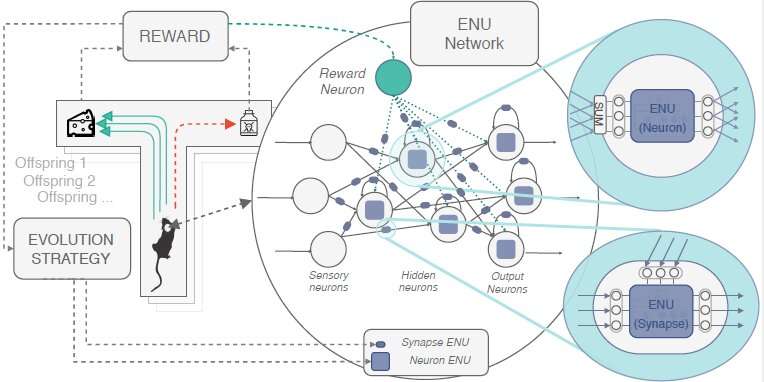
Evolvable neural units (ENUs) that can mimic the brain’s synaptic plasticity
This figure shows part of the experimental setup used by the researchers. A mouse is simulated to solve a maze task. In the maze food and poison is located, and the simulated mouse (that has a network of ENUs) has to learn to eat food and avoid eating poison. The only way it can do this is by taking reward feedback from the environment and updating the internal memory state of each ENU. Each ENU in this network thus has to evolve the ability to cooperate together to process environmental information and reward feedback to update their overall behaviour. Results show that it can evolve a type of reinforcement learning behaviour, where it can learn to change its behaviour based on external rewards and observations. Credit: Bertens & Lee.

Machine learning techniques are designed to mathematically emulate the functions and structure of neurons and neural networks in the brain. However, biological neurons are very complex, which makes artificially replicating them particularly challenging.

Researchers at Korea University have recently tried to reproduce the complexity of biological neurons more effectively by approximating the function of individual neurons and synapses. Their paper, published in Nature Machine Intelligence, introduces a network of evolvable neural units (ENUs) that can adapt to mimic specific neurons and mechanisms of synaptic plasticity.

“The inspiration for our paper comes from the observation of the complexity of biological neurons, and the fact that it seems almost impossible to model all of that complexity produced by nature mathematically,” Paul Bertens, one of the researchers who carried out the study, told TechXplore. “Current artificial neural networks used in deep learning are very powerful in many ways, but they do not really match biological neural network behavior. Our idea was to use these existing artificial neural networks not to model the entire brain, but to model each individual neuron and synapse.”

The ENUs developed by Bertens and his colleague Seong-Whan Lee are based on artificial neural networks (ANNs). However, instead of reproducing the overall structure of biological neural networks, these ANNs were used to model individual neurons and synapses.

The behavior of the ENUs was programmed to change over time, using evolutionary algorithms. These are algorithms that can simulate a specific type of evolutionary process based on the notions of survival of the fittest, random mutation and reproduction.

“By using such evolutionary methods, it is possible to evolve these units to perform very complex information processing, similar to biological neurons,” Bertens explained. “Most current neuron models only allow single output values (spikes or graded potentials), and in case of synapses only a single synaptic weight value. The main unique characteristics of ENUs is that they can output multiple values (vectors), which could be seen as analogous to neurotransmitters in the brain.”

Neurotransmitters, such as dopamine and serotonin, are essentially chemical signals that can transmit messages between different cells, traveling across synapses. These chemical ‘messengers’ are known to play a key role in many brain functions, including learning and memory. The way in which they interact with one another, however, is still poorly understood.

The ENUs developed by Bertens and Lee can output values that act in ANNs as neurotransmitters do in the brain. This characteristic allows them to learn far more complex behavior than existing, predefined mathematical models.

“I believe that the most meaningful finding and result of this study was showing that the proposed ENUs can not only perform similar mathematical operations as current neuroscience models, but they can also be evolved to essentially perform any type of behavior that is beneficial for survival,” Bertens said. “This means it is possible to get much more complex functions for each neuron than the current hand-designed mathematical ones.”

In the future, the ENUs created by these researchers at Korea University could help to create more effective bio-inspired machine learning techniques that better reflect the structure and functions of the brain. So far, these units were used to evolve a machine learning agent that can complete tasks in a T-maze environment. Although the research by Bertens and Lee is still in its early stages, the researchers hope to soon use their ENUs to create larger networks that can tackle more complex tasks.

“The brain has billions of neurons and trillions of synapses, yet currently only a handful of ENUs can be simulated efficiently,” Bertens. “Therefore, the focus of our future research focus will be to scale up our approach.”


Explore furtherA bio-inspired approach to enhance learning in ANNs


More information: Network of evolvable neural units can learn synaptic learning rules and spiking dynamics. Nature Machine Intelligence(2020). DOI: 10.1038/s42256-020-00267-xJournal information:Nature Machine Intelligence

https://www.trtworld.com/magazine/why-do-our-brains-keep-forgetting-things-43254

Why do our brains keep forgetting things?

  • 20 HOURS AGO

What would you like to learn more about?Topics

Related

Popular

Sometimes forgetfulness is better for our mental health than remembering, according to psychologists, but understanding the causes of memory lapse also helps us remember better.

We all tend to forget things, a sad fact which makes us take note of the flawed creatures we are. 

That fact is discomforting and can make us angry, but it could also help us relax – after all, would we always want to truly recall everything?

Humans want to stay loyal to their own memories from childhood to old age. We usually forget that our memories are also scarred by traumas and hurtful, heartbreaking incidents. 

Even worse, we do not usually remember our traumatic experiences as they were, tending to recall them in a distorted manner, which is called “memory amplification”. As a result, remembering might be more problematic than forgetting in our efforts to put the little house in our brain in order, according to psychologists. 

“Unfortunately, memory amplification carries real consequences: the more amplification people demonstrate, the more likely they are to report the “re-experiencing” symptoms associated with post-traumatic stress disorder (PTSD), such as intrusive thoughts and images,” wrote Deryn Strange, professor of psychology at John Jay College of Criminal Justice, and Melanie K. T. Takarangi, associate professor of psychology at Flinders University. 

Forgetting gets a bad rep, but is it so bad? Our neurotic system tends to forget traumatic experiences to get rid of its negative effects. In that sense, forgetting is a liberating experience from our suffering. 

“The human brain is remarkably flexible. Its ability to selectively prune our memories’ errant branches is a necessary adaptation. If we remembered every moment of every day, most of us would get too bogged down in our own minds to be functional,” wrote Lauren Gravitz, a science and environment writer. 

Forgetting helps to remember

Trashing some memories, which could be translated as a forgetting exercise, also helps us remember better, shrinking the heavy burden on our neurotic system, according to a 2007 study. 

“We’ve argued for some time that forgetting is adaptive, that people actively inhibit some memories to facilitate mental focus,” said Michael Anderson, a professor of cognitive neuroscience at the University of Oregon.

A fresh memory could be more a result of purging unnecessary information than processing it, the study suggested. “Your head is full of a surprising number of things that you don’t need to know,” Anderson said. 

But how could you purge useless information in favour of the essential? 

Purging isn’t just something that systematically happens as your life goes by. Experts think that moments of crisis usually force people to think about what they need to purge. 

Psychologists believe that if you identify who you are and what you want to do in your life at that moment, you will be in a good position to remove what you don’t need anymore, keeping things close which really matter.

A memento mori mosaic from excavations in the convent of San Gregorio in Rome, featuring the Greek motto 'Know Yourself'.
A memento mori mosaic from excavations in the convent of San Gregorio in Rome, featuring the Greek motto ‘Know Yourself’. (Wikipedia Commons)

In other words, you will forget things you don’t need to recall forever, which will clean your neurological storage from unnecessary information, unburdening yourself from mental loads you could not believe how long you have carried at all costs.  

Memory-improvement techniques

Scientists think that memory-improvement strategies, like rehearsing information, might help people find out what is really necessary and what is not for them. These techniques also help people separate wrong information stored in their memories from the right ones. 

Most of the time, our mental system is stuck with various motivations, information, fantasies and realities, making critical effects on our interpretations of old events or the way we remember past memories. 

When you see an old friend on the street coincidentally, you recall the old memories with him or her. If the old friend appears to have a better job than you, your memory tends to remember things about him or her, which could explain why he or she is more successful than you. But in the reverse case, the process is still on, giving you different sets of facts about the relationship and its remembrance. 

As a result, all memories are subject to the current understanding of events. 

Memory-improvement techniques, rehearsing what you thought you already knew, will help you remember various events, concepts and behaviour in a better and more objective manner. 

One of the biggest obstacles of having a good functioning memory is rooted in wrong learning and misunderstanding. This could prevent the mental system from handling future information in a rational way due to the failed understanding of previous incidents. 

This situation has been called interference, where two different versions of the facts clash with each other, leading to distraction and forgetfulness. In this situation, experts recommend settling the issue by rehearsing both versions of facts. 

The rehearsing process will eventually show which version is right or wrong, addressing the issue and freeing memory from wrong information and unnecessary burden. 

After that, the person’s memory will likely tend to remember the rehearsed information, forgetting the unprocessed old learning. 

Covid-19 side effects

The deadly pandemic has permanently changed lives across the world. The virus has not only made people psychically ill but also damaged their memories, according to health experts. 

People who have luckily recovered from the disease, have also reported various complaints like short-term memory loss, distraction and confusion.  

As Covid-19 has messed up people’s memory, it has also locked down people at their home with little choice and with fewer activities in which to engage, increasing boredom and anxiety and even leading to yet more forgetfulness. 

A recent study showed that social isolation could lead to serious neurological failures like cognitive decline and dementia. 

“We are seeing a really growing body of evidence that’s showing how isolation and loneliness are linked in incidence of different types of disease [and] with premature mortality,” said Daisy Fancourt, an epidemiologist at University College London (UCL) and one of the co-writers of the study. 

https://futurism.com/qualia-night-deep-sleep

This Groundbreaking Sleep Supplement Helps Your Body Promote the Deep Sleep You Need

Qualia Night provides your brain and body with the fuels they need for a more restorative sleep.

FUTURISM CREATIVE9 HOURS AGO

If the start of the new year has you thinking about ways to improve your physical and emotional well being, the first thing you need to do is figure out how to get better sleep. After all, you can drink a gallon of coffee to pump yourself up in the morning and eat a whole bag of CBD gummies to calm yourself down in the evening, but the reality is it’s biologically impossible to achieve peak physical or cognitive performance without good sleep. Period. Luckily, the team of scientists and researchers at Neurohacker Collective has spent years trying to figure out the best way to help people achieve a better, deep sleep. And the result of their efforts, a new sleep supplement called Qualia Night, is being hailed as a major breakthrough in the science of sleep.

(Use the discount code PRODANDNEURO at checkout to get an additional 15-percent off.)

The Science Of Sleep

deep sleep
Image via Unsplash

Poor sleep is scientifically proven to diminish critical thinking, judgment, and problem solving skills, leaving us more irritable, less empathetic, and less able to manage conflicts. It has also been scientifically linked to things like poor immune function, weight gain, high blood pressure, and accelerated aging.

So why does bad sleep make us so miserable? What exactly is going on when we sleep?

Though common sense would suggest the brain and body are inactive while we’re sleeping, in reality they are very busy. While we are sleeping, the body repairs cells, muscles, and tissues and synthesizes key proteins and hormones. Meanwhile the brain regroups and reorganizes neurons so they can efficiently communicate and store information, and the glymphatic system clears out waste from the central nervous system, including toxic chemicals that build up throughout the day.

Like all other biological processes, the ones that take place while you sleep require very specific fuels. That’s why Neurohacker Collective created Qualia Night.

Qualia Night – For Restorative Deep Sleep

Qualia Night
Image via Neurohacker

Qualia Night isn’t designed to help you sleep more. It’s designed to help you sleep better. As such, Qualia Night is not a sleeping pill, and it doesn’t contain any pharmaceutical or botanical sedatives.

At Neurohacker Collective, the goal is to help the body help itself. To do that they used a whole systems science approach to develope a patent-pending blend of the raw materials that fuel your body’s ability to heal, recover, and regenerate. This results in deeper and more restorative sleep, more energy, improved cognition, stronger immunity, and enhanced long-term brain health.

Qualia Night is intended to be taken in the early evening, about four hours before bedtime. From there it slowly eases your mind and body into a relaxing, optimal sleep process later that night. It works by:

  • Supporting the creation and use of melatonin, a hormone that regulates your circadian rhythm by signaling to your brain that it is time to sleep.
  • Supporting the creation and use of gamma aminobutyric acid, or GABA, a naturally occurring neurotransmitter that inhibits certain brain signals and decreases activity in your nervous system.
  • Supporting the creation and use of brain-derived neurotrophic factor, or BDNF, a protein that protects and supports the growth of new neurons, which is essential for memory, learning, and critical thinking.
  • Supporting the production and function of stem cells, which play a vital role in repair and regeneration.
  • Supporting stress response by providing crucial adaptogens, which are herbal substances that contribute to the stabilization of physiological processes and the promotion of homeostasis.
  • Helping to regulate the production of cortisol, which is the body’s primary stress hormone.
  • Feeding healthy gut bacteria so they can produce key molecules required for healthy brain and immune function, a relationship known as the gut-brain axis.

Save Money, Sleep Better

deep sleep
Image via Neurohacker Collective

To celebrate its release, right now you can get 50-percent off the first month of a cancel-anytime subscription to Qualia Night. You can also use the discount code PRODANDNEURO at checkout to get an additional 15 percent off.

If you want to start the new year off feeling refreshed and rejuvenated, click here to give Qualia Night a try. With that introductory discount and a 100-day money back guarantee, you’ve got nothing to lose but deep, restful, high impact sleep.

https://next.reality.news/news/apple-ar-smartglasses-concept-shows-virtual-desktop-future-0384235/

Apple AR Smartglasses Concept Shows the Virtual Desktop of the Future

The focus on augmented reality over at Apple is, so far, restricted to the iPhone and the iPad. But if some of the most reliable analysts in the business are to be believed, we’ll probably see some kind of AR or VR wearable from the company later this year.

But what will that look like? Well, designer Dominik Hofacker has a few ideas, and they’re so good they’re worth examining.

• Don’t Miss: Next Reality’s 30 People to Watch in Augmented Reality for 2020

Hofacker, who recently completed an internship at Facebook Reality Labs in Seattle, put together a concept video presentation that starts with the user slipping on a pair of concept Apple AR smartglasses and then shows the user interacting with a completely virtual operating system hovering over his real desk.

The fictional operating system is called macOS Reality, and it looks incredibly slick, just like you’d expect from Apple. Starting the system involves first scanning the environment as is common with ARKit-powered experiences shown through the iPhone.

Once the scanning is done, another presentation screen walks the user through how to interact with the virtual interface using pinch gestures that are reminiscent of the gestures common to the first HoloLens.

In addition to the in-air pinch and touch gestures, the concept design also plays with the idea of a virtual trackpad placed as a flat virtual square in the same place a real hardware trackpad might be situated.

The most interesting part of the concept design video occurs when the user scrolls down a web page and then pulls out a piece of 3D content (a dinosaur) that can be manipulated separately from the floating interface.

This kind of interaction already possible in AR through thanks to a new feature in Google Search, but imagining seeing this interaction in AR through a pair of Apple smartglasses is a compelling prospect.

The macOS Reality concept also includes a pair of virtual hands that presumably are meant to represent real hands. Wrapped around the wrist of one of those virtual hands is a control band similar to the one found on the virtual hands in the Oculus VR home environment.

Listed on the band are controls for things like Music and Calendar, which would normally be found in the new right-side slide-out tray in the interface for macOS Big Sur.

Will 2021 actually deliver a pair of Apple Glass smartglasses? Only time will tell, but if the operating system is anything like this concept design, Apple AR smartglasses would be a far easier wearable sell for first-time users than the pricey new AirPods Max or even the Apple Watch before it.

https://robbreport.com/motors/marine/narke-new-personal-watercraft-cyberjet-matches-teslas-cybertruck-1234591566/

This New All-Electric Jet Ski Was Designed to Play With Tesla’s Cybertruck

It can soar up to 43 mph and cover 31 miles on a single charge.

By RACHEL CORMACK 

Narke GT95 PWC Cyberjet

What does one pair with the new Cybertruck? A Cyberjet, of course. Allow us to introduce you to Narke’s new electric jet ski, which may just be the perfect water-ready companion for Elon Musk’s prized polygonal pickup.

The Narke team first started working on eco-conscious personal watercraft (PWC) in 2014 as an alternative to petrol-guzzling jet skis. The first generation electrojet, Narke GT45, was launched in 2018 at the Cannes Yachting Festival and sold out almost immediately, according to the company. The new model, Narke GT95, has been further fine-tuned and offers 50 percent more power and 20 percent more range than its predecessor. On top of that, it looks dead cool with a certain Tesla.

The GT95 is fitted with a gutsy electric engine and high-power battery cells that produces 95 hp, hence its moniker. The speedster can soar up to 43 mph and cover 31 miles on a single charge. Thanks to the improved hull design and unique deflection technology, the GT95 also promises a softer, quieter and more stable driving experience than comparable models.Narke GT95 PWC Cyberjet

The Narker GT95 can soar up to 43 mph. 

It’s been put through its paces, too.  The company says that world champion jet skier Péter Bíró even tested the electrojet and came away impressed with the vehicle’s speed and maneuverability.

Of course, one of its biggest drawcards is its futuristic design. The carbon fiber-reinforced composite body is ultra-sleek and further enhanced by the striking metallic colorway. Spanning 13 feet in length, the GT95 has above-average dimensions in its class and offers a surprising amount of space, along with three seats and a swim platform.Narke GT95 PWC Cyberjet

The GT95 features a customizable 7-inch display. juhaszbalazs.com

“This elegant personal watercraft delivers everything users can expect from a 21st-century, three-seater electric PWC,” Narke writes in the press release. “It’s fun, safe, powerful and protects the waters for future generations.”

Onboard, the GT95 features a customizable 7-inch display that tracks the charge level, mileage, distance from the port and water temperature. It can also take incoming calls should something important arise while you’re on the waves.Narke GT95 PWC Cyberjet

Narke’s multi-stage protection system is cleverly designed to avoid battery overcharge. 

When it’s time to recharge the 24 kWh lithium-ion battery, you can opt for the optional in-built fast charger that gives you full juice in just 1.5 hours. Alternatively, you can use a standard household socket which will take roughly 6 hours to fully charge the PWC.

The Narke GT95 will be showcased this September at the Top Marques Show in Monaco. You can also reserve a model through Narke or at one of the dealer partners. Designs start from $47,000 (€39,000).

Check out more images of the jet ski below:

Narke GT95 PWC Cyberjet

https://www.prnewswire.com/news-releases/mindmed-adds-chief-development-officer-with-fda-phase-2-psilocybin-clinical-trial-experience-301208199.html

MindMed Adds Chief Development Officer with FDA Phase 2 Psilocybin Clinical Trial Experience

Mindmed logo (PRNewsfoto/Mind Medicine, Inc. (Mindmed))

NEWS PROVIDED BYMind Medicine (MindMed) Inc. 

Jan 14, 2021, 07:30 ET

SHARE THIS ARTICLE


Psychedelic Pharmaceutical Scientist and Clinical Pharmacologist Robert Barrow Appointed as Chief Development Officer

NEW YORK, Jan. 14, 2021 /PRNewswire/ — MindMed (NEO: MMED), (OTCQB: MMEDF), (DE: MMQ), a leading psychedelic medicine biotech company today announced the addition of Robert Barrow, an accomplished pharmaceutical executive, as Chief Development Officer. Mr. Barrow has over a decade of experience leading drug development programs aimed at identifying and testing novel treatments in a wide range of disease conditions under FDA and EMA.

In his most recent position, Mr. Barrow served as Director of Drug Development & Discovery at the Usona Institute, where he oversaw preclinical, clinical and regulatory development efforts for all of Usona’s development programs in psychedelics. At Usona, Mr. Barrow was responsible for launching the Phase 2 clinical program for psilocybin in the treatment of Major Depressive Disorder and for obtaining Breakthrough Therapy Designation for the program at FDA.

MindMed Co-CEO J.R. Rahn said, “Rob has been an integral advisor to MindMed on Project Lucy and in preparing our meetings with the FDA, and we are honored he is now joining us on the senior leadership team. We are excited to attract such top tier talent from the psychedelic drug development community. The entire MindMed team is looking forward to exploring potential additional programs evaluating psilocybin and other psychedelics backed by Rob’s recent experience and expertise gaining a breakthrough therapy designation at FDA for a psychedelic assisted therapy.”

MindMed Chief Development Officer Rob Barrow said, “Psychedelic therapies offer a once in a lifetime opportunity to revolutionize the delivery of mental healthcare.  In joining MindMed, I look forward to delivering on this potential and working to further build and progress MindMed’s pipeline of clinical development programs, offering hope to millions of people suffering from addiction and mental health disorders.”

Robert Barrow Bio:

Mr. Barrow is an accomplished pharmaceutical executive and clinical pharmacologist with over a decade of experience leading drug development programs in a variety of disease areas. Mr. Barrow previously served as Director of Drug Development & Discovery at Usona Institute, where he oversaw preclinical, clinical and regulatory development efforts for all of Usona’s development programs. Prior to joining Usona, Mr. Barrow served as Chief Operating Officer of Olatec Therapeutics where he oversaw the execution of numerous early- and late-stage clinical trials in the fields of analgesics, rheumatology, immunology and cardiovascular disease. In addition, he has been responsible for the design and execution of preclinical research programs for new molecular entity drugs in CNS conditions such as multiple sclerosis, Alzheimer’s Disease and Parkinson’s Disease. Mr. Barrow holds a Masters degree in Pharmacology from The Ohio State University and a Bachelor of Science degree from Wake Forest University, where he graduated summa cum laude.

About MindMed

MindMed is a psychedelic medicine biotech company that discovers, develops and deploys psychedelic inspired medicines and therapies to address addiction and mental illness. The company is assembling a compelling drug development pipeline of innovative treatments based on psychedelic substances including Psilocybin, LSD, MDMA, DMT and an Ibogaine derivative, 18-MC. The MindMed executive team brings extensive biopharmaceutical experience to the company’s groundbreaking approach to developing the next-generation of psychedelic inspired medicines and therapies.

MindMed trades on the Canadian exchange NEO under the symbol MMED. MindMed is also traded in the United States under the symbol MMEDF and in Germany under the symbol MMQ. For more information:www.mindmed.co

MindMed Forward-Looking Statements

This press release includes forward-looking statements that involve risks and uncertainties relating to future events and performance of Mind Medicine (MindMed) Inc. (“MindMed”), and actual events or results may differ materially from these forward-looking statements. Words such as “anticipate,” “expect,” “intend,” “plan,” “believe,” “seek,” “estimate,” variations of such words, and similar expressions are intended to identify such forward-looking statements, although not all forward-looking statements contain these identifying words. These statements concern, and these risks and uncertainties include, among others, MindMed’s and its collaborators’ ability to continue to conduct research and clinical programs, MindMed’s ability to manage its supply chain, product sales of products marketed by MindMed and/or its collaborators (collectively, ” Products”), and the global economy; the nature, timing, and possible success and therapeutic applications of Products and Product candidates and research and clinical programs now underway or planned; the likelihood, timing, and scope of possible regulatory approval and commercial launch of Product candidates and new indications for Products; unforeseen safety issues resulting from the administration of Products and Product candidates in patients, including serious complications or side effects in connection with the use of MindMed’s Products and product candidates in clinical trials; determinations by regulatory and administrative governmental authorities which may delay or restrict MindMed’s ability to continue to develop or commercialize Products; ongoing regulatory obligations and oversight impacting Products, research and clinical programs, and business, including those relating to patient privacy; uncertainty of market acceptance and commercial success of Products and Product candidates and the impact of studies on the commercial success of Products and Product candidates; the availability and extent of reimbursement of Products from third-party payers, including private payer healthcare and insurance programs, health maintenance organizations, pharmacy benefit management companies, and government programs such as Medicare and Medicaid; competing drugs and product candidates that may be superior to Products and Product candidates; the extent to which the results from the research and development programs conducted by MindMed or its collaborators may be replicated in other studies and lead to therapeutic applications; the ability of MindMed to manufacture and manage supply chains for multiple products and product candidates; the ability of MindMed’s collaborators, suppliers, or other third parties (as applicable) to perform manufacturing, filling, finishing, packaging, labelling, distribution, and other steps related to MindMed’s Products and product candidates; unanticipated expenses; the costs of developing, producing, and selling products; the ability of MindMed to meet any of its financial projections or guidance and changes to the assumptions underlying those projections or guidance; the potential for any license or collaboration agreement to be cancelled or terminated without any further product success; and risks associated with intellectual property of other parties and pending or future litigation relating thereto, other litigation and other proceedings and government investigations relating to MindMed and its operations, the ultimate outcome of any such proceedings and investigations, and the impact any of the foregoing may have on MindMed’s business, prospects, operating results, and financial condition. Any forward-looking statements are made based on management’s current beliefs and judgment. MindMed does not undertake any obligation to update publicly any forward-looking statement.

Media Contact: mindmed@150bond.com

SOURCE Mind Medicine (MindMed) Inc.