https://www.cnet.com/how-to/elon-musk-wants-you-to-use-signal-instead-of-facebook-heres-why-and-how-it-works/

Elon Musk wants you to use Signal instead of Facebook — here’s why, and how it works

The Signal app uses encryption to keep your messages private. We’ve got the details on how it works.

Rae Hodge headshot

Rae HodgeJan. 14, 2021 3:00 a.m. PT

LISTEN- 03:23

gettyimages-1225248137
The Signal app encrypts all of your messages to others on the platform.Roy Liu/Bloomberg/Getty Images

Tech mogul Elon Musk — known as widely for slinging cars into the sun’s orbit as he is for advocating against COVID-19 safety measures — took to Twitter last week to slam Facebook over its latest privacy policy updates for its supposedly secure encrypted messaging app WhatsAppMusk instead recommended users choose encrypted messaging app Signal. https://platform.twitter.com/embed/index.html?creatorScreenName=RaeHodge&dnt=false&embedId=twitter-widget-0&frame=false&hideCard=false&hideThread=false&id=1347165127036977153&lang=en&origin=https%3A%2F%2Fwww.cnet.com%2Fhow-to%2Felon-musk-wants-you-to-use-signal-instead-of-facebook-heres-why-and-how-it-works%2F&siteScreenName=CNET&theme=light&widgetsVersion=ed20a2b%3A1601588405575&width=550px

The tweet was then retweeted by Twitter CEO Jack Dorsey. Shortly after, Signal tweeted that it was working to handle the surge of new users. https://platform.twitter.com/embed/index.html?creatorScreenName=RaeHodge&dnt=false&embedId=twitter-widget-1&frame=false&hideCard=false&hideThread=false&id=1347240006444675072&lang=en&origin=https%3A%2F%2Fwww.cnet.com%2Fhow-to%2Felon-musk-wants-you-to-use-signal-instead-of-facebook-heres-why-and-how-it-works%2F&siteScreenName=CNET&theme=light&widgetsVersion=ed20a2b%3A1601588405575&width=550px

Musk’s Twitter endorsement also incidentally led shares in the biotechnology company Signal Advance to soar, despite the fact that it is completely unrelated to Signal, which is not a publicly traded company. https://platform.twitter.com/embed/index.html?creatorScreenName=RaeHodge&dnt=false&embedId=twitter-widget-2&frame=false&hideCard=false&hideThread=false&id=1347622177437151233&lang=en&origin=https%3A%2F%2Fwww.cnet.com%2Fhow-to%2Felon-musk-wants-you-to-use-signal-instead-of-facebook-heres-why-and-how-it-works%2F&siteScreenName=CNET&theme=light&widgetsVersion=ed20a2b%3A1601588405575&width=550px

This isn’t the first time Musk has publicly sparred with Facebook over privacy concerns. In 2018, he not only had his own personal Facebook page removed, but those of his companies Tesla and SpaceX. His take on the long-fought battle between Signal and WhatsApp isn’t off-base, though. 

Both of the encrypted messaging apps have been found to have security bugs over the years that have been resolved. For years, WhatsApp has openly collected certain user data to share with parent company Facebook. Its latest policy change just expands that. Signal, on the other hand, has a history of fighting any entity that asks for your data, and adds features to further anonymize you where possible. 

Here are the basics of Signal you should know if you’re interested in using the secure messaging app.

What Signal is, and how encrypted messaging works 

Signal is a typical one-tap install app that can be found in your normal marketplaces like Google’s Play Store and Apple’s App Store, and works just like the usual text messaging app. It’s an open source development provided free of charge by the non-profit Signal Foundation, and has been famously used for years by high-profile privacy icons like Edward Snowden.https://platform.twitter.com/embed/index.html?creatorScreenName=RaeHodge&dnt=false&embedId=twitter-widget-3&frame=false&hideCard=false&hideThread=false&id=661313394906161152&lang=en&origin=https%3A%2F%2Fwww.cnet.com%2Fhow-to%2Felon-musk-wants-you-to-use-signal-instead-of-facebook-heres-why-and-how-it-works%2F&siteScreenName=CNET&theme=light&widgetsVersion=ed20a2b%3A1601588405575&width=550px

Signal’s main function is that it can send text, video, audio and picture messages protected by end-to-end encryption, after verifying your phone number and letting you independently verify other Signal users’ identity. You can also use it to make voice and video calls, either one-to-one or with a group. For a deeper dive into the potential pitfalls and limitations of encrypted messaging apps, CNET’s Laura Hautala’s explainer is a life-saver. But for our purposes, the key to Signal is encryption.

Despite the buzz around the term, end-to-end encryption is simple: Unlike normal SMS messaging apps, it garbles up your messages before sending them, and only ungarbles them for the verified recipient. This prevents law enforcement, your mobile carrier and other snooping entities from being able to read the contents of your messages even when they intercept them (which happens more often than you might think). https://playlist.megaphone.fm/?e=CBS2842307110&light=true

When it comes to privacy it’s hard to beat Signal’s offer. It doesn’t store your user data. And beyond its encryption prowess, it gives you extended, onscreen privacy options, including app-specific locks, blank notification pop-ups, face-blurring anti-surveillance tools, and disappearing messages. Occasional bugs have proven that the tech is far from bulletproof, of course, but the overall arc of Signal’s reputation and results have kept it at the top of every privacy-savvy person’s list of identity protection tools. 

For years, the core privacy challenge for Signal lay not in its technology but in its wider adoption. Sending an encrypted Signal message is great, but if your recipient isn’t using Signal, then your privacy may be nil. Think of it like the herd immunity created by vaccines, but for your messaging privacy. 

Now that Musk and Dorsey’s endorsements have sent a surge of users to get a privacy booster shot, however, that challenge may be a thing of the past. 

Now playing: Facebook removes Trump video, Twitter locks his account… 1:32

First published on Jan. 7, 2021 at 12:16 p.m. PT.

https://mashable.com/article/chrome-extensions-for-students/

11 great chrome extensions for students

BY SARAH LINDENFELD HALL8 HOURS AGO

In a student’s tech toolbox, Chrome extensions can be an invaluable player — expanding the capabilities of their browser to do everything from check their grammar to keep distractions at bay. 

Here are some expert-recommended Chrome extensions for students.

RescueTime

RescueTime, also a great app for iOS and Android, tells students exactly how much time they’re spending in the active tab or window of Chrome or a ChromeOS device. It categorizes the sites they visit and rates them from very productive to very distracting. “It tracks what you’re doing, and it will block sites that you don’t want to access, so it won’t distract you,” said Christine Elgersma, a former teacher and senior editor of social media and learning resources at Common Sense Media, which has rated Chrome extensions for students.

Work Mode

If your child has a hard time staying off social media when they should be studying, Work Mode might be an answer. This one blocks all social media, Elgersma said. So, no more mindless scrolling on Instagram during their virtual English class.

DayBoard

DayBoard, a new tab and website blocker, lets students key in their priorities for the day and makes it more difficult to procrastinate. “You can create your own five item to-do list for the day,” Elgersma said. “Every time you open your tab, it will remind you … you’re opening Facebook, here are the things you wanted to do.” And then, hopefully, they’ll get back on track. 

Screencastify

Screencastify is popular with teachers, but it can be helpful for students too, Elgersma said. Older students, especially, who often are assigned presentations will find it handy. With it, students can record their screen, face and voice and do things like narrate slideshows, give a speech or dub a video

Just Read

Just Read, a reader viewer, gets rid of ads, pop-ups and comments from web pages, so when a student has to do some research, they won’t get sidetracked by clickbait. “This will strip all that business out, so it will be less distracting to be online,” Elgersma said.

Grammarly

A powerhouse extension that’s useful for anybody who writes, Grammarly checks spelling and grammar so that essays and assignments are polished when they’re turned in. It also supports 25 other languages, including Spanish, French, German and Italian, some of the more popular foreign languages that U.S. students study.

InsertLearning 

Teachers often use InsertLearning to add questions or notes for students on a website. But it’s also a great extension for students, Elgersma said. “Kids can use it on web pages to make them more interactive,” she said. When they’re working on a project, for example, they can add annotations and digital sticky notes on web pages as they do their research. 

Save to Pocket

Save to Pocket bookmarks content and can be an essential tool for students who are working on a project and attempting to catalog research and content they’ve found online. With Pocket, they can store it all in one place, tag it based on the topic and read later.

“If a student is collecting information about a topic, he, she, they can easily just mark it in their Pocket and they also can share it easily out of the Pocket,” said Todd Cherner, director of the master of arts in educational innovation, technology and entrepreneurship at the University of North Carolina at Chapel Hill and co-founder of App Ed Review, which reviews apps for educators.

Hypothesis

Hypothesis lets users annotate and highlight information on web pages for their own private use, to share with a study group or post publicly. It’s popular with teachers, but students can use it too. “If I was limited to very few pieces of edtech, Hypothesis would make my short list,” Cherner said. “I’ve had great success with it on 98% of the websites that I’ve tried to use it with. It’s a nice tool.” 

StayFocusd

StayFocusd is another productivity extension that blocks the websites that make it easy for students to waste time. “It’s really customizable,” said Ashley Morris, a former teacher and long-time math tutor. “You can pick a time it locks stuff down or have it lock down certain websites.” So, if Twitter is the problem, a student can tell StayFocusd to turn off the app while it’s time to study.

Google Dictionary

When students encounter a word they don’t understand online, with Google Dictionary, they can just double click the word and a pop-up bubble will appear with the definition. It saves students from opening another tab to get the definition (and the potential to go down a rabbit hole). It also supports languages beyond English, including French, German, Italian and Spanish. 

Noisli

For kids who get distracted easily by noises, especially those around the house as they’re trying to do their virtual schoolwork, Noisli offers a solution. They can choose from a variety of background sounds that will help them stay focused.

Some apps offer similar capabilities, but Chrome extensions come with a big benefit — they don’t typically embed ads like some apps. Still, parents and students should pay attention to an extension’s privacy policies, especially the extensions that say they are tracking any tabs you open or requesting access to Gmail, Google Docs or other Google apps that you may want to keep private.

“See what they’re actually tracking and what they are storing,” Elgersma said. “If it’s down to keystrokes, then it’s probably not worth it. You don’t want to trade too much privacy for blocking tabs or something.” 

https://torontosun.com/life/relationships/sleep-heals-why-is-it-so-elusive-lately


Sleep heals – why is it so elusive lately?

Author of the article:Rita DeMontisPublishing date:Jan 13, 2021  •  20 hours ago  •  4 minute read

PHOTO BY OCUSFOCUS /Getty Images

Article Sidebar

Share

TRENDING

  1. Rebel Wilson claims co-star asked her ‘to put my finger up his arse’
  2. Paul Bettany says he was the victim of ‘Wandavision’ snotgate, not Elizabeth Olsen
  3. Minnesota man stabbed to death in Toronto’s first murder of 2021
  4. Jessica Campbell, ‘Election’ and ‘Freaks and Geeks’ actress, dead at 38
  5. Mary-Kate Olsen strikes a divorce deal

Article content

Are you having trouble sleeping? Falling asleep but waking up shortly after hitting the sack?

How about sleeping weird hours? Are your dreams more vibrant and detailed?LILLEY UNLEASHED: Lockdowns staying until Canada gets vaccines right. https://s3-us-west-2.amazonaws.com/distroscale-public/vplayer-parallel/20201216_1412/ima_html5/index.htmlhttps://c5x8i7c7.ssl.hwcdn.net/vplayer-parallel/20201216_1412/videojs/show.html?controls=1&loop=30&autoplay=0&tracker=7751c56a-9e90-4754-94f7-582a75ddb175&height=307&width=546&vurl=%2F%2Fa.jsrdn.com%2Fvideos%2Fcdgv_torontosun%2F20210114064111_5fffe5e1d7680%2Fcdgv_torontosun_trending_articles_20210114064111_5fffe5e1d7680_new.mp4&poster=%2F%2Fa.jsrdn.com%2Fvideos%2Fcdgv_torontosun%2F20210114064111_5fffe5e1d7680%2Fcdgv_torontosun_trending_articles_20210114064111_5fffe5e1d7680_new.jpg

You’re not alone. Sleep issues, including insomnia, have always been part of the healthcare landscape, but lately, the problem with getting a good night’s rest is literally off the charts.

And it appears the COVID-19 pandemic is to blame, bringing out the worst in those just trying to sleep.

Research shows the pandemic has certainly disrupted normal sleeping patterns since its arrival, leading to increases in stress, anxiety and depression, and leading to many Canadians looking for help in everything from relaxation apps to over-the-counter and prescription medications – anything for a few good ZZZZs.

Some see it as an annoying distraction, while others, especially in the medical community, are worried we’re looking at the potential for long-term mental health issues.

Advertisement

STORY CONTINUES BELOWThis advertisement has not loaded yet, but your article continues below.

Article content continued

Dr. Rebecca Robillard. PHOTO BY SUPPLIED /University of Ottawa

In a recent study lead by researcher Dr. Rebecca Robillard, professor at The Royal and the University of Ottawa (uottawa.ca), the pandemic is causing quite the uproar: “The pandemic is having a diverse impact on people’s sleep, with clinically meaningful sleep difficulties having undergone a sharp increase,” said Robillard on the university’s website. “We found that half of our participants showed signs of serious sleep problems during the pandemic.”

Specifically, said Robillard, principle investigator for the study, the researchers identified three different profiles of sleep changes: those who sleep more; those whose sleep schedule was pushed to later bed and wake-up times; and those who are getting less sleep than they did before the pandemic.

Robillard, co-director of the sleep laboratory of the School of Psychology at U of Ottawa, and head scientist in the sleep research unit at The Royal Institute of Mental Health Research, said that active changes people made on sleep-related behaviours during the pandemic “not only affected sleep quality and quantity, but also affected their psychological response to this unprecedented situation,” that not only included increased insomnia but worsening symptoms of “stress, anxiety and depression.”https://www.youtube.com/embed/mVgb4PjzwEA?embed_config={%27relatedChannels%27:%20[],%27autonav%27:true}&autoplay=0&playsinline=1&enablejsapi=1

The National Library of Medicine reports that sleep disorders affect 40% of Canadians, with the main culprit being insomnia. And yes, the pandemic is disrupting sleeping habits across Canada at an alarming rate, and can pose serious health risks (Ontario has the highest numbers of those suffering sleep-related issues).

Advertisement

STORY CONTINUES BELOWThis advertisement has not loaded yet, but your article continues below.

Article content continued

The government of Canada website (canada.ca) reports one in four of us are not getting enough sleep. And it’s not just getting to sleep, but staying asleep and waking up refreshed. Lack of sleep causes chronic stress and poor mental health and can contribute to a wide variety of medical issues, including obesity.

Sleep disorders can affect every age group, with middle-aged women suffering some of the highest rates. In fact, “new sleep difficulties seem to be disproportionately affecting women, those with families and family responsibilities, the employed, and individuals with chronic illnesses,” notes Robillard.

Similar research shows these numbers have spiked due to the pandemic.https://www.youtube.com/embed/gMH4bHmwFVM?embed_config={%27relatedChannels%27:%20[],%27autonav%27:true}&autoplay=0&playsinline=1&enablejsapi=1

It’s not just sleep that’s being impacted – it’s our dreams, too. According to clinical psychologist and sleep specialist Dr. Michael Breus in an earlier interview, pandemic dreams and nightmares are weirder, more intense, with isolation and quarantining major culprits in this.

There are explanations for “quaran-dreaming” – the crazy dreams many are experiencing, said Breus, of thesleepdoctor.com: “You are not alone with this dream pandemic as recent research has revealed (an) increase in vivid dreams since the quarantine began – with increases in nightmares.”

Why is this happening? “Dreams are a way for our brains to process emotionally charged memories,” he said. “This is one of the most well-studied, commonly held theories about dreaming – that our brains employ dreams to work through emotionally difficult and stressful experiences, to reduce their psychological load and make them less disruptive to daily functioning.”

Advertisement

STORY CONTINUES BELOWhttps://45d2fdafb96adbd8fc71be4cbccf4c5e.safeframe.googlesyndication.com/safeframe/1-0-37/html/container.htmlThis advertisement has not loaded yet, but your article continues below.

Article content continued

What are the obvious offenders? “Social isolation, massive upheaval to daily routines, fears about health, finances and deep uncertainty about what lies ahead,” Breus said in an earlier interview. Add to that everything from boredom, overwork, stress, anxiety – describing pretty much how most of us are living lately – and you have a recipe for a sleep crisis.

What can be read into people’s sleep patterns during the pandemic? “The large scale of sleep changes in response to the pandemic highlights the need for more accessible, yet tailored interventions to address sleep problems,” says Dr. Robillard on the university’s website. “Sleep and mental health issues are something to be expected with the current circumstances, but we never expected to see it hit this level. It is important to intervene to address the unique phenomenon that we are facing right now.”

What are some ways people can improve their sleep, even during the pandemic? “Some simple habits can help you to get  a good night sleep,” says Robillard, offering the following tips:

  1. Getting up at the same time each morning (even on weekends). Even if you fall asleep very late, you should still get up at the same time each morning.
  2. Develop relaxing pre-sleep rituals such as reading.
  3. Avoid caffeine and alcohol within six hours of bedtime, and don’t smoke at bedtime.
  4. Exercise regularly. Get vigorous exercise such as jogging either in the morning or afternoon. Get mild exercise, such as walking, two to three hours before bedtime.

Journaling may also help, as well as talking it out with someone you trust, or seeking help from your doctor.

https://www.newscientist.com/article/2264636-superhuman-sight-may-be-possible-with-lens-that-makes-uv-light-visible/

Superhuman sight may be possible with lens that makes UV light visible

TECHNOLOGY 13 January 2021

By Matthew Sparkes

The lens
A lens for viewing UV light

A series of coated lenses can allow people to see ultraviolet light superimposed onto the visible spectrum, extending the range of our senses without the need of electronic devices.

UV imaging can be used to diagnose skin conditions or detect faults in electrical systems. It can also help reveal normally camouflaged objects, which is perhaps why animals such as reindeer have evolved to have this ability.

Existing devices to view UV light have a major drawback in that they block the normally visible spectrum of light – you can see UV, …

Read more: https://www.newscientist.com/article/2264636-superhuman-sight-may-be-possible-with-lens-that-makes-uv-light-visible/#ixzz6jXyaTisB

https://news.mit.edu/2021/brain-circuit-timing-cells-0111

Neuroscientists identify brain circuit that encodes timing of events

Findings suggest this hippocampal circuit helps us to maintain our timeline of memories.Anne Trafton | MIT News OfficePublication Date:January 11, 2021 PRESS INQUIRIES

CA2 region of the hippocampus

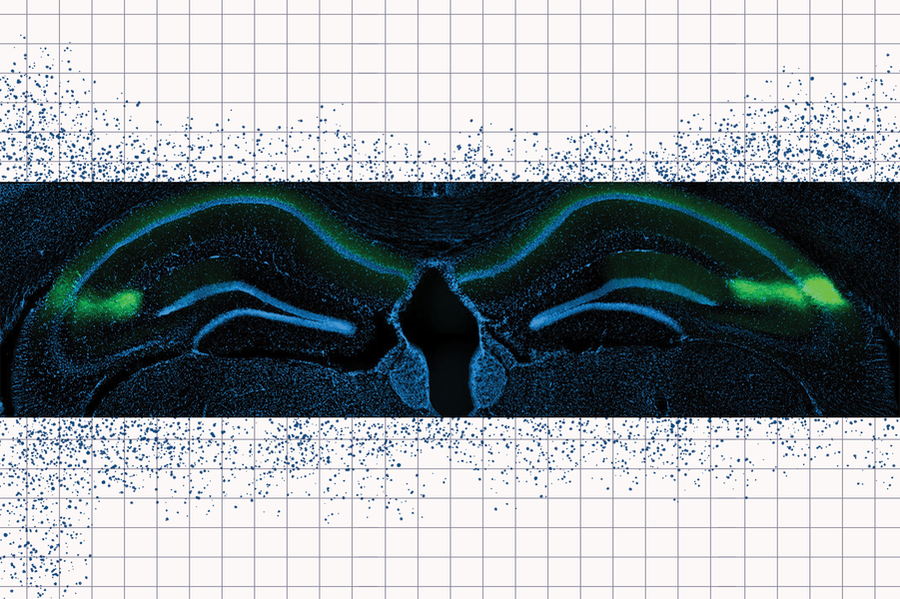
Caption:MIT neuroscientists have found that pyramidal cells (green) in the CA2 region of the hippocampus are responsible for storing critical timing information.Credits:Image: The Tonegawa Lab, edited by MIT News

When we experience a new event, our brain records a memory of not only what happened, but also the context, including the time and location of the event. A new study from MIT neuroscientists sheds light on how the timing of a memory is encoded in the hippocampus, and suggests that time and space are encoded separately.

In a study of mice, the researchers identified a hippocampal circuit that the animals used to store information about the timing of when they should turn left or right in a maze. When this circuit was blocked, the mice were unable to remember which way they were supposed to turn next. However, disrupting the circuit did not appear to impair their memory of where they were in space.

The findings add to a growing body of evidence suggesting that when we form new memories, different populations of neurons in the brain encode time and place information, the researchers say.

“There is an emerging view that ‘place cells’ and ‘time cells’ organize memories by mapping information onto the hippocampus. This spatial and temporal context serves as a scaffold that allows us to build our own personal timeline of memories,” says Chris MacDonald, a research scientist at MIT’s Picower Institute for Learning and Memory and the lead author of the study.

Susumu Tonegawa, the Picower Professor of Biology and Neuroscience at the RIKEN-MIT Laboratory of Neural Circuit Genetics at the Picower Institute, is the senior author of the study, which appears this week in the Proceedings of the National Academy of Sciences

Time and place

About 50 years ago, neuroscientists discovered that the brain’s hippocampus contains neurons that encode memories of specific locations. These cells, known as place cells, store information that becomes part of the context of a particular memory.

The other critical piece of context for any given memory is the timing. In 2011, MacDonald and the late Howard Eichenbaum, a professor of psychological and brain sciences at Boston University, discovered cells that keep track of time, in a part of the hippocampus called CA1.

In that study, MacDonald, who was then a postdoc at Boston University, found that these cells showed specific timing-related firing patterns when mice were trained to associate two stimuli — an object and an odor — that were presented with a 10-second delay between them. When the delay was extended to 20 seconds, the cells reorganized their firing patterns to last 20 seconds instead of 10.

“It’s almost like they’re forming a new representation of a temporal context, much like a spatial context,” MacDonald says. “The emerging view seems to be that both place and time cells organize memory by mapping experience to a representation of context that is defined by time and space.”

In the new study, the researchers wanted to investigate which other parts of the brain might be feeding CA1 timing information. Some previous studies had suggested that a nearby part of the hippocampus called CA2 might be involved in keeping track of time. CA2 is a very small region of the hippocampus that has not been extensively studied, but it has been shown to have strong connections to CA1.

To study the links between CA2 and CA1, the researchers used an engineered mouse model in which they could use light to control the activity of neurons in the CA2 region. They trained the mice to run a figure-eight maze in which they would earn a reward if they alternated turning left and right each time they ran the maze. Between each trial, they ran on a treadmill for 10 seconds, and during this time, they had to remember which direction they had turned on the previous trial, so they could do the opposite on the upcoming trial.

When the researchers turned off CA2 activity while the mice were on the treadmill, they found that the mice performed very poorly at the task, suggesting that they could no longer remember which direction they had turned in the previous trial.

“When the animals are performing normally, there is a sequence of cells in CA1 that ticks off during this temporal coding phase,” MacDonald says. “When you inhibit the CA2, what you see is the temporal coding in CA1 becomes less precise and more smeared out in time. It becomes destabilized, and that seems to correlate with them also performing poorly on that task.”

Memory circuits

When the researchers used light to inhibit CA2 neurons while the mice were running the maze, they found little effect on the CA1 “place cells” that allow the mice to remember where they are. The findings suggest that spatial and timing information are encoded preferentially by different parts of the hippocampus, MacDonald says.

“One thing that’s exciting about this work is this idea that spatial and temporal information can operate in parallel and might merge or separate at different points in the circuit, depending on what you need to accomplish from a memory standpoint,” he says.

MacDonald is now planning additional studies of time perception, including how we perceive time under different circumstances, and how our perception of time influences our behavior. Another question he hopes to pursue is whether the brain has different mechanisms for keeping track of events that are separated by seconds and events that are separated by much longer periods of time.

“Somehow the information that we store in memory preserves the sequential order of events across very different timescales, and I’m very interested in how it is that we’re able to do that,” he says.

The research was funded by the RIKEN Center for Brain Science, the Howard Hughes Medical Institute, and the JPB Foundation.

https://www.ubergizmo.com/2021/01/activelook-head-up-display-smartglass/

ActiveLook Tiny Head-Up Display Module for Smartglasses

By Eliane Fiolet, on 01/13/2021 06:17 PST

Microoled is a provider of low-power, high-resolution OLED microdisplays that develops the ActiveLook smartglass platform. ActiveLook is a lightweight head-up display dedicated to sports connected eyewear and a CES 2021 Innovation Award winner.Advertisinghttps://dd4ed776b95e695b315288b99060b398.safeframe.googlesyndication.com/safeframe/1-0-37/html/container.html

The Microoled’s optical module is perfect for sports activity, thanks to its super lightweight, compact body and long battery life. Users can see their sports performance data in real-time, such as pace, speed, and distance, directly in the glasses.
The technology is currently embedded in the Julbo EVAD-1, another CES Innovation Award winner.

According to the company, at only 9 grams, Activelook is the lightest head-up display (HUD) module on the market, making the full glasses weigh only 35 grams. The closest competitor Everysight delivers its display technology at 90 grams.
The light and compact body makes it comfortable to wear glasses during high energy activities. The tiny body did not prevent the manufacturer from delivering a long battery life ranging from 12 to 30 hours. The compact design allows ActiveLook to be embedded in regular glasses as well.

Microoled recently secured an €8 million round of funding to help the OLED microdisplay manufacturer develop the ActiveLook technology. Founded in 2007 by Eric Marcellin-Dibon, CEO, and Gunther Haas, CTO, the company has experienced record growth in 2019, probably driven by the increasing global demand for OLED microdisplays.

If you are registered at CES 2021, you can visit the Microoled virtual booth on the CES website. There you can connect with Xavier Bonjour, Marketing & Partnerships Director, Microoled.

Microoled is part of the French Tech delegation at CES 2021, you can check our coverage here and connect with the other French Tech startups here on the CES 2021 website (requires registration).

https://www.mindbodygreen.com/articles/how-dry-january-affects-sleep-quality-pros-and-cons

Doing Dry January? Here’s How It Might Affect Your Sleep

mbg Senior Sustainability EditorBy Emma Loewe

Image by Boris Jovanovic / StocksyJanuary 13, 2021 — 10:47 AMShare on:

There are many reasons to give Dry Jan a go: Maybe you’re intrigued by its potential skin-clearing, mood-boosting benefits, looking to save some money, or just want to see how your body reacts to the break from booze. If you’re in it for better, deeper sleep in the new year, there are some things you should know.

The link between alcohol and sleep quality.

Alcohol—especially when consumed within a few hours of bedtime—can dampen sleep quality due to the way it’s processed in the body.

“The problem is that as alcohol metabolizes through your body, it can suppress the REM sleep, rapid-eye-movement sleep, which is the part of sleep where dreams mostly occur. It’s also really important for things like memory consolidation, learning, and emotional processing,”Wendy M. Troxel, Ph.D., a clinical psychologist and certified behavioral sleep medicine specialist, explains to mbg.

She adds that since alcohol is a diuretic, drinking it before bed can make you need to get up to use the bathroom in the middle of the night—leading to what’s known as “sleep fragmentation,” or disrupted sleep. All these factors can contribute to that groggy, tired, dreamless feeling that sometimes comes after a night of drinking, even in moderation.

Therefore, if all else stays the same, avoiding alcohol for a month should lead to improvements in overall sleep quality. And indeed, there is research to show that the majority of moderate drinkers tend to report deeper sleep and more energy after a go-round with Dry January.

But this year, in particular, the impact of giving up booze might not be so cut and dried.ADVERTISEMENT

Why it’s important to replace drinking with another wind-down activity.

Researchers have noticed a few interesting nightly habit changes in the general population since COVID began: For starters, many people are pushing back their sleep schedules—they’re going to bed later and waking up later. At the same time, alcohol consumption has also increased during the pandemic. Drinking a nightcap, it seems, has become an increasingly common way for folks to fill those extra pre-bed hours and unwind after stressful days.

If you are someone who has gotten into the routine of sipping a glass or two before bed to relax, you might find that it’s actually harder to fall asleep during Dry January. That’s because once alcohol becomes synonymous with resting, the brain is less inclined to slow down without it, causing repetitive thoughts and worries to stick around come bedtime.magnesium+The deep and restorative sleep you’ve always dreamt about*★ ★ ★ ★ ★★ ★ ★ ★ ★ (4.8)SHOP NOW

“Replacing it with some other calming ritual is really critical here,” Troxel says. “Maybe, during Dry January, you try a new routine, like taking a bath before bedtime, putting away your phone—finding new strategies to replace that calming ritual of having a glass of wine.”

Other pre-bed activities could include following a guided meditation, doing breathing exercises, reading a book, trying a soothing supplement like mbg’s magnesium+, drinking a cold, alcohol-free beverage, or enjoying a hot cup of tea.*

“Disconnecting and unwinding: That’s really the benefit that the glass of wine was giving you, but these are not going to have the consequences for your sleep quality,” Troxel explains.

The bottom line.

During a difficult year, many leaned on alcohol to relax and unwind before bed, and now might find it more difficult to fall asleep without it. If you are a moderate drinker who is having trouble quieting the mind before bed during Dry January, try experimenting with other practices that tell your body it’s time to start relaxing. Then, at the end of the month, you could walk away with a renewed sense of energy—and a fresh favorite ritual on your hands.

Emma Loewe

Emma Loewembg Senior Sustainability EditorEmma Loewe is the Senior Sustainability Editor at mindbodygreen and the co-author of The Spirit Almanac:

https://www.newscientist.com/article/mg24933170-800-crispr-gene-editing-urgently-needs-an-off-switch-now-we-have-one/

CRISPR gene-editing urgently needs an off-switch – now we have one

Making changes to genes with CRISPR has the potential to cure diseases and feed the world, if we can learn to control it. Now it looks like viruses hold the solutionTECHNOLOGY 13 January 2021

By Gege Li

New Scientist Default Image

THERE is a technology that could tackle some of life’s most pressing problems, from disease to malnutrition. It could fix medical conditions such as cystic fibrosis and sickle cell anaemia simply by changing a bit of genetic code. It could eliminate malaria by making male mosquitoes infertile. It could wipe out pests that destroy crops. And it could modify other organisms to increase their usefulness, helping to create foods that are tastier and more nutritious.

This is the promise of CRISPR, a biochemical tool at the forefront of a gene-editing revolution. Produced naturally by bacteria, CRISPR has gained rock-star status among scientists in the decade since its extraordinary potential was first recognised, and it is already starting to live up to the promise. But behind all the excitement lurk some dark questions. What if the editing goes wrong? What if it has undesired effects? What if we can’t stop it? Without a means to keep CRISPR on target and halt it in its tracks when needed, gene editing could have disastrous consequences – both for human health and for the planet.

What we need is an off-switch, one that can be used at will. Researchers around the world have spent years trying to find one, largely by investigating various biochemical solutions. However, it turns out that the answer may be right under our noses. In an evolutionary face-off between CRISPR-producing bacteria and the viruses that infect them, nature has already designed anti-CRISPR. The challenge now is to harness this evolved off-switch to our own ends and usher in the golden age that gene editing promises.

Read more: https://www.newscientist.com/article/mg24933170-800-crispr-gene-editing-urgently-needs-an-off-switch-now-we-have-one/#ixzz6jXuuYj1t

https://www.ctvnews.ca/health/these-doctors-restored-a-man-s-eyesight-and-then-learned-a-lesson-about-psychology-1.5266611

These doctors restored a man’s eyesight, and then learned a lesson about psychology

Ryan FlanaganCTVNews.ca Writer

@flanaganryan ContactPublished Thursday, January 14, 2021 10:07AM ESTEyesight

A man who was legally blind by age 47 and had his vision restored nine years later struggled with the psychological effects of returning to a sighted world. (Pixabay / Pexels)

SHARE

TORONTO — What would you do if, after nearly a decade of being legally blind, your eyesight was restored?

Would you return to your pre-blindness ways, go back to your old job, start driving a car again? Or would you find the world to be full of new worries, because you had adapted so well to being unable to see?

Medical experts say those questions will be asked of a growing number of people in the future, as advances around medical technology increase and blindness is reversed in more patients.

Related Stories

Related Links

A newly published case study details the experience of one man who went through this transformation. At first, he was ecstatic to have his eyesight back – but over time, he found unexpected social and psychological challenges crowding out that happiness.

The British man started seeking help for vision problems at age 32, according to the case study published Monday in BMJ Case Reports. Three years later, a complication from cataract surgery resulted in him losing all sight in his left eye.

Cataract surgery on his right eye was successful but after a few years, the man’s vision began to decline once again. By the time he was 39, he was finding it difficult to recognize faces. He gave up driving at age 42, retired from his job at 47, and was registered as legally blind.

The man accepted that he would live his life in blindness, according to the study, and tried to remain content with it even as his eyesight continued to worsen. By the time he turned 54, he no longer felt he could safely find his way around unfamiliar places.

Two years after that, another operation on his right eye met with what the study describes as “immediate success.” For the first time in 15 years, he could recognize the faces of the important people in his life, and even read books with the help of a magnifying glass – but not all of the effects were positive.

“Once the initial euphoria subsided … he found re-establishing himself in a sighted world more of a challenge than one would perhaps expect,” the study notes.

Although the man had spent more of his life with working vision than without it, he found that he had lost his instinct to visually spot hazards in his environment – items he might bump into or trip over. Doing this required far more concentration than it had when he was younger. Remembering the “unwritten rules” of eye contact was a problem too, and he reported even one year after his surgery that he was still uncomfortable in social settings.

There were other psychological issues beyond that. It was difficult for the man to reconcile how he saw himself in the mirror with how he saw himself in his memory, and to immediately intuit that the loved ones he saw in his day-to-day life were the same people he remembered from the past.

He never did get behind the wheel of a car again, or return to work, even though he now had acceptable eyesight for both activities. What he felt he lacked, the doctors who treated the man and authored the case study wrote, was the confidence to do either.

The doctors say this sort of “psychological turbulence” should be expected in patients who have their vision returned – more so than in those who have any other sense restored, because of the importance sight plays in understanding social cues.

“Individuals risk humiliation and embarrassment when for example they cannot reliably recognise faces some time after regaining sight and require the security of recognising their voice,” they wrote.

“Therefore, for many patients, despite the precipitating factor of vision loss being removed social isolation continues, as in this patient’s case, and can sustain a low mood state.”

In this case, though, the doctors did not anticipate the mental hardship that would occur, and thus never warned the man that he should be prepared for it. They say they have now adjusted their pre-operative practices so that patients are warned about the potential psychological effects of the surgery, as well as the physical consequences.

“There will be many more patients like ours, whose lives will be transformed by advances in ophthalmology,” they concluded.

“It is essential that healthcare professionals involved understand not just the visual neuroscience and physical health issues for patients, but also the full spectrum of complex psychosocial issues surrounding reinstatement of vision.”

https://globalnews.ca/news/7573815/magic-mushrooms-blood-injection/

Magic mushrooms grew in man’s blood after he injected them as a tea

ByJosh K. Elliott  Global NewsPosted January 13, 2021 11:14 am Updated January 14, 2021 6:12 am

Click to play video 'Magic mushrooms grew in man’s blood after he injected them as a tea'
WATCH ABOVE: Magic mushrooms grew in man’s blood after injected as tea

Descrease article font size-AIncrease article font sizeA+

A U.S. man was hospitalized with organ failure after he injected himself with a tea made from psychedelic mushrooms, which later started growing in his veins.

The unusual and dangerous episode is described in a case report published in the Journal of the Academy of Consultation-Liaison Psychiatry. The unidentified patient, 30, ultimately survived.

Doctors say the patient had tried to use the so-called “magic” mushrooms as an alternative treatment for his bipolar disorder, after skipping his usual course of medications.

READ MORE: The CIA released thousands of UFO documents online. Here’s how to read them

Psychedelic mushrooms contain psilocybin, a drug that causes intense hallucinations when ingested through food or drink.

According to the case report, the unidentified man made a tea out of some mushrooms, then ran it through a filter and injected it into his body. He fell ill a few days later, and showed symptoms of jaundice, diarrhea, fatigue and nausea. He also vomited blood.STORY CONTINUES BELOW ADVERTISEMENT

The man’s family rushed him to a Nebraska hospital, but he was too confused to answer doctors’ questions about his health.

Doctors ran a battery of tests and found that his liver was damaged, his kidneys weren’t functioning properly and he was on the verge of organ failure.

They also conducted a blood test and were shocked by what they found: the pulverized mushrooms had begun sprouting in the darkness of the man’s bloodstream.

READ MORE: Florida manatee found with ‘TRUMP’ scraped onto its back

Doctors put the man on a ventilator to keep him breathing and gave him antibiotics and antifungals to stamp out the spores. He ultimately spent 22 days in hospital and will remain on the antifungals and antibiotics over the long term, doctors say.

Researchers have been investigating psilocybin as a treatment for anxiety and depression for years, but the research does not recommend injecting mushroom tea — or any hallucinogenic drug, for that matter — straight into your veins.

The authors of the case study say it shows that more public education is needed around the drug.

They also injected a bad pun into the title of their case report, calling it “A ‘trip’ to the ICU.”