https://campustechnology.com/articles/2020/12/03/theres-more-to-come-for-ai-in-ed.aspx

There’s More to Come for AI in Ed

  • By Dian Schaffhauser
  • 12/03/20

The biggest uses for artificial intelligence in education haven’t been invented yet. But whatever they end up being, people working on AI applications need to keep educators and education policy makers well informed “early and deeply.” That’s the conclusion of a new report recently issued by the Center for Integrative Research in Computing and Learning Sciences.

The report was developed out of a gathering of 22 researchers and other experts in AI and learning, who met online over two days to consider two questions:

  • What will education leaders need to know about AI in support of student learning, to provide input, do planning and make better decisions?
  • What do researchers need to work on “beyond the ordinary” to generate the know-how for “shaping AI in learning for the good”?

Among the participants were representatives from higher education (North Carolina State and the University of Pittsburgh, among them), education organizations (such as Digital Promise and the Education Development Center) and the government (the U.S. Department of Education and the National Science Foundation).

The group came up with dozens of “opportunities” for AI in education, from extending what teachers can do to better understanding human learning:

  • Using virtual instructors to free up “personalization time” for classroom teachers;
  • Offloading the “cognitive load” of teaching;
  • Providing “job aids” for teachers;
  • Identifying the links between courses, credentials, degrees and skills;
  • “Revolutionizing” testing and assessment;
  • Creating new kinds of “systems of support”;
  • Helping with development of “teaching expertise”; and
  • Better understanding human learning through “modeling and building interfaces” in AI.

But contributors also offered just as many barriers to success:

  • Differences in the way teachers teach would require “different job aids”;
  • Teachers would fear losing their jobs;
  • Data privacy concerns;
  • Bias worries;
  • Dealing with unrealistic expectations and fears about AI pushed in “popular culture”;
  • Lack of diversity in gender, ethnicity and culture in AI projects; and
  • Smart use of data would require more teacher training.

Two areas that offered heightened promise to the experts were the uses of AI in “social learning” and in assessment.

For the first, the report noted, AI could be used to help orchestrate complex learning scenarios involving multiple people working on a project together. For example, for students working as team members, AI could notice, listen to and build on various members’ contributions while also providing task support, such as helping the team “organize, manage and connect their contributions” to the bigger goal. In this scenario, the report stated, AI would be “socially aware” and could “use social interaction with students as a way of bootstrapping their academic performance.”

On the assessment side, AI agents could help teachers “build a portrait of a student’s competencies” in various ways, such as by assessing writing and providing suggestions for improvement.

The panel also developed a list of seven recommendations for research priorities, including investigating AI designs for an expanded range of learning scenarios and intensifying and expanding research on AI for assessment of learning.

The full report is openly available on the CIRCLS website, along with a link to an on-demand webinar discussing the findings.

ABOUT THE AUTHOR

Dian Schaffhauser is a senior contributing editor for 1105 Media’s education publications THE JournalCampus Technology and Spaces4Learning. She can be reached at dian@dischaffhauser.com or on Twitter @schaffhauser.
https://techxplore.com/news/2021-01-ai.html

Accelerating AI computing to the speed of light

by University of Washington

ai
Credit: CC0 Public Domain

Artificial intelligence and machine learning are already an integral part of our everyday lives online. For example, search engines such as Google use intelligent ranking algorithms, and video streaming services such as Netflix use machine learning to personalize movie recommendations.

As the demands for AI online continue to grow, so does the need to speed up AI performance and find ways to reduce its energy consumption.

Now a University of Washington-led team has come up with a system that could help: an optical computing core prototype that uses phase-change material. This system is fast, energy efficient and capable of accelerating the neural networks used in AI and machine learning. The technology is also scalable and directly applicable to cloud computing.

The team published these findings Jan. 4 in Nature Communications.

“The hardware we developed is optimized to run algorithms of an artificial neural network, which is really a backbone algorithm for AI and machine learning,” said senior author Mo Li, a UW associate professor of both electrical and computer engineering and physics. “This research advance will make AI centers and cloud computing more energy efficient and run much faster.”

The team is among the first in the world to use phase-change material in optical computing to enable image recognition by an artificial neural network. Recognizing an image in a photo is something that is easy for humans to do, but it is computationally demanding for AI. Because image recognition is computation-heavy, it is considered a benchmark test of a neural network’s computing speed and precision. The team demonstrated that their optical computing core, running an artificial neural network, could easily pass this test.

“Optical computing first appeared as a concept in the 1980s, but then it faded in the shadow of microelectronics,” said lead author Changming Wu, a UW electrical and computer engineering graduate student. “Now, because of the end of Moore’s law, advances in integrated photonics and the demands of AI computing, it has been revamped. That’s very exciting.”


Explore furtherSpeeding up machine learning by means of light


More information: Changming Wu et al, Programmable phase-change metasurfaces on waveguides for multimode photonic convolutional neural network, Nature Communications (2021). DOI: 10.1038/s41467-020-20365-zJournal information:Nature CommunicationsProvided by University of Washington

https://www.madinamerica.com/2021/01/new-study-no-genes-predict-mental-illness/

New Study: No Genes to Predict “Mental Illness”

Peter Simons

By Peter SimonsJanuary 11, 2021121441FacebookTwitterEmailPrintFriendlyRediff MyPage

A new study of about 50,000 people failed to find any genes that influenced “mental illness.” David Curtis conducted the research at UCL Genetics Institute, University College London. The study was published in the Journal of Affective Disorders. 

“The results obtained from this study are completely negative,” Curtis writes.
“No gene is formally statistically significant after correction for multiple testing, and even those which are ranked highest and lowest do not include any which could be regarded as being biologically plausible candidates,” he adds.
Going further, he writes, “The distribution of results is exactly as one would expect by chance.”

The study used data from exome-sequenced participants in the UK Biobank dataset. The defining question was, “Have you ever seen a psychiatrist for nerves, anxiety, tension or depression?” to which 5,872 responded “Yes” and 43,862 responded “No.” These two groups were then compared.

One limitation of the study is that this is an inexact method—people may have psychiatric diagnoses but be treated by their general practitioner rather than a psychiatrist, for example. However, Curtis defends the use of this question as it may have more effectively captured people with more severe mental health concerns. Most importantly, it was a question that the UK Biobank participants had already answered.

Curtis also recently published another large gene sequencing study focusing on schizophrenia, which also came up negative. In the article reporting on that study, Curtis and co-author Thivia Balakrishna wrote, “The main conclusion of this investigation is a negative one” and noted that they had found no clinically significant genetic variants that influenced schizophrenia.

In the current article, Curtis concludes, “It seems unlikely that depression genetics research will implicate specific genes having a substantial impact on the risk of developing psychiatric illness severe enough to merit referral to a specialist until far larger samples become available.”

However, requiring samples larger than 50,000 people even to begin to detect a supposed genetic effect on “mental illness” means that any such effect may be negligible.

Previous research supports this finding. Other studies have found that genetics explains less than 1%, or at most 2.28%, of the risk for various psychiatric diagnoses.

****

Curtis, D. (2021). Analysis of 50,000 exome-sequenced UK Biobank subjects fails to identify genes influencing the probability of developing a mood disorder resulting in psychiatric referral. Journal of Affective Disorders, 281, 216-219. https://doi.org/10.1016/j.jad.2020.12.025 (Link)Previous articleFinding One’s Way Through WithdrawalNext articleThe Low Serotonin Theory of Depression Lives on in SwedenPeter SimonsPeter Simons was an academic researcher in psychology. Now, as a science writer, he tries to provide the layperson with a view into the sometimes inscrutable world of psychiatric research. As an editor for blogs and personal stories at Mad in America, he prizes the accounts of those with lived experience of the psychiatric system and hopes to create alternatives to the biomedical model.

https://www.today.com/health/how-have-good-mental-health-role-sleep-exercise-diet-t205509

Sleep, exercise or diet? 1 factor was most linked to better mental health

Of “three pillars of health,” one stood out when it came to predicting well-being.

Just one sleepless night can trigger up to a 30% rise in anxiety levels, separate research found.

Just one sleepless night can trigger up to a 30% rise in anxiety levels, separate research found.TODAY Illustration / Getty ImagesJan. 11, 2021, 11:19 AM PST / Source: TODAYBy A. Pawlowski

The mental health toll just keeps growing. After a year filled with fear over the coronavirus, 2021 is starting with more anxiety about COVID-19 and the violence in Washington.

What can you do to help keep stress and depression at bay?

A recent study offers clues.

Getting quality sleep, exercising and eating more raw fruits and vegetables — in that order — predicted better mental health and well-being in young adults.

They can be thought of as “three pillars of health,” said Shay-Ruby Wickham, a graduate student at Otago Medical School at the University of Otago in Dunedin, New Zealand, and lead author of the study published in Frontiers in Psychology.

Sleep quality beat the amount of sleep a person got each night as the strongest factor in good mental health.

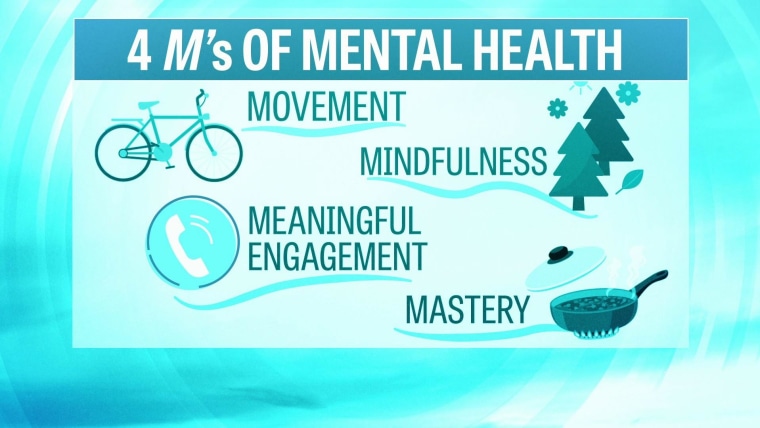
Tips for anxiety, depressive thoughts: Try the ‘4 M’s of Mental Health’

JAN. 9, 202103:19

“This is surprising because sleep recommendations predominantly focus on quantity rather than quality,” Wickham said in a statement.

“While we did see that both too little sleep — less than eight hours — and too much sleep — more than 12 hours — were associated with higher depressive symptoms… sleep quality significantly outranked sleep quantity in predicting mental health and well-being.”

Just one sleepless night can trigger up to a 30% rise in anxiety levels, according to separate research from the University of California, Berkeley.

TODAY nutritionist Joy Bauer discusses the best diets and detoxes

JAN. 11, 202110:12

For the new study, Wickham and her colleagues asked more than 1,100 adults 18 to 25 years old to fill out a survey measuring how much and how well they slept, how often they exercised and what their diet was like — including how many raw fruit and vegetables they ate in a typical week.

Next, the participants filled out questionnaires designed to gauge their mental health, including whether they felt depressed or believed they were flourishing in life. They also shared their health conditions and whether they took antidepressants.

After analyzing the answers, the researchers found:

Sleep quality and quantity were the strongest lifestyle predictors of depression: People who had better sleep quality, and those who slept inside the range of eight to 12 hours per night reported fewer symptoms of depression. Sleep quality “significantly outranked” other health behaviors linked to mental health and well-being, the study noted.

Struggling with mental health during the pandemic? These tips may help

DEC. 22, 202001:45

Inadequate physical activity was the second-strongest predictor of depression: The study didn’t specify how much exercise was optimal, but the Centers for Disease Control and Prevention recommends doing at least 150 minutes a week of any activity that gets the heart to beat faster.

Recommended

MIND & BODY‘It’s OK to be yourself’: Plus-size model offers advice on how to survive diet season

MIND & BODYTo reach a big health or fitness goal in 2021, start small, say experts

Eating raw fruits and vegetables “significantly” predicted flourishing: The sweet spot seemed to be about five servings per day. Cooked or processed fruits and vegetables weren’t as beneficial. Flourishing meant agreeing with statements such as, “I lead a purposeful and meaningful life” and “I am engaged and interested in my daily activities.”

The study’s findings were correlations only, the authors noted.How to get good quality sleep:

For the study, quality sleep was defined by feeling refreshed after waking up. How do you help make that happen?

Sleep experts offered these tips:

Stick to one sleep schedule: Keep the same bedtime and wake-up time, even on the weekends. This keeps your circadian rhythm consistent and makes it easier to fall asleep, said Michael Breus, a clinical psychologist and a fellow of the American Academy of Sleep Medicine.

Simple tips for getting a good night sleep

SEPT. 3, 202004:10

Avoid caffeine after 2 p.m.: The stimulant can impact your body for six to eight hours after it’s ingested, so if you stop in the early afternoon, its effects will stop at around 10 p.m., when most people start getting sleepy, Breus said. If you drink it later, you can still fall asleep but the quality of your slumber will be affected, he noted.

Don’t drink alcohol right before bed: Alcohol may make you feel sleepy, but it keeps you out of the deeper stages of sleep. Wait one hour per alcoholic beverage before going to sleep, Breus advised.

Don’t eat too late: Finish eating meals two to three hours before bedtime, the National Sleep Foundation recommended. Otherwise, it may be hard to get quality sleep if your body is still digesting a big dinner.

Simple ways to improve your sleep

JAN. 7, 201904:13

Exercise is the best way to improve the quality of your sleep: Just don’t do it right before bedtime.

Limit screen time before bed: Put your phone and other devices in another room. You don’t need them while you sleep.

Get morning light: If you can, as soon as you wake up, get 15 minutes of sunlight, Breus said. It keeps your internal body clock and sleep-wake cycle running optimally. Cortisol, a stress hormone, has been linked to sleep disruptions, but “exposure to natural sunlight to the early part of the day literally translated to lower cortisol levels at night,” said Shawn Stevenson, author of “Sleep Smarter.”A. PawlowskiA. Pawlowski

A. Pawlowski is a TODAY contributing editor focusing on health news and features. Previously, she was a writer, producer and editor at CNN.

https://markets.businessinsider.com/news/stocks/signal-advance-stock-price-surge-elon-musk-tweet-privacy-app-2021-1-1029956384


Signal Advance has soared 11,708% since an Elon Musk tweet recommending a similarly named privacy app spurred ticker confusion

Matthew Fox Jan. 11, 2021, 05:48 PM

elon musk laugh
Elon Musk.Reuters
  • Signal Advance soared as much as 11,708% after Elon Musk tweeted “use Signal” on Thursday.
  • Investors seemed to have confused Musk’s tweet about an encrypted messaging app with an unrelated publicly traded company.

Shares of Signal Advance have soared as much as 11,708% since Tesla CEO Elon Musk tweeted “use Signal” to his 42 million followers on Thursday.

Investors seemed to have confused Signal Advance with Signal, the encrypted messaging platform that Musk was encouraging his followers to use.

Shares of Signal Advance, a micro-cap technology stock that trades on the over-the-counter market, soared to as high as $70.85 on Monday from $0.60 just before Musk’s tweet on Thursday.

Signal Advance’s market capitalization soared to nearly $300 million from $6 million last week. Shares climbed as much as 885% on Monday.https://df2af0ec1948406da47d838a6f662594.safeframe.googlesyndication.com/safeframe/1-0-37/html/container.html

This isn’t the first time investors have been confused by two similarly named companies. In March, during COVID-19 lockdowns, shares of Zoom Technologies soared as investors confused the OTC penny stock with Zoom Video Communications. The Securities and Exchange Commission temporarily halted trading in Zoom Technologies.

Tesla Cybertruck Production Costs Could Keep Tesla Ahead Of Rivals

https://www.youtube.com/embed/jp8xE6-i7JoJan 11, 2021 7h ago27+

Steven Loveday

By: Steven Loveday

The Cybertruck costs half that of the competition. Here’s why.

Tesla CEO Elon Musk has said that the company’s manufacturing edge will work to keep it ahead of other EV makers. This could prove very true when it comes to the Tesla Cybertruck.

According to a report on Teslarati, based on a Cybertruck cost analysis video from My Tesla Weekend, the Cybertruck will cost Tesla about half as much to produce as upcoming competing electric pickup trucks.

We know Tesla won’t release the cheapest version of the Cybertruck for some time, but eventually, a $39,990 version will come to market. This price seems almost unbelievable when compared to the prices of rivals like the GMC Hummer EV and Rivian R1T, among others. Since Tesla will only produce and sell more expensive Cybertruck versions first, the company stands to see huge margins.

Tesla typically releases expensive versions of its cars first. People waited forever for the promised $35,000 Model 3. In the meantime, Tesla was making a sizable profit selling the pricier Model 3 configurations. The Model Y came to market in March, with a ~$50,000 starting price. Just last week, Tesla finally announced the launch of the $41,900 Model Y Standard Range.

As far as the Cyebrtruck is concerned, some of the reasons it may cost so little to produce are obvious as soon as you look at it. It’s made of cold-rolled stainless steel, and it won’t be painted. Not dealing with a paint shop saves time and money. Not to mention it won’t need to rely on the large and expensive casting machines Tesla uses for other models. It also has a relatively basic interior, unlike the busy, luxury-grade cabins found in electric pickup truck prototypes from some competing brands.

Sure, the electric pickup truck’s wheels, tires, and suspension parts will come from suppliers, and likely won’t contribute to cost savings over other manufacturers. However, Tesla stands to undercut rivals in other areas, such as glass, seats, battery cost, battery efficiency, and electric motors, which Tesla either makes in house, plans to make in-house, or produces as part of an exclusive partnership.

Read More About The Tesla Cybertruck: Electric Pickup Trucks Almost Ready For Prime Time Based On New Survey⠀ Tesla Cybertruck Steel Supplier Set To Begin Operations Next Fall

According to an analysis by My Tesla Weekend, Cybertruck production savings may come in at over $20,000 when compared to the competition. Check out the video above for all the details. Then, scroll down and let us know if you agree or disagree? Why?

Sources: TeslaratiMy Tesla Weekend (YouTube) via Teslarati

Tesla Cybertruck Production Costs Could Keep Tesla Ahead Of Rivals

https://www.youtube.com/embed/jp8xE6-i7JoJan 11, 2021 7h ago27+

Steven Loveday

By: Steven Loveday

The Cybertruck costs half that of the competition. Here’s why.

Tesla CEO Elon Musk has said that the company’s manufacturing edge will work to keep it ahead of other EV makers. This could prove very true when it comes to the Tesla Cybertruck.

According to a report on Teslarati, based on a Cybertruck cost analysis video from My Tesla Weekend, the Cybertruck will cost Tesla about half as much to produce as upcoming competing electric pickup trucks.

We know Tesla won’t release the cheapest version of the Cybertruck for some time, but eventually, a $39,990 version will come to market. This price seems almost unbelievable when compared to the prices of rivals like the GMC Hummer EV and Rivian R1T, among others. Since Tesla will only produce and sell more expensive Cybertruck versions first, the company stands to see huge margins.

Tesla typically releases expensive versions of its cars first. People waited forever for the promised $35,000 Model 3. In the meantime, Tesla was making a sizable profit selling the pricier Model 3 configurations. The Model Y came to market in March, with a ~$50,000 starting price. Just last week, Tesla finally announced the launch of the $41,900 Model Y Standard Range.

As far as the Cyebrtruck is concerned, some of the reasons it may cost so little to produce are obvious as soon as you look at it. It’s made of cold-rolled stainless steel, and it won’t be painted. Not dealing with a paint shop saves time and money. Not to mention it won’t need to rely on the large and expensive casting machines Tesla uses for other models. It also has a relatively basic interior, unlike the busy, luxury-grade cabins found in electric pickup truck prototypes from some competing brands.

Sure, the electric pickup truck’s wheels, tires, and suspension parts will come from suppliers, and likely won’t contribute to cost savings over other manufacturers. However, Tesla stands to undercut rivals in other areas, such as glass, seats, battery cost, battery efficiency, and electric motors, which Tesla either makes in house, plans to make in-house, or produces as part of an exclusive partnership.

Read More About The Tesla Cybertruck: Electric Pickup Trucks Almost Ready For Prime Time Based On New Survey⠀ Tesla Cybertruck Steel Supplier Set To Begin Operations Next Fall

According to an analysis by My Tesla Weekend, Cybertruck production savings may come in at over $20,000 when compared to the competition. Check out the video above for all the details. Then, scroll down and let us know if you agree or disagree? Why?

Sources: TeslaratiMy Tesla Weekend (YouTube) via Teslarati

https://insideevs.com/features/465451/tesla-cybertruck-low-production-costs-give-edge/

Tesla Cybertruck Production Costs Could Keep Tesla Ahead Of Rivals

https://www.youtube.com/embed/jp8xE6-i7JoJan 11, 2021 7h ago27+

Steven Loveday

By: Steven Loveday

The Cybertruck costs half that of the competition. Here’s why.

Tesla CEO Elon Musk has said that the company’s manufacturing edge will work to keep it ahead of other EV makers. This could prove very true when it comes to the Tesla Cybertruck.

According to a report on Teslarati, based on a Cybertruck cost analysis video from My Tesla Weekend, the Cybertruck will cost Tesla about half as much to produce as upcoming competing electric pickup trucks.

We know Tesla won’t release the cheapest version of the Cybertruck for some time, but eventually, a $39,990 version will come to market. This price seems almost unbelievable when compared to the prices of rivals like the GMC Hummer EV and Rivian R1T, among others. Since Tesla will only produce and sell more expensive Cybertruck versions first, the company stands to see huge margins.

Tesla typically releases expensive versions of its cars first. People waited forever for the promised $35,000 Model 3. In the meantime, Tesla was making a sizable profit selling the pricier Model 3 configurations. The Model Y came to market in March, with a ~$50,000 starting price. Just last week, Tesla finally announced the launch of the $41,900 Model Y Standard Range.

As far as the Cyebrtruck is concerned, some of the reasons it may cost so little to produce are obvious as soon as you look at it. It’s made of cold-rolled stainless steel, and it won’t be painted. Not dealing with a paint shop saves time and money. Not to mention it won’t need to rely on the large and expensive casting machines Tesla uses for other models. It also has a relatively basic interior, unlike the busy, luxury-grade cabins found in electric pickup truck prototypes from some competing brands.

Sure, the electric pickup truck’s wheels, tires, and suspension parts will come from suppliers, and likely won’t contribute to cost savings over other manufacturers. However, Tesla stands to undercut rivals in other areas, such as glass, seats, battery cost, battery efficiency, and electric motors, which Tesla either makes in house, plans to make in-house, or produces as part of an exclusive partnership.

Read More About The Tesla Cybertruck: Electric Pickup Trucks Almost Ready For Prime Time Based On New Survey⠀ Tesla Cybertruck Steel Supplier Set To Begin Operations Next Fall

According to an analysis by My Tesla Weekend, Cybertruck production savings may come in at over $20,000 when compared to the competition. Check out the video above for all the details. Then, scroll down and let us know if you agree or disagree? Why?

Sources: TeslaratiMy Tesla Weekend (YouTube) via Teslarati

https://phys.org/news/2021-01-antibiotic-resistance-random-dna-sequences.html


Antibiotic resistance from random DNA sequences

by Uppsala University

dna
Credit: Pixabay/CC0 Public Domain

An important and still unanswered question is how new genes that cause antibiotic resistance arise. In a new study, Swedish and American researchers have shown how new genes that produce resistance can arise from completely random DNA sequences. The results have been published in the journal PLOS Genetics.

Antibiotic resistance is a major global problem and the spread of resistant bacteria causes disease and death, and constitutes a major cost to society. The most common way for bacteria to develop resistance is by taking up various types of resistance genes from other bacteria. These genes encode proteins (peptides) that can lead to resistance by: (i) deactivating the antibiotic, (ii) reducing its concentration, or (iii) altering the antibiotic’s target so that the antibiotic can no longer bind to that target and hence halt the growth of the bacterium. Once resistance genes have arisen, they can quickly spread between different pathogenic bacteria and reduce the effectiveness of our antibiotics. It is therefore important to detect and characterize new resistance genes as quickly as possible—in order to monitor the spread of resistance and also to facilitate treatment and the development of new antibiotics.

To study the emergence of resistance genes, the researchers used laboratory experiments to investigate whether it was possible to generate a gene from random DNA sequences that would give rise to antibiotic resistance. This was done by first designing nearly one billion random DNA sequences that were then placed on a plasmid in the intestinal bacterium Escherichia coli. (Plasmids are DNA molecules that replicate independently and can be transferred from one organism to another.)

These random DNA sequences were then expressed in the bacterium as short peptides. While most of these peptides had no effect on the bacterium at all, six different peptides did, causing the bacterium to become resistant to the antibiotic Colistin, an important antibiotic medication of last resort that is used in severe infections to kill the bacteria by binding to and destroying the bacterium’s cell membrane. These peptides caused resistance by increasing the expression of genes that are involved in the modification of the bacterium’s cell membrane. This modification of the cell membrane resulted in the antibiotic not being able to bind to cell membrane, and thus not being able to reduce the survival of the bacterium.

“We have now shown in two different studies that random sequences of amino acids can give rise to new functions that are beneficial to the bacterium such as antibiotic resistance. This suggests that the evolution of new functions from random DNA sequences is not as unusual as previously thought,” says Dan I. Andersson, Professor in Medical Bacteriology and responsible for the study.

“An important question that remains unanswered and requires further study is whether these new genes are naturally present in bacteria or can only be observed in laboratory experiments,” says Michael Knopp, post-doctoral researcher at the Department of Medical Biochemistry and Microbiology and the study’s first author.


Explore furtherNew genes out of nothing


More information: Michael Knopp et al, A novel type of colistin resistance genes selected from random sequence space, PLOS Genetics (2021). DOI: 10.1371/journal.pgen.1009227Journal information:PLoS GeneticsProvided by Uppsala University

https://www.vancouverisawesome.com/vancouver-news/watch-this-crow-play-its-new-bouncy-ball-in-steveston-video-3249089

Watch this crow play with its new bouncy ball in Steveston (VIDEO)

“This is my new crow friend with his green bouncy ball”about 12 hours ago By: Brendan Kergin

crowwithbouncyballA crow in Steveston had a heckuva time playing with a bouncy ball this weekend.u/Wenniki / Reddit

It seems even members of the animal kingdom took some time this weekend to lay around.

A Reddit user in Steveston caught a crow playing with a bouncy ball, and shared the video. The black bird seems to be having a…ahem…ball of a time playing with the children’s toy.

“This is my new crow friend with his green bouncy ball,” says u/Wenniki in the video.

The crow seems to have made a game of solo catch, carrying the ball up to the traffic lights at Moncton Street and Number 1 Road, dropping it and then following it up the road. Once the ball is bouncing only a little, the crow continues to follow on foot, hopping along just behind.about:blank

“I’m watching this crow play with a bouncy ball, it’s the funniest thing,” says u/Wenniki in the video.

Crows are famously clever, and seem to use their intellect both for play and criminal activities; late last year a crow was spotted stealing items out of a backpack on Cypress.

In 2010 the Vancouver Courier spoke to UBC professor Wayne Goodey about crows and the whole Corvidae family of birds (which includes ravens and jays).

“That family is probably the most intelligent of all birds and are comparable to parrots when it comes to being smart,” said Goodey. adding that they’re smart enough to be trained and can respond to being called, if taught to do so.

In Steveston the crow decided that the traffic light location was played out and flew off into a nearby park.